
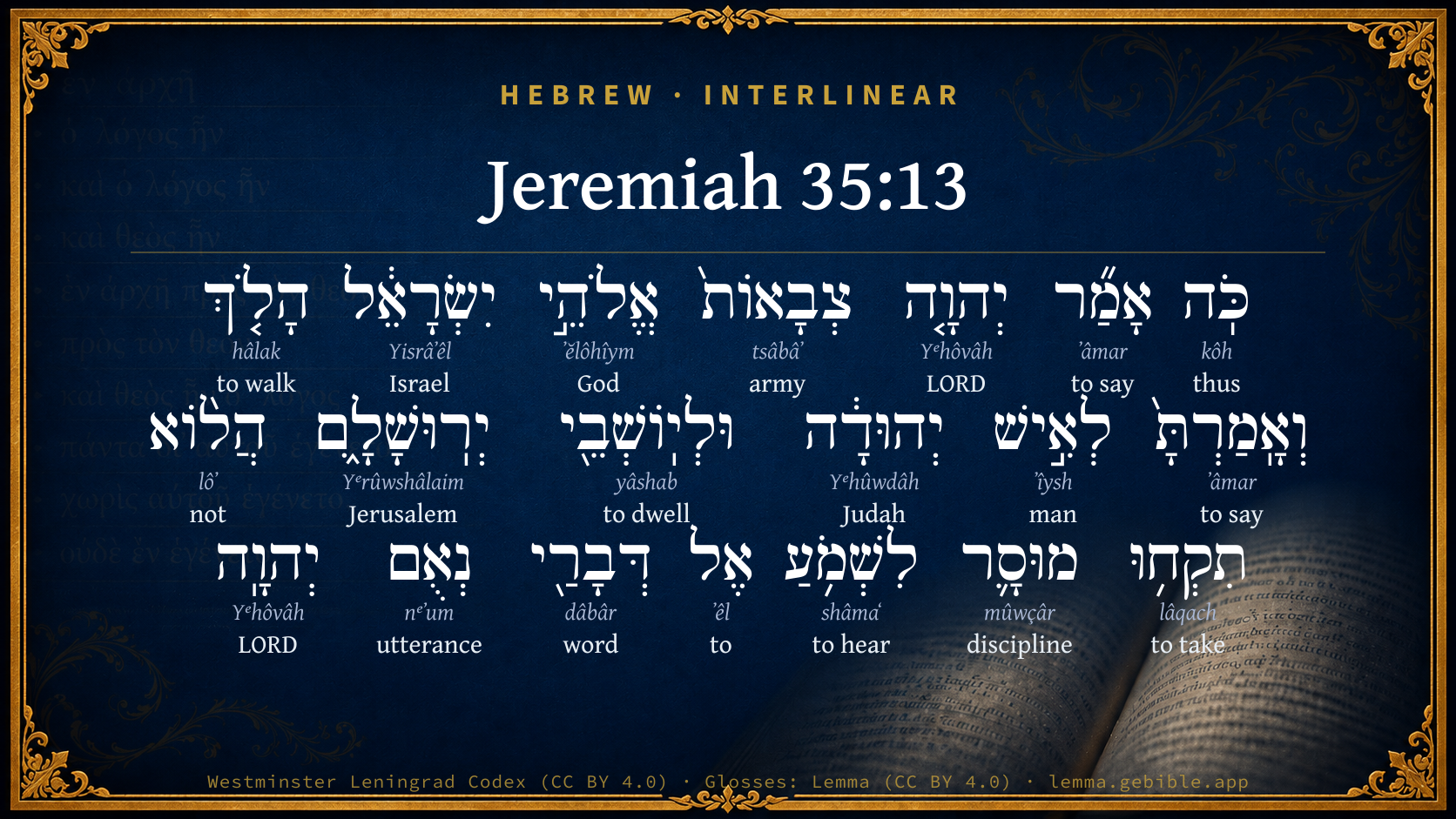
Jeremiah 35:13

Hebrew (Westminster Leningrad Codex) Jeremiah 35:13 appears in the Hebrew Old Testament. The text above is from the Westminster Leningrad Codex. Each word links to its Strong’s number, a concise gloss, and parsing drawn from the Open Scriptures Hebrew Bible morphology. Click any word for its full Brown-Driver-Briggs (BDB) entry.
Download image
Cite this verse

Jeremiah 35:13 (World English Bible). Public Domain. Lemma interlinear Bible study tool, https://lemma.gebible.app/v/jeremiah/35/13.

Show BibTeX & RIS
BibTeX
RIS
English Translation
Thus says Yahweh of Hosts, the God of Israel: Go, and tell the men of Judah and the inhabitants of Jerusalem, Will you not receive instruction to listen to my words? says Yahweh.
World English Bible · Public Domain
Download a study sheet

One document with this verse’s original text, its word-by-word gloss line, the meaning frame, cross-references with their text, attributed commentary, and full source and license credits — printable, and it pastes into notes with its structure intact.

This verse Autodidact and up

Study sheet (.html) Plain text (.txt)

A passage Seminary Student

Up to 50 verses in one chapter. A passage sheet keeps up to 6 commentary sources and 12 cross-references per verse, in the order this page ranks them, and says so on the sheet whenever that leaves anything out. Ask for a single verse and you get the Autodidact verse sheet above.

Everything on this page stays free to read, with no account — the sheet is a download of what is already on screen, not access to it.

Want to remove ads? Support Godless Engineer
Compare translations 3

The same verse in 3 English versions, stacked beneath the original-language interlinear above. Click any original word for its lexicon entry.

Each is an independent rendering of the whole verse — the interlinear is not word-aligned to these translations.

Highlighted words mark where these versions differ — a whole-verse word diff, not a word-by-word alignment.

  • World English Bible Public Domain
    Thus says Yahweh of Hosts, the God of Israel: Go, and tell the men of Judah and the inhabitants of Jerusalem, Will you not receive instruction to listen to my words? says Yahweh.
  • King James Version Public Domain
    Thus saith the LORD of hosts, the God of Israel; Go and tell the men of Judah and the inhabitants of Jerusalem, Will ye not receive instruction to hearken to my words? saith the LORD.
  • unfoldingWord Literal Text CC BY-SA 4.0
    “Yahweh of hosts, God of Israel, says this, ‘Go and say to the men of Judah and the inhabitants of Jerusalem, “Will you not receive correction and listen to my words? —This is Yahweh’s declaration.

unfoldingWord Literal Text — © unfoldingWord, licensed CC BY-SA 4.0. Word-aligned USFM3 via Door43 (git.door43.org/unfoldingWord/en_ult).

Versions to compare (up to 4)

3 of 4 selected

Show all 18 translations

Every available English version of this verse, each an independent rendering of the whole verse.

  • World English Bible Public Domain
    Thus says Yahweh of Hosts, the God of Israel: Go, and tell the men of Judah and the inhabitants of Jerusalem, Will you not receive instruction to listen to my words? says Yahweh.
  • Berean Standard Bible Public Domain
    “This is what the LORD of Hosts, the God of Israel, says: Go and tell the men of Judah and the residents of Jerusalem: ‘Will you not accept discipline and obey My words?’ declares the LORD.
  • Majority Standard Bible Public Domain
    “This is what the LORD of Hosts, the God of Israel, says: Go and tell the men of Judah and the residents of Jerusalem: ‘Will you not accept discipline and obey My words?’ declares the LORD.
  • King James Version Public Domain
    Thus saith the LORD of hosts, the God of Israel; Go and tell the men of Judah and the inhabitants of Jerusalem, Will ye not receive instruction to hearken to my words? saith the LORD.
  • American Standard Version (1901) Public Domain
    Thus saith Jehovah of hosts, the God of Israel: Go, and say to the men of Judah and the inhabitants of Jerusalem, Will ye not receive instruction to hearken to my words? saith Jehovah.
  • Revised Version (1885) Public Domain
    Thus saith the LORD of hosts, the God of Israel: Go, and say to the men of Judah and the inhabitants of Jerusalem, Will ye not receive instruction to hearken to my words? saith the LORD.
  • Geneva Bible (1599) Public Domain
    Thus saith the Lord of hostes, the God of Israel, Goe, and tell the men of Iudah, and the inhabitants of Ierusalem, Will ye not receiue doctrine to obey my wordes, saith the Lord?
  • Douay-Rheims (1899) Public Domain
    Thus saith the Lord of hosts the God of Israel: Go, and say to the men of Juda, and to the inhabitants of Jerusalem: Will you not receive instruction, to obey my words, saith the Lord?
  • Young's Literal Translation Public Domain
    `Go, and thou hast said to the men of Judah, and to the inhabitants of Jerusalem: Do ye not receive instruction? -- to hearken unto My words -- an affirmation of Jehovah.
  • Literal Standard Version CC BY-SA 4.0
    Go, and you have said to the men of Judah and to the inhabitants of Jerusalem: Do you not receive instruction to listen to My words? A declaration of YHWH.
  • Unlocked Literal Bible CC BY-SA 4.0
    “Yahweh of hosts, God of Israel, says this, 'Go and say to the men of Judah and the inhabitants of Jerusalem, “Will you not receive correction and listen to my words? —this is Yahweh's declaration.
  • unfoldingWord Literal Text CC BY-SA 4.0
    “Yahweh of hosts, God of Israel, says this, ‘Go and say to the men of Judah and the inhabitants of Jerusalem, “Will you not receive correction and listen to my words? —This is Yahweh’s declaration.
  • Darby Bible Public Domain
    Thus saith Jehovah of hosts, the God of Israel: Go and say to the men of Judah and to the inhabitants of Jerusalem, Will ye not receive instruction to hearken unto my words? saith Jehovah.
  • World Messianic Bible Public Domain
    “The LORD of Hosts, the God of Israel, says: ‘Go and tell the men of Judah and the inhabitants of Jerusalem, “Will you not receive instruction to listen to my words?” says the LORD.
  • Webster's Bible Public Domain
    Thus saith the LORD of hosts, the God of Israel; Go and tell the men of Judah and the inhabitants of Jerusalem, Will ye not receive instruction to hearken to my words? saith the LORD.
  • Free Bible Version CC BY-SA 4.0
    This is what the Lord Almighty, the God of Israel, says: Go and tell the men of Judah and the residents of Jerusalem: Why don't you accept my instructions and obey what I tell you? the Lord asks.
  • Bible in Basic English Public Domain
    This is what the Lord of armies, the God of Israel, has said: Go and say to the men of Judah and the people of Jerusalem, Is there no hope of teaching you to give ear to my words? says the Lord.
  • JPS Tanakh (1917) Public Domain
    'Thus saith the LORD of hosts, the God of Israel: Go, and say to the men of Judah and the inhabitants of Jerusalem: Will ye not receive instruction to hearken to My words? saith the LORD.

Literal Standard Version (2020), Covenant Press — licensed CC BY-SA 4.0. Text via the HelloAO Bible API (eBible.org). Unlocked Literal Bible (unfoldingWord) — licensed CC BY-SA 4.0. Text via the HelloAO Bible API (eBible.org). unfoldingWord Literal Text — © unfoldingWord, licensed CC BY-SA 4.0. Word-aligned USFM3 via Door43 (git.door43.org/unfoldingWord/en_ult). Free Bible Version, Dr. Jonathan Gallagher — licensed CC BY-SA 4.0. Text via the HelloAO Bible API (eBible.org).

Word by word

More ways to search: Search by grammar → Find every occurrence → Compare this word →

Practice this passage: Drill this verse → Learn its vocabulary →

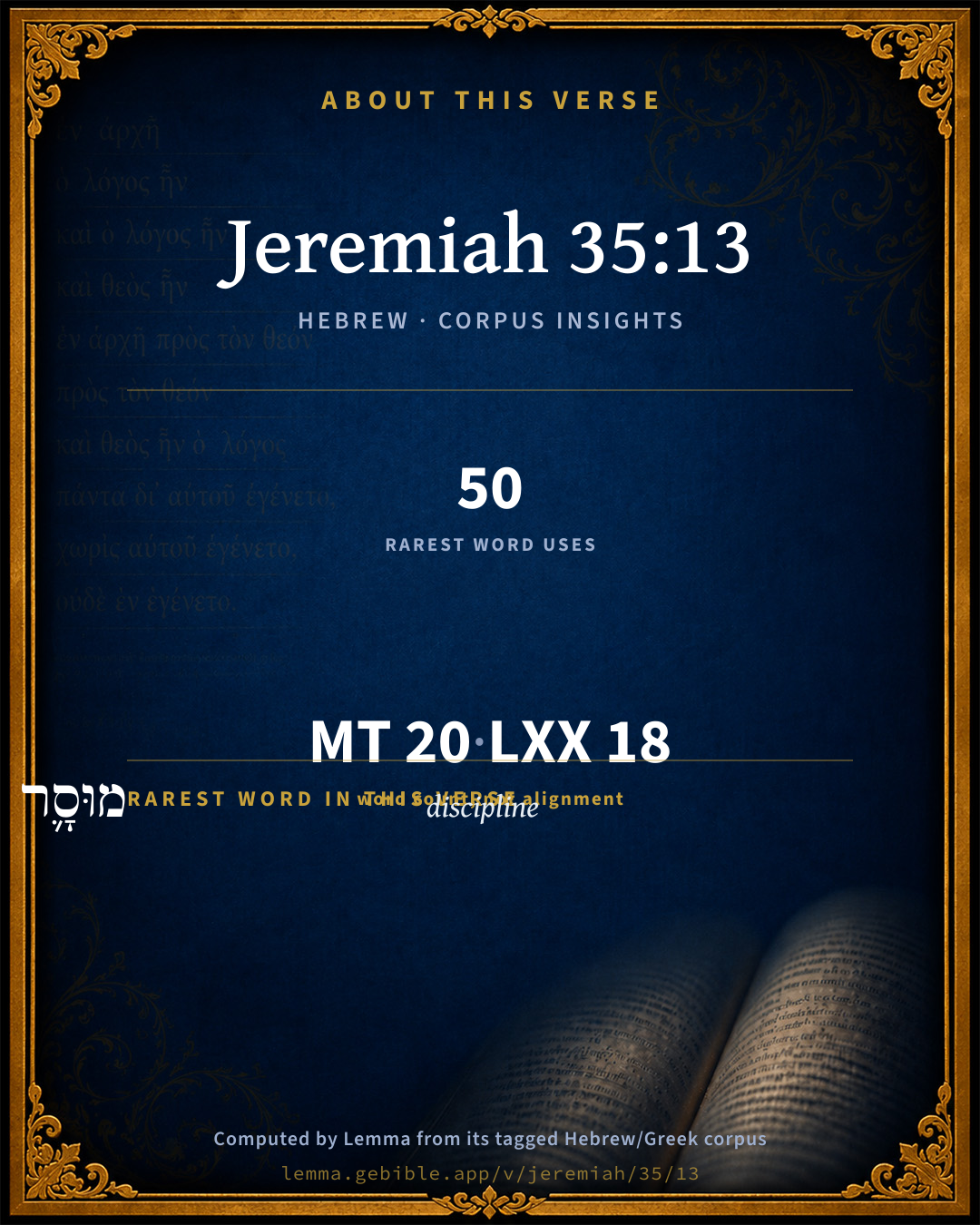
מוּסָ֛ר
mûwçâr
H4148
“discipline”
Noun, Common, Masculine, Singular, Absolute
Part of Speech
Noun
Type
Common
Gender
Masculine
Number
Singular
State
Absolute
Full BDB Definition

Origin: from H3256

TWOT: 877b

discipline, chastening, correction - discipline, correction - chastening
  1. כֹּֽה kôh H3541 “thus” Adverb
  2. אָמַ֞ר ʼâmar H559 “to say” Verb, Qal, Perfect, 3rd Person, Masculine, Singular
  3. יְהוָ֤ה Yᵉhôvâh H3068 “LORD” Noun, Proper
  4. צְבָאוֹת֙ tsâbâʼ H6635 “armies” Noun, Common, Both, Plural, Absolute
  5. אֱלֹהֵ֣י ʼĕlôhîym H430 “God(s) of” Noun, Common, Masculine, Plural, Construct
  6. יִשְׂרָאֵ֔ל Yisrâʼêl H3478 “Israel” Noun, Proper
  7. הָלֹ֤ךְ hâlak H1980 “to walk” Verb, Qal, Infinitive Absolute
  8. וְאָֽמַרְתָּ֙ ʼâmar H559 “and · to say” Conjunction + Verb, Qal, Sequential Perfect, 2nd Person, Masculine, Singular
  9. לְאִ֣ישׁ ʼîysh H376 “to/for · man of” Preposition + Noun, Common, Masculine, Singular, Construct
  10. יְהוּדָ֔ה Yᵉhûwdâh H3063 “Judah” Noun, Proper
  11. וּלְיֽוֹשְׁבֵ֖י yâshab H3427 “and · to/for · dwelling” Conjunction + Preposition + Verb, Qal, Participle Active, Masculine, Plural, Construct
  12. יְרֽוּשָׁלִָ֑ם Yᵉrûwshâlaim H3389 “Jerusalem” Noun, Proper
  13. הֲל֨וֹא lôʼ H3808 “not” Particle, Interrogative + Particle, Negative
  14. תִקְח֥וּ lâqach H3947 “to take” Verb, Qal, Imperfect, 2nd Person, Masculine, Plural
  15. לִשְׁמֹ֥עַ shâmaʻ H8085 “to hear” Preposition + Verb, Qal, Infinitive Construct
  16. אֶל ʼêl H413 “to” Preposition
  17. דְּבָרַ֖י dâbâr H1697 “words · my” Noun, Common, Masculine, Plural, Construct + Suffix, Personal, 1st Person, Common, Singular
  18. נְאֻם nᵉʼum H5002 “utterance of” Noun, Common, Masculine, Singular, Construct
  19. יְהוָֽה Yᵉhôvâh H3068 “LORD” Noun, Proper

About this verse

These counts appear in no published source. They are computed here, from the morphology-tagged text and Lemma’s own curated glosses. What Lemma adds →

20
words
18
distinct lemmas
Prophets
section

Shared distinctive vocabulary

מוּסָ֛ר discipline H4148 occurs in 50 verses of the Hebrew Bible. Also found in:

Grammatical profile

  • 6 verbs
  • 11 nouns
  • 1 preposition
  • 1 adverb
  • 1 particle

Verb forms

  • אָמַ֞ר Qal · Perfect
  • הָלֹ֤ךְ Qal · Infinitive Absolute
  • וְאָֽמַרְתָּ֙ Qal · Sequential Perfect
  • וּלְיֽוֹשְׁבֵ֖י Qal · Participle Active
  • תִקְח֥וּ Qal · Imperfect
  • לִשְׁמֹ֥עַ Qal · Infinitive Construct

Repetition

Words recur within this verse — often emphatic in Hebrew:

  • אָמַ֞ר to say H559 ×2
  • יְהוָ֤ה LORD H3068 ×2

Hebrew & Septuagint length

In the original languages it is 20 Hebrew tokens and 18 Greek tokens — but the two are counted differently (Hebrew bundles its prefixes and suffixes into one token; the Greek is in lemma form), so that isn’t a like-for-like length.

Cross-references

10

Topical passages linked to Jeremiah 35:13 in the Treasury of Scripture Knowledge — connected by theme and wording, ordered by reader-vote popularity; previews shown in the World English Bible.

  • Jeremiah 32:33 They have turned to me the back, and not the face: and though I taught them, rising up early and teaching them, yet they have not listened to receive instruction.
  • Jeremiah 5:3 O Yahweh, don't your eyes look on truth? you have stricken them, but they were not grieved; you have consumed them, but they have refused to receive correction: they have made their faces harder than a rock; they have refused to return.
  • Isaiah 28:9–12 Whom will he teach knowledge? and whom will he make to understand the message? those who are weaned from the milk, and drawn from the breasts?
  • Jeremiah 6:8–10 Be instructed, Jerusalem, lest my soul be alienated from you; lest I make you a desolation, a land not inhabited.
  • Psalms 32:8–9 I will instruct you and teach you in the way which you shall go. I will counsel you with my eye on you.
  • Proverbs 8:10 Receive my instruction rather than silver; Knowledge rather than choice gold.
  • Proverbs 19:20 Listen to counsel and receive instruction, That you may be wise in your latter end.
  • Isaiah 42:23 Who is there among you who will give ear to this? who will listen and hear for the time to come?
  • Jeremiah 9:12 Who is the wise man, that may understand this? and [who is] he to whom the mouth of Yahweh has spoken, that he may declare it? why is the land perished and burned up like a wilderness, so that none passes through?
  • Hebrews 12:25 See that you don't refuse him who speaks. For if they didn't escape when they refused him who warned on the Earth, how much more will we not escape who turn away from him who warns from heaven,

Cross-references courtesy of OpenBible.info (CC BY 4.0).

Hebrew and Greek witnesses Masoretic Hebrew ↔ Greek Septuagint

The same verse in the two great witnesses to the Old Testament, shown verse-for-verse.

These are two independent witnesses, not word-aligned to each other, and the Septuagint is shown in lemma (dictionary) form.

Hebrew Jeremiah 35:13 Masoretic · Westminster Leningrad Codex

כֹּֽה אָמַ֞ר יְהוָ֤ה צְבָאוֹת֙ אֱלֹהֵ֣י יִשְׂרָאֵ֔ל הָלֹ֤ךְ וְאָֽמַרְתָּ֙ לְאִ֣ישׁ יְהוּדָ֔ה וּלְיֽוֹשְׁבֵ֖י יְרֽוּשָׁלִָ֑ם הֲל֨וֹא תִקְח֥וּ מוּסָ֛ר לִשְׁמֹ֥עַ אֶל דְּבָרַ֖י נְאֻם יְהוָֽה

Thus says Yahweh of Hosts, the God of Israel: Go, and tell the men of Judah and the inhabitants of Jerusalem, Will you not receive instruction to listen to my words? says Yahweh.

World English Bible · Public Domain

Greek LXX Structure differs

In the Septuagint, Jeremiah is about an eighth shorter than the Hebrew and arranges its material differently — the Oracles Against the Nations (Hebrew chapters 46–51) appear in the middle of the Greek book, after 25:13. Because the chapter and verse boundaries do not line up, a verse-for-verse comparison with the Hebrew is not shown.

A verse-for-verse comparison isn’t shown here because the chapters and verses don’t line up. Switch to the LXX edition with the MT / LXX toggle above to read the Greek directly.

Hebrew: Westminster Leningrad Codex (CC BY 4.0). Greek: Septuagint (public domain); English from a public-domain English Septuagint. How the Septuagint differs from the Hebrew →

Targum (Aramaic paraphrase)

1

The Targum is the ancient Jewish Aramaic paraphrase of the Hebrew Scriptures — an interpretive translation, not the Hebrew text itself. Onkelos (literal) and Pseudo-Jonathan (expansive) render the Torah, and Jonathan the Prophets. Coverage is partial: where no permissively-licensed English translation exists for a verse, only the Aramaic is shown. This is verse-level text, not a word-by-word alignment to the Hebrew.

  1. Targum Jonathan Prophets (Joshua–Malachi)
    כִּדְנַן אֲמַר יְיָ צְבָאוֹת אֱלָהָא דְיִשְׂרָאֵל אֱזֵיל וְתֵימַר לֶאֱנַשׁ יְהוּדָה וּלְיַתְבֵי יְרוּשְׁלֵם הֲלָא תְקַבְּלוּן אוּלְפַן לְקַבָּלָא לְפִתְגָמַי אֲמַר יְיָ:

    (no public-domain English translation for this verse)

    Targum Jonathan — Aramaic: “Mikraot Gedolot” (public domain). English: “Sefaria Community Translation” (CC0 1.0 (public-domain dedication)); “London "Chaldee Paraphrase," 1871” (public domain). Text via Sefaria.

Commentary

Notes on Jeremiah 35:13 from classic Christian and Jewish commentators (each source and its license shown beneath its notes). The classic Christian expositions comment on the surrounding passage and are grouped to its opening verse, so a note may address several verses; the Jewish commentaries on the Tanakh (Rashi and others) are per-verse, so they appear only where the commentator wrote on this verse.

Lemma curates 59 commentaries, every one of them public domain or Creative Commons licensed, each selected and text-cleaned for this edition rather than reprinted as found. About our sources →

Trapp's Complete Commentary

John Trapp

Jer 35:13 Thus saith the LORD of hosts, the God of Israel; Go and tell the men of Judah and the inhabitants of Jerusalem, Will ye not receive instruction to hearken to my words? saith the LORD.

Ver. 13. Will ye not receive instruction, to hearken to my words?] Quae est illa portentosa pertinacia? What a strange stiffness and obstinace in you is this! Am not I to be better esteemed and obeyed by you than Jonadab is by the Rechabites?

John Trapp, A Commentary or Exposition upon All the Books of the Old and New Testament (1647–1656) — public domain. Text from a community e-Sword module.

Geneva Bible (1599)

Geneva Bible translators

Whom I have chosen to be my children, seeing these which were the children of an heathen man, obeyed the commandment of their father.

Geneva Bible (1599) marginal notes — public domain. Text via Bolls.life.

John Calvin's Commentaries

Here Jeremiah applies the example which he had related; for subjoined is God’s complaint, — that he was less regarded by his people than Jonadab was by his posterity. He then says, Go and speak to the men of Judah, and to the inhabitants ofJerusalem To make the reproof the more effectual, the Prophet introduces God as the speaker. It was therefore God’s purpose to convey the reproof to the Jews in his own name, and as it were in his own person. Will ye not receive instruction, he says, so as to obey me? The word מוסר musar, means sometimes ruling or governing, and sometimes correction. But God here no doubt reprehends that madness of the Jews in which they had long hardened themselves, as though he had said, “You never think it right to return to a sound mind.” Since, then, they had been for a long time incorrigible and wandered after their own lusts like unbridled wild beasts, a reproof is here given, as though he had said, “Will this people be always ungovernably wanton so as never to submit to the yoke?” And he says, so as to obey me God shews that he required nothing unjust from the Jews, so that a true excuse could be pretended, as though he was too rigid: “I require only,” he says, “that ye obey me: this is all my severity, for lovely is the rule of meekness which I use towards you. Since, then, I demand nothing but what children ought willingly to render to their fathers without being admonished, how is it that this mederation is so displeasing to you, and can by no means be approved by you?”

John Calvin's Commentaries (1540-1563) — public domain. Text from the Calvin Translation Society English edition (1840s-50s) via the Christian Classics Ethereal Library (ccel.org). Calvin's coverage is partial (roughly two-thirds of the Bible); uncommented books and verses are honest gaps, never fabricated. The 19th-century editor's footnotes and remarks are omitted so the notes are faithfully Calvin's own voice.

Ellicott's Commentary for English Readers

(13) Will ye not receive instruction . . .—The argument of the prophet is naturally an à fortiori one. The words of Jonadab had been kept faithfully as a rule of life for 300 years by his descendants or his order. The words of Jehovah, “rising early and speaking” through His prophets (we note the repetition of the characteristic phrase of Jer_7:13; Jer_25:3), were neglected by the people whom He had adopted as His children. They, too, had the same promise that by obeying they should dwell in the land which He had given them, but they had turned a deaf ear both to the promise and the warning which it implied.

A Bible Commentary for English Readers, edited by Charles John Ellicott (1878–1897) — public domain. Text from a community e-Sword module.

The Cambridge Bible for Schools and Colleges

gen. ed. J. J. S. Perowne

13. instruction] or, correction. See on Jer_17:23.

The Cambridge Bible for Schools and Colleges (gen. ed. J. J. S. Perowne; Cambridge University Press, 1878–1918) — public domain. Text from a community e-Sword module.

John Gill's Exposition

Thus saith the Lord of hosts, the God of Israel,.... The Lord of armies in heaven and earth; the Creator of Israel; their benefactor, covenant God and Father and whom they professed to worship; God and not man; infinitely greater than Jonadab, whose precepts had been observed by his posterity:

go and tell the men of Judah, and the inhabitants of Jerusalem; this is an order to the prophet to remove from the chamber where he was with the Rechabites, and go to the court of the people, where they were assembled for worship; or into the city of Jerusalem, and gather the heads of them together, and declare the following things to them:

will ye not receive instruction to hearken to my words? saith the Lord; from this instance and case of the Rechabites, who had so constantly obeyed their father, and hearkened to his words, though but a man; a father of their flesh; an earthly father; and who had been dead long ago; and therefore much more ought they to hearken to the Father of their spirits; their Father which is in heaven, and who lives for ever.

John Gill's Exposition of the Whole Bible (1746–1763) — public domain (CC PDM 1.0). Text via the HelloAO Bible API.

Albert Barnes' Notes on the Bible

Jeremiah, accompanied by the main body of the Rechabites, went into one of the courts of the temple, and there addressed to the people the rebuke following.

Albert Barnes' Notes on the Bible (1834–1885) — public domain. Text from a community e-Sword/MySword module.

Lesson kit

Teaching starters — assembled from the data on this page, not authored interpretation. Every prompt links to the verse data it draws on. Edit before teaching.

Jeremiah, in the Prophets, opens this verse with 20 words (18 distinct Hebrew lemmas). Its most distinctive word is mûwçâr (“discipline”). A historical commentator’s framing appears above. Read the whole chapter for the surrounding context.

Discussion questions

  1. The word mûwçâr carries the sense “discipline.” How does it shape the verse?
  2. How does Deuteronomy 11:2, which shares the word «discipline», read alongside this verse?
  3. What does the repetition of “to say” (2× in this one verse) do in this verse?
  4. These translations render this verse differently; the difference is in the English rendering, not the original. What questions does that raise?
  5. «אָמַ֞ר» is a Qal Perfect verb. How does that grammatical form shape the action described?
  6. Compare how Trapp's Complete Commentary and Geneva Bible (1599) read this verse. Where do they agree or differ?

Things to notice

Reading settings

Reading text

Shown beneath each verse's original-language words.

Old Testament
Old Testament edition

Read the OT as the Masoretic Hebrew (MT) or the Greek Septuagint (LXX).

English shown for the Greek Septuagint (in the Hebrew ↔ Greek comparison).

Comparing translations? Open the Compare panel on any verse page to stack up to four side by side.