Habakkuk 2:7

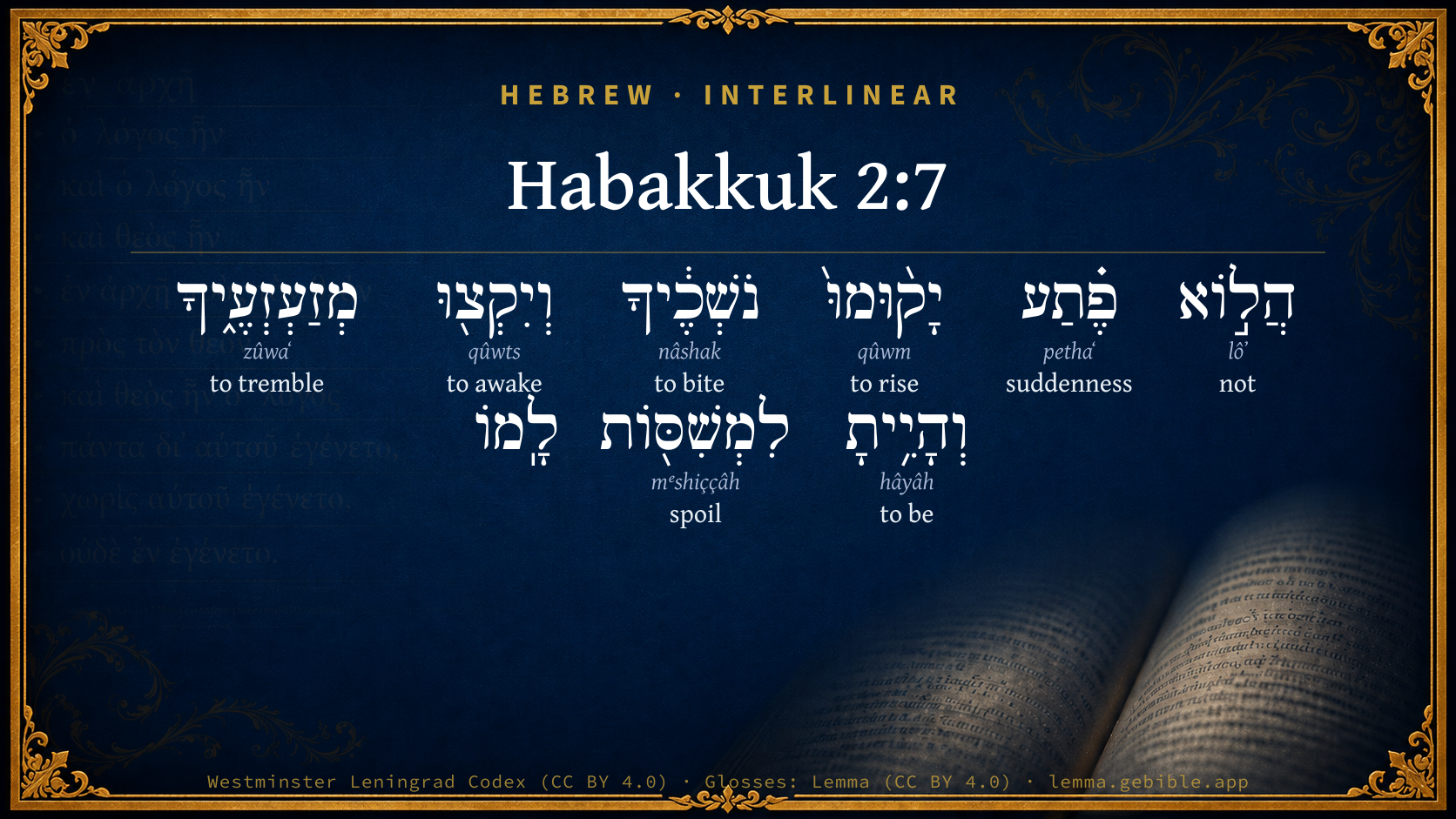
Hebrew (Westminster Leningrad Codex) Habakkuk 2:7 appears in the Hebrew Old Testament. The text above is from the Westminster Leningrad Codex. Each word links to its Strong’s number, a concise gloss, and parsing drawn from the Open Scriptures Hebrew Bible morphology. Click any word for its full Brown-Driver-Briggs (BDB) entry.
Download image
Cite this verse

Habakkuk 2:7 (World English Bible). Public Domain. Lemma interlinear Bible study tool, https://lemma.gebible.app/v/habakkuk/2/7.

Show BibTeX & RIS
BibTeX
RIS
English Translation
Won't your debtors rise up suddenly, and wake up those who make you tremble, and you will be their victim?
World English Bible · Public Domain
Download a study sheet

One document with this verse’s original text, its word-by-word gloss line, the meaning frame, cross-references with their text, attributed commentary, and full source and license credits — printable, and it pastes into notes with its structure intact.

This verse Autodidact and up

Study sheet (.html) Plain text (.txt)

A passage Seminary Student

Up to 50 verses in one chapter. A passage sheet keeps up to 6 commentary sources and 12 cross-references per verse, in the order this page ranks them, and says so on the sheet whenever that leaves anything out. Ask for a single verse and you get the Autodidact verse sheet above.

Everything on this page stays free to read, with no account — the sheet is a download of what is already on screen, not access to it.

Want to remove ads? Support Godless Engineer
Compare translations 3

The same verse in 3 English versions, stacked beneath the original-language interlinear above. Click any original word for its lexicon entry.

Each is an independent rendering of the whole verse — the interlinear is not word-aligned to these translations.

Highlighted words mark where these versions differ — a whole-verse word diff, not a word-by-word alignment.

  • World English Bible Public Domain
    Won't your debtors rise up suddenly, and wake up those who make you tremble, and you will be their victim?
  • King James Version Public Domain
    Shall they not rise up suddenly that shall bite thee, and awake that shall vex thee, and thou shalt be for booties unto them?
  • unfoldingWord Literal Text CC BY-SA 4.0
    Will not your biters suddenly rise up, and the ones shaking you awaken? Then you will become spoils for them.

unfoldingWord Literal Text — © unfoldingWord, licensed CC BY-SA 4.0. Word-aligned USFM3 via Door43 (git.door43.org/unfoldingWord/en_ult).

Versions to compare (up to 4)

3 of 4 selected

Show all 18 translations

Every available English version of this verse, each an independent rendering of the whole verse.

  • World English Bible Public Domain
    Won't your debtors rise up suddenly, and wake up those who make you tremble, and you will be their victim?
  • Berean Standard Bible Public Domain
    Will not your creditors suddenly arise and those who disturb you awaken? Then you will become their prey.
  • Majority Standard Bible Public Domain
    Will not your creditors suddenly arise and those who disturb you awaken? Then you will become their prey.
  • King James Version Public Domain
    Shall they not rise up suddenly that shall bite thee, and awake that shall vex thee, and thou shalt be for booties unto them?
  • American Standard Version (1901) Public Domain
    Shall they not rise up suddenly that shall bite thee, and awake that shall vex thee, and thou shalt be for booty unto them?
  • Revised Version (1885) Public Domain
    Shall they not rise up suddenly that shall bite thee, and awake that shall vex thee, and thou shalt be for booties unto them?
  • Geneva Bible (1599) Public Domain
    Shall they not rise vp suddenly, that shall bite thee? and awake, that shall stirre thee? and thou shalt be their praye?
  • Douay-Rheims (1899) Public Domain
    Shall they not rise up suddenly that shall bite thee: and they be stirred up that shall tear thee, and thou shalt be a spoil to them?
  • Young's Literal Translation Public Domain
    Do not thy usurers instantly rise up, And those shaking thee awake up, And thou hast been for a spoil to them?
  • Literal Standard Version CC BY-SA 4.0
    Do your usurers not instantly rise up, || And those shaking you awake, || And you have been a spoil to them?
  • Unlocked Literal Bible CC BY-SA 4.0
    Will the ones biting at you not rise up suddenly, and the ones terrifying you awaken? You will become a victim for them.
  • unfoldingWord Literal Text CC BY-SA 4.0
    Will not your biters suddenly rise up, and the ones shaking you awaken? Then you will become spoils for them.
  • Darby Bible Public Domain
    Shall they not rise up suddenly that shall bite thee, and they awake up that shall vex thee, and thou shalt be for booties unto them?
  • World Messianic Bible Public Domain
    Won’t your debtors rise up suddenly, and wake up those who make you tremble, and you will be their victim?
  • Webster's Bible Public Domain
    Shall they not rise suddenly that shall bite thee, and awake that shall disturb thee, and thou shalt be for booties to them?
  • Free Bible Version CC BY-SA 4.0
    Won't your debtors suddenly act? Won't they wake up to the situation and make you tremble? You will be plunder for them!
  • Bible in Basic English Public Domain
    Will not your creditors suddenly be moved against you, and your troublers get up from their sleep, and you will be to them like goods taken in war?
  • JPS Tanakh (1917) Public Domain
    Shall they not rise up suddenly that shall exact interest of thee, and awake that shall violently shake thee, and thou shalt be for booties unto them?

Literal Standard Version (2020), Covenant Press — licensed CC BY-SA 4.0. Text via the HelloAO Bible API (eBible.org). Unlocked Literal Bible (unfoldingWord) — licensed CC BY-SA 4.0. Text via the HelloAO Bible API (eBible.org). unfoldingWord Literal Text — © unfoldingWord, licensed CC BY-SA 4.0. Word-aligned USFM3 via Door43 (git.door43.org/unfoldingWord/en_ult). Free Bible Version, Dr. Jonathan Gallagher — licensed CC BY-SA 4.0. Text via the HelloAO Bible API (eBible.org).

Word by word

More ways to search: Search by grammar → Find every occurrence → Compare this word →

Practice this passage: Drill this verse → Learn its vocabulary →

מְזַעְזְעֶ֑יךָ
zûwaʻ
H2111
“trembling · you”
Verb, Pilpel, Participle Active, Masculine, Plural, Construct + Suffix, Personal, 2nd Person, Masculine, Singular
Part of Speech
Verb
Stem
Pilpel
Form
Participle Active
Gender
Masculine
Number
Plural
State
Construct
Full BDB Definition

Origin: a primitive root

TWOT: 540

to tremble, quiver, quake, be in terror - (Qal) to tremble, quake - (Pilpel) - to shake violently - to cause to tremble
  1. הֲל֣וֹא lôʼ H3808 “not” Particle, Interrogative + Particle, Negative
  2. פֶ֗תַע pethaʻ H6621 “suddenness” Adverb
  3. יָק֨וּמוּ֙ qûwm H6965 “to rise” Verb, Qal, Imperfect, 3rd Person, Masculine, Plural
  4. נֹשְׁכֶ֔יךָ nâshak H5391 “biting · you” Verb, Qal, Participle Active, Masculine, Plural, Construct + Suffix, Personal, 2nd Person, Masculine, Singular
  5. וְיִקְצ֖וּ qûwts H6974 “and · to awake” Conjunction + Verb, Qal, Imperfect, 3rd Person, Masculine, Plural
  6. וְהָיִ֥יתָ hâyâh H1961 “and · to be” Conjunction + Verb, Qal, Sequential Perfect, 2nd Person, Masculine, Singular
  7. לִמְשִׁסּ֖וֹת mᵉshiççâh H4933 “to/for · spoils” Preposition + Noun, Common, Feminine, Plural, Absolute

About this verse

These counts appear in no published source. They are computed here, from the morphology-tagged text and Lemma’s own curated glosses. What Lemma adds →

9
words
8
distinct lemmas
Prophets
section

Notable vocabulary

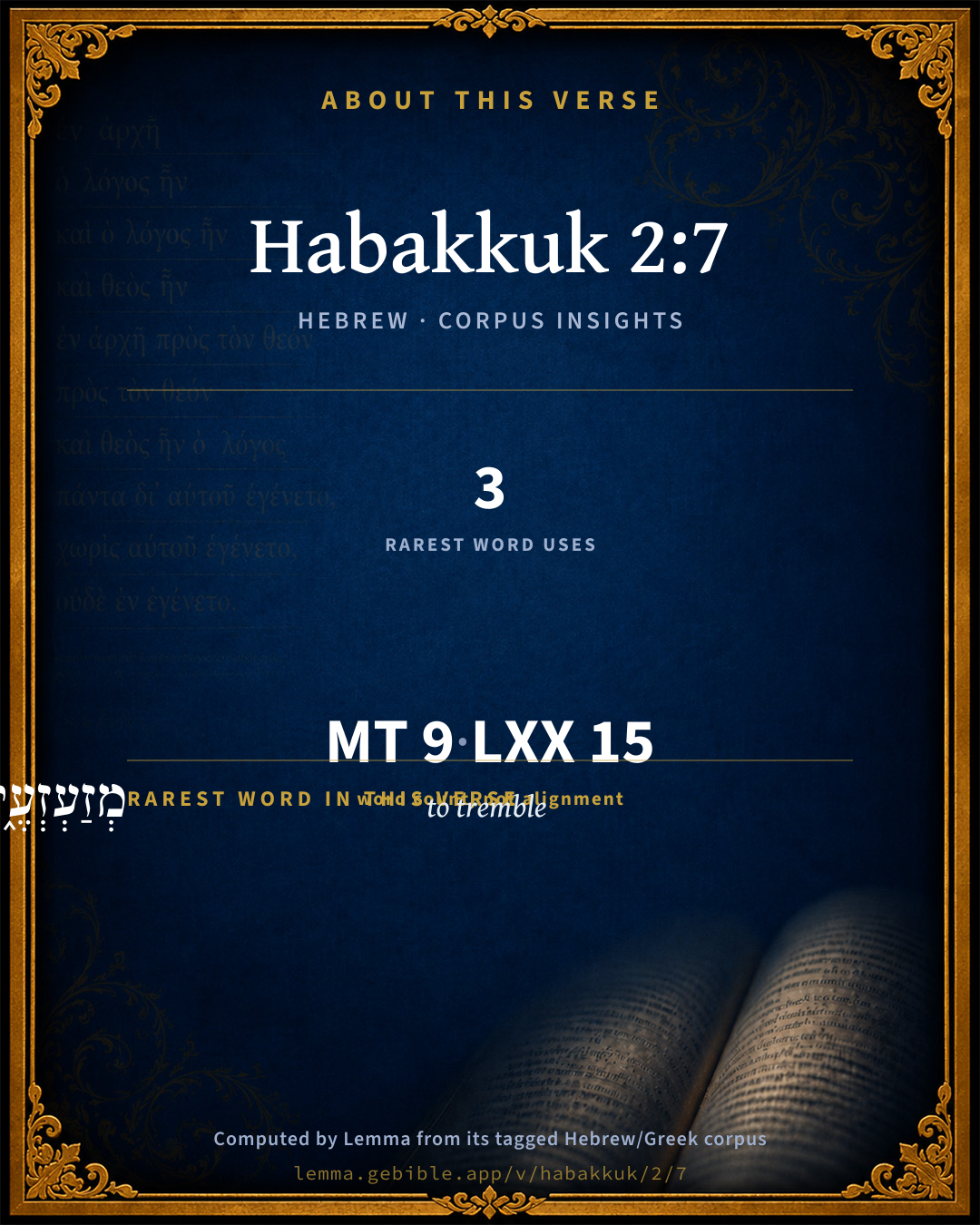
The rarest word here is מְזַעְזְעֶ֑יךָ to tremble H2111 — appearing just 3 times in the whole Hebrew Bible.

Shared distinctive vocabulary

מְזַעְזְעֶ֑יךָ to tremble H2111 occurs in 3 verses of the Hebrew Bible. Also found in:

Grammatical profile

  • 5 verbs
  • 1 noun
  • 1 preposition
  • 1 adverb
  • 1 particle

Verb forms

  • יָק֨וּמוּ֙ Qal · Imperfect
  • נֹשְׁכֶ֔יךָ Qal · Participle Active
  • וְיִקְצ֖וּ Qal · Imperfect
  • מְזַעְזְעֶ֑יךָ Pilpel · Participle Active
  • וְהָיִ֥יתָ Qal · Sequential Perfect

Hebrew & Septuagint length

In English translation the verse runs 20 words from the Hebrew and 26 from the Septuagint (LXX English) — closely comparable.

A rough comparison of the two English renderings, which tokenize alike — not a word-level alignment.

Word counts can differ between the Hebrew and the Greek without any difference in meaning — e.g. the Hebrew direct-object marker אֵת has no separate Greek word, and Greek often adds the article ὁ.

In the original languages it is 9 Hebrew tokens and 15 Greek tokens — but the two are counted differently (Hebrew bundles its prefixes and suffixes into one token; the Greek is in lemma form), so that isn’t a like-for-like length.

Cross-references

18

Topical passages linked to Habakkuk 2:7 in the Treasury of Scripture Knowledge — connected by theme and wording, ordered by reader-vote popularity; previews shown in the World English Bible.

  • Proverbs 29:1 He who is often rebuked and stiffens his neck Will be destroyed suddenly, with no remedy.
  • Ecclesiastes 10:8 He who digs a pit may fall into it; and whoever breaks through a wall may be bitten by a snake.
  • Isaiah 13:1–5 The burden of Babylon, which Isaiah the son of Amoz did see.
  • Isaiah 13:16–18 Their infants also shall be dashed in pieces before their eyes; their houses shall be rifled, and their wives ravished.
  • Isaiah 21:2–9 A grievous vision is declared to me; the treacherous man deals treacherously, and the destroyer destroys. Go up, Elam; besiege, Media; all the sighing of it have I made to cease.
  • Isaiah 41:25 I have raised up one from the north, and he has come; from the rising of the sun one who calls on my name: and he shall come on rulers as on mortar, and as the potter treads clay.
  • Isaiah 45:1–3 Thus says Yahweh to his anointed, to Cyrus, whose right hand I have held, to subdue nations before him, and I will loose the loins of kings; to open the doors before him, and the gates shall not be shut:
  • Isaiah 46:11 calling a ravenous bird from the east, the man of my counsel from a far country; yes, I have spoken, I will also bring it to pass; I have purposed, I will also do it.
  • Isaiah 47:11 Therefore shall evil come on you; you shall not know the dawning of it: and mischief shall fall on you; you shall not be able to put it away: and desolation shall come on you suddenly, which you don't know.
  • Isaiah 48:14–15 Assemble yourselves, all you, and hear; who among them has declared these things? He whom Yahweh loves shall perform his pleasure on Babylon, and his arm [shall be on] the Chaldeans.
  • Jeremiah 8:17 For, behold, I will send serpents, adders, among you, which will not be charmed; and they shall bite you, says Yahweh.
  • Jeremiah 50:21–32 Go up against the land of Merathaim, even against it, and against the inhabitants of Pekod: kill and utterly destroy after them, says Yahweh, and do according to all that I have commanded you.
  • Jeremiah 51:11 Make sharp the arrows; hold firm the shields: Yahweh has stirred up the spirit of the kings of the Medes; because his purpose is against Babylon, to destroy it: for it is the vengeance of Yahweh, the vengeance of his temple.
  • Jeremiah 51:27–28 Set up a standard in the land, blow the trumpet among the nations, prepare the nations against her, call together against her the kingdoms of Ararat, Minni, and Ashkenaz: appoint a marshal against her; cause the horses to come up as the rough canker-worm.
  • Jeremiah 51:57 I will make drunk her princes and her wise men, her governors and her deputies, and her mighty men; and they shall sleep a perpetual sleep, and not wake up, says the King, whose name is Yahweh of Hosts.
  • Daniel 5:25–31 This is the writing that was inscribed: MENE, MENE, TEKEL, UPHARSIN.
  • Nahum 1:9–10 What do you plot against Yahweh? He will make a full end. Affliction won't rise up the second time.
  • 1 Thessalonians 5:3 For when they are saying, "Peace and safety," then sudden destruction will come on them, like birth pains on a pregnant woman; and they will in no way escape.

Cross-references courtesy of OpenBible.info (CC BY 4.0).

Hebrew and Greek witnesses Masoretic Hebrew ↔ Greek Septuagint

The same verse in the two great witnesses to the Old Testament, shown verse-for-verse.

These are two independent witnesses, not word-aligned to each other, and the Septuagint is shown in lemma (dictionary) form.

Hebrew Habakkuk 2:7 Masoretic · Westminster Leningrad Codex

הֲל֣וֹא פֶ֗תַע יָק֨וּמוּ֙ נֹשְׁכֶ֔יךָ וְיִקְצ֖וּ מְזַעְזְעֶ֑יךָ וְהָיִ֥יתָ לִמְשִׁסּ֖וֹת לָֽמוֹ

Won't your debtors rise up suddenly, and wake up those who make you tremble, and you will be their victim?

World English Bible · Public Domain

Greek LXX Habakkuk 2:7 Septuagint · lemma form

ὅτι ἐξαίφνης ἀναἵστημι δάκνω αὐτός καί ἐκνήφω ὁ ἐπίβουλος σύ καί εἰμί εἰς διαρπαγή αὐτός

For suddenly there shall arise up those that bite him, and they that plot against you shall awake, and you shall be a plunder to them.

LXX2012 (modern English Septuagint) · Public Domain

On this verse, The Pulpit Commentary discusses the Septuagint’s reading. Read the note in Commentary ↓

Hebrew: Westminster Leningrad Codex (CC BY 4.0). Greek: Septuagint (public domain); English from LXX2012 (modern English Septuagint) (Public Domain). How the Septuagint differs from the Hebrew →

Targum (Aramaic paraphrase)

1

The Targum is the ancient Jewish Aramaic paraphrase of the Hebrew Scriptures — an interpretive translation, not the Hebrew text itself. Onkelos (literal) and Pseudo-Jonathan (expansive) render the Torah, and Jonathan the Prophets. Coverage is partial: where no permissively-licensed English translation exists for a verse, only the Aramaic is shown. This is verse-level text, not a word-by-word alignment to the Hebrew.

  1. Targum Jonathan Prophets (Joshua–Malachi)
    הֲלָא בִּתְכֵּיף יְקוּמוּן אַנְסָךְ וְיִתְגְלוּן מְזַעְזְעָךְ וּתְהֵי לַעֲדִי לְהוֹן:

    (no public-domain English translation for this verse)

    Targum Jonathan — Aramaic: “Mikraot Gedolot” (public domain). English: “Sefaria Community Translation” (CC0 1.0 (public-domain dedication)); “London "Chaldee Paraphrase," 1871” (public domain). Text via Sefaria.

Commentary

Notes on Habakkuk 2:7 from classic Christian and Jewish commentators (each source and its license shown beneath its notes). The classic Christian expositions comment on the surrounding passage and are grouped to its opening verse, so a note may address several verses; the Jewish commentaries on the Tanakh (Rashi and others) are per-verse, so they appear only where the commentator wrote on this verse.

Lemma curates 59 commentaries, every one of them public domain or Creative Commons licensed, each selected and text-cleaned for this edition rather than reprinted as found. About our sources →

Trapp's Complete Commentary

John Trapp

Hab 2:7 Shall they not rise up suddenly that shall bite thee, and awake that shall vex thee, and thou shalt be for booties unto them?

Ver. 7. Shall they not rise up suddenly that shall bite thee?] Rend and tear thee as hunting dogs do the beast they pursue. See Isa 13:14; Isa 13:21 Jer 51:58. The interrogation here used importeth both the certainty of the thing and their security, as if no such thing could possibly befall them. Suddenly, therefore, saith the prophet, shalt thou be surprised and spoiled by the Persians, when thy city Babylon is held impregnable, and boasteth of provision enough laid in for twenty years’ siege. Security is the certain usher of destruction, as we see in Benhadad’s army, and those Midianites, Jdg 7:12; Jdg 7:20-23, and the Amalekites, 1Sa 30:16-17; and Pompey’s marching against Caesar; and the French at the battle of Agincourt; so confident they were of a victory, that they sent to our King Henry V, who was then in the field against them, and got the day, to know what ransom he would give.

John Trapp, A Commentary or Exposition upon All the Books of the Old and New Testament (1647–1656) — public domain. Text from a community e-Sword module.

Joseph Benson's Commentary

Hab 2:7-8. Shall they not rise up suddenly that shall bite thee? — Is it not just, or what thou deservest, that others should suddenly rise against thee, and bite and tear thee? It is a metaphor taken from the hunting of wild beasts. And awake that shall vex thee — As thou hast been a vexation to others by thy tyranny and cruelty. And thou shalt be for booties unto them — Unto the Medes and Persians. The expression, rise up suddenly, very fitly describes the suddenness with which the Babylonian empire was afterward overthrown. For though Cyrus could not be said to come upon them suddenly, or unexpectedly, yet the blow, whereby the Babylonian empire was overturned, was struck extremely suddenly; for, after all Cyrus’s victories, they thought themselves very secure within the walls of Babylon; and that Cyrus must be wearied out, and his army mouldered away, before he could make himself master of it: but by an unexpected stratagem, in draining the Euphrates, he got possession of the city, and destroyed the king and all his principal men in a few hours time: see notes on Isa 13:20; Jer 50:38; and Dan 5:30. Because, &c. — The prophet proceeds to give an account of the reasons on which divine vengeance proceeded in this affair. Thou hast spoiled many nations —

Hast slain or led captive their people, destroyed their cities, robbed their treasuries, deposed their kings; and hast done this to many nations, whose cry for vengeance is come up to heaven. All the remnant of the people shall spoil thee — Now shalt thou be paid in thine own coin: the remnant of the nations, unspoiled by thee, shall combine against thee, and execute the Lord’s just sentence upon thee. This was evidently verified in the destruction of the Babylonian empire; for Cyrus’s army was made up of a great many different nations. Because of men’s blood — As a just return for thy cruelty, in the slaughter thou hast made of mankind. And for the violence of — Or rather, against, the land — And particularly for the violence offered to the land of Judea, and the city of Jerusalem, and its temple and inhabitants.

Joseph Benson's Commentary on the Old and New Testaments (1811–1818) — public domain. Text from a community e-Sword module.

Geneva Bible (1599)

Geneva Bible translators

That is, the Medes and Persians, that should destroy the Babylonians?

Geneva Bible (1599) marginal notes — public domain. Text via Bolls.life.

Jamieson, Fausset & Brown

Robert Jamieson, A. R. Fausset & David Brown

suddenly--the answer to the question, "How long?" (Hab 2:6).

bite--often used of usury; so favoring LEE'S rendering (Hab 2:6). As the Chaldean, like a usurer, oppressed others, so other nations shall, like usurers, take pledges of, that is, spoil, him.

Jamieson, Fausset & Brown — Commentary Critical and Explanatory on the Whole Bible (1871) — public domain (CC PDM 1.0). Text via the HelloAO Bible API.

Adam Clarke's Commentary

Verse 7. Shall they not rise up suddenly] Does not this refer to the sudden and unexpected taking of Babylon by Cyrus, whose troops entered into the city through the bed of the Euphrates, whose waters they had diverted by another channel; so that the Babylonians knew nothing of the matter till they saw the Persian soldiers rise up as in a moment, in the very heart of their city?

Adam Clarke's Commentary on the Bible (1810–1826) — public domain. Text from a community e-Sword/MySword module.

John Calvin's Commentaries

The Prophet proceeds with the subject which we have already begun to explain; for he introduces here the common taunts against the king of Babylon and the whole tyrannical empire, by which many nations had been cruelly oppressed. He therefore says that enemies, who should bite him, would suddenly and unexpectedly rise up. Some expound this of worms, but not rightly: for God not only inflicted punishment on the king when dead, but he intended also that there should be on earth an evident and a memorable proof of his vengeance on the Babylonians, by which it might be made known to all that their cruelty could not be suffered to go unpunished.

The words, Shall not they rise suddenly, are emphatical, both as to the question and as to the word, פתע, peto, suddenly. We indeed know that interrogations are more common in Hebrew than in Greek and Latin, and that they are stronger and more forcible. Our Prophet then speaks of what was indubitable. He adds, suddenly; for the Babylonians, relying on their own power, did not think that any evil was nigh them; and if any one dared to rise up against them, this could not have been so sudden, but they could have in time resisted and driven far away every danger. They indeed ruled far and wide; and we know that the wicked often sleep when they find themselves fortified on all sides. But the Prophet declares here that evil was nigh them, which would suddenly overwhelm them. It now follows—

John Calvin's Commentaries (1540-1563) — public domain. Text from the Calvin Translation Society English edition (1840s-50s) via the Christian Classics Ethereal Library (ccel.org). Calvin's coverage is partial (roughly two-thirds of the Bible); uncommented books and verses are honest gaps, never fabricated. The 19th-century editor's footnotes and remarks are omitted so the notes are faithfully Calvin's own voice.

Ellicott's Commentary for English Readers

(7) Bite.—This verb nâshac also means “to oppress with usury,” and this is its force here. Thy turn shall come, and men shall exact usury from thee. Similarly, the verb translated “vex” is, literally, to shake violently, in allusion to a creditor’s forcible seizure of his debtor. (Comp. Mat_18:28.) The prediction of Habakkuk in these verses was fulfilled by the rise of the Medo-Persian power, and the capture of Babylon by the forces of Cyrus, cir. B.C. 538.

A Bible Commentary for English Readers, edited by Charles John Ellicott (1878–1897) — public domain. Text from a community e-Sword module.

The Cambridge Bible for Schools and Colleges

gen. ed. J. J. S. Perowne

7. that shall bite thee] Such is the usual sense of the word, which is used of the serpent, Gen_49:17; Num_21:8-9; cf. Mic_3:5. The term is employed here in a figurative sense of the attack of enemies. In one form the verb means to exact usury from one, Deu_23:20, and some would render here thy creditors. This double sense is supposed by some to be one of the taunting allusions (Hab_2:6).

shall vex thee] Or, violently shake thee. Ecc_12:3; Est_5:9; cf. Dan_5:19; Dan_6:27; Deu_28:25; Isa_28:19.

The Cambridge Bible for Schools and Colleges (gen. ed. J. J. S. Perowne; Cambridge University Press, 1878–1918) — public domain. Text from a community e-Sword module.

John Gill's Exposition

Shall not they rise up suddenly that shall bite thee,.... Or, "thy usurers", or "creditors" (d), as some render it; the Christians, whose money, goods, and substance, they had spoiled them of, but now should be repaid with great usury and gain; these, that is, their princes and emperors, as Constantine and Theodosius, rose up suddenly, and conquered the heathen emperors, and took away their power and authority from them, and their wealth and riches, and gave them to the Christians, what they and those under them had plundered them of:

and awake that shall vex thee, or "move thee" (e); the emperor, from the throne of the empire; and other subordinate magistrates from their places of dignity, trust, and profit; the priests out of their temples; and change the face of things everywhere; and which is expressed in language agreeable to this, in Rev 6:14, and has respect to the same times and things, "and the heaven departed as a scroll when it is rolled together, and every mountain and island were moved out of their place"; which is to be understood of the fall of the Pagan Roman empire:

and thou shalt be for booties unto them? the wealth and riches found in the Roman empire, as it fell into the hands of Constantine, were converted to the use of the Christians for the building of their temples, and the maintenance of their ministers, the relief of their poor, and for the reparation of losses others had sustained under the persecutions: thus the Christian emperors rose up at once, and exerted themselves; and who before seemed to be asleep awoke, and seized upon the empire, and the riches of it, and divided the spoil among themselves and their people.

(d) "foeneratores tui, seu creditores tui", Cocceius, Van Till. (e) "qui commoveant te", Pagninus, Vatablus; so R. Sol. Urbin. Ohel Moed, fol. 56. 1. "excutientes", Cocceius, Van Till; "commoventes te", Burkius.

John Gill's Exposition of the Whole Bible (1746–1763) — public domain (CC PDM 1.0). Text via the HelloAO Bible API.

Albert Barnes' Notes on the Bible

Shall not they rise up suddenly that shall bite thee, and awake that shall vex thee? - The destruction of the wicked is ever sudden at last. Such was the flood Luk 17:26-27, the destruction of Sodom, of Pharaoh, of the enemies of God’s people through the Judges, of Sennacherib, Nineveh, Babylon by the Medes and Persians. Such shall the end be Mat 24:43-44; Mat 25:13; Luk 17:26-30; Luk 21:34-35; 1Th 5:3; 2Pe 3:10; Rev 16:15. As he by his oppressions had pierced others (it is the word used of the oppression of usury), so should it be done to him. “The Medes and Persians who were before subject to the Babylonian empire, and whose kings were subject to Nebuchudnezzar and his successors, rose up and awaked, i. e., stirred themselves up in the days of Belshazzar to rebel against the successors of Nebuchadnezzar which sat on his throne, like a man who awaketh from sleep.” The words “awake,” “arise,” are used also of the resurrection, when the worm of the wicked gnaweth and dieth not (See Isa 14:11; Isa 66:24).

And thou shall be for booties unto them? - The common phrase is modified to explain the manifoldness of the plunder which he should yield. So Jeremiah Jer 50:10, “Chaldaea shall be a spoil; all that spoil her shall be satisfied, saith the Lord.” See Cyr: “We may hear Him who saith Mat 12:29, ‘How can one enter into a strong man’s house, and spoil his goods, except he first bind the strong man? and then he will spoil his house.’ For, as soon as He was born of the holy Virgin, He began to ‘spoil his goods.’ For the Magi came from the East - and worshiped Him and honored Him with gifts and became a first-fruits of the Church of the Gentiles. And being vessels of Satan, and the most honored of all his members, they hastened to Christ.”

Albert Barnes' Notes on the Bible (1834–1885) — public domain. Text from a community e-Sword/MySword module.

Haydock's Catholic Bible Commentary

Bile, like worms in the grave. Cyrus will overturn the kingdom. The Rabbins pretend that Evilmerodac caused his father’s body to be cut in pieces for the crows, lest he should return again. (Calmet)

George Leo Haydock (1774–1849), Haydock's Catholic Family Bible and Commentary, 1859 edition — public domain. Excludes Psalms (Douay-Rheims chapter numbering differs from Protestant) and Deuterocanonical books (Catholic canon only).

Matthew Poole's English Annotations

Shall they not? this question doth more fully ascertain the thing. Rise up; either grow up, or else, as men who resolve to do a thing thoroughly, get upon their feet and stand to it. The Medes and Persians were growing to power, and would ere long rise up to ruin Babylon.

Suddenly; and surprise it in security, so they were down ere they did perceive themselves falling; and such sudden ruin is most dreadful.

Bite thee; devour and eat thee up.

And awake; thou, O Belshazzar, (and Babylon with thee,) wilt in drunken slumbers (unable to resist) fall into the hands of the awakened Medes and Persians.

Vex thee; as thou hast been, O Babylon, vexation to others by thy proud and insolent behaviour, by scoffs and cruelties, so others shall now be a vexation unto thee.

Thou shalt be for booties; not only your lands, houses, and goods, but your persons, and those of your relations, shall be booties, taken and sold for slaves, to the profit of them, Medes and Persians.

Matthew Poole's English Annotations on the Holy Bible (1683–1685) — public domain. Text from a community e-Sword/MySword module.

Whedon's Commentary on the Bible

Daniel D. Whedon

7. Retribution will surely come; the nations will not submit forever.

They… that shall bite thee — The verb has a twofold meaning, “to bite” (Gen_49:17; Num_21:8-9), and “to exact usury” (compare margin R.V.; Deu_23:20). Either sense fits admirably in this place. The use of ambiguous words is perfectly legitimate in a proverb-song. Since the verb is in the participial form it might be translated literally, “the biter” or “the (cruel) creditor.” The nations are so called because, on the one hand, the Chaldeans have taken their possessions and thus have become their debtors; on the other, the nations will take vengeance, they will bite and harass them.

Vex thee — Margin R.V., “toss thee to and fro.” In Arabic the verb is used of the shaking of trees by the wind; here of the nations that will give the Chaldeans no rest or peace; they will drive them hither and thither until finally they will expel them from their possessions.

Shalt be for booties — The wealth of the oppressor will fall into the hands of the angry nations.

Daniel D. Whedon (gen. ed.), Commentary on the Old and New Testaments (1874–1909) — public domain. Text from a community e-Sword module.

The Pulpit Commentary

That shall bite thee. As thou hast cruelly treated others, so shall they, like fierce vipers, (Jer_8:17) bite thee. Henderson, Delitzsch, Keil, and others see in the word a double entendre connected with the meaning of "lending on interest," so the "biting" would signify "exacting a debt with usury." Such a term for usury is not unknown to classical antiquity; thus (quoted by Henderson) Aristoph., "Nub.," 12 Dakomenov Upo thnhv kaitnhv kai twn crewn

By the expenditure deep bitten, And by the manger and the debts

Lucan, "Phars.," 1:181," Hinc usura vorax, avidumque in tempore faenus." The "biters" rising up suddenly are the Persians who destroyed the Babylonian power as quickly and as unexpectedly as it had arisen. Vex; literally, shake violently, like diaseishte, (Luk_3:14) or like the violent arrest of a creditor; (Mat_18:28) Septuagint, oiJ ejpibouloi sou, "thy plotters;" Vulgate, lacerantes te. So of the mystic Babylon, her end comes suddenly. (Rev_18:10, Rev_18:17)

The Pulpit Commentary (1880–1919), ed. H.D.M. Spence-Jones & Joseph S. Exell — public domain. Text from a community e-Sword module.

Rashi

Rabbi Shlomo Yitzchaki (Rashi)

awaken like וְיָקִּיצוּ

Rashi on the Tanakh — English translations: “The Judaica Press complete Tanach with Rashi, translated by A. J. Rosenberg” (CC BY 4.0); “Pentateuch with Rashi's commentary by M. Rosenbaum and A.M. Silbermann, 1929-1934” (public domain); “The Metsudah Tanach series, Lakewood, N.J” (CC BY 4.0); and “The Book of Joshua, Metsudah Publications, 1997” (CC BY 4.0). Text via Sefaria.

Lesson kit

Teaching starters — assembled from the data on this page, not authored interpretation. Every prompt links to the verse data it draws on. Edit before teaching.

Habakkuk, in the Prophets, opens this verse with 9 words (8 distinct Hebrew lemmas). Its most distinctive word is zûwaʻ (“to tremble”). A historical commentator’s framing appears above. Read the whole chapter for the surrounding context.

Discussion questions

  1. What does “to tremble” (zûwaʻ) contribute to the verse as a whole?
  2. How does Esther 5:9, which shares the word «to tremble», read alongside this verse?
  3. These translations render this verse differently; the difference is in the English rendering, not the original. What questions does that raise?
  4. «יָק֨וּמוּ֙» is a Qal Imperfect verb. How does that grammatical form shape the action described?
  5. Compare how Trapp's Complete Commentary and Joseph Benson's Commentary read this verse. Where do they agree or differ?

Things to notice

Reading settings

Reading text

Shown beneath each verse's original-language words.

Old Testament
Old Testament edition

Read the OT as the Masoretic Hebrew (MT) or the Greek Septuagint (LXX).

English shown for the Greek Septuagint (in the Hebrew ↔ Greek comparison).

Comparing translations? Open the Compare panel on any verse page to stack up to four side by side.