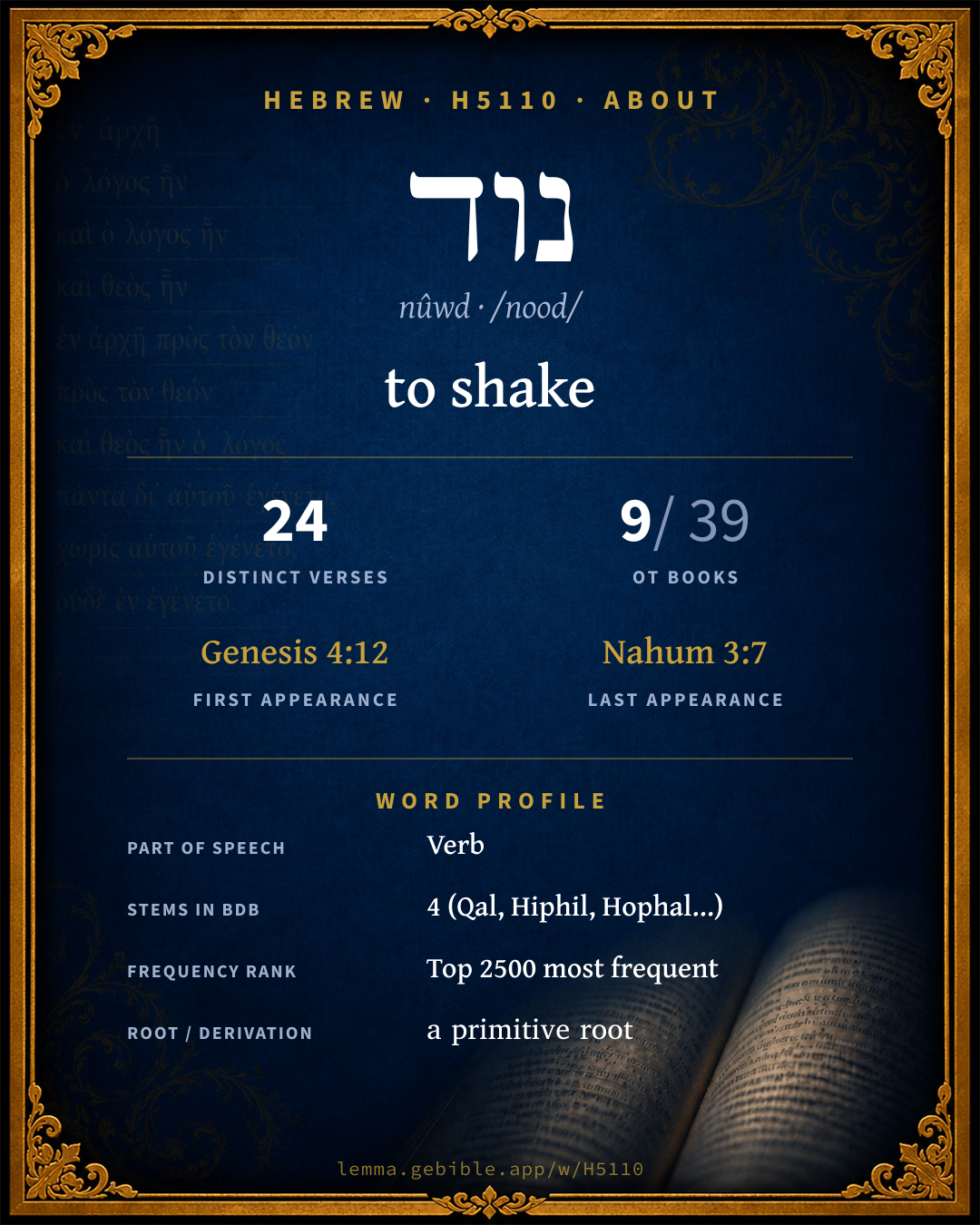
נוּד
to shake
also: waver, wander, flutter, show grief fuller range ↓
Full lexicon entry — Brown-Driver-Briggs (BDB)
From Brown-Driver-Briggs (BDB)
Where this word appears
See every Qal verb in the Hebrew Bible →
Grammar key — what these labels mean
Part of speech
- Verb
- An action or state-of-being word.
Stem
- Qal
- The basic, simple active stem — the plain form of the verb (“he wrote”). Here: ‘move to and fro’
- Hiphil
- The causative active stem (“he caused / brought about”). Here: ‘cause to wander aimlessly’
- Hithpolel
- The reflexive counterpart of the Polel. Here: ‘move oneself to and fro’
Form
- Imperfect
- An incomplete, ongoing, or future action (“he will / would write”).
- Imperative
- A direct command (“write!”).
- Infinitive Construct
- A bound verbal noun, frequently with prepositions (“to write / in writing”).
- Participle Active
- A verbal adjective expressing ongoing or characteristic action (“writing / one who writes”).
- Sequential Imperfect
- An imperfect with prefixed waw — the standard past-narrative form (waw-consecutive imperfect).
- Sequential Perfect
- A perfect with prefixed waw continuing a preceding imperfect or command (waw-consecutive perfect).
- Jussive
- A third- or second-person volitional form expressing wish or command (“let him write”).
- Perfect
- A completed action or state — Hebrew marks aspect (completeness) more than strict tense (“he wrote”).
State
- Absolute
- The independent form of a noun, not bound to a following word.
Person
- 3rd Person
- The one spoken about (“he / she / it / they”).
- 2nd Person
- The one addressed (“you”).
Gender
- Masculine
- Grammatically masculine.
- Feminine
- Grammatically feminine.
- Common
- Either gender — not distinguished for this form.
Number
- Singular
- One.
- Plural
- More than one (in Hebrew, generally three or more).
Grammatical forms 16 distinct
- Verb, Qal, Imperfect, 3rd Person, Masculine, Singular 4 times (16%)
- Verb, Qal, Imperative, 2nd Person, Masculine, Plural 4 times (16%)
- Verb, Qal, Infinitive Construct 3 times (12%)
- Verb, Qal, Participle Active, Masculine, Singular, Absolute 2 times (8%)
- Verb, Hiphil, Imperfect, 3rd Person, Masculine, Singular 1 time (4%)
- Verb, Qal, Sequential Imperfect, 3rd Person, Masculine, Plural 1 time (4%)
- Verb, Hithpolel, Sequential Perfect, 3rd Person, Feminine, Singular 1 time (4%)
- Verb, Hiphil, Infinitive Construct 1 time (4%)
+8 more forms (8 occurrences)
Parsed forms decoded from the imported morphology (morphhb / Westminster Leningrad Codex — WLC text public domain, morphhb tagging CC BY 4.0), counted across 25 parsed occurrences — not distinct verses.
Every verse where H5110 appears — 24 distinct verses across 9 books. Click any verse to open its interlinear word-by-word view. Verse text shown in the World English Bible for context — . Each verse’s Hebrew form is shown with its reference; the English is not keyword-highlighted, since the data carries no word-level English alignment. Use “Compare translations” on any verse to read it across multiple English versions. This concordance covers the Hebrew Bible; Septuagint (Greek Old Testament) occurrences are not indexed here.
Genesis 2 verses
- Genesis 4:12 וָ/נָ֖ד conj + Qal ptcp.act ms From now on, when you till the ground, it won't yield its strength to you. You shall be a fugitive and a wanderer in the earth."
- Genesis 4:14 וָ/נָד֙ conj + Qal ptcp.act ms Behold, you have driven me out this day from the surface of the ground. I will be hidden from your face, and I will be a fugitive and a wanderer in the earth. It will happen that whoever finds me will kill me."
1 Kings 1 verse
2 Kings 1 verse
Job 2 verses
- Job 2:11 לָ/נֽוּד prep + Qal inf.cs Now when Job's three friends heard of all this evil that had come on him, they each came from his own place: Eliphaz the Temanite, Bildad the Shuhite, and Zophar the Naamathite, and they made an appointment together to come to sympathize with him and to comfort him.
- Job 42:11 וַ/יָּנֻ֤דוּ conj + Qal wimpf 3mp Then came there to him all his brothers, and all his sisters, and all those who had been of his acquaintance before, and ate bread with him in his house. They comforted him, and consoled him concerning all the evil that Yahweh had brought on him. Everyone also gave him a piece of money, and everyone a ring of gold.
Psalms 3 verses
- Psalms 11:1 נודו נ֝֗וּדִי Qal impv 2mp Qal impv 2fs In Yahweh, I take refuge. How can you say to my soul, "Flee as a bird to your mountain!"
- Psalms 36:11 תְּנִדֵֽ/נִי Hiphil juss 3fs + sfx pers 1cs Don't let the foot of pride come against me. Don't let the hand of the wicked drive me away.
- Psalms 69:20 לָ/נ֣וּד prep + Qal inf.cs Reproach has broken my heart, and I am full of heaviness. I looked for some to take pity, but there was none; For comforters, but I found none.
Proverbs 1 verse
Isaiah 2 verses
- Isaiah 24:20 וְ/הִֽתְנוֹדְדָ֖ה conj + Hithpolel wpf 3fs The earth shall stagger like a drunken man, and shall sway back and forth like a hammock; and the disobedience of it shall be heavy on it, and it shall fall, and not rise again.
- Isaiah 51:19 יָנ֣וּד Qal impf 3ms These two things have happened to you. Who will bemoan you? Desolation and destruction, and the famine and the sword; how shall I comfort you?
Jeremiah 11 verses
- Jeremiah 4:1 תָנֽוּד Qal impf 2ms If you will return, Israel, says Yahweh, if you will return to me, and if you will put away your abominations out of my sight; then you shall not be removed;
- Jeremiah 15:5 יָנ֣וּד Qal impf 3ms For who will have pity on you, Jerusalem? or who will bemoan you? or who will turn aside to ask of your welfare?
- Jeremiah 16:5 תָּנֹ֖ד Qal juss 2ms For thus says Yahweh, Don't enter into the house of mourning, neither go to lament, neither bemoan them; for I have taken away my peace from this people, says Yahweh, even loving kindness and tender mercies.
- Jeremiah 18:16 וְ/יָנִ֥יד conj + Hiphil impf 3ms to make their land an astonishment, and a perpetual hissing; everyone who passes thereby shall be astonished, and shake his head.
- Jeremiah 22:10 תָּנֻ֖דוּ Qal juss 2mp Don't you weep for the dead, neither bemoan him; but weep sore for him who goes away; for he shall return no more, nor see his native country.
- Jeremiah 31:18 מִתְנוֹדֵ֔ד Hithpolel ptcp.act ms I have surely heard Ephraim bemoaning himself [thus], You have chastised me, and I was chastised, as a calf unaccustomed [to the yoke]: turn you me, and I shall be turned; for you are Yahweh my God.
- Jeremiah 48:17 נֻ֤דוּ Qal impv 2mp All you who are round about him, bemoan him, and all you who know his name; say, How is the strong staff broken, the beautiful rod!
- Jeremiah 48:27 תִּתְנוֹדָֽד Hithpolel impf 2ms For wasn't Israel a derision to you? was he found among thieves? for as often as you speak of him, you wag the head.
- Jeremiah 49:30 נֻּ֨דוּ Qal impv 2mp Flee you, wander far off, dwell in the depths, you inhabitants of Hazor, says Yahweh; for Nebuchadrezzar king of Babylon has taken counsel against you, and has conceived a purpose against you.
- Jeremiah 50:3 נָ֥דוּ Qal pf 3cp For out of the north there comes up a nation against her, which shall make her land desolate, and none shall dwell therein: they are fled, they are gone, both man and animal.
- Jeremiah 50:8 נֻ֚דוּ Qal impv 2mp Flee out of the midst of Babylon, and go forth out of the land of the Chaldeans, and be as the male goats before the flocks.
Nahum 1 verse
About this entry
At a glance — auto-summarized from this page’s data, not written by a person. Every figure links to its source below. This summary describes the numbers; it doesn’t interpret them.
At its core, נוד (nûwd) means “to shake.” The verb spans 4 stems, from Qal to Hiphil. With 24 verses in 9 books, it is an uncommon word in the Hebrew Bible. Its uses concentrate in Jeremiah (46% of all occurrences). First canonically at Genesis 4:12, it enters the text early. See the sense tree, 24-verse concordance, and the renderings breakdown below.
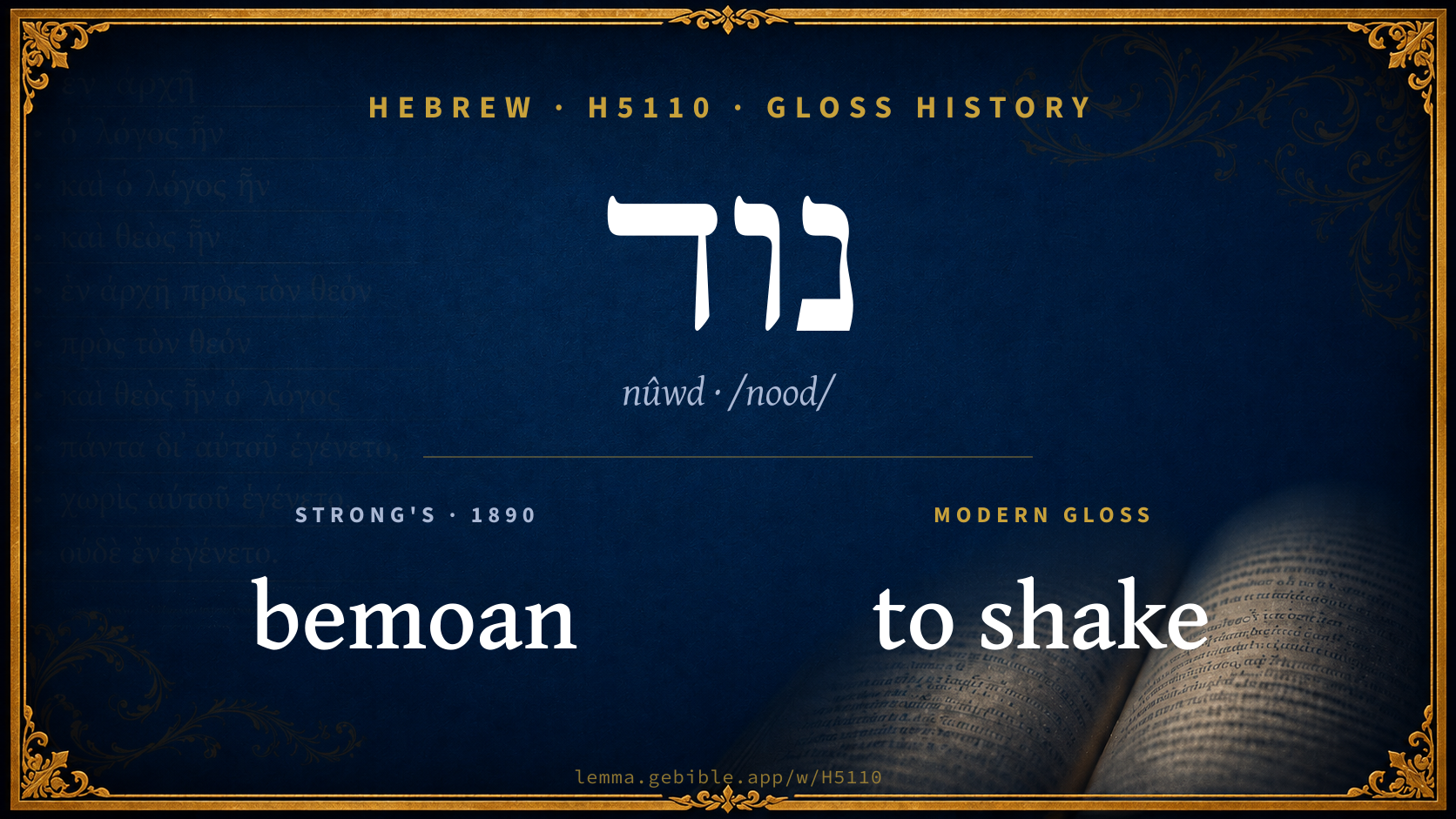
Gloss history
Strong's 1890 vs modern scholarship
About this word
Strong's H5110 catalogs a Hebrew word from the Hebrew Old Testament.
These counts are not copied from any lexicon or concordance. They are computed here, from the morphology-tagged Hebrew Old Testament. What Lemma adds →
- 24
- distinct verses
- The word appears in 24 distinct verses.
- 9 / 39
- OT books
- The word appears in 9 of 39 Old Testament books.
- #1,282
- by frequency
- Top 2500 most frequent Hebrew words (rank 1,282 of 8,640 Hebrew words by occurrence).
View all 24 occurrences in the concordance →
By section of the Old Testament
By traditional corpus
Conventional, traditional groupings — biblical authorship is debated, so this is a traditional corpus grouping, not an authorship claim. Each share is this word’s portion of its verses in that division of the Hebrew canon. Each figure is a share of the word’s 24 distinct verses.
- Prophets (Nevi'im) 16 verses · 67%
- Writings (Ketuvim) 6 verses · 25%
- Torah (Pentateuch) 2 verses · 8%
How translations render this word
Counts come from each version’s own published word-to-Strong’s tagging or interlinear alignment — an approximate guide to how each version renders this word, not a word-level alignment the data otherwise carries. Because each total is that version’s own tagged count, the per-version totals vary from one another and need not match the appearance or distinct-verse counts above. These counts may also differ from a printed concordance because Lemma counts each distinctly tagged rendering and does not collapse phrase taggings into a single head-word total. This is a fixed set of word-tagged versions (KJV, ASV, BSB, ULT) and does not change with the reading translation you choose elsewhere. Each version’s license is shown beside its name below (and on Sources).
- King James Version: Bemoan 3×, Remove 2×, Vagabond 2×
- American Standard Version: Bemoan 3×, Flee 2×, Him 2×
- Berean Standard Bible: Flee 2×, Wanderer 2×
- unfoldingWord Literal Text: Do 2×, Sways 2×, Wander 2×
King James Version Public Domain
Renders H5110 across 24 tagged occurrences — most commonly:
Plus 17 renderings that appear only once — usually multi-word phrases or single function words the recovered tagging swept in, not distinct renderings.
American Standard Version Public Domain
Renders H5110 across 24 tagged occurrences — most commonly:
Plus 15 renderings that appear only once — usually multi-word phrases or single function words the recovered tagging swept in, not distinct renderings.
Berean Standard Bible Public Domain
Renders H5110 across 24 tagged occurrences — most commonly:
Plus 20 renderings that appear only once — usually multi-word phrases or single function words the recovered tagging swept in, not distinct renderings.
unfoldingWord Literal Text CC BY-SA 4.0
Renders H5110 across 22 tagged occurrences — most commonly:
Plus 12 renderings that appear only once — usually multi-word phrases or single function words the recovered tagging swept in, not distinct renderings.
10 senses and sub-senses in the full BDB
Hebrew verbs can shift meaning by stem (binyan): Qal is the basic action, Niphal is often passive or reflexive, Piel often intensifies or makes it factitive, and Hiphil is typically causative. The senses below are grouped under the stem BDB assigns to each. This entry also uses Hophal (the passive of Hiphil) and one or more reduplicated stems (the Pōlēl/Pilpēl type), which for hollow or geminate roots behave much like Piel — often intensive or iterative.
What do BDB’s symbols mean?
BDB uses these scholarly abbreviations:
| Symbol | Meaning |
|---|---|
| 𝔊 | the Septuagint (the ancient Greek translation, LXX) |
| 𝔙 | the Vulgate (the Latin translation) |
| 𝔖 | the Syriac version (the Peshitta) |
| 𝔗 | the Targum (the Aramaic translation) |
| ψ | the Psalms |
| √ | root (the underlying root or stem) |
| ‖ | parallel passage (a synonymous or contrasted parallel) |
| † | the dagger: every passage where the word occurs is cited |
The 10 senses and sub-senses the full Brown-Driver-Briggs lexicon distinguishes for this word, in lexicon order (not ranked by frequency), with BDB’s own verbatim wording and sub-sense lettering. Shown in Hebrew script with BDB’s own scholarly abbreviations. The condensed entry is in the Lexicon Entry tab. See also the Forms in the corpus table below.
Qal
- 1.
- a. move to and fro, wander aimlessly, as fugitive
- b. flutter
- c. waver, wave, shake
- 2. shew grief (i.e. by shaking or nodding head)
Hiphil
- 1. cause to wander aimlessly, as fugitives
- 2. make a wagging, wag with the head
Hophal
- . and the worthless, like briers made to flutter (tossed away) are they
Hithpo‛lel
- 1. move oneself to and fro, sway, totter
- 2. shake oneself, in excitement
- 3. bemoan oneself
Senses from the full Brown-Driver-Briggs lexicon (Brown, Driver, Briggs; Oxford 1906 — public domain), digitized via Sefaria, supplemented by the OpenScriptures HebrewLexicon (CC BY 4.0). Full attribution on Sources.
Word origin
נוּד vb. move to and fro, wander, shudder, shew grief
— Brown-Driver-Briggs (Oxford 1906, public domain), digitized via Sefaria, supplemented by the OpenScriptures HebrewLexicon (CC BY 4.0). See Sources.
Origin: a primitive root
Jastrow Dictionary
A second Hebrew/Aramaic lexicon for comparison, covering Aramaic and post-biblical (Talmudic, Targumic, Midrashic) usage that the biblical-Hebrew BDB does not. Matched by lemma rather than by Strong’s number, so a lemma may carry more than one Jastrow headword (shown separately below), and the entries cover usage well beyond the Bible.
נוּד
- to move, be unsteady; to escape. Sabb. 63ᵇ נָד; v. וָלָד.
- to be removed. Part. מוּנָד. Yalk. Esth. 1059 (adapted from II Sam. XXIII, 6) נטלו קוץ מ׳ משם they took a chip (of a pillar) removed from there (the palace). e.g. 2 Samuel 23:6
נוּד ²
- 1. to move, be unsteady. Targ. Is. XXIV, 19; a. e.—Part. נָאֵיד, נָיֵיד; f. נָיְידָא; pl. נַיְידִין, נַיְידֵי; נַיְידָן. Targ. I Kings XIV, 15. Targ. I Sam. I, 13.—Erub. 46ᵃ מיא … מֵינַד ניידי the waters in the cloud are constantly in motion. Keth. 15ᵃ הני ניידי these (the caravans) are unsteady, opp. קביעי stationary (v. דדי ch.). Zeb. 73ᵇ דניידי, v. infra.—Ber. 59ᵇ והאי דניידי עינייהו and the reason why their eyes are unsteady. Kidd. 72ᵃ כי הוה … היינו דובא ניידא when he saw a Persian on horseback, he said, this is a restless bear. B. Bath. 25ᵇ הוה ניידא אפדניה his cottage shook; a. e.
- 2. (with ל־) to shake the head, sympathize. Targ. Job II, 11. Ib. XLII, 11 ונַיְדוּ.
- 1. to scare. Targ. O. Lev. XXVI, 6 מָנֵיד (Y. מָנֵיט); a. fr.
- 2. to shake, (with רישא or ברישא) to shake the head; to nod. Targ. Zeph. II, 15. Targ. II Esth. I, 2. Targ. II Kings XIX, 21; a. e.—Snh. 95ᵃ ומניד ברישיה and shook his head (in derision).
- to be chased, scattered. Zeb. 73ᵇ ניכבשינהו דנִינַּיְידוּ Rashi (Ms. M. דניניידן, ed. דניידי; corr. acc.) let us force them to scatter.
נוֹד
- c. (b. h., v. Ges. Thes. s. v. נָאַד) leather bottle, skin. Ges. R. s. 53 (ref. to Ps. LVI, 9) כאותה בעלת נ׳ as (thou didst to) that woman carrying the water bottle (Hagar); Yalk. Ps. 774 נֹאד; Yalk. Gen. 94. Ḥull. 14ᵇ, v. בָּקַע. Lev. R. s. 6 משביעין האדם … אתמול היה הנ׳ הזה וכ׳ they administer an oath to a person by the book of the Law and bring before him blown-up (empty) hides, to intimate, yesterday this hide was filled with sinews and bones and now it is empty, so will he who wantonly causes his neighbor to swear become empty &c. Mekh. B’shall., Shir., s. 6 (ref. to ונֵד Ex. XV, 8) מה נֹד צרור וכ׳ as a tied-up skin stands and neither lets (air) escape nor receives any &c.; Yalk. Ex. 248 נוֹד; a. e.—Pl. נוֹדוֹת. Lev. R. l. c. נ׳ נפיחים, v. supra. Y. Taan. IV, 69ᵇ top נ׳ נפוחות; Lam. R. to II, 2 נ׳ מנופחות blown-up bottles (having the appearance of being filled with water). Ab. Zar. II, 4; a. e. e.g. Psalms 56:9
A Dictionary of the Targumim, the Talmud Babli and Yerushalmi, and the Midrashic Literature (Marcus Jastrow; London, Luzac, 1903) — Public Domain. Digitized via Sefaria. Digitized via Sefaria. Full attribution on Sources.
Forms in the corpus
The 22 distinct written forms H5110 takes in the Hebrew Bible, most frequent first — each parse links to that stem’s occurrences in the concordance. Hebrew forms include their vowel points and cantillation, so a single lemma takes many written forms.
Same root — word family
Other BDB entries built from the same root as H5110, grouped by Strong’s listed origin. These share a root / origin per the lexicon — not necessarily a shared meaning. Each links to that word’s own entry.
Derived from this word
Compare all same-root words → Showing 4 of 5 — not the complete family. They share a root, not necessarily a meaning.
Septuagint verse parallels
This word appears in 20 verses that also exist in the Greek Old Testament (Septuagint), out of the 24 Hebrew verses it occurs in. You can read those verses in Greek by switching the Old Testament edition to the Septuagint.
Read these verses in the Septuagint
This is a verse-level parallel only — the same verses exist in both the Hebrew and Greek Old Testaments. No word-level Hebrew↔Greek correspondence is claimed: the data carries no such alignment, so no Greek word is shown as this Hebrew word’s translation. Coverage is not total — the Septuagint omits the deuterocanon and renumbers the Psalms, so some Hebrew verses have no direct Greek parallel.