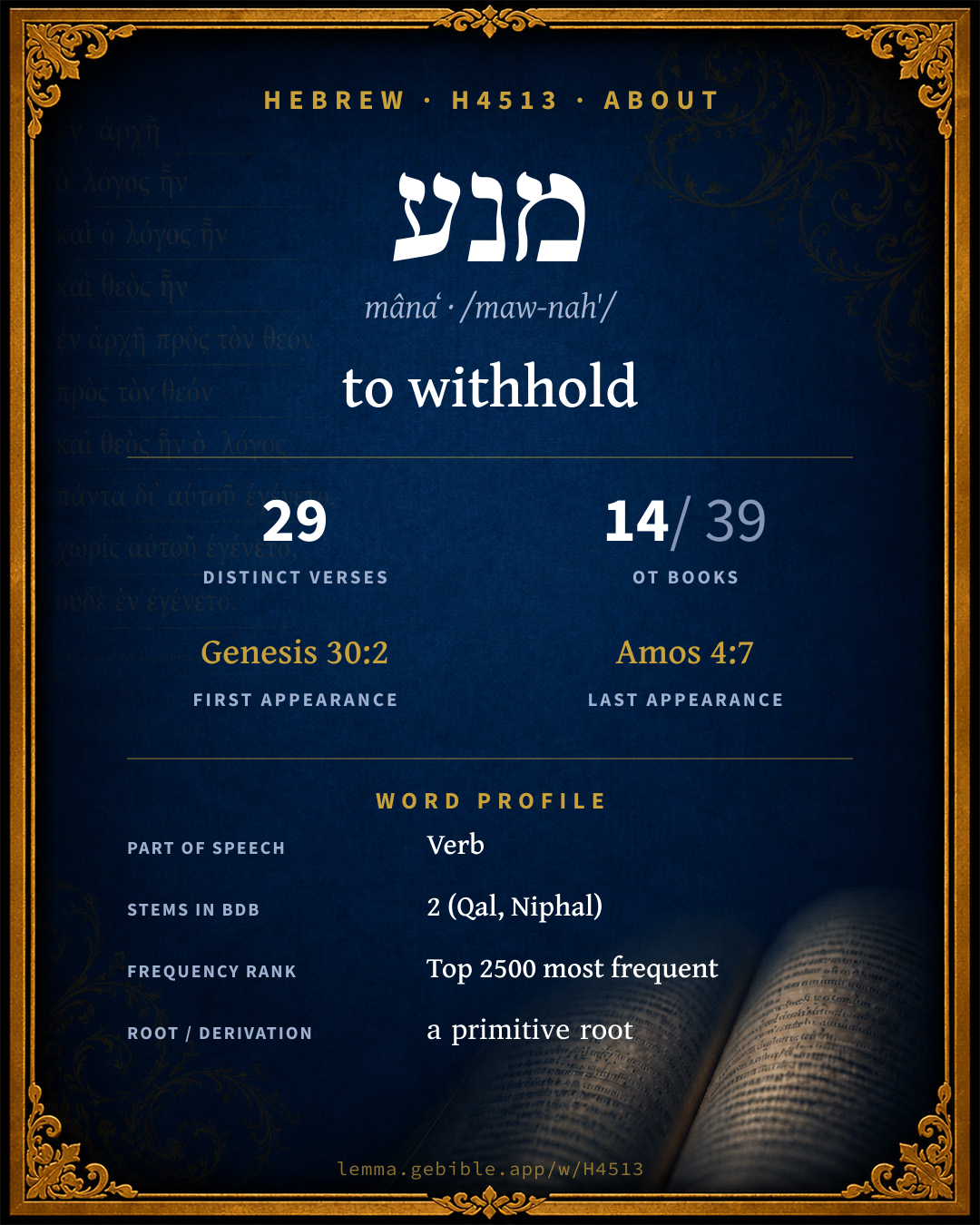
מָנַע
to withhold
also: hold back, keep back, refrain, deny fuller range ↓
Full lexicon entry — Brown-Driver-Briggs (BDB)
From Brown-Driver-Briggs (BDB)
Where this word appears
See every Qal verb in the Hebrew Bible →
Grammar key — what these labels mean
Part of speech
- Verb
- An action or state-of-being word.
Stem
- Qal
- The basic, simple active stem — the plain form of the verb (“he wrote”).
- Niphal
- Usually the simple passive or reflexive of the Qal (“he was written”).
Form
- Jussive
- A third- or second-person volitional form expressing wish or command (“let him write”).
- Perfect
- A completed action or state — Hebrew marks aspect (completeness) more than strict tense (“he wrote”).
- Imperfect
- An incomplete, ongoing, or future action (“he will / would write”).
- Participle Active
- A verbal adjective expressing ongoing or characteristic action (“writing / one who writes”).
- Imperative
- A direct command (“write!”).
- Sequential Imperfect
- An imperfect with prefixed waw — the standard past-narrative form (waw-consecutive imperfect).
State
- Absolute
- The independent form of a noun, not bound to a following word.
Person
- 2nd Person
- The one addressed (“you”).
- 1st Person
- The speaker (“I / we”).
- 3rd Person
- The one spoken about (“he / she / it / they”).
Gender
- Masculine
- Grammatically masculine.
- Common
- Either gender — not distinguished for this form.
- Feminine
- Grammatically feminine.
Number
- Singular
- One.
- Plural
- More than one (in Hebrew, generally three or more).
Grammatical forms 16 distinct
- Verb, Qal, Perfect, 3rd Person, Masculine, Singular 4 times (14%)
- Verb, Qal, Jussive, 2nd Person, Masculine, Singular 3 times (10%)
- Verb, Qal, Perfect, 1st Person, Common, Singular 3 times (10%)
- Verb, Qal, Imperfect, 3rd Person, Masculine, Singular 3 times (10%)
- Verb, Qal, Imperfect, 1st Person, Common, Singular 2 times (7%)
- Verb, Qal, Perfect, 2nd Person, Masculine, Singular 2 times (7%)
- Verb, Qal, Participle Active, Masculine, Singular, Absolute 2 times (7%)
- Verb, Qal, Imperative, 2nd Person, Feminine, Singular 2 times (7%)
+8 more forms (8 occurrences)
Parsed forms decoded from the imported morphology (morphhb / Westminster Leningrad Codex — WLC text public domain, morphhb tagging CC BY 4.0), counted across 29 parsed occurrences — not distinct verses.
Every verse where H4513 appears — 29 distinct verses across 14 books. Click any verse to open its interlinear word-by-word view. Verse text shown in the World English Bible for context — . Each verse’s Hebrew form is shown with its reference; the English is not keyword-highlighted, since the data carries no word-level English alignment. Use “Compare translations” on any verse to read it across multiple English versions. This concordance covers the Hebrew Bible; Septuagint (Greek Old Testament) occurrences are not indexed here.
Genesis 1 verse
Numbers 2 verses
- Numbers 22:16 תִמָּנַ֖ע Niphal juss 2ms They came to Balaam, and said to him, Thus says Balak the son of Zippor, Please let nothing hinder you from coming to me:
- Numbers 24:11 מְנָעֲ/ךָ֥ Qal pf 3ms + sfx pers 2ms Therefore now flee you to your place: I thought to promote you to great honor; but, behold, Yahweh has kept you back from honor.
1 Samuel 2 verses
- 1 Samuel 25:26 מְנָעֲ/ךָ֤ Qal pf 3ms + sfx pers 2ms Now therefore, my lord, as Yahweh lives, and as your soul lives, seeing Yahweh has withheld you from blood guiltiness, and from avenging yourself with your own hand, now therefore let your enemies, and those who seek evil to my lord, be as Nabal.
- 1 Samuel 25:34 מְנָעַ֔/נִי Qal pf 3ms + sfx pers 1cs For in very deed, as Yahweh, the God of Israel, lives, who has withheld me from hurting you, except you had hurried and come to meet me, surely there wouldn't have been left to Nabal by the morning light so much as one man-child.
2 Samuel 1 verse
1 Kings 1 verse
Nehemiah 1 verse
Job 4 verses
- Job 20:13 וְ֝/יִמְנָעֶ֗/נָּה conj + Qal impf 3ms + sfx pers 3fs Though he spare it, and will not let it go, But keep it still within his mouth;
- Job 22:7 תִּֽמְנַֽע Qal impf 2ms You haven't given water to the weary to drink, And you have withheld bread from the hungry.
- Job 31:16 אֶ֭מְנַע Qal impf 1cs "If I have withheld the poor from their desire, Or have caused the eyes of the widow to fail,
- Job 38:15 וְ/יִמָּנַ֣ע conj + Niphal impf 3ms From the wicked, their light is withheld, The high arm is broken.
Psalms 2 verses
Proverbs 5 verses
- Proverbs 1:15 מְנַ֥ע Qal impv 2ms My son, don't walk in the way with them. Keep your foot from their path,
- Proverbs 3:27 תִּמְנַע Qal juss 2ms Don't withhold good from those to whom it is due, When it is in the power of your hand to do it.
- Proverbs 11:26 מֹ֣נֵֽעַ Qal ptcp.act ms People curse someone who withholds grain, But blessing will be on the head of him who sells it.
- Proverbs 23:13 תִּמְנַ֣ע Qal juss 2ms Don't withhold correction from a child. If you punish him with the rod, he will not die.
- Proverbs 30:7 תִּמְנַ֥ע Qal juss 2ms "Two things I have asked of you; Don't deny me before I die:
Ecclesiastes 1 verse
Jeremiah 6 verses
- Jeremiah 2:25 מִנְעִ֤י Qal impv 2fs Withhold your foot from being unshod, and your throat from thirst: but you said, It is in vain; no, for I have loved strangers, and after them will I go.
- Jeremiah 3:3 וַ/יִּמָּנְע֣וּ conj + Niphal wimpf 3mp Therefore the showers have been withheld, and there has been no latter rain; yet you have a prostitute's forehead, you refused to be ashamed.
- Jeremiah 5:25 מָנְע֥וּ Qal pf 3cp Your iniquities have turned away these things, and your sins have withheld good from you.
- Jeremiah 31:16 מִנְעִ֤י Qal impv 2fs Thus says Yahweh: Refrain your voice from weeping, and your eyes from tears; for your work shall be rewarded, says Yahweh; and they shall come again from the land of the enemy.
- Jeremiah 42:4 אֶמְנַ֥ע Qal impf 1cs Then Jeremiah the prophet said to them, I have heard you; behold, I will pray to Yahweh your God according to your words; and it shall happen that whatever thing Yahweh shall answer you, I will declare it to you; I will keep nothing back from you.
- Jeremiah 48:10 מֹנֵ֥עַ Qal ptcp.act ms Cursed be he who does the work of Yahweh negligently; and cursed be he who keeps back his sword from blood.
Ezekiel 1 verse
Joel 1 verse
Amos 1 verse
About this entry
At a glance — auto-summarized from this page’s data, not written by a person. Every figure links to its source below. This summary describes the numbers; it doesn’t interpret them.
The Hebrew verb מנע centers on the idea of “to withhold.” Debuting at Genesis 30:2, it then recurs through the corpus. Spanning 29 verses in 14 books, it ranks among the moderately common words of the Hebrew Bible. Read the stem: it spans 2 stems, including Qal and Niphal. Sharing its root, it stands alongside ימנע and תמנע. Dig into 29-verse concordance and the renderings breakdown below.
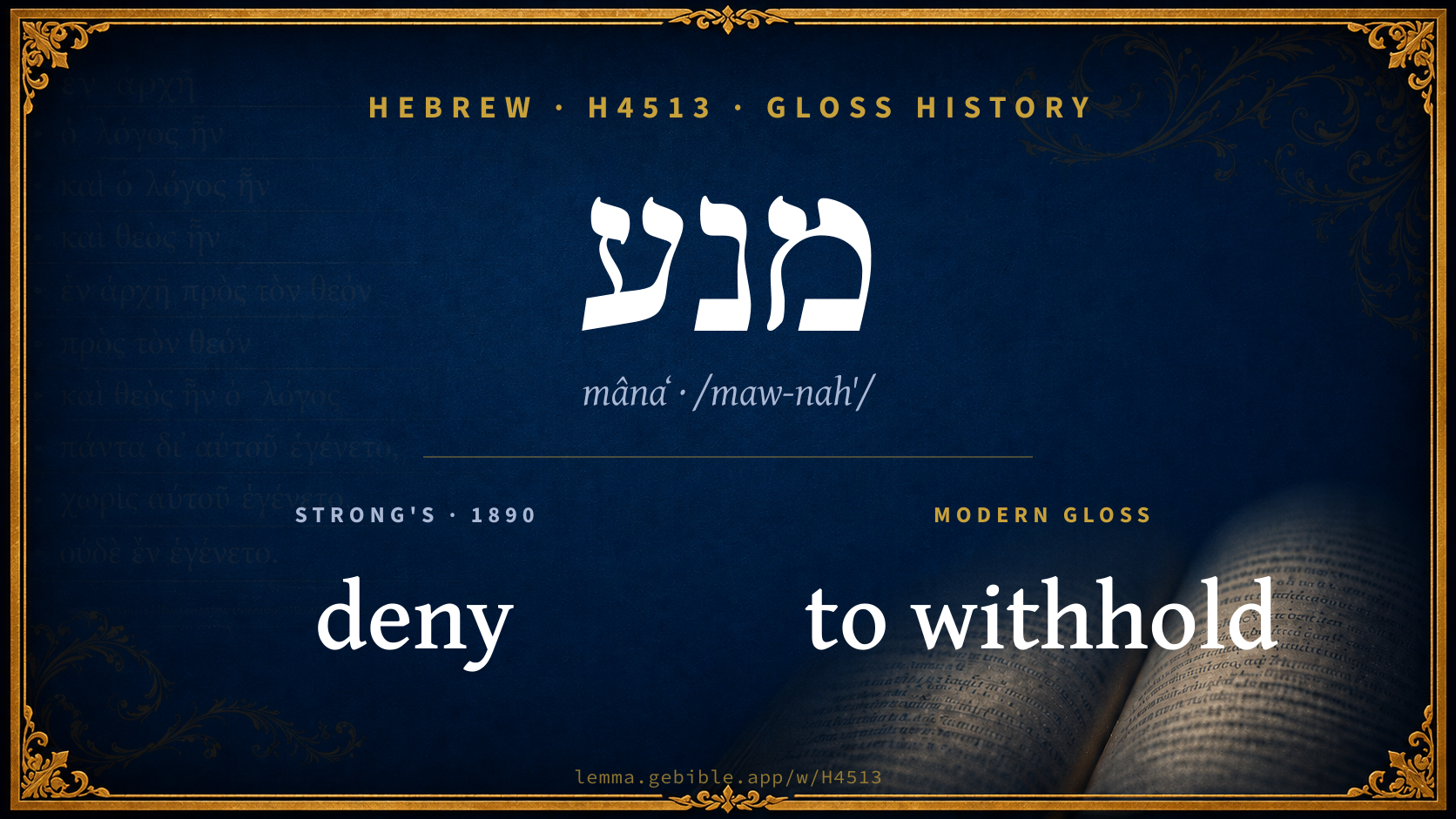
Gloss history
Strong's 1890 vs modern scholarship
About this word
Strong's H4513 catalogs a Hebrew word from the Hebrew Old Testament.
These counts are not copied from any lexicon or concordance. They are computed here, from the morphology-tagged Hebrew Old Testament. What Lemma adds →
- 29
- distinct verses
- The word appears in 29 distinct verses.
- 14 / 39
- OT books
- The word appears in 14 of 39 Old Testament books.
- #1,160
- by frequency
- Top 2500 most frequent Hebrew words (rank 1,160 of 8,640 Hebrew words by occurrence).
View all 29 occurrences in the concordance →
By section of the Old Testament
By traditional corpus
Conventional, traditional groupings — biblical authorship is debated, so this is a traditional corpus grouping, not an authorship claim. Each share is this word’s portion of its verses in that division of the Hebrew canon. Each figure is a share of the word’s 29 distinct verses.
- Prophets (Nevi'im) 13 verses · 45%
- Writings (Ketuvim) 13 verses · 45%
- Torah (Pentateuch) 3 verses · 10%
How translations render this word
Counts come from each version’s own published word-to-Strong’s tagging or interlinear alignment — an approximate guide to how each version renders this word, not a word-level alignment the data otherwise carries. Because each total is that version’s own tagged count, the per-version totals vary from one another and need not match the appearance or distinct-verse counts above. These counts may also differ from a printed concordance because Lemma counts each distinctly tagged rendering and does not collapse phrase taggings into a single head-word total. This is a fixed set of word-tagged versions (KJV, ASV, BSB, ULT) and does not change with the reading translation you choose elsewhere. Each version’s license is shown beside its name below (and on Sources).
- King James Version: Withhold 3×, Is withholden 2×, Refrain 2×
- American Standard Version: Them 3×, Withhold 3×, Hath withholden 2×
- Berean Standard Bible: Withhold 4×, Withheld 3×
- unfoldingWord Literal Text: Withhold 6×, Do 3×, Restrain 3×
King James Version Public Domain
Renders H4513 across 30 tagged occurrences — most commonly:
Plus 23 renderings that appear only once — usually multi-word phrases or single function words the recovered tagging swept in, not distinct renderings.
American Standard Version Public Domain
Renders H4513 across 30 tagged occurrences — most commonly:
Plus 22 renderings that appear only once — usually multi-word phrases or single function words the recovered tagging swept in, not distinct renderings.
Berean Standard Bible Public Domain
Renders H4513 across 29 tagged occurrences — most commonly:
Plus 22 renderings that appear only once — usually multi-word phrases or single function words the recovered tagging swept in, not distinct renderings.
unfoldingWord Literal Text CC BY-SA 4.0
Renders H4513 across 37 tagged occurrences — most commonly:
Plus 19 renderings that appear only once — usually multi-word phrases or single function words the recovered tagging swept in, not distinct renderings.
Senses in the full BDB
Hebrew verbs can shift meaning by stem (binyan): Qal is the basic action, Niphal is often passive or reflexive, Piel often intensifies or makes it factitive, and Hiphil is typically causative. The senses below are grouped under the stem BDB assigns to each.
What do BDB’s symbols mean?
BDB uses these scholarly abbreviations:
| Symbol | Meaning |
|---|---|
| 𝔊 | the Septuagint (the ancient Greek translation, LXX) |
| 𝔙 | the Vulgate (the Latin translation) |
| 𝔖 | the Syriac version (the Peshitta) |
| 𝔗 | the Targum (the Aramaic translation) |
| ψ | the Psalms |
| √ | root (the underlying root or stem) |
| ‖ | parallel passage (a synonymous or contrasted parallel) |
| † | the dagger: every passage where the word occurs is cited |
The 2 senses and sub-senses the full Brown-Driver-Briggs lexicon distinguishes for this word, in lexicon order (not ranked by frequency), with BDB’s own verbatim wording and sub-sense lettering. Shown in Hebrew script with BDB’s own scholarly abbreviations. The condensed entry is in the Lexicon Entry tab. See also the Forms in the corpus table below.
Qal
- Pf. מ׳ Gn 30:2; sf. מְנָעַ֫נִי 1 S 25:34; מָנַ֫עְתָּ ψ 21:3 Ne 9:20, etc.; Impf. יִמְנַע־ ψ 84:12; sf. יִמְנָעֵ֫נִי 2 S 13:13 etc.; Imv. מְנַע Pr 1:15; מִנְעִי Je 2:25; 31:16; Pt. מֹנֵעַ Pr 11:26 Je 48:10;—withhold, sq. מִן Gn 30:2 (obj. פְּרִי־בֶטֶן), Am 4:7 (rain), Ne 9:20 (manna; all subj. י׳); Jb 22:7 (bread), 1 K 20:7 (obj. om.; both hum. subj.), so Je 48:10 (sword), Ec 2:10 (heart), Je 5:25 (good), Pr 3:27 (id.), 1:15 (foot); Je 2:25 (id.) 31:16 (voice); further, 2 S 13:13 (woman), Je 42:4 (דָּבָר), Jb 31:16 (מן part.), Pr 23:13 (correction), obj. om. י׳ subj. Pr 30:7; מִן om. Pr 11:26 (obj. corn); cf. ψ 21:3 subj. י׳ (obj. אֲרֶשֶׁת שְׂפָתָיו ‖ נָתַן תַּאֲוַת לֵב), Jb 20:13 fig. (wickedness), Ez 31:15 י׳ subj. (obj. rivers); obj. pers. י׳ subj. sq. מן Nu 24:11; sq. מִן + inf. 1 S 25:26, 34; sq. לְ, subj. י׳ ψ 84:12 (good). e.g. Genesis 30:2
Niphal
- Pf. נִמְנַע Jo 1:13; Impf. יִמָּנַע Jb 38:15, etc.; be withholden sq. מִן, subj. מִנְחָה etc. Jo 1:13; light from wicked Jb 38:15; Nu 22:16 (sq. מִן + inf.); subj. showers (רְבִבִים) Je 3:3. e.g. Joel 1:13
Senses from the full Brown-Driver-Briggs lexicon (Brown, Driver, Briggs; Oxford 1906 — public domain), digitized via Sefaria, supplemented by the OpenScriptures HebrewLexicon (CC BY 4.0). Full attribution on Sources.
Word origin
vb. withhold, hold back (NH id.; Zinj. מנע DHMSendsch. 60; Arabic مَنَعَ; Sab. מנע Levy-OsZMG xix. 1865, 268; Aramaic מְנַע);—
— Brown-Driver-Briggs (Oxford 1906, public domain), digitized via Sefaria, supplemented by the OpenScriptures HebrewLexicon (CC BY 4.0). See Sources.
Origin: a primitive root
Jastrow Dictionary
A second Hebrew/Aramaic lexicon for comparison, covering Aramaic and post-biblical (Talmudic, Targumic, Midrashic) usage that the biblical-Hebrew BDB does not. Matched by lemma rather than by Strong’s number, so a lemma may carry more than one Jastrow headword (shown separately below), and the entries cover usage well beyond the Bible.
מָנַע
- (b. h.) [to cut off,] to withhold, refuse, refrain. Pes. 113ᵇ המוֹנֵעַ מנעלים מרגליו he who denies shoes to his feet. Keth. 96ᵃ המונע תלמידו מלשמשו כאילו מונע וכ׳ he who denies to his pupil the privilege of attendance, is considered as if denying kindness to him. Ber. 10ᵃ, sq. אל יִמְנַע עצמו מן הרחמים must not cut himself off from (despair of) divine mercy. Gen. R. s. 76, end (ref. to Job VI, 14) מָנַעְתָּ מרעך וכ׳ thou (Jacob) didst refuse kindness to thy friend (Job); a. fr. e.g. Job 6:14
- 1. to restrain one’s self; to shrink. Eduy. IV, 8; Yeb. I, 4 לא נִמְנְעוּ (מ)לישא וכ׳ they did not refrain from intermarriage. Ib. לא נ׳ (להיות) עושין טהרות וכ׳ they did not shrink from relying on one another in the observances of levitical pureness; Tosef. ib. I, 10. Ib. 12 מן הספק לא היו נִמְנָעִין (אבל) נמנעין וכ׳ they did not shrink (from interchange) where the case was doubtful &c.; Yeb. 14ᵇ. Gitt. 36ᵃ נמנעו מלהלוות וכ׳ they hesitated to lend money to one another; a. fr.
- 2. to be withheld. Num. R. s. 15 נִמְנְעָה השמחה וכ׳ (some ed. נִמְנַעַת) joy was withheld from the wicked and given to &c.
- to keep apart. Y. Taan. I, 64ᵇ top שאת מַמְנִיעָן זו מזו for thou keepest them (the rain-drops) from commingling (v. דָּפוּס); Y. Ber. IX, 14ᵃ top ממנימען (corr. acc.).
מְנַע
- , to diminish; to withhold. Targ. Gen. XXII, 16. Ib. XXX, 2. Targ. O. Deut. XIII, 1 (h. text גרע); a. fr.
- 1. to be diminished; to cease, omit. Targ. Ex. V, 11 (O. ed. Vien. יִתִּמְנַע; h. text גרע). Ib. IX, 29 (h. text חדל). Targ. Deut. XXIII, 23 (O. ed. Vien. תִתִּמְנַע). Targ. Jud. XV, 7; a. fr.
- 2. to restrain one’s self; to refuse, shrink. Targ. Ex. XXIII, 2; a. e.—Gitt. 52ᵇ אתי לאִימְּנוּעֵי he might shrink (from becoming a guardian). Y. Sabb. VII, 9ᵇ bot. לא מִתְמַנְעִין, v. ה"א; a. e.
A Dictionary of the Targumim, the Talmud Babli and Yerushalmi, and the Midrashic Literature (Marcus Jastrow; London, Luzac, 1903) — Public Domain. Digitized via Sefaria. Digitized via Sefaria. Full attribution on Sources.
Forms in the corpus
The 27 distinct written forms H4513 takes in the Hebrew Bible, most frequent first — each parse links to that stem’s occurrences in the concordance. Hebrew forms include their vowel points and cantillation, so a single lemma takes many written forms.
Same root — word family
Other BDB entries built from the same root as H4513, grouped by Strong’s listed origin. These share a root / origin per the lexicon — not necessarily a shared meaning. Each links to that word’s own entry.
Proper names from this root
People and places named from this root — a name, not an additional meaning of the word.
Compare all same-root words → 2 of the same-root words are proper names (people or places). They share a root, not necessarily a meaning.
Septuagint verse parallels
This word appears in 28 verses that also exist in the Greek Old Testament (Septuagint), out of the 29 Hebrew verses it occurs in. You can read those verses in Greek by switching the Old Testament edition to the Septuagint.
Read these verses in the Septuagint
- Genesis 30:2
- Numbers 22:16
- 1 Samuel 25:26
- 2 Samuel 13:13
- 1 Kings 20:7
- Job 20:13
- Psalms 21:2
- Proverbs 1:15
- Ecclesiastes 2:10
- Jeremiah 2:25
- Ezekiel 31:15
- Joel 1:13
This is a verse-level parallel only — the same verses exist in both the Hebrew and Greek Old Testaments. No word-level Hebrew↔Greek correspondence is claimed: the data carries no such alignment, so no Greek word is shown as this Hebrew word’s translation. Coverage is not total — the Septuagint omits the deuterocanon and renumbers the Psalms, so some Hebrew verses have no direct Greek parallel.