
Psalms 106:20

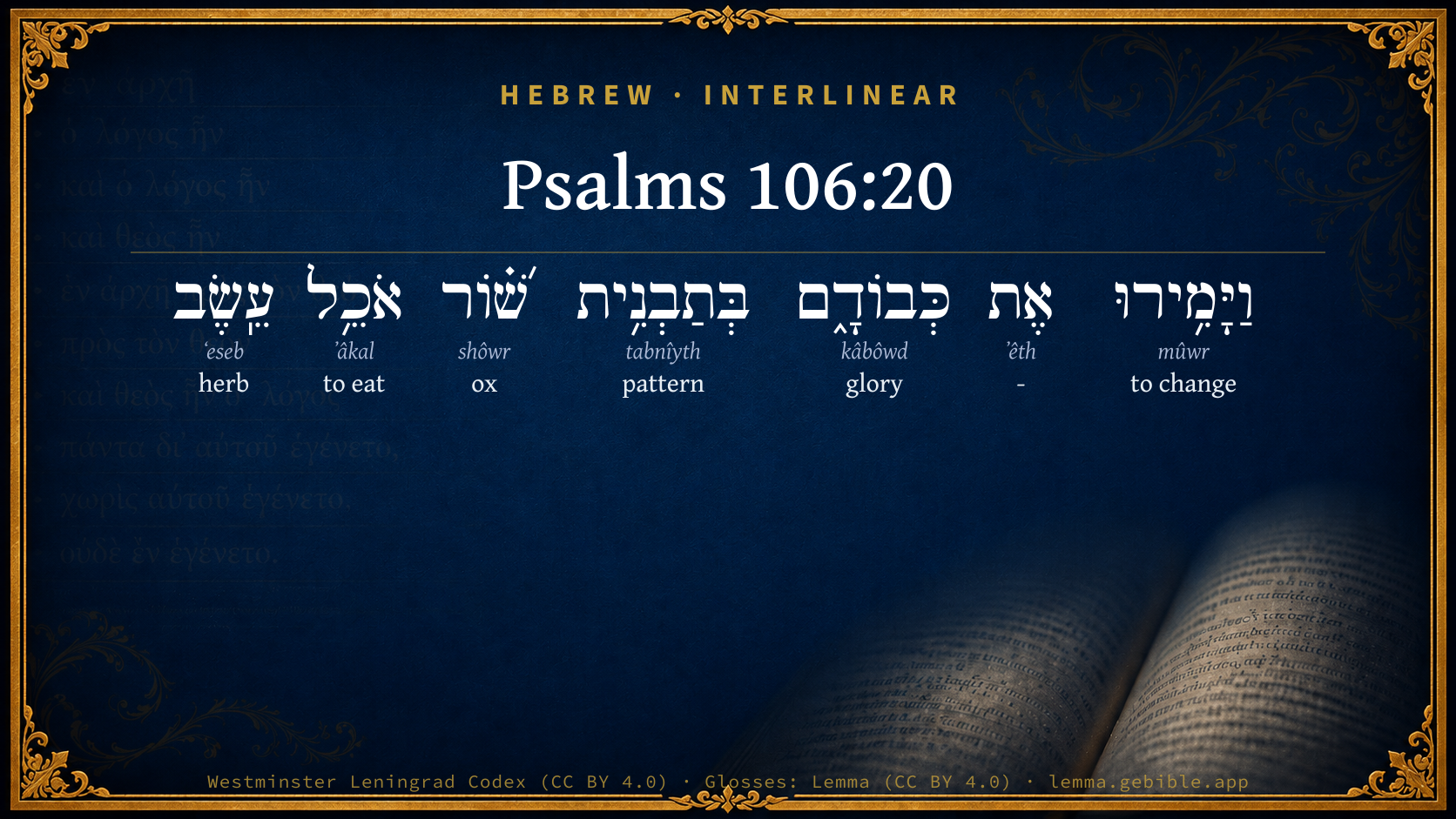
Hebrew (Westminster Leningrad Codex) Psalms 106:20 appears in the Hebrew Old Testament. The text above is from the Westminster Leningrad Codex. Each word links to its Strong’s number, a concise gloss, and parsing drawn from the Open Scriptures Hebrew Bible morphology. Click any word for its full Brown-Driver-Briggs (BDB) entry.
Download image
Cite this verse

Psalms 106:20 (World English Bible). Public Domain. Lemma interlinear Bible study tool, https://lemma.gebible.app/v/psalms/106/20.

Show BibTeX & RIS
BibTeX
RIS
English Translation
Thus they exchanged their glory For an image of a bull that eats grass.
World English Bible · Public Domain
Download a study sheet

One document with this verse’s original text, its word-by-word gloss line, the meaning frame, cross-references with their text, attributed commentary, and full source and license credits — printable, and it pastes into notes with its structure intact.

This verse Autodidact and up

Study sheet (.html) Plain text (.txt)

A passage Seminary Student

Up to 50 verses in one chapter. A passage sheet keeps up to 6 commentary sources and 12 cross-references per verse, in the order this page ranks them, and says so on the sheet whenever that leaves anything out. Ask for a single verse and you get the Autodidact verse sheet above.

Everything on this page stays free to read, with no account — the sheet is a download of what is already on screen, not access to it.

Want to remove ads? Support Godless Engineer
Compare translations 3

The same verse in 3 English versions, stacked beneath the original-language interlinear above. Click any original word for its lexicon entry.

Each is an independent rendering of the whole verse — the interlinear is not word-aligned to these translations.

Highlighted words mark where these versions differ — a whole-verse word diff, not a word-by-word alignment.

  • World English Bible Public Domain
    Thus they exchanged their glory For an image of a bull that eats grass.
  • King James Version Public Domain
    Thus they changed their glory into the similitude of an ox that eateth grass.
  • unfoldingWord Literal Text CC BY-SA 4.0
    Thus they traded their Glory for the likeness of a bull eating grass.

unfoldingWord Literal Text — © unfoldingWord, licensed CC BY-SA 4.0. Word-aligned USFM3 via Door43 (git.door43.org/unfoldingWord/en_ult).

Versions to compare (up to 4)

3 of 4 selected

Show all 18 translations

Every available English version of this verse, each an independent rendering of the whole verse.

  • World English Bible Public Domain
    Thus they exchanged their glory For an image of a bull that eats grass.
  • Berean Standard Bible Public Domain
    They exchanged their Glory for the image of a grass-eating ox.
  • Majority Standard Bible Public Domain
    They exchanged their Glory for the image of a grass-eating ox.
  • King James Version Public Domain
    Thus they changed their glory into the similitude of an ox that eateth grass.
  • American Standard Version (1901) Public Domain
    Thus they changed their glory For the likeness of an ox that eateth grass.
  • Revised Version (1885) Public Domain
    Thus they changed their glory for the likeness of an ox that eateth grass.
  • Geneva Bible (1599) Public Domain
    Thus they turned their glory into the similitude of a bullocke, that eateth grasse.
  • Douay-Rheims (1899) Public Domain
    And they changed their glory into the likeness of a calf that eateth grass.
  • Young's Literal Translation Public Domain
    And change their Honour Into the form of an ox eating herbs.
  • Literal Standard Version CC BY-SA 4.0
    And change their glory || Into the form of an ox eating herbs.
  • Unlocked Literal Bible CC BY-SA 4.0
    They traded the glory of God for the image of a bull that eats grass.
  • unfoldingWord Literal Text CC BY-SA 4.0
    Thus they traded their Glory for the likeness of a bull eating grass.
  • Darby Bible Public Domain
    And they changed their glory into the similitude of an ox that eateth grass.
  • World Messianic Bible Public Domain
    Thus they exchanged their glory for an image of a bull that eats grass.
  • Webster's Bible Public Domain
    Thus they changed their glory into the similitude of an ox that eateth grass.
  • Free Bible Version CC BY-SA 4.0
    They replaced their God of glory with a bull that eats grass!
  • Bible in Basic English Public Domain
    And their glory was changed into the image of an ox, whose food is grass.
  • JPS Tanakh (1917) Public Domain
    Thus they exchanged their glory for the likeness of an ox that eateth grass.

Literal Standard Version (2020), Covenant Press — licensed CC BY-SA 4.0. Text via the HelloAO Bible API (eBible.org). Unlocked Literal Bible (unfoldingWord) — licensed CC BY-SA 4.0. Text via the HelloAO Bible API (eBible.org). unfoldingWord Literal Text — © unfoldingWord, licensed CC BY-SA 4.0. Word-aligned USFM3 via Door43 (git.door43.org/unfoldingWord/en_ult). Free Bible Version, Dr. Jonathan Gallagher — licensed CC BY-SA 4.0. Text via the HelloAO Bible API (eBible.org).

Word by word

More ways to search: Search by grammar → Find every occurrence → Compare this word →

Practice this passage: Drill this verse → Learn its vocabulary →

About this verse

These counts appear in no published source. They are computed here, from the morphology-tagged text and Lemma’s own curated glosses. What Lemma adds →

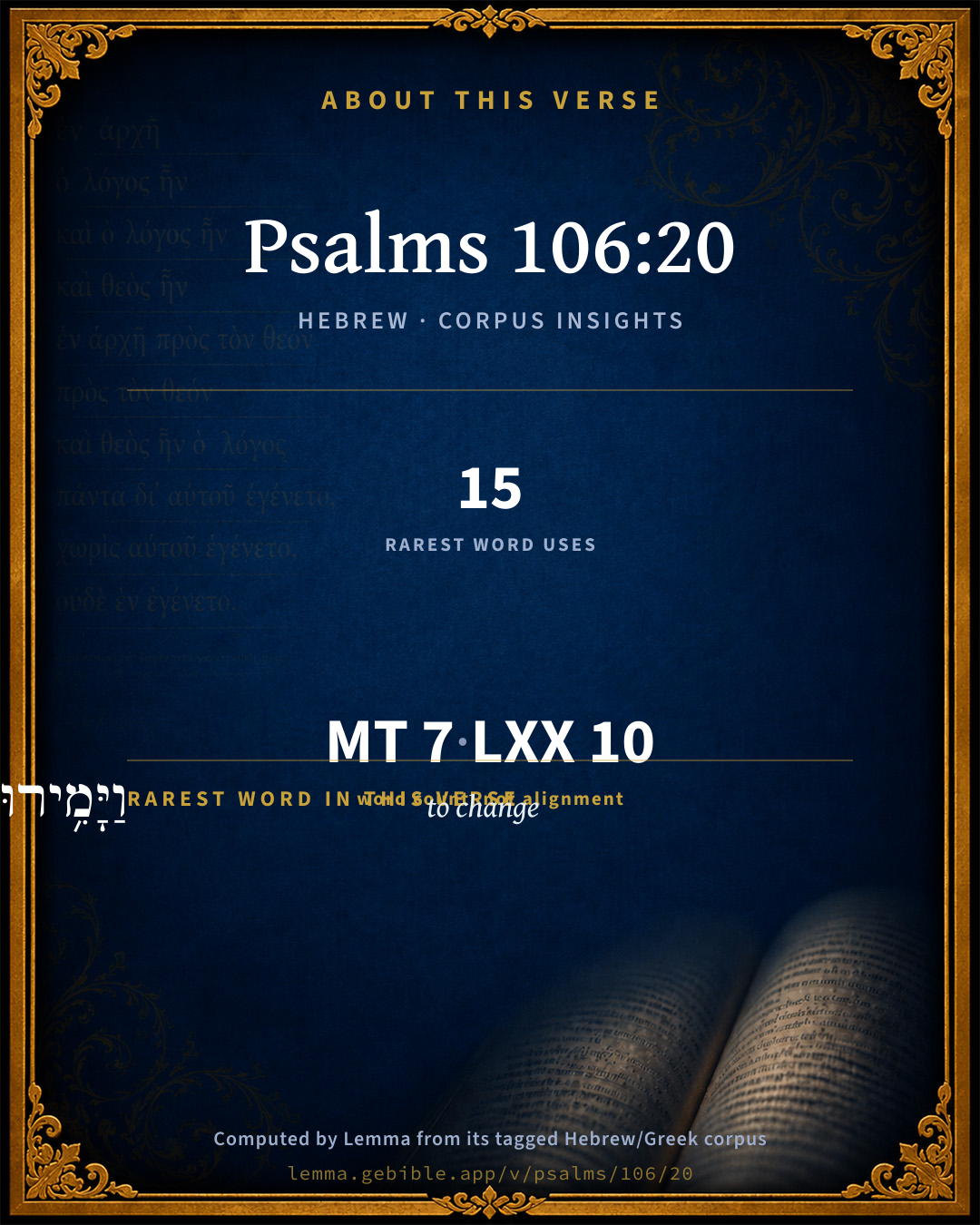
7
words
7
distinct lemmas
Wisdom
section

Notable vocabulary

The rarest word here is וַיָּמִ֥ירוּ to change H4171 — appearing just 15 times in the whole Hebrew Bible.

Shared distinctive vocabulary

וַיָּמִ֥ירוּ to change H4171 occurs in 10 verses of the Hebrew Bible. Also found in:

Grammatical profile

  • 2 verbs
  • 4 nouns
  • 1 particle

Verb forms

  • וַיָּמִ֥ירוּ Hiphil · Sequential Imperfect
  • אֹכֵ֥ל Qal · Participle Active

Hebrew & Septuagint length

In English translation the verse runs 14 words from the Hebrew and 15 from the Septuagint (LXX English) — closely comparable.

A rough comparison of the two English renderings, which tokenize alike — not a word-level alignment.

Word counts can differ between the Hebrew and the Greek without any difference in meaning — e.g. the Hebrew direct-object marker אֵת has no separate Greek word, and Greek often adds the article ὁ.

In the original languages it is 7 Hebrew tokens and 10 Greek tokens — but the two are counted differently (Hebrew bundles its prefixes and suffixes into one token; the Greek is in lemma form), so that isn’t a like-for-like length.

Cross-references

5

Topical passages linked to Psalms 106:20 in the Treasury of Scripture Knowledge — connected by theme and wording, ordered by reader-vote popularity; previews shown in the World English Bible.

  • Jeremiah 2:11 Has a nation changed [its] gods, which yet are no gods? but my people have changed their glory for that which does not profit.
  • Exodus 20:4–5 "You shall not make for yourselves an idol, nor any image of anything that is in the heavens above, or that is in the earth beneath, or that is in the water under the earth:
  • Romans 1:22–23 Professing themselves to be wise, they became fools,
  • Psalms 89:17 For you are the glory of their strength. In your favor, our horn will be exalted.
  • Isaiah 40:18–25 To whom then will you liken God? or what likeness will you compare to him?

Cross-references courtesy of OpenBible.info (CC BY 4.0).

Hebrew and Greek witnesses Masoretic Hebrew ↔ Greek Septuagint

The same verse in the two great witnesses to the Old Testament, shown verse-for-verse.

You’re reading Greek Psalm 105 (Hebrew Psalm 106). The Septuagint counts the superscription, so verse numbers can differ from the Hebrew — chapter-level alignment, not verse-by-verse. Numbering follows Rahlfs.

These are two independent witnesses, not word-aligned to each other, and the Septuagint is shown in lemma (dictionary) form.

Hebrew Psalms 106:20 Masoretic · Westminster Leningrad Codex

וַיָּמִ֥ירוּ אֶת כְּבוֹדָ֑ם בְּתַבְנִ֥ית שׁ֝֗וֹר אֹכֵ֥ל עֵֽשֶׂב

Thus they exchanged their glory For an image of a bull that eats grass.

World English Bible · Public Domain

Greek LXX Greek Psalm 105:20 Septuagint · lemma form

καί ἀλλάσσω ὁ δόξα αὐτός ἐν ὁμοίωμα μόσχος ἐσθίω χόρτος

and they changed their glory into the similitude of a calf that feeds on grass.

LXX2012 (modern English Septuagint) · Public Domain

On this verse, The Cambridge Bible for Schools and Colleges discusses the Septuagint’s reading. Read the note in Commentary ↓

Hebrew: Westminster Leningrad Codex (CC BY 4.0). Greek: Septuagint (public domain); English from LXX2012 (modern English Septuagint) (Public Domain). How the Septuagint differs from the Hebrew →

Commentary

Notes on Psalms 106:20 from classic Christian and Jewish commentators (each source and its license shown beneath its notes). The classic Christian expositions comment on the surrounding passage and are grouped to its opening verse, so a note may address several verses; the Jewish commentaries on the Tanakh (Rashi and others) are per-verse, so they appear only where the commentator wrote on this verse.

Lemma curates 59 commentaries, every one of them public domain or Creative Commons licensed, each selected and text-cleaned for this edition rather than reprinted as found. About our sources →

Trapp's Complete Commentary

John Trapp

Psa 106:20 Thus they changed their glory into the similitude of an ox that eateth grass.

Ver. 20. Thus they changed their glory] i.e. Their God, Rom 1:23, the Creator for a contemptible creature.

Of an ox that eateth grass] Tunc stercora egerit, et multum inquinatur, as R. Solomon here glosseth. They pretended not to worship the calf, but God in the calf, as did also Jebu, 2Ki 10:16; 2Ki 10:29 2Ch 11:15, and as the idolatrous Papists do at this day. See Exo 32:5-6. Yet the text here saith, "They worshipped the molten image, they changed their glory into the similitude of an ox." And although some of the Rabbis would excuse this gross idolatry of their forefathers, yet others, more wise, bewail it, and say that there is an ounce of this golden calf in all their present sufferings.

John Trapp, A Commentary or Exposition upon All the Books of the Old and New Testament (1647–1656) — public domain. Text from a community e-Sword module.

J. A. Alexander on Psalms

Joseph Addison Alexander

20. (Psa 106:20) And exchange their glory for the likeness of an ox eating grass. This must be read in the closest connection with Psa 106:19, in Order to complete it. Their folly consisted in exchanging the true God, whose worship and whose favour was their highest honour, for the mere likeness of an irrational brute. Eating grass, not in the act, but in the habit, of so doing. Although the golden calf at Horeb, and the golden calves at Dan and Beesheba, were all regarded as representatives of Jehovah himself, their worshipwas uniformly treated as idolatry, and as a virtual though not a formal or avowed renunciation of his service. Compare Jer 2:10-13.

Joseph Addison Alexander, The Psalms Translated and Explained (1850) — public domain. Text from a community e-Sword module.

Geneva Bible (1599)

Geneva Bible translators

He showeth that all idolaters renounce God to be their glory, when instead of him they worship any creature, much more wood, stone, metal, or calves.

Geneva Bible (1599) marginal notes — public domain. Text via Bolls.life.

Adam Clarke's Commentary

Verse 20. Thus they changed their glory] That is, their God, who was their glory; and they worshipped an ox in his stead. See the use St Paul makes of this, Ro 1:23; see also the note there. See Clarke on Ro 1:23. The incorruptible God was thus served by all the heathen world.

Adam Clarke's Commentary on the Bible (1810–1826) — public domain. Text from a community e-Sword/MySword module.

Ellicott's Commentary for English Readers

(20) Their glory—i.e., Jehovah, as shown by Jer_2:11.

Similitude.—This is also a Deuteronomic word (Deu_4:16; Deu_4:18), meaning originally “structure,” from a root meaning “to build,” and so “form,” “model.”

A Bible Commentary for English Readers, edited by Charles John Ellicott (1878–1897) — public domain. Text from a community e-Sword module.

The Cambridge Bible for Schools and Colleges

gen. ed. J. J. S. Perowne

20. So they exchanged their glory

For the likeness of an ox that eateth grass.

Jehovah was the glory of Israel (Deu_4:6-8; Deu_10:21); and this spiritual invisible God they bartered for the likeness of an animal, such as they were forbidden to make (Deu_4:16-18; Exo_20:4). Cp. Jer_2:11.

The reading their glory is reckoned as one of the eighteen Tiqqûnç Sôpherîm[60] or ‘corrections of the scribes,’ and is said to stand for ‘his glory.’ It is disputed whether the term means that the scribes actually altered the text from motives of reverence, or held that his glory was what the Psalmist would have written, had he not purposely avoided it as an indecorous expression. It is noteworthy that some MSS of the LXX (אc.a ART) read his glory, and to this form of the text St Paul refers in Rom_1:23. The Targ. gives ‘the glory of their Lord.’

[60] See Ginsburg, Introd. to the Heb. Bible, pp. 347 ff., who holds the view that the Scribes altered the text: and Barnes in the journal of Theol. Studies, i. 387 ff., who holds that the so-called corrections are interpretations not readings.

The Cambridge Bible for Schools and Colleges (gen. ed. J. J. S. Perowne; Cambridge University Press, 1878–1918) — public domain. Text from a community e-Sword module.

John Gill's Exposition

Thus they changed their glory,.... God, who is glorious in all the perfections of his nature, and is glory itself, and was the glory of these people; it was their greatest honour that they had knowledge of him, nearness to him, the true worship of him among them, and that they were worshippers of him; and who, though he is unchangeable in himself, may be said to be changed when another is substituted and worshipped in his room, or worshipped besides him; which was what the Heathen did, and in which the Israelites exceeded them, Rom 1:23, the Targum is,

"they changed the glory of their Lord.''

Into the similitude of an ox that eateth grass; which was monstrous stupidity, to leave the worship of the true God, El Shaddai, God all sufficient, all powerful, that stands in need of nothing, but upholds and supports all creatures in being, and provides them with necessaries; and worship an ox, yea, the figure of one that eats grass, that lives on hay, and is supported by that which is so weak and withering; the Targum adds,

"and makes dung;''

or defiles itself with it, as the ox does while it is eating grass; Jarchi observes, there is nothing more abominable and filthy than an ox when it is eating grass, which then makes much dung, and defiles itself; this the Targumist adds, to make the worship of such a creature the more contemptible.

John Gill's Exposition of the Whole Bible (1746–1763) — public domain (CC PDM 1.0). Text via the HelloAO Bible API.

Albert Barnes' Notes on the Bible

Thus they changed their glory - Their true glory - the proper object of worship - God. Compare the notes at Rom 1:23. They “exchanged” that as an object of worship for the image of an ox.

Into the similitude of an ox that eateth grass - Into the likeness of an ox. That is, They worshipped God under that image. The circumstance of its “eating grass” is added to show the absurdity of the act. Instead of worshipping God - an independent Being, who does not need to be supported, but who himself sustains all things, and provides for all - they worshipped an animal that had need of constant sustenance, and would itself soon die if deprived of its proper nourishment. Compare the notes at Isa 40:18-20; notes at Isa 41:6-7.

Albert Barnes' Notes on the Bible (1834–1885) — public domain. Text from a community e-Sword/MySword module.

Matthew Poole's English Annotations

Changed, as far as in them lay, and in respect of their worship.

Their glory; their God, who was indeed their glory; for they had this just occasion of triumphing and glorying over all the nations of the world; that whereas all other nations worshipped stocks and stones, or the heavenly bodies, or dead men, they only worshipped the living and true God, who was present and in covenant with them, and with them only.

Into the similitude of an ox; into the golden image of an ox or calf.

That eateth grass; which is so far from feeding his people, as the true God did the Israelites, that he must be fed by them. And yet the image of such a creature was preferred by them, before the all-sufficient and ever-blessed God, which was an evidence of their horrid contempt of God, and also of their prodigious folly and stupidity.

Matthew Poole's English Annotations on the Holy Bible (1683–1685) — public domain. Text from a community e-Sword/MySword module.

The Treasury of David

Charles H. Spurgeon

Ver. 20. Thus they changed their glory into the similitude of an ox that eateth grass. They said that they only meant to worship the one God under a fitting and suggestive similitude by which his great power would be set forth to the multitude; they pleaded the great Catholic revival which followed upon this return to a more ornate ceremonial, for the people thronged around Aaron, and danced before the calf with all their might. But in very deed they had given up the true God, whom it had been their glory to adore, and had set up a rival to him, not a representation of him; for how should he be likened to a bullock? The psalmist is very contemptuous, and justly so: irreverence towards idols is an indirect reverence to God. False gods, attempts to represent the true God, and indeed, all material things which are worshipped, are so much filth upon the face of the earth, whether they be crosses, crucifixes, virgins, wafers, relics, or even the Pope himself. We are by far too mealy mouthed about these infamous abominations: God abhors them, and so should we. To renounce the glory of spiritual worship for outward pomp and show is the height of folly, and deserves to be treated as such.

Ver. 20. An ox that eateth grass. The Egyptians, when they consulted Apis, presented a bottle of hay or of grass, and if the ox received it, they expected good success. Daniel Cresswell.

Ver. 20. Although some of the Rabbins would excuse this gross idolatry of their forefathers, yet others more wise bewail them, and say that there is an ounce of this golden calf in all their present sufferings. John Trapp.

Psalms 106:21*

Charles H. Spurgeon's The Treasury of David (1869–1885) — public domain. Psalms only. Text from a community e-Sword/MySword module.

Whedon's Commentary on the Bible

Daniel D. Whedon

20. Their glory—The cloud of light, or fire, in which God appeared to them, as Exo_16:7; Exo_16:10; Exo_24:16-17; Deu_5:24. In all these appearances “they saw no similitude.” Deu_4:12; Deu_4:15. In making one they fundamentally revolted from Jehovah, though they saw it not at first. Comp. Rom_1:23.

That eateth grass—A description at once definitive of species and expressive of contempt.

Daniel D. Whedon (gen. ed.), Commentary on the Old and New Testaments (1874–1909) — public domain. Text from a community e-Sword module.

The Pulpit Commentary

Thus they changed their glory into the similitude of an ox that eateth grass; i.e. they exchanged the spiritual revelation of Jehovah, in all his glorious attributes, for a material emblem, which would naturally suggest low and unworthy thoughts of the supreme Being. So Schultz and Cheyne. The expression, "an ox that eateth grass," emphasizes the contempt of the writer for a people who could so act. He has, probably, in his thoughts not only the golden calf, but the Apis bulls of Egypt.

Our God our glory.

The "glory" of Israel was found, as this verse indicates, in the God whom her sons worshipped; not in her cultivated fields, not in her varied scenery, not in her peculiar civilization, not even in her temple and its rites, but in her God. No other contemporary nation worshipped one, pure, righteous, pitiful God, who sought the well being, material and spiritual, of all his children. Well may we, to whom God has revealed himself in Jesus Christ, claim that our God is the glory of our land.

The Pulpit Commentary (1880–1919), ed. H.D.M. Spence-Jones & Joseph S. Exell — public domain. Text from a community e-Sword module.

John Wesley's Explanatory Notes

Their glory - God, who was indeed their glory. Into - Into the golden image of an ox or calf, which is so far from feeding his people, as the true God did the Israelites, that he must be fed by them.

John Wesley, Explanatory Notes Upon the Whole Bible (1754–1765) — public domain. Text via the GEBible commentary corpus.

Rashi

Rabbi Shlomo Yitzchaki (Rashi)

eating grass There is nothing as disgusting and repugnant as an ox. When it eats grass, it emits much dung, with which it sullies itself. Other books read: its saliva.

Rashi on the Tanakh — English translations: “The Judaica Press complete Tanach with Rashi, translated by A. J. Rosenberg” (CC BY 4.0); “Pentateuch with Rashi's commentary by M. Rosenbaum and A.M. Silbermann, 1929-1934” (public domain); “The Metsudah Tanach series, Lakewood, N.J” (CC BY 4.0); and “The Book of Joshua, Metsudah Publications, 1997” (CC BY 4.0). Text via Sefaria.

Lesson kit

Teaching starters — assembled from the data on this page, not authored interpretation. Every prompt links to the verse data it draws on. Edit before teaching.

Psalms, in the Wisdom, opens this verse with 7 words (7 distinct Hebrew lemmas). Its most distinctive word is mûwr (“to change”). A historical commentator’s framing appears above. Read the whole chapter for the surrounding context.

Discussion questions

  1. How does “to change” (mûwr) shape what this verse is saying?
  2. How does Leviticus 27:10, which shares the word «to change», read alongside this verse?
  3. These translations render this verse differently. What is at stake in choosing one wording over another?
  4. «וַיָּמִ֥ירוּ» is a Hiphil Sequential Imperfect verb. How does that grammatical form shape the action described?
  5. Compare how Trapp's Complete Commentary and J. A. Alexander on Psalms read this verse. Where do they agree or differ?

Things to notice

Reading settings

Reading text

Shown beneath each verse's original-language words.

Old Testament
Old Testament edition

Read the OT as the Masoretic Hebrew (MT) or the Greek Septuagint (LXX).

English shown for the Greek Septuagint (in the Hebrew ↔ Greek comparison).

Comparing translations? Open the Compare panel on any verse page to stack up to four side by side.