
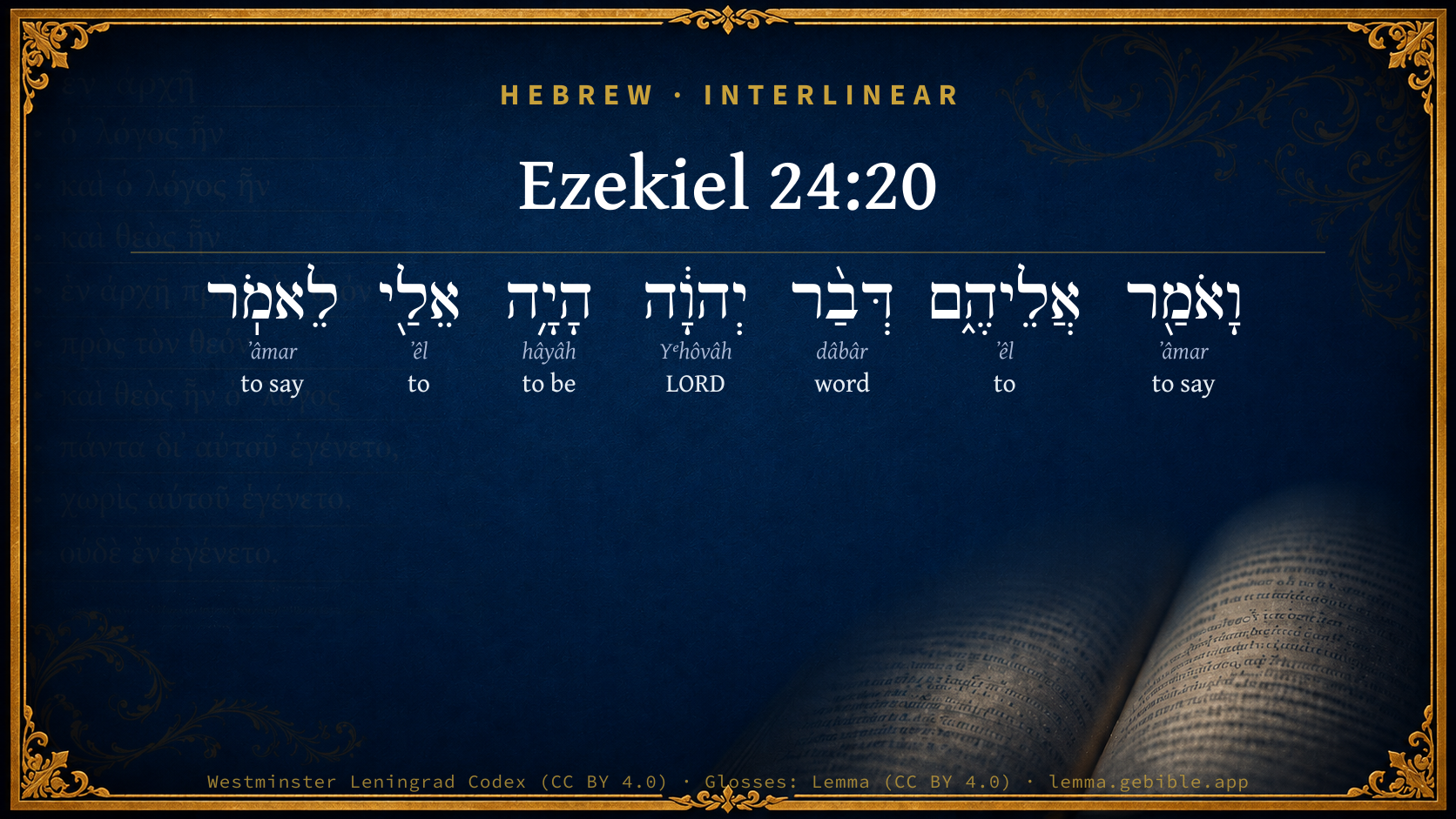
Ezekiel 24:20

Hebrew (Westminster Leningrad Codex) Ezekiel 24:20 appears in the Hebrew Old Testament. The text above is from the Westminster Leningrad Codex. Each word links to its Strong’s number, a concise gloss, and parsing drawn from the Open Scriptures Hebrew Bible morphology. Click any word for its full Brown-Driver-Briggs (BDB) entry.
Download image
Cite this verse

Ezekiel 24:20 (World English Bible). Public Domain. Lemma interlinear Bible study tool, https://lemma.gebible.app/v/ezekiel/24/20.

Show BibTeX & RIS
BibTeX
RIS
English Translation
Then I said to them, The word of Yahweh came to me, saying,
World English Bible · Public Domain
Download a study sheet

One document with this verse’s original text, its word-by-word gloss line, the meaning frame, cross-references with their text, attributed commentary, and full source and license credits — printable, and it pastes into notes with its structure intact.

This verse Autodidact and up

Study sheet (.html) Plain text (.txt)

A passage Seminary Student

Up to 50 verses in one chapter. A passage sheet keeps up to 6 commentary sources and 12 cross-references per verse, in the order this page ranks them, and says so on the sheet whenever that leaves anything out. Ask for a single verse and you get the Autodidact verse sheet above.

Everything on this page stays free to read, with no account — the sheet is a download of what is already on screen, not access to it.

Want to remove ads? Support Godless Engineer
Compare translations 3

The same verse in 3 English versions, stacked beneath the original-language interlinear above. Click any original word for its lexicon entry.

Each is an independent rendering of the whole verse — the interlinear is not word-aligned to these translations.

Highlighted words mark where these versions differ — a whole-verse word diff, not a word-by-word alignment.

  • World English Bible Public Domain
    Then I said to them, The word of Yahweh came to me, saying,
  • King James Version Public Domain
    Then I answered them, The word of the LORD came unto me, saying,
  • unfoldingWord Literal Text CC BY-SA 4.0
    So I said to them, “The word of Yahweh came to me, saying,

unfoldingWord Literal Text — © unfoldingWord, licensed CC BY-SA 4.0. Word-aligned USFM3 via Door43 (git.door43.org/unfoldingWord/en_ult).

Versions to compare (up to 4)

3 of 4 selected

Show all 18 translations

Every available English version of this verse, each an independent rendering of the whole verse.

  • World English Bible Public Domain
    Then I said to them, The word of Yahweh came to me, saying,
  • Berean Standard Bible Public Domain
    So I answered them, “The word of the LORD came to me, saying:
  • Majority Standard Bible Public Domain
    So I answered them, “The word of the LORD came to me, saying:
  • King James Version Public Domain
    Then I answered them, The word of the LORD came unto me, saying,
  • American Standard Version (1901) Public Domain
    Then I said unto them, The word of Jehovah came unto me, saying,
  • Revised Version (1885) Public Domain
    Then I said unto them, The word of the LORD came unto me, saying,
  • Geneva Bible (1599) Public Domain
    Then I answered them, The worde of the Lord came vnto me, saying,
  • Douay-Rheims (1899) Public Domain
    And I said to them: The word of the Lord came to me, saying:
  • Young's Literal Translation Public Domain
    And I say unto them, `A word of Jehovah hath been unto me, saying:
  • Literal Standard Version CC BY-SA 4.0
    And I say to them, “A word of YHWH has been to me, saying,
  • Unlocked Literal Bible CC BY-SA 4.0
    So I said to them, “The word of Yahweh came to me, saying,
  • unfoldingWord Literal Text CC BY-SA 4.0
    So I said to them, “The word of Yahweh came to me, saying,
  • Darby Bible Public Domain
    And I said to them, The word of Jehovah came unto me, saying,
  • World Messianic Bible Public Domain
    Then I said to them, “The LORD’s word came to me, saying,
  • Webster's Bible Public Domain
    Then I answered them, the word of the LORD came to me, saying,
  • Free Bible Version CC BY-SA 4.0
    So I told them, “A message from the Lord came to me, saying:
  • Bible in Basic English Public Domain
    Then I said to them, The word of the Lord came to me, saying,
  • JPS Tanakh (1917) Public Domain
    Then I said unto them: 'The word of the LORD came unto me, saying:

Literal Standard Version (2020), Covenant Press — licensed CC BY-SA 4.0. Text via the HelloAO Bible API (eBible.org). Unlocked Literal Bible (unfoldingWord) — licensed CC BY-SA 4.0. Text via the HelloAO Bible API (eBible.org). unfoldingWord Literal Text — © unfoldingWord, licensed CC BY-SA 4.0. Word-aligned USFM3 via Door43 (git.door43.org/unfoldingWord/en_ult). Free Bible Version, Dr. Jonathan Gallagher — licensed CC BY-SA 4.0. Text via the HelloAO Bible API (eBible.org).

Word by word

More ways to search: Search by grammar → Find every occurrence → Compare this word →

Practice this passage: Drill this verse → Learn its vocabulary →

About this verse

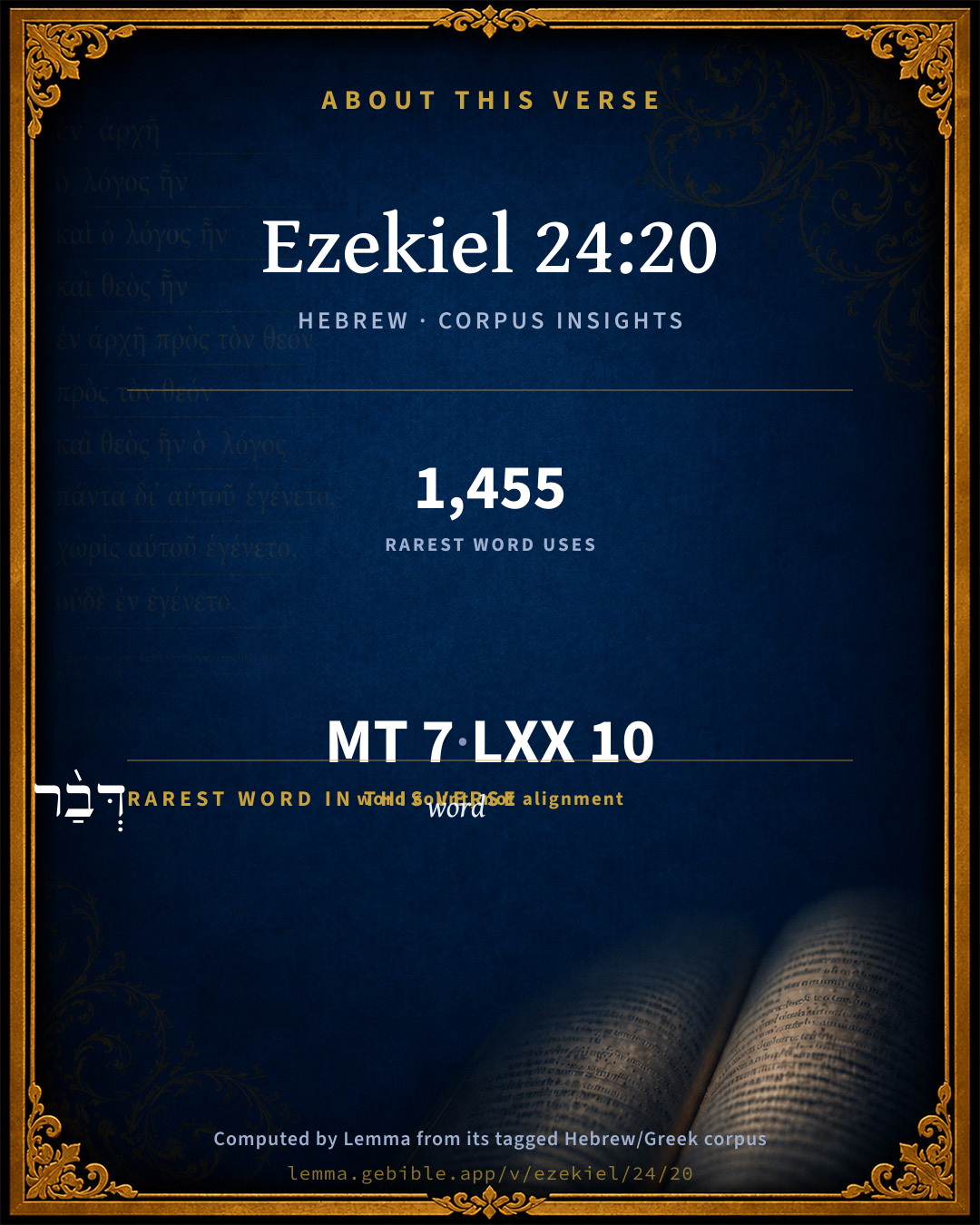
These counts appear in no published source. They are computed here, from the morphology-tagged text and Lemma’s own curated glosses. What Lemma adds →

7
words
5
distinct lemmas
Prophets
section

Grammatical profile

  • 3 verbs
  • 2 nouns
  • 2 prepositions

Verb forms

  • וָאֹמַ֖ר Qal · Sequential Imperfect
  • הָיָ֥ה Qal · Perfect
  • לֵאמֹֽר Qal · Infinitive Construct

Repetition

Words recur within this verse — often emphatic in Hebrew:

  • וָאֹמַ֖ר to say H559 ×2
  • אֲלֵיהֶ֑ם to H413 ×2

Hebrew & Septuagint length

In English translation the verse runs 13 words from the Hebrew and 14 from the Septuagint (LXX English) — closely comparable.

A rough comparison of the two English renderings, which tokenize alike — not a word-level alignment.

Word counts can differ between the Hebrew and the Greek without any difference in meaning — e.g. the Hebrew direct-object marker אֵת has no separate Greek word, and Greek often adds the article ὁ.

In the original languages it is 7 Hebrew tokens and 10 Greek tokens — but the two are counted differently (Hebrew bundles its prefixes and suffixes into one token; the Greek is in lemma form), so that isn’t a like-for-like length.

Hebrew and Greek witnesses Masoretic Hebrew ↔ Greek Septuagint

The same verse in the two great witnesses to the Old Testament, shown verse-for-verse.

These are two independent witnesses, not word-aligned to each other, and the Septuagint is shown in lemma (dictionary) form.

Hebrew Ezekiel 24:20 Masoretic · Westminster Leningrad Codex

וָאֹמַ֖ר אֲלֵיהֶ֑ם דְּבַ֨ר יְהוָ֔ה הָיָ֥ה אֵלַ֖י לֵאמֹֽר

Then I said to them, The word of Yahweh came to me, saying,

World English Bible · Public Domain

Greek LXX Ezekiel 24:20 Septuagint · lemma form

καί εἶπον πρός αὐτός λόγος κύριος πρός ἐγώ γίγνομαι λέγω

Then I said to them, The word of the Lord came to me, saying,

LXX2012 (modern English Septuagint) · Public Domain

Hebrew: Westminster Leningrad Codex (CC BY 4.0). Greek: Septuagint (public domain); English from LXX2012 (modern English Septuagint) (Public Domain). How the Septuagint differs from the Hebrew →

Targum (Aramaic paraphrase)

1

The Targum is the ancient Jewish Aramaic paraphrase of the Hebrew Scriptures — an interpretive translation, not the Hebrew text itself. Onkelos (literal) and Pseudo-Jonathan (expansive) render the Torah, and Jonathan the Prophets. Coverage is partial: where no permissively-licensed English translation exists for a verse, only the Aramaic is shown. This is verse-level text, not a word-by-word alignment to the Hebrew.

  1. Targum Jonathan Prophets (Joshua–Malachi)
    וַאֲמָרֵית לְהוֹן פִּתְגַם נְבוּאָה מִן קֳדָם יְיָ הֲוָה עִמִי לְמֵימָר:

    (no public-domain English translation for this verse)

    Targum Jonathan — Aramaic: “Mikraot Gedolot” (public domain). English: “Sefaria Community Translation” (CC0 1.0 (public-domain dedication)); “London "Chaldee Paraphrase," 1871” (public domain). Text via Sefaria.

Commentary

Notes on Ezekiel 24:20 from classic Christian and Jewish commentators (each source and its license shown beneath its notes). The classic Christian expositions comment on the surrounding passage and are grouped to its opening verse, so a note may address several verses; the Jewish commentaries on the Tanakh (Rashi and others) are per-verse, so they appear only where the commentator wrote on this verse.

Lemma curates 59 commentaries, every one of them public domain or Creative Commons licensed, each selected and text-cleaned for this edition rather than reprinted as found. About our sources →

Trapp's Complete Commentary

John Trapp

Eze 24:20 Then I answered them, The word of the LORD came unto me, saying,

Ver. 20. Then I answered them.] The prophet was ready to tell them the true meaning of all; so should ministers be. See Job 33:23. {See Trapp on "Job 33:23"}

John Trapp, A Commentary or Exposition upon All the Books of the Old and New Testament (1647–1656) — public domain. Text from a community e-Sword module.

Tyndale Open Study Notes

Tyndale Open Resources

24:20-24 Ezekiel’s lack of mourning (24:15-17) was a sign to Israel of what lay ahead for them. The Lord was about to take away the place your heart delights in—the Temple of Jerusalem. God was going to desecrate it and destroy the sons and daughters they had left behind in Jerusalem. On that day, the people would behave as Ezekiel had done; they would not mourn in public or carry out the associated rituals. Though they would feel the loss deeply in their hearts, the scale of the devastation would be so overwhelming that there would be no opportunity for normal mourning rites. In the context of such terrible and complete desolation, only internal grief could be observed.

Tyndale Open Study Notes — © Tyndale Open Resources, licensed CC BY-SA 4.0. Text via the HelloAO Bible API.

Ellicott's Commentary for English Readers

(20) That which your soul pitieth.—In the margin the pity of your soul. The word rather means in this connection love, in the sense of the object of love: “that which your soul loves.” The expression in the original is a difficult one, and is used by Ezekiel on account of the alliteration with the previous clause: “the machmad of your eyes, and the machmal of your souls.” (Comp. the parallel in Eze_24:25 : “That whereupon they set their minds.”)

A Bible Commentary for English Readers, edited by Charles John Ellicott (1878–1897) — public domain. Text from a community e-Sword module.

John Gill's Exposition

Speak unto the house of Israel,.... By word of mouth, to those who were upon the spot with him in Chaldea: and by a messenger, or a letter, to them that were in Judea:

thus saith the Lord of hosts, behold, I will profane my sanctuary; the temple, built for him, and where he dwelt, and was worshipped; where duties performed and holy sacrifices offered up formerly; this he now says he would profane, that is, would bring the Chaldeans against Jerusalem, who should take it, and enter into the temple, and so profane it, and make it common, yea, utterly destroy it:

the excellency of your strength, desire of your eyes, and that which your soul pitieth; all which is said of the temple; it was the pride and glory of the Jews, what they boasted of, and put their confidence in, and reckoned their strength and security; it was as dear and as desirable to them as Ezekiel's wife was to him, the emblem of it; the destruction and desolation of which would be pitied by them, and would sensibly affect them upon hearing of it, even in prophecy:

and your sons and your daughters whom ye have left shall fall by the sword; whom they had left behind them in Judea, when they were carried captive with Jehoiakim, and to whom they hoped to return, as their false prophets had assured them; but so it should not be, for these should die by the sword of the Chaldeans, when the city of Jerusalem should be taken, and the temple profaned; and this should be the case of the sons and daughters of those who then should be carried captive, that should be left in the land; as was the case of Gedaliah, and those that were with him.

John Gill's Exposition of the Whole Bible (1746–1763) — public domain (CC PDM 1.0). Text via the HelloAO Bible API.

The Pulpit Commentary

Vers. 20-23. An awful catastrophe and a prohibition of mourning.

word of the Lord came unto me, saying, Speak unto the house of Israel, Thus saith the Lord God," etc. The death of Ezekiel"s wife, and his abstinence from mourning by reason thereof, were symbolical, and their signification is brought before us in our text. Two scenes are presented for our contemplation.

I A PEOPLE DEPRIVED OF THEIR MOST PRECIOUS POSSESSIONS.

1. The possessions of which they were to be deprived.

(1) The temple itself. "Behold, I will profane my sanctuary, the pride of your power, the desire of your eyes, and that which your soul pitieth" The last clause is literally, "the pity of your soul;" that which "your soul would spare pledging life itself for it." See also in what exalted terms the temple is spoken of in Ver. 25: "I take from them their strength," or stronghold, "the joy of their glory, the desire of their eyes, and that whereupon they set their heart." The wife of Ezekiel, who was the desire of his eyes, symbolized the temple. In some respects the Jews made too much of their temple. They gloried in its outward beauty and splendor, even while they dishonored God by their idolatries; they trusted in it as their stronghold, instead of making him their Refuge and Strength; they set their heart upon it, when they should have loved him with all their heart, and soul, and mind, and strength. And they were now about to lose that temple. Heathen intruders would first desecrate it and then destroy it. (cf. Psa_79:1 Psa_74:3-8)

(2) The temple as a symbol. "The temple," says Schroder, "symbolizes all the possessions and power of Israel. To its existence in their midst they appealed against their brethren; (Eze_11:15) and to this they trusted amid all their wickedness and apostasy." (Eze_8:6; Jer_8:4) And Hengstenberg remarks that in the profanation of the sanctuary "is included the dissolving of the whole covenant relation, the removal of everything sublime and glorious, that had flown from that covenant relation, of all that was valuable and dear to the people. The general conception is demanded by the fundamental passage, Lev_26:19, where by the pride of power is meant all the glory of Israel. Then also by Ver. 25, where in place of the sanctuary here all that is glorious appears.

(3) Their sons and daughters. "Your sons and your daughters whom ye have left behind shall fall by the sword." Hitzig suggests that, "on the occasion of the expatriation, many parents may have been obliged to leave their children with relatives, from their being of too tender age to accompany them; and these would be slain by the sword. But it seems to us better to interpret, with Hengstenberg, "The sons and the daughters are not those of individuals, but of the people as a whole. The house of Israel, not the exiles in particular, are addressed. In point of fact, it is as much as to say, "your countrymen. They were soon to be stripped of their temple and its ordinances, their independence and liberty, their homes and country, and many of their fellow-countrymen would perish by famine, pestilence, and sword.

1. The Person by whom they were to be thus deprived. "Thus saith the Lord God; Behold, I will profane my sanctuary," etc. (Ver. 21); "I take from them their strength," etc. (Ver. 25). In this destruction and slaughter the Chaldeans were as instruments and weapons in the hand of God, who was himself the great Agent.

2. The reason why they were to be thus deprived. All this loss and misery was coming upon them because of their sins. They had forsaken God, and he was about to leave them without his defense. They had profaned his temple by their idolatries, and he was about to allow the idolatrous Chaldeans to enter into it and destroy it. Their calamities were caused by their crimes. Their sufferings were the righteous retribution of their sins.

II A PEOPLE THAT SHOULD NOT MOURN THE LOSS OF EVEN THEIR MOST PRECIOUS POSSESSIONS. "And ye shall do as I have done: ye shall not cover your lips, nor eat the bread of men. And your tires shall be upon your heads," etc. The outward demonstrations of mourning are thus forbidden to the Jews in their distress. The covering of the face from the upper lip downwards was a sign of mourning. (cf. Mic_3:7) In great grief the mourners partook of food which their neigh-hours prepared and sent to them. (cf. Jer_16:7, Revised Version) This is here called "the bread of men." In many cases of mourning the headdress was taken off, and dust or ashes sprinkled upon the head. (cf. Lev_10:6; Job_2:12; Isa_61:3; Lam_2:10) But David and his companions in a season of deep distress went weeping with their heads covered. (2Sa_15:30) It was also customary for mourners to go barefoot, as David did on the occasion just referred to. All these visible symbols of grief were to be absent from the house of Israel during the great distresses that were coming upon them. Yet our text speaks of their great sorrow. "Ye shall pine away in your iniquities, and moan one toward another." We suggest, by way of explanation:

1. Their calamities would so overwhelm them as to leave them no power to think of the ceremonial of mourning. Their losses and miseries would stun them with amazement and anguish of soul. "As in the prophet"s case," says Schroder, "the misfortune of his wife"s death disappears in the deep shadows of the overthrow of Jerusalem and Judah, so all the personal feelings of the exiles" (and we must not limit this to them to the exclusion of their fellow-countrymen) "shall be absorbed in this destruction of the last remnant of the kingdom and city. One and another shall be benumbed with pain, so that no comfort shall come from any quarter; on the contrary, a desolating feeling of guilt shall be general such shall be their knowledge of the Lord.

2. Their consciousness of the sin which caused their calamities should check the outward exhibitions of sorrow because of them. This is well set forth by Fairbairn: "In the typical part of the delineation, it was not because the prophet was insensible to the loss he sustained by the death of his wife that he was to abstain from the habiliments and usages of mourning; but because there was another source of grief behind, of which this was but the sign and presage, and in itself so much greater and more appalling, that his spirit, instead of venting itself in expressions of sorrow at the immediate and ostensible calamity, was rather to brood in silent agony and concern over the more distressing evil it foreshadowed. And in like manner with the people, when all their fond hopes and visions were finally exploded, when the destruction of their beautiful temple, and the slaughter of their sons and daughters, came home to them as dreadful realities, they could only refrain from bewailing the loss of what had so deep a hold on their desires and affections, by having come to discern in this the sign of what was still greatly more dreadful and appalling. And what might that be but the bloodstained guilt of their iniquities, which had brought on the catastrophe? The overwhelming sense should then break in upon them of the iniquities to which they had clung with such fatal perverseness, absorbing their spirits, and turning their moanings into a new and higher direction. The agonies of bereavement would be in a manner lost under the self-inflicted pains of contrition and remorse. (cf. Eze_7:16) Yet the description must be understood with certain qualifications, and indeed is to be viewed as the somewhat ideal delineation of a state of things that should be found, rather than the exact and literal description of what was actually to take place The people should, on the occurrence of such a fearful catastrophe, have sunk under an overpowering sense of their guilt and folly, and, like the prophet, turned the tide of their grief and mourning rather against the gigantic evil that lay behind, seen only in the chambers of imagery, than what outwardly appeared; they should have bewailed the enormous sins that had provoked the righteous displeasure of God, rather than the present troubles in which that displeasure had taken effect. And such, undoubtedly, was the case with the better and more enlightened portion of the people; but many still cleaved to their idols, and would not receive the instruction given them, either by the prophet"s parabolical example or by the reality of God"s afflicting dispensations.

CONCLUSION. Mark well the dread consequences of persistence in sin. W.J.

The Pulpit Commentary (1880–1919), ed. H.D.M. Spence-Jones & Joseph S. Exell — public domain. Text from a community e-Sword module.

Lesson kit

Teaching starters — assembled from the data on this page, not authored interpretation. Every prompt links to the verse data it draws on. Edit before teaching.

Ezekiel, in the Prophets, opens this verse with 7 words (5 distinct Hebrew lemmas). Its most distinctive word is dâbâr (“word”). A historical commentator’s framing appears above. Read the whole chapter for the surrounding context.

Discussion questions

  1. What does “word” (dâbâr) contribute to the verse as a whole?
  2. What does the repetition of “to say” (2× in this one verse) do in this verse?
  3. The translations on this page render this verse differently — a whole-verse word diff, not a word-by-word alignment. What might account for the different wordings?
  4. «וָאֹמַ֖ר» is a Qal Sequential Imperfect verb. How does that grammatical form shape the action described?
  5. Compare how Trapp's Complete Commentary and Tyndale Open Study Notes read this verse. Where do they agree or differ?

Things to notice

Reading settings

Reading text

Shown beneath each verse's original-language words.

Old Testament
Old Testament edition

Read the OT as the Masoretic Hebrew (MT) or the Greek Septuagint (LXX).

English shown for the Greek Septuagint (in the Hebrew ↔ Greek comparison).

Comparing translations? Open the Compare panel on any verse page to stack up to four side by side.