
Proverbs 23:6

Hebrew (Westminster Leningrad Codex) Proverbs 23:6 appears in the Hebrew Old Testament. The text above is from the Westminster Leningrad Codex. Each word links to its Strong’s number, a concise gloss, and parsing drawn from the Open Scriptures Hebrew Bible morphology. Click any word for its full Brown-Driver-Briggs (BDB) entry.
Download image
Cite this verse

Proverbs 23:6 (World English Bible). Public Domain. Lemma interlinear Bible study tool, https://lemma.gebible.app/v/proverbs/23/6.

Show BibTeX & RIS
BibTeX
RIS
English Translation
Don't eat the food of him who has a stingy eye, And don't crave his delicacies:
World English Bible · Public Domain
Download a study sheet

One document with this verse’s original text, its word-by-word gloss line, the meaning frame, cross-references with their text, attributed commentary, and full source and license credits — printable, and it pastes into notes with its structure intact.

This verse Autodidact and up

Study sheet (.html) Plain text (.txt)

A passage Seminary Student

Up to 50 verses in one chapter. A passage sheet keeps up to 6 commentary sources and 12 cross-references per verse, in the order this page ranks them, and says so on the sheet whenever that leaves anything out. Ask for a single verse and you get the Autodidact verse sheet above.

Everything on this page stays free to read, with no account — the sheet is a download of what is already on screen, not access to it.

Want to remove ads? Support Godless Engineer
Compare translations 3

The same verse in 3 English versions, stacked beneath the original-language interlinear above. Click any original word for its lexicon entry.

Each is an independent rendering of the whole verse — the interlinear is not word-aligned to these translations.

Highlighted words mark where these versions differ — a whole-verse word diff, not a word-by-word alignment.

  • World English Bible Public Domain
    Don't eat the food of him who has a stingy eye, And don't crave his delicacies:
  • King James Version Public Domain
    Eat thou not the bread of him that hath an evil eye, neither desire thou his dainty meats:
  • unfoldingWord Literal Text CC BY-SA 4.0
    Do not eat the bread of evil of eye, and do not desire his delicious morsels.

unfoldingWord Literal Text — © unfoldingWord, licensed CC BY-SA 4.0. Word-aligned USFM3 via Door43 (git.door43.org/unfoldingWord/en_ult).

Versions to compare (up to 4)

3 of 4 selected

Show all 18 translations

Every available English version of this verse, each an independent rendering of the whole verse.

  • World English Bible Public Domain
    Don't eat the food of him who has a stingy eye, And don't crave his delicacies:
  • Berean Standard Bible Public Domain
    Do not eat the bread of a stingy man, and do not crave his delicacies;
  • Majority Standard Bible Public Domain
    Do not eat the bread of a stingy man, and do not crave his delicacies;
  • King James Version Public Domain
    Eat thou not the bread of him that hath an evil eye, neither desire thou his dainty meats:
  • American Standard Version (1901) Public Domain
    Eat thou not the bread of him that hath an evil eye, Neither desire thou his dainties:
  • Revised Version (1885) Public Domain
    Eat thou not the bread of him that hath an evil eye, neither desire thou his dainties:
  • Geneva Bible (1599) Public Domain
    Eate thou not the bread of him that hath an euil eye, neither desire his deintie meates.
  • Douay-Rheims (1899) Public Domain
    Eat not with an envious man, and desire not his meats:
  • Young's Literal Translation Public Domain
    Eat not the bread of an evil eye, And have no desire to his dainties,
  • Literal Standard Version CC BY-SA 4.0
    Do not eat the bread of an evil eye, || And have no desire to his delicacies,
  • Unlocked Literal Bible CC BY-SA 4.0
    Do not eat the food of one with an evil eye— and do not crave his delicacies,
  • unfoldingWord Literal Text CC BY-SA 4.0
    Do not eat the bread of evil of eye, and do not desire his delicious morsels.
  • Darby Bible Public Domain
    Eat thou not the food of him that hath an evil eye, neither desire thou his dainties.
  • World Messianic Bible Public Domain
    Don’t eat the food of him who has a stingy eye, and don’t crave his delicacies,
  • Webster's Bible Public Domain
    Eat thou not the bread of him that hath an evil eye, neither desire thou his dainties:
  • Free Bible Version CC BY-SA 4.0
    Don't accept meal invitations from miserly people; don't be greedy for their fancy food,
  • Bible in Basic English Public Domain
    Do not take the food of him who has an evil eye, or have any desire for his delicate meat:
  • JPS Tanakh (1917) Public Domain
    Eat thou not the bread of him that hath an evil eye, neither desire thou his dainties;

Literal Standard Version (2020), Covenant Press — licensed CC BY-SA 4.0. Text via the HelloAO Bible API (eBible.org). Unlocked Literal Bible (unfoldingWord) — licensed CC BY-SA 4.0. Text via the HelloAO Bible API (eBible.org). unfoldingWord Literal Text — © unfoldingWord, licensed CC BY-SA 4.0. Word-aligned USFM3 via Door43 (git.door43.org/unfoldingWord/en_ult). Free Bible Version, Dr. Jonathan Gallagher — licensed CC BY-SA 4.0. Text via the HelloAO Bible API (eBible.org).

Word by word

More ways to search: Search by grammar → Find every occurrence → Compare this word →

Practice this passage: Drill this verse → Learn its vocabulary →

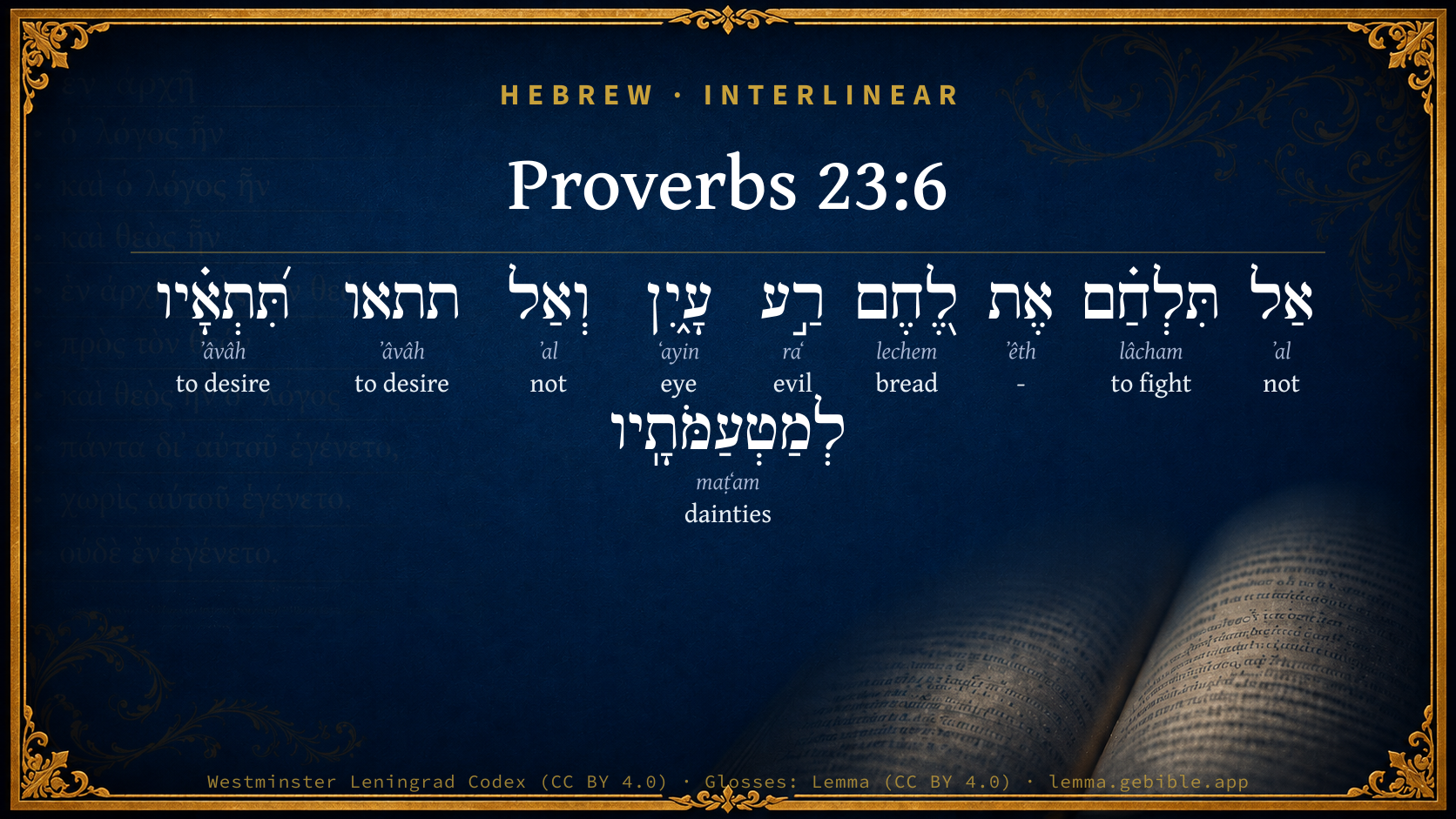
לְמַטְעַמֹּתָֽיו
maṭʻam
H4303
“to/for · dainties · his”
Preposition + Noun, Common, Masculine, Plural, Construct + Suffix, Personal, 3rd Person, Masculine, Singular
Part of Speech
Preposition + Noun
Type
Common
Gender
Masculine
Number
Plural
State
Construct
Full BDB Definition

Origin: from H2938

TWOT: 815b

tasty or savory food, delectable food, dainties
  1. אַל ʼal H408 “not” Particle, Negative
  2. תִּלְחַ֗ם lâcham H3898 “to fight” Verb, Qal, Jussive, 2nd Person, Masculine, Singular
  3. אֶת ʼêth H853 “-” Particle, Direct Object
  4. לֶ֭חֶם lechem H3899 “bread of” Noun, Common, Both, Singular, Construct
  5. רַ֣ע raʻ H7451 “evil of” Adjective, Adjective, Masculine, Singular, Construct
  6. עָ֑יִן ʻayin H5869 “eye” Noun, Common, Both, Singular, Absolute
  7. וְאַל ʼal H408 “and · not” Conjunction + Particle, Negative
  8. תתאו ʼâvâh H183 “to desire” Verb, Hithpael, Jussive, 2nd Person, Masculine, Singular
  9. תִּ֝תְאָ֗יו ʼâvâh H183 “to desire” Verb, Hithpael, Jussive, 2nd Person, Masculine, Singular

About this verse

These counts appear in no published source. They are computed here, from the morphology-tagged text and Lemma’s own curated glosses. What Lemma adds →

10
words
8
distinct lemmas
Wisdom
section

Notable vocabulary

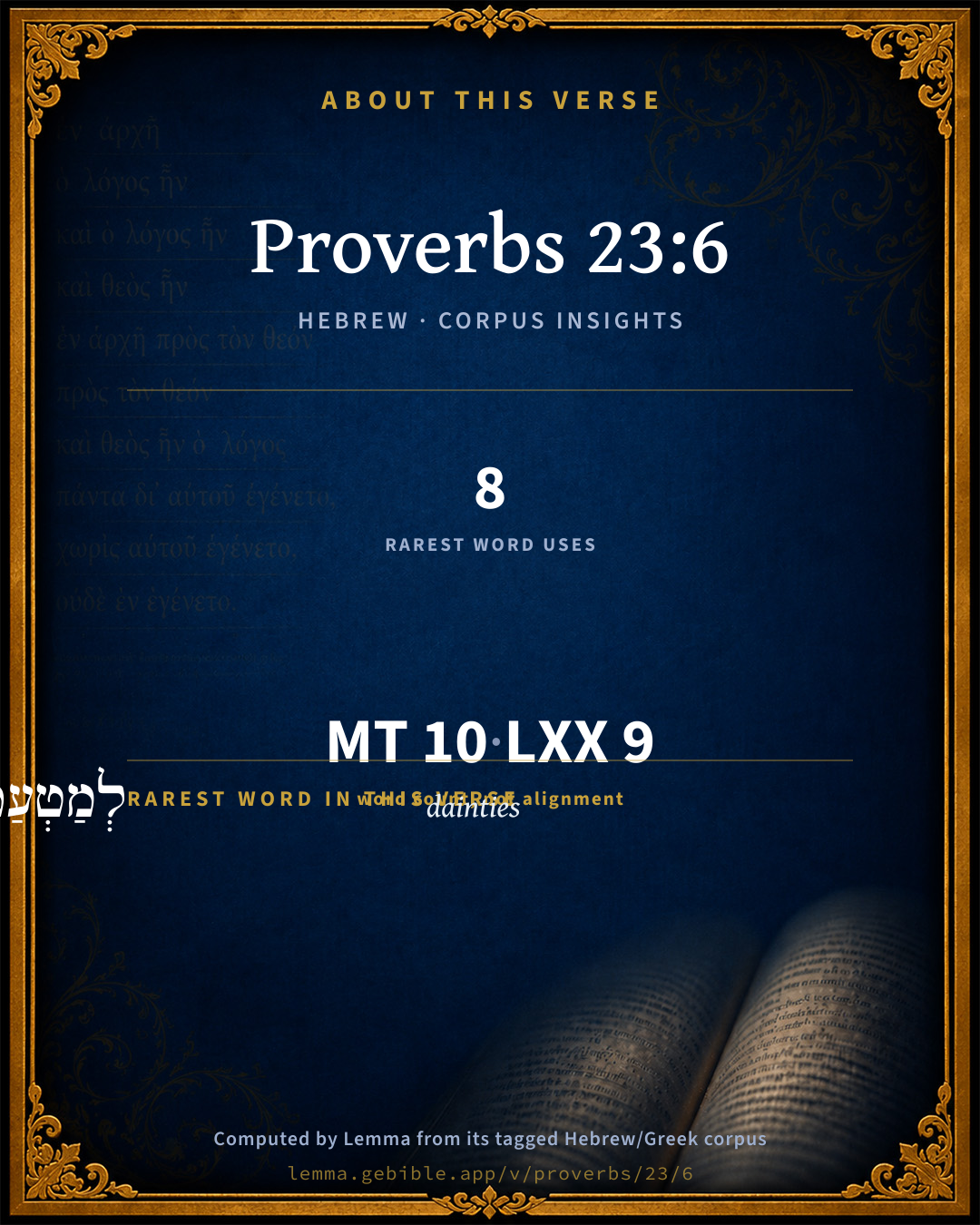
The rarest word here is לְמַטְעַמֹּתָֽיו dainties H4303 — appearing just 8 times in the whole Hebrew Bible.

Shared distinctive vocabulary

לְמַטְעַמֹּתָֽיו dainties H4303 occurs in 8 verses of the Hebrew Bible. Also found in:

Grammatical profile

  • 3 verbs
  • 3 nouns
  • 1 adjective
  • 3 particles

Verb forms

  • תִּלְחַ֗ם Qal · Jussive
  • תתאו Hithpael · Jussive
  • תִּ֝תְאָ֗יו Hithpael · Jussive

Repetition

Words recur within this verse — often emphatic in Hebrew:

  • תתאו to desire H183 ×2
  • אַל not H408 ×2

Hebrew & Septuagint length

In English translation the verse runs 16 words from the Hebrew and 11 from the Septuagint (LXX English) — the Septuagint runs noticeably shorter here. See the side-by-side →

A rough comparison of the two English renderings, which tokenize alike — not a word-level alignment.

Word counts can differ between the Hebrew and the Greek without any difference in meaning — e.g. the Hebrew direct-object marker אֵת has no separate Greek word, and Greek often adds the article ὁ.

In the original languages it is 10 Hebrew tokens and 9 Greek tokens — but the two are counted differently (Hebrew bundles its prefixes and suffixes into one token; the Greek is in lemma form), so that isn’t a like-for-like length.

Cross-references

9

Topical passages linked to Proverbs 23:6 in the Treasury of Scripture Knowledge — connected by theme and wording, ordered by reader-vote popularity; previews shown in the World English Bible.

  • Psalms 141:4 Don't incline my heart to any evil thing, To practice deeds of wickedness with men who work iniquity. Don't let me eat of their delicacies.
  • Proverbs 23:3 Don't be desirous of his dainties, Seeing they are deceitful food.
  • Daniel 1:8–10 But Daniel purposed in his heart that he would not defile himself with the king's dainties, nor with the wine which he drank: therefore he requested of the prince of the eunuchs that he might not defile himself.
  • Deuteronomy 15:9 Beware that there not be a base thought in your heart, saying, The seventh year, the year of release, is at hand; and your eye be evil against your poor brother, and you give him nothing; and he cry to Yahweh against you, and it be sin to you.
  • Matthew 20:15 Isn't it lawful for me to do what I want to with what I own? Or is your eye evil, because I am good?'
  • Deuteronomy 28:56 The tender and delicate woman among you, who would not adventure to set the sole of her foot on the ground for delicateness and tenderness, her eye shall be evil toward the husband of her bosom, and toward her son, and toward her daughter,
  • Proverbs 22:9 He who has a generous eye will be blessed; For he shares his food with the poor.
  • Proverbs 28:22 A stingy man hurries after riches, And doesn't know that poverty waits for him.
  • Mark 7:22 covetings, wickedness, deceit, lustful desires, an evil eye, blasphemy, pride, and foolishness.

Cross-references courtesy of OpenBible.info (CC BY 4.0).

Hebrew and Greek witnesses Masoretic Hebrew ↔ Greek Septuagint

The same verse in the two great witnesses to the Old Testament, shown verse-for-verse.

Here the Septuagint runs noticeably shorter than the Hebrew — LXX2012 (modern English Septuagint) 11 words vs World English Bible 16. A rough length comparison of the two English translations, not a word-level alignment — read both below.

These are two independent witnesses, not word-aligned to each other, and the Septuagint is shown in lemma (dictionary) form.

Hebrew Proverbs 23:6 Masoretic · Westminster Leningrad Codex

אַל תִּלְחַ֗ם אֶת לֶ֭חֶם רַ֣ע עָ֑יִן וְאַל תתאו תִּ֝תְאָ֗יו לְמַטְעַמֹּתָֽיו

Don't eat the food of him who has a stingy eye, And don't crave his delicacies:

World English Bible · Public Domain

Greek LXX Proverbs 23:6 Septuagint · lemma form

μή συνδειπνέω ἀνήρ βάσκανος μηδέ ἐπιθυμέω ὁ βρῶμα αὐτός

Sup not with an envious man, neither desire you his meats:

LXX2012 (modern English Septuagint) · Public Domain

On this verse, The Pulpit Commentary discusses the Septuagint’s reading. Read the note in Commentary ↓

Hebrew: Westminster Leningrad Codex (CC BY 4.0). Greek: Septuagint (public domain); English from LXX2012 (modern English Septuagint) (Public Domain). How the Septuagint differs from the Hebrew →

Commentary

Notes on Proverbs 23:6 from classic Christian and Jewish commentators (each source and its license shown beneath its notes). The classic Christian expositions comment on the surrounding passage and are grouped to its opening verse, so a note may address several verses; the Jewish commentaries on the Tanakh (Rashi and others) are per-verse, so they appear only where the commentator wrote on this verse.

Lemma curates 59 commentaries, every one of them public domain or Creative Commons licensed, each selected and text-cleaned for this edition rather than reprinted as found. About our sources →

Trapp's Complete Commentary

John Trapp

Pro 23:6 Eat thou not the bread of [him that hath] an evil eye, neither desire thou his dainty meats:

Ver. 6. Eat thou not the bread of him that hath an evil eye.] That is, of a miserly muckworm, that wisheth thee choked for so doing, even then when he maketh greatest show of hospitality and humanity.

John Trapp, A Commentary or Exposition upon All the Books of the Old and New Testament (1647–1656) — public domain. Text from a community e-Sword module.

Joseph Benson's Commentary

Pro 23:6-8. Eat not thou the bread of him that hath an evil eye — Of an envious or covetous man, who secretly grudges thee the meat which is set before thee. For as he thinketh in his heart, so is he — Thou must not judge of him by his words, for in them he professes kindness, (as it follows,) but by the constant temper of his mind, which he hath fully discovered to all that know him by the course of his life. Eat and drink, saith he, but his heart is not with thee — He hath no sincere love to thee, but inwardly grudges thee that which he outwardly offers thee. The morsel, &c., shall thou vomit up again — When thou perceivest his churlish disposition and conduct, his meat will be loathsome to thee, and thou wilt wish that thou hadst never eaten it; and lose thy sweet words — Thy pleasant discourse, wherewith thou didst adorn his table, and design both to delight and profit him, is lost, and of no effect to him, and thou wilt be ready to repent of it.

Joseph Benson's Commentary on the Old and New Testaments (1811–1818) — public domain. Text from a community e-Sword module.

The Preacher's Complete Homiletical Commentary

Joseph S. Exell (gen. ed.)

CRITICAL NOTES.—

Pro_23:6. Him that hath an evil eye—i.e., the jealous man.

MAIN HOMILETICS OF THE PARAGRAPH.—Pro_23:6-8

FEIGNED GENEROSITY

I. Men’s inward life and feelings are often directly opposed to their outward life and actions. A man is here pictured as manifesting a large hospitality. His board is laden with dainty meats and surrounded with guests whom he presses to eat and drink with such an appearance of goodwill that it seems ungenerous to suspect him of insincerity. But words and even deeds do not always proclaim the man. “As he thinketh in his heart, so is he;” and this man’s thoughts give the lie to his actions. He gives of his good things from no desire to cheer and relieve those who are poorer than himself, or to cement the bonds of friendship with his equals, but from some unworthy, and, it may be, from some base motive. He puts on for the time the garment of benevolence, but he is a “wolf in sheep’s clothing,” and will not hesitate to throw off his disguise, if the selfish ends which he has in view demand it. It is painful for us to be obliged to admit the truthfulness of the portrait here sketched by the Wise Man, but we know that it is not an exaggerated one.

II. Those who encourage such hypocrisy will meet with a well-deserved punishment. It is taken for granted, and it is undoubtedly true, that there is a false gloss upon such feigned generosity which makes it easy to distinguish from the real thing. And, if we accept the hospitality of such a man knowing it to be a deception, we too practise hypocrisy, and thus become a partaker of his evil deeds. Such a man is guilty of two heinous sins, he is first a covetous and self-seeking sinner and then he is a gross hypocrite. The covetous man is according to the Inspired Book an idolator (Col_3:5), and our Lord when on earth could endure without anger all contradiction of sinners against Himself (Heb_12:3) except hypocrisy. This always set His holy nature on fire with indignation and called forth the only Woes that ever passed His lips. It was forbidden to the apostolic churches to sit at the table of any man who, “calling himself a brother,” was yet covetous or an idolator” (1Co_5:11). For such a man was under a far deeper condemnation than one who openly manifested his real character, seeing that he added to his other sins that of professing to be what he was not, and to eat with such a man was not only to countenance his covetousness and idolatry but to share his hypocrisy. The Old Testament preacher here issues the same prohibition and obviously for the same reasons, and if men disregard them they fully deserve the negative and the positive punishment with which they are here threatened. All the friendly words which they utter to save appearances and to further selfish interests, and which convict them in their turn of hypocrisy, will be “lost,” and bitter regret and self-condemnation will be their final portion.

OUTLINES AND SUGGESTIVE COMMENTS

The injunction, or dissuasion, I need not surely say, is by no means intended to give any licence or encouragement to a spirit of pride or disdain. No. It is only a salutary warning to be cautious of bringing yourselves under obligation to any selfish and hypocritical dissembler of kindness, who only wishes to lay you under such obligation to serve purposes of his own. The man who has thus entertained you will boast of his hospitality; tell others of it, making the most of it for his own behoof; set it down against you, debiting you on account of it with certain expected good turns at your hand, when he comes to need them. He will throw it up to you, should you not do all he looks for; or rail at you to others for ingratitude and meanness in forgetting his kindness. He will remind you of it again and again, with vexatious importunity,—teazing you for your favour and influence in some object he has in view for himself or his family. It is amazing what an amount of expectation a man of this sordid and selfish disposition will found upon a dinner! Your having sat at his table, eaten of his dainties, and drunk of his wines, is price enough even for your conscience itself. Beware of him. Keep yourself free.—Wardlaw.

The Preacher's Complete Homiletical Commentary (gen. ed. Joseph S. Exell; Funk & Wagnalls, c. 1892) — public domain (pre-1929). A full-Bible homiletical/sermon-outline anthology covering 65 of 66 books (2 John is absent from the source module). Text from a community e-Sword module.

Tyndale Open Study Notes

Tyndale Open Resources

23:6-8 Saying 8: Proverbs puts a high premium on generosity (11:24-26; 21:13; 22:9).

Tyndale Open Study Notes — © Tyndale Open Resources, licensed CC BY-SA 4.0. Text via the HelloAO Bible API.

Geneva Bible (1599)

Geneva Bible translators

That is, covetous, as contrary a good eye is taken for liberal, as Prov. 22:9.

Geneva Bible (1599) marginal notes — public domain. Text via Bolls.life.

Matthew Henry's Commentary

Those that are voluptuous and given to appetite (Pro 23:2) are glad to be where there is good cheer stirring, and those that are covetous and saving, that they may spare at home, will be glad to get a dinner at another man's table; and therefore both are here advised not to be forward to accept of every man's invitation, but especially not to thrust themselves in uninvited. Observe, 1. There are those that pretend to bid their friends welcome that are not hearty and sincere in it. They have a fair tongue, and know what they should say: Eat and drink, saith he, because it is expected that the master of the feast should so compliment his guests; but they have an evil eye, and grudge their guests every bit they eat, especially if the eat freely. They would seem to be liberal in making the entertainment, and would have the credit of it, but they have so great a love to their money, and so little to their friends, that they cannot have the comfort of it, nor any enjoyment of themselves or their friends. The miser's feast is his penance. If a man be so very selfish, and sordid, and mean that he cannot find in his heart to bid his friends welcome to what he has, he ought not to add to that the guilt of dissimulation by inviting them, but let him own himself to be what he is, that the vile person may not be called liberal nor the churl bountiful, Isa 32:5. 2. One can have no comfort in accepting the entertainments that are given grudgingly: "Eat not thou the bread of such a man; let him keep it to himself. Do not sponge upon those that are bountiful, nor make thyself burdensome to any; but especially scorn to be beholden to those that are paltry and not sincere. Better have a dinner of herbs, and true welcome, than dainty meats without it. Therefore," (1.) "Judge of the man as his mind is. Thou thinkest to pay thy respect to him as a friend, so thou takest him to be, because he compliments thee, but as he thinks in his heart so is he, not as he speaks with his tongue." We are that really, both to God and man, which we are inwardly; and neither religion nor friendship is worth any thing further than as it is sincere. (2.) "Judge of the meat as the digestion is and as it agrees with thee. He bids thee eat freely, but, first or last, he will discover his sordid covetous humour, and as he thinks in his heart so will he look, and give thee to understand that thou art not welcome, and then the morsel thou hast eaten thou shalt vomit up; the very thought of that will make thee even to vomit the meat thou hast eaten, and eat the words thou has spoken in returning his compliments and giving him thanks for his civilities. Thou shalt lose thy sweet words, which he has given thee and thou has given him."

Matthew Henry's Commentary on the Whole Bible (1708–1710) — public domain (CC PDM 1.0). Text via the HelloAO Bible API.

Jamieson, Fausset & Brown

Robert Jamieson, A. R. Fausset & David Brown

Beware of deceitful men, whose courtesies even you will repent of having accepted.

evil eye--or purpose (Pro 22:9; Deu 15:9; Mat 6:23).

Jamieson, Fausset & Brown — Commentary Critical and Explanatory on the Whole Bible (1871) — public domain (CC PDM 1.0). Text via the HelloAO Bible API.

Adam Clarke's Commentary

Verse 6. Of him that hath an evil eye] Never eat with a covetous or stingy man; if he entertains you at his own expense, he grudges every morsel you put in your mouth. This is well marked by the wise man in the next verse: "Eat and drink, saith he: but his heart is not with thee."

Adam Clarke's Commentary on the Bible (1810–1826) — public domain. Text from a community e-Sword/MySword module.

Ellicott's Commentary for English Readers

(6) Him that hath an evil eye.—A sordid, grudging temper.

A Bible Commentary for English Readers, edited by Charles John Ellicott (1878–1897) — public domain. Text from a community e-Sword module.

The Cambridge Bible for Schools and Colleges

gen. ed. J. J. S. Perowne

6. evil] i.e. grudging. See Pro_22:9 note, and comp. Deu_15:9; Mat_20:15.

dainty meats] Better, dainties.

The Cambridge Bible for Schools and Colleges (gen. ed. J. J. S. Perowne; Cambridge University Press, 1878–1918) — public domain. Text from a community e-Sword module.

John Gill's Exposition

Eat thou not the bread of him that hath an evil eye,.... A sordid covetous man, that grudges every bit that is eaten, in opposition to a man of a good eye, or a bountiful one, that is liberal and generous, Pro 22:9; if he invites to a meal, do not accept of it, sit not down at his table to eat with him:

neither desire thou his dainty meats; or savoury food, so as to lust after it; See Gill on Pro 23:3.

John Gill's Exposition of the Whole Bible (1746–1763) — public domain (CC PDM 1.0). Text via the HelloAO Bible API.

Albert Barnes' Notes on the Bible

A different danger from that of Pro 23:1. The hazard here is the hospitality of the purse-proud rich, avaricious or grudging even in his banquets.

Evil eye - Not with the later associations of a mysterious power for mischief, but simply, as in the margin ref. and in Mat 20:15.

Albert Barnes' Notes on the Bible (1834–1885) — public domain. Text from a community e-Sword/MySword module.

Haydock's Catholic Bible Commentary

Man. Hebrew, "eat not bread of an evil eye," the envious, or rather the sordid miser.

George Leo Haydock (1774–1849), Haydock's Catholic Family Bible and Commentary, 1859 edition — public domain. Excludes Psalms (Douay-Rheims chapter numbering differs from Protestant) and Deuterocanonical books (Catholic canon only).

Matthew Poole's English Annotations

Of him that hath an evil eye; of the envious or covetous man, who secretly grudgeth thee the meat which he sets before thee, as this phrase is used, Pro 28:22; Mat 20:15; as, on the contrary, a liberal man is said to have a good eye, Pro 22:9.

Matthew Poole's English Annotations on the Holy Bible (1683–1685) — public domain. Text from a community e-Sword/MySword module.

Whedon's Commentary on the Bible

Daniel D. Whedon

6-8. An evil eye — Is evil of eye: a metaphor denoting a malignant disposition or design — an envious, avaricious, or evil-designing mind.

Deu_15:7-9; Mat_20:15. The word שׁער. (sha’har,) thinketh, has given the critics some trouble, but it is probable that our Authorized Version gives the right sense. A man’s character is determined by the state of his mind, and not merely by the words he utters. An evil design may be concealed under a mask of pleasant words. Pro_23:8 represents, by a strong metaphor, the disgust that will be produced in the mind of the guest at the discovery that all the courtesies of the host were deceitful, and covered a malignant or selfish design.

Sweet words — Meaning, perhaps, those addressed to the guest at the feast. Stuart expresses the sentiment well: “Beware of flattering and deceitful men, who show you special civilities only to mislead you and to put you off your guard. Their courtesies will be loathed when their design is known.” For the opposite of an “evil eye,” compare Pro_22:9.

Daniel D. Whedon (gen. ed.), Commentary on the Old and New Testaments (1874–1909) — public domain. Text from a community e-Sword module.

The Pulpit Commentary

Vers. 6-8. Another maxim, here a heptastich, concerning temperance.

Eat thou not the bread of him that hath an evil eye; the envious and jealous man, in contrast to the "good of eye". (Pro_22:9) Vulgate, Ne comedas cum heroine invido. Septuagint, andri baskanw , the man who has the evil eye that fascinates, which, however, is a later idea; here the notion is rather of a grudging, sordid temper, that cannot bear the sight of others" happiness or prosperity. (comp. Deu_15:9 Mat_20:15) Ecc 16:8, Ponhronwn ofyalmw , "The envious man hath an evil eye; he turneth away his face, and he is one who despiseth men." Dainty meats; as in ver. 3. The word (matammoth) occurs also throughout Genesis 27, where it is rendered, "savoury meat." Talmud, "To ask a favour from a miser is as if you asked wisdom from a woman, modesty from a harlot, fish on the dry land.

Vers. 6-8. The graces of giving, receiving, and refusing.

The text treats of a hospitality which does not deserve the name, and of our duty when we are invited to accept a glint that is grudged. It thus opens the whole subject of giving and receiving. There are three graces here.

I THE GRACE OF GIVING. This is one which is readily recognized as heaven born.

1. God commends it to us. He says, "Give, and it shall be given unto you"; (Luk_6:38) "Give to him that asketh thee"; (Mat_5:42) "He that giveth let him do it with liberality" (Revised Version); "given to hospitality". (Rom_12:8, Rom_12:13)

1. It is the best reward of labour. (Eph_4:28)

2. It is the most God-like of all graces. For God lives to give; he is ever giving forth to all his creation; he is feeding the multitudes and millions of his creatures beneath every sky.

3. It is the source of the purest and most elevating joy. "It is more blessed to give than to receive.

II THE GRACE OF RECEIVING. If it is right and good for some men to give of their abundance, then the correlative act of receiving must also be right and good. There is, indeed, a virtue, a grace, in receiving cheerfully and cordially as well as gratefully, which may be almost, if not quite, as acceptable to God as that of generosity itself. There is truth in Miss Proctor"s lines"I hold him great who for love"s sake Can give with generous, earnest will; Yet he who takes for love"s sweet sake, I think I hold more generous still.

III THE GRACE OF REFUSING.

1. We may rightly refuse a gift, whether it he in the way of hospitality or not, which we are sure the giver cannot honestly afford; we do not wish to be enriched or entertained at the expense of his creditors.

2. We may properly decline a gift if we feel that it is offered us under a misconception; when we are imagined to be, or to believe, or to be working toward, that which is contrary to our spirit, our creed, our aim

3. We do well to decline the hospitality which does not come from the heart. The host is "as he thinketh in his heart." His fair or "sweet words" are no real part of himself; they only come from his lips; and if he is grudging us what he gives us, we may well wish ourselves far away from his table. No man who has any self-respect whatever will wish to take a crust from the man who counts what he gives his friends. Such food as that, however dainty, would choke us as we ate it. Nor is it begrudged hospitality alone that we should have the independence to refuse, but all else that is in the shape of gift; all money, all position, all friendship. Better to go entirely without than to have abundance at the cost of our own self-respect. Better to toil hard and wait long than to accept such offers as those. Better to turn to him "who giveth liberally and upbraideth not," and ask of him. C.

The Pulpit Commentary (1880–1919), ed. H.D.M. Spence-Jones & Joseph S. Exell — public domain. Text from a community e-Sword module.

John Wesley's Explanatory Notes

Evil eye - Of the envious or covetous man.

John Wesley, Explanatory Notes Upon the Whole Bible (1754–1765) — public domain. Text via the GEBible commentary corpus.

Keil & Delitzsch

C. F. Keil & F. Delitzsch

There now follows a proverb with unequally measured lines, perhaps a heptastich:

6 Eat not the bread of the jealous,

And let not thyself lust after his dainties;

7 For as one who calculates with himself, so is he:

"Eat and drink," saith he to thee;

But his heart is not with thee.

8 Thy morsel which thou hast enjoyed wilt thou cast up,

And hast lost thy pleasant words.

As טוב עין, Pro 22:9, benignus oculo, denotes the pleasantness and joy of social friendship; so here (cf. Deu 15:9; Mat 15:15) רע עין, malignus oculo, the envy and selfishness of egoism seeking to have and retain all for itself. The lxx ἀνδρὶ βασκάνῳ, for the look of the evil eye, עין רע, עינא בישׁא (cattivo occhio), refers to enchantment; cf. βασκαίνειν, fascinare, to bewitch, to enchant, in modern Greek, to envy, Arab. 'an, to eye, as it were, whence ma‛jûn, ma‛ı̂n, hit by the piercing look of the envious eye, invidiae, as Apuleius says, letali plaga percussus (Fleischer). Regarding תּתאו with Pathach, vid., the parallel line 3a. 7a is difficult. The lxx and Syr. read שׂער [hair]. The Targ. renders תּרעא רמא, and thus reads שׁער [fool], and thus brings together the soul of the envious person and a high portal, which promises much, but conceals only deception behind (Ralbag). Joseph ha-Nakdan reads

(Note: In an appendix to Ochla We-Ochla, in the University Library at Halle, he reads שׂער, but with פליגא [doubtful] added.)

שׂער with sn; and Rashi, retaining the schn, compares the "sour figs," Jer 29:17. According to this, Luther translates: like a ghost (a monster of lovelessness) is he inwardly; for, as it appears in שׂער, the goat-like spectre שׂעיר hovered before him. Schultens better, because more in conformity with the text: quemadmodum suam ipsius animam abhorret (i.e., as he does nothing to the benefit of his own appetite) sic ille (erga alios multo magis). The thought is appropriate, but forced. Hitzig for once here follows Ewald; he does not, however, translate: "like as if his soul were divided, so is it;" but: "as one who is divided in his soul, so is he;" but the verb שׁער, to divide, is inferred from שׁער, gate = division, and is as foreign to the extra-bibl. usus loq. as it is to the bibl. The verb שׁער signifies to weigh or consider, to value, to estimate. These meanings Hitzig unites together: in similitudinem arioli et conjectoris aestimat quod ignorat, perhaps meaning thereby that he conjecturally supposes that as it is with him, so it is with others: he dissembles, and thinks that others dissemble also. Thus also Jansen explains. The thought is far-fetched, and does not cover itself by the text. The translation of the Venet. also: ὡς γὰρ ἐμέτρησεν ἐν ψυχῇ οἱ οὕτως ἐστίν (perhaps: he measures to others as penuriously as to himself), does not elucidate the text, but obscures it. Most moderns (Bertheau, Zckler, Dchsel, etc.): as he reckons in his soul, so is he (not as he seeks to appear for a moment before thee). Thus also Fleischer: quemadmodum reputat apud se, ita est (sc. non ut loquitur), with the remark that שׁער (whence שׁער, measure, market value, Arab. si'r), to measure, to tax to as to determine the price, to reckon; and then like חשׁב, in general, to think, and thus also Meri with the neut. rendering of ita est. But why this circumlocution in the expression? The poet ought in that case just to have written כי לא למו דבּר בשׂפתיו כן הוא, for he is not as he speaks with his mouth. If one read שׁער (Symmachus, εἰκάζων), then we have the thought adapted to the portrait that is drawn; for like one calculating by himself, so is he, i.e., he is like one who estimates with himself the value of an object; for which we use the expression: he reckons the value of every piece in thy mouth. However, with this understanding the punctuation also of שׁער as finite may be retained and explained after Isa 26:18 : for as if he reckoned in his soul, so is he; but in this the perf. is inappropriate; by the particip. one reaches the same end

(Note: We may write כּן הוּא: the Mehuppach (Jethb) sign of the Olewejored standing between the two words represents also the place of the Makkeph; vid., Thorath Emeth, p. 20.)

by a smoother way. True, he says to thee: eat and drink (Sol 5:1), he invites thee with courtly words; but his heart is not with thee (בּל, like Pro 24:23): he only puts on the appearance of joy if thou partakest abundantly, but there lurks behind the mask of liberal hospitality the grudging niggardly calculator, who poisons thy every bite, every draught, by his calculating, grudging look. Such a feast cannot possibly do good to the guest: thy meal (פּת, from פּתת; cf. κλᾶν τὸν ἄρτον, Aram. פּרס לחמא, to divide and distribute bread, whence פּרנס, to receive aliment, is derived) which thou hast eaten thou wilt spue out, i.e., wilt vomit from disgust that thou hast eaten such food, so that that which has been partaken of does thee no good. פּתּך is also derived from פּתּה:

(Note: Immanuel makes so much of having recognised the verb in this פּתּך (and has he persuaded thee), that in the concluding part of his Divan (entitled Machberoth Immanuel), which is an imitation of Dante's Divina Commedia, he praises himself on this account in the paradise of King Solomon, who is enraptured by this explanation, and swears that he never meant that word otherwise.)

has he deceived thee (with his courtly words), but with this אכלתּ, which, as the Makkeph rightly denotes, stands in an attributive relation to פתך, does not agree. תקיאנּה is Hiph. of קוא, as transitive: to make vomiting; in Arab. the fut. Kal of ka terminates in . The fair words which the guest, as the perf. consec. expresses, has lavished, are the words of praise and thanks in which he recognises the liberality of the host appearing so hospitable. Regarding the penult. accenting of the perf. consec. by Mugrasch, as Pro 30:9, vid., under Psa 27:1. Pinsker (Babyl.-Hebr. Punktationssystem, p. 134) conjectures that the line 8b originally formed the concluding line of the following proverb. But at the time of the lxx (which erroneously expresses ושׁחת) it certainly stood as in our text.

Keil & Delitzsch — Biblical Commentary on the Old Testament (1861–1891) — public domain (CC PDM 1.0). Text via the HelloAO Bible API. (Old Testament only.)

Bridges on Proverbs

Charles Bridges

Kindly intercourse with our neighbors is a part of the courtesies of life.†1 yet we ought not to entertain the invitation of a niggardly man, who grudges the very food we eat, or of a deceitful man, whose friendship is a cloak for selfish purposes. The evil eye will peep through the covers of his dainty meats, and betray him, in spite of his effort for concealment. We judge him not by his words; for as he thinketh in his heart, so is he. And while he saith, Eat and drink, it is but too plain, that his heart is not with us. (Luk 11:37 .) "Better is a dinner of herbs where love is," than his dainty meats. "A poor man is far better than such a liar."†2 Every morsel at his table is loathsome; and gladly would we retract, and lose the sweet words, with which we had unworthily complimented our host.

No such danger attaches to the invitations of the Gospel. There is no evil eye,†3 no grudging — "Ho, every one that thirsteth, come ye to the waters." (Isa 55:1 .) The table is set. The herald is sent to make the proclamation. (Compare Pro 9:2-3 .) Hunger is the only qualification. While he saith — "Eat, O friends; yea, drink abundantly, O beloved" (Song of Son 5:1 ), his whole heart is with us. There are no repentings, no disappointments here. Every taste increases the appetite for more. And the prospect is near at hand, when we "shall be abundantly" and eternally "satisfied with the fatness of his house." (Psa 36:8 ; Psa 16:11 .)

Footnotes:

†1 1Co 5:10-11 ; 1Co 10:27 .

†2 Pro 15:17; Pro 19:22 .

†3 2Sa 11:13 ; 2Sa 13:26-28 .

Charles Bridges, An Exposition of the Book of Proverbs (1846) — public domain. Text from a community e-Sword module.

Kretzmann's Popular Commentary

Paul E. Kretzmann

v. 6. Eat thou not the bread of him that hath an evil eye, of a jealous and covetous man, neither desire thou his dainty meats, which are held out before his guest as a sort of bait, not with open kindliness, but with a hidden purpose, for the envious person’s selfishness will not permit him to dispense true hospitality;

Paul E. Kretzmann, Popular Commentary of the Bible (1921–1924) — public domain. Text from a community e-Sword module.

unfoldingWord translationNotes

Door43 World Missions Community

General Information:

These verses continue the "thirty sayings" (Proverbs 22:20).

one with an evil eye

Possible meanings are 1) a stingy person, one who does not like to give things to other people, or 2) an evil person.

do not crave

"do not strongly desire." See how you translated "craves" in Proverbs 21:9.

his delicacies

"his special and expensive food." See how you translated this in Proverbs 23:3.

his heart is not with you

This is an idiom. AT: "he really does not want you to enjoy the meal" (See: Idiom)

You will vomit up the little you have eaten

This is an exaggeration for wishing one had not eaten anything. AT: "You will wish that you had not eaten anything" (See: Hyperbole and Generalization)

you will have wasted your compliments

Compliments are spoken of as if they were valuable objects. The abstract noun "compliments" can be translated as a verb. AT: "he will not be happy even if you say good things about him and the food" (See: Metaphor and Abstract Nouns)

translationWords

evil

heart

unfoldingWord translationNotes — © Distant Shores Media and the Door43 World Missions Community, licensed CC BY-SA 4.0. Source: git.door43.org/Door43/en_tn.

Lesson kit

Teaching starters — assembled from the data on this page, not authored interpretation. Every prompt links to the verse data it draws on. Edit before teaching.

Proverbs, in the Wisdom, opens this verse with 10 words (8 distinct Hebrew lemmas). Its most distinctive word is maṭʻam (“dainties”). The Greek Septuagint runs shorter here. A historical commentator’s framing appears above. Read the whole chapter for the surrounding context.

Discussion questions

  1. The word maṭʻam carries the sense “dainties.” How does it shape the verse?
  2. Genesis 27:4 shares the word «dainties» with this verse. How do the two illuminate each other?
  3. “to desire” occurs 2× in this one verse. What is the effect of the repetition?
  4. Compared with the Hebrew, the Septuagint runs shorter here. What questions does that raise?
  5. These translations render this verse differently; the difference is in the English rendering, not the original. What questions does that raise?
  6. The verb «תִּלְחַ֗ם» is Qal Jussive. How does its form color the action?
  7. Reading how Trapp's Complete Commentary and Joseph Benson's Commentary read this verse, where do the two commentators agree and where do they part?

Things to notice

Reading settings

Reading text

Shown beneath each verse's original-language words.

Old Testament
Old Testament edition

Read the OT as the Masoretic Hebrew (MT) or the Greek Septuagint (LXX).

English shown for the Greek Septuagint (in the Hebrew ↔ Greek comparison).

Comparing translations? Open the Compare panel on any verse page to stack up to four side by side.