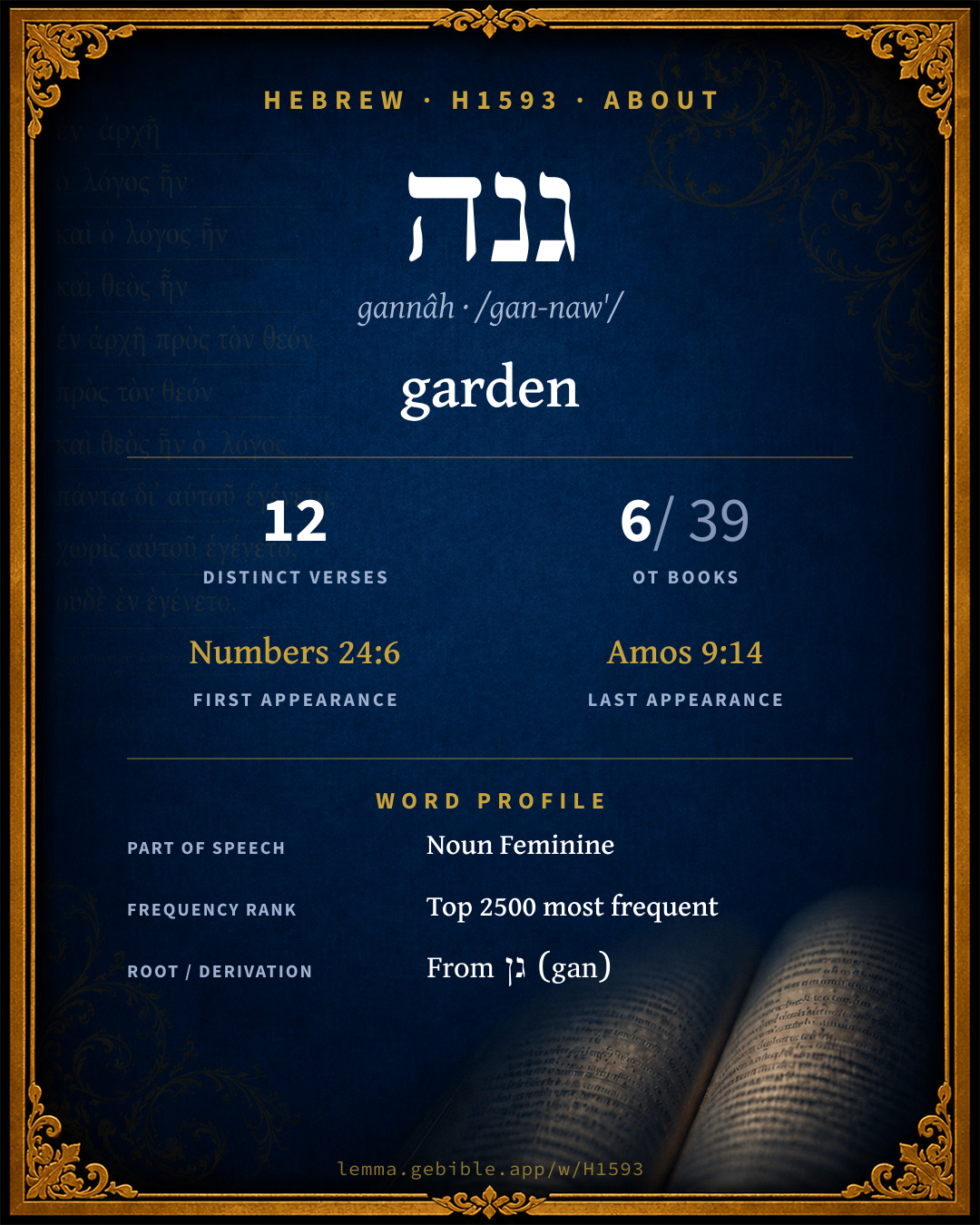
גַּנָּה
garden
Full lexicon entry — Brown-Driver-Briggs (BDB)
From Brown-Driver-Briggs (BDB)
Where this word appears
See every Absolute-state word in the Hebrew Bible →
Grammar key — what these labels mean
Part of speech
- Noun
- A naming word — a person, place, thing, or idea.
Noun type
- Common
- A common noun — a general class of person, place, or thing (“king,” “city,” “water”), not a specific name.
State
- Absolute
- The independent form of a noun, not bound to a following word.
- Construct
- A noun bound to a following noun in a possessive / “of” relationship (the construct chain).
Gender
- Feminine
- Grammatically feminine.
Number
- Plural
- More than one (in Hebrew, generally three or more).
- Singular
- One.
Grammatical forms
- Noun, Common, Feminine, Plural, Absolute 8 times (67%)
- Noun, Common, Feminine, Singular, Absolute 2 times (17%)
- Noun, Common, Feminine, Plural, Construct 1 time (8%)
- Noun, Common, Feminine, Singular, Construct 1 time (8%)
Parsed forms decoded from the imported morphology (morphhb / Westminster Leningrad Codex — WLC text public domain, morphhb tagging CC BY 4.0), counted across 12 parsed occurrences — not distinct verses.
Every verse where H1593 appears — 12 distinct verses across 6 books. Click any verse to open its interlinear word-by-word view. Verse text shown in the World English Bible for context — . Each verse’s Hebrew form is shown with its reference; the English is not keyword-highlighted, since the data carries no word-level English alignment. Use “Compare translations” on any verse to read it across multiple English versions. This concordance covers the Hebrew Bible; Septuagint (Greek Old Testament) occurrences are not indexed here.
Numbers 1 verse
Job 1 verse
Ecclesiastes 1 verse
Isaiah 5 verses
- Isaiah 1:29 מֵ/הַ/גַּנּ֖וֹת prep + ptcl def.art + n c fp For they shall be ashamed of the oaks which you have desired, And you shall be confounded for the gardens that you have chosen.
- Isaiah 1:30 וּֽ/כְ/גַנָּ֔ה conj + prep + n c fs For you shall be as an oak whose leaf fades, And as a garden that has no water.
- Isaiah 61:11 וּ/כְ/גַנָּ֖ה conj + prep + n c fs For as the earth brings forth its bud, and as the garden causes the things that are sown in it to spring forth; so the Lord Yahweh will cause righteousness and praise to spring forth before all the nations.
- Isaiah 65:3 בַּ/גַּנּ֔וֹת prep det + n c fp a people who provoke me to my face continually, sacrificing in gardens, and burning incense on bricks;
- Isaiah 66:17 הַ/גַּנּ֗וֹת ptcl def.art + n c fp Those who sanctify themselves and purify themselves [to go] to the gardens, behind one in the midst, eating pig's flesh, and the abomination, and the mouse, they shall come to an end together, says Yahweh.
Jeremiah 2 verses
Amos 2 verses
- Amos 4:9 גַּנּוֹתֵי/כֶ֧ם n c fp cs + sfx pers 2mp I struck you with blight and mildew many times in your gardens and your vineyards; And your fig trees and your olive trees have the swarming locust devoured: Yet you haven't returned to me," says Yahweh.
- Amos 9:14 גַנּ֔וֹת n c fp I will bring back the captivity of my people Israel, And they will rebuild the ruined cities, and inhabit them; and they will plant vineyards, and drink wine from them. They shall also make gardens, And eat the fruit of them.
About this entry
At a glance — auto-summarized from this page’s data, not written by a person. Every figure links to its source below. This summary describes the numbers; it doesn’t interpret them.
At its core, גנה (gannâh) means “garden.” It first appears in Numbers 24:6. Spanning 12 verses in 6 books, it ranks among the uncommon words of the Hebrew Bible. Its uses concentrate in Isaiah (42% of all occurrences). Sharing its root, it stands alongside גן and גנה. Each statement above links to its evidence; the full detail follows below.
Gloss history
Strong's 1890 vs modern scholarship
About this word
Strong's H1593 catalogs a Hebrew word from the Hebrew Old Testament.
These counts are not copied from any lexicon or concordance. They are computed here, from the morphology-tagged Hebrew Old Testament. What Lemma adds →
- 12
- distinct verses
- The word appears in 12 distinct verses.
- 6 / 39
- OT books
- The word appears in 6 of 39 Old Testament books.
- #2,101
- by frequency
- Top 2500 most frequent Hebrew words (rank 2,101 of 8,640 Hebrew words by occurrence).
View all 12 occurrences in the concordance →
By section of the Old Testament
By traditional corpus
Conventional, traditional groupings — biblical authorship is debated, so this is a traditional corpus grouping, not an authorship claim. Each share is this word’s portion of its verses in that division of the Hebrew canon. Each figure is a share of the word’s 12 distinct verses.
- Prophets (Nevi'im) 9 verses · 75%
- Writings (Ketuvim) 2 verses · 17%
- Torah (Pentateuch) 1 verse · 8%
How translations render this word
Counts come from each version’s own published word-to-Strong’s tagging or interlinear alignment — an approximate guide to how each version renders this word, not a word-level alignment the data otherwise carries. Because each total is that version’s own tagged count, the per-version totals vary from one another and need not match the appearance or distinct-verse counts above. These counts may also differ from a printed concordance because Lemma counts each distinctly tagged rendering and does not collapse phrase taggings into a single head-word total. This is a fixed set of word-tagged versions (KJV, ASV, BSB, ULT) and does not change with the reading translation you choose elsewhere. Each version’s license is shown beside its name below (and on Sources).
- King James Version: Gardens 8×, Garden 3×
- American Standard Version: Gardens 5×, Garden 2×, Plant gardens 2×
- Berean Standard Bible: Gardens 7×, Garden 2×
- unfoldingWord Literal Text: Gardens 5×, Garden 2×
King James Version Public Domain
Renders H1593 across 12 tagged occurrences — most commonly:
Plus 1 rendering that appears only once — usually multi-word phrases or single function words the recovered tagging swept in, not distinct renderings.
American Standard Version Public Domain
Renders H1593 across 12 tagged occurrences — most commonly:
Plus 3 renderings that appear only once — usually multi-word phrases or single function words the recovered tagging swept in, not distinct renderings.
Berean Standard Bible Public Domain
Renders H1593 across 12 tagged occurrences — most commonly:
Plus 3 renderings that appear only once — usually multi-word phrases or single function words the recovered tagging swept in, not distinct renderings.
unfoldingWord Literal Text CC BY-SA 4.0
Renders H1593 across 10 tagged occurrences — most commonly:
Plus 3 renderings that appear only once — usually multi-word phrases or single function words the recovered tagging swept in, not distinct renderings.
Senses in BDB
The 1 sense BDB distinguishes for this word, in lexicon order (not ranked by frequency or importance). The full entry — with sub-senses — is in the Lexicon Entry tab.
- garden, orchard
Word origin
Derived from גן (gan) (H1588) — garden.
Jastrow Dictionary
A second Hebrew/Aramaic lexicon for comparison, covering Aramaic and post-biblical (Talmudic, Targumic, Midrashic) usage that the biblical-Hebrew BDB does not. Matched by lemma rather than by Strong’s number, so a lemma may carry more than one Jastrow headword (shown separately below), and the entries cover usage well beyond the Bible.
גְּנַהּ
- , v. גְּנַח I
גַּנָּה
- , v. גַּן
גָּנָה
- , v. גני
*גְּנַה II
- to cut, pass swiftly. Targ. Ps. VIII, 9 Ar. (ed. חליף, h. text עובר).
- to castrate. B. Mets. 90ᵇ top they take them stealthily ומְגַנְּחִין יתהון (Ms. M. וגזזין, v. גְּזַז; v. Rabb. D. S. a. l. note). [גנח prob. misread for גוזז, a. מגנחין for מְגַוְּוזִין, denom. of גַּוָּוזָא II. Cmp. form of letters, Sabb. XII, 5; 103ᵇ; 104ᵇ.]
גני
- (cmp. גָּנַן) to cover, be covered.
- to overshadow, to obscure, to put to shame; to censure. Snh. 92ᵇ היו מְגַנִּין את החמה וכ׳ obscured the sun with their beauty. Gitt. 58ᵃ היו מג׳ את הפז וכ׳ they outshone the finest gold with their beauty. Snh. l. c. ביקש לְגַנּוֹת וכ׳ he would have attempted to excel all the praises &c.—Sabb. 33ᵇ שגי׳ who criticised (the Roman government); a. fr.—Part. pass. מְגוּנֶּה deserving to be covered up, reprehensible, indecent; ugly. Pes. 3ᵃ דבר מג׳ an ugly expression e.g. טמא in place of לא טהור. Ber. 33ᵇ הרי זה מג׳ he is to be reprehended; ib. 45ᵇ, opp. משובח; a. fr.
- to make one’s self reprehensible, to become repulsive. Ḥag. 15ᵇ ומה למִתְגַּנִּין בה וכ׳ if such regard is paid to those who abuse the knowledge of the Law &c., opp. משתבחין. Kidd. 41ᵃ he may see in her דבר מגינה ותִתְגַּנֶּה עליו something objectionable, and she may become repulsive to him. Yoma 78ᵇ, v. אֵיבָה. Keth. 65ᵇ; a. fr.
A Dictionary of the Targumim, the Talmud Babli and Yerushalmi, and the Midrashic Literature (Marcus Jastrow; London, Luzac, 1903) — Public Domain. Digitized via Sefaria. Digitized via Sefaria. Full attribution on Sources.
Forms in the corpus
The 10 distinct written forms H1593 takes in the Hebrew Bible, most frequent first — each parse links to that state’s occurrences in the concordance. Hebrew forms include their vowel points and cantillation, so a single lemma takes many written forms.
| Form | Parsing | Example | Uses |
|---|---|---|---|
| גַנּ֔וֹת | Noun, Common, Feminine, Plural, Absolute | Amos 9:14 | 3 |
| בַּ/גַּנּ֔וֹת | Noun, Common, Feminine, Plural, Absolute | Isaiah 65:3 | 1 |
| גַּ֝נָּת֗/וֹ | Noun, Common, Feminine, Singular, Construct | Job 8:16 | 1 |
| גַּנּ֖וֹת | Noun, Common, Feminine, Plural, Absolute | Ecclesiastes 2:5 | 1 |
| גַּנּוֹתֵי/כֶ֧ם | Noun, Common, Feminine, Plural, Construct | Amos 4:9 | 1 |
| הַ/גַּנּ֗וֹת | Noun, Common, Feminine, Plural, Absolute | Isaiah 66:17 | 1 |
| וּ/כְ/גַנָּ֖ה | Noun, Common, Feminine, Singular, Absolute | Isaiah 61:11 | 1 |
| וּֽ/כְ/גַנָּ֔ה | Noun, Common, Feminine, Singular, Absolute | Isaiah 1:30 | 1 |
| כְּ/גַנֹּ֖ת | Noun, Common, Feminine, Plural, Absolute | Numbers 24:6 | 1 |
| מֵ/הַ/גַּנּ֖וֹת | Noun, Common, Feminine, Plural, Absolute | Isaiah 1:29 | 1 |
Same root — word family
Other BDB entries built from the same root as H1593, grouped by Strong’s listed origin. These share a root / origin per the lexicon — not necessarily a shared meaning. Each links to that word’s own entry.
Derives from
Derived from this word
Compare all same-root words → They share a root, not necessarily a meaning.
Septuagint verse parallels
This word appears in 11 verses that also exist in the Greek Old Testament (Septuagint), out of the 12 Hebrew verses it occurs in. You can read those verses in Greek by switching the Old Testament edition to the Septuagint.
Read these verses in the Septuagint
This is a verse-level parallel only — the same verses exist in both the Hebrew and Greek Old Testaments. No word-level Hebrew↔Greek correspondence is claimed: the data carries no such alignment, so no Greek word is shown as this Hebrew word’s translation. Coverage is not total — the Septuagint omits the deuterocanon and renumbers the Psalms, so some Hebrew verses have no direct Greek parallel.