
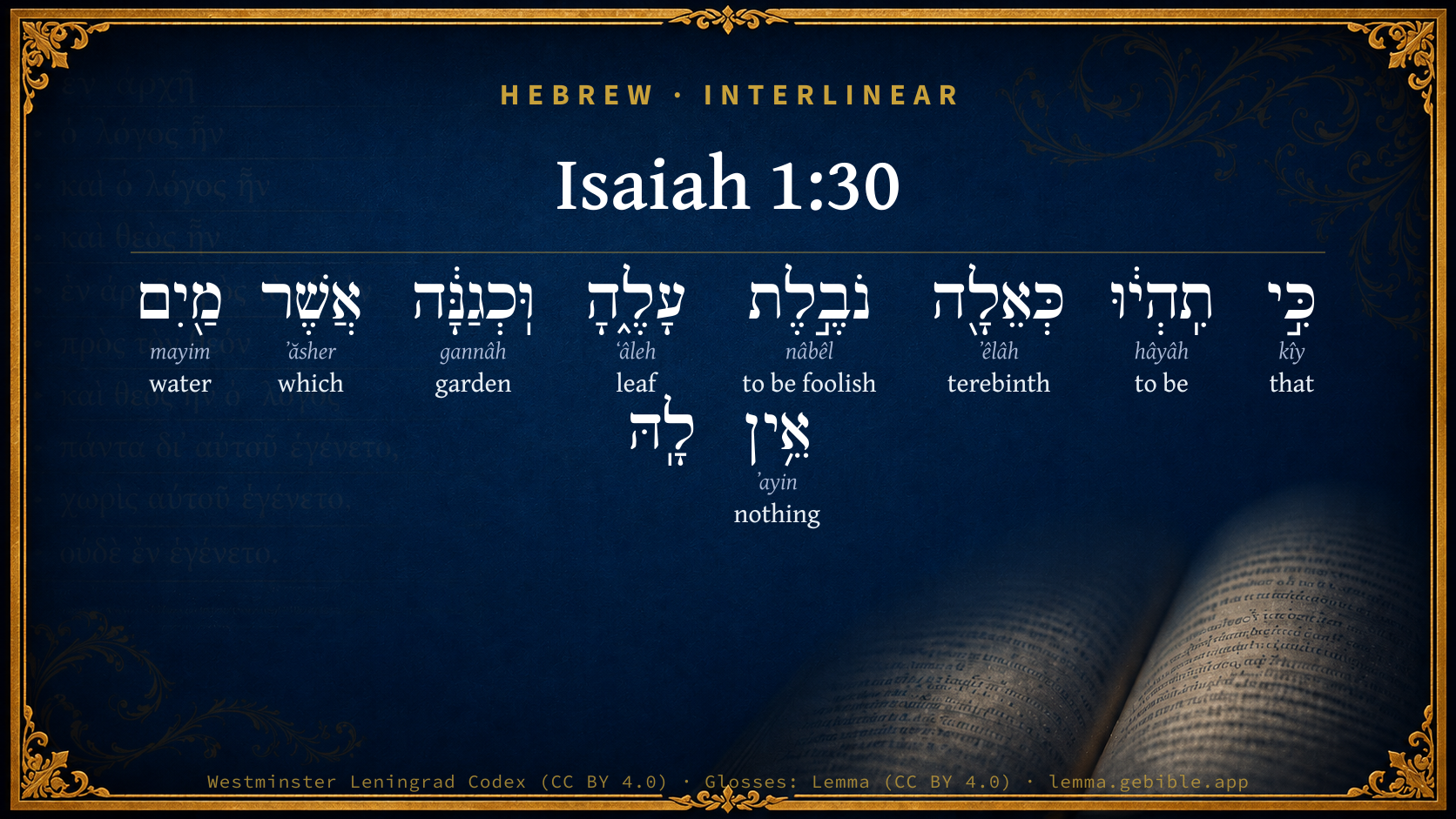
Isaiah 1:30

Hebrew (Westminster Leningrad Codex) Isaiah 1:30 appears in the Hebrew Old Testament. The text above is from the Westminster Leningrad Codex. Each word links to its Strong’s number, a concise gloss, and parsing drawn from the Open Scriptures Hebrew Bible morphology. Click any word for its full Brown-Driver-Briggs (BDB) entry.
Download image
Cite this verse

Isaiah 1:30 (World English Bible). Public Domain. Lemma interlinear Bible study tool, https://lemma.gebible.app/v/isaiah/1/30.

Show BibTeX & RIS
BibTeX
RIS
English Translation
For you shall be as an oak whose leaf fades, And as a garden that has no water.
World English Bible · Public Domain
Download a study sheet

One document with this verse’s original text, its word-by-word gloss line, the meaning frame, cross-references with their text, attributed commentary, and full source and license credits — printable, and it pastes into notes with its structure intact.

This verse Autodidact and up

Study sheet (.html) Plain text (.txt)

A passage Seminary Student

Up to 50 verses in one chapter. A passage sheet keeps up to 6 commentary sources and 12 cross-references per verse, in the order this page ranks them, and says so on the sheet whenever that leaves anything out. Ask for a single verse and you get the Autodidact verse sheet above.

Everything on this page stays free to read, with no account — the sheet is a download of what is already on screen, not access to it.

Want to remove ads? Support Godless Engineer
Compare translations 3

The same verse in 3 English versions, stacked beneath the original-language interlinear above. Click any original word for its lexicon entry.

Each is an independent rendering of the whole verse — the interlinear is not word-aligned to these translations.

Highlighted words mark where these versions differ — a whole-verse word diff, not a word-by-word alignment.

  • World English Bible Public Domain
    For you shall be as an oak whose leaf fades, And as a garden that has no water.
  • King James Version Public Domain
    For ye shall be as an oak whose leaf fadeth, and as a garden that hath no water.
  • unfoldingWord Literal Text CC BY-SA 4.0
    For you will be like an oak, its leaf withering, and like a garden that no water to it.

unfoldingWord Literal Text — © unfoldingWord, licensed CC BY-SA 4.0. Word-aligned USFM3 via Door43 (git.door43.org/unfoldingWord/en_ult).

Versions to compare (up to 4)

3 of 4 selected

Show all 18 translations

Every available English version of this verse, each an independent rendering of the whole verse.

  • World English Bible Public Domain
    For you shall be as an oak whose leaf fades, And as a garden that has no water.
  • Berean Standard Bible Public Domain
    For you will become like an oak whose leaves are withered, like a garden without water.
  • Majority Standard Bible Public Domain
    For you will become like an oak whose leaves are withered, like a garden without water.
  • King James Version Public Domain
    For ye shall be as an oak whose leaf fadeth, and as a garden that hath no water.
  • American Standard Version (1901) Public Domain
    For ye shall be as an oak whose leaf fadeth, and as a garden that hath no water.
  • Revised Version (1885) Public Domain
    For ye shall be as an oak whose leaf fadeth, and as a garden that hath no water.
  • Geneva Bible (1599) Public Domain
    For ye shalbe as an oke, whose leafe fadeth: and as a garden that hath no water.
  • Douay-Rheims (1899) Public Domain
    When you shall be as an oak with the leaves falling off, and as a garden without water.
  • Young's Literal Translation Public Domain
    For ye are as an oak whose leaf is fading, And as a garden that hath no water.
  • Literal Standard Version CC BY-SA 4.0
    For you are as an oak whose leaf is fading, || And as a garden that has no water.
  • Unlocked Literal Bible CC BY-SA 4.0
    For you will be like an oak whose leaf fades, and like a garden that has no water.
  • unfoldingWord Literal Text CC BY-SA 4.0
    For you will be like an oak, its leaf withering, and like a garden that no water to it.
  • Darby Bible Public Domain
    For ye shall be as a terebinth whose leaf fadeth, and as a garden that hath no water.
  • World Messianic Bible Public Domain
    For you shall be as an oak whose leaf fades, and as a garden that has no water.
  • Webster's Bible Public Domain
    For ye shall be as an oak whose leaf fadeth, and as a garden that hath no water.
  • Free Bible Version CC BY-SA 4.0
    As a result you will become like an oak whose leaves have withered, a dried-out garden that has no water.
  • Bible in Basic English Public Domain
    For you will be like a tree whose leaves have become dry, and like a garden without water.
  • JPS Tanakh (1917) Public Domain
    For ye shall be as a terebinth whose leaf fadeth, and as a garden that hath no water.

Literal Standard Version (2020), Covenant Press — licensed CC BY-SA 4.0. Text via the HelloAO Bible API (eBible.org). Unlocked Literal Bible (unfoldingWord) — licensed CC BY-SA 4.0. Text via the HelloAO Bible API (eBible.org). unfoldingWord Literal Text — © unfoldingWord, licensed CC BY-SA 4.0. Word-aligned USFM3 via Door43 (git.door43.org/unfoldingWord/en_ult). Free Bible Version, Dr. Jonathan Gallagher — licensed CC BY-SA 4.0. Text via the HelloAO Bible API (eBible.org).

Word by word

More ways to search: Search by grammar → Find every occurrence → Compare this word →

Practice this passage: Drill this verse → Learn its vocabulary →

וּֽכְגַנָּ֔ה
gannâh
H1593
“and · like/as · garden”
Conjunction + Preposition + Noun, Common, Feminine, Singular, Absolute
Part of Speech
Conjunction + Preposition + Noun
Type
Common
Gender
Feminine
Number
Singular
State
Absolute
Full BDB Definition

Origin: from H1588

TWOT: 367b

garden, orchard
  1. כִּ֣י kîy H3588 “that” Conjunction
  2. תִֽהְי֔וּ hâyâh H1961 “to be” Verb, Qal, Imperfect, 2nd Person, Masculine, Plural
  3. כְּאֵלָ֖ה ʼêlâh H424 “like/as · terebinth” Preposition + Noun, Common, Feminine, Singular, Absolute
  4. נֹבֶ֣לֶת nâbêl H5034 “being foolish” Verb, Qal, Participle Active, Feminine, Singular, Construct
  5. עָלֶ֑הָ ʻâleh H5929 “leaf · her” Noun, Common, Masculine, Singular, Construct + Suffix, Personal, 3rd Person, Feminine, Singular
  6. אֲשֶׁר ʼăsher H834 “which” Particle, Relative
  7. מַ֖יִם mayim H4325 “water(s)” Noun, Common, Masculine, Plural, Absolute
  8. אֵ֥ין ʼayin H369 “nothing” Particle, Negative

About this verse

These counts appear in no published source. They are computed here, from the morphology-tagged text and Lemma’s own curated glosses. What Lemma adds →

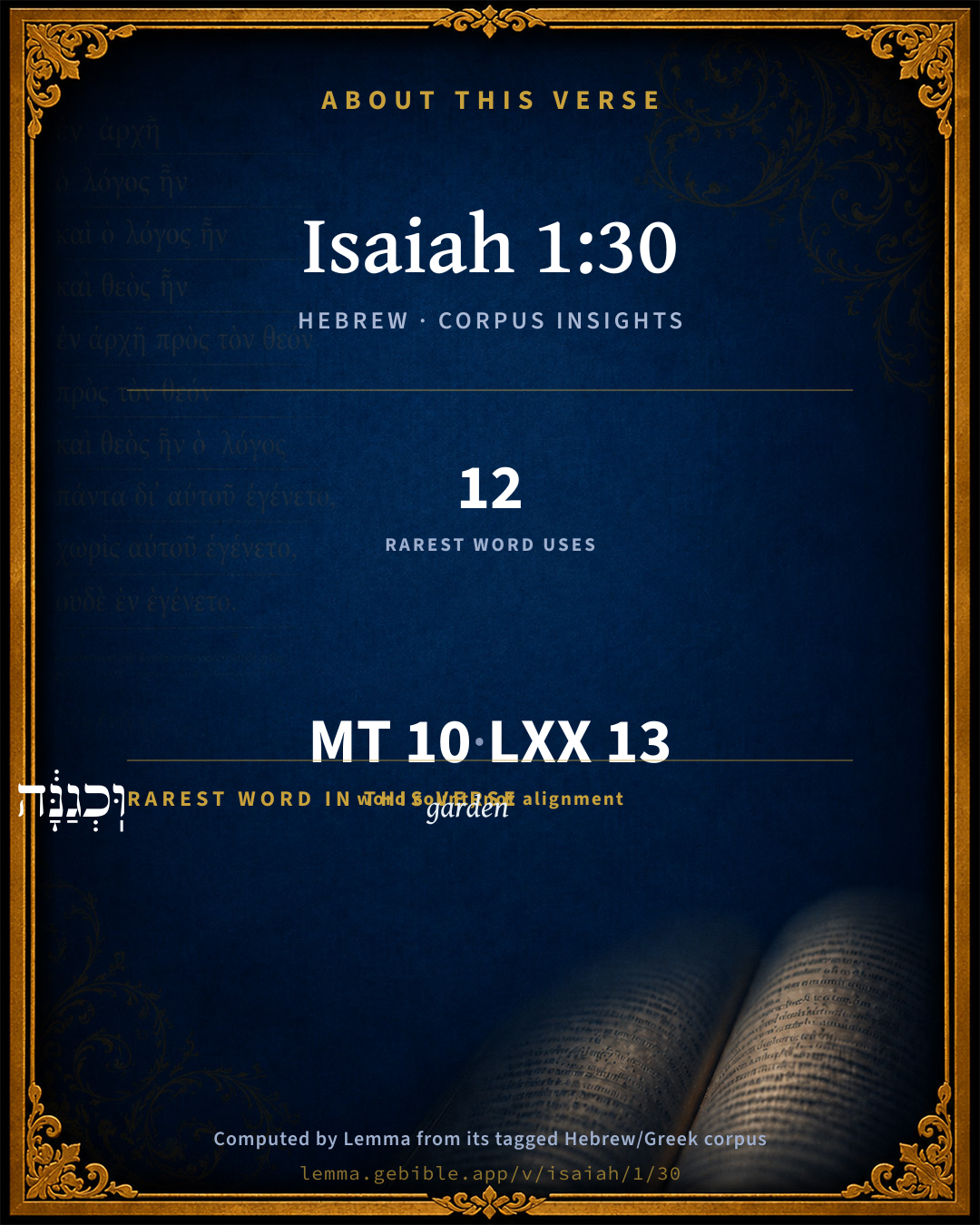
10
words
9
distinct lemmas
Prophets
section

Notable vocabulary

The rarest word here is וּֽכְגַנָּ֔ה garden H1593 — appearing just 12 times in the whole Hebrew Bible.

Shared distinctive vocabulary

וּֽכְגַנָּ֔ה garden H1593 occurs in 12 verses of the Hebrew Bible. Also found in:

Grammatical profile

  • 2 verbs
  • 4 nouns
  • 1 preposition
  • 1 conjunction
  • 2 particles

Verb forms

  • תִֽהְי֔וּ Qal · Imperfect
  • נֹבֶ֣לֶת Qal · Participle Active

Hebrew & Septuagint length

In English translation the verse runs 18 words from the Hebrew and 21 from the Septuagint (LXX English) — closely comparable.

A rough comparison of the two English renderings, which tokenize alike — not a word-level alignment.

Word counts can differ between the Hebrew and the Greek without any difference in meaning — e.g. the Hebrew direct-object marker אֵת has no separate Greek word, and Greek often adds the article ὁ.

In the original languages it is 10 Hebrew tokens and 13 Greek tokens — but the two are counted differently (Hebrew bundles its prefixes and suffixes into one token; the Greek is in lemma form), so that isn’t a like-for-like length.

Cross-references

8

Topical passages linked to Isaiah 1:30 in the Treasury of Scripture Knowledge — connected by theme and wording, ordered by reader-vote popularity; previews shown in the World English Bible.

  • Jeremiah 17:5–6 Thus says Yahweh: Cursed is the man who trusts in man, and makes flesh his arm, and whose heart departs from Yahweh.
  • Isaiah 5:6 I will lay it a wasteland. It won't be pruned nor hoed, But it will grow briers and thorns. I will also command the clouds that they rain no rain on it."
  • Isaiah 58:11 and Yahweh will guide you continually, and satisfy your soul in dry places, and make strong your bones; and you shall be like a watered garden, and like a spring of water, whose waters don't fail.
  • Jeremiah 31:12 They shall come and sing in the height of Zion, and shall flow to the goodness of Yahweh, to the grain, and to the new wine, and to the oil, and to the young of the flock and of the herd: and their soul shall be as a watered garden; and they shall not sorrow any more at all.
  • Ezekiel 17:9–10 Say you, Thus says the Lord Yahweh: Shall it prosper? shall he not pull up the roots of it, and cut off the fruit of it, that it may wither; that all its fresh springing leaves may wither? and not by a strong arm or much people can it be raised from the roots of it.
  • Ezekiel 17:24 All the trees of the field shall know that I, Yahweh, have brought down the high tree, have exalted the low tree, have dried up the green tree, and have made the dry tree to flourish; I, Yahweh, have spoken and have done it.
  • Ezekiel 31:4–18 The waters nourished it, the deep made it to grow: the rivers of it ran round about its plantation; and it sent out its channels to all the trees of the field.
  • Matthew 21:19 Seeing a fig tree by the road, he came to it, and found nothing on it but leaves. He said to it, "Let there be no fruit from you forever!" Immediately the fig tree withered away.

Cross-references courtesy of OpenBible.info (CC BY 4.0).

Hebrew and Greek witnesses Masoretic Hebrew ↔ Greek Septuagint

The same verse in the two great witnesses to the Old Testament, shown verse-for-verse.

These are two independent witnesses, not word-aligned to each other, and the Septuagint is shown in lemma (dictionary) form.

Hebrew Isaiah 1:30 Masoretic · Westminster Leningrad Codex

כִּ֣י תִֽהְי֔וּ כְּאֵלָ֖ה נֹבֶ֣לֶת עָלֶ֑הָ וּֽכְגַנָּ֔ה אֲשֶׁר מַ֖יִם אֵ֥ין לָֽהּ

For you shall be as an oak whose leaf fades, And as a garden that has no water.

World English Bible · Public Domain

Greek LXX Isaiah 1:30 Septuagint · lemma form

εἰμί γάρ ὡς τερέβινθος ἀποβάλλω ὁ φύλλον καί ὡς παράδεισος ὕδωρ μή ἔχω

For they shall be as a turpentine tree that has cast its leaves, and as a garden that has no water.

LXX2012 (modern English Septuagint) · Public Domain

Hebrew: Westminster Leningrad Codex (CC BY 4.0). Greek: Septuagint (public domain); English from LXX2012 (modern English Septuagint) (Public Domain). How the Septuagint differs from the Hebrew →

Targum (Aramaic paraphrase)

1

The Targum is the ancient Jewish Aramaic paraphrase of the Hebrew Scriptures — an interpretive translation, not the Hebrew text itself. Onkelos (literal) and Pseudo-Jonathan (expansive) render the Torah, and Jonathan the Prophets. Coverage is partial: where no permissively-licensed English translation exists for a verse, only the Aramaic is shown. This is verse-level text, not a word-by-word alignment to the Hebrew.

  1. Targum Jonathan Prophets (Joshua–Malachi)
    אֲרֵי תְהוֹן כְּבוּטְמָא דִי מְנַתַּר טַרְפוֹהִי וּכְגִנַת שַׁקְיָא דְמַיָן לֵית לָהּ:

    For ye shall be as an oak whose leaf fadeth, and as a watered garden that hath no water.

    Targum Jonathan — Aramaic: “Mikraot Gedolot” (public domain). English: “Sefaria Community Translation” (CC0 1.0 (public-domain dedication)); “London "Chaldee Paraphrase," 1871” (public domain). Text via Sefaria.

Commentary

Notes on Isaiah 1:30 from classic Christian and Jewish commentators (each source and its license shown beneath its notes). The classic Christian expositions comment on the surrounding passage and are grouped to its opening verse, so a note may address several verses; the Jewish commentaries on the Tanakh (Rashi and others) are per-verse, so they appear only where the commentator wrote on this verse.

Lemma curates 59 commentaries, every one of them public domain or Creative Commons licensed, each selected and text-cleaned for this edition rather than reprinted as found. About our sources →

Trapp's Complete Commentary

John Trapp

Isa 1:30 For ye shall be as an oak whose leaf fadeth, and as a garden that hath no water.

Ver. 30. For ye shall be as an oak.] Peccato poenam accommodat; By oaks they sinned, and by a withering {a} oak is their punishment set forth: as also by a garden that wanteth water, wherein everything fadeth and hangeth the head, as suffering a marasm. Well might God say, Hos 12:10, "I have multiplied visions, and used similitudes by the ministry of the prophets," such as are very natural, plain, and proper.

{a} Infelicissime marcescetis et exarescetis. - Jun.

John Trapp, A Commentary or Exposition upon All the Books of the Old and New Testament (1647–1656) — public domain. Text from a community e-Sword module.

Joseph Benson's Commentary

Isa 1:30. For ye shall be as an oak, &c. — As you have sinned under the oaks and in the gardens, so you shall be like unto oaks and gardens, not when they are green and flourishing, but when they wither and decay. This verse is remarkably elegant, in which, what was the pleasure and confidence of those idolaters, is made to denote their punishment. “All the gardens in the East,” says a late writer, “have water in them, which is so absolutely necessary, that without it every thing, in summer, would be parched up. This is a circumstance which we should attend to, if we would enter into the energy of the latter clause.”

Joseph Benson's Commentary on the Old and New Testaments (1811–1818) — public domain. Text from a community e-Sword module.

MacLaren's Expositions of Holy Scripture

Alexander MacLaren

Isaiah

WHAT SIN DOES TO MEN

Isa 1:30 - Isa 1:31.

The original reference of these words is to the threatened retribution for national idolatry, of which ‘oaks’ and ‘gardens’ were both seats. The nation was, as it were, dried up and made inflammable; the idol was as the ‘spark’ or the occasion for destruction. But a wider application, which comes home to us all, is to the fatal results of sin. These need to be very plainly stated, because of the deceitfulness of sin, which goes on slaying men by thousands in silence.

‘That grim wolf with privy paw

Daily devours apace.’

I. Sin withers.

We see the picture of a blasted tree in the woods, while all around are in full leaf, with tiny leaves half developed and all brown at the edges. The prophet draws another picture, that of a garden not irrigated, and therefore, in the burning East, given over to barrenness.

Sin makes men fruitless and withered.

It involves separation from God, the source of all fruitfulness {Psa 1:1 - Psa 1:6}.

Think of how many pure desires and innocent susceptibilities die out of a sinful soul. Think of how many capacities for good disappear. Think of how dry and seared the heart becomes. Think of how conscience is stifled.

All sin-any sin-does this.

Not only gross, open transgressions, but any piece of godless living will do it.

Whatever a man does against his conscience-neglect of duty, habitual unveracity, idleness-in a word, his besetting sin withers him up.

And all the while the evil thing that is drawing his life-blood is growing like a poisonous, blotched fungus in a wine-cask.

II. Sin makes men inflammable.

‘As tow’ or tinder.

A subsidiary reference may be intended to the sinful man as easily catching fire at temptation. But the main thought is that sin makes a man ready for destruction, ‘whose end is to be burned.’

The materials for retribution are laid up in a man’s nature by wrong-doing. The conspirators store the dynamite in a dark cellar. Conscience and memory are charged with explosives.

If tendencies, habits, and desires become tyrannous by long indulgence and cannot be indulged, what a fierce fire would rage then!

We have only to suppose a man made to know what is the real moral character of his actions, and to be unable to give them up, to have hell.

All this is confirmed by occasional glimpses which men get of themselves. Our own characters are the true Medusa-head which turns a man into stone when he sees it.

What, then, are we really doing by our sins? Piling together fuel for burning.

III. Sin burns up.

‘Work as a spark.’ The evil deeds brought into contact with the doer work destruction. That is, if, in a future life or at any time, a man is brought face to face with his acts, then retribution begins. We shake off the burden of our actions by want of remembrance. But that power of ignoring the past may be broken down at any time. Suppose it happens that in another world it can no longer be exercised, what then?

Evil deeds are the occasion of the divine retribution. They are ‘a spark.’ It is they who light the pyre, not God. The prophet here protests in God’s name against the notion that He is to be blamed for punishing. Men are their own self-tormentors. The sinful man immolates himself. Like Isaac, he carries the wood and lays the pile for his own burning.

Christ severs the connection between us and our evil. He restores beauty and freshness to the blighted tree, planting it as ‘by the river of water,’ so that it ‘bringeth forth its fruit in its season,’ and its ‘leaf also doth not wither.’

Alexander MacLaren, Expositions of Holy Scripture (1904–1910) — public domain. Text from a community e-Sword module.

Jamieson, Fausset & Brown

Robert Jamieson, A. R. Fausset & David Brown

oak--Ye shall be like the "oaks," the object of your "desire" (Isa 1:29). People become like the gods they worship; they never rise above their level (Psa 135:18). So men's sins become their own scourges (Jer 2:9). The leaf of the idol oak fades by a law of necessary consequence, having no living sap or "water" from God. So "garden" answers to "gardens" (Isa 1:29).

Jamieson, Fausset & Brown — Commentary Critical and Explanatory on the Whole Bible (1871) — public domain (CC PDM 1.0). Text via the HelloAO Bible API.

Adam Clarke's Commentary

Verse 30. Whose leaf - "Whose leaves"] Twenty-six of Kennicott's, twenty-four of De Rossi's, one ancient, of my own, and seven editions, read אליה aleyha, in its full and regular form. This is worth remarking, as it accounts for a great number of anomalies of the like kind, which want only the same authority to rectify them.

As a garden that hath no water - "A garden wherein is no water."] In the hotter parts of the Eastern countries, a constant supply of water is so absolutely necessary for the cultivation and even for the preservation and existence of a garden, that should it want water but for a few days, every thing in it would be burnt up with the heat, and totally destroyed. There is therefore no garden whatever in those countries but what has such a certain supply, either from some neighbouring river, or from a reservoir of water collected from springs, or filled with rain water in the proper season, in sufficient quantity to afford ample provision for the rest of the year.

Moses, having described the habitation of man newly created as a garden planted with every tree pleasant to the sight and good for food, adds, as a circumstance necessary to complete the idea of a garden, that it was well supplied with water, "And a river went out of Eden to water the garden;" Ge 2:10: see also Ge 13:10.

That the reader may have a clear notion of this matter, it will be necessary to give some account of the management of their gardens in this respect.

"Damascus," says Maundrell, p. 122, "is encompassed with gardens, extending no less, recording to common estimation, than thirty miles round; which makes it look like a city in a vast wood. The gardens are thick set with fruit trees of all kinds, kept fresh and verdant by the waters of the Barrady, (the Chrysorrhoas of the ancients,) which supply both the gardens and city in great abundance. This river, as soon as it issues out from between the cleft of the mountain before mentioned into the plain, is immediately divided into three streams; of which the middlemost and biggest runs directly to Damascus, and is distributed to all the cisterns and fountains of the city. The other two (which I take to be the work of art) are drawn round, one to the right hand, and the other to the left, on the borders of the gardens, into which they are let as they pass, by little currents, and so dispersed all over the vast wood, insomuch that there is not a garden but has a fine quick stream running through it. The Barrady is almost wholly drunk up by the city and gardens. What small part of it escapes is united, as I was informed, in one channel again on the southeast side of the city; and, after about three or four hours' course finally loses itself in a bog there, without ever arriving at the sea." This was likewise the case in former times, as Strabo, lib. xvi., Pliny, lib. v. 18, testify; who say, "that this river was expended in canals, and drunk up by watering the place."

"The best sight," says the same Maundrell, p. 39, "that the palace of the emir of Beroot, anciently Berytus, affords, and the worthiest to be remembered, is the orange garden. It contains a large quadrangular plat of ground, divided into sixteen lesser squares, four in a row, with walks between them. The walks are shaded with orange trees of a large spreading size. Every one of these sixteen lesser squares in the garden was bordered with stone; and in the stone work were troughs, very artificially contrived, for conveying the water all over the garden; there being little outlets cut at every tree for the stream as it passed by to flow out and water it." The royal gardens at Ispahan are watered just in the same manner, according to Kempfer's description, Amoen. Exot., p. 193.

This gives us a clear idea of the פלגי מים palgey mayim, mentioned in the first Psalm, and other places of Scripture, "the divisions of waters," the waters distributed in artificial canals; for so the phrase properly signifies. The prophet Jeremiah, Jer 17:8, has imitated, and elegantly amplified, the passage of the psalmist above referred to: -

"He shall be like a tree planted by the water side,

And which sendeth forth her roots to the aqueduct.

She shall not fear, when the heat cometh;

But her leaf shall be green;

And in the year of drought she shall not be anxious,

Neither shall she cease from bearing fruit."

From this image the son of Sirach, Ecclus. 24:30, 31, has most beautifully illustrated the influence and the increase of religious wisdom in a well prepared heart.

"I also come forth as a canal from a river,

And as a conduit flowing into a paradise.

I said, I will water my garden,

And I will abundantly moisten my border:

And, lo! my canal became a river,

And my river became a sea."

This gives us the true meaning of the following elegant proverb, Pr 21:1: -

"The heart of the king is like the canals of

waters in the hand of JEHOVAH;

Whithersoever it pleaseth him, he inclineth it."

The direction of it is in the hand of JEHOVAH, as the distribution of the water of the reservoir through the garden by different canals is at the will of the gardener.

"Et, cum exustus ager morientibus aestuat herbis,

Ecce supercilio clivosi tramitis undam

Elicit: illa cadens raucum per levia murmur

Saxa ciet, scatebrisque arentia temperat arva."

Virg., Georg. i. 107.

"Then, when the fiery suns too fiercely play,

And shrivelled herbs on withering stems decay,

The wary ploughman on the mountain's brow

Undams his watery stores; huge torrents flow;

And, rattling down the rocks, large moisture yield,

Tempering the thirsty fever of the field."

DRYDEN.

Solomon, Ec 2:5-6, mentions his own works of this kind: -

"I made me gardens, and paradises;

And I planted in them all kinds of fruit trees.

I made me pools of water,

To water with them the grove flourishing with trees."

Maundrell, p. 88, has given a description of the remains, as they are said to be, of these very pools made by Solomon, for the reception and preservation of the waters of a spring, rising at a little distance from them; which will give us a perfect notion of the contrivance and design of such reservoirs.

"As for the pools, they are three in number, lying in a row above each other; being so disposed that the waters of the uppermost may descend into the second, and those of the second into the third. Their figure is quadrangular, the breadth is the same in all, amounting to about ninety paces. In their length there is some difference between them; the first being about one hundred and sixty paces long, the second, two hundred, and the third, two hundred and twenty. They are all lined with wall and plastered; and contain a great depth of water."

The immense works which were made by the ancient kings of Egypt for recovering the waters of the Nile, when it overflowed, for such uses, are well known. But there never was a more stupendous work of this kind than the reservoir of Saba, or Merab, in Arabia Felix. According to the tradition of the country, it was the work of Balkis, that queen of Sheba who visited Solomon. It was a vast lake formed by the collection of the waters of a torrent in a valley, where, at a narrow pass between two mountains, a very high mole or dam was built. The water of the lake so formed had near twenty fathoms depth; and there were three sluices at different heights, by which, at whatever height the lake stood, the plain below might be watered. By conduits and canals from these sluices the water was constantly distributed in due proportion to the several lands; so that the whole country for many miles became a perfect paradise. The city of Saba, or Merab, was situated immediately below the great dam; a great flood came, and raised the lake above its usual height; the dam gave way in the middle of the night; the waters burst forth at once, and overwhelmed the whole city, with the neighbouring towns and people. The remains of eight tribes were forced to abandon their dwellings, and the beautiful valley became a morass and a desert. This fatal catastrophe happened long before the time of Mohammed, who mentions it in the Koran, chap. xxxiv. ver. 15. See also Sale, Prelim. s. i. p. 10, and Michaelis, Quest. aux Voyag. Dan. No. 94. Niebuhr, Descrip. de l'Arabie. p. 240.-L.

Adam Clarke's Commentary on the Bible (1810–1826) — public domain. Text from a community e-Sword/MySword module.

Ellicott's Commentary for English Readers

(30) Ye shall be . . .—Men were to think of the pleasant places that had tempted them, not as they had seen them, fresh and green, but as burnt up and withered, and then were to see in that desolation a parable of their own future. The word for “strong” occurs only in Amo_2:9, where we find “strong as the oaks.”

A Bible Commentary for English Readers, edited by Charles John Ellicott (1878–1897) — public domain. Text from a community e-Sword module.

The Cambridge Bible for Schools and Colleges

gen. ed. J. J. S. Perowne

30. To the nature worshippers themselves the falling leaf of the terebinth and the failure of the spring in the garden, would mean the decay of the divine life which was supposed to animate these objects. To Isaiah, who recognises no divine life in nature but that of Jehovah, they are simply appropriate images of the collapse of superstition.

31 refers probably (though not certainly) to idolatry in the strict sense of image-worship. the strong] Apparently “the powerful (opulent) man.” The word occurs only once again in Amo_2:9.

and the maker of it] Render with R.V. and his work, i.e. either “his idol,” or “his unrighteous work.”

they shall both burn … quench them] The “work” is a spark and the worker like tinder. The idea is that the product of sin will become the means of the sinner’s destruction.

The Cambridge Bible for Schools and Colleges (gen. ed. J. J. S. Perowne; Cambridge University Press, 1878–1918) — public domain. Text from a community e-Sword module.

John Gill's Exposition

For ye shall be as an oak whose leaf fadeth,.... Shall be stripped of all their dependencies and self confidence, and be as naked and as bare as an oak that has cast its leaves; or thus, in a way of just retaliation, since they have desired oaks, and sacrificed under them, they shall be like them as in the wintertime, stripped of all their riches, honour, substance, and desirable things; see Rev 18:12.

and as a garden that hath no water; in which the herbs and plants are dried up and withered: it signifies the uncomfortable condition such shall be in, as before.

John Gill's Exposition of the Whole Bible (1746–1763) — public domain (CC PDM 1.0). Text via the HelloAO Bible API.

Albert Barnes' Notes on the Bible

For ye ... - The mention of the tree in the previous verse, gives the prophet occasion for the beautiful image in this. They had desired the oak, and they should be like it. That, when the frost came, was divested of its beauty, and its leaves faded, and fell; so should their beauty and privileges and happiness, as a people, fade away at the anger of God.

A garden that hath no water - That is therefore withered and parched up; where nothing would flourish, but where all would be desolation - a most striking image of the approaching desolation of the Jewish nation. In Eastern countries this image would be more striking than with us. In these hot regions, a constant supply of water is necessary for the cultivation, and even for the very existence and preservation of a garden. Should it lack water for a few days, everything in it would be burned up with neat and totally destroyed. In all gardens, therefore, in those regions; there must be a constant supply of water, either from some neighboring river, or from some fountain or reservoir within it. To secure such a fountain became an object of indispensable importance, not only for the coolness and pleasantness of the garden, but for the very existence of the vegetation. Dr. Russell, in his Natural History of Aleppo, says, that ‘all the gardens of Aleppo are on the banks of the river that runs by that city, or on the sides of the rill that supplies their aqueduct;’ and all the rest of the country he represents as perfectly burned up in the summer months, the gardens only retaining their verdure, on account of the moistness of their situation.

Albert Barnes' Notes on the Bible (1834–1885) — public domain. Text from a community e-Sword/MySword module.

Matthew Poole's English Annotations

As you have sinned under the oaks and in gardens, so you shall be made like unto oaks and gardens, not when they are green and flourishing, but when they wither and decay.

Matthew Poole's English Annotations on the Holy Bible (1683–1685) — public domain. Text from a community e-Sword/MySword module.

Whedon's Commentary on the Bible

Daniel D. Whedon

30. An oak whose leaf fadeth — “Notice the beautiful sarcasm. Ye have chosen oaks, and as a fading-leafed oak ye shall be; ye have chosen gardens, and ye shall be as a garden dry and parched. The objects or your idolatry are the images of your ruin.” — Whedon.

Daniel D. Whedon (gen. ed.), Commentary on the Old and New Testaments (1874–1909) — public domain. Text from a community e-Sword module.

The Pulpit Commentary

Ye shall be as an oak, etc. Contrast the case of the godly, whose "leaf shall not wither". (Psa_1:3)

The Pulpit Commentary (1880–1919), ed. H.D.M. Spence-Jones & Joseph S. Exell — public domain. Text from a community e-Sword module.

Keil & Delitzsch

C. F. Keil & F. Delitzsch

He still continues in the same excitement, piling a second explanatory sentence upon the first, and commencing this also with "for" (Chi); and then, carried away by the association of ideas, he takes terebinths and gardens as the future figures of the idolatrous people themselves. "For ye shall become like a terebinth with withered leaves, and like a garden that hath no water." Their prosperity is distroyed, so that they resemble a terebinth withered as to its leaves, which in other cases are always green (nobleth ‛aleah, genitives connection according to (Ges. 112, 2). Their sources of help are dried up, so that they are like a garden without water, and therefore waste. In this withered state terebinths and gardens, to which the idolatrous are compared, are easily set on fire. All that is wanted is a spark to kindle them, when they are immediately in flames.

Keil & Delitzsch — Biblical Commentary on the Old Testament (1861–1891) — public domain (CC PDM 1.0). Text via the HelloAO Bible API. (Old Testament only.)

J. A. Alexander on Isaiah

Joseph Addison Alexander

The mention of trees and gardens, as places of idolatrous worship, suggests a beautiful comparison, under which the destruction of the idolaters is again set forth. They who choose trees and gardens, in preference to God’s appointed place of worship, shall themselves be like trees and gardens, but in the most alarming sense. For, in answer to the tacit question why they should be ashamed and confounded for their oaks and gardens, “ye yourselves shall be like an oak or terebinth, fading, decaying, in its leaf” or as to its leaf, “and like a garden which has no water,” a lively emblem, to an oriental reader, of entire desolation. Some writers understand the Prophet to allude to the terebinth when dead, on the ground that it never sheds its leaves when living; but according to Robinson and Smith (Bib. Res. vol. iii. p. 15), the terebinth "is not an evergreen, as is often represented; its small, feathered, lancet-shaped leaves fall in the autumn and are renewed in the spring."

Joseph Addison Alexander, The Prophecies of Isaiah (1846–1847; New York: Scribner, 1870–1878) — public domain. Text from a community e-Sword module.

Rashi

Rabbi Shlomo Yitzchaki (Rashi)

whose leaves wilt Its leaf ([Other editions read:] whose leaf) wilts, becomes wilted [flatisant in O. F.]. When heat or cold comes upon it, it wilts and its moisture is lost and destroyed. [The word] נבל is not an expression of decay like בלה, for no ‘nun’ is found in that expression, but נבל [is an expression of something that becomes fatigued and its strength is curtailed, from the root of] נָבֹל תִּבֹּל (Exod. 18: 18), which Onkelos renders: You will surely be exhausted.

that has no water to water its seeds; to the thing with which they sin, he compares their punishment.

Rashi on the Tanakh — English translations: “The Judaica Press complete Tanach with Rashi, translated by A. J. Rosenberg” (CC BY 4.0); “Pentateuch with Rashi's commentary by M. Rosenbaum and A.M. Silbermann, 1929-1934” (public domain); “The Metsudah Tanach series, Lakewood, N.J” (CC BY 4.0); and “The Book of Joshua, Metsudah Publications, 1997” (CC BY 4.0). Text via Sefaria.

Ibn Ezra

Rabbi Abraham ibn Ezra

For he shall be as an oak tree, etc. After having said that they shall be ashamed of the oak trees they have coveted and stolen, the prophet compares them to an oak tree whose leaves have withered.

נובלת עליה Whose leaf fadeth. Literally, which is withering with regard to its leaves; comp. ותאבדו דרך, And you shall perish with regard to the way (Ps. 2:12); similarly we say in the Confession, (קשינו ערף (ודוי We are stiff with regard to our neck. כאלה As an oak. This proves that מאי לים(ver. 29) is the plural of אלה oak, especially since this is likewise followed by and as a garden, etc.

Ibn Ezra on the Tanakh — English translations: “Sefaria Community Translation” (CC0 1.0 (public-domain dedication)); “Yalkut, Sifsei Chachomim Chumash, Metsudah Publications, 2009” (CC BY 4.0); and “Commentary of Ibn Ezra on Isaiah - trans. by M. Friedlander, 1873” (public domain). Text via Sefaria.

Lesson kit

Teaching starters — assembled from the data on this page, not authored interpretation. Every prompt links to the verse data it draws on. Edit before teaching.

Isaiah, in the Prophets, opens this verse with 10 words (9 distinct Hebrew lemmas). Its most distinctive word is gannâh (“garden”). A historical commentator’s framing appears above. Read the whole chapter for the surrounding context.

Discussion questions

  1. What does “garden” (gannâh) contribute to the verse as a whole?
  2. How does Numbers 24:6, which shares the word «garden», read alongside this verse?
  3. The translations on this page render this verse differently — a whole-verse word diff, not a word-by-word alignment. What might account for the different wordings?
  4. «תִֽהְי֔וּ» is a Qal Imperfect verb. How does that grammatical form shape the action described?
  5. Compare how Trapp's Complete Commentary and Joseph Benson's Commentary read this verse. Where do they agree or differ?

Things to notice

Reading settings

Reading text

Shown beneath each verse's original-language words.

Old Testament
Old Testament edition

Read the OT as the Masoretic Hebrew (MT) or the Greek Septuagint (LXX).

English shown for the Greek Septuagint (in the Hebrew ↔ Greek comparison).

Comparing translations? Open the Compare panel on any verse page to stack up to four side by side.