
Titus 3:10

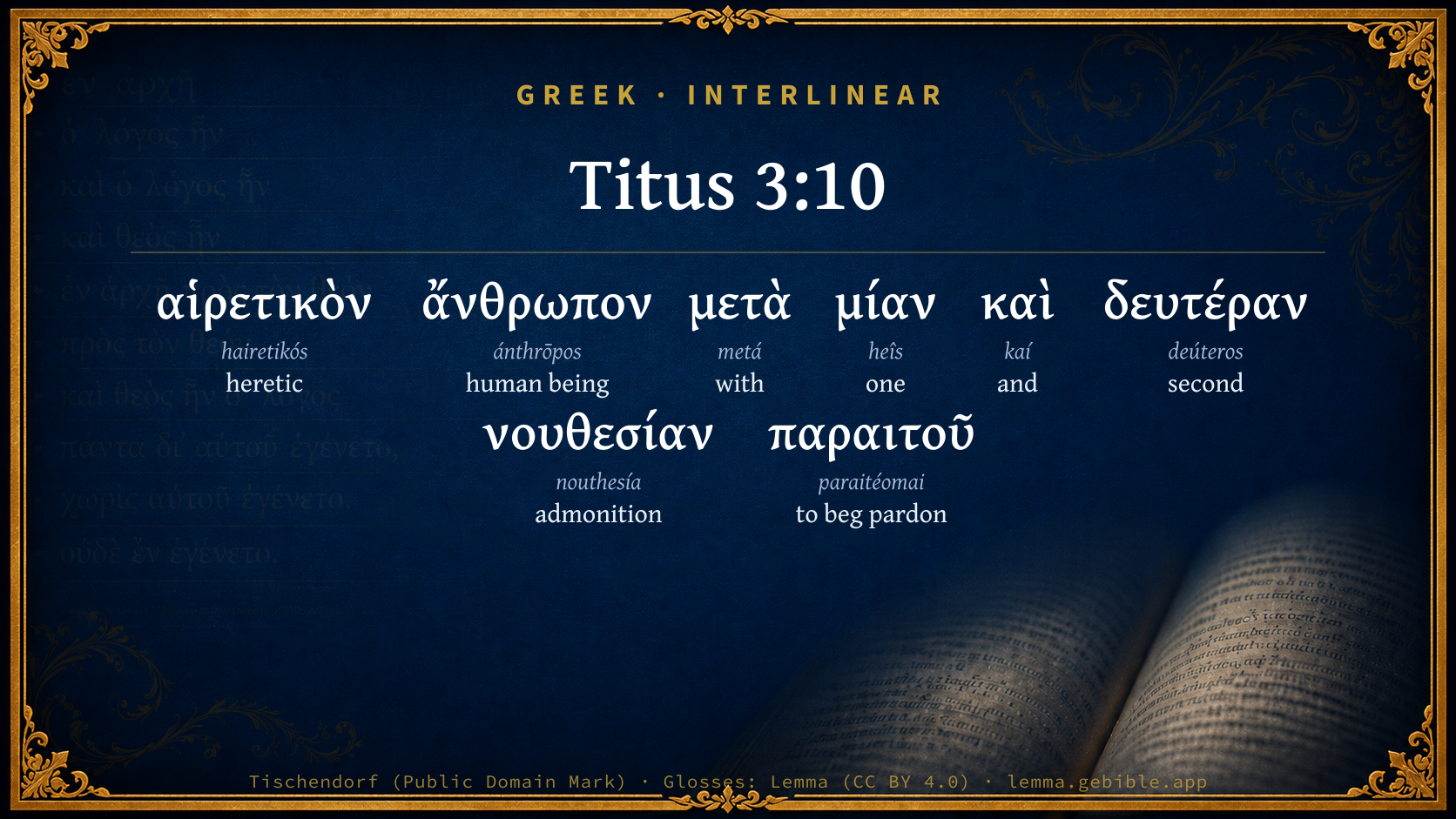
Greek (Tischendorf 8th ed.) Titus 3:10 appears in the Greek New Testament. The text above is from the Tischendorf 8th edition. Each word links to its Strong’s number and a concise gloss. Click any word for its full Thayer’s Greek Lexicon entry.
Download image
Cite this verse

Titus 3:10 (World English Bible). Public Domain. Lemma interlinear Bible study tool, https://lemma.gebible.app/v/titus/3/10.

Show BibTeX & RIS
BibTeX
RIS
English Translation
Avoid a factious man after a first and second warning;
World English Bible · Public Domain
Highlights
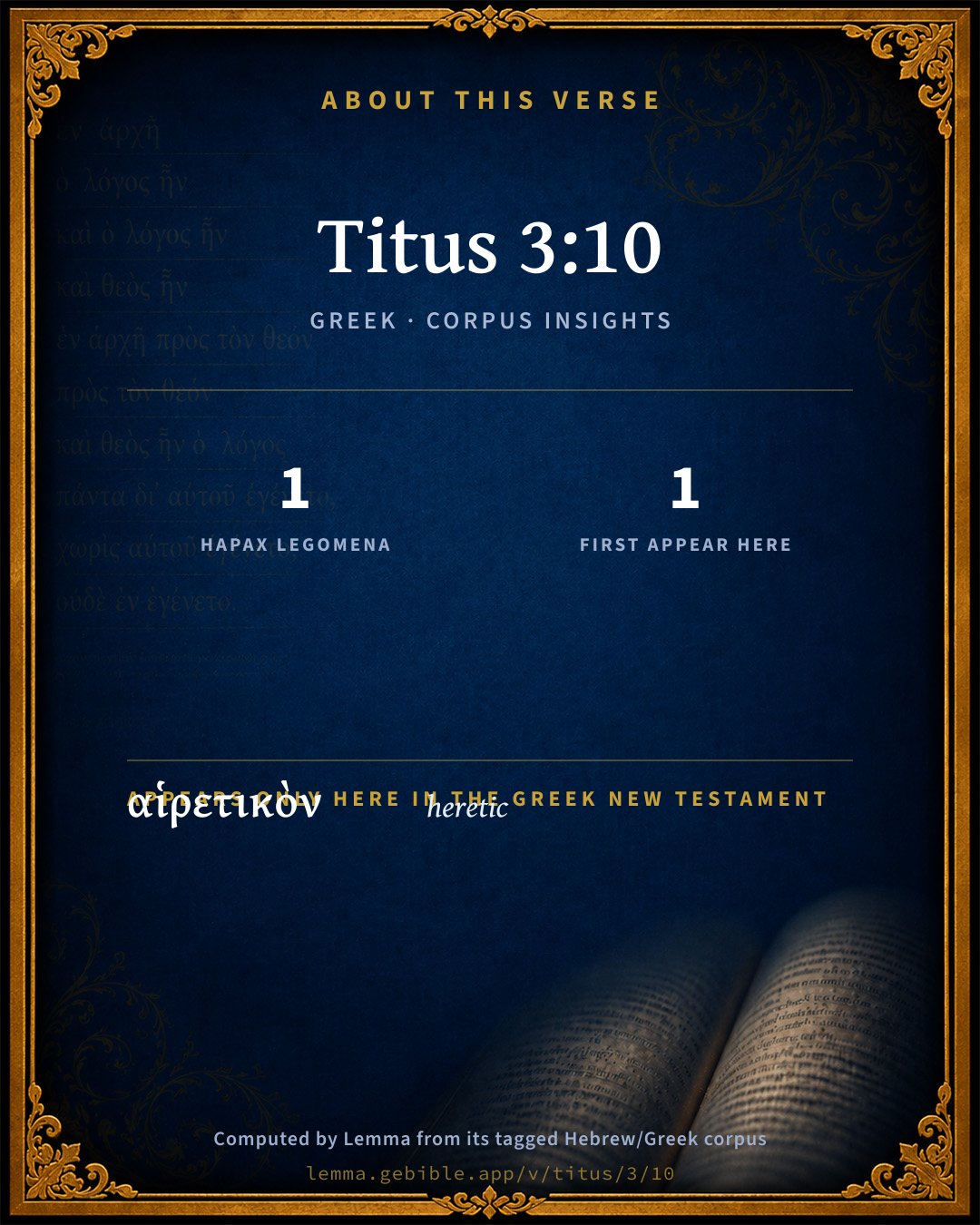
  • 1 hapax legomenon — only here in the Greek New Testament
  • 1 first appearance in the Greek New Testament
Full analysis ↓
Download a study sheet

One document with this verse’s original text, its word-by-word gloss line, the meaning frame, cross-references with their text, attributed commentary, and full source and license credits — printable, and it pastes into notes with its structure intact.

This verse Autodidact and up

Study sheet (.html) Plain text (.txt)

A passage Seminary Student

Up to 50 verses in one chapter. A passage sheet keeps up to 6 commentary sources and 12 cross-references per verse, in the order this page ranks them, and says so on the sheet whenever that leaves anything out. Ask for a single verse and you get the Autodidact verse sheet above.

Everything on this page stays free to read, with no account — the sheet is a download of what is already on screen, not access to it.

Want to remove ads? Support Godless Engineer
Compare translations 3

The same verse in 3 English versions, stacked beneath the original-language interlinear above. Click any original word for its lexicon entry.

Each is an independent rendering of the whole verse — the interlinear is not word-aligned to these translations.

Highlighted words mark where these versions differ — a whole-verse word diff, not a word-by-word alignment.

  • World English Bible Public Domain
    Avoid a factious man after a first and second warning;
  • King James Version Public Domain
    A man that is an heretick after the first and second admonition reject;
  • unfoldingWord Literal Text CC BY-SA 4.0
    Reject a divisive person after one or two warnings,

unfoldingWord Literal Text — © unfoldingWord, licensed CC BY-SA 4.0. Word-aligned USFM3 via Door43 (git.door43.org/unfoldingWord/en_ult).

Versions to compare (up to 4)

3 of 4 selected

Show all 19 translations

Every available English version of this verse, each an independent rendering of the whole verse.

  • World English Bible Public Domain
    Avoid a factious man after a first and second warning;
  • Berean Standard Bible Public Domain
    Reject a divisive man after a first and second admonition,
  • Majority Standard Bible Public Domain
    Reject a divisive man after a first and second admonition,
  • King James Version Public Domain
    A man that is an heretick after the first and second admonition reject;
  • American Standard Version (1901) Public Domain
    A factious man after a first and second admonition refuse;
  • Revised Version (1885) Public Domain
    A man that is heretical after a first and second admonition refuse;
  • Geneva Bible (1599) Public Domain
    Reiect him that is an heretike, after once or twise admonition,
  • Douay-Rheims (1899) Public Domain
    A man that is a heretic, after the first and second admonition, avoid:
  • Young's Literal Translation Public Domain
    A sectarian man, after a first and second admonition be rejecting,
  • Literal Standard Version CC BY-SA 4.0
    Reject a heretical man, after a first and second admonition,
  • Unlocked Literal Bible CC BY-SA 4.0
    Reject anyone who is causing divisions among you, after one or two warnings,
  • unfoldingWord Literal Text CC BY-SA 4.0
    Reject a divisive person after one or two warnings,
  • Darby Bible Public Domain
    An heretical man after a first and second admonition have done with,
  • World Messianic Bible Public Domain
    Avoid a factious man after a first and second warning,
  • Webster's Bible Public Domain
    A man that is a heretic, after the first and second admonition, reject;
  • Free Bible Version CC BY-SA 4.0
    Warn someone who is divisive once, and then again—after that don't pay them any attention,
  • Bible in Basic English Public Domain
    A man whose opinions are not those of the church, after a first and second protest, is to be kept out of your society;
  • Text-Critical English NT CC BY 4.0
    Reject a divisive person after a first and second warning.
  • Tyndale New Testament (1534) Public Domain
    A man that is geue to heresie after the fyrst and the seconde admonicion avoyde

Literal Standard Version (2020), Covenant Press — licensed CC BY-SA 4.0. Text via the HelloAO Bible API (eBible.org). Unlocked Literal Bible (unfoldingWord) — licensed CC BY-SA 4.0. Text via the HelloAO Bible API (eBible.org). unfoldingWord Literal Text — © unfoldingWord, licensed CC BY-SA 4.0. Word-aligned USFM3 via Door43 (git.door43.org/unfoldingWord/en_ult). Free Bible Version, Dr. Jonathan Gallagher — licensed CC BY-SA 4.0. Text via the HelloAO Bible API (eBible.org).

Word by word

More ways to search: Search by grammar → Find every occurrence → Compare this word →

Practice this passage: Drill this verse → Learn its vocabulary →

About this verse

These counts appear in no published source. They are computed here, from the morphology-tagged text and Lemma’s own curated glosses. What Lemma adds →

8
words
8
distinct lemmas
Pauline Epistles
section

Notable vocabulary

1 hapax legomenon — a word that appears only here in the entire Greek New Testament:

  • αἱρετικὸν heretic G141

First appearance in Scripture

This word makes its first canonical appearance in the Greek New Testament here:

  • αἱρετικὸν heretic G141

Shared distinctive vocabulary

νουθεσίαν admonition G3559 occurs in 3 verses of the Greek New Testament. Also found in:
Cross-references

12

Topical passages linked to Titus 3:10 in the Treasury of Scripture Knowledge — connected by theme and wording, ordered by reader-vote popularity; previews shown in the World English Bible.

  • Romans 16:17 Now I beg you, brothers, look out for those who are causing the divisions and occasions of stumbling, contrary to the doctrine which you learned, and turn away from them.
  • 2 John 1:10 If anyone comes to you, and doesn't bring this teaching, don't receive him into your house, and don't welcome him,
  • Matthew 18:15–17 "If your brother sins against you, go, show him his fault between you and him alone. If he listens to you, you have gained back your brother.
  • 2 Thessalonians 3:6 Now we command you, brothers, in the name of our Lord Jesus Christ, that you withdraw yourselves from every brother who walks in rebellion, and not after the tradition which they received from us.
  • 2 Thessalonians 3:14 If any man doesn't obey our word in this letter, note that man, that you have no company with him, to the end that he may be ashamed.
  • 2 Timothy 3:5 holding a form of godliness, but having denied the power thereof. Turn away from these, also.
  • Galatians 5:20 idolatry, sorcery, hatred, strife, jealousies, outbursts of anger, rivalries, divisions, heresies,
  • 1 Corinthians 11:19 For there also must be factions among you, that those who are approved may be revealed among you.
  • Galatians 5:12 I wish that those who disturb you would cut themselves off.
  • 2 Corinthians 13:2 I have said beforehand, and I do say beforehand, as when I was present the second time, so now, being absent, I write to those who have sinned before now, and to all the rest, that, if I come again, I will not spare;
  • 1 Corinthians 5:4–13 In the name of our Lord Jesus Christ, you being gathered together, and my spirit, with the power of our Lord Jesus Christ,
  • 2 Peter 2:1 But there also arose false prophets among the people, as among you also there will be false teachers, who will secretly bring in destructive heresies, denying even the Master who bought them, bringing on themselves swift destruction.

Cross-references courtesy of OpenBible.info (CC BY 4.0).

Commentary

Notes on Titus 3:10 from classic Christian and Jewish commentators (each source and its license shown beneath its notes). The classic Christian expositions comment on the surrounding passage and are grouped to its opening verse, so a note may address several verses; the Jewish commentaries on the Tanakh (Rashi and others) are per-verse, so they appear only where the commentator wrote on this verse.

Lemma curates 59 commentaries, every one of them public domain or Creative Commons licensed, each selected and text-cleaned for this edition rather than reprinted as found. About our sources →

The Biblical Illustrator

Joseph S. Exell

Tit_3:10-11

An heretic … reject

The treatment of heresy

I.

Heresy is not an unsound opinion, but an unsound life. A man may hold an erroneous opinion, and hold it sincerely; but the word used here denotes one who seeks to promote discord in the Church (See Rom_16:17).

II. Heresy is to be dealt with firmly, but gently.

1. Firmly--by admonition.

2. Gently--by repeated admonitions.

III. Hardened heretics are to be rejected.

1. But this only applies to exclusion from Church fellowship.

2. It is no warrant for persecution.

3. Excluded heretics are to be deemed objects of pity. (F. Wagstaff.)

Treatment of heretics

Paul having exhorted Titus both to teach the truth according to godliness, as also to resist all such foolish and vain doctrine as might do hurt in the Church of God. Titus might object: This indeed is my duty wherein I extend to exercise myself with diligence; but when I have laboured and done all I can, many there are who will not yield to the truth, nor submit themselves to this ordinance of God; how am I to carry myself towards such? Answer: The apostle, careful to prevent all such things as he foresaw might be hurtful to the Church, giveth direction in these two verses how to proceed in this business also. The former, giving direction and laying down the duty; and the latter, enforcing the same by moment of reason. In the former are three things to be considered:

1. The persons against whom Titus is to deal--here called heretics.

2. The direction how he is to behave himself towards them--reject them.

3. The orderly manner of proceeding, after once or twice admonition.

The latter verse containeth the reason of this severity, because such persons are incurable and incorrigible; which is proved by two arguments.

1. Such a one is subverted, that is, turned or cast off the foundation.

2. He sinneth against his own conscience, being damned of his own self, that is, he wittingly and willingly spurneth against that truth of which his conscience is by the former admonition convinced. (T. Taylor, D. D.)

Heresy not to be trifled with

I am asked sometimes to read an heretical book. Well, if I believed my reading it would help its refutation, and might be an assistance to others in keeping them out of error, I might do it as a hard matter of duty, but I shall not do it unless I see some good will come from it. I am not going to drag my spirit through a ditch for the sake of having it washed afterwards, for it is not my own. It may be that good medicine would restore me if I poisoned myself with putrid meat, but I am not going to try it: I dare not experiment on a mind which no longer belongs to me. There is a mother and a child, and the child has a book to play with, and a blacklead pencil. It is making drawings and marks upon the book, and the mother takes no notice. It lays down one book and snatches another from the table, and at once the mother rises from her seat, and hurriedly takes the book away, saying: No, my dear, you must not mark that, for it is not ours. So with my mind, intellect, and spirit; if it belonged to me I might or might not play tomfool with it, and go to hear Socinians, Universalists, and suchlike preach; but as it is not my own, I will preserve it from such fooleries, and the pure word shall not be mingled with the errors of men. (C. H. Spurgeon.)

Contagion of false doctrine

Sin is like the bale of goods which came from the East to this city in the olden time, which brought the pest in it. Probably it was but a small bale, but yet it contained in it the deaths of hundreds of the inhabitants of London. In those days one piece of rag carried the infection into a whole town. So, if you permit one sin or false doctrine in a church knowingly and wittingly, none can tell the extent to which that evil may ultimately go. The Church, therefore, is to be purged of practical and doctrinal evil as diligently as possible That sour and corrupting thing which God abhors must be purged out, and it is to be the business of the Christian minister, and of all his fellow helpers, to keep the church free from it. (C. H. Spurgeon.)

Dilution of the truth

I have likened the career of certain divines to the journey of a Roman wine cask from the vineyard to the city. It starts from the wine press as the pure juice of the grape, but at the first halting place the drivers of the cart must needs quench their thirst, and when they come to a fountain they substitute water for what they had drunk. In the next village there are numbers of lovers of wine who beg or buy a little, and the discreet carrier dilutes again. The watering is repeated, till, on its entrance into Rome, the fluid is remarkably different from that which originally started from the vineyard. There is a way of doctoring the gospel in much the same manner. A little truth is given up, and then a little more, and men fill up the vacuum with opinions, inferences, speculations, and dreams, till their wine is mixed with water, and the water none of the best. (C. H. Spurgeon.)

Wilful heresy

Heresy, in the New Testament, is most commonly used in an indifferent sense, and but seldom in a bad one. It generally signifies no more than a sect or party in religion. Thus we read of the sect, or heresy, of the Sadducees; of the sect, or heresy, of the Pharisees; St. Paul is styled a ring leader of the sect, or heresy, of the Nazarenes; and he says of himself that, after the strictest sect (where the same Greek word is used) of the Jewish religion, he lived a Pharisee. In this last passage particularly nothing can be more plain than that the word has an innocent meaning, since the apostle rather commends than charges himself with anything criminal for having been a Pharisee before his conversion to the Christian faith. And we find it applied in the same manner in Act_28:22. I shall mention but one text more, and that is, For there must also be heresies among you, etc. (1Co_11:19). The evident design of which is, that considering the various tempers of men, their different views, passions, prejudices, their selfishness, ambition, vanity, and the like, it was natural to expect that they would divide into parties about religion, as well as about politics, and the civil affairs of life; and that the providence of God wisely permitted this for the trial of their integrity, and to distinguish the indolent, careless, and insincere from the real friends of truth, persons of an honest, inquisitive, and ingenuous temper. Now, according to this account, the general notion of a heretic is no more than this, viz., one that sets up to be the head, or chooses to join himself to a particular religious sect. I say who makes this the matter of his choice because it is implied in the original signification of the word; and, besides, nothing can be supposed to have any concern with religion but what is a voluntary action. A heretic, therefore, in a bad sense, must be one who knowingly espouses a false doctrine, is insincere in his profession, and asserts and defends what he is convinced is contrary to Christianity, and, consequently, one who maintains and supports the interest of a faction, to serve some base designs. According to St. Pauls account in the text, a heretic is not only subverted or turned aside from the true faith, he not only entertains wrong sentiments of Christianity, but sinneth, i.e., doth this wilfully, and with an ill attention. He is one that makes religion a cloak for his immoralities, and espouses and propagates what he knows to be false, to promote the ends of his ambition, covetousness, or sensual pleasure; who, indeed, thinks it his interest to retain the name of a Christian, and in that circumstance only differs from a thorough and wilful apostate from Christianity, but which incurs the greater guilt may perhaps be hard to determine; for as the one rejects the Christian religion altogether, the other out of choice corrupts it, and opposes its true doctrines, even while he pretends to believe and reverence its authority. Such as these, I say, persons of such vile and dishonest principles, and of so flagitious a character, are the heretics condemned by St. Paul; and therefore to fix it as a term of reproach on any in whom there does not appear hatred of the truth, a sensual mind, and a profligate conscience, must be unChristian and scandalous. And if we examine other passages of the New Testament we shall find that they all concur in giving us the same idea of heresy. It is represented as a work of the flesh, because it has its foundation in the corrupt inclinations of human nature. It is reckoned among the most heinous and execrable vices--such as adultery, idolatry, hatred, variance, seditions, murders. And heretics are constantly described as men of no probity or honour, strangers to all the principles of virtue, and embracing such opinions only as were calculated for the gratification of irregular appetites, and advancing selfish and worldly views (1Ti_1:19; 2Pe_2:1.)

1. It appears from what has been said that no mere error of the judgment can be heresy. For heresy is a high degree of wickedness; and necessarily supposes irregularity of the affections and a depraved and vicious choice; whereas erroneous conceptions and apprehensions of things are no crime at all, but natural to mankind in the present weak and imperfect state of the faculties.

2. We may infer that no honest man can possibly be a heretic. He may, indeed, have errors (and who is there among us that has not?)--nay, he may err in points of importance too, but his mistakes cannot be dangerous while he takes care to maintain a good conscience.

3. If heresy be an error of the will, and such only can be guilty of it who are condemned of themselves, how can we certainly know, in most cases at least, whether a man be a heretic or not? Let each of us put this question to himself impartially, and if we cannot answer it to our satisfaction, let us, however, learn thus much from our ignorance, to be modest in the censures we pass upon others. If it be said that such wicked deceivers are generally known by their fruits, and that their vicious lives will show us by what views they are acted, and the vile design of their imposture, I answer that, even upon this supposition, I should think it better that they be rejected for their immorality, which is notorious and palpable, than for heresy, of which we cannot so certainly judge.

4. Though it be a point of great nicety to judge of heresy in particular instances, the persons who come nearest the character of the old heretics are violent party men, who confine Christianity to their own faction, and excommunicate all that take the liberty to differ from them; the rigid imposers of human schemes of doctrine and modes of worship, as essential branches of religion, and laws binding conscience, these, I say, are most like the heretics condemned in Scripture, notwithstanding their insolence and presumption. (James Foster.)

I. What patience the Lord useth in His just proceedings, even against the worst men, whom He wilt. Not have condemned nor cast out of the Church upon suspicions, or surmises; nor nor presently after an open sin is committed; but there must be a time between wherein the Church must rightly inform herself, that she may know the nature and degree of the sin before she turn her to any censure or sentence. Yea, and further, the sin being apparent, she must not reject any, till all good means of reclaiming have been in vain used. Which may teach us, that to hasten excommunications ipso facto; or (as it is often) before the party can come to the knowledge or suspicion of any such proceeding, is to swerve from the rules of the Word, and those weighty reasons also upon which they are grounded. As namely:

1. Some offenders are curable; and what man in his wits will cut off his arm or leg so soon as it beginneth to ache and pain him, and not rather use means of surgery and cure? is any member in the body so despised?

2. Ourselves must not be so uncharitable as presently, to despair of any mans conversion. God may in time raise the most desperate stoner unto repentance.

3. The means used are not lost; for if it attain no other end, yet shall it make them more inexcusable, the censure more just, and the Churchs proceeding more equal and moderate.

4. Add here unto the Lords example, who never striketh before He have sufficiently warned; He never precipitateth either sentence or execution, but first cometh down to see (Gen_18:21), and hearkeneth and heareth (Mal_3:16), and accordingly passeth sentence.

II. Note that when a sinner is known to sin of obstinacy, the best way is to avoid him and cast him out.

1. For labour is but lost on such a one.

2. He doth but tread holy things under his feet; of which holy things the Church is the keeper, and must be faithful.

3. He sins not only of judgment and reason, but of affection; and this is the reason why very few heretics are converted, when many unregenerate men and outrageously wicked in other kinds are, who sin not of affection and wilfulness, but of corrupt judgment only.

4. The Lords example (Hos_4:17).

III. Note hence, also, what use the Lord maketh of a wicked conscience, even in desperate sinners. It shall be the accuser, witness, and judge to pronounce the sentence of death against his own soul; and so shall make way unto the Lords most righteous judgment. Use.

1. It letteth us see what an intolerable torment a wicked conscience is. Use.

2. This further teaches us not to neglect the checks of conscience, nor our own hearts reproving us of our ways; as those men who are resolved to hold on their lewd courses, let the word and spirit, yea, their own spirits, suggest what they will or can against it. For the time cometh when thou canst not set the voice of thy conscience so light, and then that conscience which hath checked thee shall judge thee, and that heart which hath reproved thee shall torment thee, and thou shalt never be able to turn off the charge of it, but shalt by it be accused and convicted to have been a wilful chooser of thine own destruction. Use.

3. This consideration also teacheth us to look that in everything we keep good consciences before God and all men, the use of which will be manifold.

(1) To keep us from errors and heresies, and contain us in the profession of the true faith; for let good conscience be put away, there must needs follow a shipwreck of faith; as is to be seen in all heretics. Hence are we counselled to make pure conscience as the coffer to keep faith in (1Ti_3:9).

(2) In doing any action lawful in itself, a good con science only maketh it good to the doer; for to do even the will of God against my conscience is sin to me, be the same in itself never so materially good.

(3) In suffering or enduring anything for well doing (as not the pain, but the cause maketh a martyr so), not the cause so much as the conscience of the sufferer worketh out his boldness and peace in the midst of the combat, and giveth him security, in his conflict; whereas a bad conscience will betray the best cause.

(4) In enjoying any condition of this present life, a good conscience is a sweet companion; even a dry morsel with peace of heart is better than a house full of sacrifices with strife and war within. In outward afflictions there is inward rejoicing, for let the heart be pacified in God, it can rejoice in tribulation. The disciples can go away rejoicing from the council that they were counted worthy to be beaten and suffer rebuke for Christ (Act_5:41). The martyrs can kiss the stake, embrace the fire, and sing in the midst of the flames.

(5) Yea, it doth not only through the whole life minister joy and comfort even in the remembrance of death, as in 2Ti_4:7-8, but it followeth a man after death, when all things else forsake him; and as a most faithful friend it goeth with him before Gods judgment seat, and pleadeth for him at the bar of Jesus Christ; yea, testifieth with him, and cleareth, and quite acquitteth him from the judgment of the great day. All which being so, what pains and labour can be thought too much in the getting and keeping of such a jewel, which bringeth in so rich a recompense for so little labour, and how worthily doth he forfeit all these sweet fruits of it, who will be at no costs nor pains for it. (T. Taylor, D. D.)

Heresy hunters

You can imagine a husbandman who would neglect to care for his soil, and go out after squirrels and all manner of vermin that were eating his grain if he had any that they could eat--who would go out to shoot weasels in the wall, foxes in the field, wolves in the wood, and bears everywhere; and who, when he could find nothing to shoot, would lie out at night, watching for racoons, and range up and down through the day, searching for some stray dog, where there should be sheep, but where there are none. There are in the Church what may be called heresy hunters. They always carry a rifle--a spiritual rifle under their arm. You will find them forever outlying, watching for heresy--not so much in their own hearts, not so much in their own Church, not so much in their own minister, but in other peoples hearts, in other peoples Churches, in other peoples ministers. If any man happens to hold an opinion respecting any doctrine which does not accord with their own peculiar views, they all spread abroad to run him down. They are taking care of and defending the faith! They are searching for foxes, and wolves, and bears, that they suppose are laying waste Gods husbandry! They never do anything except fire at other folks. I have no doubt that Nimrod was a very good fellow in his own poor, miserable way, but a Nimrod minister is the meanest of all sorts of hunters. (H. W. Beecher.)

Treatment of heretics

In what way are the directions here given to Titus to be used for our own guidance at the present time? They do not apply to persons who have always been, or who have ended in placing themselves outside the Christian Church. They refer to persons who contend that their self-chosen views are part and parcel of the gospel, and who claim to hold and teach such views as members or even ministers of the Church. Secondly, they refer to grave and fundamental errors with regard to first principles; not to eccentric views respecting matters of detail. And in determining this second point much caution will be needed; especially when inferences are drawn from a mans teaching. We should be on our guard with regard to assertions that a particular teacher virtually denies the Divinity of Christ, or the Trinity, or the personality of God. But when both these points are quite clear, that the person contradicts some of the primary truths of the gospel, and that he claims to do so as a Christian, what is a minister to do to such a member of his flock? He is to make one or two effects to reclaim him, and then to have as little to do with him as possible. In all such cases there are three sets of persons to be considered: the heretic himself, those who have to deal with him, and the Church at large. What conduct on the part of those who have to deal with him will be least prejudicial to themselves and to the Church, and most beneficial to the man himself? The supreme law of charity must be the guiding principle. But that is no true charity which shows tenderness to one person in such a way as to do grievous harm to others, or to do more harm than good to the person who receives it. Love of what is good is not only consistent with hatred of what is evil; it cannot exist without such hatred. What we have to consider, therefore, is this. Will friendliness confirm him in his error? Would he be more impressed by severity? Is intercourse with him likely to lead to our being led astray? Will it increase his influence and his opportunities of doing harm? Is severity likely to excite sympathy in other people, first for him, and then for his teaching? It is impossible to lay down a hard and fast rule that would cover all cases; and while we remember the stern instructions which St. Paul gives to Titus, and St. John to the elect lady, let us not forget the way in which Jesus Christ treated publicans and sinners. (A. Plummer, D. D.)

Condemning of himself

Ferdinand, Emperor of Germany, possessed a great number of watches, in collecting of which he had a fancy. It pleased him once, says our quaint author, to put this, his variety of speaking gold, upon a table, as if he would expose it to sale: he then stepped aside. A stander-by, driven by a desire of stealing, filched one of them (a repeater), which the emperor espying aslant, called him, and without accusation, kept him in various discourse till the watch striking disclosed the hour and his theft. (Saturday Magazine.)

The Biblical Illustrator, edited by Joseph S. Exell (c. 1880s–1900s) — public domain. Text from a community e-Sword module.

Joseph Benson's Commentary

Tit 3:10-11. A man that is a heretic — Greek, αιρετικον, a party or schism-maker, namely, in the church, among the true, genuine people of God; or one that causes divisions among those that are united in Christian fellowship; see on Rom 16:17; after the first and second admonition — From thee and the elders of the church, given with proper solemnity; reject — Avoid, and declare him unfit to be any longer looked upon as a member of your community. “This is the only place in the whole Scripture where this word heretic occurs; and here it evidently means a man that obstinately persists in contending about foolish questions, and thereby occasions strifes and animosities, schisms and parties, among the faithful. This, and this alone, is a heretic in the Scripture sense. And his punishment likewise is here fixed. Shun, avoid, leave him to himself, have no fellowship with him. As for the Popish sense of the word, ‘A man that errs in fundamentals,’ although it crept, with many other things, early into the church, yet it has no shadow of foundation either in the Old or New Testament.” — Wesley. Knowing that such a one — Who is so fond of his own darling notions, that he will ruin the peace of the church: and will not submit to thy remonstrances, and those of the wiser and better part of the society; is subverted — Or perverted, as εξεστραπται maybe properly rendered; and sinneth — In making such obstinate efforts to diffuse his notions, and form a party to himself; being condemned of himself — Convinced in his own conscience that he acts wrong, as he cannot but see it to be evil to cause strife, animosity, contention, and disunion among those that fear God, and were, before he thus troubled them, united in Christian love. “In the first age, when the doctrines of the gospel were delivered by the apostles in person, under the guidance of inspiration, and when the true meaning of the doctrines was not liable to any doubt, because it was ascertained by the apostles themselves, if any teacher taught differently from them, and made a party in the church in opposition to them, he must have done these things contrary to his conscience, either from the love of money, or the lust of power, or from an immoderate propensity to sensual pleasures.” — Macknight; who observes further, “This method of treating heretics is worthy of attention; for the Spirit of God doth not order heretics to be banished, and their goods confiscated; far less doth he order them to be imprisoned, tortured, and burned, if they will not retract their errors. He doth not even give allowance to rail at or speak evil of them. Such methods of treating heretics never proceeded from the college of the apostles, but from the synagogue of Satan. To disown a wicked man as a Christian brother, and to avoid all familiar society with him, and to cast him out of the church by a public sentence of excommunication, is what the church and every society hath a right to do, agreeably to our Lord’s rule, (Mat 18:15; Mat 18:17,) and is all that should be done in such a case.”

Joseph Benson's Commentary on the Old and New Testaments (1811–1818) — public domain. Text from a community e-Sword module.

The Expositor's Bible

Chapter 26

THE MEANING OF HERESY IN THE NEW TESTAMENT, AND THE APOSTLES DIRECTIONS RESPECTING THE TREATMENT OF HERETICAL PERSONS. - Tit_3:10-11

IT is in connection with this instruction respecting the treatment of heretical persons that we have some of the earliest testimonies to the genuineness of the Epistle to Titus. Thus Irenaeus about A.D. 180 writes: "But as many as fall away from" (αφιστανται, 1Ti_4:1) "the Church and give heed to these old wives fables" (γραωδεσι μυθοις, 1Ti_4:7), "are truly self-condemned" (αυτοκατακριτοι, Tit_3:1): "whom Paul charges us after a first and second admonition to refuse" ("Adv. Haer.," I 16. 3). It will be observed that in this passage Irenaeus makes an obvious allusion to the First Epistle to Timothy, and then quotes the very words of our text, attributing them expressly to St. Paul. And about ten or twelve years later, Tertullian, after commenting on St. Pauls words to the Corinthians, "For there must be also heresies among you, that they which are approved may be made manifest among, {1Co_11:19} continues as follows: "But no more about that, seeing that it is the same Paul who elsewhere also in writing to the Galatians reckons heresies among sins of the flesh," {Gal_5:20} and who intimates to Titus that a man who is heretical must after a first admonition be refused, because he that is such is perverted and sinneth as being self-condemned. But in almost every Epistle, when insisting on the duty of avoiding false doctrines, he censures heresies of which the practical results are false doctrines, called in Greek heresies, with reference to the choice which a man exercises, whether in instituting or in adopting them. For this reason he says that the heretical person is also self-condemned, because he has chosen for himself that in which he is condemned. We, however, may not allow ourselves anything after our own will; nor yet choose what any one has introduced of his own will. The Apostles of the Lord are our authorities; and even they did not choose to introduce anything of their own will, but faithfully consigned to the nations the instruction which they received from Christ. And so, even if an angel from heaven were to preach any other gospel, he would be called accursed by us" ("De Pries. Haer.," 6). In this passage, which contains a valuable comment on the meaning of the word "heresy, " it will be noticed that Tertullian not only quotes the text before us as coming from the Epistle to Titus, but, like Irenaeus, his earlier contemporary, says expressly that the words are those of St. Paul. Thus, from both sides of the Mediterranean, men who had very large opportunities of knowing what books were accepted as Apostolic and what not, attribute our Epistle without hesitation to St. Paul. And in both cases this is done in treatises directed against heretics, who might be expected to reply with very telling effect, if it could be shown that what was quoted against them as the writing of an Apostle was of quite doubtful origin and authority.

But the testimony which these passages bear to the authenticity of this Epistle is not the main reason for their being quoted here. Their interest for us now consists in the light which they throw upon the history of the word "heresy," and upon the attitude of the primitive Church towards heretics.

"Heresy," as Tertullian points out, is a word of Greek origin, and the idea which lies at the root of it is "choice." Choosing for oneself what pleases oneself, independently of other considerations; -that is the fundamental notion on which later meanings of the term are based. Thus in the Septuagint it is used of a free-will offering, as distinct from what a man is bound to offer (Lev_22:18; comp. /RAPC 1Ma 8:30). Then comes the notion of choice in reference to matters of opinion, without, however, necessarily implying that the chosen opinion is a bad one. And in this sense it is used quite as often for the party or school of thought which holds the particular opinion as for the body of opinion which is held. In this sense it is several times used in the Acts of the Apostles; as "the sect of the Sadducees," {Act_5:17} "the sect of the Pharisees": {Act_15:5; Act_26:5} and in this way Christianity itself was spoken of as a "heresy" or "sect"; that is, a party with chosen opinions. {Act_24:5; Act_24:14; Act_28:22} And in profane literature we find Diogenes Laertius in the second or third century speaking of ten "heresies" or schools in moral philosophy (1:19). But it will be seen from the passages in the Acts that the word is already acquiring somewhat of a bad meaning; and indeed this was almost inevitable, unless the original signification was entirely abandoned. In all spheres of thought and action, and especially in matters of belief, a tendency to choose for oneself, and to pursue ones own way independently, almost of necessity leads to separation from others, to divisions and factions. And factions in the Church readily widen into schisms and harden into heresies.

Outside the Acts of the Apostles the word heresy is found in the New Testament only in three passages: 1Co_11:19; Gal_5:20; and 2Pe_2:1. In the last of these it is used of the erroneous opinions themselves; in the other two the parties who hold them may be indicated. But in all cases the word is used of divisions inside the Church, not of separations from it or of positions antagonistic to it. Thus in 2Pe_2:1 we have the prophecy that "there shall be false teachers, who shall privily bring in destructive heresies, denying even the Master that bought them." Here the false teachers are evidently inside the Church, corrupting its members; not outside, inducing its members to leave it. For the prophecy continues: "And many shall follow their lascivious doings; by reason of whom the way of the truth shall be evil spoken of." They could not cause "the way of the truth to be evil spoken of," if they were complete outsiders, professing to have no connection with it. In Gal_5:20 "heresies" are among "the works of the flesh" against which St. Paul warns his fickle converts, and "heresies" are there coupled with "factions" and "divisions." In 1Co_11:19 the Apostle gives as a reason for believing the report that there are divisions in the Church of Corinth the fact that (mans tendency to differ being what it is) divisions are inevitable, and have their use, for in this way those which are approved among Christians are made manifest. It is possible in both these passages to understand St. Paul as meaning the "self-chosen views," as in the passage in 2 Peter, rather than the schools or parties which have adopted the views. But this is not of much moment. The important thing to notice is, that in all three cases the "heresies" have caused or are tending to cause splits inside the Church: they do not indicate hostile positions outside it. This use of the word is analogous to that in the Acts of the Apostles, where it represents the Pharisees and Sadducees, and even the Christian Church itself, as parties or schools inside Judaism, not as revolts against it. We shall be seriously misled, if we allow the later meaning of "heresy," with all its mediaeval associations, to color our interpretation of the term as we find it in the New Testament.

Another important thing to remember in reference to the strong language which St. Paul and other writers in the New Testament use with regard to "heresies" and erroneous doctrine, and the still stronger language used by early Christian writers in commenting on these texts, is the downright wickedness of a good many of the "self-chosen views" which had begun to appear in the Church in the first century, and which became rampant during the second. The peril, not only to faith, but to morals, was immense, and it extended to the very foundations of both. When Christians were told that there were two Creators, of whom one was good and one was evil; that the Incarnation was an impossibility; that mans body was so vile that it was a duty to abuse it; that his spirit was so pure that it was impossible to defile it; that to acquire knowledge through crime was estimable, for knowledge was good, and crime was of no moral significance to the enlightened; -then it was necessary to speak out, and tell men in plain terms what the persons who were inculcating such views were really doing, and what strong measures would be necessary if they persisted in such teaching.

Unless we keep a firm grasp upon these two facts; -

(1) the difference between the meaning of the word "heresy" as we find it in the New Testament and its usual meaning at the present time; and

(2) the monstrous character of some of the views which many persons in the first century, and many more in the second, claimed to hold as part and parcel of the Christian religion; -we shall be liable to go grievously astray in drawing conclusions as to our own practice from what is said on the subject in Scripture.

"Woe unto the world," said our blessed Lord, "because of occasions of stumbling! For it must needs be that the occasions come; but woe to that man through whom the occasion cometh". {Mat_18:7} Human nature being what it is, it is morally impossible that no one should ever lead another into sin. But that fact does not destroy the responsibility of the individual who leads his fellows into sin. St. Paul takes up the principle thus laid down by Christ and applies it in a particular sphere. He tells his Corinthian converts that "there must be heresies" among them, and that they serve the good purpose of shifting the chaff from the wheat. Wherever the light comes, it provokes opposition; there is at once antagonism between light and darkness. This is as true in the sphere of faith and morals as in that of the material world. Sooner or later, and generally sooner rather than later, truth and innocence are met and opposed by falsehood and sin; and it is falsehood, willfully maintained in opposition to revealed and generally held truth, that constitutes the essence of heresy. There are many false opinions outside what God has revealed to mankind, outside the scope of the Gospel. However serious these may be, they are not heresies. A man may be fatally at fault in matters of belief; but, unless in some sense he accepts Christianity as true, he is no heretic. As Tertullian says, "In all cases truth precedes its copy; after the reality the likeness follows" ("De Pries. Haer.," 29.). That is, heresy, which is the caricature of Christian truth, must be subsequent to it. It is a distortion of the original truth, which some one has arrogantly chosen as preferable to that of which it is the distortion. Error which has not yet come in contact with revelation, and which has had no opportunity of either submitting to it or rebelling against it, is not heretical. The heretical spirit is seen in that cold critical temper, that self-confident and self-willed attitude, which accepts and rejects opinions on principles of its own, quite independently of the principles which are the guaranteed and historical guides of the Church. But it cannot accept or reject what has never been presented to it; nor, until the Christian faith has to some extent been accepted, can the rejection of the remainder of it be accounted heresy. Heresy is "a disease of Christian knowledge." The disease may have come from without, or may have developed entirely from within; and in the former case the source of the malady may be far older than Christianity itself. But until the noxious elements have entered the Christian organism and claimed a home within the system, it is a misuse of language to term them heretical.

We have not exhausted the teaching of the Apostles respecting this plague of self-assertion and independent teaching, which even in their time began to afflict the infant Church, when we have considered all the passages in which the words "heresy" and "heretical" occur. There are other passages, in which the thing is plainly mentioned, although this name for it is not used. It has been said that "the Apostles, though they claimed disciplinary authority, had evidently no thought of claiming infallibility for any utterances of theirs." But they certainly treated opposition to their teaching, or deviations from it, as a very serious matter. St. Paul speaks of those who opposed him in the Church of Corinth as, "false apostles, deceitful workers" and "ministers of Satan" {2Co_11:13-15}. He speaks of the Galatians as "bewitched" by those who would pervert the Gospel of Christ, and pronounces an anathema on those who should "preach any gospel other than that which he preached". {Gal_1:7-8; Gal_3:1} Of the same class of teachers at Philippi he writes: "Beware of the dogs, beware of the evil workers, beware of the concision." {Php_3:2} He warns the Colossians: against any one who may "make spoil of them through his philosophy and vain deceit, after the tradition" "of men, after the rudiments of the world, and not after Christ"; {Col_2:8} just as he warned the elders of the Church at Ephesus that after his departure "grievous wolves would enter in among them, not sparing the flock; and that from among themselves men would arise, speaking perverse things, to draw away the disciples after them". {Act_20:29-30} And in the Pastoral Epistles we have several utterances of the same kind, including the one before us. {1Ti_1:3-7; 1Ti_1:19-20; 1Ti_4:1-3; 1Ti_6:3-4; 1Ti_6:20-21; Tit_1:10-16; Tit_3:8-11; 2Ti_2:16-18; 2Ti_3:8; 2Ti_3:13}

Nor is St. Paul the only writer in the New Testament who feels bound to write in this strain. The same kind of language fills no inconsiderable portion of the Second Epistle of Peter and the Epistle of Jude. {2 Pe. 2; Jud_1:8-16} More remarkable still, we find even the Apostle of Love speaking in tones not less severe. The Epistles to the Seven Churches of Asia abound in such things. {Rev_2:3} In his General Epistle he asks, "Who is the liar but he that denieth that Jesus is the Christ? This is the antichrist, even he that denieth the Father and the Son" (1Jn_2:22 : comp. 1Jn_2:26; 1Jn_4:1; 1Jn_4:3). In his letter to "the elect lady and her children" he speaks of the "many deceivers" who "confess not that Jesus Christ cometh in the flesh." And, in a passage not unlike the direction to Titus which we are now considering, he says: "If any one cometh unto you, and bringeth not this teaching, receive him not into your house, and give him no greeting: for he that giveth him greeting partaketh in his evil works."

The impression which these passages produce on our minds is at least this; -that, whether or no the Apostles were conscious of being protected by the Holy Spirit from teaching anything that was doctrinally false, they were at any rate very stern in their condemnation of those Christians who deliberately contravened what an Apostle had taught. And this sternness is not confined to those who resisted the instructions of Apostles in matters of discipline. It is quite as clearly manifested against those who contradicted Apostolic teaching in matters of faith. The context of the passage before us shows that by "a man that is heretical" is meant one who willfully takes his own line and thereby causes divisions in doctrine quite as much as one who does so as regards the order and discipline of the Church.

What, then, does St. Paul mean when he directs Titus to "refuse" such a person after once or twice admonishing him? Certainly not that he is to excommunicate him; the passage has nothing to do with formal excommunication. It is possible to maintain that the direction here given may imply excommunication; but it is also possible to maintain that it need not imply anything of the kind; and therefore that such an interpretation substitutes an uncertain inference for what is certainly expressed. The word translated in the R.V. "refuse," and in the A.V. "reject," is the same as that which is used in 1Ti_5:2 in the text, "Younger widows refuse" (παραιτου). It means, "avoid, shun, excuse yourself from having anything to do with". {comp. Heb_12:25} It is also used of things as well as of persons, and in much the same sense: "Refuse profane and old wives fables," {1Ti_4:7} and "Foolish and ignorant questions refuse." {2Ti_2:23} The meaning, then, here seems to be that, after a few attempts to induce the heretical person to desist from his perverse and self-willed conduct, Titus is to waste no more time on him, because now he knows that his efforts will be useless. At first he did not know this; but after having failed once or twice, he will see that it is vain to repeat what produces no effect. The mans self-will is incorrigible; and not only that, but inexcusable; for he stands self-condemned. He deliberately chose what was opposed to the received teaching; and he deliberately persists in it after its erroneous character has been pointed out to him. He "is perverted, and sinneth": that is, he not only has sinned, but goes on sinning: he continues in his sin, in spite of entreaty, exhortation, and reproof.

In what way are the directions here given to Titus to be used for our own guidance at the present time? Certain limitations as to their application have been already pointed out. They do not apply to persons who have always been, or who have ended in placing themselves, outside the Christian Church. They refer to persons who contend that their self-chosen views are part and parcel of the Gospel, and who claim to hold and teach such views as members or even ministers of the Church. Secondly, they refer to grave and fundamental errors with regard to first principles; not to eccentric views respecting matters of detail. And in determining this second point much caution will be needed; especially when inferences are drawn from a mans teaching. We should be on our guard with regard to assertions that a particular teacher virtually denies the Divinity of Christ, or the Trinity, or the personality of God. But when both these points are quite clear, that the person contradicts some of the primary truths of the Gospel, and that he claims to do so as a Christian, what is a minister to do to such a member of his flock? He is to make one or two efforts to reclaim him, and then to have as little to do with him as possible.

In all such cases there are three sets of persons to be considered:-the heretic himself, those who have to deal with him, and the Church at large. What conduct on the part of those who have to deal with him will be least prejudicial to themselves and to the Church and most beneficial to the man himself? The supreme law of charity must be the guiding principle. But that is no true charity which shows tenderness to one person in such a way as to do grievous harm to others, or to do more harm than good to the person who receives it. Love of what is good is not only consistent with hatred of what is evil; it cannot exist without such hatred. What we have to consider, therefore, is this. Will friendliness confirm him in his error? Would he be more impressed by severity? Is intercourse with him likely to lead to our being led astray? Will it increase his influence and his opportunities of doing harm? Is severity likely to excite sympathy in other people, first for him, and then for his teaching? It is impossible to lay down a hard-and-fast rule that would cover all cases; and while we remember the stern instructions which St. Paul gives to Titus, and St. John to the "elect lady," let us not forget the way in which Jesus Christ treated publicans and sinners.

In our own day there is danger of mistaking lazy or weak indifferentism for Christian charity. It is a convenient doctrine that the beliefs of our fellow-Christians are no concern of ours, even when they try to propagate what contradicts the creed. And, while emphasis is laid upon the responsibility of accepting articles of faith, it is assumed that there is little or no responsibility in refusing to accept, or in teaching others to refuse also. To plead for tenderness, where severity is needed, is not charity, but Laodicaean lukewarmness; and mistaken tenderness may easily end in making us "partakers in evil works." To be severe, when severity is imperatively called for, is not only charity to the offenders, it "is also charity towards all men besides. It is charity towards the ignorant as carrying instruction along with it; charity towards the unwary, as giving them warning to stand off from infection; charity towards the confirmed Christians, as encouraging them still more, and preserving them from insults; charity towards the whole Church, as supporting both their unity and purity; charity towards all mankind, towards them that are without, as it is recommending pure religion to them in the most advantageous light, obviating their most plausible calumnies, and giving them less occasion to blaspheme."

William Robertson Nicoll, ed., The Expositor's Bible (London: Hodder & Stoughton, 1887–1910) — public domain. 65 of 66 books (1 Corinthians is not separately keyed, as that volume carries no machine-parseable verse references); section-level commentary keyed to the opening verse. Introductory and overview sections not keyed to a specific passage are excluded.

Tyndale Open Study Notes

Tyndale Open Resources

3:10-11 have nothing more to do with . . . people like that: This refers to incorrigibly quarrelsome and divisive people (see 1:11, 13).

Tyndale Open Study Notes — © Tyndale Open Resources, licensed CC BY-SA 4.0. Text via the HelloAO Bible API.

Bengel's Gnomon

Johann Albrecht Bengel

Tit 3:10. Αἱρετικὸν, a heretic) one following, according to his own will, the things which are found fault with at Tit 3:9.—παραιτοῦ, reject) cease to admonish him, for of what advantage is it? We should be labouring in vain.[14] Mat 7:6.

[14] The proverb is, we should be washing a brick.

Bengel's Gnomon of the New Testament — English translation (T&T Clark, Edinburgh, 1860) — public domain. Text from a community e-Sword module.

Meyer's Critical & Exegetical Commentary

Heinrich August Wilhelm Meyer

Tit_3:10-11. An injunction regarding behaviour towards the heretics.

Αἱρετικὸν ἄνθρωπον] αἱρετικός (ἅπ. λεγ.) is not equivalent to contentiosus, but is, according to Calvin: quisquis sua protervia unitatem ecclesiae abrumpit, any one who causes departure from the pure sound doctrine of the gospel. With this Wiesinger agrees, only that he wishes to consider the divisions as not brought about by heresies, but by eccentricities and perversities. The word αἱρέσεις is often used by Paul of ecclesiastical divisions, 1Co_11:19; Gal_5:20. So, too, in 2Pe_2:1, where it expressly refers to heresies. Comp. also Rom_16:17 : παρακαλῶ ὑμᾶς σκοπεῖν τοὺς τὰς διχοστασίας καὶ τὰ σκάνδαλα παρὰ τὴν διδαχὴν ἣν ὑμεῖς ἐμάθετε ποιοῦντας καὶ ἐκκλίνατε ἀπʼ αὐτῶν.

μετὰ μίαν καὶ δευτέραν νουθεσίαν παραιτοῦ] Vitringa (De Vet. Synag. iii. 1. 10) understands παραιτοῦ to mean the formal excommunication, and νουθεσία the excommunicatio privata, as these were appointed among the Jews for certain cases. But he is wrong; Paul is not speaking here of excommunication proper. Νουθεσία (1Co_10:11; Eph_6:4) is equivalent to reprimand, including both blame and exhortation. This is not to be employed once, but several times: after one or two.

παραιτοῦ] 1Ti_4:7. Bengel: monere desine, quid enim juvat? laterem lavares.

Tit_3:11. εἰδώς] see 2Ti_2:23.

ὅτι ἐξέστραπται ὁ τοιοῦτος] that such an one is perverse; comp. Deu_32:20 : ὅτι γενεὰ ἐξεστραμμένη ἐστιν, דּוֹר תַּחְפֻּחֹת; it shows the total perversion of thought and endeavour. Baur says arbitrarily and wrongly: he has turned away from us, and departed out of the communion of believers.

καὶ ἁμαρτάνει ὢν αὐτοκατάκριτος] defines the preceding words more precisely. Ὢν αὐτοκατάκριτος is connected with ἁμαρτάνει, but not with ἐξέστραπται also (Hofmann). The perversity shows itself in the fact that he sins condemning himself. Αὐτοκατάκριτος is equivalent to κεκαυτηριασμένος τὴν ἰδίαν συνείδησιν, 1Ti_4:2, qui suopte judicio est condemnatus. The meaning is: he sins with the consciousness of his guilt and of his own condemnation, so that there is no hope of his return.

Meyer — Critical and Exegetical Commentary on the New Testament — English translation by Peter Christie, edited by Frederick Crombie (T&T Clark, 1880) — public domain. Text from a community e-Sword module.

Expositor's Greek Testament

ed. W. Robertson Nicoll

Tit 3:10 . αἱρετικὸν ἄνθρωπον : St. Paul passes from the reprehensible opinions to the man who propagates them. He is the same kind of man as the φιλόνεικος of 1Co 11:16 ; or “he that refuseth to hear the church” of Mat 18:17 ; he is of “them which cause divisions and occasions of stumbling,” Rom 16:17 . The term αἵρεσις is applied in a non-offensive sense to the sects of Judaism, Act 5:17 ; Act 15:5 ; Act 26:5 . St. Luke represents the Jews as so speaking of the Christian Church (Act 24:5 ; Act 28:22 ), and St. Paul as resenting this application of the term (Act 24:14 ). The Apostle himself uses the word in an unfavourable sense (1Co 11:19 ; Gal 5:20 ), as does 2Pe 2:1 . A comparison of 1Co 11:19 with 1Jn 2:19 suggests that αἵρεσις involved the formation of a separate society (so R.V.m. here, factious ), not merely the holding of aberrant opinions, or the favouring a policy different from that of the Church rulers. The νουθεσία addressed to a member of such a αἵρεσις would be of the nature of a verbal remonstrance, pointing out the essentially unchristian character of needless separation. It is evident that the αἱρετικὸς ἄνθρωπος would be beyond any Church discipline. The permission of a second attempt at reconciliation is probably not unconnected with our Lord’s counsel, Mat 18:15 .

παραιτοῦ : Have nothing to do with him . See note on 1Ti 4:7 . The word does not necessarily imply any formal excommunication. Such procedure would be unnecessary. Excommunication has no terrors for those who deliberately separate themselves. “Monere desine. quid enim iuvat? laterem lavares” (Bengel).

The Expositor's Greek Testament, edited by W. Robertson Nicoll (1897–1910) — public domain. Text from a community e-Sword module.

Geneva Bible (1599)

Geneva Bible translators

The ministers of the word must at once cast off heretics, that is, such as stubbornly and seditiously disquiet the Church, and will give no ear to Ecclesiastical admonitions.

Geneva Bible (1599) marginal notes — public domain. Text via Bolls.life.

Jamieson, Fausset & Brown

Robert Jamieson, A. R. Fausset & David Brown

heretic--Greek "heresy," originally meant a division resulting from individual self-will; the individual doing and teaching what he chose, independent of the teaching and practice of the Church. In course of time it came to mean definitely "heresy" in the modern sense; and in the later Epistles it has almost assumed this meaning. The heretics of Crete, when Titus was there, were in doctrine followers of their own self-willed "questions" reprobated in Tit 3:9, and immoral in practice.

reject--decline, avoid; not formal excommunication, but, "have nothing more to do with him," either in admonition or intercourse.

Jamieson, Fausset & Brown — Commentary Critical and Explanatory on the Whole Bible (1871) — public domain (CC PDM 1.0). Text via the HelloAO Bible API.

Adam Clarke's Commentary

Verse 10. A man that is a heretic] Generally defined, one that is obstinately attached to an opinion contrary to the peace and comfort of society, and will neither submit to Scripture nor reason. Here it means a person who maintains Judaism in opposition to Christianity, or who insists on the necessity of circumcision, c., in order to be saved. This is obviously the meaning of the word heretic in the only place in which it occurs in the sacred writings.

After the first and second admonition, reject] Labour to convince him of his error but if he will not receive instruction, if he have shut his heart against conviction, then - burn him alive? No: even if demonstrably a heretic in any one sense of that word, and a disturber of the peace of the Church, God gives no man any other authority over him but to shun him, παραιτου. Do him no harm in body, soul, character, or substance; hold no communion with him; but leave him to God. See the notes on Ac 5:17; Ac 24:14, where the word heresy is particularly explained.

Adam Clarke's Commentary on the Bible (1810–1826) — public domain. Text from a community e-Sword/MySword module.

John Calvin's Commentaries

10 Avoid an heretical man This is properly added; because there will be no end of quarrels and dispute, if we wish to conquer obstinate men by argument; for they will never want words, and they will derive fresh courage from impudence, so that they will never grow weary of fighting. Thus, after having given orders to Titus as to the form of doctrine which he should lay down, he now forbids him to waste much time in debating with heretics, because battle would lead to battle and dispute to dispute. Such is the cunning of Satan, that, by the impudent talkativeness of such men, he entangles good and faithful pastors, so as to draw them away from diligence in teaching. We must therefore beware lest we become engaged in quarrelsome disputes; for we shall never have leisure to devote our labors to the Lord’s flock, and contentious men will never cease to annoy us.

When he commands him to avoid such persons, it is as if he said that he must not toil hard to satisfy them, and even that there is nothing better than to cut off the handle for fighting which they are eager to find. This is a highly necessary admonition; for even they who would willingly take no part in strifes of words are sometimes drawn by shame into controversy, because they think that it would be shameful cowardice to quit the field. Besides, there is no temper, however mild, that is not liable to be provoked by the fierce taunts of enemies, because they look upon it as intolerable that those men should attack the truth, (as they are accustomed to do,) and that none should reply. Nor are there wanting men who are either of a combative disposition, or excessively hot-tempered, who are eager for battle. On the contrary, Paul does not wish that the servant of Christ should be much and long employed in debating with heretics.

We must now see what he means by the word heretic. There is a common and well-known distinction between a heretic and a schismatic. But here, in my opinion, Paul disregards that distinction: for, by the term “heretic” he describes not only those who cherish and defend an erroneous or perverse doctrine, but in general all who do not yield assent to the sound doctrine which he laid down a little before. Thus under this name he includes all ambitious, unruly, contentious persons, who, led away by sinful passions, disturb the peace of the Church, and raise disputings. In short, every person who, by his overweening pride, breaks up the unity of the Church, is pronounced by Paul to be “heretic.”

But we must exercise moderation, so as not instantly to declare every man to be a “heretic” who does not agree with our opinion. There are some matters on which Christians may differ from each other, without being divided into sects. Paul himself commands that they shall not be so divided, when he bids them keep their harmony unbroken, and wait for the revelation of God. (Philippians 3:16.) But whenever the obstinacy of any person grows to such an extent, that, led by selfish motives, he either separates from the body, or draws away some of the flock, or interrupts the course of sound doctrine, in such a case we must boldly resist.

In a word, a heresy or sect and the unity of the Church — are things totally opposite to each other. Since the unity of the Church is dear to God, and ought to be held by us in the highest estimation, we ought to entertain the strongest abhorrence of heresy. Accordingly, the name of sect or heresy, though philosophers and statesmen reckon it to be honorable, is justly accounted infamous among Christians. We now understand who are meant by Paul, when he bids us dismiss and avoid heretics. But at the same time we ought to observe what immediately follows, —

After the first and second admonition; for neither shall we have a right to pronounce a man to be a heretic, nor shall we be at liberty to reject him, till we have first endeavored to bring him back to sound views. He does not mean any “admonition,” whatever, or that of a private individual, but an “admonition” given by a minister, with the public authority of the Church; for the meaning of the Apostle’s words is as if he had said, that heretics must be rebuked with solemn and severe censure.

They who infer from this passage, that the supporters of wicked doctrines must be restrained by excommunication alone, and that no rigorous measures beyond this must be used against them, do not argue conclusively. There is a difference between the duties of a bishop and those of a magistrate. Writing to Titus, Paul does not treat of the office of a magistrate, but points out what belongs to a bishop. Yet moderation is always best, that, instead of being restrained by force and violence, they may be corrected by the discipline of the Church, if there be any ground to believe that they can be cured.

John Calvin's Commentaries (1540-1563) — public domain. Text from the Calvin Translation Society English edition (1840s-50s) via the Christian Classics Ethereal Library (ccel.org). Calvin's coverage is partial (roughly two-thirds of the Bible); uncommented books and verses are honest gaps, never fabricated. The 19th-century editor's footnotes and remarks are omitted so the notes are faithfully Calvin's own voice.

Ellicott's Commentary for English Readers

(10) A man that is an heretick.—The Greek word translated “heretick” in the New Testament occurs here only. The term “heresies” occurs twice (1Co_11:19; Gal_5:20). In neither, however, of these passages does the word signify there a fundamental or doctrinal error. This sense belongs to a usage of later times. From the meaning of the word “heresy” in these passages of St. Paul, we are able to deduce the signification of the term “heretic” here. The “heretic” of the Church in Crete appears to have been a man who, dissatisfied with the organisation and discipline introduced by Titus into the Christian community—not improbably considering himself in some way slighted—withdrew himself from the common body, and gathering round him other discontented spirits, established what might be termed a rival Church in Crete. Although at first, perhaps, no marked erroneous teaching forms part of the practice of such schismatics, still the tendency in such small rival communities is ever more and more to distinguish between their teaching and that of the larger body from whom they, in the first instance, cut themselves adrift.

After the first and second admonition reject.—The Greek word rendered “reject” would be more accurately translated shun, or avoid. There was, no doubt, some self-willed factious party leader in Crete well known to St. Paul to whom he referred here; but partly out of a loving hope that Titus would win him to his side, partly from the knowledge that this Letter was a public instruction to many a Church besides that of Crete, the disturber remained nameless. He was to be exhorted once, twice, and then if he remained contumacious he was to be left simply alone to his own devices. The community over which Titus presided in the place of Paul no longer were to know the obstinate heretic as a brother.

A Bible Commentary for English Readers, edited by Charles John Ellicott (1878–1897) — public domain. Text from a community e-Sword module.

The Cambridge Bible for Schools and Colleges

gen. ed. J. J. S. Perowne

10. This and the next verse seem to close the last instruction; St Paul reviews the counsel given as to doctrine and discipline; similarly at the close of 1 Tim. See summary at beginning of ch. vi.

A man that is a heretick] This being so, it would be unnatural if the epithet here were required to have the definite narrowed meaning which we now give to the word ‘heretic’. The internal consideration favours a meaning which covers quarrelsome opinionative controversy and speculation, contentiousness in faith and morals. The external consideration is from St Paul’s usage of the word and its substantive. Prof. Reynolds misrepresents Bp Ellicott as saying ‘St Paul uses the word for contentious conduct, not heterodox opinions: divisions, not doctrinal error.’ His words are, ‘the word does not imply specially the open espousal of any fundamental error in 1Co_11:18-19; Gal_5:20; but more generally, “divisions in church matters,” possibly of a somewhat maturer kind.’ In that early day the ‘self chosen divergence,’ which is the essence of the word, included both religious belief and practice. Theod. Mops. Lat. Comm. defines ‘haereticum—illum qui ea quae contraria sunt pietatis praeelegit.’ And Augustine’s definition was exact, ‘haeresis schisma inveteratum.’ it was not till later that Jerome’s distinction held good, ‘haeresis perversum dogma habet; schisma propter Episcopalem dissensionem ab ecclesia separatur.’ This distinction as to doctrine and discipline found illustration in the Council of Nicæa, Arius being condemned as a heretic for maintaining that Christ was a Divine being but created, Meletius as a schismatic for ordaining bishops without the authority of his metropolitan or consent of his fellow bishops in the province of Egypt. Here the R.V. by its rendering heretical and its marginal ‘factious’ adopts this more general meaning for the word.

after the first and second admonition, reject] A first and second admonition. Cf. Eph_6:4, ‘nurture them in the chastening and admonition of the Lord.’ ‘Discipline’ or ‘chastening’ (see the verb ch. Tit_2:11) is per poenas, ‘admonition’ is verbis, encouraging or reproving words according to the occasion. Here the reference must be to Tit_1:13, the reproof of confutation and condemnation. ‘Reject’ should be rather refuse, as in 1Ti_4:7 where see note; and (of the widows) 1Ti_5:11; refuse, that is, to argue with, or to countenance. St Paul’s use is against the interpretation which has classical support, ‘exclude’ from Church membership, as in Lucian of divorcing a wife. But his use is for a stronger meaning than ‘avoid.’

The Cambridge Bible for Schools and Colleges (gen. ed. J. J. S. Perowne; Cambridge University Press, 1878–1918) — public domain. Text from a community e-Sword module.

John Gill's Exposition

A man that is an heretic,.... An heretic, according to the notation of the word, is either one that makes choice of an opinion upon his own judgment, contrary to the generally received sense of the churches of Christ, and prefers it to theirs, and obstinately persists in it; separates from them, forms a party, and sets himself at the head of them, whom he has drawn into the same way of thinking with himself: or he is one that removes and takes away a fundamental doctrine of Christianity, which affects particularly the doctrine of the Trinity, the deity, and personality of Father, Son, and Spirit, and especially the doctrines relating to the person, office, and grace of Christ; one that brings in, or receives damnable doctrines; speaks or professes perverse things, and draws away disciples after him; or is among such disciples: for though schism and heresy do differ, and every schismatic may not be an heretic, yet every heretic is a schismatic; he makes a rent in the doctrine of Christ, and makes parties and divisions in his church; and such are not always to be contended and disputed with, but to be avoided and rejected:

after the first and second admonition reject; have nothing to do with him; have no society with him; admit him not to private conversation; and eject him from church communion, after he has been publicly admonished twice by the order of the church; for this is not to be understood of private admonition, by a particular person or persons; as in the case of private offences, Mat 18:15 but of public admonition, in the name of the church. An admonition with the Jews did not continue less than seven days (a); some say (b) thirty; that is, there were so many days before it was out, or between one and another.

(a) T. Bab. Moed Katon, fol. 16. 1. (b) Bereshit Rabba, sect. 33. fol. 28. 3.

John Gill's Exposition of the Whole Bible (1746–1763) — public domain (CC PDM 1.0). Text via the HelloAO Bible API.

Trapp's Complete Commentary

John Trapp

10 A man that is an heretick after the first and second admonition reject;

Ver. 10. A man that is a heretic] All heresies are found to flow (saith Chemnitius) either from the supercilious pride of Samosatenus, or from the sophistry of Arius, or from the ignorance of Aetius. (Loc. Com., i. 2.) These men’s wits will better serve them to devise a thousand shifts to elude the truth, than their pride will suffer them once to yield and acknowledge it. And here this rule of St Paul takes place. Nestorius was an unlearned and proud man, but very bold and well spoken; insomuch as thereby he often carried it, and so seduced the emperor Theodosius, as that Cyril, a very good bishop, was thrown out of his place. Howbeit he was afterwards restored again with honour, when the emperor had better bethought himself, and the heretic Nestorius was condemned and cast out. (Zanch. Misc. Epist. Dedicat.)

After the first and second admonition reject] Or, avoid, devita, which some Popish dolts interpreted de vita tolle, kill them (as Erasmus reporteth), so to justify their bloody practice of putting Protestants to death. But what saith the same Erasmus speaking of Berquin the martyr, burnt by them for religion; Damnari, dissecari, suspendi, exuri; To be condemned, hanged, quartered, burned, beheaded, are things common to good and bad people. (Scultet. Annal.) To condemn, hang, quarter, burn, behead, is a thing common to righteous judges with pirates and tyrants. The judgments of men are various; happy is he that is absolved by God the Judge of all. And this was as much as he dared say against their proceedings, who for saying so much as he did, hardly escaped with this reproach, that for Erasmus they named him Erat-mus; because he so truly but bitterly biteth their ulcers.

John Trapp, A Commentary or Exposition upon All the Books of the Old and New Testament (1647–1656) — public domain. Text from a community e-Sword module.

Albert Barnes' Notes on the Bible

A man that is an heretic - The word “heretic” is now commonly applied to one who holds some fundamental error of doctrine, “a person who holds and teaches opinions repugnant to the established faith, or that which is made the standard of orthodoxy.” Webster. The Greek word here used αἱρετικὸς hairetikos occurs nowhere else in the New Testament. The corresponding noun (αἵρεσις hairesis) occurs in the following places: Act 5:17; Act 15:5; Act 24:5; Act 26:5; Act 28:22, where it is rendered “sect;” and Act 25:14; 1Co 11:19; Gal 5:20; 2Pe 2:1, where it is rendered “heresy,” and “heresies;” see the notes at Act 24:14. The true notion of the word is that of one who is a promoter of a sect or party. The man who makes divisions in a church, instead of aiming to promote unity, is the one who is intended. Such a man may form sects and parties on some points of doctrine on which be differs from others, or on some custom, religious rite, or special practice; he may make some unimportant matter a ground of distinction from his brethren, and may refuse to have fellowship with them, and endeavor to get up a new organization. Such a man, according to the Scripture usage, is a heretic, and not merely one who holds a different doctrine from that which is regarded as orthodoxy. The spirit of the doctrine here is the same as in Rom 16:17, and the same class of persons is referred to. “Mark them which cause divisions and offences contrary to the doctrine which ye have received; and avoid them.” See the notes at that passage. The word here used is defined by Robinson (Lexicon), “one who creates dissensions, introduces errors, a factious person.” It is not found in classic Greek, but often in ecclesiastical writers; see Suicer’s Thesaurus.

After the first and second admonition - Compare Mat 18:15-17. That is, do not do it hastily and rashly. Give him an opportunity to explain himself, and to repent and abandon his course. No man is to be cut off without giving him a proper opportunity to vindicate his conduct, and to repent if he has done wrong. If after the first and second admonition a man who is undoubtedly doing wrong, will not repent, then he is to be cut off. The apostle does not say in what way this admonition is to be given, or whether it should be public or private. The language which he uses would justify either, and the method which is to be adopted is doubtless to be determined by circumstances. The thing which is to be reached is, that his fault is to be fairly set before his mind.

Reject - παραιτοῦ paraitou. This word is rendered “excuse” in Luk 14:18-19; “refuse,” Act 25:11; 1Ti 4:7; 1Ti 5:11; Heb 12:25; “avoid,” 2Ti 2:23, and “entreated,” Heb 12:19. Its prevailing meaning, as used in connections like the one before us, is to reject in relation to an office; that is, to decline appointing one to an office. It probably had a primary reference to that here, and meant that a man who was given to making dissensions, or who was a factious person, should not be admitted to an office in the church. The general direction would also include this, - that he should not be admitted to the church. He is neither to be owned as a member, nor admitted to office; compare Mat 18:17. “Let him be unto thee as a heathen man and a publican.” In regard to this passage, then, we may observe:

(1) That the utmost limit which this allows is mere exclusion. It does not allow us to follow the offender with injury.

(2) It does not authorize us to oppose one on account of his mere private opinions. The essential idea is that of a factious, division-making man; a man who aims to form sects and parties, whether on account of opinions, or from any other cause.

(3) It does not make it right to deliver such a man over to the “secular arm,” or to harm him in body, soul, property, or reputation. It gives no power to torture him on the rack, or with thumb-screws, or to bind him to the stake. It authorizes us not to recognize him as a Christian brother, or to admit him to an office in the church - but beyond this it gives us no right to go. He has a right to his own opinion still, as far as we are concerned, and we are not to molest him in the enjoyment of that right.

(4) It demands that, when a man is undoubtedly a heretic in the sense here explained, there should be the utmost kindness towards him, in order if possible to reclaim him. We should not begin by attacking and denouncing his opinions; or by formally arraigning him; or by blazoning his name as a heretic; but he is to be dealt with in all Christian kindness and brotherly fidelity. He is to be admonished more than once by those who have the right to admonish him; and then, and then only, if he does not repent, he is to be simply avoided. That is to be an end of the matter so far as we are concerned. The power of the church there ceases. It has no power to deliver him over to anyone else for persecution or punishment, or in any way to meddle with him. He may live where he pleases; pursue his own plans; entertain his own opinions or company, provided he does not interfere with us; and though we have a right to examine the opinions which he may entertain, yet our work with him is done. If these plain principles had been observed, what scenes of bloody and cruel persecution in the church would have been avoided!

Albert Barnes' Notes on the Bible (1834–1885) — public domain. Text from a community e-Sword/MySword module.

Haydock's Catholic Bible Commentary

A man that is, &c. Many ancient copies have this passage thus, Avoid a heretic after one reprehension. St. Irenæus, Tertullian, St. Cyprian, St. Ambrose, &c. and many ancient Greek copies, omit a second reprehension. They thought once warning a heretic sufficient; a second correction only served to render him more insolent, and more obstinate in his false opinions. Certainly the faith of Christ has been so firmly established, that a man instructed in Scripture and tradition cannot conscientiously remain a heretic; he must be well aware of the crime of disunion; his own judgment, as St. Paul says, must condemn him.

George Leo Haydock (1774–1849), Haydock's Catholic Family Bible and Commentary, 1859 edition — public domain. Excludes Psalms (Douay-Rheims chapter numbering differs from Protestant) and Deuterocanonical books (Catholic canon only).

Matthew Poole's English Annotations

A man that is an heretic: two things make up a heretic according to the common acceptation of the term now:

1. An error in some matters of faith.

2. Stubbornness and contumacy in the holding and maintaining of it.

Whether it so signified so early I cannot tell; it seems to refer to the former verse, supposing some that, notwithstanding all the endeavours of Titus, would be striving and contending for niceties about questions, genealogies, &c.

After the first and second admonition reject: for such, saith the apostle, admonish them once and again; if they will not have done, refuse them, reject them. Whether excommunication can be certainly built upon this text, may be doubted; παραιτεομαι signifies no more than to avoid, reject, or refuse.

Matthew Poole's English Annotations on the Holy Bible (1683–1685) — public domain. Text from a community e-Sword/MySword module.

Whedon's Commentary on the Bible

Daniel D. Whedon

10. A heretic—A maintainer of the above profitless dogmas, yet in the Church, seeking to form a party.

Admonition—That his are not Christian doctrines, and that the Christian Church is not the place for their propagation.

Reject—Rather, abandon, let alone. And as the Church is supposed to follow its bishop, the Church will leave him to his own fellowship.

Daniel D. Whedon (gen. ed.), Commentary on the Old and New Testaments (1874–1909) — public domain. Text from a community e-Sword module.

The Pulpit Commentary

Heretical for a heretick, A.V; a for the, A.V; refuse for reject, A.V Heretical (airetikon); only here in the New Testament, not found in the LXX, but used in classical Greek for intelligent," i.e. able to choose. The use of it here by St. Paul is drawn from the use of airesiv for "a sect", (Act_5:17 Act_15:5 Act_24:5, 14 26:5 28:22 Gal_5:20 2Pe_2:1) or the doctrines taught by a sect. The heretic is one who forsakes the truth held by the Church, and chooses some doctrine of his own devising (airesiv). The tendency of such departures from the doctrine of the Church to assume more and more of a deadly character, and to depart wider and wider from the truth, gave to the name of heretic a darker shade of condemnation in the mouth of Church writers as time advanced. But even in apostolic times some denied the resurrection; (2Ti_2:11, 2Ti_2:12) others denied the Lord that bought them; (2Pe_2:1) and there were some who were of the synagogue of Satan; (Rev_2:9) so that already a heretical man, drawing away disciples after him, was a great blot in the Church. Admonition (nouyesia); as 1Co_10:11 Eph_6:4. After a first and second admonition refuse (paraitou); see 1Ti_4:7 1Ti_5:11. It does not clearly appear what is intended by this term 1Ti_5:11 it meant refusing admission into the college of Church widows. If these had been persons seeking admission into the Church, or ordination, it would mean "refuse them." Vitringa (Huther) thinks it means "excommunication." Beza, Ellicott, Huther, Alford, etc., render it "shun," "let alone," "cease to admonish," and the like.

Vers. 10, 11. The right attitude of Christian ministers toward divisive errorists.

"A man that is a heretic after a first and second admonition avoid.

I THE TRUE NATURE OF HIS OFFENSE.

1. It is not a case of fundamental or doctrinal error, such as the words "heretic" and "heresy" came to imply in after-ages. Yet it is a mistake to suppose that separatist ways are not caused by divergences of judgment on some points from the settled belief of the Christian community.

2. It was a case of a turbulent sectary, dissatisfied with the Church, who withdrew from her communion to the disturbance of her peace. He would try to justify his course by a difference of opinion upon matters of doctrine, worship, or organization.

II THE METHOD OF DEALING WITH THE OFFENDER.

1. He was to receive two admonitions in succession. He was to be twice warned not to pursue his divisive courses; he was not to be contended with, but rebuke was to be employed to recover him from his error.

2. His pride or his ambition would not allow him to yield to admonition, he was to be, not excommunicated the course adopted by the apostle himself in another case; (1Ti_1:20) but simply avoided. There must be no intercourse with him. This was a virtual excommunication, for he no longer held the place of a Christian brother.

III THE JUSTIFICATION OF THIS METHOD. "Knowing that he that is such is perverted, and sinneth, being self-condemned." The case is an utterly hopeless one. You must have done with the divisive sectary; let him alone.

1. For he is perverted; implying an inward corruption of character, which steels him against all official admonition of the Church.

2. He sinneth. He errs knowingly, for his course has been authoritatively condemned by the messenger of God.

3. He is self-condemned. This does not mean that he consciously acts a part he knows to be wrong, but that he has condemned himself by his own practice, practically consenting by his separation that he is unworthy the fellowship of the Church, and thus justifying the Church in its rejection of him, or that he stands condemned by the Scriptures which he himself accepts as his rule of faith and life. T.C.

The Pulpit Commentary (1880–1919), ed. H.D.M. Spence-Jones & Joseph S. Exell — public domain. Text from a community e-Sword module.

John Wesley's Explanatory Notes

An heretic (after a first and second admonition) reject - Avoid, leave to himself. This is the only place, in the whole scripture, where this word heretic occurs; and here it evidently means, a man that obstinately persists in contending about "foolish questions," and thereby occasions strife and animosities, schisms and parties in the church. This, and this alone, is an heretic in the scripture sense; and his punishment likewise is here fixed. Shun, avoid him, leave him to himself. As for the Popish sense, "A man that errs in fundamentals," although it crept, with many other things, early into the church, yet it has no shadow of foundation either in the Old or New Testament.

John Wesley, Explanatory Notes Upon the Whole Bible (1754–1765) — public domain. Text via the GEBible commentary corpus.

Fairbairn on Ezekiel, Jonah & the Pastoral Epistles

Patrick Fairbairn

Ver. 10. A heretical man, after one and a second admonition, shun. The word αἱρετικὸν only in part corresponds to our term heretical; perhaps schismatical or factious would more nearly approach to it. It denoted one who set himself to make a αἵρεσις or party, separate from the community of the faithful. In the history of the Acts the designation is applied to the sectional divisions among the Jews—the sects (as the word is rendered) of the Pharisees and the Sadducees (Act 5:17, Act 15:5). On one occasion Paul applies it to himself, and his former co-religionists, in a good sense; he spoke of it as a thing creditable to them that they formed “the strictest sect of their religion” (Act 26:5). This, however, might be called an exceptional use; for, shortly before, Paul himself confesses that, in a way which his countrymen called heresy (αἱρέσιν), he worshipped God, and was stigmatized by his accusers as a ringleader of the Nazarene heresy or sect (Act 24:5, Act 24:14). Also in St. Paul’s own writings the expression is similarly used—Gal 5:20, 1Co 11:19; the latter of which passages especially throws light on the import of the word in the apostolic church. In the preceding verse he had mentioned with grief that he heard there were schisms or divisions among them; and then he adds, “for there must be also αἱρέσεις among you, that they who are approved may be made manifest among you.” It is clear that the persons who taught the αἱρέσεις were just those who caused the schismatical divisions—formed some kind of separate interest by unduly elevating a human mode of teaching, or teaching what was in itself at variance with the principles of the gospel. I conclude, therefore, with Campbell (Preliminary Dissertations on the Gospels, ix. 4), that the heretical man of our text “must mean one who is the founder of a sect, or at least has the disposition to create sects in the community, and may properly be called a factious man. The admonition here given to Titus is the same, though differently expressed, with what Paul had given to the Romans when he said, ‘Mark them which cause divisions, and avoid them’” (Rom 16:7). (The dissertation on this point is in general good, but carries to an extreme the idea of false doctrine having nothing to do with heresy in the gospel age. False or erroneous teaching must certainly have been an element.) A person of this conceited, opinionative stamp Titus is counselled not summarily to cast off, but to deal with him as an offender against the peace and good order of the church—to give him one and even a second admonition; and then, if these failed to reclaim him from his waywardness, to shun him as an evil-doer. The apostle does not carry the matter further; he does not advise formal excommunication, the course he had himself adopted in the case of others (1Ti 1:20); but the kind of shunning or avoiding enjoined was a virtual excommunication, as it plainly involved a resolution not to recognise him as a Christian brother so long as he pursued his divisive and factious course. And the reason given in the next verse for the action recommended confirms this view.

Patrick Fairbairn — An Exposition of Ezekiel (1851), Jonah (1849), and The Pastoral Epistles (1874) — public domain. Text from a community e-Sword module.

Burkitt's Expository Notes on the New Testament

William Burkitt

As if the apostle had said, Avoid and shun, and refuse communion with, him that doth obstinately persist in dangerous errors and heresies, and accordingly let him be excommunicated.

Learn hence, 1. Who is an heretic in the apostle’s sense; even he who is preverted from the true faith, and holds opinions which subvert the foundations of it; and one who is condemned in his own conscience, and sins against his own convictions: for the apostle here bids Titus not to inform him of his fault, which shows him that the crime lay not in his head, in his understanding, but in his will and affections: for no man who acts according to his judgment and conscience, how erroneous soever, is self-condemned in that action.

Learn, 2. That even heretics themselves ought to be tenderly and lovingly dealt with, so long as there is any hope that they may be gained or won.

Learn, 3. That the charity of the church, in her censure of excomminication, aims rather at the cutting off errors than of persons.

William Burkitt's Expository Notes on the New Testament (1700–1703) — public domain. Text from a community e-Sword module.

The People's New Testament

B. W. Johnson

10, 11. An heretic. A divider, or schismatic. Any one who preaches doctrines which divide the household of faith is a heretic. So is any schismatic or factious man. Reject. First admonish and warn, repeat it, and if there is no change, then refuse his fellowship.

B. W. Johnson's The People's New Testament with Notes (1889–1891) — public domain. Electronic text from the Christian Classics Ethereal Library (CCEL) ThML edition.

Cambridge Greek Testament for Schools and Colleges

10, 11. (c) SHUN OBSTINATE HERETICS

10. καὶ δευτέραν νουθεσίαν. This, the rec. reading, is supported by אACKLP and the great majority of MSS. and versions, and is indubitably the primitive reading; but the variants (νουθεσίαν καὶ [ἣ] δευτέραν D2cG g, and νουθεσίαν καὶ δύο D2*E d e) are curious, and point to early corruption. The various readings do not affect the meaning.

10. αἱρετικὸν ἄνθρωπον μετὰ μίαν καὶ δευτέραν νουθεσίαν παραιτοῦ. A man that is heretical after a first and second admonition avoid. We must be careful not to read into the adjective αἱρετικός all that it came to imply at a later stage of the Church’s life. The essence of the idea of αἵρεσις in St Paul (see 1Co 11:19; Gal 5:20) is that wilful ‘choosing’ for oneself, which is the root of division and schism. The duty of the Christian teacher, in his view, is to ‘guard the deposit’ of doctrine which has been entrusted to him, and to refrain from vain and irrelevant speculations on matters where our only possible source of knowledge is revelation. The αἱρετικὸς ἄνθρωπος, on the other hand, is the man who is always trying to strike out a new line, and who is a cause of faction in the Church. αἱρετικός, thus, means rather ‘one who causes divisions’ than ‘one who holds false doctrine,’ a meaning which the word did not connote until a later date.

παραιτεῖσθαι (see on 1Ti 4:7) has no reference to anything like formal excommunication; the counsel here offered to Titus is simply to avoid persons who cause strife by their unedifying disputations and theories.

Cambridge Greek Testament for Schools and Colleges (Cambridge University Press, 1896; 21 vols, various authors incl. Carr, Maclear, Plummer, Farrar, Lumby, Moule, M. R. James, Simcox) — public domain. Text from a community e-Sword module.

Alford’s Greek Testament

Henry Alford

10.] An heretical man (one who founds or belongs to an αἵρεσις—a self-chosen and divergent form of religious belief or practice. When St. Paul wrote 1 Cor., these forms had already begun to assume consistency and to threaten danger: see 1Co 11:19. We meet with them also in Gal 5:20, both times as αἱρέσεις, divisions gathering round forms of individual self-will. But by this time, they had become so definite and established, as to have their acknowledged adherents, their αἱρετικοί. See also 2Pe 2:1. For a history of the subsequent usage and meanings of the word, see Suicer, vol. i. pp. 119 ff. “It should be observed,” says Conyb., “that these early heretics united moral depravity with erroneous teaching: their works bore witness against their doctrine”), after one and a second admonition (reff. and note on ref. Eph.), decline (intercourse with: ref. and note: there is no precept concerning excommunication, as the middle παραιτοῦ shews: it was to be a subjective act), knowing that such an one (a thoroughly Pauline expression: see reff.) is thoroughly perverted (ref. Deut.: and compare 1Ti 1:6; 1Ti 5:15: 2Ti 4:4), and is a sinner (is living in sin: the present gives the force of habit), being (at the same time) self-condemned (cf. 1Ti 4:2, note,—with his own conscience branded with the foul mark of depravity: see Conyb. above).

Henry Alford, The Greek Testament (1849–1861) — public domain. Text from a community e-Sword module.

International Critical Commentary

10. αἱρετικόν here only in N.T. It is used in Plato (?), Def. 412 A = “having the power of choice”: here it is still an adjective, from the secondary meaning of αἵρεσις = either a self-chosen party, a sect (Act 5:17, Act 15:5, Act 24:5 (of Jewish sects), Gal 5:20, 1Co 11:19, 1Co 11:2 P 2:1 (of Christian)), or, self-chosen teaching, heresy (Ign. Eph_6Eph_6). Either is possible here. (a) factious (R.V. margin), partisan, “an auctor of sectes,” Cranmer: cf. φιλόνεικος, 1Co 11:16 “ambitiosos omnes, præfractos, contentiosos, qui libidine impulsi turbant Ecclesiæ pacem ac dissidia concitant … quod nomen, quamvis inter philosophos et politicos homines sit honorificum, merito infame est inter Christianos” (Calvin); or (b) “given to heresie,” Tynd., heretical (cf. Tert. de Præscr. 6). This suits vv. 9, 10 better, and cf. Gal 1:6-9, Rom 16:17 τοὺς τὰς διχοστασίας καὶ τὰ σκάνδαλα παρὰ τὴν διδαχὴν . . . ποιοῦντας, which shows how close the two thoughts lay in St. Paul’s mind. This seems the earliest use of the adjective in this sense: it is not found in the Apostolic Fathers, but is frequent in Irenæus and Tertullian, as a substantive = “a heretic,” though it still preserved the sense of a “schismatic,” cf. Concil. Constant. Canon 6. with Dr. Bright’s Note and Suicer, Thes. s.v.

μετὰ μίαν καὶ δευτ. (For the reading, cf. Introd., p. xxxviii) νουθεσίαν (1Co 10:11, Eph 6:4 only in N.T.), either of private appeal (cf. Act 20:31) or of public censure (2Th 3:15, 1Ti 1:20). There may be a conscious allusion to Our Lord’s command, Mat 18:15-17, and also a reminiscence of the practice of the Jews, under which there was a first admonition of an offending Rabbi lasting for thirty days: then a second for another thirty days: then excommunication was pronounced (Edersheim, Life and Times of Jesus, ii. p. 183).

παραιτοῦ] a favourite word in P.E. not in the earlier letters: cf. 1Ti 4:7, 1Ti 4:5:11, 2Ti 2:23.

International Critical Commentary — older volumes (1896–1929), various authors — public domain. Text from a community e-Sword module.

Vincent's Word Studies in the New Testament

Marvin R. Vincent

A man that is an heretic [αιρετικον ανθρωπον] . Airetikov heretical, N. T. o. For airesiv heresy see on 1Pe 2:1.

Admonition [νουθεσιαν] . Only here, 1Co 10:11; Eph 6:4 (note). See on nouqetein to admonish, Acts 20. 31.

Marvin R. Vincent, Word Studies in the New Testament (1887–1900) — public domain. Text from a community e-Sword/MySword module.

Lesson kit

Teaching starters — assembled from the data on this page, not authored interpretation. Every prompt links to the verse data it draws on. Edit before teaching.

Titus, in the Pauline Epistles, opens this verse with 8 words (8 distinct Greek lemmas). Its most distinctive word is hairetikós (“heretic”). A historical commentator’s framing appears above. Read the whole chapter for the surrounding context.

Discussion questions

  1. The word hairetikós carries the sense “heretic.” How does it shape the verse?
  2. 1 word here appears nowhere else in the Greek New Testament. Why might the author reach for such rare wording?
  3. This is the first place “heretic” appears in Scripture (first appears here). What does its debut here establish?
  4. How does 1 Corinthians 10:11, which shares the word «admonition», read alongside this verse?
  5. These translations render this verse differently; the difference is in the English rendering, not the original. What questions does that raise?
  6. Compare how The Biblical Illustrator and Joseph Benson's Commentary read this verse. Where do they agree or differ?

Things to notice

  • 1 word in this verse appears nowhere else in the Greek New Testament.
  • 1 word makes its first canonical appearance in Scripture here.
  • These translations choose different wording for 14 words in this verse.
  • 8 distinct Greek lemmas span 8 words in this verse.

Reading settings

Reading text

Shown beneath each verse's original-language words.

Old Testament
Old Testament edition

Read the OT as the Masoretic Hebrew (MT) or the Greek Septuagint (LXX).

English shown for the Greek Septuagint (in the Hebrew ↔ Greek comparison).

Comparing translations? Open the Compare panel on any verse page to stack up to four side by side.