
Proverbs 8:35

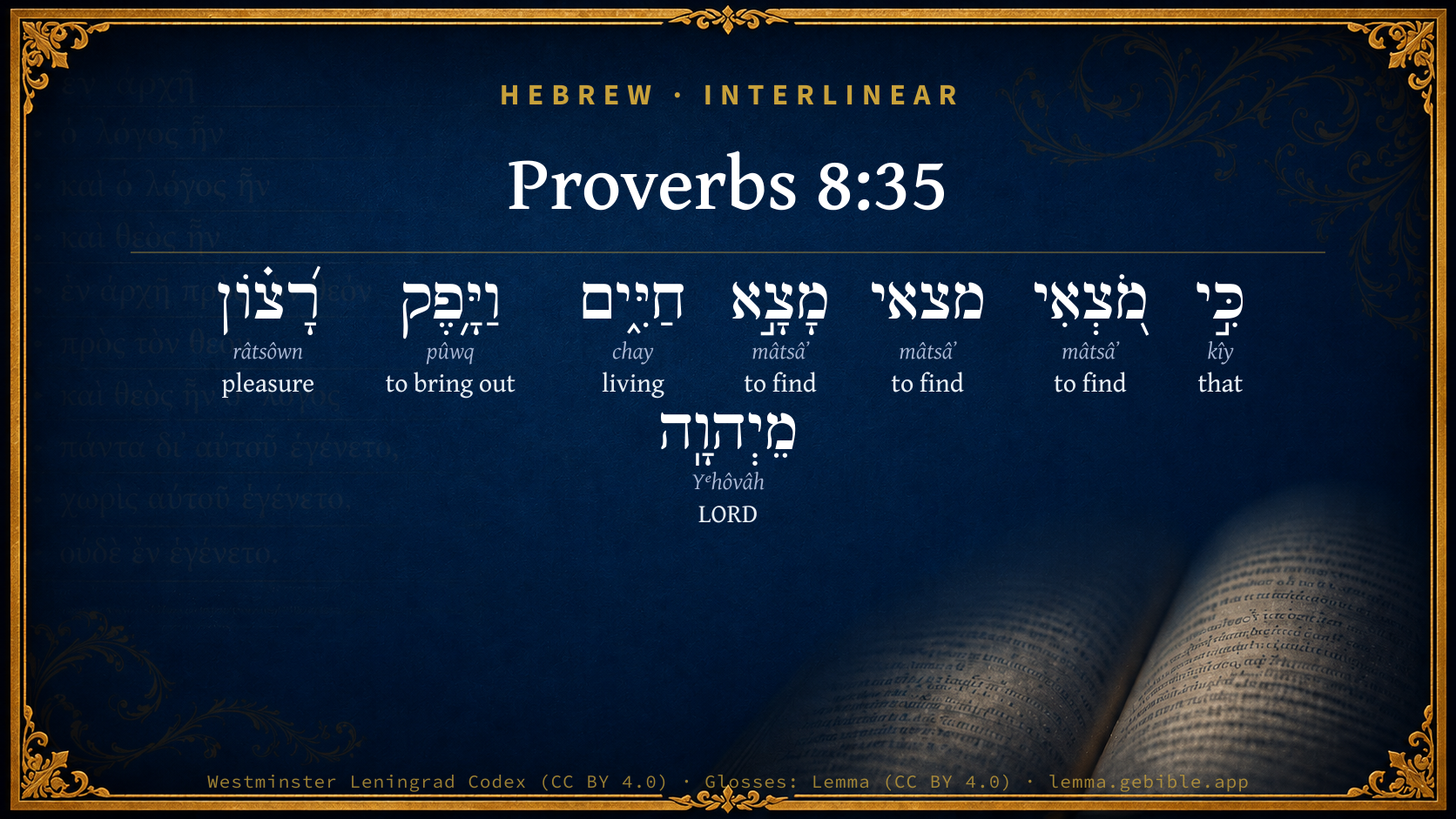
Hebrew (Westminster Leningrad Codex) Proverbs 8:35 appears in the Hebrew Old Testament. The text above is from the Westminster Leningrad Codex. Each word links to its Strong’s number, a concise gloss, and parsing drawn from the Open Scriptures Hebrew Bible morphology. Click any word for its full Brown-Driver-Briggs (BDB) entry.
Download image
Cite this verse

Proverbs 8:35 (World English Bible). Public Domain. Lemma interlinear Bible study tool, https://lemma.gebible.app/v/proverbs/8/35.

Show BibTeX & RIS
BibTeX
RIS
English Translation
For whoever finds me, finds life, And will obtain favor from Yahweh.
World English Bible · Public Domain
Download a study sheet

One document with this verse’s original text, its word-by-word gloss line, the meaning frame, cross-references with their text, attributed commentary, and full source and license credits — printable, and it pastes into notes with its structure intact.

This verse Autodidact and up

Study sheet (.html) Plain text (.txt)

A passage Seminary Student

Up to 50 verses in one chapter. A passage sheet keeps up to 6 commentary sources and 12 cross-references per verse, in the order this page ranks them, and says so on the sheet whenever that leaves anything out. Ask for a single verse and you get the Autodidact verse sheet above.

Everything on this page stays free to read, with no account — the sheet is a download of what is already on screen, not access to it.

Want to remove ads? Support Godless Engineer
Compare translations 3

The same verse in 3 English versions, stacked beneath the original-language interlinear above. Click any original word for its lexicon entry.

Each is an independent rendering of the whole verse — the interlinear is not word-aligned to these translations.

Highlighted words mark where these versions differ — a whole-verse word diff, not a word-by-word alignment.

  • World English Bible Public Domain
    For whoever finds me, finds life, And will obtain favor from Yahweh.
  • King James Version Public Domain
    For whoso findeth me findeth life, and shall obtain favour of the LORD.
  • unfoldingWord Literal Text CC BY-SA 4.0
    For a finder of me a finder of life, and he obtains favor from Yahweh.

unfoldingWord Literal Text — © unfoldingWord, licensed CC BY-SA 4.0. Word-aligned USFM3 via Door43 (git.door43.org/unfoldingWord/en_ult).

Versions to compare (up to 4)

3 of 4 selected

Show all 18 translations

Every available English version of this verse, each an independent rendering of the whole verse.

  • World English Bible Public Domain
    For whoever finds me, finds life, And will obtain favor from Yahweh.
  • Berean Standard Bible Public Domain
    For whoever finds me finds life and obtains the favor of the LORD.
  • Majority Standard Bible Public Domain
    For whoever finds me finds life and obtains the favor of the LORD.
  • King James Version Public Domain
    For whoso findeth me findeth life, and shall obtain favour of the LORD.
  • American Standard Version (1901) Public Domain
    For whoso findeth me findeth life, And shall obtain favor of Jehovah.
  • Revised Version (1885) Public Domain
    For whoso findeth me findeth life, and shall obtain favour of the LORD.
  • Geneva Bible (1599) Public Domain
    But he that sinneth against me, hurteth his owne soule: and all that hate me, loue death.
  • Douay-Rheims (1899) Public Domain
    He that shall find me, shall find life, and shall have salvation from the Lord:
  • Young's Literal Translation Public Domain
    For whoso is finding me, hath found life, And bringeth out good-will from Jehovah.
  • Literal Standard Version CC BY-SA 4.0
    For whoever is finding me, has found life, || And brings out goodwill from YHWH.
  • Unlocked Literal Bible CC BY-SA 4.0
    For whoever finds me, finds life, and he will find the favor of Yahweh.
  • unfoldingWord Literal Text CC BY-SA 4.0
    For a finder of me a finder of life, and he obtains favor from Yahweh.
  • Darby Bible Public Domain
    For whoso findeth me findeth life, and obtaineth favour of Jehovah;
  • World Messianic Bible Public Domain
    For whoever finds me finds life, and will obtain favor from the LORD.
  • Webster's Bible Public Domain
    For whoever findeth me findeth life, and shall obtain favor from the LORD.
  • Free Bible Version CC BY-SA 4.0
    For those who find me, find life, and are accepted by the Lord.
  • Bible in Basic English Public Domain
    For whoever gets me gets life, and grace from the Lord will come to him.
  • JPS Tanakh (1917) Public Domain
    For whoso findeth me findeth life, and obtaineth favour of the LORD.

Literal Standard Version (2020), Covenant Press — licensed CC BY-SA 4.0. Text via the HelloAO Bible API (eBible.org). Unlocked Literal Bible (unfoldingWord) — licensed CC BY-SA 4.0. Text via the HelloAO Bible API (eBible.org). unfoldingWord Literal Text — © unfoldingWord, licensed CC BY-SA 4.0. Word-aligned USFM3 via Door43 (git.door43.org/unfoldingWord/en_ult). Free Bible Version, Dr. Jonathan Gallagher — licensed CC BY-SA 4.0. Text via the HelloAO Bible API (eBible.org).

Word by word

More ways to search: Search by grammar → Find every occurrence → Compare this word →

Practice this passage: Drill this verse → Learn its vocabulary →

וַיָּ֥פֶק
pûwq
H6329
“and · to bring out”
Conjunction + Verb, Hiphil, Sequential Imperfect, 3rd Person, Masculine, Singular
Part of Speech
Conjunction + Verb
Stem
Hiphil
Form
Sequential Imperfect
Person
3rd Person
Gender
Masculine
Number
Singular
Full BDB Definition

Origin: a primitive root [identical with H6328 through the idea of dropping out

TWOT: 1748

to bring out, furnish, promote, go out, issue - (Hiphil) - to produce, furnish - to bring out, elicit, obtain, cause to come out from - to promote - to cause to go out to
  1. כִּ֣י kîy H3588 “that” Conjunction
  2. מֹ֭צְאִי mâtsâʼ H4672 “finding · me” Verb, Qal, Participle Active, Masculine, Singular, Construct + Suffix, Personal, 1st Person, Common, Singular
  3. מצאי mâtsâʼ H4672 “finding” Verb, Qal, Participle Active, Masculine, Plural, Construct
  4. מָצָ֣א mâtsâʼ H4672 “to find” Verb, Qal, Perfect, 3rd Person, Masculine, Singular
  5. חַיִּ֑ים chay H2416 “living things” Noun, Common, Masculine, Plural, Absolute
  6. רָ֝צ֗וֹן râtsôwn H7522 “pleasure” Noun, Common, Masculine, Singular, Absolute
  7. מֵיְהוָֽה Yᵉhôvâh H3068 “from · LORD” Preposition + Noun, Proper

About this verse

These counts appear in no published source. They are computed here, from the morphology-tagged text and Lemma’s own curated glosses. What Lemma adds →

8
words
6
distinct lemmas
Wisdom
section

Notable vocabulary

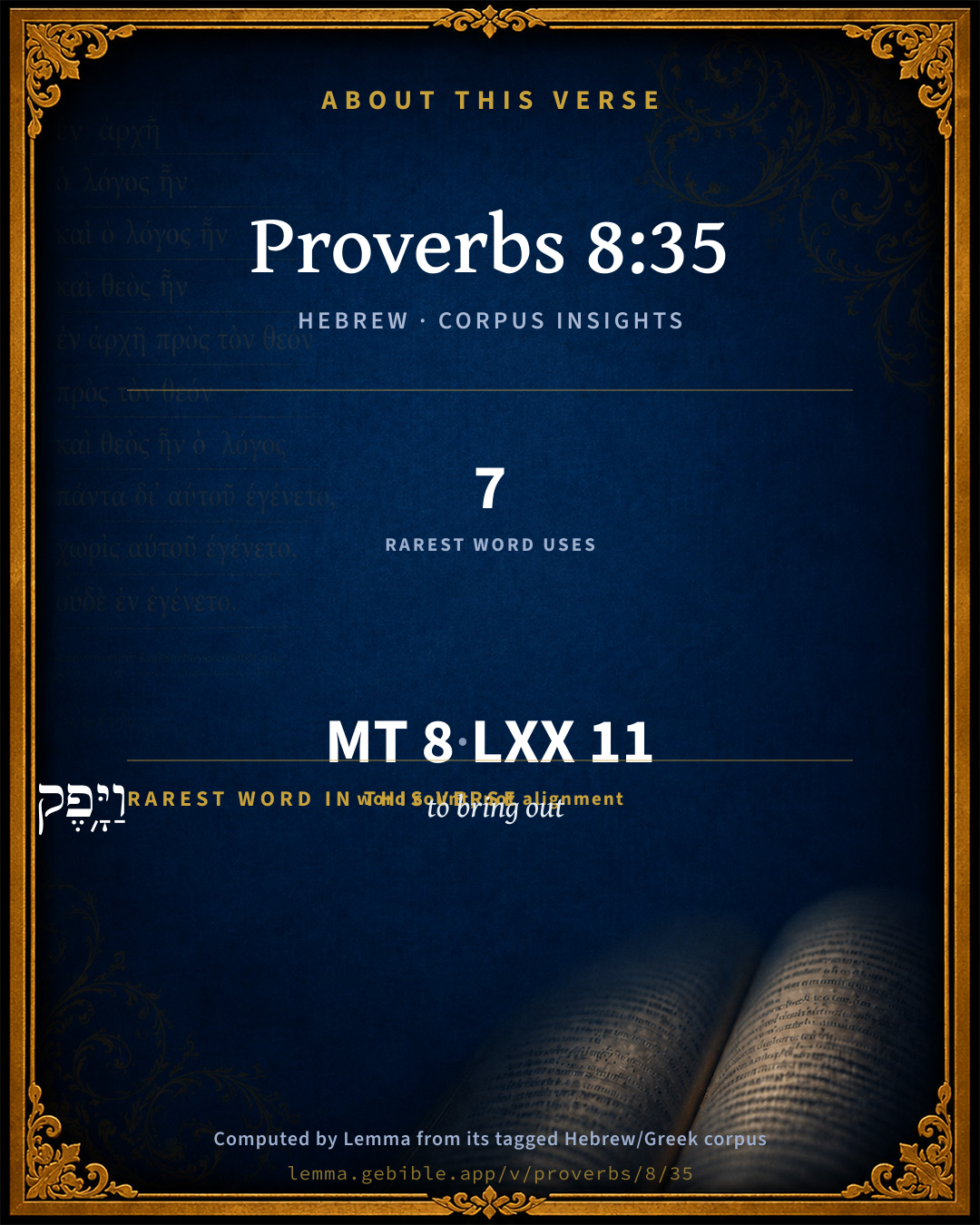
The rarest word here is וַיָּ֥פֶק to bring out H6329 — appearing just 7 times in the whole Hebrew Bible.

Shared distinctive vocabulary

וַיָּ֥פֶק to bring out H6329 occurs in 7 verses of the Hebrew Bible. Also found in:

Grammatical profile

  • 4 verbs
  • 3 nouns
  • 1 conjunction

Verb forms

  • מֹ֭צְאִי Qal · Participle Active
  • מצאי Qal · Participle Active
  • מָצָ֣א Qal · Perfect
  • וַיָּ֥פֶק Hiphil · Sequential Imperfect

Repetition

A word recurs within this verse — often emphatic in Hebrew:

  • מֹ֭צְאִי to find H4672 ×3

Hebrew & Septuagint length

In English translation the verse runs 12 words from the Hebrew and 17 from the Septuagint (LXX English) — the Septuagint runs noticeably longer here. See the side-by-side →

A rough comparison of the two English renderings, which tokenize alike — not a word-level alignment.

Word counts can differ between the Hebrew and the Greek without any difference in meaning — e.g. the Hebrew direct-object marker אֵת has no separate Greek word, and Greek often adds the article ὁ.

In the original languages it is 8 Hebrew tokens and 11 Greek tokens — but the two are counted differently (Hebrew bundles its prefixes and suffixes into one token; the Greek is in lemma form), so that isn’t a like-for-like length.

Cross-references

11

Topical passages linked to Proverbs 8:35 in the Treasury of Scripture Knowledge — connected by theme and wording, ordered by reader-vote popularity; previews shown in the World English Bible.

  • John 3:36 One who believes in the Son has eternal life, but one who disobeys the Son won't see life, but the wrath of God remains on him."
  • 1 John 5:11–12 The testimony is this, that God gave to us eternal life, and this life is in his Son.
  • Proverbs 12:2 A good man shall obtain favor from Yahweh, But he will condemn a man of wicked devices.
  • Philippians 3:8 Yes most assuredly, and I count all things to be loss for the excellency of the knowledge of Christ Jesus, my Lord, for whom I suffered the loss of all things, and count them nothing but refuse, that I may gain Christ
  • John 17:3 This is eternal life, that they should know you, the only true God, and him whom you sent, Jesus Christ.
  • Colossians 3:3 For you died, and your life is hidden with Christ in God.
  • Proverbs 3:13–18 Happy is the man who finds wisdom, The man who gets understanding.
  • John 14:6 Jesus said to him, "I am the way, the truth, and the life. No one comes to the Father, except through me.
  • Proverbs 1:33 But whoever listens to me will dwell securely, And will be at ease, without fear of harm."
  • Ephesians 1:6 to the praise of the glory of his grace, by which he freely bestowed favor on us in the Beloved,
  • John 3:16 For God so loved the world, that he gave his one and only Son, that whoever believes in him should not perish, but have eternal life.

Cross-references courtesy of OpenBible.info (CC BY 4.0).

Hebrew and Greek witnesses Masoretic Hebrew ↔ Greek Septuagint

The same verse in the two great witnesses to the Old Testament, shown verse-for-verse.

Here the Septuagint runs noticeably longer than the Hebrew — LXX2012 (modern English Septuagint) 17 words vs World English Bible 12. A rough length comparison of the two English translations, not a word-level alignment — read both below.

These are two independent witnesses, not word-aligned to each other, and the Septuagint is shown in lemma (dictionary) form.

Hebrew Proverbs 8:35 Masoretic · Westminster Leningrad Codex

כִּ֣י מֹ֭צְאִי מצאי מָצָ֣א חַיִּ֑ים וַיָּ֥פֶק רָ֝צ֗וֹן מֵיְהוָֽה

For whoever finds me, finds life, And will obtain favor from Yahweh.

World English Bible · Public Domain

Greek LXX Proverbs 8:35 Septuagint · lemma form

ὁ γάρ ἔξοδος ἐγώ ἔξοδος ζωή καί ἑτοιμάζω θέλησις παρά κύριος

For my outgoings are the outgoings of life, and in them is prepared favor from the Lord.

LXX2012 (modern English Septuagint) · Public Domain

On this verse, Haydock's Catholic Bible Commentary discusses the Septuagint’s reading. Read the note in Commentary ↓

Hebrew: Westminster Leningrad Codex (CC BY 4.0). Greek: Septuagint (public domain); English from LXX2012 (modern English Septuagint) (Public Domain). How the Septuagint differs from the Hebrew →

Commentary

Notes on Proverbs 8:35 from classic Christian and Jewish commentators (each source and its license shown beneath its notes). The classic Christian expositions comment on the surrounding passage and are grouped to its opening verse, so a note may address several verses; the Jewish commentaries on the Tanakh (Rashi and others) are per-verse, so they appear only where the commentator wrote on this verse.

Lemma curates 59 commentaries, every one of them public domain or Creative Commons licensed, each selected and text-cleaned for this edition rather than reprinted as found. About our sources →

Trapp's Complete Commentary

John Trapp

Pro 8:35 For whoso findeth me findeth life, and shall obtain favour of the LORD.

Ver. 35. For whoso findeth me, findeth life.] Lest any man should hold it too hard a task to wait at wisdom’s gates - as princes’ guards, or as the Levites did in the temple - she tells them what they shall have for so doing.

And shall obtain favour.] Which is better than life. God’s favour is no empty favour; it is not like the winter’s sun, that casts a goodly countenance when it shines, but gives little heat or comfort. As air lights not without the sun, nor wood heats without fire, so neither can anything yield comfort without God’s favour.

John Trapp, A Commentary or Exposition upon All the Books of the Old and New Testament (1647–1656) — public domain. Text from a community e-Sword module.

The Biblical Illustrator

Joseph S. Exell

Pro_8:35

Whoso findeth Me findeth life.

The Christian life delineated: Christ to be found in the ordinances, with the import and happy effects of finding Him

I. The ordinances are the place where Christ is to be found of poor sinners

1. What are the ordinances? The Divine ordinance of meditation. Christian conference about spiritual matters. Singing of the Lords praises. Prayer. The Word. Baptism and the Lords Supper.

2. Confirm this doctrine. The ordinances are by Christs own appointment the trysting-places wherein He has promised to be found of those that seek Him. Trysting-places for sinners, where they may be convinced, converted, and regenerated. Trysting-places for saints, where they may receive life more abundantly. They are the places wherein His people seek Him, who know best where He is to be found. They are what the Lord has allowed His people to supply the want of heaven, until they come there.

3. Apply this doctrine. It reproves those who slight attendance on ordinances; those who come to meet some they have worldly business with; who come, but not to find Christ there; who stand in the way of others attending on ordinances. It urges to seek Christ in ordinances. He is well worth the seeking.

II. People may come to ordinances and not find Christ.

1. Reasons on the sinners side. Some have no design of finding Christ in ordinances at all. Many are indifferent whether they find Christ or not. Some desire not to see Him at all. Some cannot wait patiently at the gates.

2. Improve this point. Seek Him sincerely and uprightly with all your heart. Seek Him honestly and generously for Himself. Seek Him fervently, humbly, diligently, mournfully. Seek Him till you find.

III. Then do people find christ when, upon a saving discovery of Christ made to their souls, they close with Him by faith.

1. Things in general touching the finding of Christ. There is a twofold finding of Him, initial and progressive. The immediate effect of the former is union, of the other actual communion with Christ. Some things to be observed. Sinners in their natural state have lost God. Man is a seeking creature. There is no satisfying of the soul till it come to God. God is in Christ, and is to be found in Him only.

2. More particularly explain the souls finding Christ. The soul savingly discovers and discerns Jesus Christ by a new light let into it. There is a twofold discovery of Him in the gospel, objective and subjective. There are six things the soul sees in Christ: A transcendent excellency. A fulness for the supply of all wants. A suitableness to meet his case and to glorify God. The Wisdom of God in Him. An ability to save. Willingness to save. Upon this discovery of Christ made unto and by the soul, the soul closes with Christ by faith. Such a discovery is not made to the soul till it be hunger-bitten. The nature of the object discovered speaks for itself. And the discovery is always attended with a heart-conquering power.

IV. Sinners finding Christ find life.

1. Unfold that life which sinners find. It is a life of grace, in regeneration. A life of favour with God. A life of new obedience. A life of comfort. And eternal life.

2. What are the qualities of this life? It is a Divine life. A life of the whole man. A pleasant life. A persevering life. A growing life.

3. Confirm this doctrine. The sinner finding Christ finds all things necessary to make him happy. Look to the whole of Christs purchase, what He bought for poor sinners with His blood; and the soul finding Christ finds it all, and may say, It is all mine. (T. Boston, D. D.)

Wisdoms rewards

Some man might say, Why should we watch so much for Wisdom? What shall we get by so much labour? Lest any should refuse and despise Wisdom, as terrified with the mention of so much pains in getting, Wisdom promises large rewards of life and favour from God. Heavy things grow light, when great rewards are propounded. And if any man be inquisitive to know what is that blessedness promised to such as take pains to get Wisdom, she tells them that their diligence in seeking her shall be recompensed in a most copious reward. As if she had said, They that find Me shall not obtain some vulgar matter of little weight, but an incomparable treasure of all good things--to wit, life, which all men naturally desire, and eternal life, which only God can give, and all that a man can justly desire; and so shall he be fully happy in Gods favour. (Francis Taylor, B. D.)

Life

The life that is found in Christ, who is our life--the life which, if diligently sought, shall be assuredly found, and which, when found, fills the soul with joy and peace.

I. The advantage of seeking Christ. We seek not only Him personally, but all that is in Him. We seek Him in whom all fulness dwells, and in seeking Him all the fulness that dwells in Him becomes ours. In finding Christ we find happiness, holiness, and heaven; pardon, peace, a quiet conscience, relief from the weary load of sin.

II. What do we find in Christ? Life is the great aim of all sentient beings; to obtain life, and having obtained it, to preserve it. Inquire, by way of contrast, what is gained by that life which is found elsewhere than in Christ? Sometimes life is sought in pleasure, in the world, in the love of things of the world, and in sin. Mistaking the great object of living, and pursuing a career of sin, men find that sin bringeth forth death--death of body and of soul, death for time, and death throughout eternity. There is a more excellent way, a way which has the promise of the life that now is and of that which is to come. The true life commences here. This life of ours is a pilgrimage. He that findeth life finds a life that is clothed with immortality, that revels in eternal day, that climbs unwearied the everlasting hills, that wears the crown of everlasting victory. (Robert Maguire, M. A.)

And shall obtain favour of the Lord.

Sinners interested in Christ obtaining favour of the Lord

I. Show some things supposed in this truth tending to clear the meaning of it.

1. There is a treasure of favour for poor sinners with the Lord. A treasure speaks preciousness, variety, and abundance.

2. This treasure is locked on sinners out of Christ, they have no access to it.

3. The sinner once interested in Christ has free access to the treasure, to bring forth from thence whatever he needs.

4. The sinner, when interested in Christ, will still be needing, while he is in this world.

5. It is the privilege and duty of believers to bring forth and fetch supply for all their wants out of that treasure.

II. Show wherein the soul once interested in Christ shall obtain favour of the Lord.

1. In prosperity. They shall have balancing grace, to make them carry evenly and usefully. Balancing providences; some such mixture of bitterness in their cup as keeps them from miskenning themselves.

2. In personal outward athletics. But they shall be bettered by it; supported under it, and have deliverance in due time.

3. In desertion. They shall never be totally or finally forsaken.

4. In temptation. They shall either be made to keep their ground against the temptation, or at least temptation shall not be allowed to gain a complete victory over them.

5. Even when fallen into sin, the Lord will not leave them, nor cast them off.

6. In time of public calamity. They shall either be hid, or gracious favour shall be mixed with the trouble, or the sting shall be taken out of it.

7. Death. They shall then be freed from sin and freed from trouble.

III. Confirm this doctrine.

1. Sinners have a right to the whole treasure of favour in Christ, in whom they are interested.

2. Jesus Christ is the dispenser of the treasure, the high Steward of the house of heaven.

3. The enjoyment is secured by the covenant of promises.

4. They have each of them a private key to the treasure, and that is faith. Improve this doctrine--

(1) In a way of information;

(2) in a way of encouragement. (T. Boston, D. D.)

What found with wisdom

I. Wisdom may be found. Else these promises were annexed in vain.

II. If wisdom be found, life is found withal.

1. Natural.

2. Spiritual.

3. Eternal life.

III. Not only life, but Gods favour is gotten also by getting wisdom.

1. He shall find favour from God in receiving Him.

2. He shall find favour from God in rewarding him here.

3. He shall find favour from God in preserving him from many dangers.

4. He shall receive favour from God in preferring, or crowning him with eternal glory in heaven.

Use--

1. To confute the doctrine of merits.

2. Seek wisdom earnestly and truly; not faintly and hypocritically, seeing ye look not only for life, but also for Gods favour from thence, which is the very cause of life, and the very life of life itself. (Francis Taylor, B. D.)

The favour of God obtained by wisdom

The intention of this text is to represent a very great blessedness to good men, whether in the present or a future state, annexed to wisdom, or religious virtue, in consequence of their obtaining Gods favour.

I. How great, how substantial and comprehensive a felicity this is. It will be easily allowed, if we consider our most obvious notions of the Deity, as a Being infinitely perfect and all-sufficient, the fountain of life and happiness. We judge of the importance of any persons favour, and of the security and advantage which may arise to ourselves from it, by his power and capacity. It is impossible that Gods favourites should be unhappy, because He neither wanteth power to effect what His good-will inclineth to, nor wisdom to contrive the best method for their safety and advantage. Though there are objects suitable to the inclinations God hath planted in our nature, yet even supposing them sought after, and enjoyed without sin, they come short of being our true felicity, both in the perfection of degree and in the duration of them. They cannot yield solid contentment and satisfaction to the mind of man, because they are too low in their kind for its high capacity; and they are of a perishing nature; pleasure is but for a season, honour only an empty shadow; nothing can be more variable and uncertain than it is. But the favour of God is a substantial good, and never-failing foundation of hope and spring of comfort; it extendeth to all possible cases, and is a support in the most distressed situation of affairs.

II. Upon what grounds may we expect that, if we find wisdom, we shall obtain favour of the Lord? How can men do anything that is good out of a regard to the Deity, unless they first believe Him to be good, and a lover of virtue? The greatest corruptions of religion and morality have taken their rise from wrong notions of God. But how doth it appear that the wise and virtuous obtain favour of the Lord, since His providence doth not distinguish them by marks of favour, but, by the confession of the sacred writers themselves, they are in as bad a condition with respect to the affairs of this life as the wicked? This objection hath been advanced against the equity and wisdom of Providence, and as seeming to prove that the affairs of this world are under no intelligent direction, but left to blind chance or necessity; but this is not conclusive against the doctrine of the text for the following reasons:

1. The present state is appointed in the wisdom of God to be a state of discipline and improvement.

2. The sufferings of good men in the present state may be considered as trials, and it is consistent with the favour of God to His servants that He should try them in order to their growth in virtue, and so becoming still more the objects of His favour.

3. We must keep in mind those things promised in the gospel. Two practical reflections.

(1) See what is the noblest end of life, the worthiest of our affections, our choice, and of our most diligent and constant endeavours, that we may attain it.

(2) The way to obtain this end is plainly marked out to us in Scripture, and it is very inexcusable folly and thoughtlessness if we mistake it. (J. Abernethy, M. A.)

The Biblical Illustrator, edited by Joseph S. Exell (c. 1880s–1900s) — public domain. Text from a community e-Sword module.

Tyndale Open Study Notes

Tyndale Open Resources

8:35-36 Life is the ultimate reward for the wise, while rejecting wisdom results in death. These verses point to eternal life and death (see Luke 23:43; 1 Cor 15).

Tyndale Open Study Notes — © Tyndale Open Resources, licensed CC BY-SA 4.0. Text via the HelloAO Bible API.

Jamieson, Fausset & Brown

Robert Jamieson, A. R. Fausset & David Brown

(Compare Luk 13:23-24).

Jamieson, Fausset & Brown — Commentary Critical and Explanatory on the Whole Bible (1871) — public domain (CC PDM 1.0). Text via the HelloAO Bible API.

Adam Clarke's Commentary

Verse 35. Whoso findeth me] The wisdom that comes from God, teaching to avoid evil and cleave to that which is good; findeth life-gets that knowledge which qualifies him to answer the purposes for which he was made; for he is quickened with Christ, and made a partaker of the Divine life. Christ dwells in his heart by faith; he lives a new life, for Christ liveth in him; the law of the spirit of life in Christ Jesus makes him free from the law of sin and death. And shall obtain favour of the Lord. The more he walks after the Divine counsel, the more he obtains of the Divine image; and the more he resembles his Maker, the more he partakes of the Divine favour.

Adam Clarke's Commentary on the Bible (1810–1826) — public domain. Text from a community e-Sword/MySword module.

Ellicott's Commentary for English Readers

(35) Whoso findeth me findeth life.—Comp. 1Jn_5:12; Joh_8:51; and above, Pro_3:18, where Wisdom is described as a “tree of life.”

A Bible Commentary for English Readers, edited by Charles John Ellicott (1878–1897) — public domain. Text from a community e-Sword module.

The Cambridge Bible for Schools and Colleges

gen. ed. J. J. S. Perowne

35. obtain] “Heb. draw forth,” R.V. marg. See Pro_3:13, note.

The Cambridge Bible for Schools and Colleges (gen. ed. J. J. S. Perowne; Cambridge University Press, 1878–1918) — public domain. Text from a community e-Sword module.

John Gill's Exposition

For whoso findeth me findeth life,.... Of finding Christ; see Gill on Pro 3:13. Such that find Christ find "life" or "lives" (z), life spiritual and eternal; till they are found of Christ, and find him in effectual calling, they are dead; but, when called by his grace and converted, they live a life of justification and sanctification; they live a life of faith on Christ, of holiness from him, and communion with him: and such that find life in this sense find spiritual food in and from Christ, to support this life; and spiritual clothing, a justifying righteousness, called the justification of life, and which is the comfort of it; and rest in him, which makes life pleasant and delightful. Such an one finds that which of all things is most valuable, the life of his immortal soul; and which he can find nowhere else; and which, being found, can never be lost, for he finds eternal life in him; and has both a right unto it, and a meetness for it; yea, has the beginning, pledge, and earnest of it, Jo1 5:11;

and shall obtain favour of the Lord; by which is meant, not favour among men, though that is had from the Lord, it is he that gives it; nor temporal blessings, for in this sense favour is not to men of spiritual skill and wisdom; rather spiritual blessings, an access to God, acceptance with him; the presence of God, and communion with him; peace of conscience, and every needful supply of grace: but it seems most principally to design the love, grace, and good will of God, the spring and fountain of all blessings: and "obtaining" it does not intend getting an interest in it, for that is free and sovereign; nor is there anything in men, or done by them, which can procure it; but an enjoyment of it. The word (a) used signifies a drawing it out, as water out of a well; and denotes that it is before it is drawn out or manifested; that it is in the heart of God, and lies hid there, from whence it flows as from a well or fountain; and is enjoyed in the exercise of the grace of faith; when the Lord remembers his people, and encompasses them about with it; or draws it out in great lengths, or grants continued and comfortable manifestations of it; see Psa 36:10.

(z) "vitas", Montanus. (a) "educet", Pagninus, Montanus; "hauriet", V. L. "haurit", Vatablus, Mercerus, Gejerus; "depromit", Schultens.

John Gill's Exposition of the Whole Bible (1746–1763) — public domain (CC PDM 1.0). Text via the HelloAO Bible API.

Albert Barnes' Notes on the Bible

Wisdom then is the only true life. The Word, the Light, is also the Life of man Joh 1:4. The eternal life is to know God and Christ Joh 17:3.

Albert Barnes' Notes on the Bible (1834–1885) — public domain. Text from a community e-Sword/MySword module.

Haydock's Catholic Bible Commentary

Lord. Wisdom, or Jesus Christ, is our salvation, happiness, and life. Septuagint, "and the will is prepared by the Lord." St. Augustine often quotes this to prove the necessity of preventing grace. (Ep. ccxvii., and clxxxvi.) (Calmet)

George Leo Haydock (1774–1849), Haydock's Catholic Family Bible and Commentary, 1859 edition — public domain. Excludes Psalms (Douay-Rheims chapter numbering differs from Protestant) and Deuterocanonical books (Catholic canon only).

Whedon's Commentary on the Bible

Daniel D. Whedon

35, 36. That sinneth against me — חשׂאי, misses me, taking the word in its primitive sense, which best suits the context, as it stands opposed to those finding or meeting her in the preceding verse.

Wrongeth his own soul — חמס נפשׁו, does violence to his own life, commits suicide.

All they that hate me love death — That is, their conduct will be their destruction. They love their own evil way which leads to death, and hence, by a bold metaphor, they are represented as loving death itself, as if bent upon their own ruin.

We may appropriately close our notes on this part of the allegory by quoting a writer of the New Testament who, perhaps more than any other writer thereof, wrote in the spirit and style of this book: “If any of you lack wisdom, let him ask of God, that giveth to all men [who ask] liberally, and upbraideth not; and it shall be given him.” Jas_1:5.

ADDENDA. — The importance attached to some portions of this chapter justifies a few additional remarks. From the time of the great Arian controversies (4th century) the theologians on both sides generally assumed that the Hhokmah, or Wisdom, of the Proverbs was the same as the Logos of John 1. Accordingly, the meaning of the terms in which the Hhokmah was spoken of (Pro_8:22, et seq.) became a matter of great moment, of careful scrutiny, and of excited controversy. The Arians, who held that the Son was not properly God, but only the first of creatures, favoured that translation of kanah (Pro_8:22) which seems to support their theory, while the orthodox, on the other side, contended for the rendering most accordant with their creed. As usual, each had some authorities on their side. The Arians could appeal to the Septuagint, Syriac, Chaldee, and Arabic, all of which translated the word by a term corresponding to our word created, founded, etc., while Aquila, Symmachus, Theodotion, and the Vulgate, rendered it by possessed. Modern criticism is about as much divided as was the ancient. There is, however, this difference, that modern critics and theologians do not all think the Hhokmah and the Logos identical. And some, who believe in the supreme divinity of our Lord, as Stuart, do not hesitate to translate the word by created. Nor were the ancients entirely unanimous in regarding the Hhokmah and the Logos as the same, for some of them identified the Hhokmah with the Holy Spirit. Many very sound modern divines regard the Hhokmah as simply the personification of wisdom, considered first in its more general sense, and, secondly, as an attribute of Jehovah. Others, without identifying the Hhokmah and the Logos, regard the poetic pictures of Solomon as the shadowing forth of the New Testament doctrine of the divine Word. “The error of our English exegetical and theological literature,” says Aiken, (in notes on Zockler,) “has been the attempt to force upon it more distinctness and precision in the revelation of the mysteries of the divine nature than is disclosed by fair exegesis. Sometimes it is the doctrine of the Logos that is made to stand out with all the clearness of New Testament announcement; sometimes it is the eternal generation of the Son that Solomon is made the Spirit’s mouthpiece to reveal… We can go no farther than our author (Zockler) has done in discovering here the pre-shadowings of the doctrine of the Logos. We are induced to prefer the still more guarded statement of John Pye Smith, that this beautiful picture cannot be satisfactorily proved to be a designed description of our Saviour’s person; or that of Dr. John Harris: “At all events, while, on the one hand, none can demonstrate that Christ is here directly intended, on the other, none can prove that he is not contemplated, and, perhaps, both will admit that, under certain conditions, language such as that in our text may be justifiably applied to him. One of these conditions is, that the language be not employed argumentatively, or in proof of any thing relating to Christ, but only for the purpose of illustration; and another is, that when so employed it be only adduced to illustrate such views of the Son of God as are already established by such other parts of Scripture as are admitted by the parties addressed.”

The difference of gender between the Hhokmah and the Logos, the former being feminine and the latter masculine, is noteworthy, and, theologically, of deep significance.

Daniel D. Whedon (gen. ed.), Commentary on the Old and New Testaments (1874–1909) — public domain. Text from a community e-Sword module.

The Pulpit Commentary

For whoso findeth me findeth life. Here is the reason why the man is blessed who attends to the instruction of Wisdom. A similar promise is made at Pro_3:16, Pro_3:18, Pro_3:22. The truth here enunciated is also spoken or the Word of God, the everlasting Son of the Father. Joh_1:4, "In him was life; and the life was the light of men;" Joh_3:36, "He that believeth on the Son hath eternal life;" Joh_17:3, "This is life eternal, that they should know thee the only true God, and him whom thou didst send, even Jesus Christ". (comp. Joh_8:51 1Jn_5:12; Ecc_4:12) Shall obtain favour of the Lord; Vulgate, hauriet salutem, which happily renders the Hebrew verb. (Pro_12:2) The grace of God bringeth salvation. (Tit_2:11) Septuagint, "For my outgoings (exodoi ) are the outgoings of life, and the will is prepared by the Lord (kai etoimazetai yelhsiv para Kuriou )." This latter clause was used by the Fathers, especially in the Pelagian controversy, to prove the necessity of prevenient grace (see St. Augustine, "Enchiridion," 2:32; "De Gratia," 6:16, 17).

Vers. 35, 36. Life and favour with God.

It is common to see this and similar passages applied directly to the soul"s possession of God, or to the special Christian faith in Jesus Christ. Now, it is quite true that we have here in germ what will lead up to those experiences. But apart from the mistake of ignoring the distinction between the elementary truth and its full development, there is a practical consideration that is too often overlooked. It is thought to be good policy to "Christianize" these passages of the Old Testament; i.e. it is thought they are thus most profitably used. On this low ground even an answer can be given it may be shown that the policy is bad. The more Christian idea is true in itself. But it is expressed clearly enough in the New Testament. We gain no new light, therefore, if we contrive to see it here. We simply repeat a lesson that we have learnt elsewhere. But if we take the more literal meaning of the words, then, though the thought given to us may not be so exalted nor so valuable as the perfected Christian thought, it may have a distinct worth and use of its own, and therefore may add somewhat to our knowledge of Divine things an addition which we should not have if we read the words as a mere repetition of what we had already learnt elsewhere, however much more important that other lesson might be. The New Testament teaches us that we have life in Christ. We who have that later and fuller revelation gain little or nothing by reading the same truth in the Book of Proverbs. That life is to be found in the Divine wisdom may be a has valuable thought. But it is a distinct thought, and therefore some addition to our knowledge; and as such it should be spiritually helpful to us. For this reason, though it may be perfectly legitimate for us to show how the words of our text foreshadow the great truths of Christianity, it may be more profitable for us to keep to their simple meaning, and see how life and Divine favour are received through the finding of Divine wisdom.

I WHAT IS MEANT BY FINDING DIVINE WISDOM.

1. It is not the mere knowledge of religious doctrine. Many have this, and yet miss the life eternal. We may know the Bible without knowing God.

2. It is not the results of some rare intuition, nor the achievements of elaborate intellectual effort; it is neither the vision of the mystic nor the secret of the Gnostic. For this wisdom is repeatedly offered to the simple with a most general invitation (e.g. vers. 4, 5).

3. To find Divine wisdom is to come to the knowledge of God as far as this affects our own conduct, to know his disposition towards us, his will regarding our conduct, the way of life to which he calls us; it is further to know so much of God"s ways and thoughts as to be able to set them before us as a pattern, and thus to imbibe some of the great primeval wisdom described in the preceding verses; lastly, it is to set these thoughts in relation to practice and to make the knowledge of Divine things the rule of life.

II HOW LIFE AND THE FAVOUR OF GOD RESULT FROM THE FINDING OF WISDOM.

1. Life.

(1) In this wisdom we see the way to life that life which is to Christians here on earth as well as hereafter the life eternal.

(2) The only life worth living is that lived with thoughts of God and aims directed by the knowledge of God. Eternal life consists in this knowledge of God.

2. The favour of God. God is pleased with us in so far as we walk in his ways. Divine wisdom only can direct us aright, so that we may please God. But the very habit of mind that consists in the thinking of Divine thoughts and the desiring and attempting to accomplish the purposes of Divine wisdom must be pleasing to God. "Base-minded they that want intelligence; For God himself for wisdom most is prais"d, And men to God thereby are nighest rais"d. (Spenser)

III HOW SELF-INJURY AND DEATH RESULT FROM THE LOSS OF THIS WISDOM. "He that misseth me," etc.

1. The common evils of life will lead to our ruin unless we are saved by higher means. The traveller who rejects the guide may parish in the perils of his path; the patient who disobeys the physician may die of his disease. We shall ruin ourselves in sin "if we neglect so great salvation.

2. The rejection of Divine wisdom is itself a fatal sin. It is our duty to hearken to its voice. If we refuse to do this, we shall suffer as a penalty for our wilful disobedience to the message from Heaven.

The Pulpit Commentary (1880–1919), ed. H.D.M. Spence-Jones & Joseph S. Exell — public domain. Text from a community e-Sword module.

unfoldingWord translationNotes

Door43 World Missions Community

finds me ... hate me

This is still wisdom talking about herself. (See: Personification)

he who fails

The complete thought is, "he who fails to find me" (See: Assumed Knowledge and Implicit Information)

his own life

Here "life" represents the person's self. (See: Metonymy)

translationWords

life

favor

Yahweh

love

die

unfoldingWord translationNotes — © Distant Shores Media and the Door43 World Missions Community, licensed CC BY-SA 4.0. Source: git.door43.org/Door43/en_tn.

Lesson kit

Teaching starters — assembled from the data on this page, not authored interpretation. Every prompt links to the verse data it draws on. Edit before teaching.

Proverbs, in the Wisdom, opens this verse with 8 words (6 distinct Hebrew lemmas). Its most distinctive word is pûwq (“to bring out”). The Greek Septuagint runs longer here. A historical commentator’s framing appears above. Read the whole chapter for the surrounding context.

Discussion questions

  1. How does “to bring out” (pûwq) shape what this verse is saying?
  2. How does Psalms 140:8, which shares the word «to bring out», read alongside this verse?
  3. What does the repetition of “to find” (3× in this one verse) do in this verse?
  4. The Septuagint runs longer here than the Hebrew. What might account for the difference?
  5. These translations render this verse differently. What is at stake in choosing one wording over another?
  6. «מֹ֭צְאִי» is a Qal Participle Active verb. How does that grammatical form shape the action described?
  7. Compare how Trapp's Complete Commentary and The Biblical Illustrator read this verse. Where do they agree or differ?

Things to notice

Reading settings

Reading text

Shown beneath each verse's original-language words.

Old Testament
Old Testament edition

Read the OT as the Masoretic Hebrew (MT) or the Greek Septuagint (LXX).

English shown for the Greek Septuagint (in the Hebrew ↔ Greek comparison).

Comparing translations? Open the Compare panel on any verse page to stack up to four side by side.