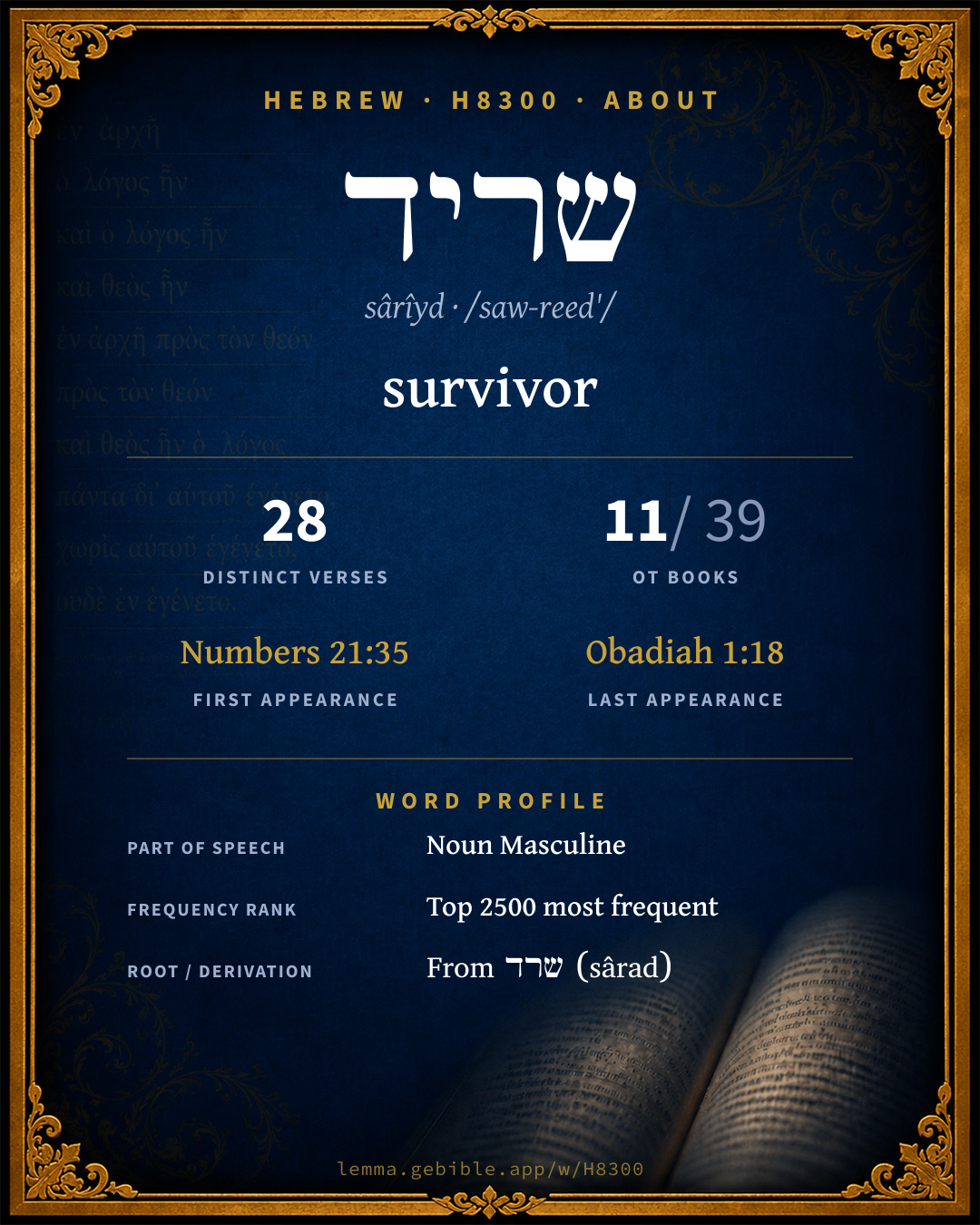
שָׂרִיד
survivor
‘survivor’ is one of 2 main senses fuller range ↓
Full lexicon entry — Brown-Driver-Briggs (BDB)
From Brown-Driver-Briggs (BDB)
Where this word appears
See every Absolute-state word in the Hebrew Bible →
Grammar key — what these labels mean
Part of speech
- Noun
- A naming word — a person, place, thing, or idea.
Noun type
- Common
- A common noun — a general class of person, place, or thing (“king,” “city,” “water”), not a specific name.
State
- Absolute
- The independent form of a noun, not bound to a following word.
- Construct
- A noun bound to a following noun in a possessive / “of” relationship (the construct chain).
Gender
- Masculine
- Grammatically masculine.
Number
- Singular
- One.
- Plural
- More than one (in Hebrew, generally three or more).
Grammatical forms
- Noun, Common, Masculine, Singular, Absolute 23 times (79%)
- Noun, Common, Masculine, Plural, Construct 3 times (10%)
- Noun, Common, Masculine, Plural, Absolute 2 times (7%)
- Noun, Common, Masculine, Singular, Construct 1 time (3%)
Parsed forms decoded from the imported morphology (morphhb / Westminster Leningrad Codex — WLC text public domain, morphhb tagging CC BY 4.0), counted across 29 parsed occurrences — not distinct verses.
Every verse where H8300 appears — 28 distinct verses across 11 books. Click any verse to open its interlinear word-by-word view. Verse text shown in the World English Bible for context — . Each verse’s Hebrew form is shown with its reference; the English is not keyword-highlighted, since the data carries no word-level English alignment. Use “Compare translations” on any verse to read it across multiple English versions. This concordance covers the Hebrew Bible; Septuagint (Greek Old Testament) occurrences are not indexed here.
Numbers 2 verses
Deuteronomy 2 verses
- Deuteronomy 2:34 שָׂרִֽיד n c ms We took all his cities at that time, and utterly destroyed every inhabited city, with the women and the little ones; we left none remaining:
- Deuteronomy 3:3 שָׂרִֽיד n c ms So Yahweh our God delivered into our hand Og also, the king of Bashan, and all his people: and we struck him until none was left to him remaining.
Joshua 9 verses
- Joshua 8:22 שָׂרִ֥יד n c ms The others came forth out of the city against them; so they were in the midst of Israel, some on this side, and some on that side: and they struck them, so that they let none of them remain or escape.
- Joshua 10:20 וְ/הַ/שְּׂרִידִים֙ conj + ptcl def.art + n c mp It happened, when Joshua and the children of Israel had made an end of killing them with a very great slaughter, until they were consumed, and the remnant which remained of them had entered into the fortified cities,
- Joshua 10:28 שָׂרִ֑יד n c ms Joshua took Makkedah on that day, and struck it with the edge of the sword, and the king of it: he utterly destroyed them and all the souls who were therein; he left none remaining; and he did to the king of Makkedah as he had done to the king of Jericho.
- Joshua 10:30 שָׂרִ֑יד n c ms and Yahweh delivered it also, and the king of it, into the hand of Israel; and he struck it with the edge of the sword, and all the souls who were therein; he left none remaining in it; and he did to the king of it as he had done to the king of Jericho.
- Joshua 10:33 שָׂרִֽיד n c ms Then Horam king of Gezer came up to help Lachish; and Joshua struck him and his people, until he had left him none remaining.
- Joshua 10:37 שָׂרִ֔יד n c ms and they took it, and struck it with the edge of the sword, and the king of it, and all the cities of it, and all the souls who were therein; he left none remaining, according to all that he had done to Eglon; but he utterly destroyed it, and all the souls who were therein.
- Joshua 10:39 שָׂרִ֑יד n c ms and he took it, and the king of it, and all the cities of it; and they struck them with the edge of the sword, and utterly destroyed all the souls who were therein; he left none remaining: as he had done to Hebron, so he did to Debir, and to the king of it; as he had done also to Libnah, and to the king of it.
- Joshua 10:40 שָׂרִ֑יד n c ms So Joshua struck all the land, the hill-country, and the South, and the lowland, and the slopes, and all their kings: he left none remaining, but he utterly destroyed all that breathed, as Yahweh, the God of Israel, commanded.
- Joshua 11:8 שָׂרִֽיד n c ms Yahweh delivered them into the hand of Israel, and they struck them, and chased them to great Sidon, and to Misrephoth Maim, and to the valley of Mizpeh eastward; and they struck them, until they left them none remaining.
Judges 1 verse
2 Kings 1 verse
Job 4 verses
- Job 18:19 שָׂ֝רִ֗יד n c ms He shall have neither son nor grandson among his people, Nor any remaining where he sojourned.
- Job 20:21 שָׂרִ֥יד n c ms There was nothing left that he didn't devour, Therefore his prosperity shall not endure.
- Job 20:26 שָׂרִ֣יד n c ms All darkness is laid up for his treasures. An unfanned fire shall devour him. It shall consume that which is left in his tent.
- Job 27:15 שריד/ו שְׂ֭רִידָי/ו n c ms cs + sfx pers 3ms n c mp cs + sfx pers 3ms Those who remain of him shall be buried in death. His widows shall make no lamentation.
Isaiah 1 verse
Jeremiah 4 verses
- Jeremiah 31:2 שְׂרִ֣ידֵי n c mp cs Thus says Yahweh, The people who were left of the sword found favor in the wilderness; even Israel, when I went to cause him to rest.
- Jeremiah 42:17 שָׂרִ֣יד n c ms So shall it be with all the men who set their faces to go into Egypt to sojourn there: they shall die by the sword, by the famine, and by the pestilence; and none of them shall remain or escape from the evil that I will bring on them.
- Jeremiah 44:14 וְ/שָׂרִיד֙ conj + n c ms so that none of the remnant of Judah, who have gone into the land of Egypt to sojourn there, shall escape or be left, to return into the land of Judah, to which they have a desire to return to dwell there: for none shall return save such as shall escape.
- Jeremiah 47:4 שָׂרִ֣יד n c ms because of the day that comes to destroy all the Philistines, to cut off from Tyre and Sidon every helper who remains: for Yahweh will destroy the Philistines, the remnant of the isle of Caphtor.
Lamentations 1 verse
Joel 1 verse
Obadiah 2 verses
- Obadiah 1:14 שְׂרִידָ֖י/ו n c mp cs + sfx pers 3ms Don't stand in the crossroads to cut off those of his who escape. Don't deliver up those of his who remain in the day of distress.
- Obadiah 1:18 שָׂרִיד֙ n c ms The house of Jacob will be a fire, the house of Joseph a flame, and the house of Esau for stubble. They will burn among them, and devour them. There will not be any remaining to the house of Esau." Indeed, Yahweh has spoken.
About this entry
At a glance — auto-summarized from this page’s data, not written by a person. Every figure links to its source below. This summary describes the numbers; it doesn’t interpret them.
At its core, שריד (sârîyd) means “survivor.” Translators differ — “none remaining” in the King James Version, then “survivors” (Berean Standard Bible) and “survivor” (unfoldingWord Literal Text), as the renderings breakdown shows. With 28 verses in 11 books, it is a moderately common word in the Hebrew Bible. Its uses concentrate in Joshua (32% of all occurrences). Carrying more than one sense, it rewards its full sense range. Dig into 28-verse concordance and the renderings breakdown below.
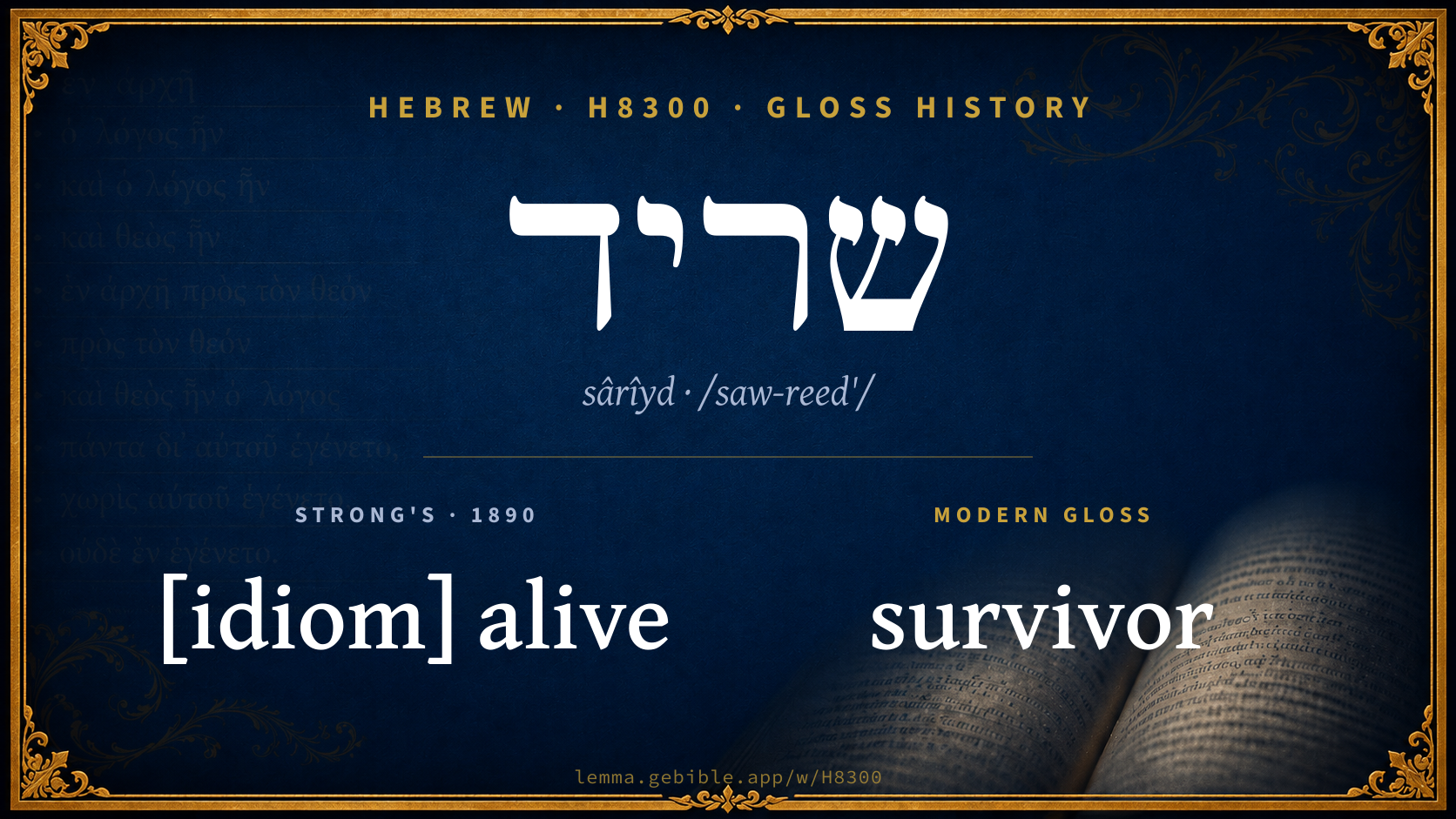
Gloss history
Strong's 1890 vs modern scholarship
About this word
Strong's H8300 catalogs a Hebrew word from the Hebrew Old Testament.
These counts are not copied from any lexicon or concordance. They are computed here, from the morphology-tagged Hebrew Old Testament. What Lemma adds →
- 28
- distinct verses
- The word appears in 28 distinct verses.
- 11 / 39
- OT books
- The word appears in 11 of 39 Old Testament books.
- #1,160
- by frequency
- Top 2500 most frequent Hebrew words (rank 1,160 of 8,640 Hebrew words by occurrence).
View all 28 occurrences in the concordance →
By section of the Old Testament
By traditional corpus
Conventional, traditional groupings — biblical authorship is debated, so this is a traditional corpus grouping, not an authorship claim. Each share is this word’s portion of its verses in that division of the Hebrew canon. Each figure is a share of the word’s 28 distinct verses.
- Prophets (Nevi'im) 19 verses · 68%
- Writings (Ketuvim) 5 verses · 18%
- Torah (Pentateuch) 4 verses · 14%
How translations render this word
Counts come from each version’s own published word-to-Strong’s tagging or interlinear alignment — an approximate guide to how each version renders this word, not a word-level alignment the data otherwise carries. Because each total is that version’s own tagged count, the per-version totals vary from one another and need not match the appearance or distinct-verse counts above. These counts may also differ from a printed concordance because Lemma counts each distinctly tagged rendering and does not collapse phrase taggings into a single head-word total. This is a fixed set of word-tagged versions (KJV, ASV, BSB, ULT) and does not change with the reading translation you choose elsewhere. Each version’s license is shown beside its name below (and on Sources).
BDB lists this Strong’s number as 2 distinct words (homographs). Each count above pools all of them and is not split by sense — see the Senses section below. A low-frequency rendering may belong to a different one of those words, not the primary meaning.
- King James Version†: None remaining 6×, None remain 2×, Remaineth 2×
- American Standard Version†: He left none remaining 4×, None remaining 4×, Remnant 3×
- Berean Standard Bible†: Survivors 13×, Survivor 5×, Remaining 2×
- unfoldingWord Literal Text†: Survivor 16×, Remnant 4×, Survivors 2×
King James Version Public Domain
Renders H8300 across 28† tagged occurrences — most commonly:
Plus 16 renderings that appear only once — usually multi-word phrases or single function words the recovered tagging swept in, not distinct renderings.
American Standard Version Public Domain
Renders H8300 across 28† tagged occurrences — most commonly:
Plus 13 renderings that appear only once — usually multi-word phrases or single function words the recovered tagging swept in, not distinct renderings.
Berean Standard Bible Public Domain
Renders H8300 across 27† tagged occurrences — most commonly:
Plus 7 renderings that appear only once — usually multi-word phrases or single function words the recovered tagging swept in, not distinct renderings. Not rendered by a distinct English word in 1 further occurrence.
unfoldingWord Literal Text CC BY-SA 4.0
Renders H8300 across 24† tagged occurrences — most commonly:
Plus 2 renderings that appear only once — usually multi-word phrases or single function words the recovered tagging swept in, not distinct renderings.
Senses in the full BDB
What do BDB’s symbols mean?
BDB uses these scholarly abbreviations:
| Symbol | Meaning |
|---|---|
| 𝔊 | the Septuagint (the ancient Greek translation, LXX) |
| 𝔙 | the Vulgate (the Latin translation) |
| 𝔖 | the Syriac version (the Peshitta) |
| 𝔗 | the Targum (the Aramaic translation) |
| ψ | the Psalms |
| √ | root (the underlying root or stem) |
| ‖ | parallel passage (a synonymous or contrasted parallel) |
| † | the dagger: every passage where the word occurs is cited |
The 2 senses and sub-senses the full Brown-Driver-Briggs lexicon distinguishes for this word, in lexicon order (not ranked by frequency), with BDB’s own verbatim wording and sub-sense lettering. Shown in Hebrew script with BDB’s own scholarly abbreviations. The condensed entry is in the Lexicon Entry tab. See also the Forms in the corpus table below.
שריד I
- 1. survivor (often ‖ פָּלִיט): especially עַד בִּלְתִּי הִשְׁאִיר לוֹ שׂ׳ Nu 21:35; Jos 8:22 (both JE), Dt 3:3; Jos 10:33; 11:8; 2 K 10:11 (all D); more simply, לֹא הִשׁ׳ שׂ׳ Dt 2:34; Jos 10:28, 30, 37, 39, 40 (all D); י׳ הוֹתִיר לָנוּ שׂ׳ Is 1:9; לֹא יִהְיֶה שׂ׳ לְ Je 42:17; 44:14 Ob 18; אֵין שׂ׳ Jb 18:19; וְהֶאֱבִיד שׂ׳ מֵעִיר Nu 24:19 (JE); עַם שְׂרִידֵי הָ֑רֶב Je 31:2, pl. also Jos 10:20 (subj. of שָֽׂרְדוּ), Jo 3:5; Ob 14; Jb 27:15 (v. supra); sg. also Ju 5:13 (obscure, for שׂ׳ לְ read perhaps יִשְׂרָאֵל GFM Now cf. Bu), Je 47:4; La 2:22. e.g. Numbers 21:35
- 2. of things: אֵין שׂ׳ לְאָבְלוֹ Jb 20:21, i.e. nothing has escaped his greed; יֵ֫רַע שׂ׳ בְּאָהֳלוֹ (אֵשׁ) v 26. e.g. Job 20:21
שריד II loc. on border of Zebulun
Senses from the full Brown-Driver-Briggs lexicon (Brown, Driver, Briggs; Oxford 1906 — public domain), digitized via Sefaria, supplemented by the OpenScriptures HebrewLexicon (CC BY 4.0). Full attribution on Sources.
Word origin
I. n.m. Je 47:4 survivor (from a defeat, etc.);—abs. שׂ׳ Is 1:9 +; sf. שְׂרִידוֹ Jb 27:15 Kt; pl. שְׂרִידִים Jos 10:20 Jo 3:5; cstr. שְׂרִידֵי Je 31:2; sf. שְׂרִידָיו Ob 14 + Jb 27:15 Qr (van d. H. also Kt);—
II. n.pr.loc. on border of Zebulun;—עַד־שׂ׳ Jos 19:10 (P; Εσεδεκγωλα, A ἕως Σαρθιδ, 𝔊L Σαρειδ), מִשּׂ׳ v 12 (P; ἀπὸ Σεδδουκ; A Σαριδ).
— Brown-Driver-Briggs (Oxford 1906, public domain), digitized via Sefaria, supplemented by the OpenScriptures HebrewLexicon (CC BY 4.0). See Sources.
Derived from שרד (sârad) (H8277) — to escape.
Jastrow Dictionary
A second Hebrew/Aramaic lexicon for comparison, covering Aramaic and post-biblical (Talmudic, Targumic, Midrashic) usage that the biblical-Hebrew BDB does not. Matched by lemma rather than by Strong’s number, so a lemma may carry more than one Jastrow headword (shown separately below), and the entries cover usage well beyond the Bible.
שָׂרִיד
- Saf. of ירד) [run-off,] fugitive, escaped, remainder. Yoma 72ᵇ (play on בגדי השרד, Ex. XXXV, 19) אלמלא … ש׳ ופליט but for the garments of priesthood, there would not be left of Israel a remnant or a survivor. Ḥull. 133ᵃ; Snh. 92ᵃ (ref. to Job XX, 26) אין ש׳ וכ׳ by sarid a scholar is meant (with ref. to Joel III, 5); Yalk. Job 907. Pirké d’R. El. ch. XXXV עד שיבוא ש׳ מיעקב וכ׳ until a remnant of Jacob shall come and give to his (Esau’s), sons a dish of lentils in mourning and trouble &c.; a. e.—Pl. שְׂרִידִים. Meg. 6ᵃ (in a eulogy) אוהבי ש׳ יושבי וכ׳ ye lovers of the saved (the scholars, v. supra), dwellers of Rakkath, go forth &c. e.g. Exodus 35:19
שריד
- , Targ. Y. II, Deut. XXXIII, 29; שרידייא, Targ. II Chr. V, 10, v. שָׁרִיר
A Dictionary of the Targumim, the Talmud Babli and Yerushalmi, and the Midrashic Literature (Marcus Jastrow; London, Luzac, 1903) — Public Domain. Digitized via Sefaria. Digitized via Sefaria. Full attribution on Sources.
Forms in the corpus
The 16 distinct written forms H8300 takes in the Hebrew Bible, most frequent first — each parse links to that state’s occurrences in the concordance. Hebrew forms include their vowel points and cantillation, so a single lemma takes many written forms.
Same root — word family
Other BDB entries built from the same root as H8300, grouped by Strong’s listed origin. These share a root / origin per the lexicon — not necessarily a shared meaning. Each links to that word’s own entry.
Derives from
Shares the same root
Proper names from this root
People and places named from this root — a name, not an additional meaning of the word.
Compare all same-root words → Showing 4 of 5 — not the complete family. 1 of the same-root words is a proper name (a person or place). They share a root, not necessarily a meaning.
Septuagint verse parallels
This word appears in 27 verses that also exist in the Greek Old Testament (Septuagint), out of the 28 Hebrew verses it occurs in. You can read those verses in Greek by switching the Old Testament edition to the Septuagint.
Read these verses in the Septuagint
- Numbers 21:35
- Deuteronomy 2:34
- Joshua 8:22
- Judges 5:13
- 2 Kings 10:11
- Job 18:19
- Isaiah 1:9
- Jeremiah 31:2
- Lamentations 2:22
- Obadiah 1:14
This is a verse-level parallel only — the same verses exist in both the Hebrew and Greek Old Testaments. No word-level Hebrew↔Greek correspondence is claimed: the data carries no such alignment, so no Greek word is shown as this Hebrew word’s translation. Coverage is not total — the Septuagint omits the deuterocanon and renumbers the Psalms, so some Hebrew verses have no direct Greek parallel.