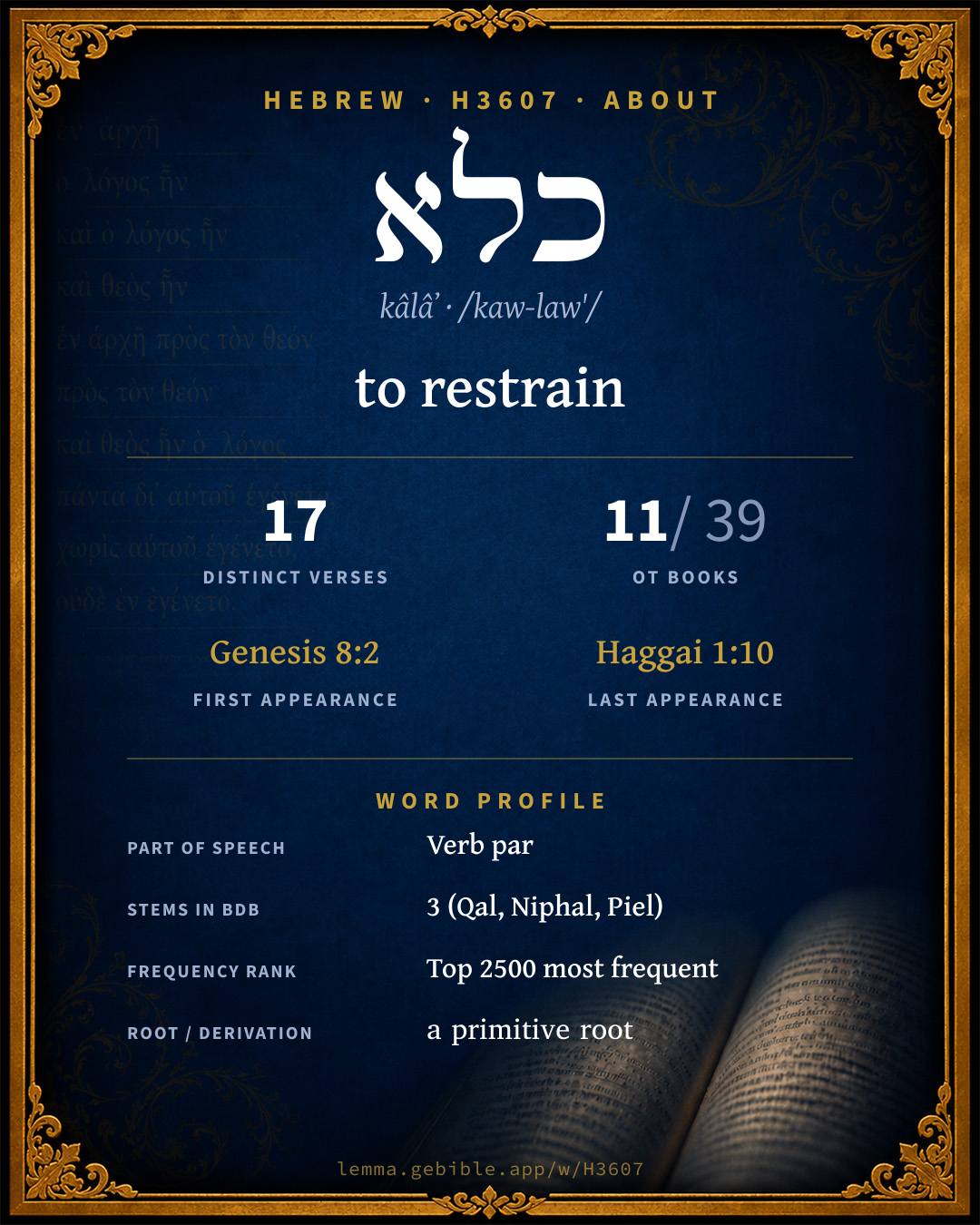
כָּלָא
to restrain
‘to restrain’ is one of 3 main senses fuller range ↓
Full lexicon entry — Brown-Driver-Briggs (BDB)
From Brown-Driver-Briggs (BDB)
Where this word appears
See every Qal verb in the Hebrew Bible →
Grammar key — what these labels mean
Part of speech
- Verb
- An action or state-of-being word.
Stem
- Niphal
- Usually the simple passive or reflexive of the Qal (“he was written”).
- Qal
- The basic, simple active stem — the plain form of the verb (“he wrote”). Here: ‘shut up’
- Piel
- An intensive or resultative active stem.
Form
- Sequential Imperfect
- An imperfect with prefixed waw — the standard past-narrative form (waw-consecutive imperfect).
- Perfect
- A completed action or state — Hebrew marks aspect (completeness) more than strict tense (“he wrote”).
- Participle Passive
- A verbal adjective expressing action received (“written”).
- Infinitive Construct
- A bound verbal noun, frequently with prepositions (“to write / in writing”).
- Imperfect
- An incomplete, ongoing, or future action (“he will / would write”).
- Jussive
- A third- or second-person volitional form expressing wish or command (“let him write”).
- Imperative
- A direct command (“write!”).
State
- Absolute
- The independent form of a noun, not bound to a following word.
Person
- 3rd Person
- The one spoken about (“he / she / it / they”).
- 1st Person
- The speaker (“I / we”).
- 2nd Person
- The one addressed (“you”).
Gender
- Masculine
- Grammatically masculine.
- Common
- Either gender — not distinguished for this form.
- Feminine
- Grammatically feminine.
Number
- Singular
- One.
- Plural
- More than one (in Hebrew, generally three or more).
Grammatical forms 15 distinct
- Verb, Niphal, Sequential Imperfect, 3rd Person, Masculine, Singular 2 times (11%)
- Verb, Qal, Perfect, 3rd Person, Common, Plural 2 times (11%)
- Verb, Qal, Participle Passive, Masculine, Singular, Absolute 2 times (11%)
- Verb, Niphal, Sequential Imperfect, 3rd Person, Masculine, Plural 1 time (6%)
- Verb, Piel, Infinitive Construct 1 time (6%)
- Verb, Qal, Infinitive Construct 1 time (6%)
- Verb, Qal, Imperfect, 1st Person, Common, Singular 1 time (6%)
- Verb, Qal, Imperfect, 2nd Person, Masculine, Singular 1 time (6%)
+7 more forms (7 occurrences)
Parsed forms decoded from the imported morphology (morphhb / Westminster Leningrad Codex — WLC text public domain, morphhb tagging CC BY 4.0), counted across 18 parsed occurrences — not distinct verses.
Every verse where H3607 appears — 17 distinct verses across 11 books. Click any verse to open its interlinear word-by-word view. Verse text shown in the World English Bible for context — . Each verse’s Hebrew form is shown with its reference; the English is not keyword-highlighted, since the data carries no word-level English alignment. Use “Compare translations” on any verse to read it across multiple English versions. This concordance covers the Hebrew Bible; Septuagint (Greek Old Testament) occurrences are not indexed here.
Genesis 2 verses
- Genesis 8:2 וַ/יִּכָּלֵ֥א conj + Niphal wimpf 3ms The deep's fountains and the sky's windows were also stopped, and the rain from the sky was restrained.
- Genesis 23:6 יִכְלֶ֥ה Qal impf 3ms "Hear us, my lord. You are a prince of God among us. In the choice of our tombs bury your dead. None of us will withhold from you his tomb, but that you may bury your dead."
Exodus 1 verse
Numbers 1 verse
1 Samuel 2 verses
- 1 Samuel 6:10 כָּל֥וּ Qal pf 3cp The men did so, and took two milk cattle, and tied them to the cart, and shut up their calves at home;
- 1 Samuel 25:33 כְּלִתִ֜/נִי Qal pf 2fs + sfx pers 1cs and blessed be your discretion, and blessed be you, that have kept me this day from blood guiltiness, and from avenging myself with my own hand.
Psalms 4 verses
- Psalms 40:9 אֶכְלָ֑א Qal impf 1cs I have proclaimed glad news of righteousness in the great assembly. Behold, I will not seal my lips, Yahweh, you know.
- Psalms 40:11 תִכְלָ֣א Qal impf 2ms Don't withhold your tender mercies from me, Yahweh. Let your loving kindness and your truth continually preserve me.
- Psalms 88:8 כָּ֝לֻ֗א Qal ptcp.pass ms You have taken my friends from me. You have made me an abomination to them. I am confined, and I can't escape.
- Psalms 119:101 כָּלִ֣אתִי Qal pf 1cs I have kept my feet from every evil way, That I might observe your word.
Ecclesiastes 1 verse
Isaiah 1 verse
Jeremiah 2 verses
- Jeremiah 32:2 כָלוּא֙ Qal ptcp.pass ms Now at that time the king of Babylon's army was besieging Jerusalem; and Jeremiah the prophet was shut up in the court of the guard, which was in the king of Judah's house.
- Jeremiah 32:3 כְּלָא֔/וֹ Qal pf 3ms + sfx pers 3ms For Zedekiah king of Judah had shut him up, saying, Why do you prophesy, and say, Thus says Yahweh, Behold, I will give this city into the hand of the king of Babylon, and he shall take it;
Ezekiel 1 verse
Daniel 1 verse
Haggai 1 verse
About this entry
At a glance — auto-summarized from this page’s data, not written by a person. Every figure links to its source below. This summary describes the numbers; it doesn’t interpret them.
At its core, כלא (kâlâʼ) means “to restrain.” It first appears in Genesis 8:2. It turns up in 17 verses across 11 books, an uncommon footprint. Read the stem: it spans 3 stems, including Qal and Niphal. It clusters with כלא, כליא and מכלאה under a shared root. Dig into 17-verse concordance and the renderings breakdown below.
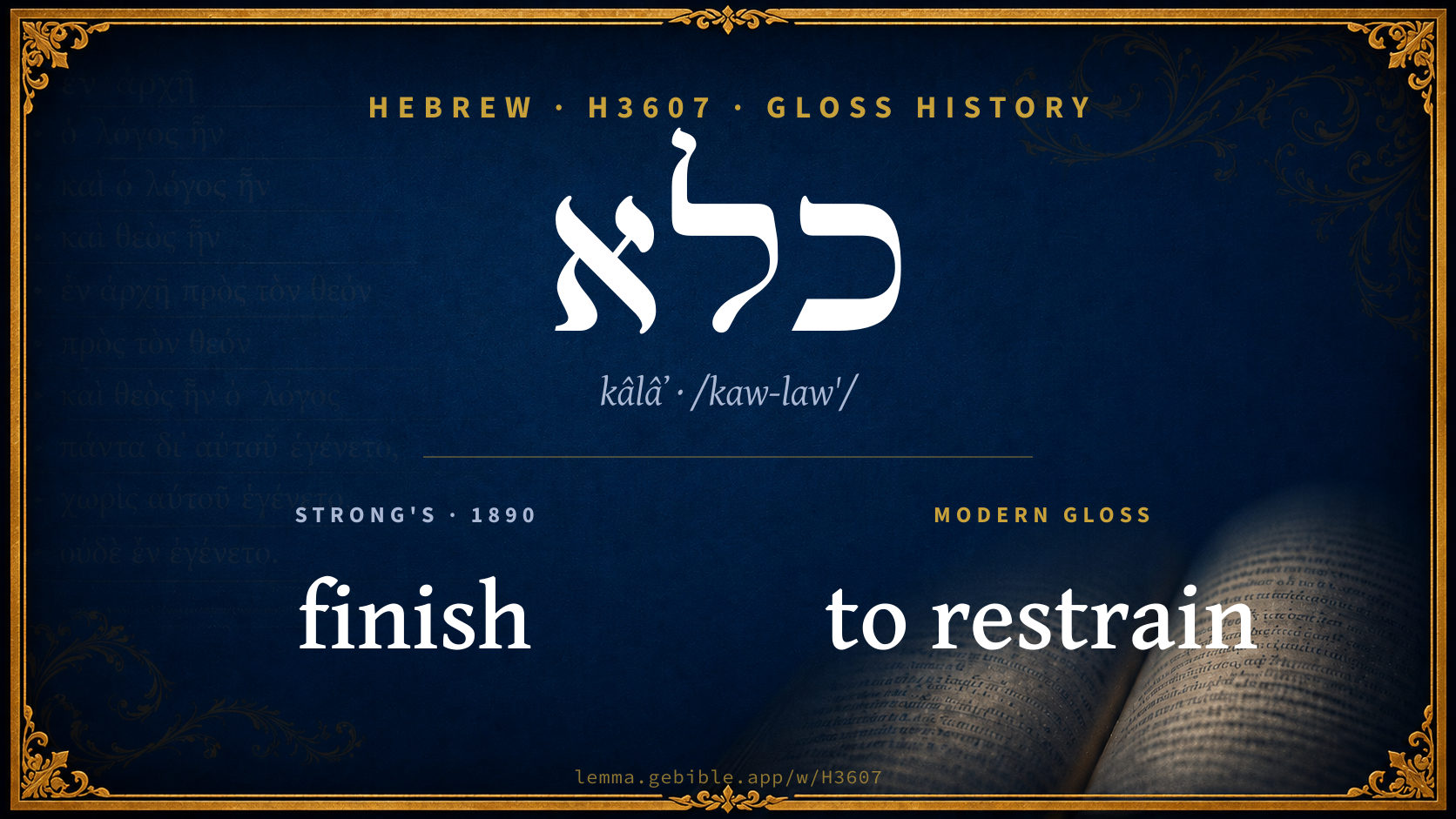
Gloss history
Strong's 1890 vs modern scholarship
About this word
Strong's H3607 catalogs a Hebrew word from the Hebrew Old Testament.
These counts are not copied from any lexicon or concordance. They are computed here, from the morphology-tagged Hebrew Old Testament. What Lemma adds →
- 17
- distinct verses
- The word appears in 17 distinct verses.
- 11 / 39
- OT books
- The word appears in 11 of 39 Old Testament books.
- #1,612
- by frequency
- Top 2500 most frequent Hebrew words (rank 1,612 of 8,640 Hebrew words by occurrence).
View all 17 occurrences in the concordance →
By section of the Old Testament
By traditional corpus
Conventional, traditional groupings — biblical authorship is debated, so this is a traditional corpus grouping, not an authorship claim. Each share is this word’s portion of its verses in that division of the Hebrew canon. Each figure is a share of the word’s 17 distinct verses.
- Prophets (Nevi'im) 7 verses · 41%
- Writings (Ketuvim) 6 verses · 35%
- Torah (Pentateuch) 4 verses · 24%
How translations render this word
Counts come from each version’s own published word-to-Strong’s tagging or interlinear alignment — an approximate guide to how each version renders this word, not a word-level alignment the data otherwise carries. Because each total is that version’s own tagged count, the per-version totals vary from one another and need not match the appearance or distinct-verse counts above. These counts may also differ from a printed concordance because Lemma counts each distinctly tagged rendering and does not collapse phrase taggings into a single head-word total. This is a fixed set of word-tagged versions (KJV, ASV, BSB, ULT) and does not change with the reading translation you choose elsewhere. Each version’s license is shown beside its name below (and on Sources).
- King James Version: Be thou which hast kept 1×, Finish 1×, Forbid 1×
- American Standard Version: Withhold 2×
- Berean Standard Bible: Were restrained 2×
- unfoldingWord Literal Text: And 2×, Restrain 2×, Withhold 2×
King James Version Public Domain
Renders H3607 across 18 tagged occurrences — most commonly:
Plus other, less common renderings.
American Standard Version Public Domain
Renders H3607 across 18 tagged occurrences — most commonly:
Plus 16 renderings that appear only once — usually multi-word phrases or single function words the recovered tagging swept in, not distinct renderings.
Berean Standard Bible Public Domain
Renders H3607 across 17 tagged occurrences — most commonly:
Plus 15 renderings that appear only once — usually multi-word phrases or single function words the recovered tagging swept in, not distinct renderings.
unfoldingWord Literal Text CC BY-SA 4.0
Renders H3607 across 22 tagged occurrences — most commonly:
Plus 16 renderings that appear only once — usually multi-word phrases or single function words the recovered tagging swept in, not distinct renderings.
Senses in the full BDB
Hebrew verbs can shift meaning by stem (binyan): Qal is the basic action, Niphal is often passive or reflexive, Piel often intensifies or makes it factitive, and Hiphil is typically causative. The senses below are grouped under the stem BDB assigns to each.
What do BDB’s symbols mean?
BDB uses these scholarly abbreviations:
| Symbol | Meaning |
|---|---|
| 𝔊 | the Septuagint (the ancient Greek translation, LXX) |
| 𝔙 | the Vulgate (the Latin translation) |
| 𝔖 | the Syriac version (the Peshitta) |
| 𝔗 | the Targum (the Aramaic translation) |
| ψ | the Psalms |
| √ | root (the underlying root or stem) |
| ‖ | parallel passage (a synonymous or contrasted parallel) |
| † | the dagger: every passage where the word occurs is cited |
The 5 senses and sub-senses the full Brown-Driver-Briggs lexicon distinguishes for this word, in lexicon order (not ranked by frequency), with BDB’s own verbatim wording and sub-sense lettering. Shown in Hebrew script with BDB’s own scholarly abbreviations. The condensed entry is in the Lexicon Entry tab. See also the Forms in the corpus table below.
Qal
- Pf. 3 ms. sf. כְּלָאוֹ Je 32:3; 3 fs. כָּֽלְאָה Hg 1:10; 2 fs. sf. כְּלִתִ֫נִי 1 S 25:33; 1 s. כָּלִאתִי ψ 119:101; 3 pl. כָּֽלְאוּ Hg 1:10, כָּלוּ 1 S 6:10; Impf. 3 ms. יִכְלֶה Gn 23:6; 2 ms. תִּכְלָא ψ 40:12; 2 fs. תִּכְלָ֑אִי Is 43:6; 1 s. אֶכְלָא ψ 40:10; Imv. sf. כְּלָאֵם Nu 11:28; Inf. cstr. לִכְלוֹא Ec 8:8; Pt. pass. כָּלוּא Je 32:2, כָּלֻא ψ 88:9; (on the metapl. forms, as if from כלה, v. Ges § 75, 21 c Köi 611);— e.g. Jeremiah 32:3
- 1. shut up, c. acc. 1 S 6:10 (+ בְ loc.), Je 32:3; pt. pass. Je 32:2 (בְ loc.), fig. ψ 88:9 (opp. יצא). e.g. 1 Samuel 6:10
- 2. restrain, c. acc. 1 S 25:33 (+ מִבּוֹא בְדָמִים), ψ 119:101 (+ מִכָּל־); כְּלָאֵם (sc. מֵהִתְנַבֵּא) Nu 11:28; כ׳ שְׂפָתַי ψ 40:10; כ׳ אֶת־הָרוּחַ Ec 8:8. On ψ 74:11 v. כלה Pi. 2. 3. withhold, כ׳ אֶת־קִבְרוֹ מִמְּךָ מִקְּבֹר מֵתֶ֑ךָ Gn 23:6 (P), כ׳ רַחֲמֶיךָ מִמֶּ֑נּי ψ 40:12, Hg 1:10b, prob. also v a (read מָ֑ל for MT 𝔊 מִטָּ֑ל, We); abs. אַל־תִּכְלָאִי (sc. exiles) Is 43:6 (‖ תְּנִי). e.g. 1 Samuel 25:33
Niphal
- Impf. וַיִּכָּלֵא הַגֶּשֶׁם מִן־הַשָּׁמַיִם Gn 8:2 (J), and the rain from heaven was restrained, cf. וַיִּכָּֽלְאוּ מַיִם רַבִּים Ez 31:15 (in fig.; ‖ מנע); וַיִּכָּלֵא הָעָם מֵהָבִיא Ex 36:6 (P). e.g. Genesis 8:2
Piel
- [Pf. כִּלָּא and] Inf. cstr. לְכַלֵּא v. כלה Pi.
Senses from the full Brown-Driver-Briggs lexicon (Brown, Driver, Briggs; Oxford 1906 — public domain), digitized via Sefaria, supplemented by the OpenScriptures HebrewLexicon (CC BY 4.0). Full attribution on Sources.
Word origin
vb. shut up, restrain, withhold (NH id.; Aramaic כְּלָא, ܟܠܴܐ; Ethiopic ከልአ: restrain, hinder; Assyrian kâiû, id.; Arabic كَلَأَ protect Qor 21:43 cf. Ba ZMG 1887, 605 Anm. 4)—
— Brown-Driver-Briggs (Oxford 1906, public domain), digitized via Sefaria, supplemented by the OpenScriptures HebrewLexicon (CC BY 4.0). See Sources.
Origin: a primitive root
Jastrow Dictionary
A second Hebrew/Aramaic lexicon for comparison, covering Aramaic and post-biblical (Talmudic, Targumic, Midrashic) usage that the biblical-Hebrew BDB does not. Matched by lemma rather than by Strong’s number, so a lemma may carry more than one Jastrow headword (shown separately below), and the entries cover usage well beyond the Bible.
כָּל
- ch., v. כּוֹל
כָּלָא
- , v. כלי
כַּלָּה
- 1. [crown, ornament, v. Is. XLIX, 18,] (sub. בעלת or בת, cmp. אִיתּוּ, חוֹרִים a. בֶּן חוֹרִים) bride; daughter-in-law. Yeb. I, 1 וכַלָּתוֹ and his (deceased) son’s wife. Sot. IX, 14 שתצא הב׳ וכ׳ that the bride on her wedding day may be taken around in procession, v. אַפִּרְיוֹן. Keth. 71ᵇ; Pes. 87ᵃ ככ׳ שנמצאת וכ׳ like a bride (daughter-in-law) found perfect in the house of her father-in-law. Ib. כ׳ בבית אביה a bride in her father’s house (not yet taken to her husband’s paternal house). Ex. R. s. 41 (play on ככלתו, Ex. XXXI, 18, cmp. כְּלַל Pa.) מה כ׳ זו מקושטת וכ׳ as the bride is adorned &c.; a. fr. [Tanḥ. Ki Thissa 18 כ׳ נופי, read with ed. Bub. ib. 9 קלי נינפי.]—Pl. כַּלּוֹת. Sot. l. c. עטרות כ׳ (Talm. ed. sing.) the bridal wreaths. Ib. 49ᵇ; a. fr e.g. Isaiah 49:18
- 2. general assembly, esp. Kallah, the assembly of Babylonian students in the months of Elul and Adar. Ber. 8ᵇ פרשייתא דכ׳ Ar. (Ms. Paris דכַלָּא, v. Rabb. D. S., Vol. I, p. 384; ed. דכולא שתא) the weekly Scripture lessons of the Kallah weeks (during which R. Bibi could not find time to peruse the section of each week). Ib. 6ᵃ, v. דּוּחֲקָא. Ib. 57ᵃ ראש לבני כ׳; B. Bath. 22ᵃ ריש כ׳ the president of the Kallah.—Pl. (of כַּלָּא) כַּלֵּי. Ḥull. 49ᵃ רישי כ׳.—מסכת כלה, מסכתא דכ׳ a (small) treatise of the Talmud named Kallah (from its first word). Sabb. 114ᵃ; Kidd. 49ᵇ; Taan. 10ᵇ; [oth. opin.: a subject which has been discussed in the general assembly].
כְּלֵי
- 1. to keep enclosed, to withhold, restrain. Targ. I Sam. VI, 10. Targ. Ps. XXI, 3. Targ. Is. XXXIII, 15 כָּלֵי (ed. Wil. כָּל) restrains his eyes. Targ. Prov. XI, 26 כָּאלֵא ed. Lag.; ib. XVII, 28 כָּאלֵי ed. Lag.—Part. pass. כְּלֵי. Targ. Jer. XXXII, 2; (Targ. Ps. LXXXVIII, 9 כָּלוּא, h. form).—Sabb. 57ᵇ כַּלְיָא פרוחי, v. בִּזְיוּנָא I; [Var. Ar. דידבי, reminiscence fr. Nidd. 17ᵃ, v. בָּאלֵי.]—כַּלְיָא עורב, v. preced.
- 2. to be finished, gone. Ber. 39ᵃ כַּלְיָא ברכה the benediction is finished &c., v. preced. B. Mets. 79ᵃ וקא כליא קרנא and the capital itself is used up (v. infra). Yoma 69ᵇ כ׳ עלמא the world would come to an end; a. fr.
- 3. (cmp. שלם) [to be entirely with,] to trust. Targ. Ps. XXXI, 7. Ib. 25 כַּלְיָין (ed. Lag. a. oth. כיילין, corr. acc.). Ib. XXXII, 10; a. e.; v. תְּכַל. [Differ. fr. b. h. כָּלָה to be consumed by anxiety, to long, die for.]
- to lock up, restrain. Targ. II Chr. VII, 13.—Kidd. 81ᵇ מַכְלֵי להו מִכּוּלָּהּ וכ׳ Ar. a. Tosaf. (ed. מכלליה, read: מכלי ליה) kept the cattle off from the entire field (in which he walked); (ed.: kept himself aloof from the entire pasture ground). B. Bath. 5ᵃ, v. next w.
- to destroy, use up, diminish. B. Mets. l. c. מְכַלִּינָן קרנא (when hiring the usufruct of an object,) we are permitted to use up the stock itself, e.g. if you hired an ass for travelling, and it died on the road, you may sell its carcass, and hire another ass for the money; ib. לא מכ׳ קרנא we must not use up the stock, i.e. you may buy another ass for the carcass, but not hire one. Ib. Ms. M. לכַלּוּיֵי קרנא לא חיישינן (v. Rabb. D. S. a. l. note 8) and as for using up the stock, we need not take that into consideration. B. Kam. 3ᵃ דמְכַלְּיָא קרנא when the obnoxious subject destroys the object itself (not only the fruits).
- to be closed up, withheld; to refrain. Targ. O. Gen. VIII, 2. Targ. Prov. III, 27; a. fr.
כְּלֵי ²
- , Af. אַכְלֵי (v. preced.) [to assemble, call together (cmp. אוֹכְלוֹסָא),]
- 1. to call, give a signal. Targ. Jer. I, 15. Targ. Zeph. II, 15; a. e.
- 2. (of the lion) to roar; to shout, thunder &c. Targ. Ps. CIV, 21, v. אַכְלִי. Ib. XXIX, 3. Ib. LXXIV, 4; a. e.—B. Bath. 5ᵃ עיזא בעלמא אַכְלוּיֵי מַכְלִינָן בה v. Ar. s. v. כל; (incorr. in eds. לאו לאכלויי בעיא) as to a goat, we need only shout at her (to drive her off). Ib. ולאו גברא בעי לאכלויי Rashi (ed. דמיכלי, read דמַכְלֵי) and need you not a man to shout at her?; [oth. opin. we need only keep her off, v. preced.]
לֹא
- v. לַאי) not, no. Ber. I, 1 לא קרינו וכ׳ we have omitted to recite &c. Ib. III, 4 לא … ולא וכ׳ neither before nor after. Nidd. 5ᵃ לא אין להן וכ׳, no; it means &c., v. לַאו; a. v. fr.—וְלֹא indeed not? Ḥull. 4ᵇ ולא והכתיב וכ׳ indeed not (is it so that the verb הֵסִית never refers to persuasion by speech)? Do we not read &c.?; a. v. fr.—(מִצְוַת) לֹא תַעֲשֶׂה a prohibitory law, opp. עֲשֵׂה, a positive command; v. לַאו. Kidd. I, 7. Macc. 14ᵇ bot.; a. v. fr.—בְּלֹא without. Ber. 35ᵃ bot. ב׳ ברכה without pronouncing a benediction; a. v. fr.—והוא שלא, v. הוּא.
לָא I
- Targ. Gen. II, 5; a. v. fr.—Pes. 10ᵇ מקמיה … אין בתר … לא before the time when it is forbidden, yes (he must search after leavened bread); after the time, no (he must not search). Ib. לא שנא there is no difference; a. v. fr.
לָא II
- (preced. wds.) particle, mote. Yoma 20ᵇ, v. חִרְגָּא. Midr. Till. to Ps. LXVIII, 3 כלא חשיבי they are like a mote.
לָא III
- La, abbrev. of אִילָא, הִילָא; v. Fr. M’bo, p. 75ᵇ.
A Dictionary of the Targumim, the Talmud Babli and Yerushalmi, and the Midrashic Literature (Marcus Jastrow; London, Luzac, 1903) — Public Domain. Digitized via Sefaria. Digitized via Sefaria. Full attribution on Sources.
Forms in the corpus
The 17 distinct written forms H3607 takes in the Hebrew Bible, most frequent first — each parse links to that stem’s occurrences in the concordance. Hebrew forms include their vowel points and cantillation, so a single lemma takes many written forms.
Same root — word family
Other BDB entries built from the same root as H3607, grouped by Strong’s listed origin. These share a root / origin per the lexicon — not necessarily a shared meaning. Each links to that word’s own entry.
Derived from this word
Proper names from this root
People and places named from this root — a name, not an additional meaning of the word.
Compare all same-root words → Showing 4 of 5 — not the complete family. 1 of the same-root words is a proper name (a person or place). They share a root, not necessarily a meaning.
Septuagint verse parallels
This word appears in 16 verses that also exist in the Greek Old Testament (Septuagint), out of the 17 Hebrew verses it occurs in. You can read those verses in Greek by switching the Old Testament edition to the Septuagint.
Read these verses in the Septuagint
- Genesis 8:2
- Exodus 36:6
- Numbers 11:28
- 1 Samuel 6:10
- Psalms 40:9
- Ecclesiastes 8:8
- Isaiah 43:6
- Jeremiah 32:2
- Ezekiel 31:15
- Daniel 9:24
- Haggai 1:10
This is a verse-level parallel only — the same verses exist in both the Hebrew and Greek Old Testaments. No word-level Hebrew↔Greek correspondence is claimed: the data carries no such alignment, so no Greek word is shown as this Hebrew word’s translation. Coverage is not total — the Septuagint omits the deuterocanon and renumbers the Psalms, so some Hebrew verses have no direct Greek parallel.