1 Samuel 30:5

Hebrew (Westminster Leningrad Codex) 1 Samuel 30:5 appears in the Hebrew Old Testament. The text above is from the Westminster Leningrad Codex. Each word links to its Strong’s number, a concise gloss, and parsing drawn from the Open Scriptures Hebrew Bible morphology. Click any word for its full Brown-Driver-Briggs (BDB) entry.
Download image
Cite this verse

1 Samuel 30:5 (World English Bible). Public Domain. Lemma interlinear Bible study tool, https://lemma.gebible.app/v/1-samuel/30/5.

Show BibTeX & RIS
BibTeX
RIS
English Translation
David's two wives were taken captive, Ahinoam the Jezreelitess, and Abigail the wife of Nabal the Carmelite.
World English Bible · Public Domain
Highlights
  • 1 first appearance in the Hebrew Bible
Full analysis ↓
Download a study sheet

One document with this verse’s original text, its word-by-word gloss line, the meaning frame, cross-references with their text, attributed commentary, and full source and license credits — printable, and it pastes into notes with its structure intact.

This verse Autodidact and up

Study sheet (.html) Plain text (.txt)

A passage Seminary Student

Up to 50 verses in one chapter. A passage sheet keeps up to 6 commentary sources and 12 cross-references per verse, in the order this page ranks them, and says so on the sheet whenever that leaves anything out. Ask for a single verse and you get the Autodidact verse sheet above.

Everything on this page stays free to read, with no account — the sheet is a download of what is already on screen, not access to it.

Want to remove ads? Support Godless Engineer
Compare translations 3

The same verse in 3 English versions, stacked beneath the original-language interlinear above. Click any original word for its lexicon entry.

Each is an independent rendering of the whole verse — the interlinear is not word-aligned to these translations.

Highlighted words mark where these versions differ — a whole-verse word diff, not a word-by-word alignment.

  • World English Bible Public Domain
    David's two wives were taken captive, Ahinoam the Jezreelitess, and Abigail the wife of Nabal the Carmelite.
  • King James Version Public Domain
    And David's two wives were taken captives, Ahinoam the Jezreelitess, and Abigail the wife of Nabal the Carmelite.
  • unfoldingWord Literal Text CC BY-SA 4.0
    And the two wives of David had been taken captive, Ahinoam the Jezreelitess and Abigail the Carmelitess, the wife of Nabal.

unfoldingWord Literal Text — © unfoldingWord, licensed CC BY-SA 4.0. Word-aligned USFM3 via Door43 (git.door43.org/unfoldingWord/en_ult).

Versions to compare (up to 4)

3 of 4 selected

Show all 18 translations

Every available English version of this verse, each an independent rendering of the whole verse.

  • World English Bible Public Domain
    David's two wives were taken captive, Ahinoam the Jezreelitess, and Abigail the wife of Nabal the Carmelite.
  • Berean Standard Bible Public Domain
    David’s two wives, Ahinoam of Jezreel and Abigail the widow of Nabal of Carmel, had been taken captive.
  • Majority Standard Bible Public Domain
    David’s two wives, Ahinoam of Jezreel and Abigail the widow of Nabal of Carmel, had been taken captive.
  • King James Version Public Domain
    And David's two wives were taken captives, Ahinoam the Jezreelitess, and Abigail the wife of Nabal the Carmelite.
  • American Standard Version (1901) Public Domain
    And David's two wives were taken captive, Ahinoam the Jezreelitess, and Abigail the wife of Nabal the Carmelite.
  • Revised Version (1885) Public Domain
    And David’s two wives were taken captives, Ahinoam the Jezreelitess, and Abigail the wife of Nabal the Carmelite.
  • Geneva Bible (1599) Public Domain
    Dauids two wiues were taken prisoners also, Ahinoam the Izreelite, and Abigail the wife of Nabal the Carmelite.
  • Douay-Rheims (1899) Public Domain
    For the two wives also of David were taken captives, Achinoam the Jezrahelitess, and Abigail the wife of Nabal of Carmel.
  • Young's Literal Translation Public Domain
    And the two wives of David have been taken captive, Ahinoam the Jezreelitess, and Abigail wife of Nabal the Carmelite;
  • Literal Standard Version CC BY-SA 4.0
    And the two wives of David have been taken captive, Ahinoam the Jezreelitess, and Abigail wife of Nabal the Carmelite;
  • Unlocked Literal Bible CC BY-SA 4.0
    David's two wives were taken captive, Ahinoam the Jezreelite woman, and Abigail the wife of Nabal the Carmelite.
  • unfoldingWord Literal Text CC BY-SA 4.0
    And the two wives of David had been taken captive, Ahinoam the Jezreelitess and Abigail the Carmelitess, the wife of Nabal.
  • Darby Bible Public Domain
    And David's two wives were taken captives, Ahinoam the Jizreelitess, and Abigail the wife of Nabal the Carmelite.
  • World Messianic Bible Public Domain
    David’s two wives were taken captive, Ahinoam the Jezreelitess, and Abigail the wife of Nabal the Carmelite.
  • Webster's Bible Public Domain
    And David's two wives were taken captives, Ahinoam the Jezreelitess, and Abigail the wife of Nabal the Carmelite.
  • Free Bible Version CC BY-SA 4.0
    David's two wives had also been taken as prisoners—Ahinoam from Jezreel and Abigail, Nabal's widow, from Carmel.
  • Bible in Basic English Public Domain
    And David's two wives, Ahinoam of Jezreel and Abigail, the wife of Nabal of Carmel, had been made prisoners.
  • JPS Tanakh (1917) Public Domain
    And David's two wives were taken captives, Ahinoam the Jezreelitess, and Abigail the wife of Nabal the Carmelite.

Literal Standard Version (2020), Covenant Press — licensed CC BY-SA 4.0. Text via the HelloAO Bible API (eBible.org). Unlocked Literal Bible (unfoldingWord) — licensed CC BY-SA 4.0. Text via the HelloAO Bible API (eBible.org). unfoldingWord Literal Text — © unfoldingWord, licensed CC BY-SA 4.0. Word-aligned USFM3 via Door43 (git.door43.org/unfoldingWord/en_ult). Free Bible Version, Dr. Jonathan Gallagher — licensed CC BY-SA 4.0. Text via the HelloAO Bible API (eBible.org).

Word by word

More ways to search: Search by grammar → Find every occurrence → Compare this word →

Practice this passage: Drill this verse → Learn its vocabulary →

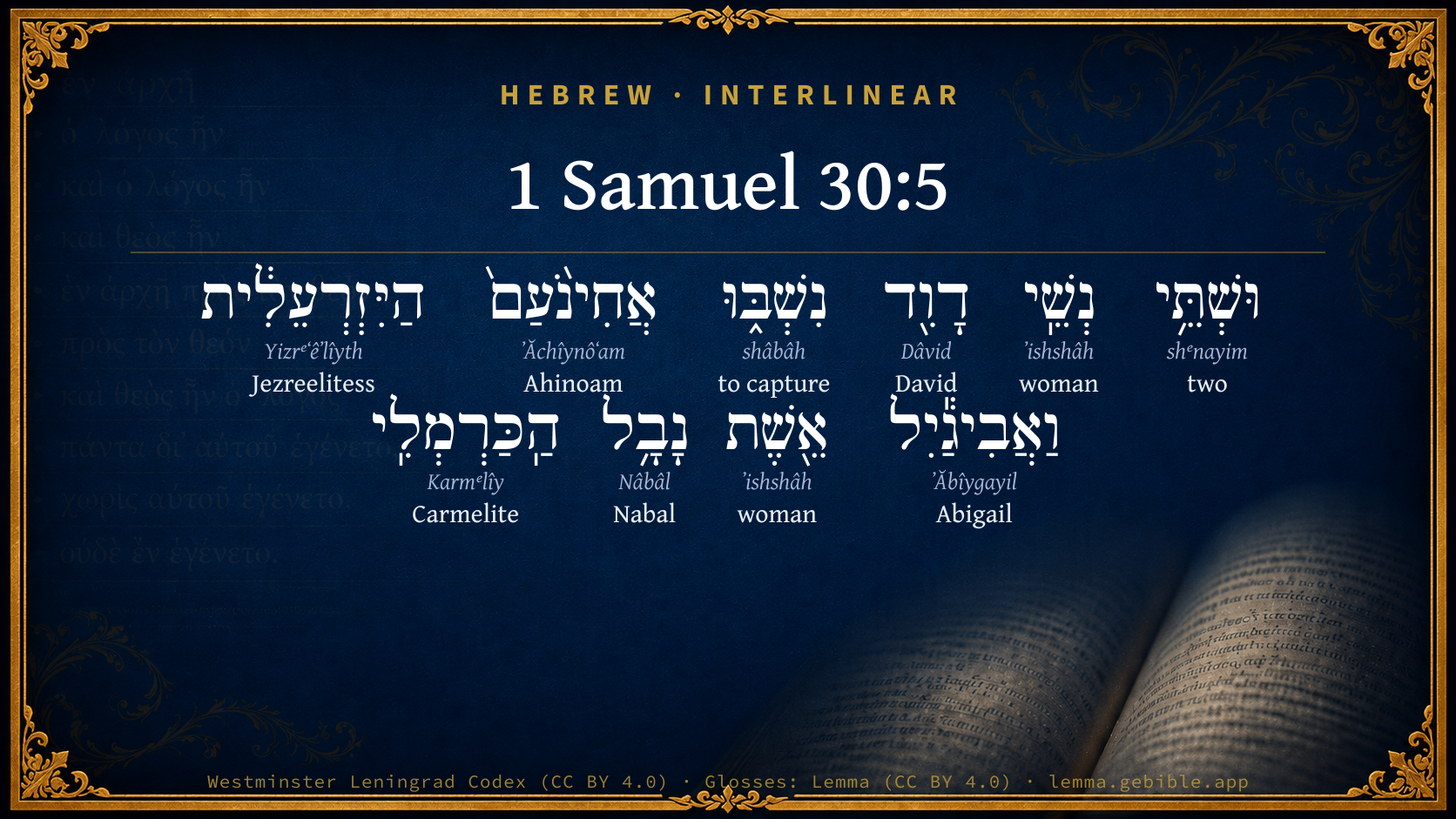
הַיִּזְרְעֵלִ֔ית
Yizrᵉʻêʼlîyth
H3159
“the · Jezreelitess”
Particle, Definite Article + Noun, Gentilic, Feminine, Singular, Absolute
Part of Speech
Particle + Noun
Type
Gentilic
Gender
Feminine
Number
Singular
State
Absolute
Full BDB Definition

Origin: from H3158

TWOT: None

Jezreelitess = see Jezreel " sown of God" - a female inhabitant of Jezreel - used only of Ahinoam, a wife of David
  1. וּשְׁתֵּ֥י shᵉnayim H8147 “and · two” Conjunction + Adjective, Cardinal number, Feminine, Dual, Construct
  2. נְשֵֽׁי ʼishshâh H802 “women of” Noun, Common, Feminine, Plural, Construct
  3. דָוִ֖ד Dâvid H1732 “David” Noun, Proper
  4. נִשְׁבּ֑וּ shâbâh H7617 “to capture” Verb, Niphal, Perfect, 3rd Person, Common, Plural
  5. אֲחִינֹ֨עַם֙ ʼĂchîynôʻam H293 “Ahinoam” Noun, Proper
  6. וַאֲבִיגַ֕יִל ʼĂbîygayil H26 “and · Abigail” Conjunction + Noun, Proper
  7. אֵ֖שֶׁת ʼishshâh H802 “woman of” Noun, Common, Feminine, Singular, Construct
  8. נָבָ֥ל Nâbâl H5037 “Nabal” Noun, Proper
  9. הַֽכַּרְמְלִֽי Karmᵉlîy H3761 “the · Carmelite” Particle, Definite Article + Noun, Gentilic, Masculine, Singular, Absolute

About this verse

These counts appear in no published source. They are computed here, from the morphology-tagged text and Lemma’s own curated glosses. What Lemma adds →

10
words
9
distinct lemmas
Historical
section

Notable vocabulary

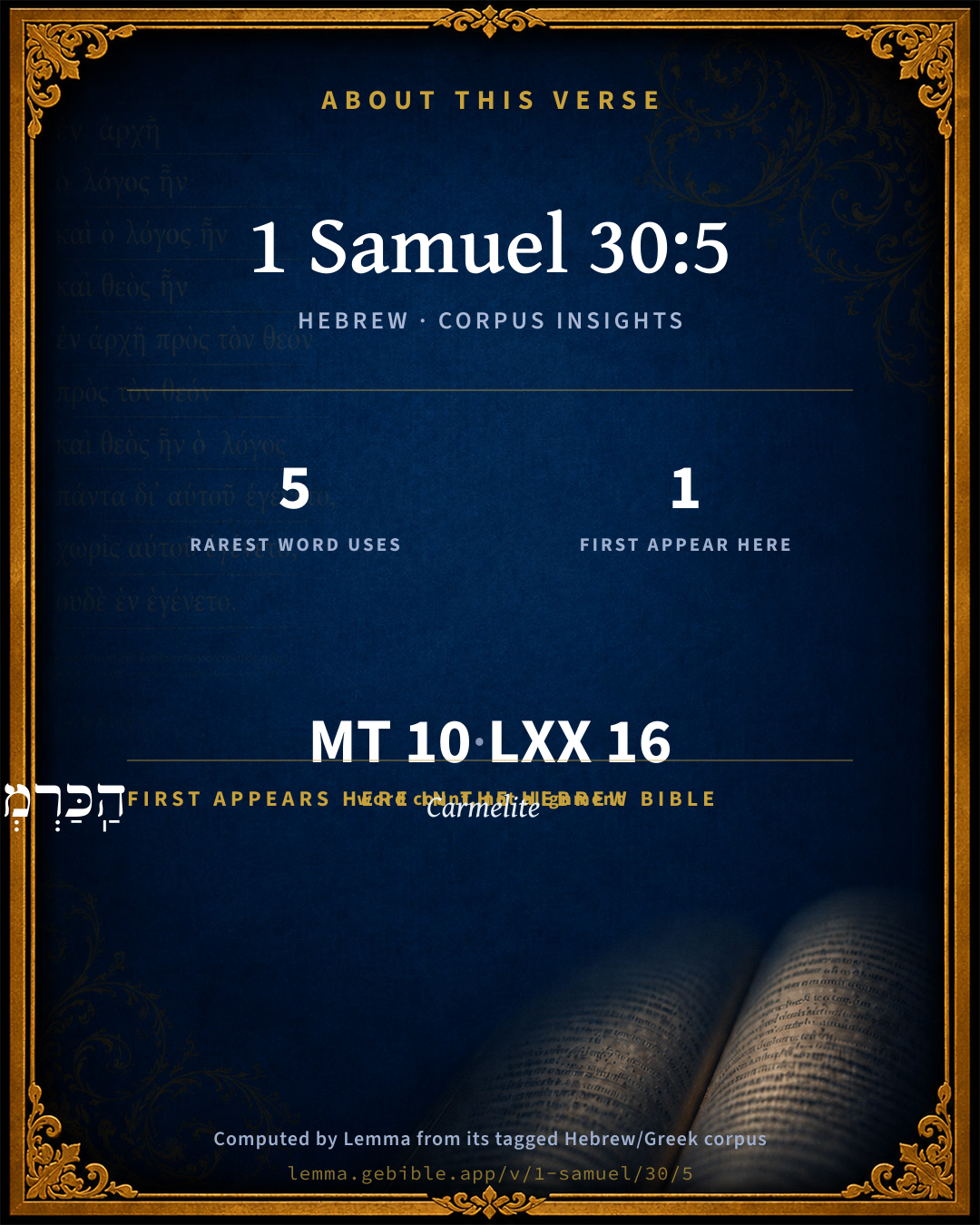
The rarest word here is הַיִּזְרְעֵלִ֔ית Jezreelitess H3159 — appearing just 5 times in the whole Hebrew Bible.

First appearance in Scripture

This word makes its first canonical appearance in the Hebrew Bible here:

  • הַֽכַּרְמְלִֽי Carmelite H3761

Shared distinctive vocabulary

הַיִּזְרְעֵלִ֔ית Jezreelitess H3159 occurs in 5 verses of the Hebrew Bible. Also found in:

Grammatical profile

  • 1 verb
  • 8 nouns
  • 1 adjective

Verb forms

  • נִשְׁבּ֑וּ Niphal · Perfect

Repetition

A word recurs within this verse — often emphatic in Hebrew:

  • נְשֵֽׁי woman H802 ×2

Hebrew & Septuagint length

In English translation the verse runs 17 words from the Hebrew and 20 from the Septuagint (LXX English) — closely comparable.

A rough comparison of the two English renderings, which tokenize alike — not a word-level alignment.

Word counts can differ between the Hebrew and the Greek without any difference in meaning — e.g. the Hebrew direct-object marker אֵת has no separate Greek word, and Greek often adds the article ὁ.

In the original languages it is 10 Hebrew tokens and 16 Greek tokens — but the two are counted differently (Hebrew bundles its prefixes and suffixes into one token; the Greek is in lemma form), so that isn’t a like-for-like length.

Cross-references

5

Topical passages linked to 1 Samuel 30:5 in the Treasury of Scripture Knowledge — connected by theme and wording, ordered by reader-vote popularity; previews shown in the World English Bible.

  • 1 Samuel 25:42–43 Abigail hurried, and arose, and rode on a donkey, with five ladies of hers who followed her; and she went after the messengers of David, and became his wife.
  • 2 Samuel 2:2 So David went up there, and his two wives also, Ahinoam the Jezreelitess, and Abigail the wife of Nabal the Carmelite.
  • 1 Samuel 1:2 and he had two wives; the name of the one was Hannah, and the name of other Peninnah: and Peninnah had children, but Hannah had no children.
  • 1 Samuel 27:3 David lived with Achish at Gath, he and his men, every man with his household, even David with his two wives, Ahinoam the Jezreelitess, and Abigail the Carmelitess, Nabal's wife.
  • 2 Samuel 3:2–3 To David were sons born in Hebron: and his firstborn was Amnon, of Ahinoam the Jezreelitess;

Cross-references courtesy of OpenBible.info (CC BY 4.0).

Hebrew and Greek witnesses Masoretic Hebrew ↔ Greek Septuagint

The same verse in the two great witnesses to the Old Testament, shown verse-for-verse.

These are two independent witnesses, not word-aligned to each other, and the Septuagint is shown in lemma (dictionary) form.

Hebrew 1 Samuel 30:5 Masoretic · Westminster Leningrad Codex

וּשְׁתֵּ֥י נְשֵֽׁי דָוִ֖ד נִשְׁבּ֑וּ אֲחִינֹ֨עַם֙ הַיִּזְרְעֵלִ֔ית וַאֲבִיגַ֕יִל אֵ֖שֶׁת נָבָ֥ל הַֽכַּרְמְלִֽי

David's two wives were taken captive, Ahinoam the Jezreelitess, and Abigail the wife of Nabal the Carmelite.

World English Bible · Public Domain

Greek LXX 1 Samuel 30:5 Septuagint · lemma form

καί ἀμφότεροι ὁ γυνή δαυίδ αἰχμαλωτεύω αχινοομ ὁ ιεζραηλῖτις καί αβιγαια ὁ γυνή ναβαλ ὁ καρμήλιος

And both the wives of David were carried captive, Achinaam, the Jezraelitess, and Abigaia the wife of Nabal the Carmelite.

LXX2012 (modern English Septuagint) · Public Domain

Hebrew: Westminster Leningrad Codex (CC BY 4.0). Greek: Septuagint (public domain); English from LXX2012 (modern English Septuagint) (Public Domain). How the Septuagint differs from the Hebrew →

Targum (Aramaic paraphrase)

1

The Targum is the ancient Jewish Aramaic paraphrase of the Hebrew Scriptures — an interpretive translation, not the Hebrew text itself. Onkelos (literal) and Pseudo-Jonathan (expansive) render the Torah, and Jonathan the Prophets. Coverage is partial: where no permissively-licensed English translation exists for a verse, only the Aramaic is shown. This is verse-level text, not a word-by-word alignment to the Hebrew.

  1. Targum Jonathan Prophets (Joshua–Malachi)
    וְתַרְתֵּין נְשֵׁי דָוִד אִשְׁתְּבִיאָה אֲחִינוֹעַם דְמִיזְרְעֶאל וַאֲבִיגַיִל אִתַּת נָבָל דְמִכַּרְמְלָא:

    (no public-domain English translation for this verse)

    Targum Jonathan — Aramaic: “Mikraot Gedolot” (public domain). English: “Sefaria Community Translation” (CC0 1.0 (public-domain dedication)); “London "Chaldee Paraphrase," 1871” (public domain). Text via Sefaria.

Commentary

Notes on 1 Samuel 30:5 from classic Christian and Jewish commentators (each source and its license shown beneath its notes). The classic Christian expositions comment on the surrounding passage and are grouped to its opening verse, so a note may address several verses; the Jewish commentaries on the Tanakh (Rashi and others) are per-verse, so they appear only where the commentator wrote on this verse.

Lemma curates 59 commentaries, every one of them public domain or Creative Commons licensed, each selected and text-cleaned for this edition rather than reprinted as found. About our sources →

Trapp's Complete Commentary

John Trapp

1Sa 30:5 And David’s two wives were taken captives, Ahinoam the Jezreelitess, and Abigail the wife of Nabal the Carmelite.

Ver. 5. And David’s two wives were taken captives.] This was a very great aggravation of his grief; for good wives are rare commodities, their price is above that of rubies. {Pro 31:10} What huge sums offered Darius to Alexander for the ransom of his dear wife!

John Trapp, A Commentary or Exposition upon All the Books of the Old and New Testament (1647–1656) — public domain. Text from a community e-Sword module.

Tyndale Open Study Notes

Tyndale Open Resources

30:5 Ahinoam: See study note on 25:43. • Abigail: See 25:3-42.

Tyndale Open Study Notes — © Tyndale Open Resources, licensed CC BY-SA 4.0. Text via the HelloAO Bible API.

John Gill's Exposition

And David's two wives were taken captives,.... Which is observed as one cause of his particular distress, and another follows in Sa1 30:6,

Ahinoam the Jezreelitess, and Abigail the wife of Nabal the Carmelite: that is, who had been his wife; for he was now dead, Sa1 25:39, and was so before she was married to David; both these came with him to Gath, and were left at Ziklag when he went with Achish, and here they were taken; see Sa1 25:42.

John Gill's Exposition of the Whole Bible (1746–1763) — public domain (CC PDM 1.0). Text via the HelloAO Bible API.

unfoldingWord translationNotes

Door43 World Missions Community

General Information:

David finds strength in Yahweh after the raid.

Ahinoam the Jezreelite woman

"Ahinoam from Jezreel"

Nabal the Carmelite

"Nabal the man from Carmel"

Ahinoam ... Abigail

women's names (See: How to Translate Names)

distressed

suffering

all the people were bitter in spirit

The word "bitter" is a metaphor for the desire to rebel. The word "spirit" is a synecdoche for the person. AT: "all the people were ready to rebel against David" or "all the people were very unhappy" (See: Synecdoche)

David strengthened himself in Yahweh, his God

Possible meanings are 1) "David took courage because he knew Yahweh his God would help him" or 2) "Yahweh his God made David strong."

translationWords

David

captive

Jezreel

Carmel

stone

spirit

Yahweh

God

unfoldingWord translationNotes — © Distant Shores Media and the Door43 World Missions Community, licensed CC BY-SA 4.0. Source: git.door43.org/Door43/en_tn.

Lesson kit

Teaching starters — assembled from the data on this page, not authored interpretation. Every prompt links to the verse data it draws on. Edit before teaching.

1 Samuel, in the Historical, opens this verse with 10 words (9 distinct Hebrew lemmas). Its most distinctive word is Yizrᵉʻêʼlîyth (“Jezreelitess”). A historical commentator’s framing appears above. Read the whole chapter for the surrounding context.

Discussion questions

  1. How does “Jezreelitess” (Yizrᵉʻêʼlîyth) shape what this verse is saying?
  2. The word “Carmelite” first appears here in Scripture. What is being introduced at this debut?
  3. 1 Samuel 27:3 shares the word «Jezreelitess» with this verse. How do the two illuminate each other?
  4. “woman” occurs 2× in this one verse. What is the effect of the repetition?
  5. These translations render this verse differently. What is at stake in choosing one wording over another?
  6. The verb «נִשְׁבּ֑וּ» is Niphal Perfect. How does its form color the action?
  7. Reading how Trapp's Complete Commentary and Tyndale Open Study Notes read this verse, where do the two commentators agree and where do they part?

Things to notice

Reading settings

Reading text

Shown beneath each verse's original-language words.

Old Testament
Old Testament edition

Read the OT as the Masoretic Hebrew (MT) or the Greek Septuagint (LXX).

English shown for the Greek Septuagint (in the Hebrew ↔ Greek comparison).

Comparing translations? Open the Compare panel on any verse page to stack up to four side by side.