
1 Chronicles 4:11

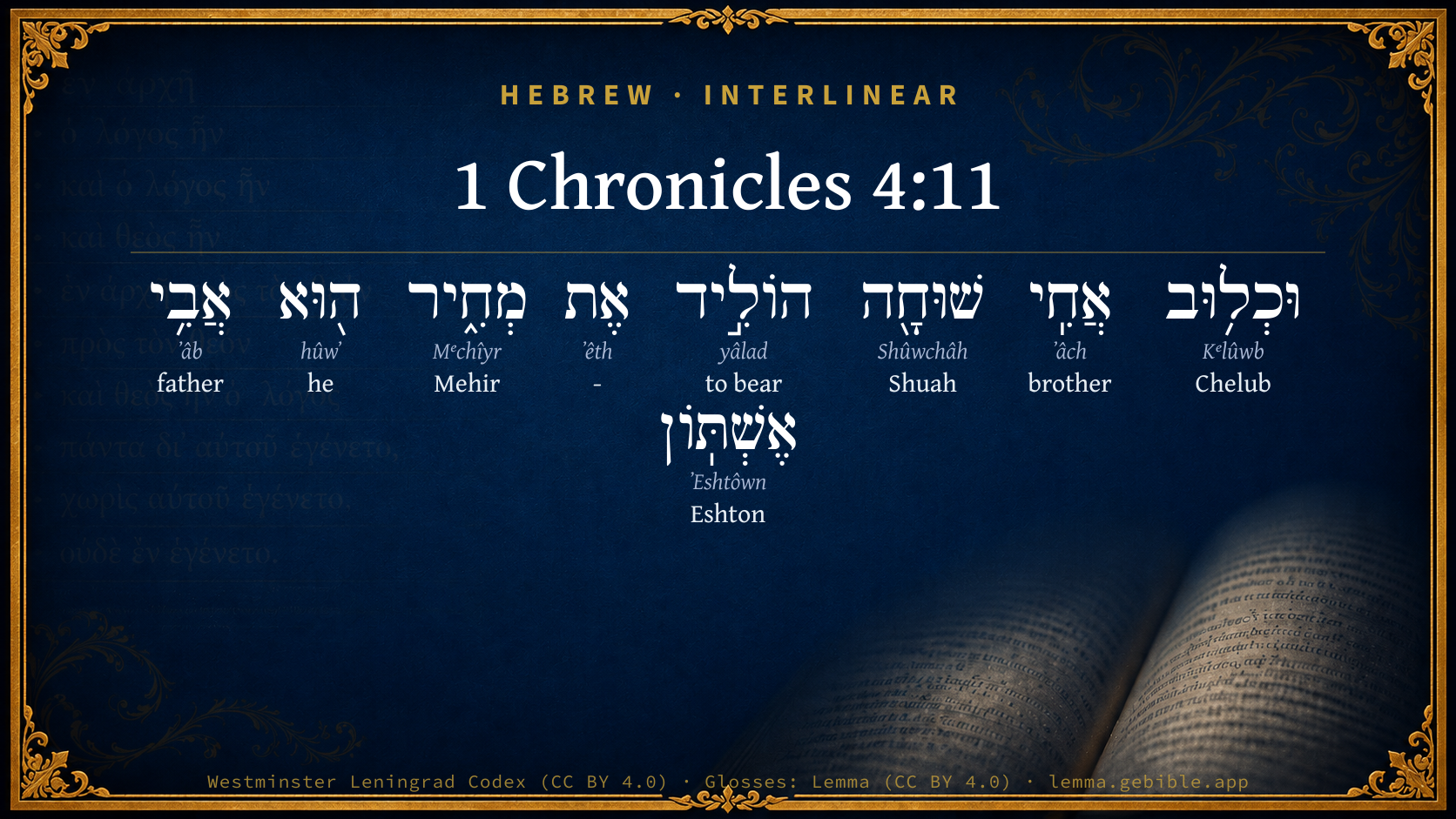
Hebrew (Westminster Leningrad Codex) 1 Chronicles 4:11 appears in the Hebrew Old Testament. The text above is from the Westminster Leningrad Codex. Each word links to its Strong’s number, a concise gloss, and parsing drawn from the Open Scriptures Hebrew Bible morphology. Click any word for its full Brown-Driver-Briggs (BDB) entry.
Download image
Cite this verse

1 Chronicles 4:11 (World English Bible). Public Domain. Lemma interlinear Bible study tool, https://lemma.gebible.app/v/1-chronicles/4/11.

Show BibTeX & RIS
BibTeX
RIS
English Translation
Chelub the brother of Shuhah became the father of Mehir, who was the father of Eshton.
World English Bible · Public Domain
Highlights
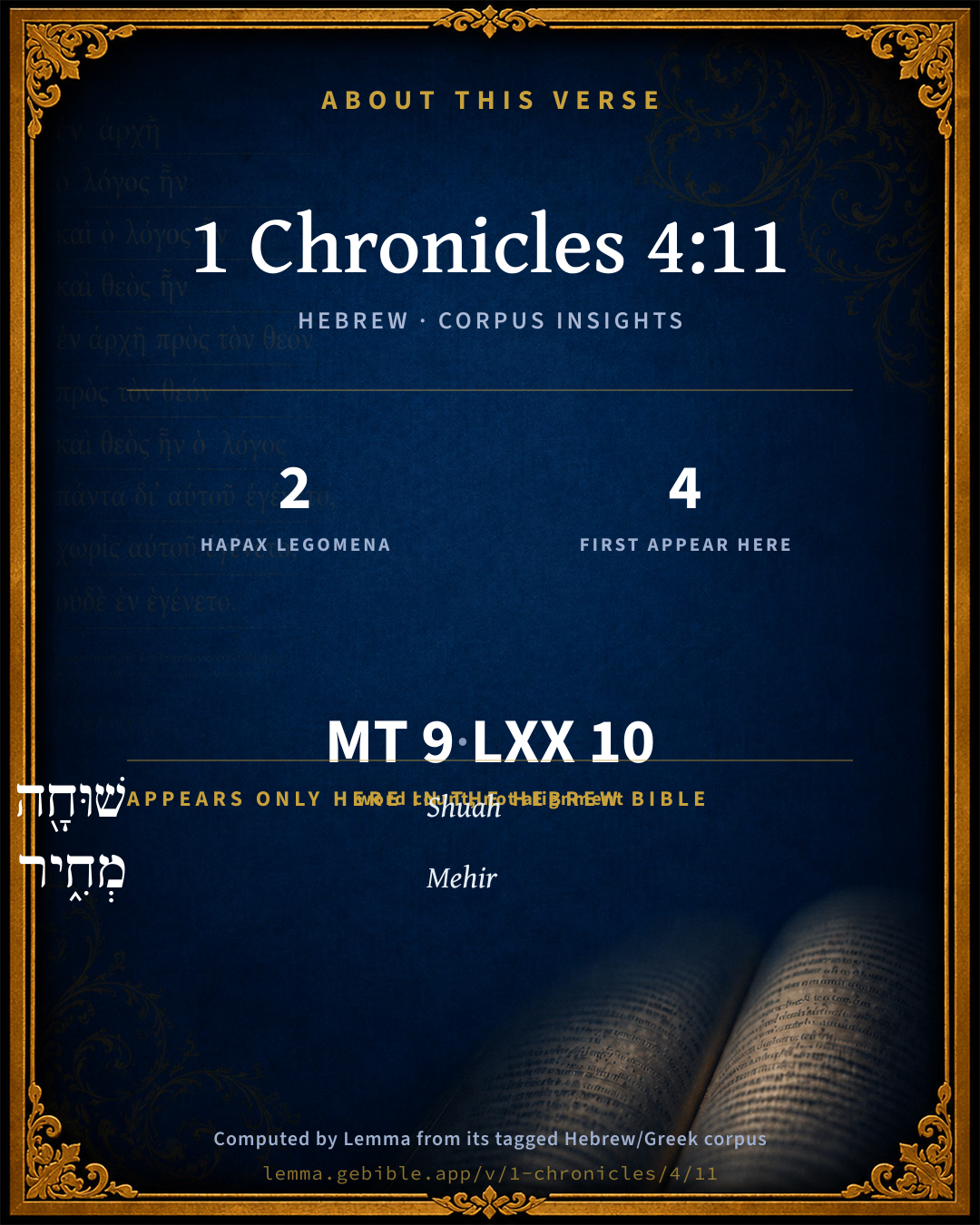
  • 2 hapax legomena — only here in the Hebrew Bible
  • 4 first appearances in the Hebrew Bible
Full analysis ↓
Download a study sheet

One document with this verse’s original text, its word-by-word gloss line, the meaning frame, cross-references with their text, attributed commentary, and full source and license credits — printable, and it pastes into notes with its structure intact.

This verse Autodidact and up

Study sheet (.html) Plain text (.txt)

A passage Seminary Student

Up to 50 verses in one chapter. A passage sheet keeps up to 6 commentary sources and 12 cross-references per verse, in the order this page ranks them, and says so on the sheet whenever that leaves anything out. Ask for a single verse and you get the Autodidact verse sheet above.

Everything on this page stays free to read, with no account — the sheet is a download of what is already on screen, not access to it.

Want to remove ads? Support Godless Engineer
Compare translations 3

The same verse in 3 English versions, stacked beneath the original-language interlinear above. Click any original word for its lexicon entry.

Each is an independent rendering of the whole verse — the interlinear is not word-aligned to these translations.

Highlighted words mark where these versions differ — a whole-verse word diff, not a word-by-word alignment.

  • World English Bible Public Domain
    Chelub the brother of Shuhah became the father of Mehir, who was the father of Eshton.
  • King James Version Public Domain
    And Chelub the brother of Shuah begat Mehir, which was the father of Eshton.
  • unfoldingWord Literal Text CC BY-SA 4.0
    And Chelub, the brother of Shuhah, fathered Mehir. He the father of Eshton.

unfoldingWord Literal Text — © unfoldingWord, licensed CC BY-SA 4.0. Word-aligned USFM3 via Door43 (git.door43.org/unfoldingWord/en_ult).

Versions to compare (up to 4)

3 of 4 selected

Show all 18 translations

Every available English version of this verse, each an independent rendering of the whole verse.

  • World English Bible Public Domain
    Chelub the brother of Shuhah became the father of Mehir, who was the father of Eshton.
  • Berean Standard Bible Public Domain
    Chelub the brother of Shuhah was the father of Mehir, who was the father of Eshton.
  • Majority Standard Bible Public Domain
    Chelub the brother of Shuhah was the father of Mehir, who was the father of Eshton.
  • King James Version Public Domain
    And Chelub the brother of Shuah begat Mehir, which was the father of Eshton.
  • American Standard Version (1901) Public Domain
    And Chelub the brother of Shuhah begat Mehir, who was the father of Eshton.
  • Revised Version (1885) Public Domain
    And Chelub the brother of Shuhah begat Mehir, which was the father of Eshton.
  • Geneva Bible (1599) Public Domain
    And Chelub the brother of Shuah begate Mehir, which was the father of Eshton.
  • Douay-Rheims (1899) Public Domain
    And Caleb the brother of Sua beget Mahir, who was the father of Esthon.
  • Young's Literal Translation Public Domain
    And Chelub brother of Shuah begat Mehir; he `is' father of Eshton.
  • Literal Standard Version CC BY-SA 4.0
    And Chelub brother of Shuah begot Mehir; he [is] father of Eshton.
  • Unlocked Literal Bible CC BY-SA 4.0
    Kelub brother of Shuhah became the father of Mehir, who was the father of Eshton.
  • unfoldingWord Literal Text CC BY-SA 4.0
    And Chelub, the brother of Shuhah, fathered Mehir. He the father of Eshton.
  • Darby Bible Public Domain
    And Chelub the brother of Shuah begot Mehir, who was the father of Eshton.
  • World Messianic Bible Public Domain
    Chelub the brother of Shuhah became the father of Mehir, who was the father of Eshton.
  • Webster's Bible Public Domain
    And Chelub the brother of Shuah begat Mehir, who was the father of Eshton.
  • Free Bible Version CC BY-SA 4.0
    Kelub, Shuhah's brother, was the father of Mehir, who in turn was the father of Eshton.
  • Bible in Basic English Public Domain
    And Chelub, the brother of Shuhah, was the father of Mehir, who was the father of Eshton.
  • JPS Tanakh (1917) Public Domain
    And Chelub the brother of Shuhah begot Mehir, who was the father of Eshton.

Literal Standard Version (2020), Covenant Press — licensed CC BY-SA 4.0. Text via the HelloAO Bible API (eBible.org). Unlocked Literal Bible (unfoldingWord) — licensed CC BY-SA 4.0. Text via the HelloAO Bible API (eBible.org). unfoldingWord Literal Text — © unfoldingWord, licensed CC BY-SA 4.0. Word-aligned USFM3 via Door43 (git.door43.org/unfoldingWord/en_ult). Free Bible Version, Dr. Jonathan Gallagher — licensed CC BY-SA 4.0. Text via the HelloAO Bible API (eBible.org).

Word by word

More ways to search: Search by grammar → Find every occurrence → Compare this word →

Practice this passage: Drill this verse → Learn its vocabulary →

About this verse

These counts appear in no published source. They are computed here, from the morphology-tagged text and Lemma’s own curated glosses. What Lemma adds →

9
words
9
distinct lemmas
Historical
section

Notable vocabulary

2 hapax legomena — words that appear only here in the entire Hebrew Bible:

  • שׁוּחָ֖ה Shuah H7746
  • מְחִ֑יר Mehir H4243

First appearance in Scripture

These words make their first canonical appearance in the Hebrew Bible here:

  • וּכְל֥וּב Chelub H3620
  • שׁוּחָ֖ה Shuah H7746
  • מְחִ֑יר Mehir H4243
  • אֶשְׁתּֽוֹן Eshton H850

Shared distinctive vocabulary

וּכְל֥וּב Chelub H3620 occurs in 2 verses of the Hebrew Bible. Also found in:

Grammatical profile

  • 1 verb
  • 6 nouns
  • 1 pronoun
  • 1 particle

Verb forms

  • הוֹלִ֣יד Hiphil · Perfect

Hebrew & Septuagint length

In English translation the verse runs 16 words from the Hebrew and 14 from the Septuagint (LXX English) — closely comparable.

A rough comparison of the two English renderings, which tokenize alike — not a word-level alignment.

Word counts can differ between the Hebrew and the Greek without any difference in meaning — e.g. the Hebrew direct-object marker אֵת has no separate Greek word, and Greek often adds the article ὁ.

In the original languages it is 9 Hebrew tokens and 10 Greek tokens — but the two are counted differently (Hebrew bundles its prefixes and suffixes into one token; the Greek is in lemma form), so that isn’t a like-for-like length.

Hebrew and Greek witnesses Masoretic Hebrew ↔ Greek Septuagint

The same verse in the two great witnesses to the Old Testament, shown verse-for-verse.

These are two independent witnesses, not word-aligned to each other, and the Septuagint is shown in lemma (dictionary) form.

Hebrew 1 Chronicles 4:11 Masoretic · Westminster Leningrad Codex

וּכְל֥וּב אֲחִֽי שׁוּחָ֖ה הוֹלִ֣יד אֶת מְחִ֑יר ה֖וּא אֲבִ֥י אֶשְׁתּֽוֹן

Chelub the brother of Shuhah became the father of Mehir, who was the father of Eshton.

World English Bible · Public Domain

Greek LXX 1 Chronicles 4:11 Septuagint · lemma form

καί χαλεβ πατήρ ασχα γεννάω ὁ μαχιρ οὗτος πατήρ ασσαθων

And Chaleb the father of Ascha begot Machir; he was the father of Assathon.

LXX2012 (modern English Septuagint) · Public Domain

On this verse, Ellicott's Commentary for English Readers discusses the Septuagint’s reading. Read the note in Commentary ↓

Hebrew: Westminster Leningrad Codex (CC BY 4.0). Greek: Septuagint (public domain); English from LXX2012 (modern English Septuagint) (Public Domain). How the Septuagint differs from the Hebrew →

Commentary

Notes on 1 Chronicles 4:11 from classic Christian and Jewish commentators (each source and its license shown beneath its notes). The classic Christian expositions comment on the surrounding passage and are grouped to its opening verse, so a note may address several verses; the Jewish commentaries on the Tanakh (Rashi and others) are per-verse, so they appear only where the commentator wrote on this verse.

Lemma curates 59 commentaries, every one of them public domain or Creative Commons licensed, each selected and text-cleaned for this edition rather than reprinted as found. About our sources →

Ellicott's Commentary for English Readers

(11-12) A fragment relating to the “men of Rechah,” a name which occurs nowhere else, and for which Rechab appears a plausible correction. So the Vat., LXX. Ρηχάβ. Compare 1Ch_2:55, where the Sopherim of Jabez are called Rechabites, and see Notes on the passage. These Rechabites united with the Salmaite branch of Hurites; and Hur was a son of Caleb, 1Ch_2:19. Hence it is likely that the Chelub of 1Ch_4:11 is identical with the Caleb-Chelubai of 1 Chronicles 2, who represents a main division of the Hezronites. Others suppose that the epithet, “brother of Shuah” (Shuhah), is meant to obviate this identification. The other names in this short section are wholly unknown. But their form shows at once that Beth-rapha and Ir-nahash (serpent city) are towns.

Paseah (lame; comp. Latin Claudius as a family name) recurs Neh_3:6; and as the name of a clan of Nethinim, Ezr_2:49, Neh_7:51. The subscription, “these are the men of Rechah” (Rechab), probably looks back as far as 1Ch_4:8.

(13–15) The sons of Kenaz—i.e., the Kenizzite element in Judah. Kenaz was the name of an Edomite clan, 1Ch_1:53, and of an old Canaanite race.

Othniel.—Jdg_1:13, one of the heroes of the conquest; Jdg_3:9, he vanquishes Chushan-rishathaim, king of Aram-naharaim. In both passages he is called “son of Kenaz, Caleb’s younger brother.” The Kenizzites, who cast in their lot with the Calebites of Judah, were naturally called “younger brothers” of their new kindred.

Seraiah is unknown.

The sons of Othniel, Hathath.—Eathath means dread, Job_6:21. Comp. the name Hittites, from the same root. The sons of Othniel (lion of God) would be a terror to their foes.

“And Meonothai” has perhaps been accidentally omitted at the end of this verse, before the same phrase in 1Ch_4:14. Or the genealogist may have purposely omitted it, as implied by what follows 1Ch_4:14. Meonothai is apparently a gentilic name, i.e., Meonothites. The name Maon occurs Jos_15:55 as a Judcan town; and Maon was the residence of the Calebite Nabal, 1Sa_25:2-3.

Ophrah.—Occurs several times as the name of a town; in Jud_1:7 as the city of Gideon, who belonged to Manasseh; in Jos_18:23, as a place in Benjamin. The latter may be meant here, as the boundaries of the tribes varied at different epochs.

Joab, father of the valley of Charashim.—Charashim means workers in wood, or metal, or stone, 1Ch_14:1, 2Ch_24:12, 1Ch_22:15. This valley of craftsmen (Val-aux-forges, as Reuss translates it) is mentioned again, Neh_11:35. Lod, that is Lydda-Diospolis of Roman times, was situate here; a place occupied by Benjamites after the return. In Neh_7:11, Ezr_2:6, in a list of those who returned with Zerubbabel, mention is made of some “sons of Joab.” For the term father in this connection, comp. Gen_4:20-21.

They—i.e., the sons of Joab, were craftsmen or smiths.

A Bible Commentary for English Readers, edited by Charles John Ellicott (1878–1897) — public domain. Text from a community e-Sword module.

Trapp's Complete Commentary

John Trapp

1Ch 4:11 And Chelub the brother of Shuah begat Mehir, which [was] the father of Eshton.

Ver. 11. Brother of Shuah.] Called Hushah. {1Ch 4:4}

John Trapp, A Commentary or Exposition upon All the Books of the Old and New Testament (1647–1656) — public domain. Text from a community e-Sword module.

Matthew Henry's Commentary

We may observe in these verses, 1. That here is a whole family of craftsmen, handicraft tradesmen, that applied themselves to all sorts of manufactures, in which they were ingenious and industrious above their neighbours, Ch1 4:14. There was a valley where they lived which was, from them, called the valley of craftsmen. Those that are craftsmen are not therefore to be looked upon as mean men. These craftsmen, though two of a trade often disagree, yet chose to live together, for the improving of arts by comparing notes, and that they might support one another's reputation. 2. That one of these married the daughter of Pharaoh (Ch1 4:18), which was the common name of the kings of Egypt. If an Israelite in Egypt before the bondage began, while Joseph's merits were yet fresh in mind, was preferred to be the king's son-in-law, it is not to be thought strange: few Israelites could, like Moses, refuse an alliance with the court. 3. That another is said to be the father of the house of those that wrought fine linen, Ch1 4:21. It is inserted in their genealogy as their honour that they were the best weavers in the kingdom, and they brought up their children, from one generation to another, to the same business, not aiming to make them gentlemen. This Laadah is said to be the father of those that wrought fine linen, as before the flood Jubal is said to be the father of musicians and Jabal of shepherds, etc. His posterity inhabited the city of Mareshah, the manufacture or staple commodity of which place was linen-cloth, with which their kings and priests were clothed. 4. That another family had had dominion in Moab, but were now in servitude in Babylon, Ch1 4:22, Ch1 4:23. (1.) It was found among the ancient things that they had the dominion in Moab. Probably in David's time, when that country was conquered, they transplanted themselves thither, and were put in places of power there, which they held for several generations; but this was a great while ago, time out of mind. (2.) Their posterity were now potters and gardeners, as is supposed in Babylon, where they dwelt with the king for his work, got a good livelihood by their industry, and therefore cared not for returning with their brethren to their own land, after the years of captivity had expired. Those that now have dominion know not what their posterity may be reduced to, nor what mean employments they may be glad to take up with. But those were unworthy the name of Israelites that would dwell among plants and hedges rather than be at the pains to return to Canaan.

Matthew Henry's Commentary on the Whole Bible (1708–1710) — public domain (CC PDM 1.0). Text via the HelloAO Bible API.

John Gill's Exposition

And Chelub the brother of Shuah begat Mehir,.... If Shuah is the same with Hushah, Ch1 4:4, then Chelub was the son of Ezer:

which was the father of Eshton; not the prince of a place called Eshton, as Vatablus; for it is the name of a man, the son of Mehir, and who in the next verse is said to beget sons.

John Gill's Exposition of the Whole Bible (1746–1763) — public domain (CC PDM 1.0). Text via the HelloAO Bible API.

Albert Barnes' Notes on the Bible

It has been conjectured from the strangeness of all the names in this list, that we have here a fragment of Canaanite record, connected with the family of the “Shua,” whose daughter Judah took to wife 1Ch 2:3; Gen 38:2, and whose family thus became related to the tribe of Judah.

Albert Barnes' Notes on the Bible (1834–1885) — public domain. Text from a community e-Sword/MySword module.

Haydock's Catholic Bible Commentary

Caleb. Hebrew, "Celub," different bother from Calubi and the son of Jephone, ver. 15. (Calmet) --- Brother, &c. Septuagint, "father of Ascha," which would seem to make him the same with the latter.

George Leo Haydock (1774–1849), Haydock's Catholic Family Bible and Commentary, 1859 edition — public domain. Excludes Psalms (Douay-Rheims chapter numbering differs from Protestant) and Deuterocanonical books (Catholic canon only).

The Pulpit Commentary

Vers. 11, 12. Of the whole of the group of names, contained in these two verses, it must be said that we are in the dark. The suggestion of Grove, in his art. "Ir-enahash" (Smith"s "Bible Dictionary"), is worth notice, that possibly the versos may be a reminiscence of some Canaanitish graft on Judah the Shuah (hjWv) of ver. 11 pointing to the Shua (Wv)of 1Ch_2:3; Gen_38:2. Beth-rapha (the house of the giant) looks more like the name of a place than of a person, though the text needs a person, and such may be covered possibly by this name, though it be of a place. Ir-nahash (the city of the serpent). Jerome, in his "Quaestiones Hebraicae in Parah," asserts or repeats the assertion of some one else that this is no other place than Bethlehem; taking Nahash as a synonym with Jesse. Unlikely as this is, no place of the name is known.

Vers. 11-43.

General truths from genealogical tables.

Reading lessons from this list of names, we gather

I THAT OBSCURITY IS BETTER THAN PROMINENCE FOR MOST OF US. In this long table we have one or two celebrated men, such as Caleb (ver. 15) and Othniei (ver. 13), but most of them are men of no repute. We only know their names and their relationship to those that preceded and followed them. It is a mere truism to say that the generality of men must spend their lives in obscurity, that it is only a few who can be conspicuous. But it is a truth worth treasuring, that lowliness of position is far better for most of us than elevation would he. But few men can bear distinction without spiritual deterioration. The graces which the Master most loves to see (and those which are most acceptable to man also) flourish in the quiet valley far better than on the lofty mountain. If God ordain prominence, "Be not high-minded, but fear." If obscurity be our portion, let us say with the psalmist, Lord, my heart is not haughty, nor mine eyes lofty," etc.. (Psa_131:1) Let us not be envious of the exalted, but rather be thankful that we are not exposed to their peculiar perils.

He that is down need fear no fall, He that is low no pride.

II THAT GOD PUTS HONOUR ON THE USEFUL ARTS. It is specially mentioned of some "that they were craftsmen;" of others that they were members of the" house of them that wrought fine linen" (ver. 21). It is significant enough that, in this brief recital, these two industries should have honourable mention. We should feel that when we cut and carve, when we spin and weave, when we are occupied in manufactures, when we are turning, by industry and knowledge, the materials around us into objects of service and of beauty, we are not only "making money," enriching our nation, gratifying human tastes, we are also fulfilling the will of God concerning us, we are doing that for which he placed us here; and we should engage in all useful arts as in his sight, serving him in all our labour.

III THAT CONTENTED INDUSTRY IS BETTER THAN SUCCESSFUL VIOLENCE. Two instances are given at the close of the chapter (vers. 39-41, 42, 43) of appropriation by violence. The sons of Simeon took forcible possession of" fat pasture and good," where "the land was wide, and quiet, and peaceable;" they established themselves there by "utterly destroying" the inhabitants. Others of them (ver. 42) repeated the same deed of violence. Possibly they may have been justified in their act by commands which were binding, or by a permission which was sufficient. Probably they satisfied their own conscience, and wrought their work without compunction. But we read with far greater pleasure of the craftsmen who gave their name to the valley by their industry (ver. 14) and of those who "wrought fine linen" and of those engaged in simple agriculture (ver. 23), and thus gained a peaceful, houourable livelihood. Feats of arms are brilliant things in their way, but beneath the surface are heartrending injuries, and long after they are performed comes a series of sorrows. The industry and energy which work no injury to the conscience, and which carry benefit and comfort in their train, are immeasurably to be preferred to "the pomp and circumstance of war.

IV THAT IT IS WISE TO CONSIDER OURSELVES IN THE LIGHT IN WHICH WE LOOK AT OTHERS. The chronicler remarks, shortly but significantly, "These are ancient things" (ver. 22). The events of his "modern" time are now very much more "ancient" to us than those old times of which he was writing were to his generation. We stand in the graveyard, and the sloping, timeworn tombstones speak to our hearts of the distant days in which once lived the generation beneath our feet. The day will come when we shall be separated by the same breadth of time from the living men that will then be walking where we sleep. We shall soon be nothing to the world but the people of a day that is passed.

1. How great is the folly of men who own no treasure but that of thistransient time!

2. How true the wisdom of those whose portion no graveyard will hold, who in the far hereafter will live with God, and be rich with the wealth of Heaven! C. (Rev_2:15-17)

The Pulpit Commentary (1880–1919), ed. H.D.M. Spence-Jones & Joseph S. Exell — public domain. Text from a community e-Sword module.

Keil & Delitzsch

C. F. Keil & F. Delitzsch

And Chelub the brother of Shuah begat Mehir,.... If Shuah is the same with Hushah, Ch1 4:4, then Chelub was the son of Ezer:

which was the father of Eshton; not the prince of a place called Eshton, as Vatablus; for it is the name of a man, the son of Mehir, and who in the next verse is said to beget sons.

Keil & Delitzsch — Biblical Commentary on the Old Testament (1861–1891) — public domain (CC PDM 1.0). Text via the HelloAO Bible API. (Old Testament only.)

unfoldingWord translationNotes

Door43 World Missions Community

Kelub ... Shuhah ... Mehir ... Eshton ... Beth Rapha ... Paseah ... Tehinnah

These are the names of men. (See: How to Translate Names)

Tehinnah, the father of Ir Nahash

It apprears that Ir Nahash may have been a city. AT: "Tehinnah, the founder of the city of Nahash" (See: How to Translate Names)

Nahash ... Rekah

These are the names of places. (See: How to Translate Names)

unfoldingWord translationNotes — © Distant Shores Media and the Door43 World Missions Community, licensed CC BY-SA 4.0. Source: git.door43.org/Door43/en_tn.

Rashi

Rabbi Shlomo Yitzchaki (Rashi)

And Celub, the brother of Shuhah He briefly enumerates families, although he did not mention him above; similarly (v. 13): “and the sons of Kenaz,” although he did not mention him above; and similarly (verse 14): “And Meonothai,” was not mentioned, for so is the manner of this Book.

Rashi on the Tanakh — English translations: “The Judaica Press complete Tanach with Rashi, translated by A. J. Rosenberg” (CC BY 4.0); “Pentateuch with Rashi's commentary by M. Rosenbaum and A.M. Silbermann, 1929-1934” (public domain); “The Metsudah Tanach series, Lakewood, N.J” (CC BY 4.0); and “The Book of Joshua, Metsudah Publications, 1997” (CC BY 4.0). Text via Sefaria.

Lesson kit

Teaching starters — assembled from the data on this page, not authored interpretation. Every prompt links to the verse data it draws on. Edit before teaching.

1 Chronicles, in the Historical, opens this verse with 9 words (9 distinct Hebrew lemmas). Its most distinctive word is Shûwchâh (“Shuah”). A historical commentator’s framing appears above. Read the whole chapter for the surrounding context.

Discussion questions

  1. How does “Shuah” (Shûwchâh) shape what this verse is saying?
  2. 2 words here appear nowhere else in the Hebrew Bible. Why might the author reach for such rare wording?
  3. 4 words make their first appearance in Scripture here. What does this debut establish?
  4. How does 1 Chronicles 27:26, which shares the word «Chelub», read alongside this verse?
  5. The translations on this page render this verse differently — a whole-verse word diff, not a word-by-word alignment. What might account for the different wordings?
  6. «הוֹלִ֣יד» is a Hiphil Perfect verb. How does that grammatical form shape the action described?
  7. Compare how Ellicott's Commentary for English Readers and Trapp's Complete Commentary read this verse. Where do they agree or differ?

Things to notice

Reading settings

Reading text

Shown beneath each verse's original-language words.

Old Testament
Old Testament edition

Read the OT as the Masoretic Hebrew (MT) or the Greek Septuagint (LXX).

English shown for the Greek Septuagint (in the Hebrew ↔ Greek comparison).

Comparing translations? Open the Compare panel on any verse page to stack up to four side by side.