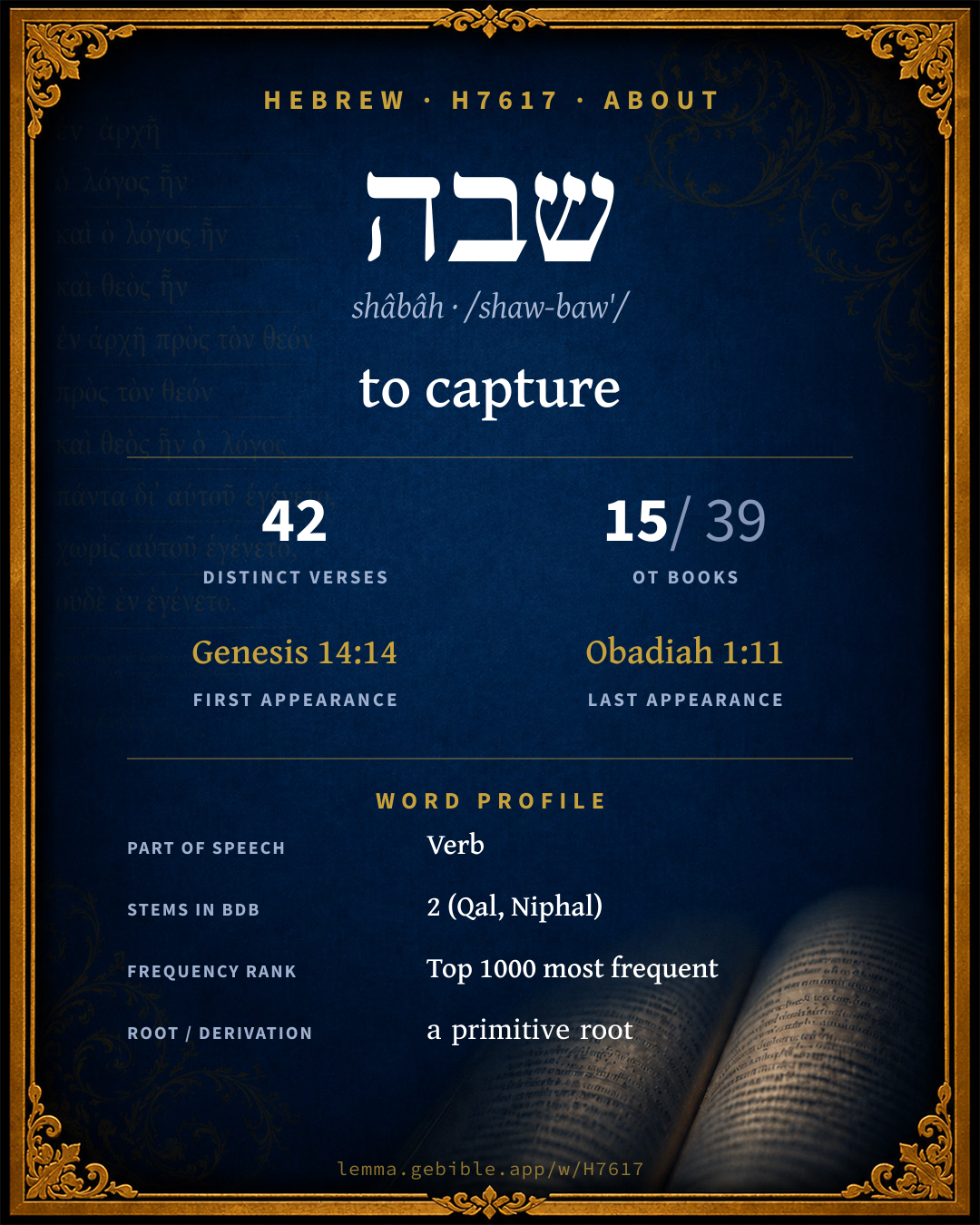
שָׁבָה
to capture
‘to capture’ is one of 2 main senses fuller range ↓
Full lexicon entry — Brown-Driver-Briggs (BDB)
From Brown-Driver-Briggs (BDB)
Where this word appears
See every Qal verb in the Hebrew Bible →
Grammar key — what these labels mean
Part of speech
- Verb
- An action or state-of-being word.
Stem
- Qal
- The basic, simple active stem — the plain form of the verb (“he wrote”). Here: ‘acc.’
- Niphal
- Usually the simple passive or reflexive of the Qal (“he was written”). Here: ‘be taken captive’
Form
- Sequential Imperfect
- An imperfect with prefixed waw — the standard past-narrative form (waw-consecutive imperfect).
- Participle Active
- A verbal adjective expressing ongoing or characteristic action (“writing / one who writes”).
- Perfect
- A completed action or state — Hebrew marks aspect (completeness) more than strict tense (“he wrote”).
- Sequential Perfect
- A perfect with prefixed waw continuing a preceding imperfect or command (waw-consecutive perfect).
- Imperative
- A direct command (“write!”).
- Participle Passive
- A verbal adjective expressing action received (“written”).
- Infinitive Construct
- A bound verbal noun, frequently with prepositions (“to write / in writing”).
- Imperfect
- An incomplete, ongoing, or future action (“he will / would write”).
State
- Construct
- A noun bound to a following noun in a possessive / “of” relationship (the construct chain).
- Absolute
- The independent form of a noun, not bound to a following word.
Person
- 3rd Person
- The one spoken about (“he / she / it / they”).
- 2nd Person
- The one addressed (“you”).
Gender
- Masculine
- Grammatically masculine.
- Common
- Either gender — not distinguished for this form.
- Feminine
- Grammatically feminine.
Number
- Plural
- More than one (in Hebrew, generally three or more).
- Singular
- One.
Every verse where H7617 appears in the Book of 1 Kings — 4 distinct verses. Click any verse to open its interlinear word-by-word view. Verse text shown in the World English Bible for context — . Each verse’s Hebrew form is shown with its reference; the English is not keyword-highlighted, since the data carries no word-level English alignment. Use “Compare translations” on any verse to read it across multiple English versions. This concordance covers the Hebrew Bible; Septuagint (Greek Old Testament) occurrences are not indexed here.
1 Kings
- 1 Kings 8:46 וְ/שָׁב֤וּ/ם שֹֽׁבֵי/הֶם֙ conj + Qal wpf 3cp + sfx pers 3mp Qal ptcp.act mp cs + sfx pers 3mp If they sin against you (for there is no man who doesn't sin), and you are angry with them, and deliver them to the enemy, so that they carry them away captive to the land of the enemy, far off or near;
- 1 Kings 8:47 נִשְׁבּוּ שֹֽׁבֵי/הֶם֙ Niphal pf 3cp Qal ptcp.act mp cs + sfx pers 3mp yet if they shall repent themselves in the land where they are carried captive, and turn again, and make supplication to you in the land of those who carried them captive, saying, We have sinned, and have done perversely, we have dealt wickedly;
- 1 Kings 8:48 שָׁב֣וּ Qal pf 3cp if they return to you with all their heart and with all their soul in the land of their enemies, who carried them captive, and pray to you toward their land, which you gave to their fathers, the city which you have chosen, and the house which I have built for your name:
- 1 Kings 8:50 שֹׁבֵי/הֶ֖ם Qal ptcp.act mp cs + sfx pers 3mp and forgive your people who have sinned against you, and all their transgressions in which they have transgressed against you; and give them compassion before those who carried them captive, that they may have compassion on them
About this entry
At a glance — auto-summarized from this page’s data, not written by a person. Every figure links to its source below. This summary describes the numbers; it doesn’t interpret them.
שבה — transliterated shâbâh — is a Hebrew verb carrying the sense “to capture.” Its English rendering has broadened — “captives” classically, “captors” (unfoldingWord Literal Text) in modern versions; see the renderings breakdown. The Hebrew Bible uses it across 42 verses — moderately common. More than a quarter of its appearances fall in 2 Chronicles. Across 2 stems, its meaning turns on the binyan (Qal, Niphal). Each statement above links to its evidence; the full detail follows below.
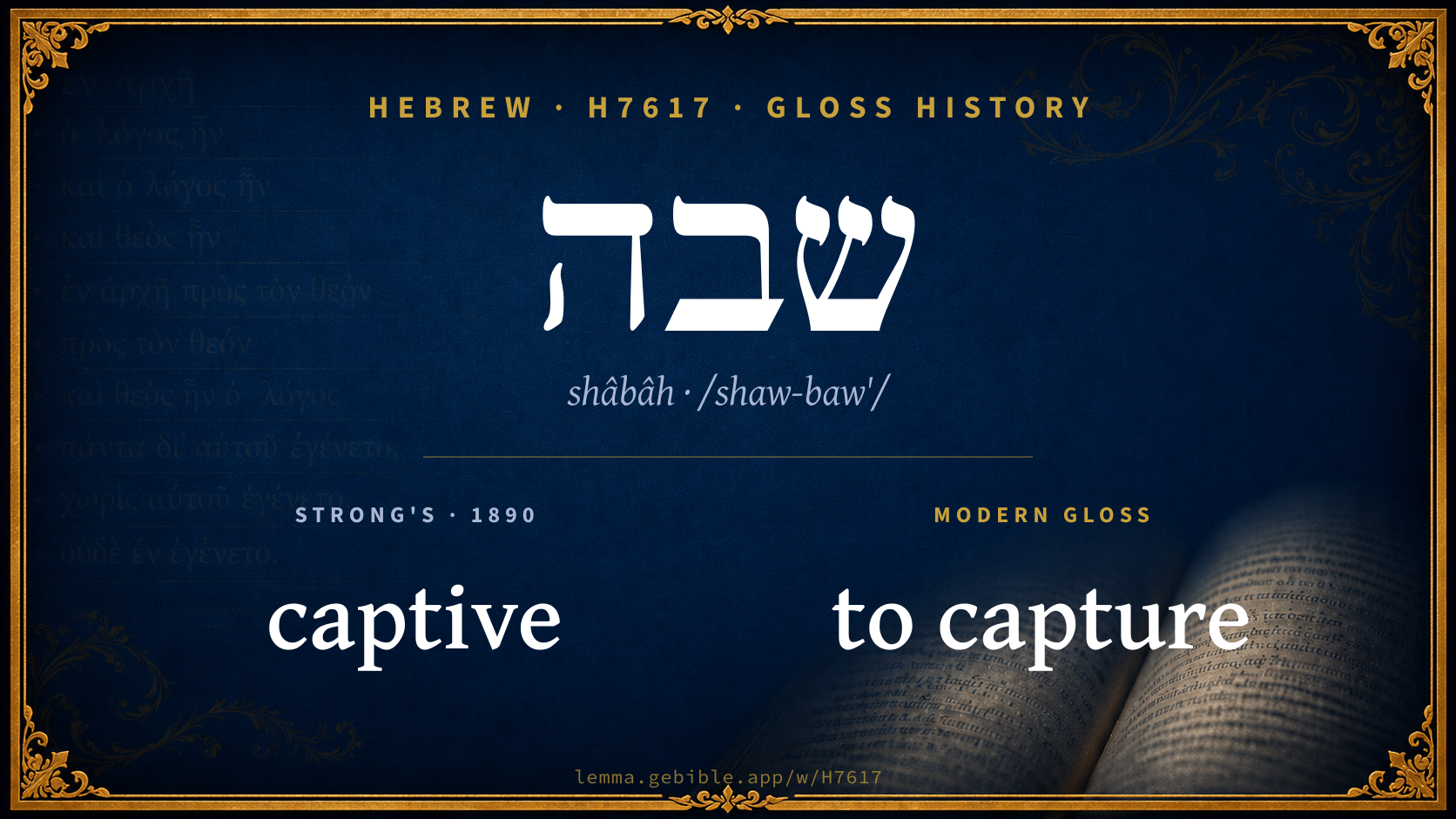
Gloss history
Strong's 1890 vs modern scholarship
About this word
Strong's H7617 catalogs a Hebrew word from the Hebrew Old Testament.
These counts are not copied from any lexicon or concordance. They are computed here, from the morphology-tagged Hebrew Old Testament. What Lemma adds →
- 42
- distinct verses
- The word appears in 42 distinct verses.
- 15 / 39
- OT books
- The word appears in 15 of 39 Old Testament books.
- #783
- by frequency
- Top 1000 most frequent Hebrew words (rank 783 of 8,640 Hebrew words by occurrence).
View all 42 occurrences in the concordance →
Most concentrated in
- 2 Chronicles 11 verses 26%
- Jeremiah 5 verses 12%
- 1 Kings 4 verses 10%
By section of the Old Testament
By traditional corpus
Conventional, traditional groupings — biblical authorship is debated, so this is a traditional corpus grouping, not an authorship claim. Each share is this word’s portion of its verses in that division of the Hebrew canon. Each figure is a share of the word’s 42 distinct verses.
- Prophets (Nevi'im) 19 verses · 45%
- Writings (Ketuvim) 15 verses · 36%
- Torah (Pentateuch) 8 verses · 19%
How translations render this word
Counts come from each version’s own published word-to-Strong’s tagging or interlinear alignment — an approximate guide to how each version renders this word, not a word-level alignment the data otherwise carries. Because each total is that version’s own tagged count, the per-version totals vary from one another and need not match the appearance or distinct-verse counts above. These counts may also differ from a printed concordance because Lemma counts each distinctly tagged rendering and does not collapse phrase taggings into a single head-word total. This is a fixed set of word-tagged versions (KJV, ASV, BSB, ULT) and does not change with the reading translation you choose elsewhere. Each version’s license is shown beside its name below (and on Sources).
- King James Version: Captives 7×, Carried away 4×, Carried away captive 3×
- American Standard Version: Captives 4×, Carried them captive 3×, Captive 2×
- Berean Standard Bible: Captives 6×, Captors 6×, Captured 3×
- unfoldingWord Literal Text: Captors 7×, Captive 4×, They took captive 4×
King James Version Public Domain
Renders H7617 across 47 tagged occurrences — most commonly:
Plus 27 renderings that appear only once — usually multi-word phrases or single function words the recovered tagging swept in, not distinct renderings.
American Standard Version Public Domain
Renders H7617 across 46 tagged occurrences — most commonly:
Plus 27 renderings that appear only once — usually multi-word phrases or single function words the recovered tagging swept in, not distinct renderings.
Berean Standard Bible Public Domain
Renders H7617 across 46 tagged occurrences — most commonly:
Plus 21 renderings that appear only once — usually multi-word phrases or single function words the recovered tagging swept in, not distinct renderings. Not rendered by a distinct English word in 1 further occurrence.
unfoldingWord Literal Text CC BY-SA 4.0
Renders H7617 across 50 tagged occurrences — most commonly:
Plus 18 renderings that appear only once — usually multi-word phrases or single function words the recovered tagging swept in, not distinct renderings.
6 senses and sub-senses in the full BDB
Hebrew verbs can shift meaning by stem (binyan): Qal is the basic action, Niphal is often passive or reflexive, Piel often intensifies or makes it factitive, and Hiphil is typically causative. The senses below are grouped under the stem BDB assigns to each.
What do BDB’s symbols mean?
BDB uses these scholarly abbreviations:
| Symbol | Meaning |
|---|---|
| 𝔊 | the Septuagint (the ancient Greek translation, LXX) |
| 𝔙 | the Vulgate (the Latin translation) |
| 𝔖 | the Syriac version (the Peshitta) |
| 𝔗 | the Targum (the Aramaic translation) |
| ψ | the Psalms |
| √ | root (the underlying root or stem) |
| ‖ | parallel passage (a synonymous or contrasted parallel) |
| † | the dagger: every passage where the word occurs is cited |
The 6 senses and sub-senses the full Brown-Driver-Briggs lexicon distinguishes for this word, in lexicon order (not ranked by frequency), with BDB’s own verbatim wording and sub-sense lettering. Shown in Hebrew script with BDB’s own scholarly abbreviations. The condensed entry is in the Lexicon Entry tab. See also the Forms in the corpus table below.
Qal
- Pf. 3 ms. שׁ׳ Je 41:14; sf. וְשָׁבָם (consec.) 43:12 (but read וְשָׁבָה Gie; Du conj. וְשָֽׁמְמוּ); 2 ms. שָׁבִיתָ 2 K 6:22 ψ 68:19, etc.; Impf. 3 ms. וַיִּשְׁבְּ Nu 21:1 Je 41:10, etc.; Imv. ms. וּשְׁבֵה Ju 5:12; Inf. cstr. שְׁבוֹת Ob 11; Pt. act. pl. שֹׁבִים Is 14:2, etc.; pass. mpl. שְׁבוּיִם Is 61:1, fpl. cstr. שְׁבֻיוֹת Gn 31:26;—take captive: e.g. Jeremiah 41:14
- 1.
- a. c. acc. pers., Nu 24:22 (JE), 1 S 30:2; 2 K 5:2; 6:22 (+ ב instr.) Je 41:10(×2) (but v 10b Gie reads וַיַּשְׁכֵּם, cf. 𝔊 Luc), v 14, Gn 34:29 (P), 2 Ch 28:8 (+ מִן part.), + 6 times; + Je 43:12 appar. c. acc. idols (but v. supra; acc. of land Gie). e.g. Numbers 24:22
- b. acc. חֵילוֹ Ob 11, הָֽרְכוּשׁ 2 Ch 21:17, cattle, etc., 1 Ch 5:21; 2 Ch 14:14. e.g. Obadiah 1:11
- c. pt. in periphrast. conjug. (לְשֹׁבֵיהֶם) וְהָיוּ שֹׁבִים Is 14:2; pt. c. sf. = their captives, etc., 1 K 8:46 = 2 Ch 6:36; Is 14:2; Je 50:33, + 5 times; pt. pass. Is 61:1 = captives; כִּשְׁבֻיוֹת חָ֑רֶב Gn 31:26 my daughters as captives of the sword. e.g. Isaiah 14:2
- 2. c. acc. cogn. שְׁבִי Ju 5:12 lead captive thy captives, cf. ψ 68:19 2 Ch 28:17, so (+ מִן pers.) Nu 21:1 (JE), and (acc. שִׁבְיָה) 2 Ch 28:5, 11; שׁ׳ שִׁבְיוֹ Dt 21:10 = take him captive. e.g. Judges 5:12
Niphal
- be taken captive: Pf. 3 ms. נִשְׁבָּה, of man Gn 14:14, of beast Ex 22:9 (E), of עֵדֶר י׳ Je 13:17; 3 pl. נִשְׁבּוּ, human subj. 1 S 30:3, 5; 1 K 8:47 = 2 Ch 6:37; Ez 6:9. e.g. Genesis 14:14
Senses from the full Brown-Driver-Briggs lexicon (Brown, Driver, Briggs; Oxford 1906 — public domain), digitized via Sefaria, supplemented by the OpenScriptures HebrewLexicon (CC BY 4.0). Full attribution on Sources.
Word origin
vb. take captive (NH, Old Aramaic id.; Arabic سَبَا (سبى); Aramaic שְׁבָא ܫܒܳܐ );—
— Brown-Driver-Briggs (Oxford 1906, public domain), digitized via Sefaria, supplemented by the OpenScriptures HebrewLexicon (CC BY 4.0). See Sources.
Origin: a primitive root
Jastrow Dictionary
A second Hebrew/Aramaic lexicon for comparison, covering Aramaic and post-biblical (Talmudic, Targumic, Midrashic) usage that the biblical-Hebrew BDB does not. Matched by lemma rather than by Strong’s number, so a lemma may carry more than one Jastrow headword (shown separately below), and the entries cover usage well beyond the Bible.
שָׁבָה
- , v. שבי
A Dictionary of the Targumim, the Talmud Babli and Yerushalmi, and the Midrashic Literature (Marcus Jastrow; London, Luzac, 1903) — Public Domain. Digitized via Sefaria. Digitized via Sefaria. Full attribution on Sources.
Forms in the corpus
The 39 distinct written forms H7617 takes in the Hebrew Bible, most frequent first — each parse links to that stem’s occurrences in the concordance. Hebrew forms include their vowel points and cantillation, so a single lemma takes many written forms.
Same root — word family
Other BDB entries built from the same root as H7617, grouped by Strong’s listed origin. These share a root / origin per the lexicon — not necessarily a shared meaning. Each links to that word’s own entry.
Derived from this word
Proper names from this root
People and places named from this root — a name, not an additional meaning of the word.
Compare all same-root words → Showing 4 of 5 — not the complete family. 2 of the same-root words are proper names (people or places). They share a root, not necessarily a meaning.
Septuagint verse parallels
This word appears in 39 verses that also exist in the Greek Old Testament (Septuagint), out of the 42 Hebrew verses it occurs in. You can read those verses in Greek by switching the Old Testament edition to the Septuagint.
Read these verses in the Septuagint
- Genesis 14:14
- Exodus 22:10
- Numbers 21:1
- Deuteronomy 21:10
- Judges 5:12
- 1 Samuel 30:2
- 1 Kings 8:46
- 2 Kings 5:2
- 1 Chronicles 5:21
- 2 Chronicles 6:36
- Psalms 68:18
- Isaiah 14:2
This is a verse-level parallel only — the same verses exist in both the Hebrew and Greek Old Testaments. No word-level Hebrew↔Greek correspondence is claimed: the data carries no such alignment, so no Greek word is shown as this Hebrew word’s translation. Coverage is not total — the Septuagint omits the deuterocanon and renumbers the Psalms, so some Hebrew verses have no direct Greek parallel.