
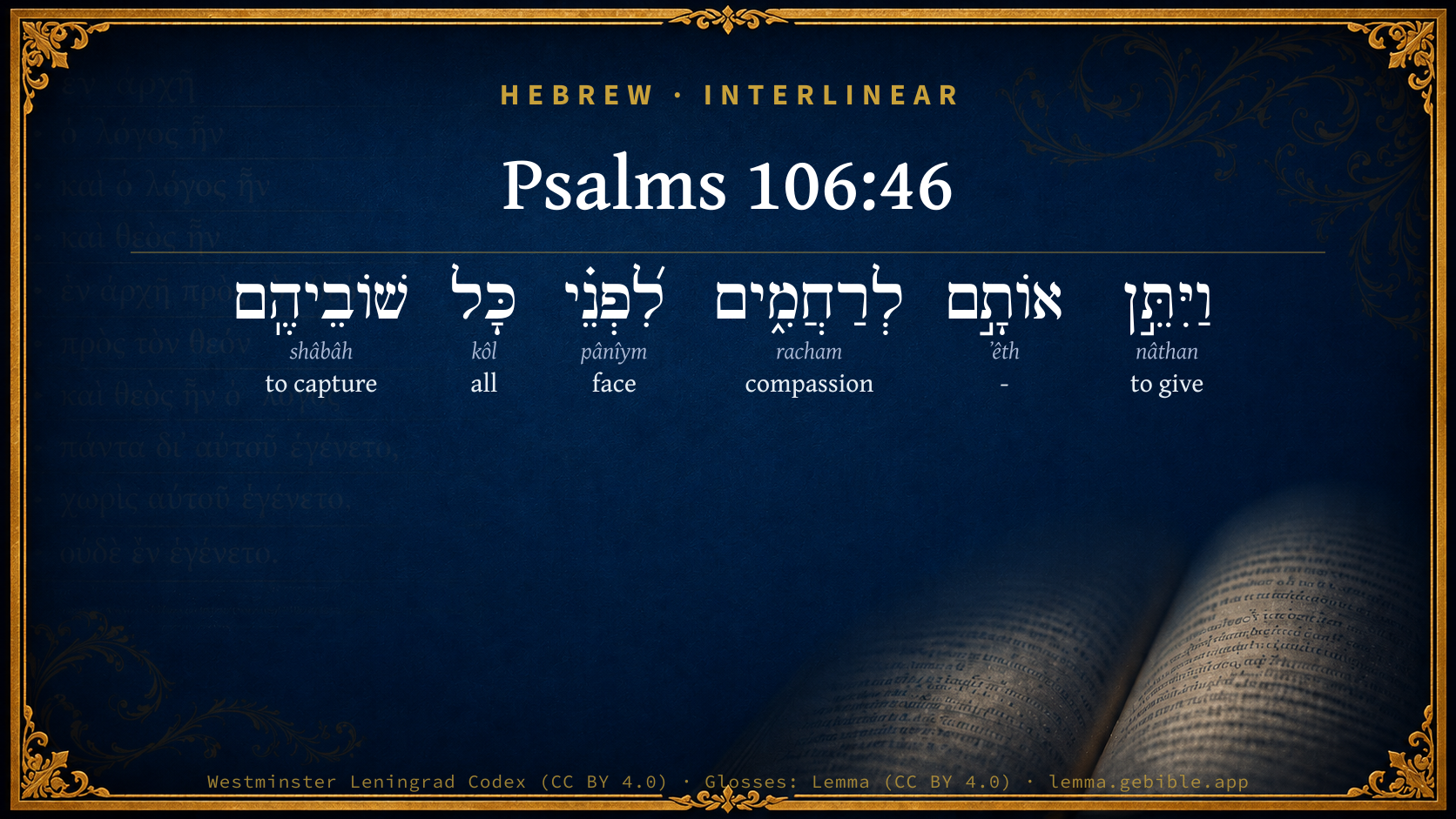
Psalms 106:46

Hebrew (Westminster Leningrad Codex) Psalms 106:46 appears in the Hebrew Old Testament. The text above is from the Westminster Leningrad Codex. Each word links to its Strong’s number, a concise gloss, and parsing drawn from the Open Scriptures Hebrew Bible morphology. Click any word for its full Brown-Driver-Briggs (BDB) entry.
Download image
Cite this verse

Psalms 106:46 (World English Bible). Public Domain. Lemma interlinear Bible study tool, https://lemma.gebible.app/v/psalms/106/46.

Show BibTeX & RIS
BibTeX
RIS
English Translation
He made them also to be pitied By all those who carried them captive.
World English Bible · Public Domain
Download a study sheet

One document with this verse’s original text, its word-by-word gloss line, the meaning frame, cross-references with their text, attributed commentary, and full source and license credits — printable, and it pastes into notes with its structure intact.

This verse Autodidact and up

Study sheet (.html) Plain text (.txt)

A passage Seminary Student

Up to 50 verses in one chapter. A passage sheet keeps up to 6 commentary sources and 12 cross-references per verse, in the order this page ranks them, and says so on the sheet whenever that leaves anything out. Ask for a single verse and you get the Autodidact verse sheet above.

Everything on this page stays free to read, with no account — the sheet is a download of what is already on screen, not access to it.

Want to remove ads? Support Godless Engineer
Compare translations 3

The same verse in 3 English versions, stacked beneath the original-language interlinear above. Click any original word for its lexicon entry.

Each is an independent rendering of the whole verse — the interlinear is not word-aligned to these translations.

Highlighted words mark where these versions differ — a whole-verse word diff, not a word-by-word alignment.

  • World English Bible Public Domain
    He made them also to be pitied By all those who carried them captive.
  • King James Version Public Domain
    He made them also to be pitied of all those that carried them captives.
  • unfoldingWord Literal Text CC BY-SA 4.0
    He gave them for compassion to the face of all of their captors.

unfoldingWord Literal Text — © unfoldingWord, licensed CC BY-SA 4.0. Word-aligned USFM3 via Door43 (git.door43.org/unfoldingWord/en_ult).

Versions to compare (up to 4)

3 of 4 selected

Show all 18 translations

Every available English version of this verse, each an independent rendering of the whole verse.

  • World English Bible Public Domain
    He made them also to be pitied By all those who carried them captive.
  • Berean Standard Bible Public Domain
    He made them objects of compassion to all who held them captive.
  • Majority Standard Bible Public Domain
    He made them objects of compassion to all who held them captive.
  • King James Version Public Domain
    He made them also to be pitied of all those that carried them captives.
  • American Standard Version (1901) Public Domain
    He made them also to be pitied Of all those that carried them captive.
  • Revised Version (1885) Public Domain
    He made them also to be pitied of all those that carried them captives.
  • Geneva Bible (1599) Public Domain
    And gaue them fauour in the sight of all them that lead them captiues.
  • Douay-Rheims (1899) Public Domain
    And he gave them unto mercies, in the sight of all those that had made them captives.
  • Young's Literal Translation Public Domain
    And He appointeth them for mercies Before all their captors.
  • Literal Standard Version CC BY-SA 4.0
    And He appoints them for mercies || Before all their captors.
  • Unlocked Literal Bible CC BY-SA 4.0
    He caused all their conquerers to have pity on them.
  • unfoldingWord Literal Text CC BY-SA 4.0
    He gave them for compassion to the face of all of their captors.
  • Darby Bible Public Domain
    And he caused them to find compassion of all those that had carried them captives.
  • World Messianic Bible Public Domain
    He made them also to be pitied by all those who carried them captive.
  • Webster's Bible Public Domain
    He made them also to be pitied by all those that carried them captives.
  • Free Bible Version CC BY-SA 4.0
    He made the people who captured them treat them with mercy.
  • Bible in Basic English Public Domain
    He put pity into the hearts of those who made them prisoners.
  • JPS Tanakh (1917) Public Domain
    He made them also to be pitied of all those that carried them captive.

Literal Standard Version (2020), Covenant Press — licensed CC BY-SA 4.0. Text via the HelloAO Bible API (eBible.org). Unlocked Literal Bible (unfoldingWord) — licensed CC BY-SA 4.0. Text via the HelloAO Bible API (eBible.org). unfoldingWord Literal Text — © unfoldingWord, licensed CC BY-SA 4.0. Word-aligned USFM3 via Door43 (git.door43.org/unfoldingWord/en_ult). Free Bible Version, Dr. Jonathan Gallagher — licensed CC BY-SA 4.0. Text via the HelloAO Bible API (eBible.org).

Word by word

More ways to search: Search by grammar → Find every occurrence → Compare this word →

Practice this passage: Drill this verse → Learn its vocabulary →

About this verse

These counts appear in no published source. They are computed here, from the morphology-tagged text and Lemma’s own curated glosses. What Lemma adds →

6
words
6
distinct lemmas
Wisdom
section

Shared distinctive vocabulary

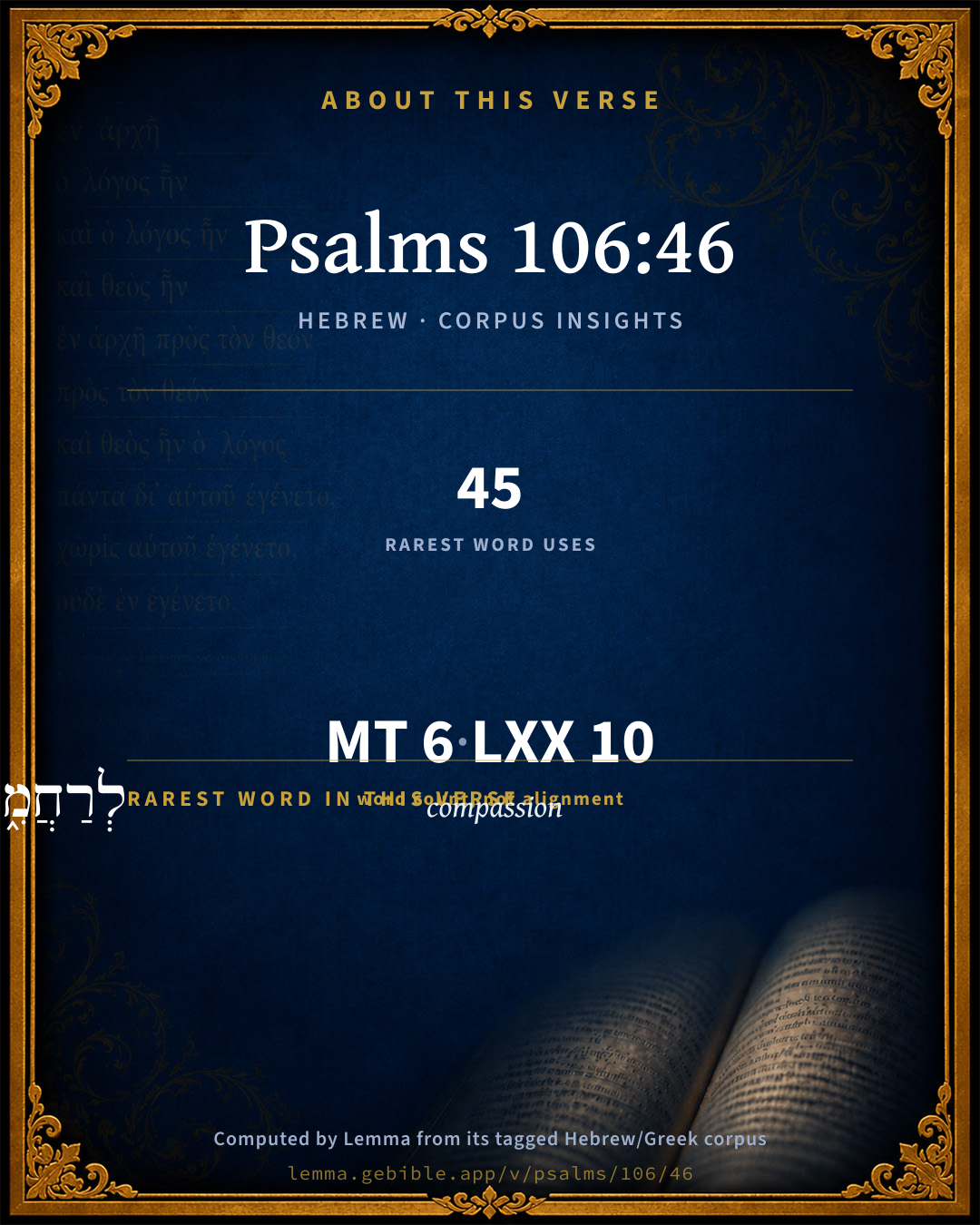
לְרַחֲמִ֑ים compassion H7356 occurs in 44 verses of the Hebrew Bible. Also found in:

Grammatical profile

  • 2 verbs
  • 3 nouns
  • 1 particle

Verb forms

  • וַיִּתֵּ֣ן Qal · Sequential Imperfect
  • שׁוֹבֵיהֶֽם Qal · Participle Active

Hebrew & Septuagint length

In English translation the verse runs 14 words from the Hebrew and 16 from the Septuagint (LXX English) — closely comparable.

A rough comparison of the two English renderings, which tokenize alike — not a word-level alignment.

Word counts can differ between the Hebrew and the Greek without any difference in meaning — e.g. the Hebrew direct-object marker אֵת has no separate Greek word, and Greek often adds the article ὁ.

In the original languages it is 6 Hebrew tokens and 10 Greek tokens — but the two are counted differently (Hebrew bundles its prefixes and suffixes into one token; the Greek is in lemma form), so that isn’t a like-for-like length.

Cross-references

6

Topical passages linked to Psalms 106:46 in the Treasury of Scripture Knowledge — connected by theme and wording, ordered by reader-vote popularity; previews shown in the World English Bible.

  • Ezra 9:9 For we are bondservants; yet our God has not forsaken us in our bondage, but has extended loving kindness to us in the sight of the kings of Persia, to give us a reviving, to set up the house of our God, and to repair the ruins of it, and to give us a wall in Judah and in Jerusalem.
  • Jeremiah 42:12 I will grant you mercy, that he may have mercy on you, and cause you to return to your own land.
  • 1 Kings 8:50 and forgive your people who have sinned against you, and all their transgressions in which they have transgressed against you; and give them compassion before those who carried them captive, that they may have compassion on them
  • Jeremiah 15:11 Yahweh said, Most assuredly I will strengthen you for good; most assuredly I will cause the enemy to make supplication to you in the time of evil and in the time of affliction.
  • Nehemiah 1:11 Lord, I beg you, let now your ear be attentive to the prayer of your servant, and to the prayer of your servants, who delight to fear your name; and please prosper your servant this day, and grant him mercy in the sight of this man. Now I was cup bearer to the king.
  • 2 Chronicles 30:9 For if you turn again to Yahweh, your brothers and your children shall find compassion before those who led them captive, and shall come again into this land: for Yahweh your God is gracious and merciful, and will not turn away his face from you, if you return to him.

Cross-references courtesy of OpenBible.info (CC BY 4.0).

Hebrew and Greek witnesses Masoretic Hebrew ↔ Greek Septuagint

The same verse in the two great witnesses to the Old Testament, shown verse-for-verse.

You’re reading Greek Psalm 105 (Hebrew Psalm 106). The Septuagint counts the superscription, so verse numbers can differ from the Hebrew — chapter-level alignment, not verse-by-verse. Numbering follows Rahlfs.

These are two independent witnesses, not word-aligned to each other, and the Septuagint is shown in lemma (dictionary) form.

Hebrew Psalms 106:46 Masoretic · Westminster Leningrad Codex

וַיִּתֵּ֣ן אוֹתָ֣ם לְרַחֲמִ֑ים לִ֝פְנֵ֗י כָּל שׁוֹבֵיהֶֽם

He made them also to be pitied By all those who carried them captive.

World English Bible · Public Domain

Greek LXX Greek Psalm 105:46 Septuagint · lemma form

καί δίδωμι αὐτός εἰς οἰκτιρμός ἐναντίον πᾶς ὁ αἰχμαλωτίζω αὐτός

And he caused them to be pitied in the sight of all who carried them captive.

LXX2012 (modern English Septuagint) · Public Domain

Hebrew: Westminster Leningrad Codex (CC BY 4.0). Greek: Septuagint (public domain); English from LXX2012 (modern English Septuagint) (Public Domain). How the Septuagint differs from the Hebrew →

Commentary

Notes on Psalms 106:46 from classic Christian and Jewish commentators (each source and its license shown beneath its notes). The classic Christian expositions comment on the surrounding passage and are grouped to its opening verse, so a note may address several verses; the Jewish commentaries on the Tanakh (Rashi and others) are per-verse, so they appear only where the commentator wrote on this verse.

Lemma curates 59 commentaries, every one of them public domain or Creative Commons licensed, each selected and text-cleaned for this edition rather than reprinted as found. About our sources →

Trapp's Complete Commentary

John Trapp

Psa 106:46 He made them also to be pitied of all those that carried them captives.

Ver. 46. He made them also to be pitied] God can soon turn the hearts of tyrants, and make them of lions lambs, &c.

John Trapp, A Commentary or Exposition upon All the Books of the Old and New Testament (1647–1656) — public domain. Text from a community e-Sword module.

J. A. Alexander on Psalms

Joseph Addison Alexander

46. (Psa 106:46) And has given them favour before all their captors. The literal translation of the first clause is, and has given them for mercies or compassions. This remarkable expression is borrowed from 1 Kings viii. 50 (compare 2Ch 30:9), not only here but in the history of Daniel and his fellow-captives (Dan 1:9), which makes it not at all improbable, that what is there recorded is among the indications of returning divine favour here referred to by the Psalmist.

Joseph Addison Alexander, The Psalms Translated and Explained (1850) — public domain. Text from a community e-Sword module.

Tyndale Open Study Notes

Tyndale Open Resources

106:46 As harsh as the Exile was, the Lord still protected his people (see 2 Kgs 25:27-29).

Tyndale Open Study Notes — © Tyndale Open Resources, licensed CC BY-SA 4.0. Text via the HelloAO Bible API.

Adam Clarke's Commentary

Verse 46. He made them also to be pitied] This was particularly true as to the Babylonish captivity; for Cyrus gave them their liberty; Darius favoured them, and granted them several privileges; and Artaxerxes sent back Nehemiah, and helped him to rebuild Jerusalem and the temple. See the Books of Ezra and Nehemiah; and see Calmet.

Adam Clarke's Commentary on the Bible (1810–1826) — public domain. Text from a community e-Sword/MySword module.

John Calvin's Commentaries

46. And he made them to find pity As he had above said, that the Jews had been delivered into the hands of their enemies, because God’s anger was, as it were, arms to their adversaries to subdue them; so now he says, that the same God had softened the hearts of these very enemies, who, by terrible means, and with great cruelty, had executed his vengeance upon them. As, then, the hearts of all men are entirely under God’s control, to harden or to soften them according to his sovereign pleasure, so, while his anger was kindled against his people, their enemies were at the same time also inflamed with implacable resentment towards them. But the moment his anger was appeased, the fire which issued from the furnace of his judgment was extinguished, and the cruelty of their enemies was changed into mercy. And that enemies, cruel and barbarous, should begin to love and pity those whom they formerly hated, was a change so astonishing as to be incredible, had they not, in the kind providence of God, from wolves been transformed into lambs.

John Calvin's Commentaries (1540-1563) — public domain. Text from the Calvin Translation Society English edition (1840s-50s) via the Christian Classics Ethereal Library (ccel.org). Calvin's coverage is partial (roughly two-thirds of the Bible); uncommented books and verses are honest gaps, never fabricated. The 19th-century editor's footnotes and remarks are omitted so the notes are faithfully Calvin's own voice.

Ellicott's Commentary for English Readers

(46) Made them also to be pitied.—Literally, gave them for companions, a phrase found in Solomon’s prayer (1Ki_8:50, and also in Dan_1:9, Heb.).

A Bible Commentary for English Readers, edited by Charles John Ellicott (1878–1897) — public domain. Text from a community e-Sword module.

The Cambridge Bible for Schools and Colleges

gen. ed. J. J. S. Perowne

46. He made them also to be pitied &c.] In answer to Solomon’s prayer, 1Ki_8:50. Cp. Neh_1:11; Dan_1:9.

The Cambridge Bible for Schools and Colleges (gen. ed. J. J. S. Perowne; Cambridge University Press, 1878–1918) — public domain. Text from a community e-Sword module.

John Gill's Exposition

Blessed be the Lord God of Israel,.... God is to be blessed as the Father of mercies; as the God and Father of our Lord Jesus Christ; and as the covenant God and Father of his people in him, of the true Israel of God: which is done by celebrating his blessedness in himself; by ascribing to him all blessedness enjoyed, as the author of it; and by giving him honour, glory, and blessing for it.

From everlasting to everlasting; here and hereafter, in time and to all eternity; from this world to that which is to come, as the Targum; and which Arama observes are the days of the Messiah.

And let all the people say, Amen; so be it; to giving thanks to God, to praising his name, and ascribing blessing to him.

Praise ye the Lord; or "hallelujah"; so these two words, "Amen, hallelujah", are joined together in Rev 19:4. The psalm ends as it began; for though the greatest part of it is taken up in relating the sins of the people of Israel; yet as the Lord was merciful to them and forgave them, and notwithstanding bestowed great mercies on them, there was reason for praise and thanksgiving. Here ends the fourth part of the book of Psalms; the fifth part begins, with the following psalm.

Next: Psalms Chapter 107

John Gill's Exposition of the Whole Bible (1746–1763) — public domain (CC PDM 1.0). Text via the HelloAO Bible API.

Albert Barnes' Notes on the Bible

He made them also to be pitied of all those that carried them captives - That is, he exercised such control over the minds of the pagan that they were willing to show them mercy and to release them. It was not by any native tenderness on the part of the pagan; it was not because they were disposed of themselves to show them any favor; it was not because they had any “natural” relentings on the subject; but it was because God had access to their hearts, and “inclined” them to show compassion for their suffering prisoners. This is a remarkable instance of the power of God over even the hardened minds and hearts of pagan men; and it shows that he holds this power, and can exercise it when he pleases. If he could excite in their hard hearts feelings of compassion toward his own people in bondage, what should prevent his having such access to the hearts of the pagan now as to lead them to repentance toward himself? On the exercise of this power the salvation of the pagan world - as of all sinners - must depend; and for the putting forth of this power we should most fervently pray. The “literal” rendering of this verse would be, “And he gave them to compassions before all those that made them captive.” That is, he inclined them to show favor or compassion. Compare Dan 1:9; 1Ki 8:50.

Albert Barnes' Notes on the Bible (1834–1885) — public domain. Text from a community e-Sword/MySword module.

Matthew Poole's English Annotations

By changing their opinions of them, and inclining their hearts towards them, which he had alienated from them See Poole "Psa 105:25".

Matthew Poole's English Annotations on the Holy Bible (1683–1685) — public domain. Text from a community e-Sword/MySword module.

The Treasury of David

Charles H. Spurgeon

Ver. 46. He made them also to be pitied of all those that carried them captives. Having the hearts of all men in his hands he produced compassion even in heathen bosoms. Even as he found Joseph friends in Egypt, so did he raise up sympathizers for his captive servants. In our very worst condition our God has ways and means for allaying the severity of our sorrows: he can find us helpers among those who have been our oppressors, and he will do so if we be indeed his people.

Ver. 46. He made them also to be pitied of all them that carried them captives. This improved feeling towards the Jews through God's influence appears in Da 1:9; as Joseph similarly had his captivity improved by God's favour (Ge 39:21). So Evil merodach, King of Babylon, treated kindly Jehoiachin, king of Judah (2Ki 25:27). A.R. Fausset.

Psalms 106:47*

Charles H. Spurgeon's The Treasury of David (1869–1885) — public domain. Psalms only. Text from a community e-Sword/MySword module.

Whedon's Commentary on the Bible

Daniel D. Whedon

46. He made them… to be pitied—An exquisite touch in the poet’s description, and a doctrine, as to divine providence, infinitely worthy of God, and according to the prayer of Solomon in 1Ki_8:50

Daniel D. Whedon (gen. ed.), Commentary on the Old and New Testaments (1874–1909) — public domain. Text from a community e-Sword module.

The Pulpit Commentary

He made them also to be pitied of all those that carried them captives. Solomon had prayed that so it might be. (1Ki_8:50) The fact that compassion was shown to many of the captives appears from 2Ki_25:27-30 Dan_1:3-5, 19 2:49 3:30 6:28 Ezr_1:4-6 Neh_1:11 Neh_2:1-8.

The Pulpit Commentary (1880–1919), ed. H.D.M. Spence-Jones & Joseph S. Exell — public domain. Text from a community e-Sword module.

Lesson kit

Teaching starters — assembled from the data on this page, not authored interpretation. Every prompt links to the verse data it draws on. Edit before teaching.

Psalms, in the Wisdom, opens this verse with 6 words (6 distinct Hebrew lemmas). Its most distinctive word is racham (“compassion”). A historical commentator’s framing appears above. Read the whole chapter for the surrounding context.

Discussion questions

  1. How does “compassion” (racham) shape what this verse is saying?
  2. How does Genesis 43:14, which shares the word «compassion», read alongside this verse?
  3. These translations render this verse differently. What is at stake in choosing one wording over another?
  4. «וַיִּתֵּ֣ן» is a Qal Sequential Imperfect verb. How does that grammatical form shape the action described?
  5. Compare how Trapp's Complete Commentary and J. A. Alexander on Psalms read this verse. Where do they agree or differ?

Things to notice

Reading settings

Reading text

Shown beneath each verse's original-language words.

Old Testament
Old Testament edition

Read the OT as the Masoretic Hebrew (MT) or the Greek Septuagint (LXX).

English shown for the Greek Septuagint (in the Hebrew ↔ Greek comparison).

Comparing translations? Open the Compare panel on any verse page to stack up to four side by side.