1 Samuel 30:2

Hebrew (Westminster Leningrad Codex) 1 Samuel 30:2 appears in the Hebrew Old Testament. The text above is from the Westminster Leningrad Codex. Each word links to its Strong’s number, a concise gloss, and parsing drawn from the Open Scriptures Hebrew Bible morphology. Click any word for its full Brown-Driver-Briggs (BDB) entry.
Download image
Cite this verse

1 Samuel 30:2 (World English Bible). Public Domain. Lemma interlinear Bible study tool, https://lemma.gebible.app/v/1-samuel/30/2.

Show BibTeX & RIS
BibTeX
RIS
English Translation
and had taken captive the women [and all] who were therein, both small and great: they didn't kill any, but carried them off, and went their way.
World English Bible · Public Domain
Download a study sheet

One document with this verse’s original text, its word-by-word gloss line, the meaning frame, cross-references with their text, attributed commentary, and full source and license credits — printable, and it pastes into notes with its structure intact.

This verse Autodidact and up

Study sheet (.html) Plain text (.txt)

A passage Seminary Student

Up to 50 verses in one chapter. A passage sheet keeps up to 6 commentary sources and 12 cross-references per verse, in the order this page ranks them, and says so on the sheet whenever that leaves anything out. Ask for a single verse and you get the Autodidact verse sheet above.

Everything on this page stays free to read, with no account — the sheet is a download of what is already on screen, not access to it.

Want to remove ads? Support Godless Engineer
Compare translations 3

The same verse in 3 English versions, stacked beneath the original-language interlinear above. Click any original word for its lexicon entry.

Each is an independent rendering of the whole verse — the interlinear is not word-aligned to these translations.

Highlighted words mark where these versions differ — a whole-verse word diff, not a word-by-word alignment.

  • World English Bible Public Domain
    and had taken captive the women [and all] who were therein, both small and great: they didn't kill any, but carried them off, and went their way.
  • King James Version Public Domain
    And had taken the women captives, that were therein: they slew not any, either great or small, but carried them away, and went on their way.
  • unfoldingWord Literal Text CC BY-SA 4.0
    And they had taken captive the women who in it, from small and to great. They had not caused a man to die, but they had led away and gone to their way.

unfoldingWord Literal Text — © unfoldingWord, licensed CC BY-SA 4.0. Word-aligned USFM3 via Door43 (git.door43.org/unfoldingWord/en_ult).

Versions to compare (up to 4)

3 of 4 selected

Show all 18 translations

Every available English version of this verse, each an independent rendering of the whole verse.

  • World English Bible Public Domain
    and had taken captive the women [and all] who were therein, both small and great: they didn't kill any, but carried them off, and went their way.
  • Berean Standard Bible Public Domain
    They had taken captive the women and all who were there, both young and old. They had not killed anyone, but had carried them off as they went on their way.
  • Majority Standard Bible Public Domain
    They had taken captive the women and all who were there, both young and old. They had not killed anyone, but had carried them off as they went on their way.
  • King James Version Public Domain
    And had taken the women captives, that were therein: they slew not any, either great or small, but carried them away, and went on their way.
  • American Standard Version (1901) Public Domain
    and had taken captive the women `and all' that were therein, both small and great: they slew not any, but carried them off, and went their way.
  • Revised Version (1885) Public Domain
    and had taken captive the women and all that were therein, both small and great: they slew not any, but carried them off, and went their way.
  • Geneva Bible (1599) Public Domain
    And had taken the women that were therein, prisoners, both small and great, and slewe not a man, but caryed them away, and went their wayes.
  • Douay-Rheims (1899) Public Domain
    And had taken the women captives that were in it, both little and great: and they had not killed any person, but had carried them with them, and went on their way.
  • Young's Literal Translation Public Domain
    and they take captive the women who `are' in it; from small unto great they have not put any one to death, and they lead away, and go on their way.
  • Literal Standard Version CC BY-SA 4.0
    and they take the women who [are] in it captive; they have not put anyone to death from small to great, and they lead [them] away, and go on their way.
  • Unlocked Literal Bible CC BY-SA 4.0
    and captured the women and everyone who was in it, both small and great. They killed no one, but carried them off as they went on their way.
  • unfoldingWord Literal Text CC BY-SA 4.0
    And they had taken captive the women who in it, from small and to great. They had not caused a man to die, but they had led away and gone to their way.
  • Darby Bible Public Domain
    and had taken the women captives that were in it; both great and small: they had put none to death, but had carried them off, and went on their way.
  • World Messianic Bible Public Domain
    and had taken captive the women and all who were in it, both small and great. They didn’t kill any, but carried them off and went their way.
  • Webster's Bible Public Domain
    And had taken the women captives that were in it, they slew not any, either great or small, but carried them away, and went on their way.
  • Free Bible Version CC BY-SA 4.0
    They had captured the women and everyone else there, young and old. They hadn't killed anyone, but they took everyone with them as they left.
  • Bible in Basic English Public Domain
    And had made the women and all who were there, small and great, prisoners: they had not put any of them to death, but had taken them all away.
  • JPS Tanakh (1917) Public Domain
    and had taken captive the women and all that were therein, both small and great; they slew not any, but carried them off, and went their way.

Literal Standard Version (2020), Covenant Press — licensed CC BY-SA 4.0. Text via the HelloAO Bible API (eBible.org). Unlocked Literal Bible (unfoldingWord) — licensed CC BY-SA 4.0. Text via the HelloAO Bible API (eBible.org). unfoldingWord Literal Text — © unfoldingWord, licensed CC BY-SA 4.0. Word-aligned USFM3 via Door43 (git.door43.org/unfoldingWord/en_ult). Free Bible Version, Dr. Jonathan Gallagher — licensed CC BY-SA 4.0. Text via the HelloAO Bible API (eBible.org).

Word by word

More ways to search: Search by grammar → Find every occurrence → Compare this word →

Practice this passage: Drill this verse → Learn its vocabulary →

וַיִּֽנְהֲג֔וּ
nâhag
H5090
“and · to drive”
Conjunction + Verb, Qal, Sequential Imperfect, 3rd Person, Masculine, Plural
Part of Speech
Conjunction + Verb
Stem
Qal
Form
Sequential Imperfect
Person
3rd Person
Gender
Masculine
Number
Plural
Full BDB Definition

Origin: a primitive root

TWOT: 1309 , 1310

to drive, lead, guide, conduct - (Qal) - to drive, lead on, drive away, drive off - to behave itself (figuratively) (of heart) - (Piel) - to drive away, lead off - to lead on, guide, guide on - to cause to drive - (Piel) to moan, lament
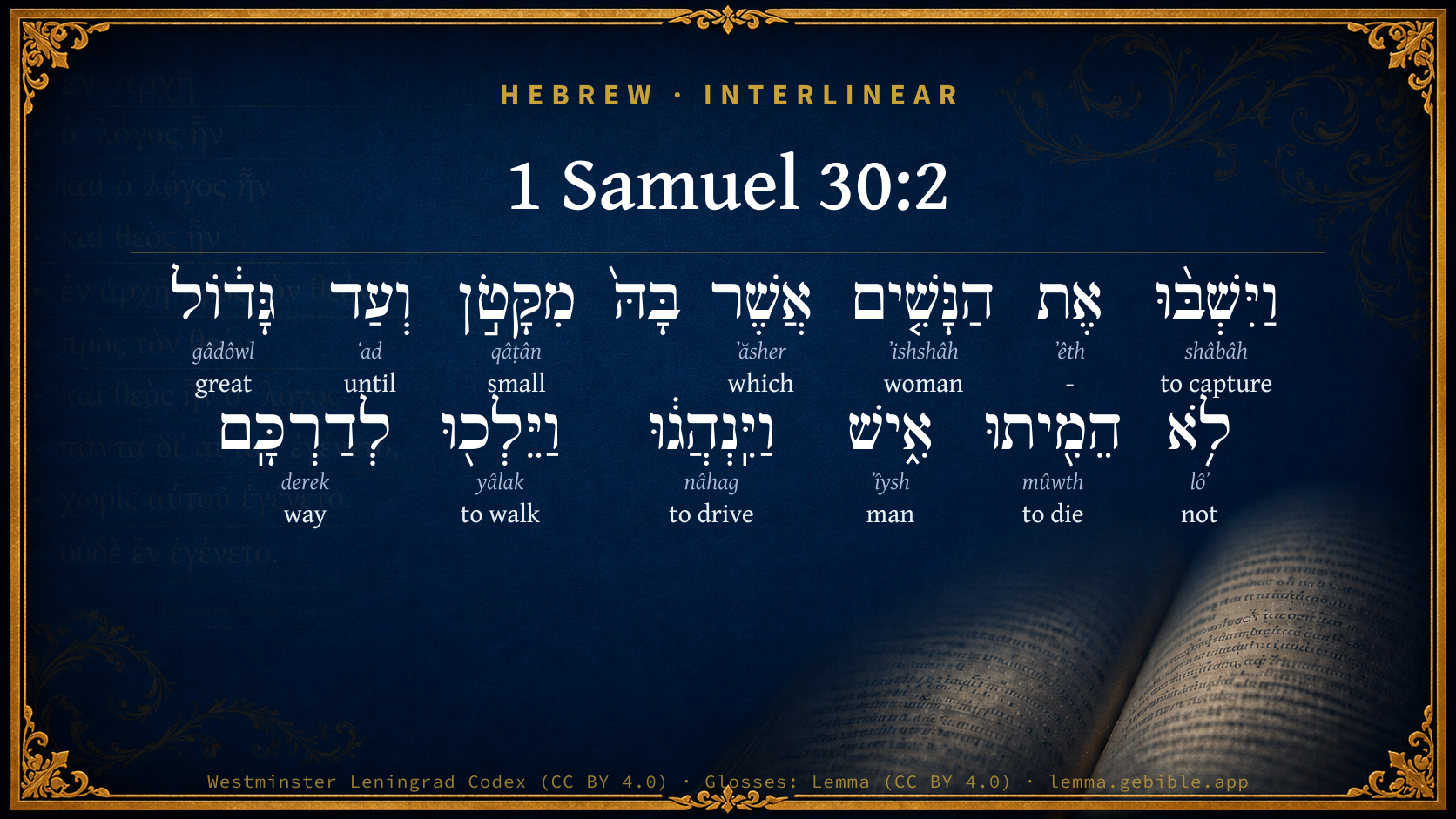
  1. וַיִּשְׁבּ֨וּ shâbâh H7617 “and · to capture” Conjunction + Verb, Qal, Sequential Imperfect, 3rd Person, Masculine, Plural
  2. אֶת ʼêth H853 “-” Particle, Direct Object
  3. הַנָּשִׁ֤ים ʼishshâh H802 “the · women” Particle, Definite Article + Noun, Common, Feminine, Plural, Absolute
  4. אֲשֶׁר ʼăsher H834 “which” Particle, Relative
  5. מִקָּטֹ֣ן qâṭân H6996 “from · small” Preposition + Adjective, Adjective, Masculine, Singular, Absolute
  6. וְעַד ʻad H5704 “and · until” Conjunction + Preposition
  7. גָּד֔וֹל gâdôwl H1419 “great” Adjective, Adjective, Masculine, Singular, Absolute
  8. לֹ֥א lôʼ H3808 “not” Particle, Negative
  9. הֵמִ֖יתוּ mûwth H4191 “to die” Verb, Hiphil, Perfect, 3rd Person, Common, Plural
  10. אִ֑ישׁ ʼîysh H376 “man” Noun, Common, Masculine, Singular, Absolute
  11. וַיֵּלְכ֖וּ yâlak H3212 “and · to walk” Conjunction + Verb, Qal, Sequential Imperfect, 3rd Person, Masculine, Plural
  12. לְדַרְכָּֽם derek H1870 “to/for · way · their” Preposition + Noun, Common, Both, Singular, Construct + Suffix, Personal, 3rd Person, Masculine, Plural

About this verse

These counts appear in no published source. They are computed here, from the morphology-tagged text and Lemma’s own curated glosses. What Lemma adds →

14
words
13
distinct lemmas
Historical
section

Shared distinctive vocabulary

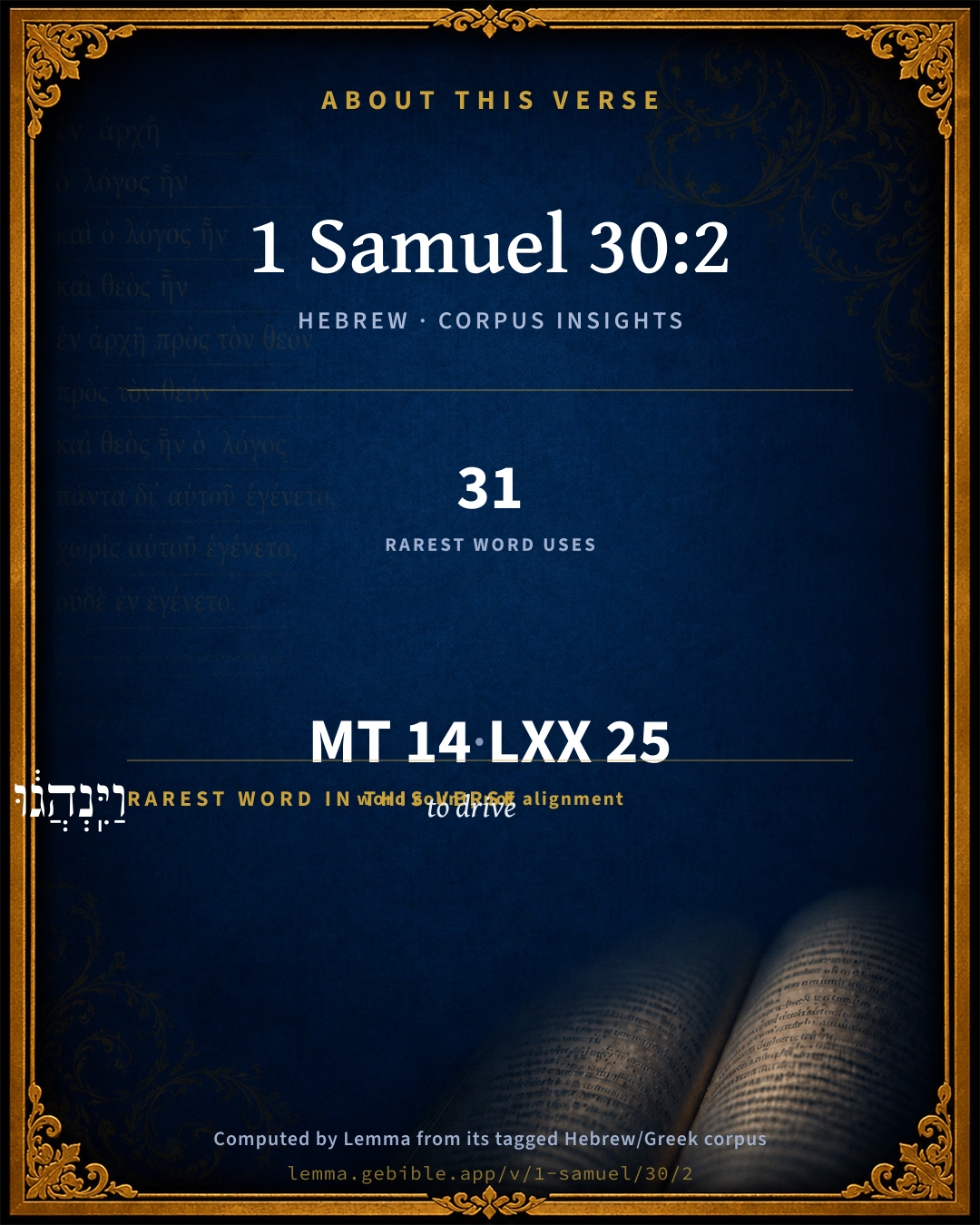
וַיִּֽנְהֲג֔וּ to drive H5090 occurs in 31 verses of the Hebrew Bible. Also found in:

Grammatical profile

  • 4 verbs
  • 3 nouns
  • 2 adjectives
  • 2 prepositions
  • 3 particles

Verb forms

  • וַיִּשְׁבּ֨וּ Qal · Sequential Imperfect
  • הֵמִ֖יתוּ Hiphil · Perfect
  • וַיִּֽנְהֲג֔וּ Qal · Sequential Imperfect
  • וַיֵּלְכ֖וּ Qal · Sequential Imperfect

Hebrew & Septuagint length

In English translation the verse runs 27 words from the Hebrew and 30 from the Septuagint (LXX English) — closely comparable.

A rough comparison of the two English renderings, which tokenize alike — not a word-level alignment.

Word counts can differ between the Hebrew and the Greek without any difference in meaning — e.g. the Hebrew direct-object marker אֵת has no separate Greek word, and Greek often adds the article ὁ.

In the original languages it is 14 Hebrew tokens and 25 Greek tokens — but the two are counted differently (Hebrew bundles its prefixes and suffixes into one token; the Greek is in lemma form), so that isn’t a like-for-like length.

Cross-references

5

Topical passages linked to 1 Samuel 30:2 in the Treasury of Scripture Knowledge — connected by theme and wording, ordered by reader-vote popularity; previews shown in the World English Bible.

  • 1 Samuel 27:11 David saved neither man nor woman alive, to bring them to Gath, saying, Lest they should tell of us, saying, So did David, and so has been his manner all the while he has lived in the country of the Philistines.
  • 1 Samuel 30:19 There was nothing lacking to them, neither small nor great, neither sons nor daughters, neither spoil, nor anything that they had taken to them: David brought back all.
  • Job 38:11 And said, 'Here you may come, but no further; Here shall your proud waves be stayed?'
  • Psalms 76:10 Surely the wrath of man praises you. The survivors of your wrath are restrained.
  • Isaiah 27:8–9 In measure, when you send them away, you do contend with them; he has removed [them] with his rough blast in the day of the east wind.

Cross-references courtesy of OpenBible.info (CC BY 4.0).

Hebrew and Greek witnesses Masoretic Hebrew ↔ Greek Septuagint

The same verse in the two great witnesses to the Old Testament, shown verse-for-verse.

These are two independent witnesses, not word-aligned to each other, and the Septuagint is shown in lemma (dictionary) form.

Hebrew 1 Samuel 30:2 Masoretic · Westminster Leningrad Codex

וַיִּשְׁבּ֨וּ אֶת הַנָּשִׁ֤ים אֲשֶׁר בָּהּ֙ מִקָּטֹ֣ן וְעַד גָּד֔וֹל לֹ֥א הֵמִ֖יתוּ אִ֑ישׁ וַיִּֽנְהֲג֔וּ וַיֵּלְכ֖וּ לְדַרְכָּֽם

and had taken captive the women [and all] who were therein, both small and great: they didn't kill any, but carried them off, and went their way.

World English Bible · Public Domain

Greek LXX 1 Samuel 30:2 Septuagint · lemma form

καί ὁ γυνή καί πᾶς ὁ ἐν αὐτός ἀπό μικρός ἕως μέγας οὐ θανατόω ἀνήρ καί γυνή ἀλλά αἰχμαλωτεύω καί ἀποἔρχομαι εἰς ὁ ὁδός αὐτός

And as to the women and all things that were in it, great and small, they killed neither man nor woman, but carried them captives, and went on their way.

LXX2012 (modern English Septuagint) · Public Domain

Hebrew: Westminster Leningrad Codex (CC BY 4.0). Greek: Septuagint (public domain); English from LXX2012 (modern English Septuagint) (Public Domain). How the Septuagint differs from the Hebrew →

Targum (Aramaic paraphrase)

1

The Targum is the ancient Jewish Aramaic paraphrase of the Hebrew Scriptures — an interpretive translation, not the Hebrew text itself. Onkelos (literal) and Pseudo-Jonathan (expansive) render the Torah, and Jonathan the Prophets. Coverage is partial: where no permissively-licensed English translation exists for a verse, only the Aramaic is shown. This is verse-level text, not a word-by-word alignment to the Hebrew.

  1. Targum Jonathan Prophets (Joshua–Malachi)
    וּשְׁבוֹ יָת נְשַׁיָא דִי בָהּ מִזְעֵירָא וְעַד רַבָּא וְלָא קָטְלוּ אֱנַשׁ וּדְבָרוּ וַאֲזַלוּ לְאוֹרְחֵיהוֹן:

    (no public-domain English translation for this verse)

    Targum Jonathan — Aramaic: “Mikraot Gedolot” (public domain). English: “Sefaria Community Translation” (CC0 1.0 (public-domain dedication)); “London "Chaldee Paraphrase," 1871” (public domain). Text via Sefaria.

Commentary

Notes on 1 Samuel 30:2 from classic Christian and Jewish commentators (each source and its license shown beneath its notes). The classic Christian expositions comment on the surrounding passage and are grouped to its opening verse, so a note may address several verses; the Jewish commentaries on the Tanakh (Rashi and others) are per-verse, so they appear only where the commentator wrote on this verse.

Lemma curates 59 commentaries, every one of them public domain or Creative Commons licensed, each selected and text-cleaned for this edition rather than reprinted as found. About our sources →

Trapp's Complete Commentary

John Trapp

1Sa 30:2 And had taken the women captives, that [were] therein: they slew not any, either great or small, but carried [them] away, and went on their way.

Ver. 2. And had taken the women captives.] Perhaps out of covetousness to make prize of them. This is likewise the practice of seducers. {2Ti 3:6 2Pe 2:3} Egregiam vero laudem! &c.

They slew not any, either great or small] By God’s restraint they took up with an unbloody revenge; while David, roving against the Amalekites not many days before, left neither man nor woman alive.

John Trapp, A Commentary or Exposition upon All the Books of the Old and New Testament (1647–1656) — public domain. Text from a community e-Sword module.

Tyndale Open Study Notes

Tyndale Open Resources

30:2 There were no fighting men left in Ziklag to protect the women and children. The Amalekites had a reputation for preying on the weak and vulnerable (see Deut 25:17-18). • without killing anyone: The Amalekites were not being compassionate; women and children were more useful alive than dead.

Tyndale Open Study Notes — © Tyndale Open Resources, licensed CC BY-SA 4.0. Text via the HelloAO Bible API.

Jamieson, Fausset & Brown

Robert Jamieson, A. R. Fausset & David Brown

they slew not any, either great or small, but carried them away--Their conduct seems to stand in favorable contrast to that of David (Sa1 27:11). But their apparent clemency did not arise from humane considerations. It is traceable to the ancient war usages of the East, where the men of war, on the capture of a city, were unsparingly put to death, but there were no warriors in Ziklag at the time. The women and boys were reserved for slaves, and the old people were spared out of respect to age.

Jamieson, Fausset & Brown — Commentary Critical and Explanatory on the Whole Bible (1871) — public domain (CC PDM 1.0). Text via the HelloAO Bible API.

Ellicott's Commentary for English Readers

(2) They slew not any.—There was no one in the hapless city to resist the attack of the fierce sons of the desert. David—never dreaming of the sudden invasion—had marched with Achish, accompanied by his whole force. The Amalekites slew none of their captives; they were, we read, women and children. These possessed a marketable value, and were carried off to be sold into slavery, probably in Egypt, with which country the Amalekites, as neighbours, had constant dealings. We read a few verses on specially of an Egyptian slave in the army.

A Bible Commentary for English Readers, edited by Charles John Ellicott (1878–1897) — public domain. Text from a community e-Sword module.

John Gill's Exposition

And had taken the women captives, that were therein,.... There being no other to take, the men were gone with David:

they slew not any, either great or small; that is, of the women, whether married or unmarried, old, or maidens, or children; which was very much, since David destroyed all that came within his reach, men and women, when he invaded them, Sa1 27:9; but perhaps this was not owing to their humanity, but to their covetousness, designing to make an advantage of them by selling them for slaves; no doubt they were restrained by the providence of God:

but carried them away, and went on their way; homewards with their captives.

John Gill's Exposition of the Whole Bible (1746–1763) — public domain (CC PDM 1.0). Text via the HelloAO Bible API.

Matthew Poole's English Annotations

They slew not any; which was strange, considering how David dealt with them, 1Sa 27:9. But this must be ascribed partly to their selfish or fleshly interest; for they might reserve them, either to make sale of them for their profit, or to abuse them for their lust; or, it may be, to revenge themselves upon David and his men, by reserving them to extraordinary, and lingering, and repeated punishments; but principally to God’s overruling and wonderful providence, who set these bounds to their rage; and though he designed to chastise David’s sin and folly, yet would not deliver him nor his up to death.

Matthew Poole's English Annotations on the Holy Bible (1683–1685) — public domain. Text from a community e-Sword/MySword module.

Whedon's Commentary on the Bible

Daniel D. Whedon

2. Taken the women captives — The men were all absent with David, but the wives and children (see 1Sa_27:3, and note) remained in Ziklag. Upon finding the town burned and their wives and children gone, David and his men probably thought first of all that plunderers from the south had been wreaking vengeance for David’s late conquests in that country, and had every reason to suppose that their families had been massacred.

Daniel D. Whedon (gen. ed.), Commentary on the Old and New Testaments (1874–1909) — public domain. Text from a community e-Sword module.

The Pulpit Commentary

Vers. 2-5. They slew not any. No resistance was made, as the men of war were all away. It was probably for thus leaving their wives and families absolutely defenceless that David"s people were so angry with him. As we are told in 1Sa_27:3 that the refugees with David had brought each his household with him into the Philistine territory, the number of women must have been large. The Amalekites spared their lives, not because they were more merciful than David, but because women and children were valuable as slaves. All the best would be picked out, and sent probably to Egypt for sale.

The Pulpit Commentary (1880–1919), ed. H.D.M. Spence-Jones & Joseph S. Exell — public domain. Text from a community e-Sword module.

Lesson kit

Teaching starters — assembled from the data on this page, not authored interpretation. Every prompt links to the verse data it draws on. Edit before teaching.

1 Samuel, in the Historical, opens this verse with 14 words (13 distinct Hebrew lemmas). Its most distinctive word is nâhag (“to drive”). A historical commentator’s framing appears above. Read the whole chapter for the surrounding context.

Discussion questions

  1. How does “to drive” (nâhag) shape what this verse is saying?
  2. How does Genesis 31:18, which shares the word «to drive», read alongside this verse?
  3. These translations render this verse differently. What is at stake in choosing one wording over another?
  4. «וַיִּשְׁבּ֨וּ» is a Qal Sequential Imperfect verb. How does that grammatical form shape the action described?
  5. Compare how Trapp's Complete Commentary and Tyndale Open Study Notes read this verse. Where do they agree or differ?

Things to notice

Reading settings

Reading text

Shown beneath each verse's original-language words.

Old Testament
Old Testament edition

Read the OT as the Masoretic Hebrew (MT) or the Greek Septuagint (LXX).

English shown for the Greek Septuagint (in the Hebrew ↔ Greek comparison).

Comparing translations? Open the Compare panel on any verse page to stack up to four side by side.