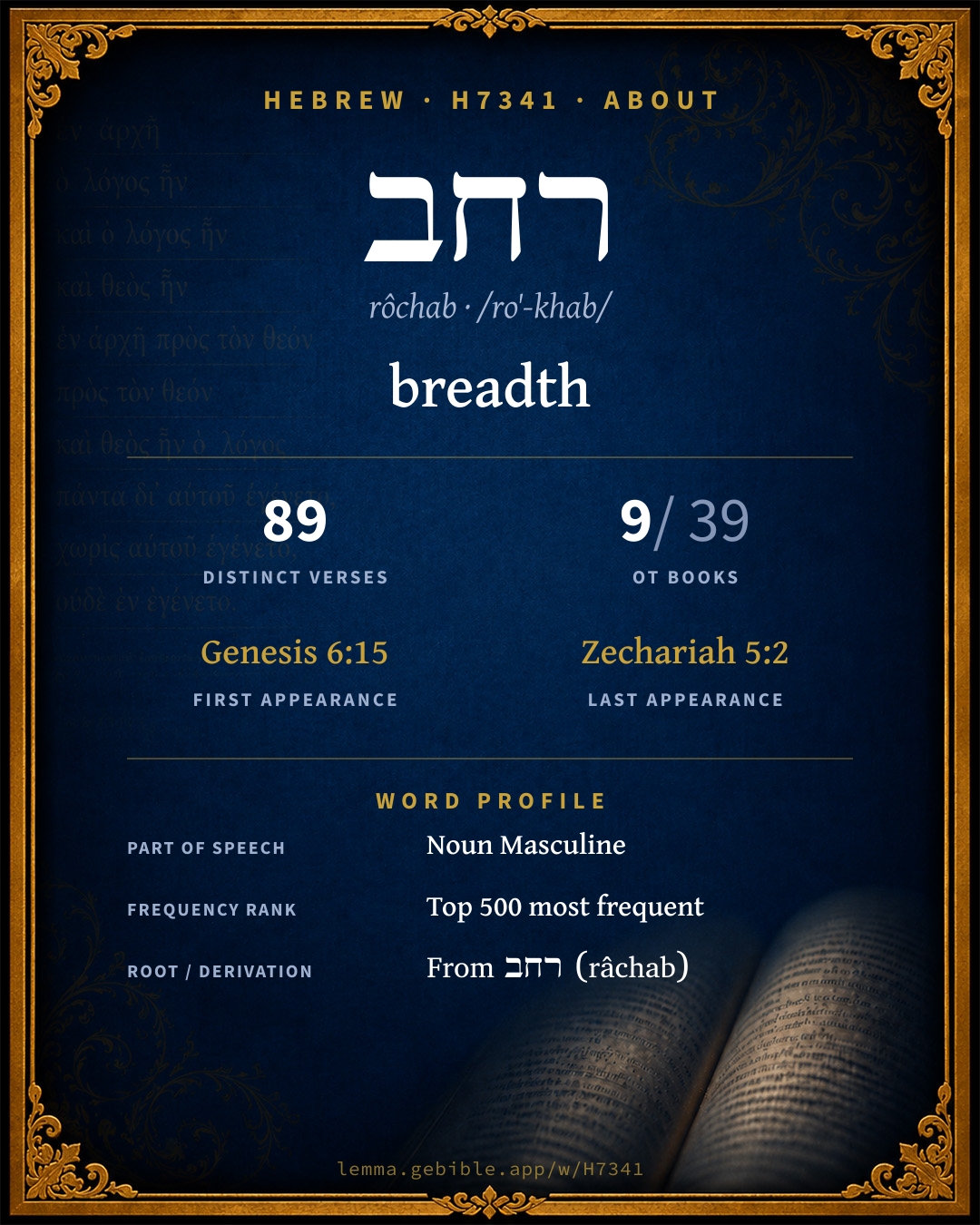
רֹ֫חַב
breadth
Full lexicon entry — Brown-Driver-Briggs (BDB)
From Brown-Driver-Briggs (BDB)
Where this word appears
See every Construct-state word in the Hebrew Bible →
Grammar key — what these labels mean
Part of speech
- Noun
- A naming word — a person, place, thing, or idea.
Noun type
- Common
- A common noun — a general class of person, place, or thing (“king,” “city,” “water”), not a specific name.
State
- Absolute
- The independent form of a noun, not bound to a following word.
- Construct
- A noun bound to a following noun in a possessive / “of” relationship (the construct chain).
Gender
- Masculine
- Grammatically masculine.
Number
- Singular
- One.
16 verses where H7341 appears in the Construct state in the Book of Exodus. Filtered view — show all forms. Click any verse to open its interlinear word-by-word view. Verse text shown in the World English Bible for context — . Each verse’s Hebrew form is shown with its reference; the English is not keyword-highlighted, since the data carries no word-level English alignment. Use “Compare translations” on any verse to read it across multiple English versions. This concordance covers the Hebrew Bible; Septuagint (Greek Old Testament) occurrences are not indexed here.
Exodus
- Exodus 25:10 רָחְבּ֔/וֹ n c ms cs + sfx pers 3ms "They shall make an ark of acacia wood. Its length shall be two and a half cubits, its breadth a cubit and a half, and a cubit and a half its height.
- Exodus 25:17 רָחְבָּֽ/הּ n c ms cs + sfx pers 3fs You shall make a mercy seat of pure gold. Two and a half cubits shall be its length, and a cubit and a half its breadth.
- Exodus 25:23 רָחְבּ֔/וֹ n c ms cs + sfx pers 3ms "You shall make a table of acacia wood. Two cubits shall be its length, and a cubit its breadth, and one and a half cubits its height.
- Exodus 26:16 רֹ֖חַב n c ms cs Ten cubits shall be the length of a board, and one and a half cubits the breadth of each board.
- Exodus 27:12 וְ/רֹ֤חַב conj + n c ms cs For the breadth of the court on the west side shall be hangings of fifty cubits; their pillars ten, and their sockets ten.
- Exodus 27:13 וְ/רֹ֣חַב conj + n c ms cs The breadth of the court on the east side eastward shall be fifty cubits.
- Exodus 28:16 רָחְבּֽ/וֹ n c ms cs + sfx pers 3ms It shall be square and folded double; a span shall be its length of it, and a span its breadth.
- Exodus 30:2 רָחְבּ/וֹ֙ n c ms cs + sfx pers 3ms Its length shall be a cubit, and its breadth a cubit. It shall be square, and its height shall be two cubits. Its horns shall be of one piece with it.
- Exodus 36:15 רֹ֖חַב n c ms cs The length of each curtain was thirty cubits, and four cubits the breadth of each curtain. The eleven curtains had one measure.
- Exodus 36:21 רֹ֖חַב n c ms cs Ten cubits was the length of a board, and a cubit and a half the breadth of each board.
- Exodus 37:1 רָחְבּ֔/וֹ n c ms cs + sfx pers 3ms Bezalel made the ark of acacia wood. Its length was two and a half cubits, and its breadth a cubit and a half, and a cubit and a half its height.
- Exodus 37:6 רָחְבָּֽ/הּ n c ms cs + sfx pers 3fs He made a mercy seat of pure gold. Its length was two and a half cubits, and a cubit and a half its breadth.
- Exodus 37:10 רָחְבּ֔/וֹ n c ms cs + sfx pers 3ms He made the table of acacia wood. Its length was two cubits, and its breadth was a cubit, and its height was a cubit and a half.
- Exodus 37:25 רָחְבּ֜/וֹ n c ms cs + sfx pers 3ms He made the altar of incense of acacia wood. It was square: its length was a cubit, and its breadth a cubit. Its height was two cubits. Its horns were of one piece with it.
- Exodus 38:1 רָחְבּ/וֹ֙ n c ms cs + sfx pers 3ms He made the altar of burnt offering of acacia wood. It was square. Its length was five cubits, its breadth was five cubits, and its height was three cubits.
- Exodus 39:9 רָחְבּ֖/וֹ n c ms cs + sfx pers 3ms It was square. They made the breastplate double. Its length was a span, and its breadth a span, being double.
About this entry
At a glance — auto-summarized from this page’s data, not written by a person. Every figure links to its source below. This summary describes the numbers; it doesn’t interpret them.
At its core, רחב (rôchab) means “breadth.” Its uses cluster heavily in Ezekiel (53% of all occurrences). With 89 verses in 9 books, it is a moderately common word in the Hebrew Bible. First canonically at Genesis 6:15, it enters the text early. Translators differ — “breadth” in the King James Version, then “wide” (Berean Standard Bible) and “width” (unfoldingWord Literal Text), as the renderings breakdown shows. Each statement above links to its evidence; the full detail follows below.
Gloss history
Strong's 1890 vs modern scholarship
About this word
Strong's H7341 catalogs a Hebrew word from the Hebrew Old Testament.
These counts are not copied from any lexicon or concordance. They are computed here, from the morphology-tagged Hebrew Old Testament. What Lemma adds →
- 89
- distinct verses
- The word appears in 89 distinct verses.
- 9 / 39
- OT books
- The word appears in 9 of 39 Old Testament books.
- #421
- by frequency
- Top 500 most frequent Hebrew words (rank 421 of 8,640 Hebrew words by occurrence).
View all 89 occurrences in the concordance →
By section of the Old Testament
By traditional corpus
Conventional, traditional groupings — biblical authorship is debated, so this is a traditional corpus grouping, not an authorship claim. Each share is this word’s portion of its verses in that division of the Hebrew canon. Each figure is a share of the word’s 89 distinct verses.
- Prophets (Nevi'im) 58 verses · 65%
- Torah (Pentateuch) 25 verses · 28%
- Writings (Ketuvim) 6 verses · 7%
How translations render this word
Counts come from each version’s own published word-to-Strong’s tagging or interlinear alignment — an approximate guide to how each version renders this word, not a word-level alignment the data otherwise carries. Because each total is that version’s own tagged count, the per-version totals vary from one another and need not match the appearance or distinct-verse counts above. These counts may also differ from a printed concordance because Lemma counts each distinctly tagged rendering and does not collapse phrase taggings into a single head-word total. This is a fixed set of word-tagged versions (KJV, ASV, BSB, ULT) and does not change with the reading translation you choose elsewhere. Each version’s license is shown beside its name below (and on Sources).
- King James Version: Breadth 60×, Broad 21×, Was the breadth 3×
- American Standard Version: Breadth 53×, Broad 20×, Cubit the breadth 4×
- Berean Standard Bible: Wide 65×, Width 14×, Deep 3×
- unfoldingWord Literal Text: Width 62×, Width of 11×, Was its width 7×
King James Version Public Domain
Renders H7341 across 100 tagged occurrences — most commonly:
Plus 14 renderings that appear only once — usually multi-word phrases or single function words the recovered tagging swept in, not distinct renderings. Not rendered by a distinct English word in 1 further occurrence.
American Standard Version Public Domain
Renders H7341 across 99 tagged occurrences — most commonly:
Plus 16 renderings that appear only once — usually multi-word phrases or single function words the recovered tagging swept in, not distinct renderings.
Berean Standard Bible Public Domain
Renders H7341 across 95 tagged occurrences — most commonly:
Plus 10 renderings that appear only once — usually multi-word phrases or single function words the recovered tagging swept in, not distinct renderings. Not rendered by a distinct English word in 6 further occurrences.
unfoldingWord Literal Text CC BY-SA 4.0
Renders H7341 across 109 tagged occurrences — most commonly:
Plus 8 renderings that appear only once — usually multi-word phrases or single function words the recovered tagging swept in, not distinct renderings.
Senses in BDB
The 1 sense BDB distinguishes for this word, in lexicon order (not ranked by frequency or importance). The full entry — with sub-senses — is in the Lexicon Entry tab.
- breadth, width, expanse
Word origin
n.[m.] breadth, width;—ר׳ abs. Ez 42:2 +, cstr. 1 K 6:3 +; sf. רָחְבּוֹ Ex 25:10 +, -בָּהּ Gn 6:15 +, רָחְבָּן Ez 42:11;—breadth, of land, + אֹרֶךְ = whole extent, expanse, Gn 13:17 (J), so ר׳ alone Is 8:8; ר׳ מַיִם Jb 37:10; fig. ר׳ לֵב largeness of understanding (like sand of sea-shore) 1 K 5:9; breadth, = thickness, of wall גֶּדֶר Ez 42:10; elsewhere only in measurements width, breadth (Dt 3:11, K 10 times, Ez 54 times, Zc 2:6; 5:2, P 23 times, Ch 6 times; ‖ אֹרֶךְ 1 K 7:6 + 63 times, + קוֹמָה 6:2 + 14 times, + גֹּבַהּ † Ez 40:42; 2 Ch 3:4; ‖ קוֹמָה alone † 1 K 7:27; Ez 40:5): of buildings, etc., 1 K 6:2, 3(×2), 6(×3) +, Ez 41:1(×3), 5, 7 +, altar Ex 27:1 = 38:1, ark, תֵּבָה, Gn 6:15, אָרוֹן Ex 25:10 = 37:1, etc.; of area, the עֶרֶשׂ of Og Dt 3:11, the תְּרוּמָה of land Ez 45:1, 3, 5, 6 +, of court Ex 27:12, 13, 18; of city Zc 2:6; of roll 5:2; of curtain Ex 26:2, 8 +, etc.; of wall (קִיד), = thickness, Ez 41:9, 12 (cf. 42:10 supr.); of doorway 40:11; 41:2, 3, etc.
— Brown-Driver-Briggs (Oxford 1906, public domain), digitized via Sefaria, supplemented by the OpenScriptures HebrewLexicon (CC BY 4.0). See Sources.
Derived from רחב (râchab) (H7337) — to grow wide.
Jastrow Dictionary
A second Hebrew/Aramaic lexicon for comparison, covering Aramaic and post-biblical (Talmudic, Targumic, Midrashic) usage that the biblical-Hebrew BDB does not. Matched by lemma rather than by Strong’s number, so a lemma may carry more than one Jastrow headword (shown separately below), and the entries cover usage well beyond the Bible.
רָחָב I
- (b. h.) pr. n. f. Rahab, a woman of Jericho who received the Israelitish spies. Zeb. 116ᵃ, sq. Sot. 34ᵃ. Meg. 15ᵃ; Taan. 5ᵇ; a. fr.
רָחַב
- (b. h.) to be wide.
- 1. (neut. verb) (neut. verb) to widen, be broader; to extend. Lev. R. s. 31 היו מקטינות … ומַרְחִיבוֹת וכ׳ (the windows of the Temple) became narrow towards the inside and wider towards the outside, in order to send light forth to the world; Pesik. Ḳumi, p. 145ᵃ, sq. Sifré Deut. s. 1; Yalk. Zech. 575 מַרְחֶבֶת, v. infra. Yalk. Is. 302, v. פָּתָה.
- 2. to broaden, widen; (with דעת) to comfort, gratify. Ber. 57ᵇ שלשה מַרְחִיבִין דעתו וכ׳ three things give a man comfort: a nice dwelling &c.
- 3. to amplify. B. Bath. 61ᵇ, v. מֵצַר.
- to be enlarged, extend. Cant. R. to VII, 5 עתידה … מִתְרַחֶבֶת וכ׳ Jerusalem will be enlarged on all sides; Sifré l. c.; Yalk. Zech. l. c. מרחבת.
רָחָב II
- preced.) wide, broad. Midd. IV, 7 מה ארי צר … ור׳ מלפניו וכ׳ (not ורוחב) as the lion’s body is narrow behind and wide in front, so was the Temple &c.; a. fr.—נפש ר׳ (wide desire,) ambition, greed, opp. שפלה. Ab. V, 19; a. e.—יד ר׳, v. יָד.—Pl. רְחָבִים, רְחָבִין; רְחָבוֹת. Tanḥ. B’haʿăl. 5 שהיו ר׳ מבחוץ וכ׳ they (the Temple windows) were wide without &c., v. preced.; Tanḥ. T’tsav. 6; Num. R. s. 15, beg. Y. Sot. IX, 24ᵃ bot., v. צַר; a. fr.
רְחַב
- , esp. (with or sub. נפשא) ambitious, greedy. Targ. Prov. XXVIII, 25 גברא ר׳ (Bxt. ר׳ נפשא; Ms. רעיינא, read: רחב עיינא or רחב רעיינא).
רֹחַב
- preced. wds.) width. Midd. II, 6 אורך … על ר׳ וכ׳ one hundred and twenty-five cubits in length by eleven in width. Ib. IV, 1 ורָחְבּוֹ וכ׳ and its width was ten cubits. Tam. 29ᵇ; Shek. VIII, 5 ורָחְבָּהּ; a. fr.—Sifré Deut. 120 בר׳ יד with liberality.
A Dictionary of the Targumim, the Talmud Babli and Yerushalmi, and the Midrashic Literature (Marcus Jastrow; London, Luzac, 1903) — Public Domain. Digitized via Sefaria. Digitized via Sefaria. Full attribution on Sources.
Forms in the corpus
The 42 distinct written forms H7341 takes in the Hebrew Bible, most frequent first — each parse links to that state’s occurrences in the concordance. Hebrew forms include their vowel points and cantillation, so a single lemma takes many written forms.
Same root — word family
Other BDB entries built from the same root as H7341, grouped by Strong’s listed origin. These share a root / origin per the lexicon — not necessarily a shared meaning. Each links to that word’s own entry.
Derives from
Shares the same root
Proper names from this root
People and places named from this root — a name, not an additional meaning of the word.
Compare all same-root words → Showing 4 of 8 — not the complete family. 2 of the same-root words are proper names (people or places). They share a root, not necessarily a meaning.
Septuagint verse parallels
This word appears in 86 verses that also exist in the Greek Old Testament (Septuagint), out of the 89 Hebrew verses it occurs in. You can read those verses in Greek by switching the Old Testament edition to the Septuagint.
Read these verses in the Septuagint
- Genesis 6:15
- Exodus 25:10
- Deuteronomy 3:11
- 1 Kings 6:2
- 2 Chronicles 3:3
- Job 37:10
- Isaiah 8:8
- Ezekiel 40:5
- Zechariah 2:2
This is a verse-level parallel only — the same verses exist in both the Hebrew and Greek Old Testaments. No word-level Hebrew↔Greek correspondence is claimed: the data carries no such alignment, so no Greek word is shown as this Hebrew word’s translation. Coverage is not total — the Septuagint omits the deuterocanon and renumbers the Psalms, so some Hebrew verses have no direct Greek parallel.