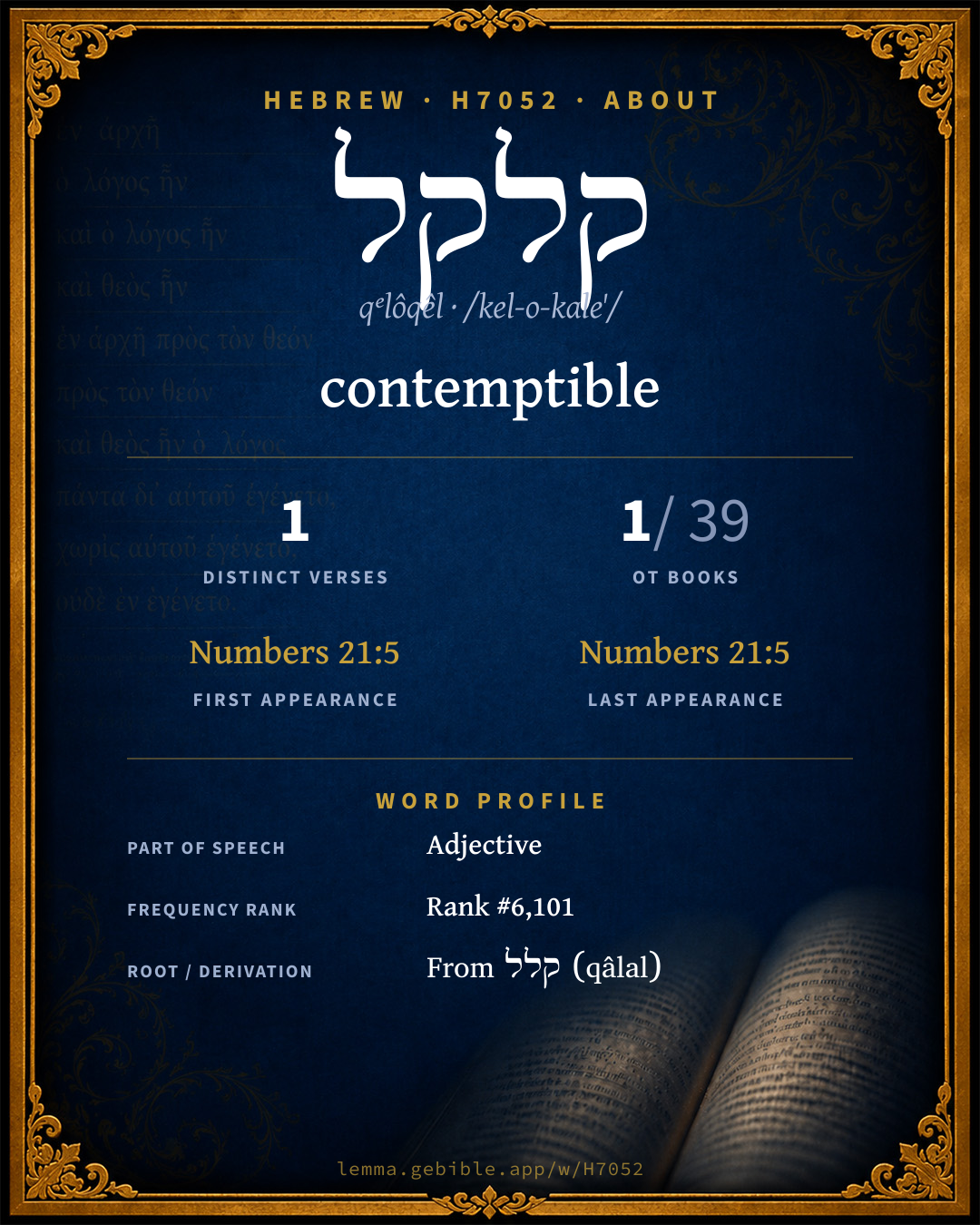
קְלֹקֵל
contemptible
Full lexicon entry — Brown-Driver-Briggs (BDB)
From Brown-Driver-Briggs (BDB)
Where this word appears
Grammar key — what these labels mean
State
- Absolute
- The independent form of a noun, not bound to a following word.
Gender
- Masculine
- Grammatically masculine.
Number
- Singular
- One.
Every verse where H7052 appears — 1 distinct verse across 1 book. Click any verse to open its interlinear word-by-word view. Verse text shown in the World English Bible for context — . Each verse’s Hebrew form is shown with its reference; the English is not keyword-highlighted, since the data carries no word-level English alignment. Use “Compare translations” on any verse to read it across multiple English versions. This concordance covers the Hebrew Bible; Septuagint (Greek Old Testament) occurrences are not indexed here.
Numbers 1 verse
About this entry
At a glance — auto-summarized from this page’s data, not written by a person. Every figure links to its source below. This summary describes the numbers; it doesn’t interpret them.
“contemptible” is the headline sense of the Hebrew adjective קלקל (qᵉlôqêl). It is rare — just 1 verse in the entire Hebrew Bible. More than three-quarters of its appearances fall in Numbers. Found nowhere else but Numbers 21:5. It shares a root with קלל, קל and קלל. See the sense tree, 1-verse concordance, and the renderings breakdown below.
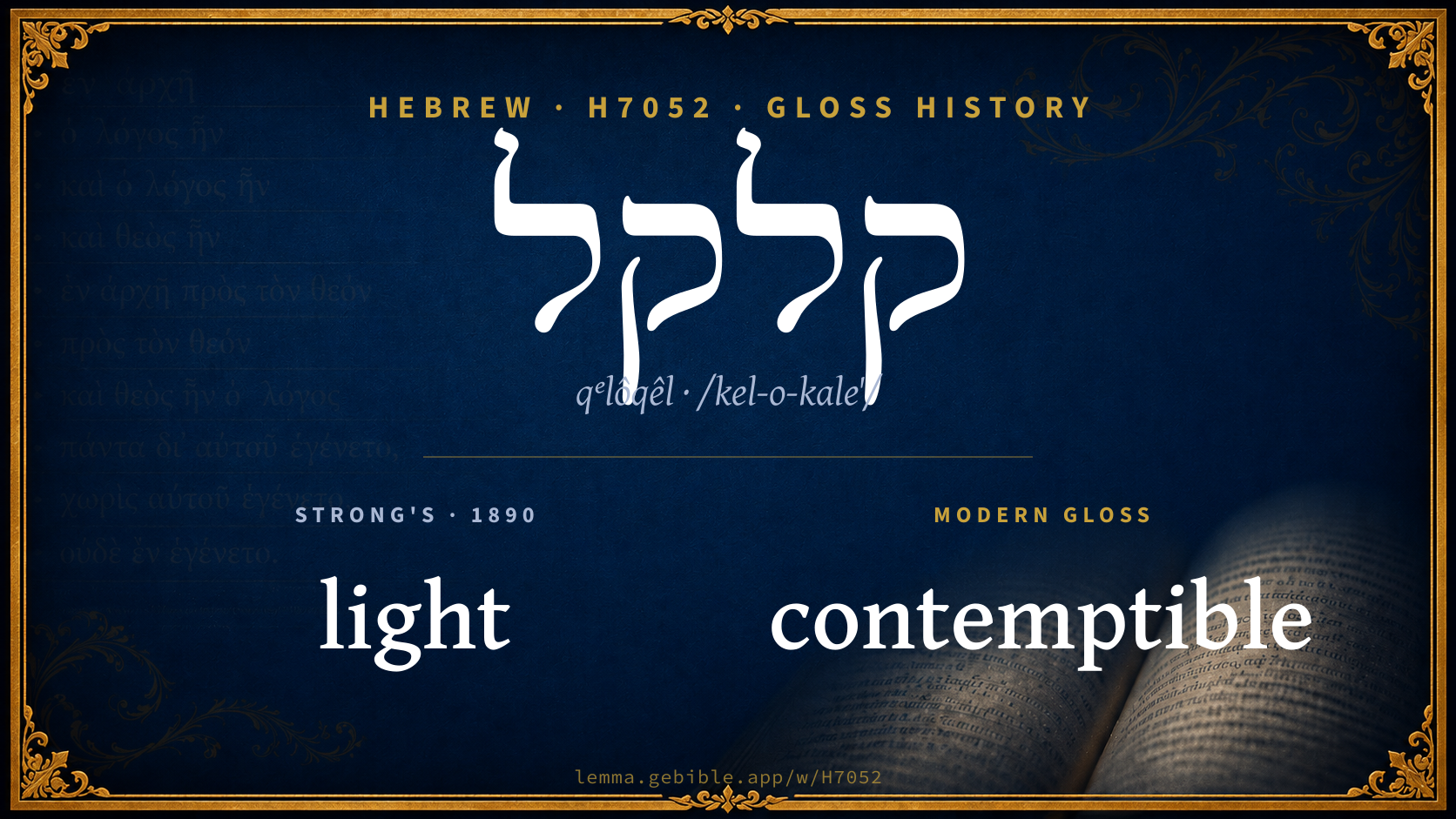
Gloss history
Strong's 1890 vs modern scholarship
About this word
Strong's H7052 catalogs a Hebrew word from the Hebrew Old Testament.
These counts are not copied from any lexicon or concordance. They are computed here, from the morphology-tagged Hebrew Old Testament. What Lemma adds →
- 1
- distinct verses
- The word appears in 1 distinct verse.
- 1 / 39
- OT books
- The word appears in 1 of 39 Old Testament books.
- #6,101
- by frequency
- Rank #6,101 (rank 6,101 of 8,640 Hebrew words by occurrence).
View all 1 occurrence in the concordance →
Most concentrated in
- Numbers 1 verse 100%
By section of the Old Testament
By traditional corpus
Conventional, traditional groupings — biblical authorship is debated, so this is a traditional corpus grouping, not an authorship claim. Each share is this word’s portion of its verses in that division of the Hebrew canon. Each figure is a share of the word’s 1 distinct verse.
- Torah (Pentateuch) 1 verse · 100%
How translations render this word
Counts come from each version’s own published word-to-Strong’s tagging or interlinear alignment — an approximate guide to how each version renders this word, not a word-level alignment the data otherwise carries. Because each total is that version’s own tagged count, the per-version totals vary from one another and need not match the appearance or distinct-verse counts above. These counts may also differ from a printed concordance because Lemma counts each distinctly tagged rendering and does not collapse phrase taggings into a single head-word total. This is a fixed set of word-tagged versions (KJV, ASV, BSB, ULT) and does not change with the reading translation you choose elsewhere. Each version’s license is shown beside its name below (and on Sources).
- King James Version: Light 1×
- American Standard Version: Light 1×
- Berean Standard Bible: Wretched 1×
- unfoldingWord Literal Text: Worthless 1×
King James Version Public Domain
Renders H7052 across 1 tagged occurrence — most commonly:
American Standard Version Public Domain
Renders H7052 across 1 tagged occurrence — most commonly:
Berean Standard Bible Public Domain
Renders H7052 across 1 tagged occurrence — most commonly:
unfoldingWord Literal Text CC BY-SA 4.0
Renders H7052 across 1 tagged occurrence — most commonly:
Senses in BDB
The 1 sense BDB distinguishes for this word, in lexicon order (not ranked by frequency or importance). The full entry — with sub-senses — is in the Lexicon Entry tab.
- contemptible, worthless
Word origin
קְלֹקֵל adj. contemptible, worthless;— Nu 21:5 (J E).
— Brown-Driver-Briggs (Oxford 1906, public domain), digitized via Sefaria, supplemented by the OpenScriptures HebrewLexicon (CC BY 4.0). See Sources.
Derived from קלל (qâlal) (H7043) — to be light.
Jastrow Dictionary
A second Hebrew/Aramaic lexicon for comparison, covering Aramaic and post-biblical (Talmudic, Targumic, Midrashic) usage that the biblical-Hebrew BDB does not. Matched by lemma rather than by Strong’s number, so a lemma may carry more than one Jastrow headword (shown separately below), and the entries cover usage well beyond the Bible.
קִלְקֵל
- (קָלַל, cmp. קְלַק)
- 1. to upset, disarrange, damage, ruin, opp. תקן. Gen. R. s. 98 ק׳ את היצועין upset the couches. Ḥull. 8ᵃ מותר … מְקַלְקֵל הוא it is permitted to slaughter with a knife belonging to idolatrous service, because slaughtering is doing damage (a living animal being more useful than a dead one). Sabb. XIII, 3 כל המְקַלְקְלִין פטורין all those who perform an act (on the Sabbath) by which they do ruin, are exempt (from sin-offering); והמקלקל ע"מ לתקן וכ׳ but he that undoes a thing for the purpose of reconstructing it is guilty. Keth. 5ᵇ; a. fr.
- 2. (with or sub. מעשה = b. h. הִשְׁחִית) to be corrupt, to disgrace one’s self by immorality. Y. Taan. I, end, 64ᵈ חם … קִילְקְלוּ מעשיהן Ham, the dog, and the raven acted mischievously (by sexual connection in the ark, v. Snh. 108ᵇ; Gen. R. s. 36). R. Hash. 12ᵃ ברותחין קלקלו וכ׳ with heat (of passion) they sinned, and with hot waters they were punished; Snh. 108ᵇ. Tosef. Sot. II, 2 אפי׳ תְקַלְקֵל וכ׳, v. עָרַר; a. fr.—[Midr. Till. to Ps. VII, ed. Bub. note 69 קלקלתי, v. כִּלְכֵּל.]—Part. pass. מְקוּלְקָל; f. מְקוּלְקֶלֶת; pl. מְקוּלְקָלִים, מְקוּלְקָלִין; מְקוּלְקָלוֹת. M. Kat. I, 2 (2ᵃ) ומתקנין את המקולקלת Y. a. Bab. ed. (Mish. המקולקלות, incorr.) and you may mend a channel that is out of order during the festive week. Snh. 39ᵇ (ref. to Ez. V, 7) כמתוקנין … כמק׳ שבהם עשיתן you did not do according to the good usages among them, but according to their corrupt usages. B. Bath. 109ᵇ, v. קַלְקָלָה; a. fr. e.g. Ezekiel 5:7
- 3. (b. h.) to sharpen; trnsf. (cmp. חָדַד, שָׁנַן) to repeat, study. Koh. R. to X, 10 אם נקהה … קַלְקֵל עליו בחילך if thy lesson is as tough to thee as iron (v. קָהָה), and … none is on hand to explain it to thee, go over it studying with thy own strength.
- 1. to be disarranged, ruined, spoiled. Y. Taan. IV, 68ᶜ bot. נִתְקַלְקְלוּ חשבונותיו וכ׳ his dates were disarranged, and he said, let this begin a new era; נתקלקלו לשעבר the dates were disarranged (confused) with regard to the events of the past, v. קִילְקוּל. Dem. III, 6, v. חָלַף. Y. Shek. VII, 50ᶜ נִתְקַלְקְלָה צורתן (not נתקלקה), v. צוּרָה; a. e.
- 2. (v. קָלָה I) to commit a nuisance, to collapse under the influence of corporal punishment. Sifré Deut. 286; Macc. III, 14; a. e.—[Bekh. 8ᵃ נתקלקל, v. קָלַל.]
קַלְקֵל
- to ruin &c. Targ. Is. III, 12 (h. text בלע). Targ. Jer. II, 36 (h. text שנה). Targ. II Sam. XV, 31 (h. text סכל). Targ. II Chr. XXVII, 2 (h. text השחית).—Part. pass. מְקַלְקַל; f. מְקַלְקְלָא; pl. מְקַלְקְלִין, מְקַלְקְלַיָּא; מְקַלְקְלָתָא. Targ. Esth. V, 1 הוות מק׳ was soiled. Targ. Job XXIX, 17 Ms. (ed. מְקַלְקִל; h. text עַוָּל). Targ. Koh. IV, 12. Targ. Zech. I, 4. Targ. Jud. II, 19; a. e.—Yeb. 119ᵇ, sq. היא לא מְקַלְקְלָא נפשה she is not likely to injure her own case (by a false statement). Ib. לקַלְקָלָא לצרה היא וכ׳ she has the intention of injuring the case of her rival. Lev. R. s. 37 מְקַלְקְלֵי they ruin (play with), v. מְיַנּוֹק.
- to be disarranged, corrupted, ruined. Targ. Jer. XLIX, 7. Targ. Y. Lev. XVII, 13 מִתְקַלְקְלָא ניכסתיה its slaughtering was ruined (illegal through faulty manipulation). Targ. Y. Deut. XIV, 21 מִיקּ׳ בניכסא made unfit through faulty slaughtering; a. e.—Erub. 49ᵃ bot. אתי עירוב לאִיקַּלְקוּלֶי the practice of ʿErub (v. עֵירוּב) may come to harm (get into disuse); a. e.
קִלְקָל
- , v. קִילְקוּל
קַלְקַל
- , Targ. Y. II, Ex. XXVII, 4, v. קנְקַל
A Dictionary of the Targumim, the Talmud Babli and Yerushalmi, and the Midrashic Literature (Marcus Jastrow; London, Luzac, 1903) — Public Domain. Digitized via Sefaria. Digitized via Sefaria. Full attribution on Sources.
Same root — word family
Other BDB entries built from the same root as H7052, grouped by Strong’s listed origin. These share a root / origin per the lexicon — not necessarily a shared meaning. Each links to that word’s own entry.
Derives from
Shares the same root
Proper names from this root
People and places named from this root — a name, not an additional meaning of the word.
Compare all same-root words → Showing 4 of 6 — not the complete family. 1 of the same-root words is a proper name (a person or place). They share a root, not necessarily a meaning.
Septuagint verse parallels
This word appears in 1 verse that also exists in the Greek Old Testament (Septuagint), out of the 1 Hebrew verse it occurs in. You can read those verses in Greek by switching the Old Testament edition to the Septuagint.
Read these verses in the Septuagint
This is a verse-level parallel only — the same verses exist in both the Hebrew and Greek Old Testaments. No word-level Hebrew↔Greek correspondence is claimed: the data carries no such alignment, so no Greek word is shown as this Hebrew word’s translation. Coverage is not total — the Septuagint omits the deuterocanon and renumbers the Psalms, so some Hebrew verses have no direct Greek parallel.