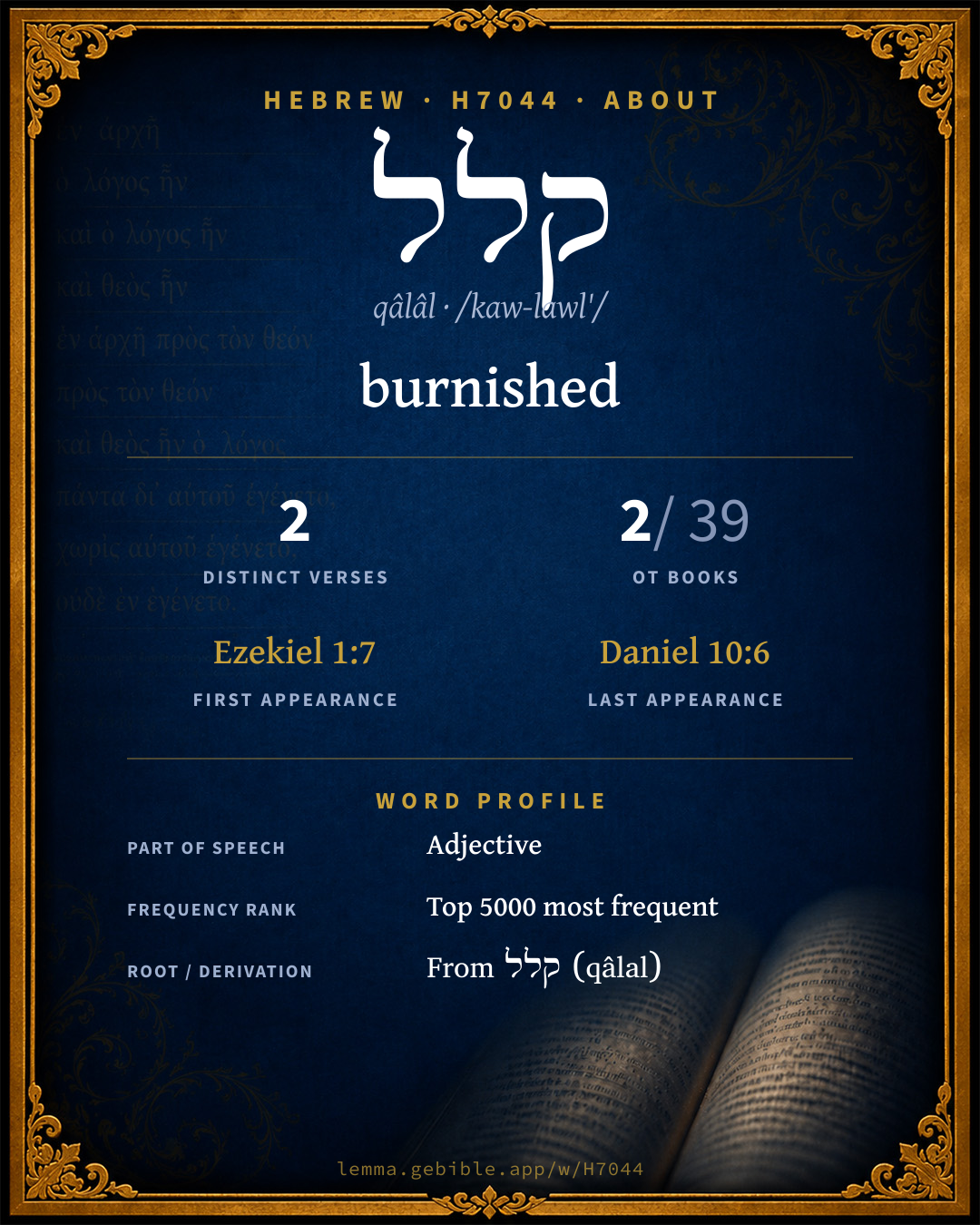
קָלָל
burnished
Full lexicon entry — Brown-Driver-Briggs (BDB)
From Brown-Driver-Briggs (BDB)
Where this word appears
Grammar key — what these labels mean
Part of speech
- Adjective
- A word that describes or qualifies a noun.
State
- Absolute
- The independent form of a noun, not bound to a following word.
Gender
- Masculine
- Grammatically masculine.
Number
- Singular
- One.
Every verse where H7044 appears — 2 distinct verses across 2 books. Click any verse to open its interlinear word-by-word view. Verse text shown in the World English Bible for context — . Each verse’s Hebrew form is shown with its reference; the English is not keyword-highlighted, since the data carries no word-level English alignment. Use “Compare translations” on any verse to read it across multiple English versions. This concordance covers the Hebrew Bible; Septuagint (Greek Old Testament) occurrences are not indexed here.
Ezekiel 1 verse
Daniel 1 verse
About this entry
At a glance — auto-summarized from this page’s data, not written by a person. Every figure links to its source below. This summary describes the numbers; it doesn’t interpret them.
קלל — transliterated qâlâl — is a Hebrew adjective carrying the sense “burnished.” With only 2 verses it sits in the long tail of Hebrew Bible vocabulary. Its uses cluster heavily in Ezekiel (50% of all occurrences). Debuting at Ezekiel 1:7, it then recurs through the corpus. Sharing its root, it stands alongside קלל, קל and קללה. Each statement above links to its evidence; the full detail follows below.
Gloss history
Strong's 1890 vs modern scholarship
About this word
Strong's H7044 catalogs a Hebrew word from the Hebrew Old Testament.
These counts are not copied from any lexicon or concordance. They are computed here, from the morphology-tagged Hebrew Old Testament. What Lemma adds →
- 2
- distinct verses
- The word appears in 2 distinct verses.
- 2 / 39
- OT books
- The word appears in 2 of 39 Old Testament books.
- #4,807
- by frequency
- Top 5000 most frequent Hebrew words (rank 4,807 of 8,640 Hebrew words by occurrence).
View all 2 occurrences in the concordance →
By traditional corpus
Conventional, traditional groupings — biblical authorship is debated, so this is a traditional corpus grouping, not an authorship claim. Each share is this word’s portion of its verses in that division of the Hebrew canon. Each figure is a share of the word’s 2 distinct verses.
- Prophets (Nevi'im) 1 verse · 50%
- Writings (Ketuvim) 1 verse · 50%
How translations render this word
Counts come from each version’s own published word-to-Strong’s tagging or interlinear alignment — an approximate guide to how each version renders this word, not a word-level alignment the data otherwise carries. Because each total is that version’s own tagged count, the per-version totals vary from one another and need not match the appearance or distinct-verse counts above. These counts may also differ from a printed concordance because Lemma counts each distinctly tagged rendering and does not collapse phrase taggings into a single head-word total. This is a fixed set of word-tagged versions (KJV, ASV, BSB, ULT) and does not change with the reading translation you choose elsewhere. Each version’s license is shown beside its name below (and on Sources).
- King James Version: Burnished 1×, Polished 1×
- American Standard Version: Burnished 2×
- Berean Standard Bible: Polished 2×
- unfoldingWord Literal Text: Like polished 1×, Polished 1×
King James Version Public Domain
Renders H7044 across 2 tagged occurrences — most commonly:
American Standard Version Public Domain
Renders H7044 across 2 tagged occurrences — most commonly:
Berean Standard Bible Public Domain
Renders H7044 across 2 tagged occurrences — most commonly:
unfoldingWord Literal Text CC BY-SA 4.0
Renders H7044 across 2 tagged occurrences — most commonly:
Senses in BDB
The 1 sense BDB distinguishes for this word, in lexicon order (not ranked by frequency or importance). The full entry — with sub-senses — is in the Lexicon Entry tab.
- burnished, polished
Word origin
adj. burnished (from light, quick movement of rubbing?);—נְחשֶׁת ק׳ burnished brass Ez 1:7; Dn 10:6 (so most; Co, Ez, קַלּוֹת, in prefixing כַּנְפֵיהֶם from v 8; Dn then follows crpt. Ez.
— Brown-Driver-Briggs (Oxford 1906, public domain), digitized via Sefaria, supplemented by the OpenScriptures HebrewLexicon (CC BY 4.0). See Sources.
Derived from קלל (qâlal) (H7043) — to be light.
Jastrow Dictionary
A second Hebrew/Aramaic lexicon for comparison, covering Aramaic and post-biblical (Talmudic, Targumic, Midrashic) usage that the biblical-Hebrew BDB does not. Matched by lemma rather than by Strong’s number, so a lemma may carry more than one Jastrow headword (shown separately below), and the entries cover usage well beyond the Bible.
קָלָל
- (v. קָלִיל) a vessel, esp. the pitcher containing the ashes of the red cow. Par. III, 3; X, 3 ק׳ של חטאת the vessel containing the ashes for lustration; Tosef. ib. IX (X), 5; a. e.—Pl. קְלָלוֹת. Par. X, 4. Tosef. ib. III (II), 4 קְלִילִיּוֹת (Var. קלולי; R. S. to Par. III, 3 קילולות, corr. acc.).
קָלָל ²
- Targ. Y. Num. XIX, 9.
קָלַל
- (b. h.) [to swing] to be light, slender, unimportant.—Part. קַל. Snh. VI, 5 (ref. to קללת, Deut. XXI, 23) בזמן … קַלַּנִי מראשי וכ׳ when man suffers punishment, what does the Shekhinah say? ‘I am lighter than my head, than my arm’ (euphem. for, I feel my head heavy &c.); Y. ib. 23ᵈ bot. אנן תנינן קַלֵּינִי (= קל איני) we read ḳalleni, I am not lighter; אית תניי תני קל אני some Tannai reads ḳal ăni; מאן דאמר קליני לית הוא אלא קליל according to him that reads ḳalleni, it is a euphemistic expression for ‘light’ (i.e. my head is light, I feel giddy; my arm is light, I feel weak); מאן דאמר קלני … נטיל according to the version ḳallani, it is a euphemistic expression for ‘heavy’ (i.e. my head, my arm is heavy); Bab. ib. 46ᵇ Abbayi says כמאן דאמר קל לית (read ḳalleni) as one says, ‘light (I am) not’ (i.e. I feel heavy, without euphemism)—(which is refuted by Raba, who explains the word in question) קליל לי עלמא, v. קַלִּיל II. e.g. Deuteronomy 21:23
- , הֵקיל I) to lighten. M. Kat. 17ᵇ הכביד … מֵיקַל וכ׳ if the mourner’s hair is too heavy, he may make it lighter with a razor; Y. ib. III, 82ᵃ top. Erub. IV, 9 להָקֵל על העשיר to make it easy for the rich man; a. fr.—Trnsf. ה׳ ראשו to be irreverent, talk frivolously (v. קַלּוּת). Ber. IX, 5 לא יָקֵל אדם את ראשו כנגד וכ׳ man (a pilgrim coming to Jerusalem) must not behave irreverently in sight of the eastern gate &c. Yalk. Gen. 24 מֵיקֶלֶת ראשה she is frivolous (light-minded); Yalk. Is. 265 מֵקֶילֶת ראש; (Gen. R. s. 18 מיקרת, v. יָקַר).—2) to be lenient; to incline towards the less restrictive practice, opp. החמיר, v. חָמַר I. Y. M. Kat. l. c. הלכה כדברי מי שהוא מיקל the adopted practice follows the opinion of him who is more lenient; Erub. 46ᵃ, a. fr. כדברי המיקל וכ׳. Yeb. 88ᵃ הֵיקַלְתָּ עליה, v. חָמַר I. Pes. 52ᵇ, v. מַגִּיד. Erub. l. c. wherever you find יחיד מיקל ורבים וכ׳ an individual scholar favoring the more lenient practice against several in favor of restriction. Sabb. 129ᵃ, a. fr. ספק נפשות להָקל where there is a doubt involving the endangering of human life, the more lenient rule is applied; a. fr.—3) to be sparing, beggarly. Ib. כל המיקל … מְקִילִין לו מזוניתיו וכ׳ he that stints himself at the meal taken after blood-letting, to him they in heaven will give his sustenance stintingly; a. e.
- [to diminish,] to curse. Keth. VII, 6 מְקַלֶּלֶת, v. יִוֹלֵד. Sabb. 62ᵇ שאשתו מְקַלַּלְתּוֹ בפניו whom his wife curses in his presence. Pes. 87ᵇ (ref. to Prov. XXX, 10 sq.) אפו׳ דור שאביו יְקַלֵּל וכ׳ even if it be a generation of men that curse their father …, do not denounce &c. Yoma 75ᵃ ק׳ את הנחש וכ׳ God cursed the serpent, yet it climbs up the roof and finds its food. Sot. 11ᵃ (expl. ועלה, Ex. I, 10, as euphem. for ועלינו) כאדם שמְקַלֵּל את עצמו וכ׳ like a man that wants to curse himself (express an ill omen about himself), and hangs his curse on others. B. Bath. 88ᵇ הקב"ה בירך … וקִלְּלָן וכ׳ the Lord blessed Israel with the twenty-two letters of the alphabet (from א of אם, Lev. XXVI, 3, to ת of קוממיות, ib. 13), and cursed them with eight letters (from ו of ואם, ib. 14, to ם of נפשם, ib. 43). Snh. 70ᵃ מתוך שקלקלו … קִלְּלוֹ ברביעי because Ham injured him by (preventing his begetting) a fourth son, he (Noah) cursed him by his fourth son (Canaan). Ib. 91ᵇ כל המונע … שבמעי אמן מְקַלְּלִין אותו (not אמו) he that withholds a tradition from his pupil, even the embryos in their mother’s womb will curse him; Yalk. Prov. 947; a. fr. e.g. Proverbs 30:10
- to be cursed. Ber. 61ᵃ בתחלה נ׳ … נִתְקַלְּלָה וכ׳ the serpent was cursed first, and then Eve &c.; Gen. R. s. 20; Erub. 18ᵃ. Ib. 18ᵇ נתקללה בבל נִתְקַלְּלוּ וכ׳ when Babylon was cursed, her neighbors were cursed. Bekh. 8ᵃ אם מבהמה נתקללה וכ׳ if she (Eve) was cursed (with prolonged pregnancy) more than cattle &c. Ib. נ׳ הוא … אחת לשבע it (the serpent) was cursed seven times more than certain cattle. Ib. נ׳ הוא מחיה (not נתקלקל); a. fr.—[Tosef. Sot. II, 3 ניקללה ניוולה, Var. ניקל, read: ניקתה בניוולה, v. נָקָה Nif.]
קְלַל
- 1. to be light; to be of light esteem. Targ. O. Gen. XVI, 4, sq.
- 2. to be reduced. Ib. VIII, 8; 11 קַלּוּ ed. Berl. (ed. Vien. קַלִּיאוּ).
- to be reduced. Targ. Y. ib.
- 1. (denom. of (denom. of קַלִּיל) to be quick, to pass swiftly. Targ. Job VII, 6; IX, 25.
- 2. to make light; trnsf. to ease, relieve. Pesik. B’shall., p. 93ᵃ קַלֵּיל גרמך וכ׳ make thyself light of weight, or I will throw thee off.—Y. Kidd. II, 62ᵈ bot. הוון מחמרין וק׳ עליהון they were strict in their practice, and he lightened their burden (allowed them what they considered forbidden). Y. M. Kat. III, 82ᵃ הן דהוינן סברין דו מְקַלְּלָה חמר he whom we thought to be lenient made it stricter; a. e.—[Yalk. Gen. 133 ומקללה בשוק, v. קְלַק.]
- 1. to disregard, dishonor; also to curse. Targ. Ex. XXII, 27 (v. קִיל II). Targ. Ps. LV, 13 (h. text חרף); a. e.—Y. Bicc. III, 65ᵈ top ר׳ מני מֵיקיל לאילין וכ׳ R. M. spoke with disrespect of those that get appointments to office for money; Midr. Sam. ch. VII ר׳ אמי הוה מֵקֵיל (or מַקֵּיל). Y. Dem. I, 22ᵃ top, v. קִיל II. Y. Peah VIII, 21ᵃ אַקְלוּנָךְ they cursed thee; a. e.
- 2. to relieve, to favor the more lenient rule. Targ. Ex. XVIII, 22 (some ed. O. וְיִקְלוּן, read וְיַ׳). Targ. I Kings XII, 4; 9.—Erub. 46ᵃ באבילות הוא דאַקִּילוּ וכ׳ (or דַּאֲקִילוּ) only as to mourning ceremonies the Rabbis adopt the more lenient rules. Yeb. 88ᵃ ולא לֵיקֵיל, or חֲמַר I; a. fr.—V. קַלְקֵל.
A Dictionary of the Targumim, the Talmud Babli and Yerushalmi, and the Midrashic Literature (Marcus Jastrow; London, Luzac, 1903) — Public Domain. Digitized via Sefaria. Digitized via Sefaria. Full attribution on Sources.
Forms in the corpus
The 2 distinct written forms H7044 takes in the Hebrew Bible, most frequent first — each parse links to that state’s occurrences in the concordance. Hebrew forms include their vowel points and cantillation, so a single lemma takes many written forms.
| Form | Parsing | Example | Uses |
|---|---|---|---|
| קָלָ֑ל | Adjective, Adjective, Masculine, Singular, Absolute | Daniel 10:6 | 1 |
| קָלָֽל | Adjective, Adjective, Masculine, Singular, Absolute | Ezekiel 1:7 | 1 |
Same root — word family
Other BDB entries built from the same root as H7044, grouped by Strong’s listed origin. These share a root / origin per the lexicon — not necessarily a shared meaning. Each links to that word’s own entry.
Derives from
Shares the same root
Proper names from this root
People and places named from this root — a name, not an additional meaning of the word.
Compare all same-root words → Showing 4 of 6 — not the complete family. 1 of the same-root words is a proper name (a person or place). They share a root, not necessarily a meaning.
Septuagint verse parallels
This word appears in 2 verses that also exist in the Greek Old Testament (Septuagint), out of the 2 Hebrew verses it occurs in. You can read those verses in Greek by switching the Old Testament edition to the Septuagint.
Read these verses in the Septuagint
This is a verse-level parallel only — the same verses exist in both the Hebrew and Greek Old Testaments. No word-level Hebrew↔Greek correspondence is claimed: the data carries no such alignment, so no Greek word is shown as this Hebrew word’s translation. Coverage is not total — the Septuagint omits the deuterocanon and renumbers the Psalms, so some Hebrew verses have no direct Greek parallel.