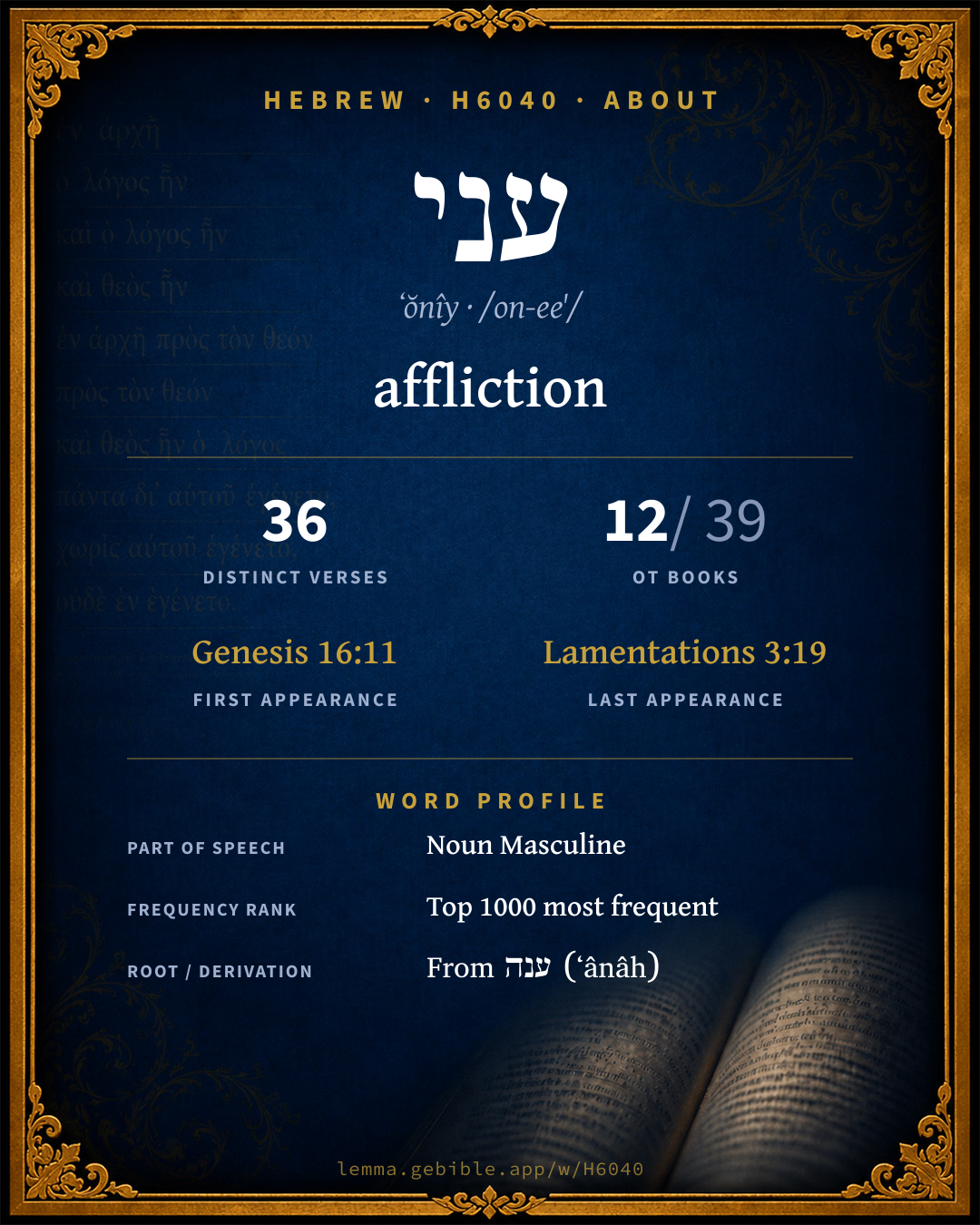
עֳנִי
affliction
also: poverty, misery fuller range ↓
Full lexicon entry — Brown-Driver-Briggs (BDB)
From Brown-Driver-Briggs (BDB)
Where this word appears
See every Absolute-state word in the Hebrew Bible →
Grammar key — what these labels mean
Part of speech
- Noun
- A naming word — a person, place, thing, or idea.
Noun type
- Common
- A common noun — a general class of person, place, or thing (“king,” “city,” “water”), not a specific name.
State
- Absolute
- The independent form of a noun, not bound to a following word.
- Construct
- A noun bound to a following noun in a possessive / “of” relationship (the construct chain).
Gender
- Masculine
- Grammatically masculine.
Number
- Singular
- One.
Every verse where H6040 appears in the Book of Deuteronomy — 2 distinct verses. Click any verse to open its interlinear word-by-word view. Verse text shown in the World English Bible for context — . Each verse’s Hebrew form is shown with its reference; the English is not keyword-highlighted, since the data carries no word-level English alignment. Use “Compare translations” on any verse to read it across multiple English versions. This concordance covers the Hebrew Bible; Septuagint (Greek Old Testament) occurrences are not indexed here.
Deuteronomy
- Deuteronomy 16:3 עֹ֑נִי n c ms You shall eat no leavened bread with it; seven days shall you eat unleavened bread therewith, even the bread of affliction; for you came forth out of the land of Egypt in haste: that you may remember the day when you came forth out of the land of Egypt all the days of your life.
- Deuteronomy 26:7 עָנְיֵ֛/נוּ n c ms cs + sfx pers 1cp and we cried to Yahweh, the God of our fathers, and Yahweh heard our voice, and saw our affliction, and our toil, and our oppression;
About this entry
At a glance — auto-summarized from this page’s data, not written by a person. Every figure links to its source below. This summary describes the numbers; it doesn’t interpret them.
עני — transliterated ʻŏnîy — is a Hebrew noun carrying the sense “affliction.” Its earliest occurrence is Genesis 16:11. It appears 36 verses across 12 books of the Hebrew Bible, among its moderately common vocabulary. More than a quarter of its appearances fall in Psalms. Alongside “affliction” the lexicon also lists “poverty” and “misery” — part of its full sense range. See the sense tree, 36-verse concordance, and the renderings breakdown below.
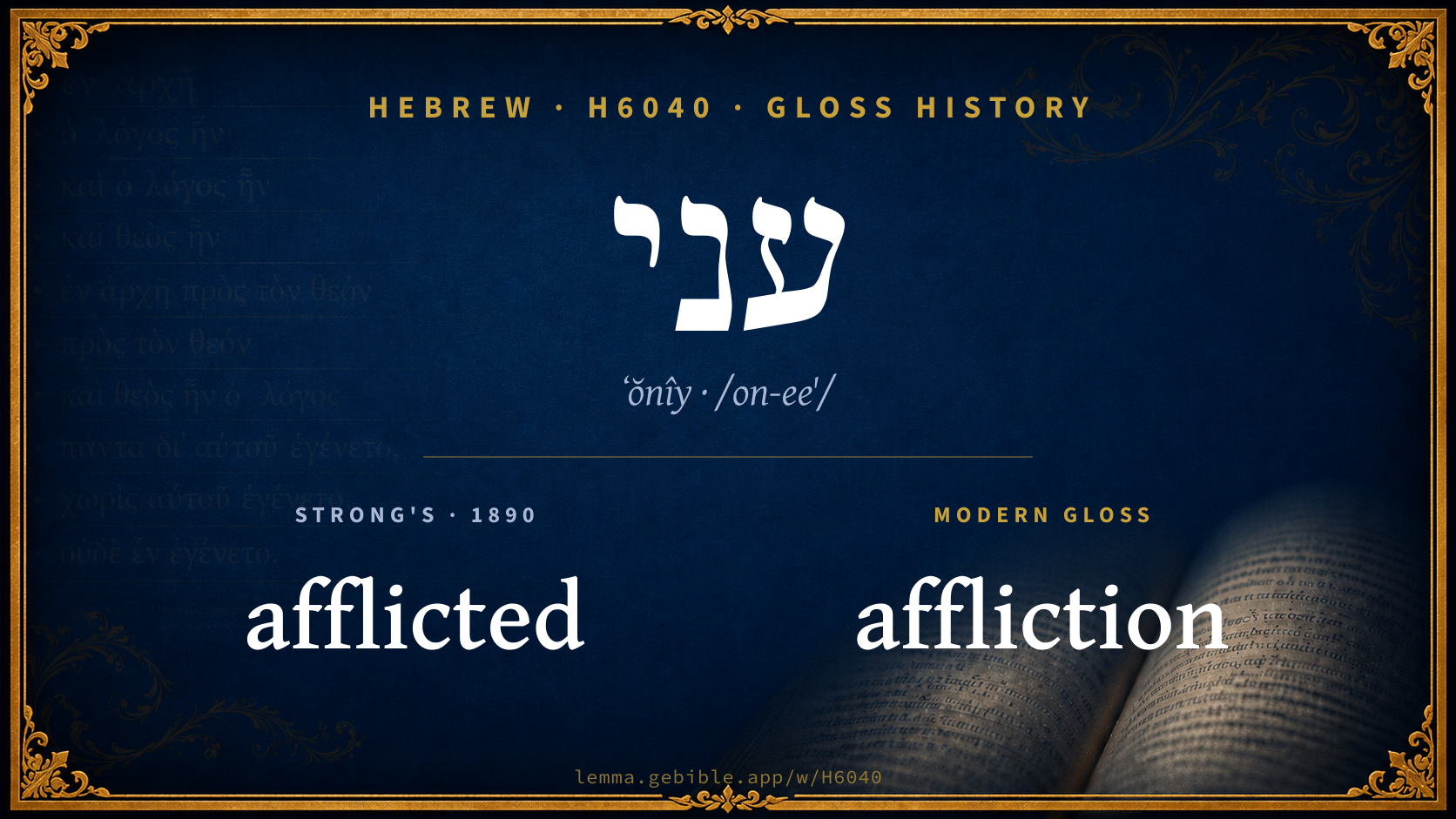
Gloss history
Strong's 1890 vs modern scholarship
About this word
Strong's H6040 catalogs a Hebrew word from the Hebrew Old Testament.
These counts are not copied from any lexicon or concordance. They are computed here, from the morphology-tagged Hebrew Old Testament. What Lemma adds →
- 36
- distinct verses
- The word appears in 36 distinct verses.
- 12 / 39
- OT books
- The word appears in 12 of 39 Old Testament books.
- #990
- by frequency
- Top 1000 most frequent Hebrew words (rank 990 of 8,640 Hebrew words by occurrence).
View all 36 occurrences in the concordance →
Most concentrated in
- Psalms 10 verses 28%
- Job 6 verses 17%
- Lamentations 5 verses 14%
By section of the Old Testament
By traditional corpus
Conventional, traditional groupings — biblical authorship is debated, so this is a traditional corpus grouping, not an authorship claim. Each share is this word’s portion of its verses in that division of the Hebrew canon. Each figure is a share of the word’s 36 distinct verses.
- Writings (Ketuvim) 24 verses · 67%
- Torah (Pentateuch) 9 verses · 25%
- Prophets (Nevi'im) 3 verses · 8%
How translations render this word
Counts come from each version’s own published word-to-Strong’s tagging or interlinear alignment — an approximate guide to how each version renders this word, not a word-level alignment the data otherwise carries. Because each total is that version’s own tagged count, the per-version totals vary from one another and need not match the appearance or distinct-verse counts above. These counts may also differ from a printed concordance because Lemma counts each distinctly tagged rendering and does not collapse phrase taggings into a single head-word total. This is a fixed set of word-tagged versions (KJV, ASV, BSB, ULT) and does not change with the reading translation you choose elsewhere. Each version’s license is shown beside its name below (and on Sources).
- King James Version: Affliction 28×, Trouble 2×
- American Standard Version: Affliction 26×, Days of affliction 2×
- Berean Standard Bible: Affliction 30×
- unfoldingWord Literal Text: Affliction 27×, Affliction of 4×, Misery 2×
King James Version Public Domain
Renders H6040 across 35 tagged occurrences — most commonly:
Plus 5 renderings that appear only once — usually multi-word phrases or single function words the recovered tagging swept in, not distinct renderings. Not rendered by a distinct English word in 2 further occurrences.
American Standard Version Public Domain
Renders H6040 across 34 tagged occurrences — most commonly:
Plus 6 renderings that appear only once — usually multi-word phrases or single function words the recovered tagging swept in, not distinct renderings.
Berean Standard Bible Public Domain
Renders H6040 across 35 tagged occurrences — most commonly:
Plus 5 renderings that appear only once — usually multi-word phrases or single function words the recovered tagging swept in, not distinct renderings. Not rendered by a distinct English word in 1 further occurrence.
unfoldingWord Literal Text CC BY-SA 4.0
Renders H6040 across 38 tagged occurrences — most commonly:
Plus 5 renderings that appear only once — usually multi-word phrases or single function words the recovered tagging swept in, not distinct renderings.
Senses in the full BDB
What do BDB’s symbols mean?
BDB uses these scholarly abbreviations:
| Symbol | Meaning |
|---|---|
| 𝔊 | the Septuagint (the ancient Greek translation, LXX) |
| 𝔙 | the Vulgate (the Latin translation) |
| 𝔖 | the Syriac version (the Peshitta) |
| 𝔗 | the Targum (the Aramaic translation) |
| ψ | the Psalms |
| √ | root (the underlying root or stem) |
| ‖ | parallel passage (a synonymous or contrasted parallel) |
| † | the dagger: every passage where the word occurs is cited |
The 2 senses and sub-senses the full Brown-Driver-Briggs lexicon distinguishes for this word, in lexicon order (not ranked by frequency), with BDB’s own verbatim wording and sub-sense lettering. Shown in Hebrew script with BDB’s own scholarly abbreviations. The condensed entry is in the Lexicon Entry tab. See also the Forms in the corpus table below.
- 1. affliction, Jb 36:15, 21 ψ 44:25; 88:10; 107:41; 119:50, 92 La 1:3; 3:19; ארץ ע׳ Gn 41:52 (E); יְמֵי ע׳ Jb 30:16, 27 La 1:7; כּוּר ע׳ Is 48:10; חַבְלֵי ע׳ Jb 36:8; אֲסִירֵי ע׳ ψ 107:10; בְּנֵי ע׳ Pr 31:5; ראה ע׳ Gn 31:42 (E), Ex 3:7; 4:31 (J), Dt 26:7; 2 K 14:26; Ne 9:9; Jb 10:15 ψ 9:14; 25:18; 31:8; 119:153; La 1:9; 3:1, ins. also before עַמִּי 1 S 9:16b 𝔊 Th We Dr Kit Bu HPS; ראה בע׳ Gn 29:32 (J), 1 S 1:11 2 S 16:12 (v. supr.); שׁמע ע׳ Gn 16:11 (J); העלה מע׳ Ex 3:17 (J); להם עני Dt 16:3. e.g. Job 36:15
- 2. frustration, בְּעָנִיִי in spite of my frustration, 1 Ch 22:14. e.g. 1 Chronicles 22:14
Senses from the full Brown-Driver-Briggs lexicon (Brown, Driver, Briggs; Oxford 1906 — public domain), digitized via Sefaria, supplemented by the OpenScriptures HebrewLexicon (CC BY 4.0). Full attribution on Sources.
Word origin
n.m. affliction, poverty;—ע׳ Ex 3:7 +; עֹ֑נִי Dt 16:3 +, ע֑וֹנִי ψ 107:41, עוני 2 S 16:12 (Kt, but read עָנְיִי; > Qr עֵינִי !); sf. עָנְיִי Gn 31:42 +, עָנְיֵךְ 16:11, etc.;—
— Brown-Driver-Briggs (Oxford 1906, public domain), digitized via Sefaria, supplemented by the OpenScriptures HebrewLexicon (CC BY 4.0). See Sources.
Derived from ענה (ʻânâh) (H6031) — to afflict.
Jastrow Dictionary
A second Hebrew/Aramaic lexicon for comparison, covering Aramaic and post-biblical (Talmudic, Targumic, Midrashic) usage that the biblical-Hebrew BDB does not. Matched by lemma rather than by Strong’s number, so a lemma may carry more than one Jastrow headword (shown separately below), and the entries cover usage well beyond the Bible.
עוֹנִי I
- , v. עוֹנָה II) misery, poverty, privation. Ab. IV, 9 כל המקיים … מע׳ וכ׳ he who fulfills the Law in spite of poverty, shall finally do so in wealth; וכל המבטל … סופו לבטלה מע׳ and he who neglects the Law on account of his wealth, shall finally neglect it from poverty. M. Kat. 17ᵇ, a. e. כל מקום … או מיתה או ע׳ wherever the scholars put their eyes (upon a person, i.e. decreed the ban), there follows either death or poverty. Midr. Till. to Ps. V (ref. to I Chr. XXII, 13) בעָנְיִי בצער וכ׳ what does ‘in my misery’ mean? In the pain which I suffered about it. Sifré Deut. 130 (ref. to Deut. XVI, 3) למה נקרא לחם ע׳ על שם עינוי וכ׳ why is it called bread of misery? For the affliction which they suffered in Egypt; a. fr.—[Pes. 36ᵇ תיפוק ליה מלחם ע׳ … באוני derive it (that you dare not use second tithes for unleavened bread to be eaten with the Passover lamb) from the expression ‘bread of misery’, which intimates ‘that which it is permitted to eat in mourning (to the exclusion of second tithes, v. Deut. XXVI, 14); ib.ᵃ לחם ע׳ מה שנאכל באנינות. Ib., a. e. לחם ע׳ לחם שעונין עליו וכ׳ ‘bread of recitation’, bread over which they recite many words (the Hagadah, Hallel &c.).] e.g. 1 Chronicles 22:13
עני
- (b. h.) [to turn, come out in turn,] to begin to speak; to respond; to speak or sing in chorus; to answer. Tem. 16ᵃ ע̇תנ̇יא̇ל̇ שעֲנָאו̇ א̇ל̇ he was surnamed Othniel, because God answered his prayer (ref. to I Chr. IV, 10). Y. Sot. V, 20ᶜ top והן עוֹנִין אחריו על כל דבר ודבר and they (the class) repeat each sentence after him; משה … והן עונין אחריו אשירה Moses said, I will sing &c., and they repeated in chorus, I will sing &c. Ib. משה אמר עזי והן עונין וכ׳ Moses said, My strength &c., and they responded, I will sing &c. Tosef. ib. VI, 2 ועונין על כל עינין ועינין and they (the class) repeat each sentence. Ib. 3 ועונין אחריו עינין ראשון and they (the people) always repeated the first sentence (as refrain). Succ. 38ᵇ מצוה לַעֲנוֹת הללויה it is proper to say in response Halleluiah. M. Kat. III, 9 כולן עוֹנוֹת כאחת all start the dirge at once; אחת מדברת וכולן עונות אחריה one speaks, and all repeat in chorus after her, v. עִינּוּי I. Ber. 47ᵃ עד שיכלה אמן מפי העוֹנִים until the Amen of the responding company is finished. Pes. 36ᵃ לחם שעונין וכ׳, v. עוֹנִי. Y. Succ. III, 54ᵃ top אם בירכך גוי עֲנֵה אחריו אמן if a gentile blesses thee, say after him Amen; a. fr. e.g. 1 Chronicles 4:10
- 1. to be answered, to have one’s prayer granted. Sabb. 30ᵃ וכשאמר זכור … מיד נ׳ but when he said, Remember &c. (Ex. XXXII, 13), his prayer was at once granted. R. Hash. 18ᵃ זה התפלל ונ׳ וכ׳ one prays and is heard, another prays and is not heard; Koh. R. to IX, 11, v. פָּגַע. Gen. R. s. 60 [read:] שלשה הם שנַעֲנוּ במענה פיהם three persons (mentioned in the Scriptures) were answered as soon as they had uttered their prayer; Yalk. ib. 108; a. fr. e.g. Exodus 32:13
- 2. to be called upon to speak; to answer, to deliver an opinion. Kidd. 40ᵇ נ׳ ר"ט ואמר וכ׳ R. Ṭ. (being asked his opinion) answered saying &c.; נַעֲנוּ כולם ואמרו וכ׳ all of them in turn answered saying &c.; Sifré Deut. 41; M. Kat. 28ᵇ (at a mourner’s house); a. fr.
- 3. [to be made to respond Amen,] to be sworn; to promise allegiance. Y. Dem. II, 23ᵃ top הוא נ׳ לחבורה … נַעֲנִין לו he (the head of the house) promises allegiance to the order (v. חֲבֵרוּת), and the members of his house make the promise to him.
- to speak or sing in chorus, esp. to lament. M. Kat. III, 9, מְעַנּוֹת, v. עִינּוּי I.
עֲנֵי
- Targ. II Esth. VI, 10. Targ. I Kings XII, 7.—Targ. Ps. XXXIV, 5 (Ms. עַנְיָינִי). Ib. CII, 3; a. fr.—Y. Succ. III, 54ᵃ top מה נַעְנֵי what shall we say in response? Ib. ר׳ יונה ע׳ הכין והכין R. J. responded, so be it, and so be it. Ab. Zar. 18ᵃ bot. אימא אלהא דמאיר עֲנֵנִי say, O God of Meïr, hear me; a. fr.—[Men. 17ᵃ עני מרי, v. עֲנֵי II.]
- to speak or sing in chorus; to respond. Targ. O. Ex. XV, 21. Targ. II Esth. VI, 11.
- 1. to be answered. Targ. O. Ex. XIX, 19. Targ. Prov. XXI, 13 נתעני ed. Wil. (ed. Lag. נַעֲנוֹי will answer him; h. text יֵעָנֶה).—
- *2. (euphem.) to be gratified, be eased. Y. Shebi. III, 34ᶜ bot. ההן דאזיל ולא מִתְעַנֵּי … he who went out to ease his bowels without success; [perhaps to be read מתפני, v. פְּנֵי?]
עני ²
- to press, be pressed; to be detained.
- 1. to detain, postpone, esp. ע׳ דין to delay execution of capital judgment (which should take place on the day of sentence). Snh. XI, 4 (89ᵃ) אין מְעַנִּין את דינו של וכ׳ we must not put off his execution (opp. to the opinion משמרין אותו). Ib. 35ᵃ וליגמריה … נמצא אתה מְעַנֶּה את דינו shall we pass sentence on Friday and put him to death on Sunday? In such a case you would postpone his execution (against the law); v. עִינּוּי II.
- 2. to cause privation; to cause to fast. Yoma 77ᵇ (ref. to ויענה, Gen. XXXIV, 2) התם שעִינָּהּ מביאות וכ׳ this may be interpreted, that he deprived her of other connections. Ib. VIII, 4 התינוקות אין מענין אותן וכ׳ we must not let children fast on the Day of Atonement, v. חָנַךְ; a. e.—Part. pass. מְעוּנֶּה fasting. Tosef. Taan. II, 7; Erub. 41ᵃ כדי שלא יכנס לשבת כשהוא מע׳ that he may not begin the Sabbath fasting; Tanḥ. B’resh. 2.– e.g. Genesis 34:2
- 3. to afflict, oppress, wrong. Mekh. Mishp., s. 18 (ref. to Ex. XXII, 22) עד שיְעַנֶּה וישנה until he practices oppression repeatedly; a. e.—Part. pass. מְעוּנֶּה; pl. מְעוּנִּין. Yeb. 48ᵇ מפני מה גרים בזמן הזה מע׳ וכ׳ why are the proselytes of our days afflicted and subject to suffering? e.g. Exodus 22:22
- 4. to violate, outrage. Num. R. s. 9 (ref. to Mic. II, 9) שהיו מְעַנִּים נשי וכ׳ they violated married women and caused them to be forbidden to their husbands. Lev. R. s. 19; a. fr.—Mekh. l. c.; Yalk. Ex. 349 אם כשלא תְעַנּוּן את הדין וכ׳ if your wives will be spared from widowhood and your children from bereavement, because you do not violate justice, how much more, when you execute justice. e.g. Micah 2:9
- 1. to be afflicted, oppressed. Mekh. l. c. אלמנה … שדרכן לֵעָנוֹת בהן וכ׳ widows and orphans who are liable to be oppressed,—of them the text speaks (Ex. XXII, 21); Yalk. l. c. שדרכן לֵיעָנוֹת (not שדרכו). e.g. Exodus 22:21
- 2. to humble one’s self; to submit to a person’s discretion, beg pardon. Ber. 28ᵃ נַעֲנֵיתִי לך מחול לי I submit myself to thee, forgive me. Pesik. R. s. 38 נעניתי לו I beg his pardon. Yoma 22ᵇ נעניתי לכם עצמות וכ׳ I beg your pardon, bones of Saul!; Yalk. Sam. 117 נעניתי לך שאול וכ׳. Keth. 67ᵇ נעניתי לך קום אכול I beg of thee, get up and eat. Tosef. Ohol. V, 12 נמיתי לכם עצמות וכ׳ ed. Zuck. (oth. ed. נמתי, read נעניתי) I beg your pardon, bones of &c.
- 1. to be afflicted, suffer. Sifré Deut. 130 שנִתְעַנּוּ, v. עִינּוּי II.
- 2. to afflict one’s self, to fast. Ber. 8ᵇ (ref. to Lev. XXIII, 32) וכי בתשעה מִתְעַנִּין do men fast on the ninth (of Tishri)? R. Hash. 18ᵇ אין גזרת … רצו מתענין when there is no political persecution, but no peace, those who wish may fast &c. Erub. 41ᵃ והִתְעַנִּינוּ בו ולא וכ׳ we fasted, but not to the end of the day; a. fr. e.g. Leviticus 23:32
- (denom. of עָנִי) to become poor. Keth. VI, 6. Ber. 33ᵃ חזרו והֶעֱנוּ when they (the Jews) became poor again. Meïl. 17ᵃ מי שיש לו אויב יַעֲנִי או יעשיר if one has an enemy, does one wish him to be poor or rich?; a. e.
עֲנֵי ²
- 1. to tarry, be detained, late. Y. Sot. I, 16ᵈ bot. חד זמן ע׳ דריש once he (R. Meïr) was long in preaching (preached to a late hour, or came late); Num. R. s. 9 אִיעַנֵּי דרשה (Ithpa., read דָּרוֹשָׁה or דָּרְשָׁא); Lev. R. s. 9 תנתא מדרשא (corr. acc.). Y. Bicc. III, 65ᶜ bot. חד זמן ע׳ מיסק (not מסיק) once he was late in coming; (Keth. 62ᵇ משכתיה שמעתא); a. e.—עַנִּי מרי be slow, my lord (a respectful form of interrupting and introducing an objection or correction). Men. 17ᵃ ע׳ מ׳ משמיה דרב וכ׳ beg pardon, sir; (do you mean to say) ‘in the name of Rab?’ Said he, yes. Ib. 81ᵃ ע׳ מ׳ ארבעין וכ׳ beg pardon, he deserves forty lashes (for exchanging sacrifices), and yet his act is legal?; Snh. 26ᵇ ע׳ מ׳ ארבעין … וכשר he deserves forty lashes, and yet his testimony is admissible? B. Kam. 49ᵇ ע׳ מורי וכ׳; [Rashi interprets: give answer, my lord, v. עֲנֵי I].
- 2. to afflict, oppress. Targ. O. Ex. XXII, 21, sq. Ib. I, 12 מְעַנַּן (Y. מְעַנְיַין); a. e.—Part. pass. מְעַנֵּי; pl. מְעַנָּן. Targ. Is. LIII, 4.
- 3. to violate. Targ. O. Deut. XXII, 24 (ed. Amst. עָנֵי, corr. acc.); a. fr.
- 4. (with, or sub. נפשא) to afflict one’s self, fast. Targ. Lam. III, 33 (ed. Amst. עָנֵי). Targ. Lev. XVI, 31; a. fr.—Part. pass. as ab. Tanḥ. B’resh. 2 בשבת גופא לא מע׳ he does not fast on the Sabbath itself.
- 1. to be delayed. Num. R. s. 9, v. supra.
- 2. to be afflicted, suffer; to fast. Targ. I Kings II, 26. Targ. Zech. VII, 5; a. e.—Y. Ber. III, 6ᵇ top; Y. Naz. VII, 56ᵃ bot. בעי מזקפוניה ואשכחוניה איע׳ they wanted to help him up, but found that he was suffering; Koh. R. to VII, 2 (not איע׳ בדבורא).—4) to be violated. Targ. Lam. V, 11.
- to become poor. Taan. 23ᵇ אמר לִיעֲנוּ ואִיעֲנוּ he said, let them become poor, and they became poor.
עֹנִי
- m., v. עוֹנִי
עַנִּי
- ch. = h. עֹנִי. Targ. O. Deut. XVI, 3 ed. Berl. (oth. ed. עָנִי, עֹנִי, עוֹנִי).
עָנִי
- [afflicted, humble,] poor. Sabb. I, 1, sq., v. בַּיִת.—מעשר ע׳, v. מַעֲשֵׂר.—Ned. 64ᵇ, a. e. ארבעה ע׳ סומא וכ׳ … four classes of people are as if dead, the poor man, the blind &c. Ib. 41ᵃ אין ע׳ אלא בדיעה only he is poor who lacks knowledge. Keth. 68ᵃ ע׳ בדעת poor in disposition, illiberal, niggardly. Pes. 118ᵃ (expl. Ps. CXVIII, 1) שגובה … עשיר בשורו ואת ע׳ בשיו he collects the debt of man out of the good bestowed upon him, taking from the rich man his ox, from the poor man his lamb. Lev. R. s. 34, v. יַעַן. Y. Ber. IX, 13ᵇ ואם היה ע׳ כופר בו but if his relative is poor, he disowns him; a. v. fr.—Pl. עֲנִיִּים. Ex. R. s. 31 (ref. to Ex. XXII, 24) אמרו … ומי הם עמך אמר להם הע׳ Israel asked the Lord, and who are thy people? Said he to them, the poor. Ab. I, 5 ויהיו ע׳ בני ביתך let the poor be members of thy household. B. Mets. 71ᵃ (ref. to Ex. l. c.) עֲנִיֶּיךָ ועֲנִיֵּי עירך וכ׳ as between thy own poor (relatives) and the poor of thy town, thy own poor have the first claim &c. Keth. 106ᵇ אף לא בשל ע׳ neither may you trade with funds designed for the poor. Peah I, 2 לפי רוב הע׳ according to the number of poor (dependent on the field corners, פֵּאָה); a. v. fr.—Fem. עֲנִיּה, עֲנִיָּיה. Keth. 62ᵇ ע׳ זו לשוא שימרה this poor woman has been waiting (for her husband) in vain. Y. ib. IX, 33ᵃ top מה נעשה באותה הע׳ what has been done in that poor woman’s case? Gen. R. s. 60 פתחו לאותה הע׳ open the gate for the poor animal; a. fr. e.g. Psalms 118:1
A Dictionary of the Targumim, the Talmud Babli and Yerushalmi, and the Midrashic Literature (Marcus Jastrow; London, Luzac, 1903) — Public Domain. Digitized via Sefaria. Digitized via Sefaria. Full attribution on Sources.
Forms in the corpus
The 28 distinct written forms H6040 takes in the Hebrew Bible, most frequent first — each parse links to that state’s occurrences in the concordance. Hebrew forms include their vowel points and cantillation, so a single lemma takes many written forms.
Same root — word family
Other BDB entries built from the same root as H6040, grouped by Strong’s listed origin. These share a root / origin per the lexicon — not necessarily a shared meaning. Each links to that word’s own entry.
Derives from
Shares the same root
- מענה maʻănâh H4618 ploughing ground
- ענה ʻănâh H6033 poor
- ענו ʻânâv H6035 poor
- ענות ʻĕnûwth H6039 affliction
- עני ʻânîy H6041 poor
- ענין ʻinyân H6045 occupation
- תענית taʻănîyth H8589 fasting
Proper names from this root
People and places named from this root — a name, not an additional meaning of the word.
Compare all same-root words → Showing 4 of 11 — not the complete family. 2 of the same-root words are proper names (people or places). They share a root, not necessarily a meaning.
Septuagint verse parallels
This word appears in 29 verses that also exist in the Greek Old Testament (Septuagint), out of the 36 Hebrew verses it occurs in. You can read those verses in Greek by switching the Old Testament edition to the Septuagint.
Read these verses in the Septuagint
- Genesis 16:11
- Exodus 3:7
- Deuteronomy 16:3
- 1 Samuel 1:11
- 2 Kings 14:26
- 1 Chronicles 22:14
- Job 10:15
- Psalms 9:13
- Proverbs 31:5
- Isaiah 48:10
- Lamentations 1:3
This is a verse-level parallel only — the same verses exist in both the Hebrew and Greek Old Testaments. No word-level Hebrew↔Greek correspondence is claimed: the data carries no such alignment, so no Greek word is shown as this Hebrew word’s translation. Coverage is not total — the Septuagint omits the deuterocanon and renumbers the Psalms, so some Hebrew verses have no direct Greek parallel.