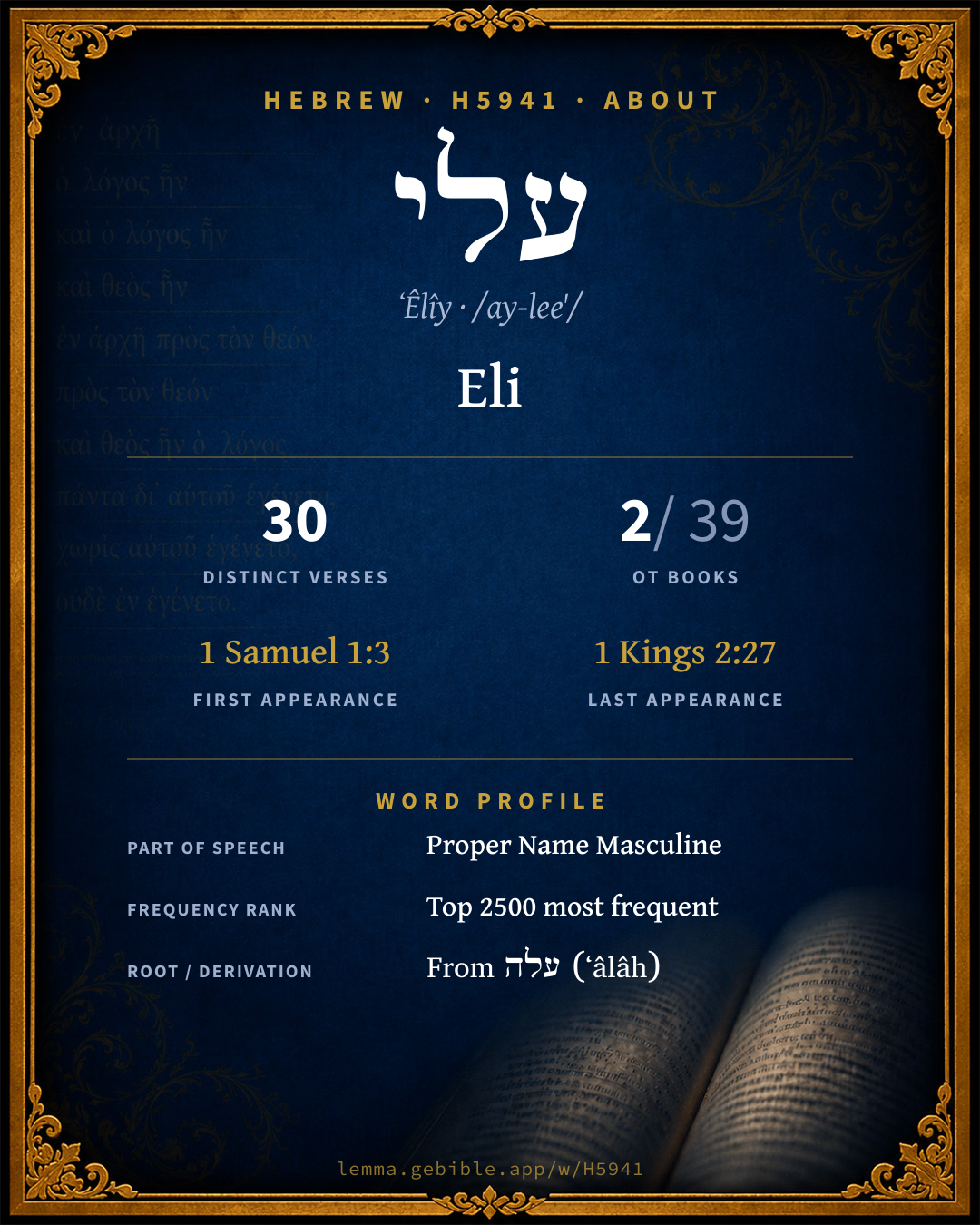
עֵלִי
Eli
BDB lists 2 entries for ‘Eli’ fuller range ↓
Full lexicon entry — Brown-Driver-Briggs (BDB)
From Brown-Driver-Briggs (BDB)
Where this word appears
Grammar key — what these labels mean
Part of speech
- Noun
- A naming word — a person, place, thing, or idea.
Noun type
- Proper
- A name of a specific person, place, or people (e.g. Abraham, Zion, Israel).
Every verse where H5941 appears in the Book of 1 Samuel — 29 distinct verses. Click any verse to open its interlinear word-by-word view. Verse text shown in the World English Bible for context — . Each verse’s Hebrew form is shown with its reference; the English is not keyword-highlighted, since the data carries no word-level English alignment. Use “Compare translations” on any verse to read it across multiple English versions. This concordance covers the Hebrew Bible; Septuagint (Greek Old Testament) occurrences are not indexed here.
1 Samuel
- 1 Samuel 1:3 עֵלִ֗י n Proper This man went up out of his city from year to year to worship and to sacrifice to Yahweh of Hosts in Shiloh. The two sons of Eli, Hophni and Phinehas, priests to Yahweh, were there.
- 1 Samuel 1:9 וְ/עֵלִ֣י conj + n Proper So Hannah rose up after they had eaten in Shiloh, and after they had drunk. Now Eli the priest was sitting on his seat by the door-post of the temple of Yahweh.
- 1 Samuel 1:12 וְ/עֵלִ֖י conj + n Proper It happened, as she continued praying before Yahweh, that Eli marked her mouth.
- 1 Samuel 1:13 עֵלִ֖י n Proper Now Hannah, she spoke in her heart; only her lips moved, but her voice was not heard: therefore Eli thought she had been drunken.
- 1 Samuel 1:14 עֵלִ֔י n Proper Eli said to her, How long will you be drunken? put away your wine from you.
- 1 Samuel 1:17 עֵלִ֛י n Proper Then Eli answered, Go in peace; and the God of Israel grant your petition that you have asked of him.
- 1 Samuel 1:25 עֵלִֽי n Proper They killed the bull, and brought the child to Eli.
- 1 Samuel 2:11 עֵלִ֥י n Proper Elkanah went to Ramah to his house. The child did minister to Yahweh before Eli the priest.
- 1 Samuel 2:12 עֵלִ֖י n Proper Now the sons of Eli were base men; they didn't know Yahweh.
- 1 Samuel 2:20 עֵלִ֜י n Proper Eli blessed Elkanah and his wife, and said, Yahweh give you seed of this woman for the petition which was asked of Yahweh. They went to their own home.
- 1 Samuel 2:22 וְ/עֵלִ֖י conj + n Proper Now Eli was very old; and he heard all that his sons did to all Israel, and how that they lay with the women who served at the door of the tent of meeting.
- 1 Samuel 2:27 עֵלִ֑י n Proper There came a man of God to Eli, and said to him, Thus says Yahweh, Did I reveal myself to the house of your father, when they were in Egypt [in bondage] to Pharaoh's house?
- 1 Samuel 3:1 עֵלִ֑י n Proper The child Samuel ministered to Yahweh before Eli. The word of Yahweh was precious in those days; there was no frequent vision.
- 1 Samuel 3:2 וְ/עֵלִ֖י conj + n Proper It happened at that time, when Eli was laid down in his place (now his eyes had begun to grow dim, so that he could not see),
- 1 Samuel 3:5 עֵלִ֗י n Proper He ran to Eli, and said, Here am I; for you called me. He said, I didn't call; lie down again. He went and lay down.
- 1 Samuel 3:6 עֵלִ֔י n Proper Yahweh called yet again, Samuel. Samuel arose and went to Eli, and said, Here am I; for you called me. He answered, I didn't call, my son; lie down again.
- 1 Samuel 3:8 עֵלִ֔י עֵלִ֔י n Proper n Proper Yahweh called Samuel again the third time. He arose and went to Eli, and said, Here am I; for you called me. Eli perceived that Yahweh had called the child.
- 1 Samuel 3:9 עֵלִ֣י n Proper Therefore Eli said to Samuel, Go, lie down: and it shall be, if he call you, that you shall say, Speak, Yahweh; for your servant hears. So Samuel went and lay down in his place.
- 1 Samuel 3:12 עֵלִ֔י n Proper In that day I will perform against Eli all that I have spoken concerning his house, from the beginning even to the end.
- 1 Samuel 3:14 עֵלִ֑י עֵלִ֛י n Proper n Proper Therefore I have sworn to the house of Eli, that the iniquity of Eli's house shall not be expiated with sacrifice nor offering forever.
- 1 Samuel 3:15 עֵלִֽי n Proper Samuel lay until the morning, and opened the doors of the house of Yahweh. Samuel feared to show Eli the vision.
- 1 Samuel 3:16 עֵלִי֙ n Proper Then Eli called Samuel, and said, Samuel, my son. He said, Here am I.
- 1 Samuel 4:4 עֵלִ֗י n Proper So the people sent to Shiloh; and they brought from there the ark of the covenant of Yahweh of Hosts, who sits [above] the cherubim: and the two sons of Eli, Hophni and Phinehas, were there with the ark of the covenant of God.
- 1 Samuel 4:11 עֵלִי֙ n Proper The ark of God was taken; and the two sons of Eli, Hophni and Phinehas, were slain.
- 1 Samuel 4:13 עֵ֠לִי n Proper When he came, behold, Eli was sitting on his seat by the road watching; for his heart trembled for the ark of God. When the man came into the city, and told it, all the city cried out.
- 1 Samuel 4:14 עֵלִי֙ לְ/עֵלִֽי n Proper prep + n Proper When Eli heard the noise of the crying, he said, What means the noise of this tumult? The man hurried, and came and told Eli.
- 1 Samuel 4:15 וְ/עֵלִ֕י conj + n Proper Now Eli was ninety-eight years old; and his eyes were set, so that he could not see.
- 1 Samuel 4:16 עֵלִ֗י n Proper The man said to Eli, I am he who came out of the army, and I fled today out of the army. He said, How went the matter, my son?
- 1 Samuel 14:3 עֵלִ֜י n Proper and Ahijah, the son of Ahitub, Ichabod's brother, the son of Phinehas, the son of Eli, the priest of Yahweh in Shiloh, wearing an ephod. The people didn't know that Jonathan was gone.
About this entry
At a glance — auto-summarized from this page’s data, not written by a person. Every figure links to its source below. This summary describes the numbers; it doesn’t interpret them.
At its core, עלי (ʻÊlîy) means “Eli.” Its uses cluster heavily in 1 Samuel (97% of all occurrences). With 30 verses in 2 books, it is a moderately common word in the Hebrew Bible. Scripture first uses it in 1 Samuel 1:3. Each statement above links to its evidence; the full detail follows below.
Gloss history
Strong's 1890 vs modern scholarship
About this word
Strong's H5941 catalogs a Hebrew word from the Hebrew Old Testament.
These counts are not copied from any lexicon or concordance. They are computed here, from the morphology-tagged Hebrew Old Testament. What Lemma adds →
- 30
- distinct verses
- The word appears in 30 distinct verses.
- 2 / 39
- OT books
- The word appears in 2 of 39 Old Testament books.
- #1,064
- by frequency
- Top 2500 most frequent Hebrew words (rank 1,064 of 8,640 Hebrew words by occurrence).
View all 30 occurrences in the concordance →
By traditional corpus
Conventional, traditional groupings — biblical authorship is debated, so this is a traditional corpus grouping, not an authorship claim. Each share is this word’s portion of its verses in that division of the Hebrew canon. Each figure is a share of the word’s 30 distinct verses.
- Prophets (Nevi'im) 30 verses · 100%
How translations render this word
Counts come from each version’s own published word-to-Strong’s tagging or interlinear alignment — an approximate guide to how each version renders this word, not a word-level alignment the data otherwise carries. Because each total is that version’s own tagged count, the per-version totals vary from one another and need not match the appearance or distinct-verse counts above. These counts may also differ from a printed concordance because Lemma counts each distinctly tagged rendering and does not collapse phrase taggings into a single head-word total. This is a fixed set of word-tagged versions (KJV, ASV, BSB, ULT) and does not change with the reading translation you choose elsewhere. Each version’s license is shown beside its name below (and on Sources).
- King James Version: Eli 25×, Now eli 3×, Therefore eli 2×
- American Standard Version: Eli 25×, Now eli 3×, Therefore eli 2×
- Berean Standard Bible: Eli 24×, Eli’s 3×, Now eli 3×
- unfoldingWord Literal Text: Eli 30×, Now eli 3×
King James Version Public Domain
Renders H5941 across 33 tagged occurrences — most commonly:
Plus 3 renderings that appear only once — usually multi-word phrases or single function words the recovered tagging swept in, not distinct renderings.
American Standard Version Public Domain
Renders H5941 across 33 tagged occurrences — most commonly:
Plus 3 renderings that appear only once — usually multi-word phrases or single function words the recovered tagging swept in, not distinct renderings.
Berean Standard Bible Public Domain
Renders H5941 across 32 tagged occurrences — most commonly:
Plus 2 renderings that appear only once — usually multi-word phrases or single function words the recovered tagging swept in, not distinct renderings. Not rendered by a distinct English word in 1 further occurrence.
unfoldingWord Literal Text CC BY-SA 4.0
Renders H5941 across 33 tagged occurrences — most commonly:
Senses in BDB
The 2 senses BDB distinguishes for this word, in lexicon order (not ranked by frequency or importance). The full entry — with sub-senses — is in the Lexicon Entry tab.
- Eli = "ascension"
- descendant of Aaron through Ithamar and high priest and judge of Israel when Samuel entered service as a child
Word origin
n.pr.m. Eli, priest at Shiloh 1 S 1:3 (+ v 3 𝔊 Th Klo HPS), v 9, 12 + 28 times 1–4 + 14:3 1 K 2:27; Ηλει.
— Brown-Driver-Briggs (Oxford 1906, public domain), digitized via Sefaria, supplemented by the OpenScriptures HebrewLexicon (CC BY 4.0). See Sources.
Derived from עלה (ʻâlâh) (H5927) — to go up.
Jastrow Dictionary
A second Hebrew/Aramaic lexicon for comparison, covering Aramaic and post-biblical (Talmudic, Targumic, Midrashic) usage that the biblical-Hebrew BDB does not. Matched by lemma rather than by Strong’s number, so a lemma may carry more than one Jastrow headword (shown separately below), and the entries cover usage well beyond the Bible.
עלי
- (b. h.) to go up, rise; to come up, arrive. Pes. VIII, 3 מי שיַּעֲלֶה מכם וכ׳ whichever of you shall first arrive at Jerusalem (for the Passover), v. infra. Snh. X, 3 אינה עתידה לַעֲלוֹת shall not rise (from the grave at the time of resurrection). Y. Peah V, end, 19ᵃ (ref. to גבול עולם, Prov. XXII, 28) זו עוֹלֵי מצרים this refers to those who came up from Egypt; Ḥag. 3ᵇ. Ib. עולי בבל those who came back from Babylonia. Ber. 20ᵃ, a. e. (ref. to Gen. XLIX, 22) א"ת עֲלֵי עין אלא עוֹלֵי עין read not ‘ăle ‘ayin, but ‘ole ‘ayin, those rising above the (evil) eye (whom the evil eye cannot affect). Snh. 111ᵃ כשע׳ משה למרום when Moses came up to heaven. Keth. 61ᵃ עוֹלָה עמו וכ׳ she rises with him, but does not go down with him, i.e. the wife rises to the husband’s social position and can claim its comforts, if it be a higher one than her own, &c.; a. v. fr.—Ḥull. 17ᵇ עוֹלֶה ויורד בסכין a going up and down in a slaughtering knife, i.e. a curved blade.—קרבן עולה ויורד, v. יָרַד.—עלה על דעת, v. דַּעַת.—Esp. to be put on the altar, be offered. Zeb. IX, 1 אם עָלְתָה לא תרד if it has been offered, it must not be taken down again. Ib. 2. Men. 22ᵇ מכאן לעוֹלִין שאינן מבטלין וכ׳ this proves that things which are offered up (e.g. blood of several sacrifices that has become mixed up) do not neutralize one another. Ib. 23ᵃ חיבורי עולין that which is attached to things which go on the altar; a. fr.—Idiomatic uses: a) (sub. לחשבון) to be counted in; to be accounted as. M. Kat. III, 5 שבת עולה ואינה וכ׳ the Sabbath counts as one of the seven days of mourning, and does not discontinue the mourning, i.e. the mourning continues after the Sabbath; רגלים מפסיקין ואינן עולין festivals discontinue (the mourning begun before), but do not count, i.e. if the burial took place on a festive day, the mourning days begin after the festival. Ab. IV, 13 עוֹלָה זדון, v. זָדוֹן. Zeb. I, 3 לא עָלוּ לבעלים משום חובה the owners of the sacrifices are not credited with them as a compliance with their obligation; a. fr.—b) to rise in value; to be esteemed. Ab. l. c. וכתר שם טוב עוֹלֶה על גביהן the crown of a good name is worth more than all of them; a. e.—c) [to rise on the scale, be outweighed,] to be void, be neutralized (cmp. בָּטֵל). Ter. IV, 7 תרומה עולה באחד ומאה T’rumah (mixed up in secular matter) is neutralized in one hundred and one (i.e. one against one hundred). Ib. 11 תַּעֲלֶה באחד ומאה is neutralized in &c.; לא תעלה is not neutralized. Ib. 13; a. fr.—d) ע׳ לרגל, or ע׳ to go up (to Jerusalem and the Temple) for the festival. Yoma 21 בשעה שישראל עולין לרגל when the Israelites were in the Temple on the festivals. Ḥag. I, 1. Ib. 4ᵃ שאינן ראויין לעלות who are not fit for the pilgrimage. Pes. 8ᵇ, a. e. עוֹלֵי רגלים pilgrims; a. fr.—e) ע׳ בידו to obtain, achieve. Ber. 35ᵇ עָלְתָה בידן they were successful. Naz. 23ᵃ מי שנתכוון לעלות בידו בשר חזיר וע׳ בידו בשר טלה he who intended to obtain flesh of the swine, and happened to obtain mutton; a. fr. e.g. Proverbs 22:28
- 1. to elevate, exalt, praise. Sabb. 33ᵇ יהודה שעי׳ יִתְעַלֶּה Judah who elevated (praised the Roman government), shall be elevated (to high office). Y. Snh. X, 29ᶜ top שעִילּוּ אותי וכ׳ who exalted me &c., v. זָבַח. Gen. R. s. 15 (ref. to וישם, Gen. II, 8) עי׳ אותו God raised him (made him a dignitary, by analogy to Deut. XVII, 15); a. fr. e.g. Genesis 2:8
- 2. to prize, to acquire at the highest price, bid for. Gen. R. s. 16 (ref. to ויקח, Gen. II, 15) עי׳ אותו he acquired him (by analogy to Is. XIV, 2; v. infra Hithpa.); Yalk. ib. 22. Gen. R. s. 40 (ref. to ויעלו, Jer. XXXVIII, 13) מְעַלִּין אותו (or מַעֲלִין, Hif.) they bade for him. e.g. Genesis 2:15
- 1. to raise, bring up. Makhsh. VI, 1 המַעֲלֶה פירותיו וכ׳ if one carries his fruits up to the roof, v. כְּנִימָה; Tosef. ib. III, 1. Pesik. R. s. 26 ובקושי הֶעֱלוּהוּ and with hard work they brought him up (out of the pit); a. v. fr.—Esp. to offer on the altar. Zeb. XIV, 3 המַעֲלֶה מבשר וכ׳ he who offers parts of the flesh of a sin offering &c. Ib. XIII, 1 שחט בפנים וה׳ בחוץ if he slaughtered a sacrifice within the Temple precincts, and offered it without; a. v. fr.
- 2. to raise, promote to a higher dignity. Yoma 20ᵇ, a. fr. מַעֲלִין בקדש ולא מורידין we may promote (a person or thing) to a higher grade of sanctity, but must not degrade. Tosef. Ned. VI, 5 שמעלה … מטומאתן which raises (relieves) the unclean from their uncleanness; Ned. 75ᵇ; Y. ib. X, 42ᵃ; a. fr.—לא מעלה ולא מוריד, v. יָרַד.—Idiomatic uses: a) to cause to go up from the reader’s place (which was low, v. תֵּיבה); to remove, discharge. Ber. 29ᵃ ולא הָעֱלוּהוּ and they did not remove him. Ib. טעה … מעלין אותו if a reader makes a mistake in the twelfth section of the T’fillah (v. מִין III), he must be removed; a. fr.—b) (v. Kal, c) to neutralize. Ter. IV, 8 תאנים שחורות מַעֲלוֹת וכ׳ black figs help to neutralize in conjunction with white ones, i.e. the black and the white secular figs are counted together against the admixture of figs of T’rumah whether black or white; a. fr.—c) (v. Kal, a) to account, credit or charge. B. Mets. 69ᵇ אני אעלה לך סלע וכ׳ I will give thee credit for one Sela each month (as a compensation for the use of the cow). Ab. II, 2 מעלה אני עליכם וכ׳ I (the Lord) shall credit you with a large reward, just as if you had accomplished (the good you had intended to do). Ib. III, 7, sq. מעלה עליו הכתוב כאילו וכ׳ the Bible text (the Lord) charges him as if he had endangered his life (v. חוּב). Yoma 81ᵇ מעלה עליו הכתוב כאילו וכ׳ it is accounted to his credit, as if he had fasted on the ninth and the tenth; a. fr.—d) (v. Kal, e) to succeed, profit. Snh. 90ᵇ הֶעֱלֵיתֶם בידכם, v. יָעַל.—f) ה׳ חן to effect grace; to find favor. Gen. R. s. 9 הלואי תהא מַעֲלַת חן לפני … כשם שהֶעֱלִית וכ׳ Oh, that thou wouldst find favor before me (please me) at all times, as thou dost now; a. e.—g) ה׳ חֵמָה [to let anger rise,] to become angry. Gen. R. s. 93 בשעה שהיה יהודה מעלה ח׳ וכ׳ whenever Judah got angry, the hair &c.; a. e.—h) (with or sub. ארוכה) to heal up. Ḥull. 77ᵃ, v. אֲרוּכָה II. Shebi. IV, 6 לא שיַעֲלֶה, v. פָּשַׁח; a. fr.
- to be removed, withdraw. Tosef. Yoma I, 12 בעון … שכינה נַעֲלַת through the sin of bloodshed has the Divine Presence withdrawn (Sifré Num. 161 מסתלקת).
- 1. to be raised, exalted. Sabb. 33ᵇ, v. supra; a. e.
- 2. to be raised in price, to be bargained for at auction. Gen. R. s. 40, end (ref. to וַתֻּקַּח, Gen. XII, 15) מִתְעַלָּה והולכת חד וכ׳ higher and higher prices were offered for her; one said, I give &c.; Esth. R. to II, 16 (ref. to ותלקח, ib.) מתעלה בליקוחין. e.g. Genesis 12:15
עֲלֵי
- Targ. Koh. III, 11 עולי ריגלאין (h. form) pilgrims to Jerusalem, v. preced.
- (v. preced.Hif. c) to balance; to estimate, value (corresp. to h. ערך). Targ. Job XXVIII, 17; 19. Targ. Y. Lev. XXVII, 8; a. fr.—Part. pass. מַעֲלֵי, v. infra.
- 1. to be elevated, exalted. Targ. Ps. XLVII, 10; a. e.
- 2. to be lifted up, be relieved of a burden. Targ. Prov. XIX, 19 כמא דמִתְעַלֵּי וכ׳ (ed. Lag. מַעֲלֵי, Pesh. מעלא) the more he is relieved, the more he adds to his burden (i.e. the more you attempt to quiet him, the angrier he gets; h. text כי אם תציל).—[Ithpe. אִתְעֲלֵי to be carried in, v. עֲלַל.]
עֱלִי
- pestle. Y. Peah I, 17ᵃ top [read:] כותש כעלי במכתש, v. כָּתַשׁ. Bets. I, 5; ib. 10ᵃ; Sabb. 123ᵃ
A Dictionary of the Targumim, the Talmud Babli and Yerushalmi, and the Midrashic Literature (Marcus Jastrow; London, Luzac, 1903) — Public Domain. Digitized via Sefaria. Digitized via Sefaria. Full attribution on Sources.
Forms in the corpus
The 15 distinct written forms H5941 takes in the Hebrew Bible, most frequent first — each parse links to that state’s occurrences in the concordance. Hebrew forms include their vowel points and cantillation, so a single lemma takes many written forms.
| Form | Parsing | Example | Uses |
|---|---|---|---|
| עֵלִ֔י | Noun, Proper | 1 Samuel 1:14 | 5 |
| עֵלִ֗י | Noun, Proper | 1 Samuel 1:3 | 4 |
| וְ/עֵלִ֖י | Noun, Proper | 1 Samuel 1:12 | 3 |
| עֵלִ֑י | Noun, Proper | 1 Samuel 2:27 | 3 |
| עֵלִ֖י | Noun, Proper | 1 Kings 2:27 | 3 |
| עֵלִי֙ | Noun, Proper | 1 Samuel 3:16 | 3 |
| עֵלִ֛י | Noun, Proper | 1 Samuel 1:17 | 2 |
| עֵלִ֜י | Noun, Proper | 1 Samuel 2:20 | 2 |
| עֵלִֽי | Noun, Proper | 1 Samuel 1:25 | 2 |
| וְ/עֵלִ֕י | Noun, Proper | 1 Samuel 4:15 | 1 |
| וְ/עֵלִ֣י | Noun, Proper | 1 Samuel 1:9 | 1 |
| לְ/עֵלִֽי | Noun, Proper | 1 Samuel 4:14 | 1 |
| עֵ֠לִי | Noun, Proper | 1 Samuel 4:13 | 1 |
| עֵלִ֣י | Noun, Proper | 1 Samuel 3:9 | 1 |
| עֵלִ֥י | Noun, Proper | 1 Samuel 2:11 | 1 |
Same root — word family
Other BDB entries built from the same root as H5941, grouped by Strong’s listed origin. These share a root / origin per the lexicon — not necessarily a shared meaning. Each links to that word’s own entry.
Derives from
Shares the same root
- מעל maʻal H4605 above
- מעל môʻal H4607 lifting
- מעלה maʻăleh H4608 ascent
- על ʻal H5920 above
- עלה ʻâleh H5929 leaf
- עלה ʻôlâh H5930 burnt offering
- עלה ʻillâh H5931 matter
- עלי ʻĕlîy H5940 pestle
- עלי ʻillîy H5942 upper
- עליה ʻălîyâh H5944 roof chamber
- עלית ʻallîyth H5952 roof chamber
- תעלה tᵉʻâlâh H8585 conduit
Proper names from this root
People and places named from this root — a name, not an additional meaning of the word.
Compare all same-root words → Showing 4 of 18 — not the complete family. 4 of the same-root words are proper names (people or places). They share a root, not necessarily a meaning.
Bible dictionary
Public-domain dictionary articles matched to this entry by name (Eli). A biblical name can be shared by more than one person or place, so an article may treat several.
Easton's Bible Dictionary · M. G. Easton, 1897
Ascent, the high priest when the ark was at Shiloh (1 Sam. 1:3, 9). He was the first of the line of Ithamar, Aaron's fourth son (1 Chr. 24:3; comp. 2 Sam. 8:17), who held that office. The office remained in his family till the time of Abiathar (1 Kings 2:26, 27), whom Solomon deposed, and appointed Zadok, of the family of Eleazar, in his stead (35). He acted also as a civil judge in Israel after the death of Samson (1 Sam. 4:18), and judged Israel for forty years.
His sons Hophni and Phinehas grossly misconducted themselves, to the great disgust of the people (1 Sam. 2:27-36). They were licentious reprobates. He failed to reprove them so sternly as he ought to have done, and so brought upon his house the judgment of God (2:22-33; 3:18). The Israelites proclaimed war against the Philistines, whose army was encamped at Aphek. The battle, fought a short way beyond Mizpeh, ended in the total defeat of Israel. Four thousand of them fell in "battle array". They now sought safety in having the "ark of the covenant of the Lord" among them. They fetched it from Shiloh, and Hophni and Phinehas accompanied it. This was the first time since the settlement of Israel in Canaan that the ark had been removed from the sanctuary. The Philistines put themselves again in array against Israel, and in the battle which ensued "Israel was smitten, and there was a very great slaughter." The tidings of this great disaster were speedily conveyed to Shiloh, about 20 miles distant, by a messenger, a Benjamite from the army. There Eli sat outside the gate of the sanctuary by the wayside, anxiously waiting for tidings from the battle-field. The full extent of the national calamity was speedily made known to him: "Israel is fled before the Philistines, there has also been a great slaughter among the people, thy two sons Hophni and Phinehas are dead, and the ark of God is taken" (1 Sam. 4:12-18). When the old man, whose eyes were "stiffened" (i.e., fixed, as of a blind eye unaffected by the light) with age, heard this sad story of woe, he fell backward from off his seat and died, being ninety and eight years old. (See ITHAMAR.)
Eli, Heb. eli, "my God", (Matt. 27:46), an exclamation used by Christ on the cross. Mark (15:34), as usual, gives the original Aramaic form of the word, Eloi.
Smith's Bible Dictionary · William Smith, 1863
(ascension), a descendant of Aaron through Ithamar, the youngest of his two surviving sons. (Leviticus 10:1,2,12) comp. 1Kin 2:27 with 2Sam 8:17; 1Chr 24:3 (B.C. 1214-1116.) he was the first of the line of Ithamar who held the office of high priest. The office remained in his family till Abiathar was thrust out by Solomon, (1 Kings 1:7; 2:26,27) when it passed back again to the family of Eleazar int he person of Zadok. (1 Kings 2:35) Its return to the elder branch was one part of the punishment which had been denounced against Eli during his lifetime, for his culpable negligence. (1 Samuel 2:22-25) when his sons profaned the priesthood; comp. (1 Samuel 2:27-36) with 1Kin 2:27 Notwithstanding this one great blemish, the character of Eli is marked by eminent piety, as shown by his meek submission to the divine judgment, (1 Samuel 3:18) and his supreme regard for the ark of God. (1 Samuel 4:18) In addition to the office of high priest he held that of judge. He died at the advanced age of 98 years, (1 Samuel 4:18) In addition to the office of high priest he held that of judge. He died at the advanced age of 98 years, (1 Samuel 4:18) overcome by the disastrous intelligence that the ark of God had been taken in battle by the Philistines, who had also slain his sons Hophni and Phinehas.
Hitchcock's Bible Names Dictionary · Roswell D. Hitchcock, 1869
the offering or lifting up
Classic public-domain reference works; full attribution on Sources.
Septuagint verse parallels
This word appears in 30 verses that also exist in the Greek Old Testament (Septuagint), out of the 30 Hebrew verses it occurs in. You can read those verses in Greek by switching the Old Testament edition to the Septuagint.
Read these verses in the Septuagint
This is a verse-level parallel only — the same verses exist in both the Hebrew and Greek Old Testaments. No word-level Hebrew↔Greek correspondence is claimed: the data carries no such alignment, so no Greek word is shown as this Hebrew word’s translation. Coverage is not total — the Septuagint omits the deuterocanon and renumbers the Psalms, so some Hebrew verses have no direct Greek parallel.