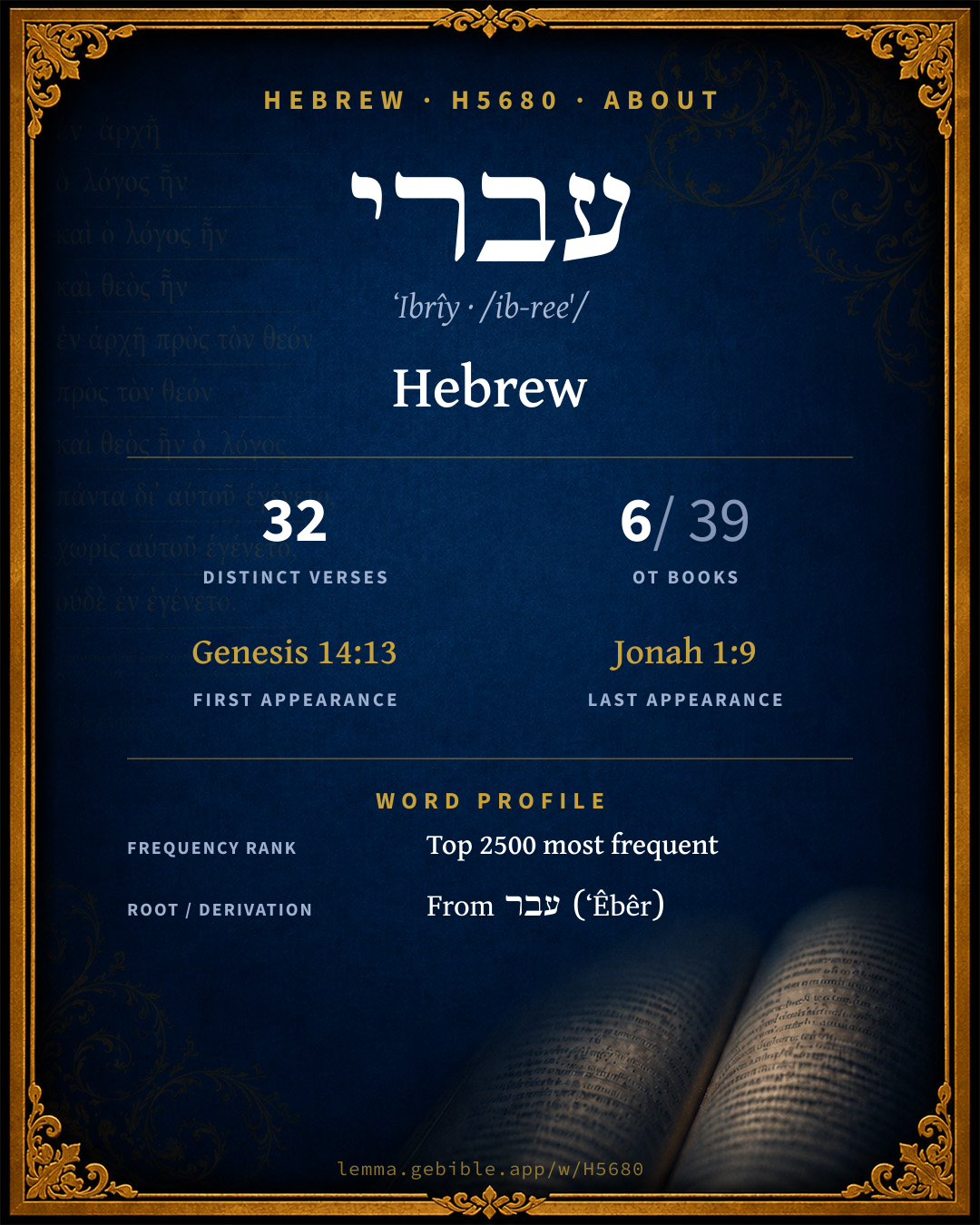
עִבְרִי
Hebrew
BDB lists 3 entries for ‘Hebrew’ fuller range ↓
Full lexicon entry — Brown-Driver-Briggs (BDB)
From Brown-Driver-Briggs (BDB)
Where this word appears
Grammar key — what these labels mean
Part of speech
- Noun
- A naming word — a person, place, thing, or idea.
Noun type
- Gentilic
- A noun naming a member of a people, tribe, or region of origin (e.g. an Israelite, a Moabite).
State
- Absolute
- The independent form of a noun, not bound to a following word.
Gender
- Masculine
- Grammatically masculine.
- Feminine
- Grammatically feminine.
Number
- Plural
- More than one (in Hebrew, generally three or more).
- Singular
- One.
Every verse where H5680 appears in the Book of 1 Samuel — 8 distinct verses. Click any verse to open its interlinear word-by-word view. Verse text shown in the World English Bible for context — . Each verse’s Hebrew form is shown with its reference; the English is not keyword-highlighted, since the data carries no word-level English alignment. Use “Compare translations” on any verse to read it across multiple English versions. This concordance covers the Hebrew Bible; Septuagint (Greek Old Testament) occurrences are not indexed here.
1 Samuel
- 1 Samuel 4:6 הָ/עִבְרִ֑ים ptcl def.art + n Gentilic mp When the Philistines heard the noise of the shout, they said, What means the noise of this great shout in the camp of the Hebrews? They understood that the ark of Yahweh was come into the camp.
- 1 Samuel 4:9 לָ/עִבְרִ֔ים prep det + n Gentilic mp Be strong, and behave yourselves like men, O you Philistines, that you not be servants to the Hebrews, as they have been to you: quit yourselves like men, and fight.
- 1 Samuel 13:3 הָ/עִבְרִֽים ptcl def.art + n Gentilic mp Jonathan struck the garrison of the Philistines that was in Geba: and the Philistines heard of it. Saul blew the trumpet throughout all the land, saying, Let the Hebrews hear.
- 1 Samuel 13:7 וְ/עִבְרִ֗ים conj + n Gentilic mp Now some of the Hebrews had gone over the Jordan to the land of Gad and Gilead; but as for Saul, he was yet in Gilgal, and all the people followed him trembling.
- 1 Samuel 13:19 הָ/עִבְרִ֔ים ptcl def.art + n Gentilic mp Now there was no smith found throughout all the land of Israel; for the Philistines said, Lest the Hebrews make them swords or spears:
- 1 Samuel 14:11 עִבְרִים֙ n Gentilic mp Both of them disclosed themselves to the garrison of the Philistines: and the Philistines said, Behold, the Hebrews come forth out of the holes where they had hid themselves.
- 1 Samuel 14:21 וְ/הָ/עִבְרִ֗ים conj + ptcl def.art + n Gentilic mp Now the Hebrews who were with the Philistines as before, and who went up with them into the camp, [from the country] round about, even they also [turned] to be with the Israelites who were with Saul and Jonathan.
- 1 Samuel 29:3 הָ/עִבְרִ֣ים ptcl def.art + n Gentilic mp Then said the princes of the Philistines, What [do] these Hebrews [here]? Achish said to the princes of the Philistines, Isn't this David, the servant of Saul the king of Israel, who has been with me these days, or [rather] these years, and I have found no fault in him since he fell away [to me] to this day?
About this entry
At a glance — auto-summarized from this page’s data, not written by a person. Every figure links to its source below. This summary describes the numbers; it doesn’t interpret them.
“Hebrew” is the headline sense of the Hebrew name עברי (ʻIbrîy). First canonically at Genesis 14:13, it enters the text early. The Hebrew Bible uses it across 32 verses — moderately common. More than a third of its appearances fall in Exodus. See 32-verse concordance and the renderings breakdown below.
Gloss history
Strong's 1890 vs modern scholarship
About this word
Strong's H5680 catalogs a Hebrew word from the Hebrew Old Testament.
These counts are not copied from any lexicon or concordance. They are computed here, from the morphology-tagged Hebrew Old Testament. What Lemma adds →
- 32
- distinct verses
- The word appears in 32 distinct verses.
- 6 / 39
- OT books
- The word appears in 6 of 39 Old Testament books.
- #1,041
- by frequency
- Top 2500 most frequent Hebrew words (rank 1,041 of 8,640 Hebrew words by occurrence).
View all 32 occurrences in the concordance →
By section of the Old Testament
By traditional corpus
Conventional, traditional groupings — biblical authorship is debated, so this is a traditional corpus grouping, not an authorship claim. Each share is this word’s portion of its verses in that division of the Hebrew canon. Each figure is a share of the word’s 32 distinct verses.
- Torah (Pentateuch) 21 verses · 66%
- Prophets (Nevi'im) 11 verses · 34%
How translations render this word
Counts come from each version’s own published word-to-Strong’s tagging or interlinear alignment — an approximate guide to how each version renders this word, not a word-level alignment the data otherwise carries. Because each total is that version’s own tagged count, the per-version totals vary from one another and need not match the appearance or distinct-verse counts above. These counts may also differ from a printed concordance because Lemma counts each distinctly tagged rendering and does not collapse phrase taggings into a single head-word total. This is a fixed set of word-tagged versions (KJV, ASV, BSB, ULT) and does not change with the reading translation you choose elsewhere. Each version’s license is shown beside its name below (and on Sources).
BDB lists this Strong’s number as 2 distinct words (homographs). Each count above pools all of them and is not split by sense — see the Senses section below. A low-frequency rendering may belong to a different one of those words, not the primary meaning.
- King James Version†: Hebrews 11×, Hebrew 9×
- American Standard Version†: Hebrews 11×, Hebrew 8×, Is a hebrew 2×
- Berean Standard Bible†: Hebrews 15×, Hebrew 13×
- unfoldingWord Literal Text†: Hebrews 17×, Hebrew 9×
King James Version Public Domain
Renders H5680 across 33† tagged occurrences — most commonly:
Plus 13 renderings that appear only once — usually multi-word phrases or single function words the recovered tagging swept in, not distinct renderings. Not rendered by a distinct English word in 1 further occurrence.
American Standard Version Public Domain
Renders H5680 across 33† tagged occurrences — most commonly:
Plus 12 renderings that appear only once — usually multi-word phrases or single function words the recovered tagging swept in, not distinct renderings.
Berean Standard Bible Public Domain
Renders H5680 across 34† tagged occurrences — most commonly:
Plus 6 renderings that appear only once — usually multi-word phrases or single function words the recovered tagging swept in, not distinct renderings.
unfoldingWord Literal Text CC BY-SA 4.0
Renders H5680 across 32† tagged occurrences — most commonly:
Plus 6 renderings that appear only once — usually multi-word phrases or single function words the recovered tagging swept in, not distinct renderings.
8 senses and sub-senses in the full BDB
What do BDB’s symbols mean?
BDB uses these scholarly abbreviations:
| Symbol | Meaning |
|---|---|
| 𝔊 | the Septuagint (the ancient Greek translation, LXX) |
| 𝔙 | the Vulgate (the Latin translation) |
| 𝔖 | the Syriac version (the Peshitta) |
| 𝔗 | the Targum (the Aramaic translation) |
| ψ | the Psalms |
| √ | root (the underlying root or stem) |
| ‖ | parallel passage (a synonymous or contrasted parallel) |
| † | the dagger: every passage where the word occurs is cited |
The 8 senses and sub-senses the full Brown-Driver-Briggs lexicon distinguishes for this word, in lexicon order (not ranked by frequency), with BDB’s own verbatim wording and sub-sense lettering. Shown in Hebrew script with BDB’s own scholarly abbreviations. The condensed entry is in the Lexicon Entry tab. See also the Forms in the corpus table below.
עברי I Hebrew, either
- a. put into the mouth of foreigners (Egyptian and Philist.), or
- b. used to distinguish Isr. from foreigners ( = one from beyond, from the other side, i.e. prob. (in Heb. trad.) from beyond the Euphrates (cf. Jos 24:2, 3 E), but poss. in fact (if name given in Canaan) from beyond the Jordan; cf. Ges§ 2 bSta§ 1 b Köi. 18 ff. WeIsr. u. Jüd. Gesch. 7 Kau‘Eber’ and ‘Hebräer’ in RiHWB 332, 600.—On connexion of ע׳ (in wide sense) with Ḫabirû (Tel Am.) v. WklGesch. Isr. 17 ff.; Sem. Studies in Mem. of Kohut, 605 ff. EMeyAegyptica [Ebers], 75 cf. GlaserMVG 1897, 255 ff. KöExp. Times xi. 238; opp. JastrJBL xi (1892), 118 ff. SayMonuments 188, 333 WMMAs. u. Eur. 396);—ms. ע׳ Gn 39:14 +; fs. עִבְרִיָּה Dt 15:12 Je 34:9; mpl. עִבְרִים Gn 43:32 +, עִבְרִיִּים Ex 3:18; fpl. עִבְרִיֹּת Ex 1:15 + 2 times, -וֹת 1:16; word not in P;— e.g. Joshua 24:2
- 1. adj.
- a. אִישׁ עִבְרִי Gn 39:14 cf. v 17 (both J), 41:12 (E). e.g. Genesis 39:14
- b. אִישׁ עִבְרִי Ex 2:11 cf. v 13; 21:2 (all E), Dt 15:12; Je 34:9, 14; f. Dt 15:12; Je 34:9. e.g. Exodus 2:11
- 2. n.
- a. Ex 1:16, 19; 2:7 (all f.) 2:6 (all E), 1 S 4:6, 9; 13:19; 14:11; 29:3. e.g. Exodus 1:16
- b. Gn 40:15 Ex 1:15 (f.; both E), 1 S 13:3; 14:21; Gn 43:32 (J); especially in אֱלֹהֵי הָעִבְרִים Ex 3:18; 5:3; 7:16; 9:1, 13; 10:3 (all J); sg. only אַבְרָם הָע׳ Gn 14:13, ע׳ אָנֹ֑כִי Jon 1:9.—𝔊 Ἐβραῖος, Ἐβραία, Gn 14:13 τῷ περάτῃ.—1 S 13:7 read prob. for וְעִבְרִים וגו׳, וְעָֽבְרוּ מַעְבְּרוֹת הַיַּרְדֵּן (We), or, better, וַיַּעַבְרוּ Dr Kit Löhr; > וְעַם רַב Klo Bu HPS. e.g. Genesis 40:15
עברי II m. Levite name, 1 Ch 24
Senses from the full Brown-Driver-Briggs lexicon (Brown, Driver, Briggs; Oxford 1906 — public domain), digitized via Sefaria, supplemented by the OpenScriptures HebrewLexicon (CC BY 4.0). Full attribution on Sources.
Word origin
I. adj. et n. gent. Hebrew, either
II. n.pr.m. Levite name, 1 Ch 24:27; 𝔊 Αβαι, A Ωβδι, 𝔊L Αβαρια.
— Brown-Driver-Briggs (Oxford 1906, public domain), digitized via Sefaria, supplemented by the OpenScriptures HebrewLexicon (CC BY 4.0). See Sources.
Derived from עבר (ʻÊbêr) (H5677) — Eber.
Jastrow Dictionary
A second Hebrew/Aramaic lexicon for comparison, covering Aramaic and post-biblical (Talmudic, Targumic, Midrashic) usage that the biblical-Hebrew BDB does not. Matched by lemma rather than by Strong’s number, so a lemma may carry more than one Jastrow headword (shown separately below), and the entries cover usage well beyond the Bible.
עַבְּרָא
- (עֲבַר Pa.) bar, bolt. Targ. O. Ex. XXVI, 28 (ed. Berl. עָבְרָא). Targ. Jud. XVI, 3 (ed. Wil. עִבְּרָא).—Erub. 102ᵃ, a. fr. עִיבְּרָא דרשא the door bolt.—Pl. עַבְּרִין, עַבְּרִי Targ. O. Ex. XXVI, 26, sq.; a. e.
עִבְרִי
- (b. h.) Hebrew; (לשין) ע׳ Hebrew language; (כתב) ע׳ Hebrew character, type. Kidd. I, 2 עבד ע׳ a Hebrew slave; אמה הע׳ a Hebrew handmaid. Gen. R. s. 42 ומשיח בלשון ע׳, v. עֵבֶר II. Gitt. IX, 6 עד אחד עברי וכ׳ if one witness signed in Hebrew type, and the other in Greek, and again one in Hebrew &c. Ib. 8 גט שכתבו עברית וכ׳ if a letter of divorce was written in Hebrew, and its witnesses signed in Greek. Y. Meg. I, 71ᵇ bot.; Esth. R. to I, 22, a. e. ע׳ לדיבור the Hebrew language is adapted for oratory; a. fr.—Meg. 18ᵃ קראה … עברית if he read the Megillah in a trans-Euphratean (Aramaic) translation.—Pl. עִבְרִים, עִבְרִיִּים; f. עִבְרִיּוֹת. Ib. עברית לע׳ an Aramaic translation read before Aramæan Jews. Ex. R. s. 3 למה קורא אותם ע׳ על שם שעברו ים why does he call them ‘Ibriim (Ex. III, 18)? Because they passed the sea (on going to Egypt). Ex. R. s. 1. Pesik. R. s. 23; a. fr. e.g. Exodus 3:18
עִבְרַי
- Targ. Gen. XIV, 13 (Y. ed. Vien. עיברא, corr. acc.). Ib. XXXIX, 14; 17 (not עִבְרָאֵי); a. fr.—Pl. עִבְרָאֵי, עִי׳. Ib. XL, 15; a. fr.—[Targ. Num. XXVII, 12; Targ. Deut. XXXII, 49 טורא דעִ׳ ed. Berl. (ed. Vien. עֲבָרָאֵי, עַבְרָאֵי; h. text הַר הָעֲבָרִים.]—Pesik. Vayhi, p. 65ᵃ; Pesik. R. s. 17; a. fr.
A Dictionary of the Targumim, the Talmud Babli and Yerushalmi, and the Midrashic Literature (Marcus Jastrow; London, Luzac, 1903) — Public Domain. Digitized via Sefaria. Digitized via Sefaria. Full attribution on Sources.
Forms in the corpus
The 29 distinct written forms H5680 takes in the Hebrew Bible, most frequent first — each parse links to that state’s occurrences in the concordance. Hebrew forms include their vowel points and cantillation, so a single lemma takes many written forms.
| Form | Parsing | Example | Uses |
|---|---|---|---|
| הָֽ/עִבְרִ֔ים | Noun, Gentilic, Masculine, Plural, Absolute | Exodus 9:1 | 3 |
| הָ/עִבְרִ֑ים | Noun, Gentilic, Masculine, Plural, Absolute | Genesis 40:15 | 2 |
| הָֽ/עִבְרִיֹּ֑ת | Noun, Gentilic, Feminine, Plural, Absolute | Exodus 1:15 | 2 |
| עִבְרִ֖י | Noun, Gentilic, Masculine, Singular, Absolute | Exodus 2:11 | 2 |
| הָ/עִבְרִ֑י | Noun, Gentilic, Masculine, Singular, Absolute | Genesis 14:13 | 1 |
| הָ/עִבְרִ֔ים | Noun, Gentilic, Masculine, Plural, Absolute | 1 Samuel 13:19 | 1 |
| הָ/עִבְרִ֖ים | Noun, Gentilic, Masculine, Plural, Absolute | Exodus 5:3 | 1 |
| הָ/עִבְרִ֜י | Noun, Gentilic, Masculine, Singular, Absolute | Jeremiah 34:14 | 1 |
| הָ/עִבְרִ֣ים | Noun, Gentilic, Masculine, Plural, Absolute | 1 Samuel 29:3 | 1 |
| הָ/עִבְרִ֥י | Noun, Gentilic, Masculine, Singular, Absolute | Jeremiah 34:9 | 1 |
| הָ/עִבְרִֽים | Noun, Gentilic, Masculine, Plural, Absolute | 1 Samuel 13:3 | 1 |
| הָ/עִבְרִיֹּ֑ת | Noun, Gentilic, Feminine, Plural, Absolute | Exodus 2:7 | 1 |
| הָ/עִבְרִים֙ | Noun, Gentilic, Masculine, Plural, Absolute | Exodus 7:16 | 1 |
| הָֽ/עִבְרִ֖ים | Noun, Gentilic, Masculine, Plural, Absolute | Exodus 2:6 | 1 |
| הָֽ/עִבְרִ֗י | Noun, Gentilic, Masculine, Singular, Absolute | Deuteronomy 15:12 | 1 |
| הָֽ/עִבְרִ֛י | Noun, Gentilic, Masculine, Singular, Absolute | Genesis 39:17 | 1 |
| הָֽ/עִבְרִיּ֔וֹת | Noun, Gentilic, Feminine, Plural, Absolute | Exodus 1:16 | 1 |
| הָֽ/עִבְרִיִּים֙ | Noun, Gentilic, Masculine, Plural, Absolute | Exodus 3:18 | 1 |
| הָֽ/עִבְרִיָּ֔ה | Noun, Gentilic, Feminine, Singular, Absolute | Deuteronomy 15:12 | 1 |
| הָֽ/עִבְרִים֙ | Noun, Gentilic, Masculine, Plural, Absolute | Genesis 43:32 | 1 |
| וְ/הָ/עִבְרִ֗ים | Noun, Gentilic, Masculine, Plural, Absolute | 1 Samuel 14:21 | 1 |
| וְ/הָ/עִבְרִיָּ֖ה | Noun, Gentilic, Feminine, Singular, Absolute | Jeremiah 34:9 | 1 |
| וְ/עִבְרִ֗ים | Noun, Gentilic, Masculine, Plural, Absolute | 1 Samuel 13:7 | 1 |
| לָ/עִבְרִ֔ים | Noun, Gentilic, Masculine, Plural, Absolute | 1 Samuel 4:9 | 1 |
| עִבְרִ֔י | Noun, Gentilic, Masculine, Singular, Absolute | Exodus 21:2 | 1 |
| עִבְרִ֖ים | Noun, Gentilic, Masculine, Plural, Absolute | Exodus 2:13 | 1 |
| עִבְרִ֗י | Noun, Gentilic, Masculine, Singular, Absolute | Genesis 41:12 | 1 |
| עִבְרִ֣י | Noun, Gentilic, Masculine, Singular, Absolute | Jonah 1:9 | 1 |
| עִבְרִים֙ | Noun, Gentilic, Masculine, Plural, Absolute | 1 Samuel 14:11 | 1 |
Same root — word family
Other BDB entries built from the same root as H5680, grouped by Strong’s listed origin. These share a root / origin per the lexicon — not necessarily a shared meaning. Each links to that word’s own entry.
Derives from
Proper names from this root
People and places named from this root — a name, not an additional meaning of the word.
Compare all same-root words → 3 of the same-root words are proper names (people or places). They share a root, not necessarily a meaning.
Bible dictionary
Public-domain dictionary articles matched to this entry by name (Hebrew). A biblical name can be shared by more than one person or place, so an article may treat several.
Easton's Bible Dictionary · M. G. Easton, 1897
A name applied to the Israelites in Scripture only by one who is a foreigner (Gen. 39:14, 17; 41:12, etc.), or by the Israelites when they speak of themselves to foreigners (40:15; Ex. 1:19), or when spoken of an contrasted with other peoples (Gen. 43:32; Ex. 1:3, 7, 15; Deut. 15:12). In the New Testament there is the same contrast between Hebrews and foreigners (Acts 6:1; Phil. 3:5).
Derivation. (1.) The name is derived, according to some, from Eber (Gen. 10:24), the ancestor of Abraham. The Hebrews are "sons of Eber" (10:21).
(2.) Others trace the name of a Hebrew root-word signifying "to pass over," and hence regard it as meaning "the man who passed over," viz., the Euphrates; or to the Hebrew word meaning "the region" or "country beyond," viz., the land of Chaldea. This latter view is preferred. It is the more probable origin of the designation given to Abraham coming among the Canaanites as a man from beyond the Euphrates (Gen. 14:13).
(3.) A third derivation of the word has been suggested, viz., that it is from the Hebrew word 'abhar, "to pass over," whence 'ebher, in the sense of a "sojourner" or "passer through" as distinct from a "settler" in the land, and thus applies to the condition of Abraham (Heb. 11:13).
Smith's Bible Dictionary · William Smith, 1863
This word first occurs as given to Abram by the Canaanites, (Genesis 4:13) because he had crossed the Euphrates. The name is also derived from Eber, "beyond, on the other side," Abraham and his posterity being called Hebrews in order to express a distinction between the races east and west of the Euphrates. It may also be derived from Heber, one of the ancestors of Abraham. (Genesis 10:24) The term Israelite was used by the Jews of themselves among themselves; the term Hebrew was the name by which they were known to foreigners. The latter was accepted by the Jews in their external relations; and after the general substitution of the word Jew, it still found a place in that marked and special feature of national contradistinction, the language.
Classic public-domain reference works; full attribution on Sources.
Septuagint verse parallels
This word appears in 32 verses that also exist in the Greek Old Testament (Septuagint), out of the 32 Hebrew verses it occurs in. You can read those verses in Greek by switching the Old Testament edition to the Septuagint.
Read these verses in the Septuagint
This is a verse-level parallel only — the same verses exist in both the Hebrew and Greek Old Testaments. No word-level Hebrew↔Greek correspondence is claimed: the data carries no such alignment, so no Greek word is shown as this Hebrew word’s translation. Coverage is not total — the Septuagint omits the deuterocanon and renumbers the Psalms, so some Hebrew verses have no direct Greek parallel.