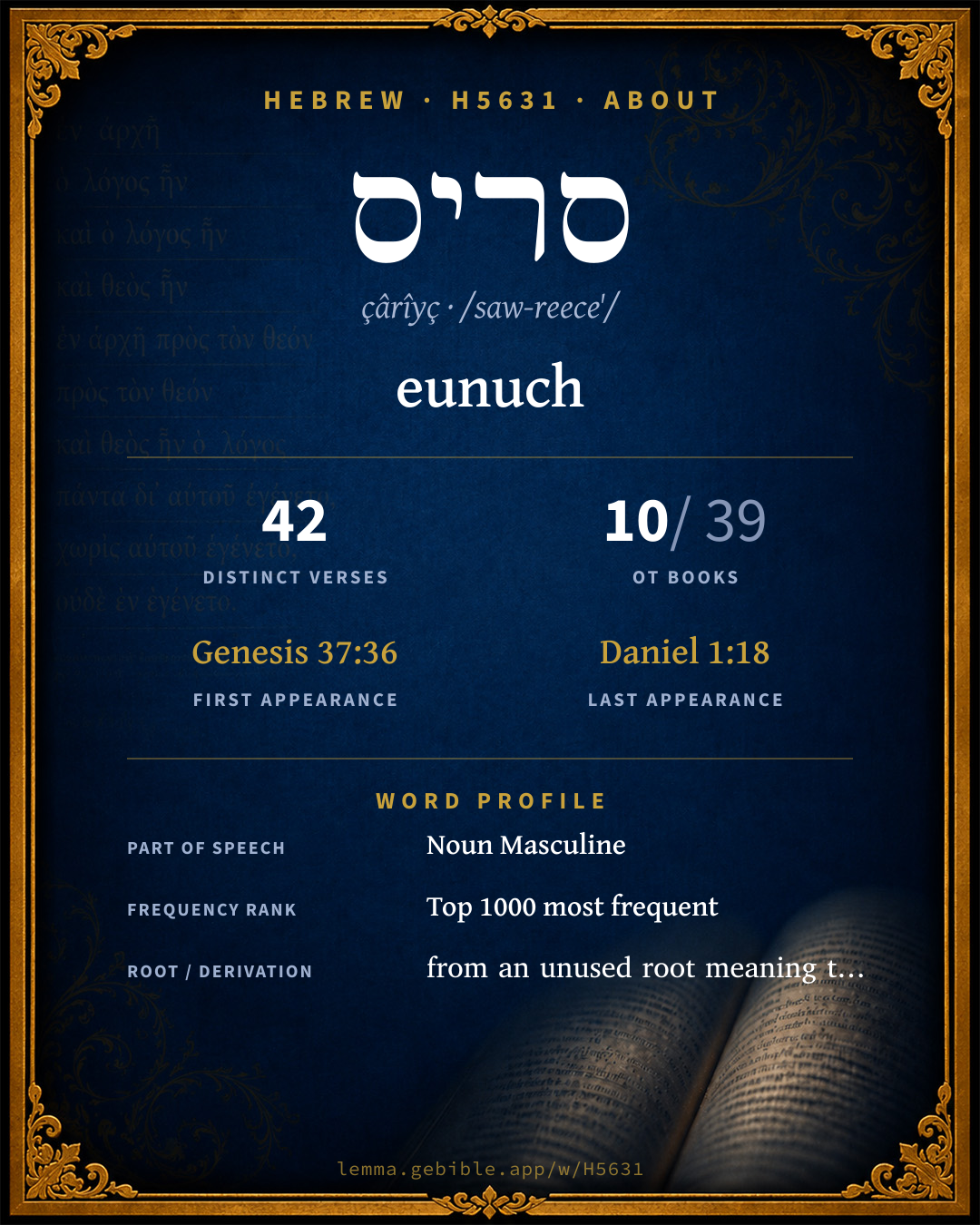
סָרִיס
eunuch
Full lexicon entry — Brown-Driver-Briggs (BDB)
From Brown-Driver-Briggs (BDB)
Where this word appears
See every Absolute-state word in the Hebrew Bible →
Grammar key — what these labels mean
Part of speech
- Noun
- A naming word — a person, place, thing, or idea.
Noun type
- Common
- A common noun — a general class of person, place, or thing (“king,” “city,” “water”), not a specific name.
State
- Absolute
- The independent form of a noun, not bound to a following word.
- Construct
- A noun bound to a following noun in a possessive / “of” relationship (the construct chain).
Gender
- Masculine
- Grammatically masculine.
Number
- Plural
- More than one (in Hebrew, generally three or more).
- Singular
- One.
Grammatical forms
- Noun, Common, Masculine, Plural, Absolute 18 times (43%)
- Noun, Common, Masculine, Plural, Construct 11 times (26%)
- Noun, Common, Masculine, Singular, Absolute 8 times (19%)
- Noun, Common, Masculine, Singular, Construct 5 times (12%)
Parsed forms decoded from the imported morphology (morphhb / Westminster Leningrad Codex — WLC text public domain, morphhb tagging CC BY 4.0), counted across 42 parsed occurrences — not distinct verses.
Every verse where H5631 appears — 42 distinct verses across 10 books. Click any verse to open its interlinear word-by-word view. Verse text shown in the World English Bible for context — . Each verse’s Hebrew form is shown with its reference; the English is not keyword-highlighted, since the data carries no word-level English alignment. Use “Compare translations” on any verse to read it across multiple English versions. This concordance covers the Hebrew Bible; Septuagint (Greek Old Testament) occurrences are not indexed here.
Genesis 4 verses
- Genesis 37:36 סְרִ֣יס n c ms cs The Midianites sold him into Egypt to Potiphar, an officer of Pharaoh's, the captain of the guard.
- Genesis 39:1 סְרִ֨יס n c ms cs Joseph was brought down to Egypt. Potiphar, an officer of Pharaoh's, the captain of the guard, an Egyptian, bought him from the hand of the Ishmaelites that had brought him down there.
- Genesis 40:2 סָרִיסָ֑י/ו n c mp cs + sfx pers 3ms Pharaoh was angry with his two officers, the chief cupbearer and the chief baker.
- Genesis 40:7 סְרִיסֵ֣י n c mp cs He asked Pharaoh's officers who were with him in custody in his master's house, saying, "Why do you look so sad today?"
1 Samuel 1 verse
1 Kings 1 verse
2 Kings 7 verses
- 2 Kings 8:6 סָרִ֨יס n c ms When the king asked the woman, she told him. So the king appointed to her a certain officer, saying, Restore all that was hers, and all the fruits of the field since the day that she left the land, even until now.
- 2 Kings 9:32 סָרִיסִֽים n c mp He lifted up his face to the window, and said, Who is on my side? who? There looked out to him two or three eunuchs.
- 2 Kings 20:18 סָֽרִיסִ֔ים n c mp Of your sons who shall issue from you, whom you shall father, shall they take away; and they shall be eunuchs in the palace of the king of Babylon.
- 2 Kings 23:11 הַ/סָּרִ֔יס ptcl def.art + n c ms He took away the horses that the kings of Judah had given to the sun, at the entrance of the house of Yahweh, by the chamber of Nathan-melech the chamberlain, which was in the precincts; and he burned the chariots of the sun with fire.
- 2 Kings 24:12 וְ/סָֽרִיסָ֑י/ו conj + n c mp cs + sfx pers 3ms and Jehoiachin the king of Judah went out to the king of Babylon, he, and his mother, and his servants, and his princes, and his officers: and the king of Babylon took him in the eighth year of his reign.
- 2 Kings 24:15 סָרִיסָ֗י/ו n c mp cs + sfx pers 3ms He carried away Jehoiachin to Babylon; and the king's mother, and the king's wives, and his officers, and the chief men of the land, carried he into captivity from Jerusalem to Babylon.
- 2 Kings 25:19 סָרִ֨יס n c ms and out of the city he took an officer who was set over the men of war; and five men of those who saw the king's face, who were found in the city; and the scribe, the captain of the host, who mustered the people of the land; and sixty men of the people of the land, who were found in the city.
1 Chronicles 1 verse
2 Chronicles 1 verse
Esther 12 verses
- Esther 1:10 הַ/סָּ֣רִיסִ֔ים ptcl def.art + n c mp On the seventh day, when the heart of the king was merry with wine, he commanded Mehuman, Biztha, Harbona, Bigtha, and Abagtha, Zethar, and Carcass, the seven chamberlains who ministered in the presence of Ahasuerus the king,
- Esther 1:12 הַ/סָּרִיסִ֑ים ptcl def.art + n c mp But the queen Vashti refused to come at the king's commandment by the chamberlains: therefore was the king very angry, and his anger burned in him.
- Esther 1:15 הַ/סָּרִיסִֽים ptcl def.art + n c mp What shall we do to the queen Vashti according to law, because she has not done the bidding of the king Ahasuerus by the chamberlains?
- Esther 2:3 סְרִ֥יס n c ms cs and let the king appoint officers in all the provinces of his kingdom, that they may gather together all the beautiful young virgins to Shushan the palace, to the house of the women, to the custody of Hegai the king's chamberlain, keeper of the women; and let their things for purification be given them;
- Esther 2:14 סְרִ֥יס n c ms cs In the evening she went, and on the next day she returned into the second house of the women, to the custody of Shaashgaz, the king's chamberlain, who kept the concubines: she came in to the king no more, except the king delighted in her, and she were called by name.
- Esther 2:15 סְרִיס n c ms cs Now when the turn of Esther, the daughter of Abihail the uncle of Mordecai, who had taken her for his daughter, was come to go in to the king, she required nothing but what Hegai the king's chamberlain, the keeper of the women, appointed. Esther obtained favor in the sight of all those who looked at her.
- Esther 2:21 סָרִיסֵ֤י n c mp cs In those days, while Mordecai was sitting in the king's gate, two of the king's chamberlains, Bigthan and Teresh, of those who kept the threshold, were angry, and sought to lay hands on the king Ahasuerus.
- Esther 4:4 וְ/סָרִיסֶ֨י/הָ֙ conj + n c mp cs + sfx pers 3fs Esther's maidens and her chamberlains came and told it her; and the queen was exceedingly grieved: and she sent clothing to clothe Mordecai, and to take his sackcloth from off him; but he didn't receive it.
- Esther 4:5 מִ/סָּרִיסֵ֤י prep + n c mp cs Then called Esther for Hathach, one of the king's chamberlains, whom he had appointed to attend on her, and charged him to go to Mordecai, to know what this was, and why it was.
- Esther 6:2 סָרִיסֵ֣י n c mp cs It was found written that Mordecai had told of Bigthana and Teresh, two of the king's chamberlains, of those who kept the threshold, who had sought to lay hands on the king Ahasuerus.
- Esther 6:14 וְ/סָרִיסֵ֥י conj + n c mp cs While they were yet talking with him, came the king's chamberlains, and hurried to bring Haman to the banquet that Esther had prepared.
- Esther 7:9 הַ/סָּרִיסִ֜ים ptcl def.art + n c mp Then said Harbonah, one of the chamberlains who were before the king, Behold also, the gallows fifty cubits high, which Haman has made for Mordecai, who spoke good for the king, stands in the house of Haman. The king said, Hang him thereon.
Isaiah 3 verses
- Isaiah 39:7 סָרִיסִ֔ים n c mp Of your sons who shall issue from you, whom you shall father, shall they take away; and they shall be eunuchs in the palace of the king of Babylon.
- Isaiah 56:3 הַ/סָּרִ֔יס ptcl def.art + n c ms Neither let the foreigner, who has joined himself to Yahweh, speak, saying, Yahweh will surely separate me from his people; neither let the eunuch say, Behold, I am a dry tree.
- Isaiah 56:4 לַ/סָּֽרִיסִים֙ prep det + n c mp For thus says Yahweh of the eunuchs who keep my Sabbaths, and choose the things that please me, and hold fast my covenant:
Jeremiah 5 verses
- Jeremiah 29:2 וְ/הַ/סָּרִיסִ֜ים conj + ptcl def.art + n c mp (after that Jeconiah the king, and the queen-mother, and the eunuchs, [and] the princes of Judah and Jerusalem, and the craftsmen, and the smiths, were departed from Jerusalem),
- Jeremiah 34:19 הַ/סָּֽרִסִים֙ ptcl def.art + n c mp the princes of Judah, and the princes of Jerusalem, the eunuchs, and the priests, and all the people of the land, who passed between the parts of the calf;
- Jeremiah 38:7 סָרִ֗יס n c ms Now when Ebedmelech the Ethiopian, a eunuch, who was in the king's house, heard that they had put Jeremiah in the dungeon (the king then sitting in the gate of Benjamin),
- Jeremiah 41:16 וְ/סָ֣רִסִ֔ים conj + n c mp Then took Johanan the son of Kareah, and all the captains of the forces who were with him, all the remnant of the people whom he had recovered from Ishmael the son of Nethaniah, from Mizpah, after that he had killed Gedaliah the son of Ahikam, [to wit], the men of war, and the women, and the children, and the eunuchs, whom he had brought back from Gibeon:
- Jeremiah 52:25 סָרִ֨יס n c ms and out of the city he took an officer who was set over the men of war; and seven men of those who saw the king's face, who were found in the city; and the scribe of the captain of the host, who mustered the people of the land; and sixty men of the people of the land, who were found in the midst of the city.
Daniel 7 verses
- Daniel 1:3 סָרִיסָ֑י/ו n c mp cs + sfx pers 3ms The king spoke to Ashpenaz the master of his eunuchs, that he should bring in [certain] of the children of Israel, even of the seed royal and of the nobles;
- Daniel 1:7 הַ/סָּרִיסִ֖ים ptcl def.art + n c mp The prince of the eunuchs gave names to them: to Daniel he gave [the name of] Belteshazzar; and to Hananiah, [of] Shadrach; and to Mishael, [of] Meshach; and to Azariah, [of] Abednego.
- Daniel 1:8 הַ/סָּרִיסִ֔ים ptcl def.art + n c mp But Daniel purposed in his heart that he would not defile himself with the king's dainties, nor with the wine which he drank: therefore he requested of the prince of the eunuchs that he might not defile himself.
- Daniel 1:9 הַ/סָּרִיסִֽים ptcl def.art + n c mp Now God made Daniel to find kindness and compassion in the sight of the prince of the eunuchs.
- Daniel 1:10 הַ/סָּרִיסִים֙ ptcl def.art + n c mp The prince of the eunuchs said to Daniel, I fear my lord the king, who has appointed your food and your drink: for why should he see your faces worse looking than the youths who are of your own age? so would you endanger my head with the king.
- Daniel 1:11 הַ/סָּֽרִיסִ֔ים ptcl def.art + n c mp Then said Daniel to the steward whom the prince of the eunuchs had appointed over Daniel, Hananiah, Mishael, and Azariah:
- Daniel 1:18 הַ/סָּרִיסִ֔ים ptcl def.art + n c mp At the end of the days which the king had appointed for bringing them in, the prince of the eunuchs brought them in before Nebuchadnezzar.
About this entry
At a glance — auto-summarized from this page’s data, not written by a person. Every figure links to its source below. This summary describes the numbers; it doesn’t interpret them.
“eunuch” is the headline sense of the Hebrew noun סריס (çârîyç). First canonically at Genesis 37:36, it enters the text early. The Hebrew Bible uses it across 42 verses — moderately common. More than a quarter of its appearances fall in Esther. See the sense tree, 42-verse concordance, and the renderings breakdown below.
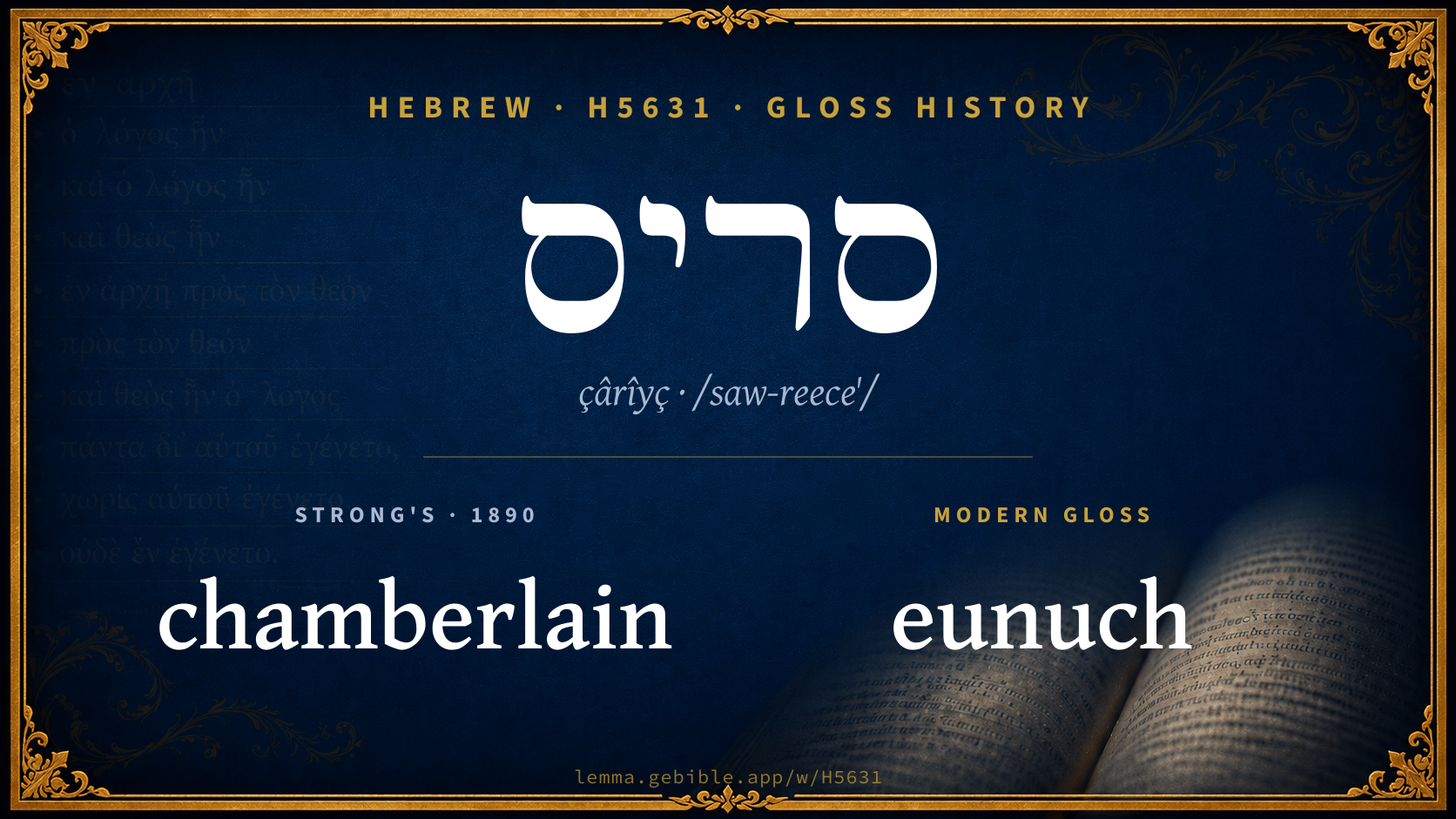
Gloss history
Strong's 1890 vs modern scholarship
About this word
Strong's H5631 catalogs a Hebrew word from the Hebrew Old Testament.
These counts are not copied from any lexicon or concordance. They are computed here, from the morphology-tagged Hebrew Old Testament. What Lemma adds →
- 42
- distinct verses
- The word appears in 42 distinct verses.
- 10 / 39
- OT books
- The word appears in 10 of 39 Old Testament books.
- #864
- by frequency
- Top 1000 most frequent Hebrew words (rank 864 of 8,640 Hebrew words by occurrence).
View all 42 occurrences in the concordance →
By section of the Old Testament
By traditional corpus
Conventional, traditional groupings — biblical authorship is debated, so this is a traditional corpus grouping, not an authorship claim. Each share is this word’s portion of its verses in that division of the Hebrew canon. Each figure is a share of the word’s 42 distinct verses.
- Writings (Ketuvim) 21 verses · 50%
- Prophets (Nevi'im) 17 verses · 40%
- Torah (Pentateuch) 4 verses · 10%
How translations render this word
Counts come from each version’s own published word-to-Strong’s tagging or interlinear alignment — an approximate guide to how each version renders this word, not a word-level alignment the data otherwise carries. Because each total is that version’s own tagged count, the per-version totals vary from one another and need not match the appearance or distinct-verse counts above. These counts may also differ from a printed concordance because Lemma counts each distinctly tagged rendering and does not collapse phrase taggings into a single head-word total. This is a fixed set of word-tagged versions (KJV, ASV, BSB, ULT) and does not change with the reading translation you choose elsewhere. Each version’s license is shown beside its name below (and on Sources).
- King James Version: Eunuchs 13×, Chamberlains 9×, Officers 7×
- American Standard Version: Eunuchs 11×, Officer 7×, Chamberlains 5×
- Berean Standard Bible: Eunuchs 13×, Official 6×, Officials 6×
- unfoldingWord Literal Text: Eunuchs 11×, Officials 10×, Eunuch 5×
King James Version Public Domain
Renders H5631 across 42 tagged occurrences — most commonly:
Plus 2 renderings that appear only once — usually multi-word phrases or single function words the recovered tagging swept in, not distinct renderings.
American Standard Version Public Domain
Renders H5631 across 42 tagged occurrences — most commonly:
Plus 5 renderings that appear only once — usually multi-word phrases or single function words the recovered tagging swept in, not distinct renderings.
Berean Standard Bible Public Domain
Renders H5631 across 41 tagged occurrences — most commonly:
Plus 3 renderings that appear only once — usually multi-word phrases or single function words the recovered tagging swept in, not distinct renderings. Not rendered by a distinct English word in 1 further occurrence.
unfoldingWord Literal Text CC BY-SA 4.0
Renders H5631 across 39 tagged occurrences — most commonly:
Plus 4 renderings that appear only once — usually multi-word phrases or single function words the recovered tagging swept in, not distinct renderings.
Senses in BDB
The 1 sense BDB distinguishes for this word, in lexicon order (not ranked by frequency or importance). The full entry — with sub-senses — is in the Lexicon Entry tab.
- official, eunuch
Word origin
n.m. eunuch (NH id., 𝔗 סָרִיסָא, Syriac ܣܳܪܝܣܳܐ (all c. vb. denom. = emasculate), Old Aramaic סרסא Lzb331 Cook86; Arabic سَرِسٌ, سَرِيسٌ (vb. سَرِسَ be impotent), Kam Frey (not Lane); prob. foreign word; according to JenZA vii. 174 = Assyrian ša rêši, he who is the head, chief, cf. BrockLex 239 b DlHWB 694 (ša-riš?), ZimZMG liii. 1899, 116; eunuch being specialized meaning; in any case Arabic is Aramaic loan-word);—abs. ס׳ 1 K 22:9 + 7 times; cstr. סְרִיס Gn 37:36 + 3 times; pl. סָרִיסִים 2 K 9:32 + 17 times; cstr. סְרִיסֵי Gn 40:7 סָֽרִיסֵי Est 2:21 +; sf. סָרִיסָיו Gn 40:2 + 4 times, סָרִיסֶ֫יהָ Est 4:4; eunuch, of Pharaoh Gn 37:36; 40:2, 7 (all E), married 39:1 (RJE); of Isr. kings 1 S 8:15 (predict.), 1 K 22:9 = 2 Ch 18:8; 2 K 8:6; 9:32 (all of N. Isr.); 1 Ch 28:1 (in David’s time), 2 K 23:11; 24:12, 15 cf. Je 29:2, also 34:19; 38:7; 41:16 (all in Judah; so likewise) 2 K 25:19 (military officer) = Je 52:25; of Bab. kings 2 K 20:18 = Is 39:7 (predict.); ascribed to Nebuch. in Dn, רַב סָרִיסָיו Dn 1:3, שַׂר הַסָּרִיסִים v 7, 8, 9, 10, 11, 18; to king of Persia in Est, 1:10, 12, 15 + 9 times Est; promises made to eunuchs Is 56:3, 4. (Term never used in law codes; on contrary cf. exclusion of פְּצוּעַ דַּכָּא, and כְּרוּת שָׁפְכָה Dt 23:2 [v. Drad loc.], also מְרוֹחַ אָ֑שֶׁךְ Lv 21:20.)—רַב־סָרִיס is title of high military officer 2 K 18:17 (Assyrian), Je 39:3, 13 (Bab.).—Vid. further, Thes SmithDB Art. ‘Eunuch,’ Di Gn 39:1 Dr Dt 23:1.
— Brown-Driver-Briggs (Oxford 1906, public domain), digitized via Sefaria, supplemented by the OpenScriptures HebrewLexicon (CC BY 4.0). See Sources.
Origin: from an unused root meaning to castrate
Jastrow Dictionary
A second Hebrew/Aramaic lexicon for comparison, covering Aramaic and post-biblical (Talmudic, Targumic, Midrashic) usage that the biblical-Hebrew BDB does not. Matched by lemma rather than by Strong’s number, so a lemma may carry more than one Jastrow headword (shown separately below), and the entries cover usage well beyond the Bible.
סָרִיס
- 1. (b. h.; impotent, castrate; eunuch. Yeb. VIII, 4 סְרִיס אדם one emasculated by man, a castrate, opp. to סְ׳ חמה, v. חַמָּה. Ib. 80ᵃ יביאו ראיה … והוא הס׳ they shall bring evidence that he is twenty years old (without showing the symptoms of maturity), and this is the legal saris. Ib. נעשה ס׳ למפרע he is considered as having been a saris at the time of the deed (and legally responsible), opp. קטן. Ib. סימני ס׳ וכ׳ persons with the symptoms of impotency … are not legally proceeded against (as responsible persons) until they are twenty years of age; a. v. fr.—Pl. סָרִיסִים, סָרִיסִין. Snh. 93ᵇ ס׳ ממש real castrates (סריס in the real sense). Deut. R. s. 3, v. סָרַח II; a. e.—[
- 2. (homilet., v. סָרַס II) mediator, manager. Num. R. s. 11; Cant. R. to III, 7, v. מוּפְלָא.]
A Dictionary of the Targumim, the Talmud Babli and Yerushalmi, and the Midrashic Literature (Marcus Jastrow; London, Luzac, 1903) — Public Domain. Digitized via Sefaria. Digitized via Sefaria. Full attribution on Sources.
Forms in the corpus
The 34 distinct written forms H5631 takes in the Hebrew Bible, most frequent first — each parse links to that state’s occurrences in the concordance. Hebrew forms include their vowel points and cantillation, so a single lemma takes many written forms.
Septuagint verse parallels
This word appears in 42 verses that also exist in the Greek Old Testament (Septuagint), out of the 42 Hebrew verses it occurs in. You can read those verses in Greek by switching the Old Testament edition to the Septuagint.
Read these verses in the Septuagint
- Genesis 37:36
- 1 Samuel 8:15
- 1 Kings 22:9
- 2 Kings 8:6
- 1 Chronicles 28:1
- 2 Chronicles 18:8
- Esther 1:10
- Isaiah 39:7
- Jeremiah 29:2
- Daniel 1:3
This is a verse-level parallel only — the same verses exist in both the Hebrew and Greek Old Testaments. No word-level Hebrew↔Greek correspondence is claimed: the data carries no such alignment, so no Greek word is shown as this Hebrew word’s translation. Coverage is not total — the Septuagint omits the deuterocanon and renumbers the Psalms, so some Hebrew verses have no direct Greek parallel.