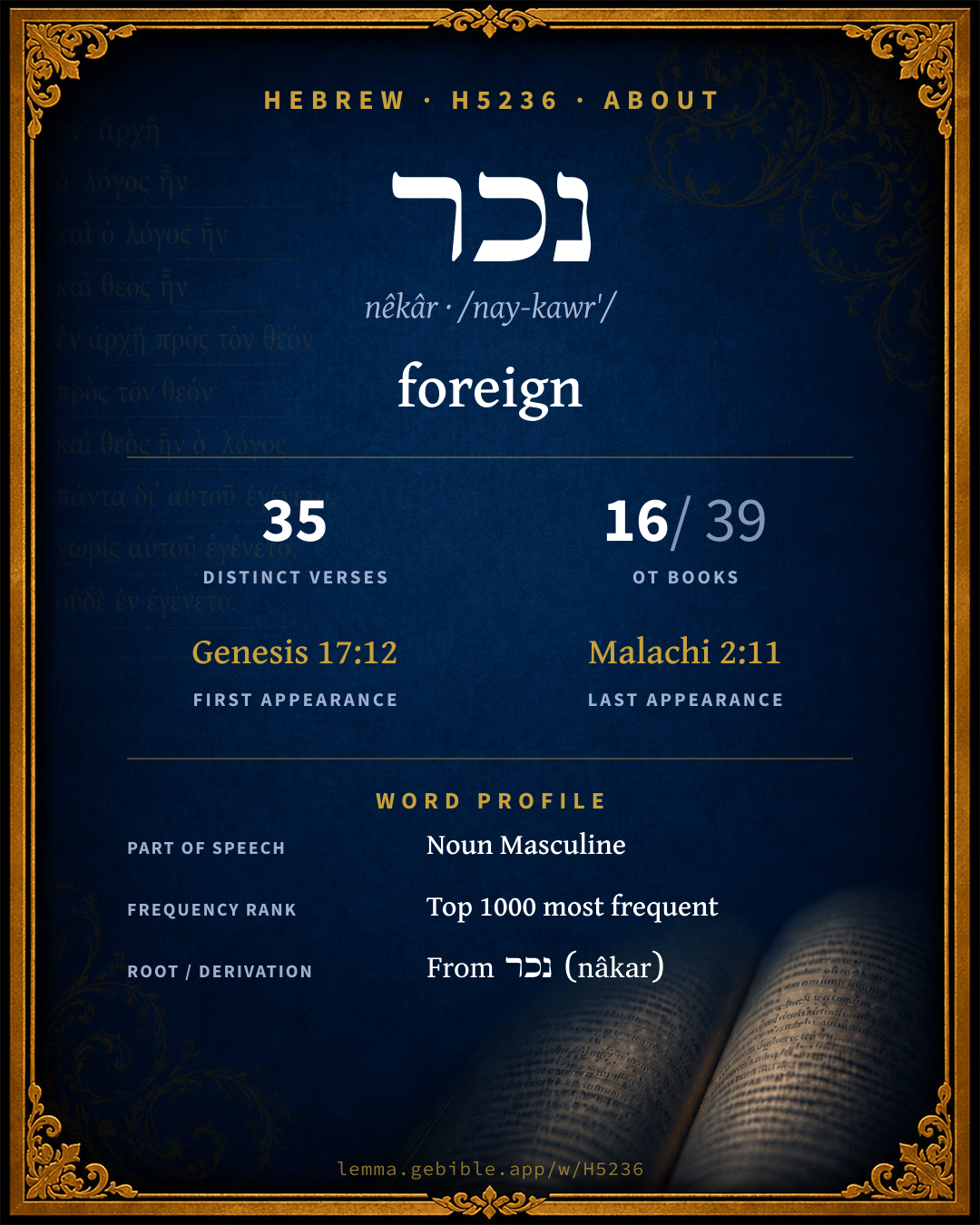
נֵכָר
foreign
also: alien, foreignness fuller range ↓
Full lexicon entry — Brown-Driver-Briggs (BDB)
From Brown-Driver-Briggs (BDB)
Where this word appears
Grammar key — what these labels mean
Part of speech
- Noun
- A naming word — a person, place, thing, or idea.
Noun type
- Common
- A common noun — a general class of person, place, or thing (“king,” “city,” “water”), not a specific name.
State
- Absolute
- The independent form of a noun, not bound to a following word.
- Construct
- A noun bound to a following noun in a possessive / “of” relationship (the construct chain).
Gender
- Masculine
- Grammatically masculine.
Number
- Singular
- One.
Every verse where H5236 appears in the Book of Joshua — 2 distinct verses. Click any verse to open its interlinear word-by-word view. Verse text shown in the World English Bible for context — . Each verse’s Hebrew form is shown with its reference; the English is not keyword-highlighted, since the data carries no word-level English alignment. Use “Compare translations” on any verse to read it across multiple English versions. This concordance covers the Hebrew Bible; Septuagint (Greek Old Testament) occurrences are not indexed here.
Joshua
- Joshua 24:20 נֵכָ֑ר n c ms If you forsake Yahweh, and serve foreign gods, then he will turn and do you evil, and consume you, after that he has done you good.
- Joshua 24:23 הַ/נֵּכָ֖ר ptcl def.art + n c ms Now therefore put away, [said he], the foreign gods which are among you, and incline your heart to Yahweh, the God of Israel.
About this entry
At a glance — auto-summarized from this page’s data, not written by a person. Every figure links to its source below. This summary describes the numbers; it doesn’t interpret them.
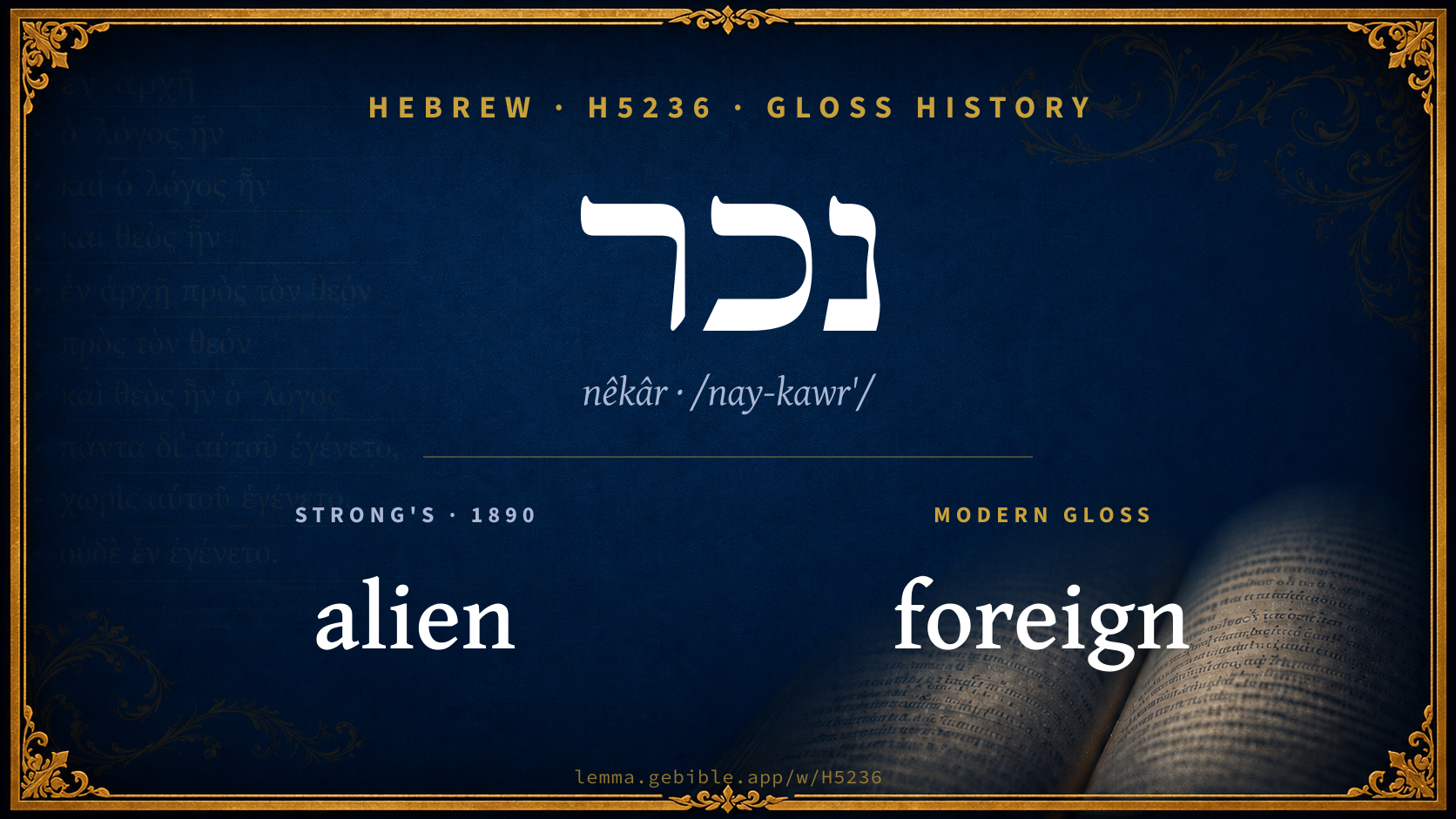
נכר (nêkâr) is a Hebrew noun most often rendered “foreign.” Its English rendering has broadened — “strange” classically, “foreign” (Berean Standard Bible) and “foreigner” (unfoldingWord Literal Text) in modern versions; see the renderings breakdown. The Hebrew Bible uses it across 35 verses — moderately common. It first appears in Genesis 17:12. Beyond its headline sense, its full sense range takes in “alien” and “foreignness”. The sections below give every sense, occurrence, and version rendering.
Gloss history
Strong's 1890 vs modern scholarship
About this word
Strong's H5236 catalogs a Hebrew word from the Hebrew Old Testament.
These counts are not copied from any lexicon or concordance. They are computed here, from the morphology-tagged Hebrew Old Testament. What Lemma adds →
- 35
- distinct verses
- The word appears in 35 distinct verses.
- 16 / 39
- OT books
- The word appears in 16 of 39 Old Testament books.
- #990
- by frequency
- Top 1000 most frequent Hebrew words (rank 990 of 8,640 Hebrew words by occurrence).
View all 35 occurrences in the concordance →
By section of the Old Testament
By traditional corpus
Conventional, traditional groupings — biblical authorship is debated, so this is a traditional corpus grouping, not an authorship claim. Each share is this word’s portion of its verses in that division of the Hebrew canon. Each figure is a share of the word’s 35 distinct verses.
- Prophets (Nevi'im) 16 verses · 46%
- Writings (Ketuvim) 11 verses · 31%
- Torah (Pentateuch) 8 verses · 23%
How translations render this word
Counts come from each version’s own published word-to-Strong’s tagging or interlinear alignment — an approximate guide to how each version renders this word, not a word-level alignment the data otherwise carries. Because each total is that version’s own tagged count, the per-version totals vary from one another and need not match the appearance or distinct-verse counts above. These counts may also differ from a printed concordance because Lemma counts each distinctly tagged rendering and does not collapse phrase taggings into a single head-word total. This is a fixed set of word-tagged versions (KJV, ASV, BSB, ULT) and does not change with the reading translation you choose elsewhere. Each version’s license is shown beside its name below (and on Sources).
- King James Version: Strange 13×, Stranger 3×, Strangers 2×
- American Standard Version: Foreign 8×, Foreigner 2×, Foreigners 2×
- Berean Standard Bible: Foreign 15×
- unfoldingWord Literal Text: Foreigner 17×, Foreign 9×, Foreignness 6×
King James Version Public Domain
Renders H5236 across 25 tagged occurrences — most commonly:
Plus 7 renderings that appear only once — usually multi-word phrases or single function words the recovered tagging swept in, not distinct renderings. Not rendered by a distinct English word in 10 further occurrences.
American Standard Version Public Domain
Renders H5236 across 23 tagged occurrences — most commonly:
Plus 9 renderings that appear only once — usually multi-word phrases or single function words the recovered tagging swept in, not distinct renderings.
Berean Standard Bible Public Domain
Renders H5236 across 19 tagged occurrences — most commonly:
Plus 4 renderings that appear only once — usually multi-word phrases or single function words the recovered tagging swept in, not distinct renderings. Not rendered by a distinct English word in 17 further occurrences.
unfoldingWord Literal Text CC BY-SA 4.0
Renders H5236 across 37 tagged occurrences — most commonly:
Plus 3 renderings that appear only once — usually multi-word phrases or single function words the recovered tagging swept in, not distinct renderings.
Senses in the full BDB
What do BDB’s symbols mean?
BDB uses these scholarly abbreviations:
| Symbol | Meaning |
|---|---|
| 𝔊 | the Septuagint (the ancient Greek translation, LXX) |
| 𝔙 | the Vulgate (the Latin translation) |
| 𝔖 | the Syriac version (the Peshitta) |
| 𝔗 | the Targum (the Aramaic translation) |
| ψ | the Psalms |
| √ | root (the underlying root or stem) |
| ‖ | parallel passage (a synonymous or contrasted parallel) |
| † | the dagger: every passage where the word occurs is cited |
The 3 senses and sub-senses the full Brown-Driver-Briggs lexicon distinguishes for this word, in lexicon order (not ranked by frequency), with BDB’s own verbatim wording and sub-sense lettering. Shown in Hebrew script with BDB’s own scholarly abbreviations. The condensed entry is in the Lexicon Entry tab. See also the Forms in the corpus table below.
- 1. אֱלֹהֵי (הַ)נֵּכָר = foreign gods Gn 35:2, 4; Jos 24:20, 23 (all E, = א׳ אֲחֵרִים of D, cf. אַחֵר), Ju 10:16; 1 S 7:3; Je 5:19; 2 Ch 33:15; א׳ נֵכַר־הָאָרֶץ Dt 31:16 = foreign gods of the land; sg. אֵל נֵכָר Dt 32:12; Mal 2:11 ψ 81:10; אֱלוֹהַּ נ׳ Dn 11:39. e.g. Genesis 35:2
- 2. בֶּן־(הַ)נֵּכָר = foreigner Gn 17:12 (‖ לֹא מִזַּרְעֲךָ), v 27 Ex 12:43 (all P), Lv 22:25 (H), Ez 44:9(×2) Ne 9:2; Is 56:3; בְּנֵי (ה)נ׳ 2 S 22:45, 46 = ψ 18:45, 46, Ez 44:7; Is 56:6; 60:10; 61:5; 62:8 ψ 144:7, 11. e.g. Genesis 17:12
- 3. other combin.: הַבְלֵי נ׳ Je 8:19 foreign vanities (idolatries); מִזְבְּחוֹת הַנּ׳ 2 Ch 14:2 foreign altars; אַדְמַת נ׳ ψ 137:4 foreign soil; מִכָּל־נ׳ Ne 13:30 from everything foreign. e.g. Jeremiah 8:19
Senses from the full Brown-Driver-Briggs lexicon (Brown, Driver, Briggs; Oxford 1906 — public domain), digitized via Sefaria, supplemented by the OpenScriptures HebrewLexicon (CC BY 4.0). Full attribution on Sources.
Word origin
n.[m.] that which is foreign, foreignness (on format. cf. LagBN 51, 154);—abs. נ׳ Ju 10:16 +, cstr. נֵכַר־ Dt 31:16;—foreignness (of another family, tribe, or nation), especially
— Brown-Driver-Briggs (Oxford 1906, public domain), digitized via Sefaria, supplemented by the OpenScriptures HebrewLexicon (CC BY 4.0). See Sources.
Derived from נכר (nâkar) (H5234) — to know.
Jastrow Dictionary
A second Hebrew/Aramaic lexicon for comparison, covering Aramaic and post-biblical (Talmudic, Targumic, Midrashic) usage that the biblical-Hebrew BDB does not. Matched by lemma rather than by Strong’s number, so a lemma may carry more than one Jastrow headword (shown separately below), and the entries cover usage well beyond the Bible.
נָכַר
- (b. h.) to be unknown, strange.
- 1. to recognize, know; to favor. Ruth R. to II, 10 (ref. to להכירני, ib.) נתנבאה … להַכִּירָהּ כדרך וכ׳ she prophesied that he would know her in the way of all people (as his wife, cmp. יָדַע). Ber. 10ᵇ האשה מַכֶּרֶת באורחין וכ׳ woman recognizes the character of guests better than man. R. Hash. II, 1 אם אינן מַכִּירִין אותו if the court does not know him personally. Y. Yeb. IV, 6ᵇ כנסה ולא הִכִּירָהּ he married her but did not touch her (v. supra). Snh. 7ᵇ (ref. to Deut. I, 17) לא תַכִּירֵהוּ thou shalt not favor him (if he is thy friend); a. fr.—Num. R. s. 9 במקום שמכיר where he knows (the people), where he is acquainted; Sifré Num. 14 במקום שמכירין אותו. e.g. Deuteronomy 1:17
- 2. to make known, identify; to acknowledge, own. R. Hash. l. c. מן המכירים on the declaration of those who identify (the witnesses; v. Rabb. D. S. a. l. note 2). Gen. R. s. 43 לא היה שמי ניכר … והִכַּרְתָּ אותי וכ׳ my name was unknown … and thou hast made me known among my creatures. Sifré Deut. 217; Kidd. 78ᵇ, a. e. (ref. to יכיר, Deut. XXI, 17) יַכִּירֶנּוּ לאחרים he may identify him before others (as his first born son). Sifré Deut. 312 שאהיה מַכִּירוֹ that I may make it known as mine. Ib. מהיכן המקום מַכִּיר את חלקו beginning with whom does the Lord acknowledge his share (claim as his)? With Jacob; a. fr. e.g. Deuteronomy 21:17
- to be recognized; to be discernible. Kidd. III, 5 ה׳ עוברה her pregnancy was certain, v. הַכָּרָה; ib. 62ᵇ. B. Mets. 93ᵇ ה׳ הגנב the thief was found out; a. e.
- same. Part. נִיכָּר. Ber. 28ᵃ מכותלי … אתה נ׳ וכ׳ by the walls of thy house, one sees that thou art a smith. Kidd. 31ᵃ מסוף דברך נ׳ וכ׳ from thy last words (the fifth and following commandments of the decalogue) it is seen that thy first one is true. Ib. מבין ריסי עיניך נ׳, v. רִיס. Gitt. 53ᵃ שאינו נ׳, v. הֶיזֵּק. Sabb. 91ᵇ מקומו נ׳ its location is discernible. Sot. 9ᵇ נִיכָּרִין דברי אמת words of truth are easily recognized. Gen. R. s. 43, v. supra; a. fr.
- to treat as a stranger, ignore; to discriminate against. Snh. l. c. (ref. to Deut. I, 17) לא תְנַכְּרֵהוּ (if he is thy enemy) do not discriminate against him (v. supra). Sifré Deut. 322 בשעת … מְנַכְּרִים וכ׳ when Israel is in trouble, the nations ignore them and act as though they did not know them; a. e. e.g. Deuteronomy 1:17
נְכַר
- ; Af. אַכֵּר to recognize, know. Targ. Y. I Gen. XXXVIII, 25, sq.
- to be distinguishable. B. Kam. 5ᵃ דמִינַּכְּרָא, v. הֶיוֵּקָא. Ib. 97ᵃ מִינַּכַּר היזיקה its reduction in value is distinguishable.
- to make strange, remove. Sabb. 82ᵇ (ref. to תזרם, Is. XXX, 22) נַכְּרִינְהוּ מינך כַּוָּר (v. Rabb. D. S. a. l. note) remove them from thee like a strange (disgusting) thing. e.g. Isaiah 30:22
A Dictionary of the Targumim, the Talmud Babli and Yerushalmi, and the Midrashic Literature (Marcus Jastrow; London, Luzac, 1903) — Public Domain. Digitized via Sefaria. Digitized via Sefaria. Full attribution on Sources.
Forms in the corpus
The 15 distinct written forms H5236 takes in the Hebrew Bible, most frequent first — each parse links to that state’s occurrences in the concordance. Hebrew forms include their vowel points and cantillation, so a single lemma takes many written forms.
Same root — word family
Other BDB entries built from the same root as H5236, grouped by Strong’s listed origin. These share a root / origin per the lexicon — not necessarily a shared meaning. Each links to that word’s own entry.
Derives from
Shares the same root
Compare all same-root words → Showing 4 of 5 — not the complete family. They share a root, not necessarily a meaning.
Septuagint verse parallels
This word appears in 30 verses that also exist in the Greek Old Testament (Septuagint), out of the 35 Hebrew verses it occurs in. You can read those verses in Greek by switching the Old Testament edition to the Septuagint.
Read these verses in the Septuagint
- Genesis 17:12
- Exodus 12:43
- Leviticus 22:25
- Deuteronomy 31:16
- Joshua 24:20
- Judges 10:16
- 1 Samuel 7:3
- 2 Samuel 22:45
- 2 Chronicles 14:3
- Psalms 137:4
- Isaiah 56:3
- Jeremiah 5:19
This is a verse-level parallel only — the same verses exist in both the Hebrew and Greek Old Testaments. No word-level Hebrew↔Greek correspondence is claimed: the data carries no such alignment, so no Greek word is shown as this Hebrew word’s translation. Coverage is not total — the Septuagint omits the deuterocanon and renumbers the Psalms, so some Hebrew verses have no direct Greek parallel.