
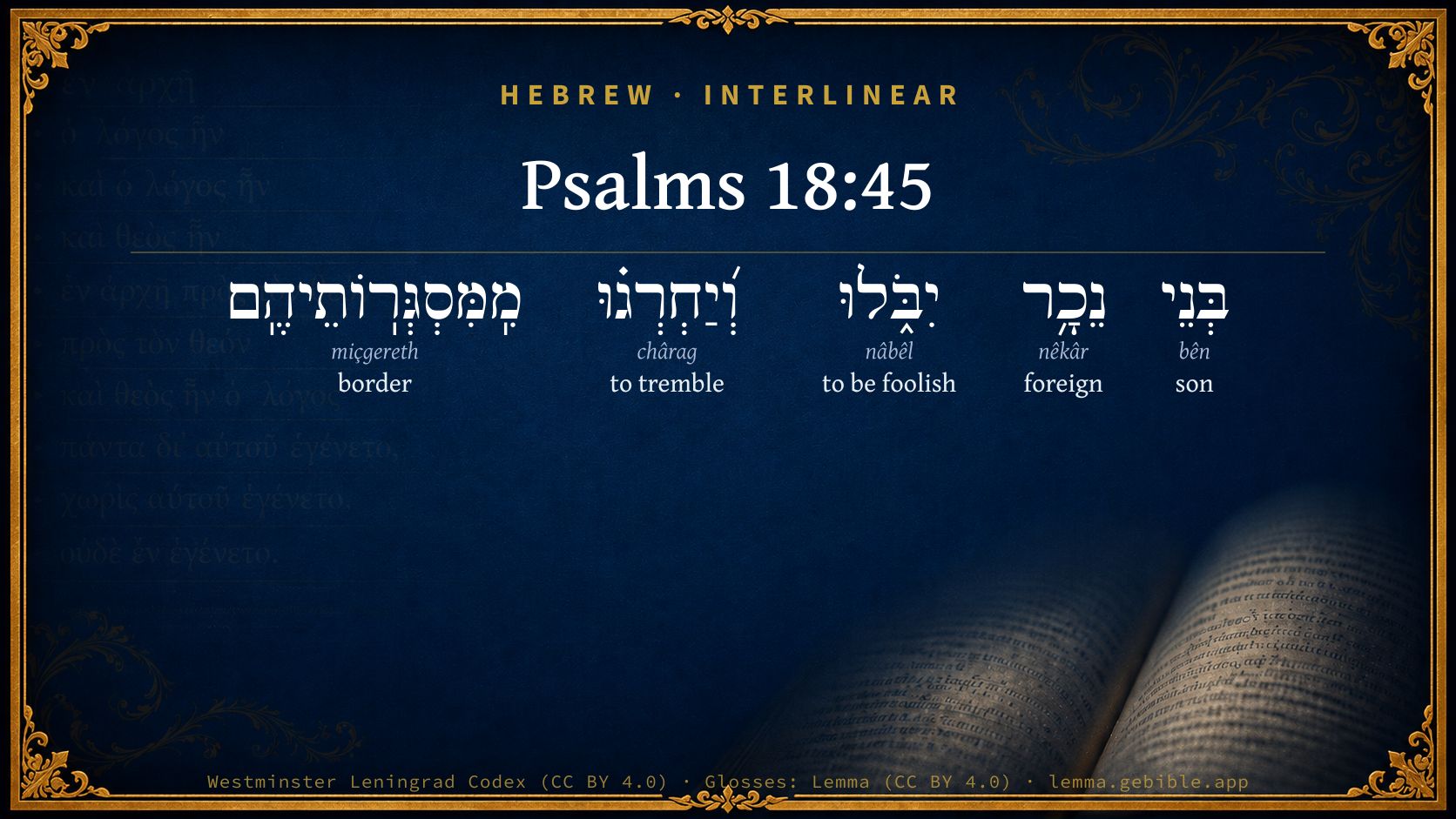
Psalms 18:45

Hebrew (Westminster Leningrad Codex) Psalms 18:45 appears in the Hebrew Old Testament. The text above is from the Westminster Leningrad Codex. Each word links to its Strong’s number, a concise gloss, and parsing drawn from the Open Scriptures Hebrew Bible morphology. Click any word for its full Brown-Driver-Briggs (BDB) entry.
Download image
Cite this verse

Psalms 18:45 (World English Bible). Public Domain. Lemma interlinear Bible study tool, https://lemma.gebible.app/v/psalms/18/45.

Show BibTeX & RIS
BibTeX
RIS
English Translation
The foreigners shall fade away, And shall come trembling out of their close places.
World English Bible · Public Domain
Highlights
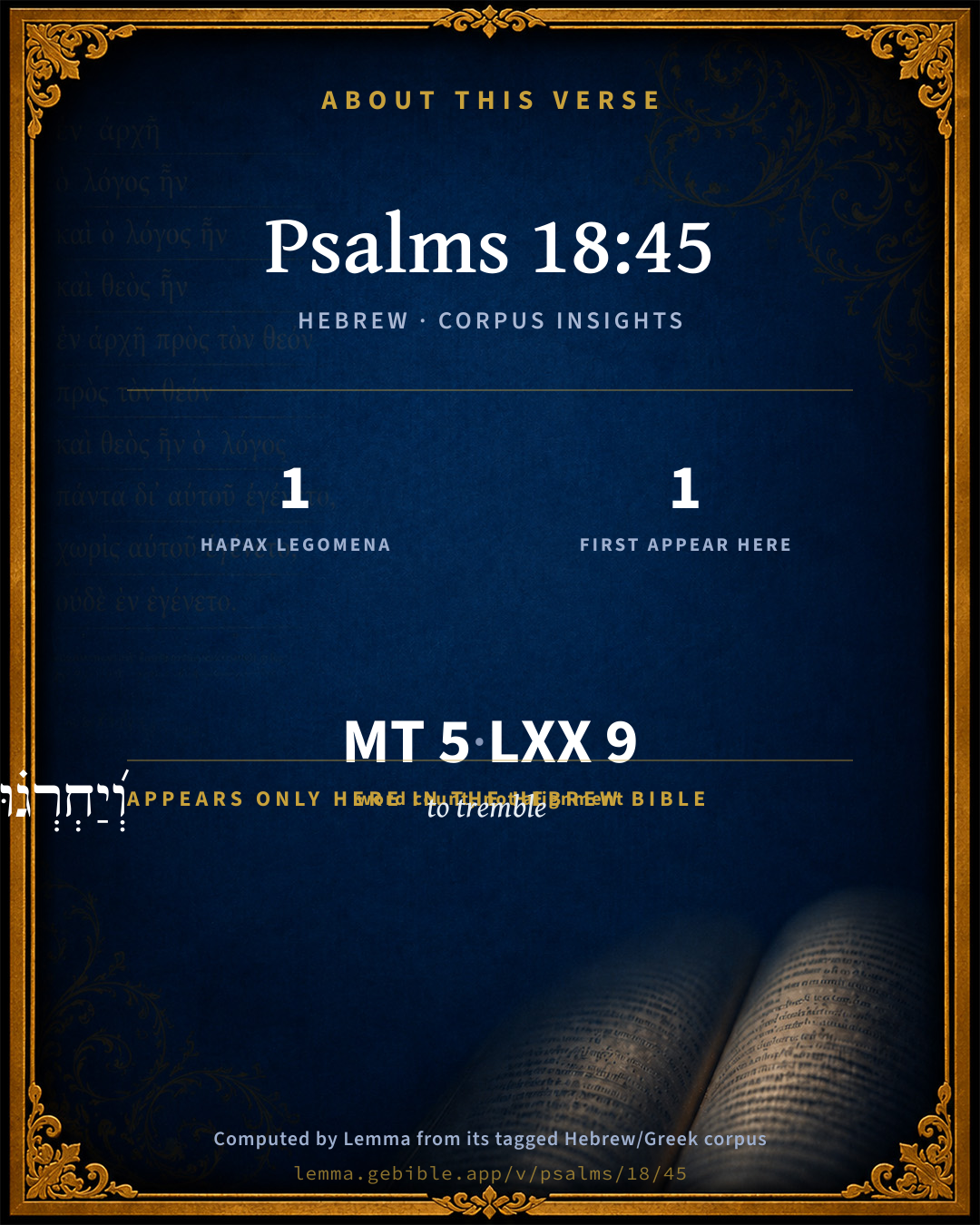
  • 1 hapax legomenon — only here in the Hebrew Bible
  • 1 first appearance in the Hebrew Bible
Full analysis ↓
Download a study sheet

One document with this verse’s original text, its word-by-word gloss line, the meaning frame, cross-references with their text, attributed commentary, and full source and license credits — printable, and it pastes into notes with its structure intact.

This verse Autodidact and up

Study sheet (.html) Plain text (.txt)

A passage Seminary Student

Up to 50 verses in one chapter. A passage sheet keeps up to 6 commentary sources and 12 cross-references per verse, in the order this page ranks them, and says so on the sheet whenever that leaves anything out. Ask for a single verse and you get the Autodidact verse sheet above.

Everything on this page stays free to read, with no account — the sheet is a download of what is already on screen, not access to it.

Want to remove ads? Support Godless Engineer
Compare translations 3

The same verse in 3 English versions, stacked beneath the original-language interlinear above. Click any original word for its lexicon entry.

Each is an independent rendering of the whole verse — the interlinear is not word-aligned to these translations.

Highlighted words mark where these versions differ — a whole-verse word diff, not a word-by-word alignment.

  • World English Bible Public Domain
    The foreigners shall fade away, And shall come trembling out of their close places.
  • King James Version Public Domain
    The strangers shall fade away, and be afraid out of their close places.
  • unfoldingWord Literal Text CC BY-SA 4.0
    Sons of the foreigner fade away, and they come trembling from their fortresses.

unfoldingWord Literal Text — © unfoldingWord, licensed CC BY-SA 4.0. Word-aligned USFM3 via Door43 (git.door43.org/unfoldingWord/en_ult).

Versions to compare (up to 4)

3 of 4 selected

Show all 18 translations

Every available English version of this verse, each an independent rendering of the whole verse.

  • World English Bible Public Domain
    The foreigners shall fade away, And shall come trembling out of their close places.
  • Berean Standard Bible Public Domain
    Foreigners lose heart and come trembling from their strongholds.
  • Majority Standard Bible Public Domain
    Foreigners lose heart and come trembling from their strongholds.
  • King James Version Public Domain
    The strangers shall fade away, and be afraid out of their close places.
  • American Standard Version (1901) Public Domain
    The foreigners shall fade away, And shall come trembling out of their close places.
  • Revised Version (1885) Public Domain
    The strangers shall fade away, and shall come trembling out of their close places.
  • Geneva Bible (1599) Public Domain
    Strangers shall shrinke away, and feare in their priuie chambers.
  • Douay-Rheims (1899) Public Domain
    A people, which I knew not, hath served me: at the hearing of the ear they have obeyed me.
  • Young's Literal Translation Public Domain
    Sons of a stranger fade away, And are slain out of their close places.
  • Literal Standard Version CC BY-SA 4.0
    Sons of a stranger fade away, || And are slain out of their close places.
  • Unlocked Literal Bible CC BY-SA 4.0
    The foreigners came trembling out of their strongholds.
  • unfoldingWord Literal Text CC BY-SA 4.0
    Sons of the foreigner fade away, and they come trembling from their fortresses.
  • Darby Bible Public Domain
    Strangers have faded away, and they come trembling forth from their close places.
  • World Messianic Bible Public Domain
    The foreigners shall fade away, and shall come trembling out of their strongholds.
  • Webster's Bible Public Domain
    \\18:44\\As soon as they hear of me, they shall obey me: the strangers shall submit themselves to me.
  • Free Bible Version CC BY-SA 4.0
    They lose heart, and come trembling in surrender from their strongholds.
  • Bible in Basic English Public Domain
    They will be wasting away, they will come out of their secret places shaking with fear.
  • JPS Tanakh (1917) Public Domain
    (18-46) The sons of the stranger fade away, and come trembling out of their close places.

Literal Standard Version (2020), Covenant Press — licensed CC BY-SA 4.0. Text via the HelloAO Bible API (eBible.org). Unlocked Literal Bible (unfoldingWord) — licensed CC BY-SA 4.0. Text via the HelloAO Bible API (eBible.org). unfoldingWord Literal Text — © unfoldingWord, licensed CC BY-SA 4.0. Word-aligned USFM3 via Door43 (git.door43.org/unfoldingWord/en_ult). Free Bible Version, Dr. Jonathan Gallagher — licensed CC BY-SA 4.0. Text via the HelloAO Bible API (eBible.org).

Word by word

More ways to search: Search by grammar → Find every occurrence → Compare this word →

Practice this passage: Drill this verse → Learn its vocabulary →

About this verse

These counts appear in no published source. They are computed here, from the morphology-tagged text and Lemma’s own curated glosses. What Lemma adds →

5
words
5
distinct lemmas
Wisdom
section

Notable vocabulary

1 hapax legomenon — a word that appears only here in the entire Hebrew Bible:

  • וְ֝יַחְרְג֗וּ to tremble H2727

First appearance in Scripture

This word makes its first canonical appearance in the Hebrew Bible here:

  • וְ֝יַחְרְג֗וּ to tremble H2727

Shared distinctive vocabulary

מִֽמִּסְגְּרֽוֹתֵיהֶֽם border H4526 occurs in 14 verses of the Hebrew Bible. Also found in:

Grammatical profile

  • 2 verbs
  • 3 nouns

Verb forms

  • יִבֹּ֑לוּ Qal · Imperfect
  • וְ֝יַחְרְג֗וּ Qal · Imperfect

Hebrew & Septuagint length

In English translation the verse runs 14 words from the Hebrew and 13 from the Septuagint (LXX English) — closely comparable.

A rough comparison of the two English renderings, which tokenize alike — not a word-level alignment.

Word counts can differ between the Hebrew and the Greek without any difference in meaning — e.g. the Hebrew direct-object marker אֵת has no separate Greek word, and Greek often adds the article ὁ.

In the original languages it is 5 Hebrew tokens and 9 Greek tokens — but the two are counted differently (Hebrew bundles its prefixes and suffixes into one token; the Greek is in lemma form), so that isn’t a like-for-like length.

Cross-references

4

Topical passages linked to Psalms 18:45 in the Treasury of Scripture Knowledge — connected by theme and wording, ordered by reader-vote popularity; previews shown in the World English Bible.

  • Micah 7:17 They will lick the dust like a serpent. Like crawling things of the earth they shall come trembling out of their dens. They will come with fear to Yahweh our God, And will be afraid because of you.
  • Isaiah 24:4 The earth mourns and fades away, the world languishes and fades away, the lofty people of the earth do languish.
  • James 1:11 For the sun arises with the scorching wind, and withers the grass, and the flower in it falls, and the beauty of its appearance perishes. So also will the rich man fade away in his pursuits.
  • Revelation 6:16 They told the mountains and the rocks, "Fall on us, and hide us from the face of him who sits on the throne, and from the wrath of the Lamb,

Cross-references courtesy of OpenBible.info (CC BY 4.0).

Hebrew and Greek witnesses Masoretic Hebrew ↔ Greek Septuagint

The same verse in the two great witnesses to the Old Testament, shown verse-for-verse.

You’re reading Greek Psalm 17 (Hebrew Psalm 18). The Septuagint counts the superscription, so verse numbers can differ from the Hebrew — chapter-level alignment, not verse-by-verse. Numbering follows Rahlfs.

These are two independent witnesses, not word-aligned to each other, and the Septuagint is shown in lemma (dictionary) form.

Hebrew Psalms 18:45 Masoretic · Westminster Leningrad Codex

בְּנֵי נֵכָ֥ר יִבֹּ֑לוּ וְ֝יַחְרְג֗וּ מִֽמִּסְגְּרֽוֹתֵיהֶֽם

The foreigners shall fade away, And shall come trembling out of their close places.

World English Bible · Public Domain

Greek LXX Greek Psalm 17:45 Septuagint · lemma form

εἰς ἀκοή ὠτίον ὑποἀκούω ἐγώ υἱός ἀλλότριος ψεύδομαι ἐγώ

The strange children waxed old, and fell away from their paths through lameness.

LXX2012 (modern English Septuagint) · Public Domain

On this verse, Ellicott's Commentary for English Readers discusses the Septuagint’s reading. Read the note in Commentary ↓

Hebrew: Westminster Leningrad Codex (CC BY 4.0). Greek: Septuagint (public domain); English from LXX2012 (modern English Septuagint) (Public Domain). How the Septuagint differs from the Hebrew →

Commentary

Notes on Psalms 18:45 from classic Christian and Jewish commentators (each source and its license shown beneath its notes). The classic Christian expositions comment on the surrounding passage and are grouped to its opening verse, so a note may address several verses; the Jewish commentaries on the Tanakh (Rashi and others) are per-verse, so they appear only where the commentator wrote on this verse.

Lemma curates 59 commentaries, every one of them public domain or Creative Commons licensed, each selected and text-cleaned for this edition rather than reprinted as found. About our sources →

Trapp's Complete Commentary

John Trapp

Psa 18:45 The strangers shall fade away, and be afraid out of their close places.

Ver. 45. The strangers shall fade away] As do the dry leaves of trees; their vigour and confidence shall perish in a moment.

And be afraid out of their close places] Whence they shall come creeping to me, their conqueror, to seek favour. And this may very fitly also be applied to Christ and his subjects, who must be driven unto him out of their close places, or starting holes of self confidences, self conceitedness, &c., by the spirit of bondage, before they will unfeignedly submit to Christ’s government.

John Trapp, A Commentary or Exposition upon All the Books of the Old and New Testament (1647–1656) — public domain. Text from a community e-Sword module.

Joseph Benson's Commentary

Psa 18:45. The strangers shall fade away — Shall wither and decay in their hopes end strength; and be afraid — That is, shall come trembling, one verb being put for two; out of their close places — Out of their strong holds, where they shall lurk and keep themselves close, for fear of me, not daring to stir out without trembling, lest I should assault and take them. Dr. Waterland renders it, They shall faint away, and come creeping out of their coverts. Grotius’s comment is, “They shall suspect their safety in the very places to which they flee for refuge.”

Joseph Benson's Commentary on the Old and New Testaments (1811–1818) — public domain. Text from a community e-Sword module.

Geneva Bible (1599)

Geneva Bible translators

Fear shall cause them to be afraid and come forth of their secret holes and holds to seek pardon.

Geneva Bible (1599) marginal notes — public domain. Text via Bolls.life.

Adam Clarke's Commentary

Verse 45. The strangers shall fade away] בני נכר beney nechar, the same persons mentioned above. They shall not be able to effect any thing against me; יבלו yibbolu, "they shall fall as the leaves fall off the trees in winter."

And be afraid out of their close places.] Those who have formed themselves into banditti, and have taken possession of rocks and fortified places, shall be so afraid when they hear of my successes, that they shall surrender at discretion, without standing a siege. Perhaps all these verbs should be understood in the perfect tense, for David is here evidently speaking of a kingdom at rest, all enemies having been subdued; or, as the title is, when the Lord HAD delivered him from all his enemies.

Adam Clarke's Commentary on the Bible (1810–1826) — public domain. Text from a community e-Sword/MySword module.

John Calvin's Commentaries

What is added immediately after, (verse 45,) the children of strangers shall fade away; they shall tremble The Hebrew word חרג, charag, signifies both to be moved and to tremble, and combining both ideas, to move fearfully. The last appears to be the view which Calvin attaches to the word. “Fear shall cause them to be afraid, and come forth of their secret holes and holds, to seek pardon.” — Note, Bassandyne’s Bible. Walford reads,

“The sons of the stranger lose their strength; Through alarm they quit their strongholds.

Street reads,

“Foreign nations are confounded, and they shudder within their fortresses.”

John Calvin's Commentaries (1540-1563) — public domain. Text from the Calvin Translation Society English edition (1840s-50s) via the Christian Classics Ethereal Library (ccel.org). Calvin's coverage is partial (roughly two-thirds of the Bible); uncommented books and verses are honest gaps, never fabricated. The 19th-century editor's footnotes and remarks are omitted so the notes are faithfully Calvin's own voice.

Ellicott's Commentary for English Readers

(45) Fade away—i.e., wither like vegetation before a scorching blast.

Be afraid out of their close places.—Better, come trembling out of their castles. LXX. and Vulgate have “grow old and came limping from their paths.”

A Bible Commentary for English Readers, edited by Charles John Ellicott (1878–1897) — public domain. Text from a community e-Sword module.

The Cambridge Bible for Schools and Colleges

gen. ed. J. J. S. Perowne

45. The strangers faded away,

And came trembling out of their fastnesses.

Their strength and courage failed like a withering leaf or a fading flower (Isa_28:1; Isa_28:4), and they surrendered at discretion to the triumphant invader. Cp. Mic_7:17; 1Sa_14:11. The obscure reading in 2 Sam. may mean “came limping out of their fastnesses”; a picture of the exhausted defenders of the fortress dragging themselves along with difficulty and reluctant to lay down their arms before the conqueror. The LXX gives this rendering (ἐχώλαναν) in the Psalm.

The Cambridge Bible for Schools and Colleges (gen. ed. J. J. S. Perowne; Cambridge University Press, 1878–1918) — public domain. Text from a community e-Sword module.

John Gill's Exposition

The Lord liveth, and blessed be my Rock,.... This, with what follows, is the concluding part of the psalm, which ends with a celebration of the Divine Being, and with thankfulness for mercies received from him. The psalmist praises him on account of what he is in himself, what he was to him, and had done for him: in himself he is the living God, "the Lord liveth": he has life in himself, essentially, originally, and independently; and is the fountain and author of life to all others, even to all creatures that have life, whether rational or irrational: he is the giver of natural life to all men, and the supporter of it; and of spiritual and eternal life to his chosen people; and he continues to live, and ever will; wherefore the saints may conclude that their life in every sense is safe and secure. Some render the phrase, by way of wish, "may the Lord live" (r); but then it must be understood only that he would show himself more abundantly to be the living God, and that he might be acknowledged so by others. The next clauses are by way of petition; "and blessed be my Rock"; on which he was built and established, to which he betook himself in times of distress, which was his place of defence, and from whence he had a supply; wherefore he desires he might be blessed, not by invoking or conferring a blessing on him, neither of which can be; there being none greater than he to call upon, and he being "Elshaddai", God all sufficient, and in no need of any; but by declaring his blessedness, by celebrating his greatness and goodness, and by ascribing blessing and honour and glory to him;

and let the God of my salvation be exalted; God was the God of his salvation in a temporal sense, saving him daily from his many enemies; and in a spiritual sense, being the contriver, author, and applier of it to him; on which account he would have him be exalted both by himself, and in the high praises of his people; ascribing the whole of salvation to him, and giving him all the glory of it. Some render the words, "the God of my salvation is high" (s); he is the most high God, the high and lofty One that inhabits eternity, and is above all others. In Sa2 22:47 the words are read, "and exalted be the God of the Rock of my salvation".

(r) "vivat Jehova", Musculus, Tigurine version, Piscator, Muis; so some in Vatablus, Ainsworth. (s) "excelsus est", Gejerus.

John Gill's Exposition of the Whole Bible (1746–1763) — public domain (CC PDM 1.0). Text via the HelloAO Bible API.

Albert Barnes' Notes on the Bible

The strangers shall fade away - Hebrew, “The sons of the stranger.” That is, foreigners. The word rendered fade away - נבל nâbêl - means properly to wilt, wither, fall away, as applicable to flowers, leaves, or plants, Psa 1:3; Psa 37:2; Isa 1:30; Isa 28:1. Here it means that those foreign nations would diminish in numbers and in power, until they should wholly disappear. The idea is, that all his foes would vanish, and that he and his kingdom would be left in peace.

And be afraid out of their close places - The word rendered be afraid means to tremble - as those do who are in fear. The word rendered close places means places that are shut up or enclosed, as fortified cities or fortresses. The reference is to their places of retreat, towns, castles, fortresses. The meaning is, that they would find such places to be no security, and would tremble out of them; that is, they would flee out of them in consternation and alarm. The general thought is that of ultimate complete security for himself and his kingdom, or entire deliverance from all his enemies.

Albert Barnes' Notes on the Bible (1834–1885) — public domain. Text from a community e-Sword/MySword module.

Matthew Poole's English Annotations

Shall fade away, i.e. shall wither and decay in their hopes and strength.

Be afraid, i.e. shall come trembling; one verb being put for two, as Psa 22:21, thou hast heard me, i.e. having delivered me; and Psa 42:1, panteth, i.e. panting hasteneth; and in many other places.

Out of their close places; out of their strong holds, where they shall lurk and keep themselves for fear of me, and whence they dare not stir without trembling. Or, for (as the particle mere is oft used)

their close places, i.e. lest I should assault and take them.

Matthew Poole's English Annotations on the Holy Bible (1683–1685) — public domain. Text from a community e-Sword/MySword module.

Whedon's Commentary on the Bible

Daniel D. Whedon

45. The strangers shall fade away—The same class who, in Psa_18:44, yielded an unwilling obedience, shall wither like grass before the hot wind of the desert. Comp. Mic_7:16-17

Daniel D. Whedon (gen. ed.), Commentary on the Old and New Testaments (1874–1909) — public domain. Text from a community e-Sword module.

The Pulpit Commentary

The strangers shall fade away, and be afraid out of their close places. Converts are represented as coming into the Church, not merely from love, but partly from fear. The kingdom of the Redeemer at once attracts and alarms. So Isaiah says, "The nation and kingdom that will not serve thee shall perish; yea, those nations shall be utterly wasted... The sons also of them that afflict thee shall come kneeling unto thee; and all they that despised thee shall bow themselves down at the soles of thy feet, and they shall call thee, The city of the Holy One of Israel". (Isa_60:12-14; see also Mic_7:16, Mic_7:17)

The Pulpit Commentary (1880–1919), ed. H.D.M. Spence-Jones & Joseph S. Exell — public domain. Text from a community e-Sword module.

John Wesley's Explanatory Notes

Close places - Out of their strong holds, where they shall lurk for fear of me.

John Wesley, Explanatory Notes Upon the Whole Bible (1754–1765) — public domain. Text via the GEBible commentary corpus.

Rashi

Rabbi Shlomo Yitzchaki (Rashi)

As soon as they hear Even in my absence, as long as they hear my message.

they shall obey me They shall give heed to my bidding and obey my orders.

shall lie to me out of fright.

Rashi on the Tanakh — English translations: “The Judaica Press complete Tanach with Rashi, translated by A. J. Rosenberg” (CC BY 4.0); “Pentateuch with Rashi's commentary by M. Rosenbaum and A.M. Silbermann, 1929-1934” (public domain); “The Metsudah Tanach series, Lakewood, N.J” (CC BY 4.0); and “The Book of Joshua, Metsudah Publications, 1997” (CC BY 4.0). Text via Sefaria.

Lesson kit

Teaching starters — assembled from the data on this page, not authored interpretation. Every prompt links to the verse data it draws on. Edit before teaching.

Psalms, in the Wisdom, opens this verse with 5 words (5 distinct Hebrew lemmas). Its most distinctive word is chârag (“to tremble”). A historical commentator’s framing appears above. Read the whole chapter for the surrounding context.

Discussion questions

  1. The word chârag carries the sense “to tremble.” How does it shape the verse?
  2. This verse holds 1 word here found nowhere else in the Hebrew Bible. What might the rare word draw attention to?
  3. The word “to tremble” first appears here in Scripture. What is being introduced at this debut?
  4. Exodus 25:25 shares the word «border» with this verse. How do the two illuminate each other?
  5. The translations on this page render this verse differently — a whole-verse word diff, not a word-by-word alignment. What might account for the different wordings?
  6. The verb «יִבֹּ֑לוּ» is Qal Imperfect. How does its form color the action?
  7. Reading how Trapp's Complete Commentary and Joseph Benson's Commentary read this verse, where do the two commentators agree and where do they part?

Things to notice

Reading settings

Reading text

Shown beneath each verse's original-language words.

Old Testament
Old Testament edition

Read the OT as the Masoretic Hebrew (MT) or the Greek Septuagint (LXX).

English shown for the Greek Septuagint (in the Hebrew ↔ Greek comparison).

Comparing translations? Open the Compare panel on any verse page to stack up to four side by side.