
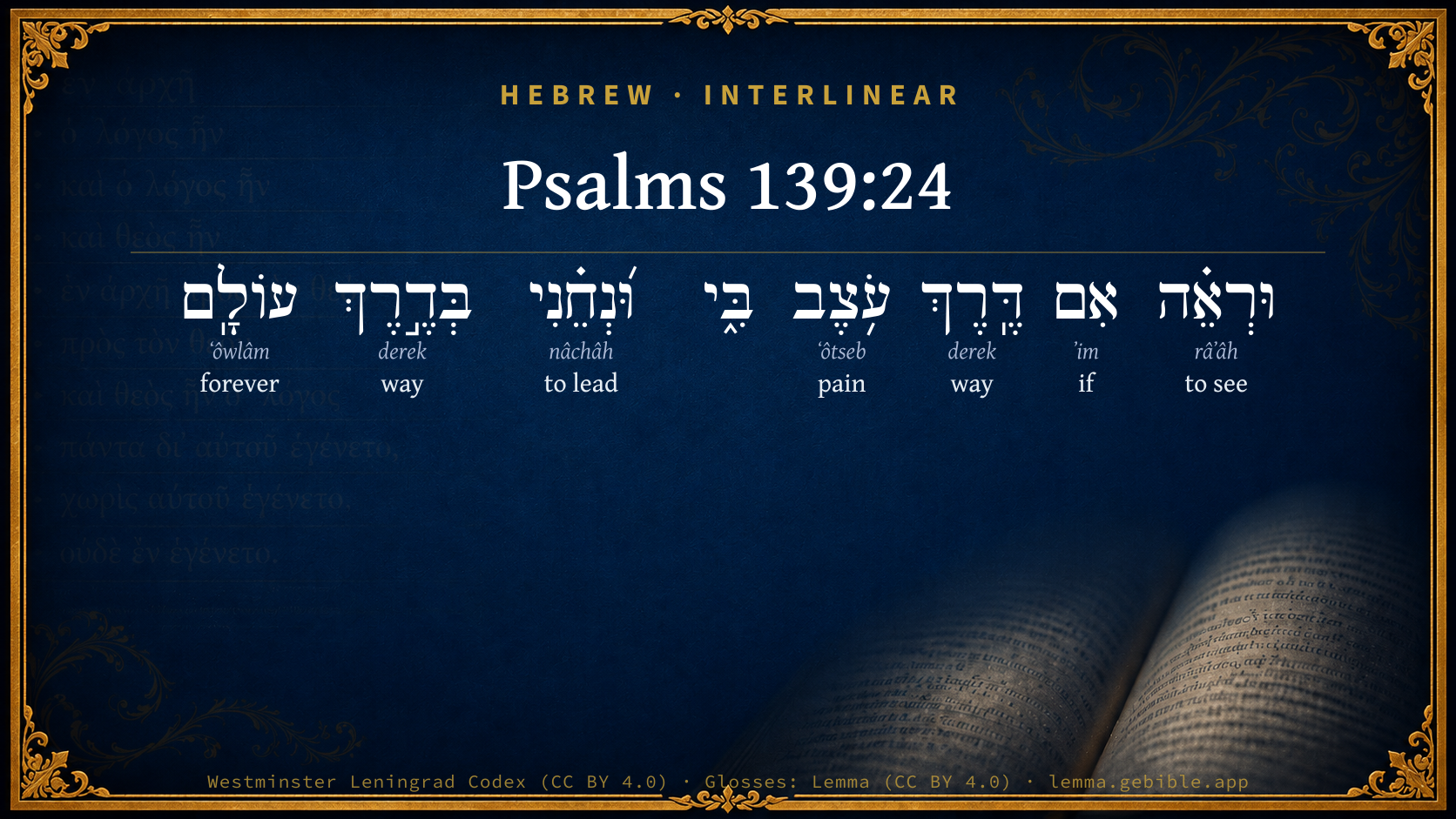
Psalms 139:24

Hebrew (Westminster Leningrad Codex) Psalms 139:24 appears in the Hebrew Old Testament. The text above is from the Westminster Leningrad Codex. Each word links to its Strong’s number, a concise gloss, and parsing drawn from the Open Scriptures Hebrew Bible morphology. Click any word for its full Brown-Driver-Briggs (BDB) entry.
Download image
Cite this verse

Psalms 139:24 (World English Bible). Public Domain. Lemma interlinear Bible study tool, https://lemma.gebible.app/v/psalms/139/24.

Show BibTeX & RIS
BibTeX
RIS
English Translation
See if there is any wicked way in me, And lead me in the everlasting way.
World English Bible · Public Domain
Download a study sheet

One document with this verse’s original text, its word-by-word gloss line, the meaning frame, cross-references with their text, attributed commentary, and full source and license credits — printable, and it pastes into notes with its structure intact.

This verse Autodidact and up

Study sheet (.html) Plain text (.txt)

A passage Seminary Student

Up to 50 verses in one chapter. A passage sheet keeps up to 6 commentary sources and 12 cross-references per verse, in the order this page ranks them, and says so on the sheet whenever that leaves anything out. Ask for a single verse and you get the Autodidact verse sheet above.

Everything on this page stays free to read, with no account — the sheet is a download of what is already on screen, not access to it.

Want to remove ads? Support Godless Engineer
Compare translations 3

The same verse in 3 English versions, stacked beneath the original-language interlinear above. Click any original word for its lexicon entry.

Each is an independent rendering of the whole verse — the interlinear is not word-aligned to these translations.

Highlighted words mark where these versions differ — a whole-verse word diff, not a word-by-word alignment.

  • World English Bible Public Domain
    See if there is any wicked way in me, And lead me in the everlasting way.
  • King James Version Public Domain
    And see if there be any wicked way in me, and lead me in the way everlasting.
  • unfoldingWord Literal Text CC BY-SA 4.0
    And see if a way of hurtfulness in me, and lead me in the way of eternity.

unfoldingWord Literal Text — © unfoldingWord, licensed CC BY-SA 4.0. Word-aligned USFM3 via Door43 (git.door43.org/unfoldingWord/en_ult).

Versions to compare (up to 4)

3 of 4 selected

Show all 17 translations

Every available English version of this verse, each an independent rendering of the whole verse.

  • World English Bible Public Domain
    See if there is any wicked way in me, And lead me in the everlasting way.
  • Berean Standard Bible Public Domain
    See if there is any offensive way in me; lead me in the way everlasting.
  • Majority Standard Bible Public Domain
    See if there is any offensive way in me; lead me in the way everlasting.
  • King James Version Public Domain
    And see if there be any wicked way in me, and lead me in the way everlasting.
  • American Standard Version (1901) Public Domain
    And see if there be any wicked way in me, And lead me in the way everlasting. Psalm 140 For the Chief Musician. A Psalm of David.
  • Revised Version (1885) Public Domain
    And see if there be any way of wickedness in me, and lead me in the way everlasting.
  • Geneva Bible (1599) Public Domain
    And consider if there be any way of wickednes in me, and leade me in the way for euer.
  • Young's Literal Translation Public Domain
    And see if a grievous way be in me, And lead me in a way age-during!
  • Literal Standard Version CC BY-SA 4.0
    And see if a grievous way be in me, || And lead me in a perpetual way!
  • Unlocked Literal Bible CC BY-SA 4.0
    See if there is any wicked way in me, and lead me in the everlasting way.
  • unfoldingWord Literal Text CC BY-SA 4.0
    And see if a way of hurtfulness in me, and lead me in the way of eternity.
  • Darby Bible Public Domain
    And see if there be any grievous way in me; and lead me in the way everlasting.
  • World Messianic Bible Public Domain
    See if there is any wicked way in me, and lead me in the everlasting way.
  • Webster's Bible Public Domain
    And see if there is any wicked way in me, and lead me in the way everlasting.
  • Free Bible Version CC BY-SA 4.0
    Please show me if I'm following any kind of idol, and lead me along the path of eternal life.
  • Bible in Basic English Public Domain
    See if there is any way of sorrow in me, and be my guide in the eternal way.
  • JPS Tanakh (1917) Public Domain
    And see if there be any way in me that is grievous, and lead me in the way everlasting.

Literal Standard Version (2020), Covenant Press — licensed CC BY-SA 4.0. Text via the HelloAO Bible API (eBible.org). Unlocked Literal Bible (unfoldingWord) — licensed CC BY-SA 4.0. Text via the HelloAO Bible API (eBible.org). unfoldingWord Literal Text — © unfoldingWord, licensed CC BY-SA 4.0. Word-aligned USFM3 via Door43 (git.door43.org/unfoldingWord/en_ult). Free Bible Version, Dr. Jonathan Gallagher — licensed CC BY-SA 4.0. Text via the HelloAO Bible API (eBible.org).

Word by word

More ways to search: Search by grammar → Find every occurrence → Compare this word →

Practice this passage: Drill this verse → Learn its vocabulary →

About this verse

These counts appear in no published source. They are computed here, from the morphology-tagged text and Lemma’s own curated glosses. What Lemma adds →

8
words
6
distinct lemmas
Wisdom
section

Notable vocabulary

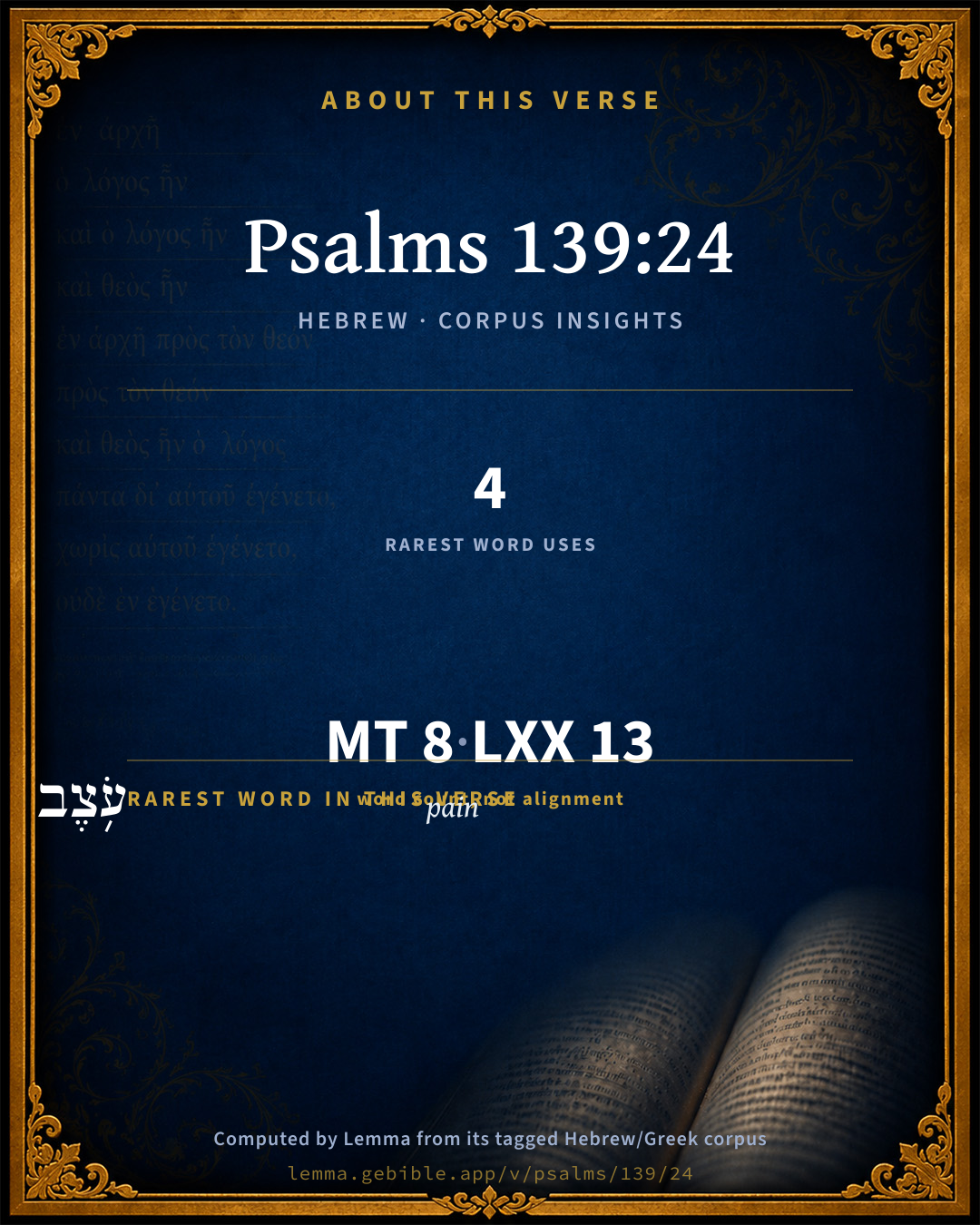
The rarest word here is עֹ֥צֶב pain H6090 — appearing just 4 times in the whole Hebrew Bible.

Shared distinctive vocabulary

עֹ֥צֶב pain H6090 occurs in 4 verses of the Hebrew Bible. Also found in:

Grammatical profile

  • 2 verbs
  • 4 nouns
  • 1 preposition
  • 1 conjunction

Verb forms

  • וּרְאֵ֗ה Qal · Imperative
  • וּ֝נְחֵ֗נִי Qal · Imperative

Repetition

A word recurs within this verse — often emphatic in Hebrew:

  • דֶּֽרֶךְ way H1870 ×2

Hebrew & Septuagint length

In English translation the verse runs 16 words from the Hebrew and 18 from the Septuagint (LXX English) — closely comparable.

A rough comparison of the two English renderings, which tokenize alike — not a word-level alignment.

Word counts can differ between the Hebrew and the Greek without any difference in meaning — e.g. the Hebrew direct-object marker אֵת has no separate Greek word, and Greek often adds the article ὁ.

In the original languages it is 8 Hebrew tokens and 13 Greek tokens — but the two are counted differently (Hebrew bundles its prefixes and suffixes into one token; the Greek is in lemma form), so that isn’t a like-for-like length.

Cross-references

16

Topical passages linked to Psalms 139:24 in the Treasury of Scripture Knowledge — connected by theme and wording, ordered by reader-vote popularity; previews shown in the World English Bible.

  • Psalms 143:10 Teach me to do your will, For you are my God. Your Spirit is good. Lead me in the land of uprightness.
  • Jeremiah 17:9–10 The heart is deceitful above all things, and it is exceedingly corrupt: who can know it?
  • Psalms 25:8–9 Good and upright is Yahweh, Therefore he will instruct sinners in the way.
  • Psalms 16:11 You will show me the path of life. In your presence is fullness of joy. In your right hand there are pleasures forevermore.
  • Psalms 119:32 I run in the path of your commandments, For you have set my heart free.
  • Psalms 5:8 Lead me, Yahweh, in your righteousness because of my enemies. Make your way straight before my face.
  • Proverbs 28:26 One who trusts in himself is a fool; But one who walks in wisdom, he is kept safe.
  • Psalms 143:8 Cause me to hear your loving kindness in the morning, For I trust in you. Cause me to know the way in which I should walk, For I lift up my soul to you.
  • John 14:6 Jesus said to him, "I am the way, the truth, and the life. No one comes to the Father, except through me.
  • Psalms 17:3 You have proved my heart; you have visited me in the night; You have tried me, and found nothing; I have resolved that my mouth shall not disobey.
  • Matthew 7:14 How narrow is the gate, and restricted is the way that leads to life! Few are those who find it.
  • Psalms 7:3–4 Yahweh, my God, if I have done this, If there is iniquity in my hands,
  • Psalms 119:1 Blessed are those whose ways are blameless, Who walk according to Yahweh's law.
  • Colossians 2:6 As therefore you received Christ Jesus, the Lord, walk in him,
  • Proverbs 15:9 The way of the wicked is an abomination to Yahweh, But he loves him who follows after righteousness.
  • Hebrews 12:15–16 looking carefully lest there be any man who falls short of the grace of God; lest any root of bitterness springing up trouble you, and thereby the many be defiled;

Cross-references courtesy of OpenBible.info (CC BY 4.0).

Hebrew and Greek witnesses Masoretic Hebrew ↔ Greek Septuagint

The same verse in the two great witnesses to the Old Testament, shown verse-for-verse.

You’re reading Greek Psalm 138 (Hebrew Psalm 139). The Septuagint counts the superscription, so verse numbers can differ from the Hebrew — chapter-level alignment, not verse-by-verse. Numbering follows Rahlfs.

These are two independent witnesses, not word-aligned to each other, and the Septuagint is shown in lemma (dictionary) form.

Hebrew Psalms 139:24 Masoretic · Westminster Leningrad Codex

וּרְאֵ֗ה אִם דֶּֽרֶךְ עֹ֥צֶב בִּ֑י וּ֝נְחֵ֗נִי בְּדֶ֣רֶךְ עוֹלָֽם

See if there is any wicked way in me, And lead me in the everlasting way.

World English Bible · Public Domain

Greek LXX Greek Psalm 138:24 Septuagint · lemma form

καί ὁράω εἰ ὁδός ἀνομία ἐν ἐγώ καί ὁδηγέω ἐγώ ἐν ὁδός αἰώνιος

and see if there is any way of iniquity in me, and lead me in an everlasting way.

LXX2012 (modern English Septuagint) · Public Domain

On this verse, Albert Barnes' Notes on the Bible discusses the Septuagint’s reading. Read the note in Commentary ↓

Hebrew: Westminster Leningrad Codex (CC BY 4.0). Greek: Septuagint (public domain); English from LXX2012 (modern English Septuagint) (Public Domain). How the Septuagint differs from the Hebrew →

Commentary

Notes on Psalms 139:24 from classic Christian and Jewish commentators (each source and its license shown beneath its notes). The classic Christian expositions comment on the surrounding passage and are grouped to its opening verse, so a note may address several verses; the Jewish commentaries on the Tanakh (Rashi and others) are per-verse, so they appear only where the commentator wrote on this verse.

Lemma curates 59 commentaries, every one of them public domain or Creative Commons licensed, each selected and text-cleaned for this edition rather than reprinted as found. About our sources →

Trapp's Complete Commentary

John Trapp

Psa 139:24 And see if [there be any] wicked way in me, and lead me in the way everlasting.

Ver. 24. And see if there be any wicked way in me] Heb. any way of pain, or of grief, or of provocation; any cause of sin that is grievous to God or man, quae spiritum tuum vexat, ut Psa 78:1-72 (Aben Ezra). A saint alloweth not of any wickedness, walloweth not in it, maketh it not his trade, is not transformed into sin’s image, the great scum abideth not in him, but (as in right wine or honey) it is continually cast out. The good heart admitteth not the mixture of any sin. Sin may cleave to it, as dross to silver, but it entereth not into the frame and constitution; it is not woven into the texture of a good man’s heart; there is no such way of wickedness to be found in him, no such evil heart of unbelief as to depart away from the living God, Heb 3:12. There is no time wherein he cannot say, as Heb 13:18, "Pray for us; for we trust we have a good conscience, in all things willing to please God."

And lead me in the way everlasting] Heb. in the way of eternity, or of antiquity, that good old way, Jer 6:16, traced by Adam, Abraham, Moses, &c., and that leadeth to heaven. Rid my heart of those remnants of hypocrisy, and help me to perfect holiness in the fear of God, 2Co 7:1.

John Trapp, A Commentary or Exposition upon All the Books of the Old and New Testament (1647–1656) — public domain. Text from a community e-Sword module.

The Biblical Illustrator

Joseph S. Exell

Psa_139:24

See if there be any wicked way in me.

Secret sins

I. The true Christian may plainly be known from all others by three things:--

1. He does really rejoice in all the attributes of God. He adores His justice, loves His mercy, confides in His power, bows to His wisdom, is glad that He knows all things.

2. tie is anxious to know the worst of his case. He is candid with himself. He greatly desires that his aims, his heart, and his motives should be right. He fears the treachery of his own heart.

3. He hates all sin, wars against it, loathes it, and never will be satisfied till he is rid of it. He would not follow any wicked way. He would do nothing contrary to the law of God.

II. That we may deal aright with our secret sins, let us--

1. Think much of the all-seeing purity of God. His holiness is a flaming fire.

2. Often compare our acts, and words, and hearts with the perfect law of God. The commandments are spiritual. If you have wrong views of the law you cannot have right views of sin, and so you may lose your soul.

3. Hide no sin from your own eyes, and refuse not to confess it before God.

4. Be careful not to subject your principles to needless trial. We cannot hinder the birds from flying over our heads, but we must not let them light and build nests in our hair.

5. Set a double guard against those sins to which you are very liable. Are you easily made angry? Then avoid men who are apt to provoke you. Are you inclined to undue sadness? Then study the promises and seek the society of cheerful Christians. Are you fond of high living? Rather shun than seek convivial gatherings.

6. Remember that there is no danger of your hating sin too much, or of your being too watchful against it.

7. Cease to hew out broken cisterns which can hold no water. Cease to rely on human wisdom, power, or goodness. Cast your care on Him who careth for you. Often commit your soul to Christ.

8. When you have done your best, remember that you may be mistaken. Earnestly offer the prayer, Search me, etc. (W. S. Plumer, D. D.)

The way of sin is the way of grief

It is worthy of remark that wicked way may be translated way of grief. The way of sin is the way of pain and grief: it is a grief to God who would save you from it; a way of grief and pain to you if you walk in it; a way of grief and harm to others who suffer by your deeds. Get rid of it, come out from it, for it is the way of death. The way of unbelief, the way of vanity, the way of selfishness, the way of worldliness, the way of sluggishness, the way of self-dependence, the way of disobedience, the way of forgetfulness. Oh, how many, many are the ways, the tastes, the leanings within us that bring us peril, pain and grief. Let us seek a holy riddance of them, one and all, that we may move steadily, only, undistractedly, in the way of purity and peace! The everlasting way! All other ways end in sorrow, finish in gloom, suddenly terminate in night. There is a way that seemeth right unto a man, but the end thereof is death. The old, true, tried way has no terminus. It leads from grace to grace, from glory to glory.

Discovery of concealed sin

Those people in India, in the last plague, gave no end of trouble to the sanitary authorities because they would hide away the corpses in the back of their hovels, and when the dead-cart came round said that there were no dead in the house; and so the corpse remained to poison the atmosphere and kill some more of them. If we keep our sins huddled up in the back premises of our nature and try to put a screen between them and God by impenitence and locking our lips against confession, then God cannot cast out the sins that we cling to, and will keep. But if we go to Him and say, See if there be any wicked way in me. Come into the very innermost recesses of my soul, and whatsoever is there smite with Thy searching light, which, like the old Greek legend of the arrows of Apollo, will slay the pythons, then God will answer the petition, and we shall be delivered. (A. Maclaren, D. D.)

Lead me in the way everlasting.--

The way everlasting

Since we must have a way, it is of the highest importance that our way should be a right one; important, because if it be not right we shall not long be happy in our course, since the happiness of those who follow the path of evil is fleeting as a meteor, mocking as a will-o-the-wisp, deceptive as the mirage, frail as a bubble on the wave, and unsubstantial as a phantom of the night.

I. A remarkable attribute of the right way--it is the way everlasting.

1. It is most certain that the way of many men cannot be everlasting.

(1) The way of the sinful is not so. I hope with regard to some that their way will last but for a very little time, for it is the way of evil. May they soon turn from it! May their road be so hedged up by Gods providence and grace that they may be compelled to take another road.

(2) The way of the merely moral man is not a way everlasting.

(3) The way of the purposeless and dilettante is not everlasting.

(4) The way even of some religious people is not the way everlasting. The hypocrite, the Pharisee, etc.

2. The right way--the way of faith in God and of a life that flows out of faith in God--the way indeed which Jesus trod, is the way everlasting--

(1) Because it is a way which was mapped out upon everlasting principles. Truth will never die; the stars will grow dim, the sun will pale his glory, but truth will be ever young. Integrity, uprightness, honesty, love, goodness, these are all imperishable.

(2) Because no circumstances can by any possibility necessitate any change in it.

(3) Because such a way even death itself shall not terminate.

II. The confession. This remarkable confession and prayer should suggest two Things--ignorance and impotence. When we say, Lead me, if it is a blind man, it means ignorance; he cannot see the way, and therefore he needs to be led, though he may be strong enough to walk if he only knew the way. Lead me, Lord, also signifies impotence if it be judged of as the childs case; he needs to be led in another sense, because he has not strength enough in his little feet to go without the help of his mothers hand.

1. Our want of knowledge.

(1) Imperfect judgment.

(2) Vitiated affections.

(3) Wrong influences.

2. Our want of strength. We need to ask of God to give us will, which is the real power.

III. The prayer. How comprehensive it is!

1. Because of its object--the whole man, his intellect, emotions, tongue, actions.

2. Its modes. God leads by the law, by the life of Christ, by the Holy Spirit, by ministers, by good books, etc.

3. Its issues. The way everlasting--a holy life, a happy death, and a heaven to crown it all.

4. The persons who may fitly use it. Who is there whom it would not suit? (C. H. Spurgeon.)

.

Psa_140:1-13

The Biblical Illustrator, edited by Joseph S. Exell (c. 1880s–1900s) — public domain. Text from a community e-Sword module.

J. A. Alexander on Psalms

Joseph Addison Alexander

24. (Psa 139:24) And see if a way of pain be in me, and guide me in a way of eternity. In the first clause some translate, the way of an idol, an idolatrous way. But the meaning idol is not justified by usage. A way of pain is one that leads to suffering and misery hereafter. The opposite of this is a way of eternity, by which some understand: an everlasting way, as distinguished from the perishable way of sinners, Psa 1:6. Others, more probably, the way that leads to everlasting life. Usage, however, is in favour of a third and very different interpretation, which gives the Hebrew phrase here the same sense with a kindred one used by Jeremiah (Jer 6:16), to wit, that of old or ancient way, the one pursued by prophets, patriarchs, and saints of old. Similar expressions are found in Jer 18:15, Job 22:15, applied, in a bad sense, to the course pursued by ancient sinners. The prayer, however, still amounts to the same thing, to wit, that God would lead him in the good old way, which is itself the way to everlasting life.

Joseph Addison Alexander, The Psalms Translated and Explained (1850) — public domain. Text from a community e-Sword module.

Tyndale Open Study Notes

Tyndale Open Resources

139:24 The path of wisdom leads to everlasting life (see 1:6; Prov 4:18; 6:23).

Tyndale Open Study Notes — © Tyndale Open Resources, licensed CC BY-SA 4.0. Text via the HelloAO Bible API.

Geneva Bible (1599)

Geneva Bible translators

That is, continue thy favor towards me to the end.

Or any heinous way or rebellious: meaning, that though he were subject to sin, yet he was not given to wickedness, and to provoke God by rebellion.

Geneva Bible (1599) marginal notes — public domain. Text via Bolls.life.

Adam Clarke's Commentary

Verse 24. If there be any wicked way] דרך עצב derech otseb: a way of idolatry, or of error. Any thing false in religious principle; any thing contrary to piety to thyself, and love and benevolence to man. And he needed to offer such prayer as this, while filled with indignation against the ways of the workers of iniquities; for he who hates, utterly hates, the practices of any man, is not far from hating the man himself. It is very difficult

"To hate the sin with all the heart,

And yet the sinner love."

Lead me in the way everlasting.] בדרך עולם bederech olam, in the old way - the way in which our fathers walked, who worshipped thee, the infinitely pure Spirit, in spirit and in truth. Lead me, guide me, as thou didst them. We have ארח עולם orach olam, the old path, Job 22:15. "The two words דרך derech and ארח orach, differ," says Bishop Horsley, "in their figurative senses: derech is the right way, in which a man ought to go; orach is the way, right or wrong, in which a man actually goes by habit." The way that is right in a man's own eyes is seldom the way to God.

ANALYSIS OF THE HUNDRED AND THIRTY-NINTH PSALM

David, having had aspersions laid upon him, calls upon God in this Psalm to witness his innocency. Now, that this his appeal be not thought unreasonable, he presents God in his two especial attributes, omniscience and omnipresence; then he shows he loved goodness, and hated wickedness.

This Psalm is divided into four parts: -

I. A description of God's omniscience, Ps 139:1-7.

II. A description of his omnipresence, Ps 139:7-18.

III. David's hatred to evil and evil men, Ps 139:19-23.

IV. A protestation of his own innocency, which he offers to the trial of God, Ps 139:23-24.

I. He begins with God's omniscience: "O Lord, thou hast searched me," c. Examined me with scrutiny.

He searches and knows our actions.

1. "Thou knowest," c. When and for what reasons I ever act.

2. "Thou understandest my thoughts," &c. Thou knowest my counsels and thoughts.

3. "Thou compassest my path," &c. The end I aim at.

4. "There is not a word," &c. Every word and thought thou knowest.

And for this he gives this reason: God is our Maker: "Thou hast beset me," &c. These two arguments prove that God knows all things.

1. God knows all the past and future: "Beset behind and before."

2. He governs man: "Thou God madest man," &c. The prophet concludes this Divine attribute, omniscience, with an acclamation: "Such knowledge," &c. It is beyond my reach and capacity.

II. From God's omnipresence the prophet argues that man cannot hide any thing from God, for he is every where present.

1. "Where shall I go," &c. That I may be hid from thy knowledge.

2. "Or whither shall I flee," &c. From thy face and eye.

There is no place that is not before thee.

1. "If I ascend up to heaven," &c.

2. "If I make my bed in hell," &c.

3. "If I take the wings of the morning," &c.

And among many instances that might be brought forward to prove God's omniscience and omnipresence, we may simply instance the formation of a child in the womb.

1. "Thou hast possessed my reins," &c. Thou hast undertaken wholly to frame, and cherish me when formed.

2. "Thou hast covered me," &c. Clothed me with flesh, skin, bones, &c.

Then the prophet breaks out in admiration of God's works.

1. "I will praise thee," &c.

2. "I am fearfully," &c. His works are enough to strike all men with reverential fear.

3. "Marvellous are thy works."

Then he proceeds with the formation of the infant embryo.

1. "My substance," &c. My strength, my essence. "Is not hid," &c.

2. "When I was made in secret," &c. In the secret cell of my mother's womb.

3. "And curiously wrought," &c. The word in the Hebrew signifies to interweave coloured threads. Man is a curious piece, and the variety of his faculties shows him such. [See the notes.]

4. "In the lowest parts of the earth," &c. In the womb, where it is as secret if God wrought it in the lowest part of the earth.

5. "Thine eyes did see my substance," &c. When in embryo, and without any distinct parts.

6. "And in thy book," &c. The idea of them was with thee, as the picture in the eye of the painter.

7. Which in continuance, &c.

The prophet closes this part with an exclamation.

1. "How precious also are thy thoughts," &c. In this and other respects.

2. "O how great is the sum of them." They are infinite.

3. And for this cause: "When I awake," &c., thy wisdom and providence are ever before my mind, and my admiration is full of them.

The prophet, having ended his discourse on the omniscience and omnipresence of God, justifies himself at God's tribunal.

1. "Surely thou wilt slay the wicked," &c. I dare not then associate with them.

2. "Depart, therefore, from me," &c. Keep at a distance.

3. "For they speak against thee wickedly," &c. Blaspheme my God.

So far from giving them the right hand of fellowship, he asks, -

1. "Do not I hate them, O Lord," &c. I hate them as sinners, but feel for and pity them as men.

2. Then he returns this answer to himself, "Yea, I hate them," &c. I count them my enemies, for they are thine.

IV. Lastly, it would appear that his heart was sincere and pure, or he would not abide such a trial.

1. "Search me, O God:" In the beginning of the Psalm he showed what God did now he entreats him to do it.

2. "Try me," c. Examine my heart and my ways.

3. "And see if there be any wicked way," &c. Presumptuous sins.

4. "And lead me in the way everlasting." This was the end proposed by his trial that, if God saw any wickedness in him that might seduce him, he would withdraw him from it and lead him to think, and devise, and do those things which would bring him to life eternal.

Adam Clarke's Commentary on the Bible (1810–1826) — public domain. Text from a community e-Sword/MySword module.

John Calvin's Commentaries

24. And lead me, etc. I see no foundation for the opinion of some that this is an imprecation, and that David adjudges himself over to punishment. It is true, that “the way of all the earth” is an expression used sometimes to denote death, which is common to all, but the verb here translated to lead is more commonly taken in a good than a bad sense, and I question if the phrase way of this life ever means death. On the margin of the French Commentary Calvin refers to Joshua 23:14.

John Calvin's Commentaries (1540-1563) — public domain. Text from the Calvin Translation Society English edition (1840s-50s) via the Christian Classics Ethereal Library (ccel.org). Calvin's coverage is partial (roughly two-thirds of the Bible); uncommented books and verses are honest gaps, never fabricated. The 19th-century editor's footnotes and remarks are omitted so the notes are faithfully Calvin's own voice.

Ellicott's Commentary for English Readers

(24) Wicked way.—The Hebrew may mean (after 1Ch_4:9; Isa_14:3) way of sorrow, or (after Isa_48:5) way of an idol, i.e., idolatry, which is preferable.

Way everlasting.—Rather, here as in Jer_6:16; Jer_18:15, of the old, i.e., the true, religion, in the ancient way. The word rendered “everlasting” merely expresses indefinite time, whether past or future.

A Bible Commentary for English Readers, edited by Charles John Ellicott (1878–1897) — public domain. Text from a community e-Sword module.

The Cambridge Bible for Schools and Colleges

gen. ed. J. J. S. Perowne

24. any wicked way] Lit. any way of grief, or pain; conduct which leads to suffering and ruin. Some critics, comparing Isa_48:5, explain way of idolatry, in contrast to the way of Jehovah (Psa_25:4), but there is no hint that this was the special danger of the Psalmist.

the way everlasting] A way of life (Psa_16:11; Pro_12:28) and peace (Isa_59:8), the opposite to the way of ruin and death. See Psa_1:6; Psa_25:4-5; Jer_21:8. Whether the Psalmist’s view was limited to this world, or whether he saw that such a way must lead on to fuller life after death, cannot be decided with certainty. Some render the ancient way, and follow the Targum in explaining it to mean the good old way in which the godly men of former ages walked (cp. Jer_6:16; Jer_18:15); but this sense is less obvious.

The Cambridge Bible for Schools and Colleges (gen. ed. J. J. S. Perowne; Cambridge University Press, 1878–1918) — public domain. Text from a community e-Sword module.

Albert Barnes' Notes on the Bible

And see if there be any wicked way in me - Margin, “way of pain,” or “grief.” The Hebrew word properly means an image, an idol Isa 48:5, but it also means pain, 1Ch 4:9; Isa 14:3. The word in the form used here does not occur elsewhere. Gesenius (Lexicon) renders it here idol-worship. DeWette, “way of idols.” Prof. Alexander, “way of pain.” The Septuagint and Vulgate, “way of iniquity.” So Luther. The Syriac, “way of falsehood.” Rosenmuller, “way of an idol.” According to this, the prayer is that God would search him and see if there was anything in him that partook of the nature of idolatry, or of defection from the true religion; any tendency to go back from God, to worship other gods, to leave the worship of the true God. As idolatry comprehends the sum of all that is evil, as being alienation from the true God, the prayer is that there might be nothing found in his heart which tended to alienate him from God - would indicate unfaithfulness or want of attachment to him.

And lead me in the way everlasting - The way which leads to eternal life; the path which I may tread forever. In any other way than in the service of God his steps must be arrested. He must encounter his Maker in judgment, and be cut off, and consigned to woe. The path to heaven is one which man may steadily pursue; one, in reference to which death itself is really no interruption - for the journey commenced here will be continued through the dark valley, and continued forevermore. Death does not interrupt the journey of the righteous for a moment. It is the same journey continued - as when we cross a narrow stream, and are on the same path still.

Albert Barnes' Notes on the Bible (1834–1885) — public domain. Text from a community e-Sword/MySword module.

Matthew Poole's English Annotations

Wicked way in me, Heb. way of trouble or grief; any course of life which is grievous, either,

1. To myself, as all sin is to the sinner sooner or later: or,

2. To others; as I am accused of causing much trouble and designing mischief to the king and kingdom.

In the way everlasting; in the right and good way, which is lasting, and leads to everlasting life; whereas the way of wickedness, to which this is opposed, will perish, as is said, Psa 1:6, and bring men into utter destruction. Or, as others render it, in the old way, which is the good way, as it is called Jer 6:16; in the way of righteousness and holiness, which may well be called the old way, because it was from the beginning of the world written in man’s heart, whereas wickedness is of a later date. Possibly it may be rendered, in thy way (the ellipsis of the pronoun being very frequent, as hath been noted and proved before; or, in the way, to wit, the way of God, which is oft called emphatically the way, as Psa 25:8; 119:1; Pro 23:19; 29:27, and which is sufficiently understood from its opposition to the wicked way in the former clause) for ever, or as long as I live, as this Hebrew word olam without any prefix to it is used, Job 41:4; Psa 21:4; 45:7, and elsewhere. But this with submission.

Matthew Poole's English Annotations on the Holy Bible (1683–1685) — public domain. Text from a community e-Sword/MySword module.

The Treasury of David

Charles H. Spurgeon

Ver. 24. And see if there be any wicked way in me. See whether there be in my heart, or in my life, any evil habit unknown to myself. If there be such an evil way, take me from it, take it from me. No matter how dear the wrong may have become, nor how deeply prejudiced I may have been in its favour, be pleased to deliver me therefrom altogether, effectually, and at once, that I may tolerate nothing which is contrary to thy mind. As I hate the wicked in their way, so would I hate every wicked way in myself.

And lead me in the way everlasting. If thou hast introduced me already to the good old way, be pleased to keep me in it, and conduct me further and further along it. It is a way which thou hast set up of old, it is based upon everlasting principles, and it is the way in which immortal spirits will gladly run for ever and ever. There will be no end to it world without end. It lasts for ever, and they who are in it last for ever. Conduct me into it, O Lord, and conduct me throughout the whole length of it. By thy providence, by thy word, by thy grace, and by thy Spirit, lead me evermore.

Ver. 24. See if there be any wicked way in me. This is a beautiful and impressive prayer for the commencement of every day. It is, also, a great sentiment to admonish us at the beginning of each day.

There is the way of unbelief within, to which we are very prone. There is the way of vanity and pride, to which we often accustom ourselves. There is the way of selfishness in which we frequently walk. There is the way of worldliness we often pursue empty pleasures, shadowy honours, etc. There is the way of sluggishness. What apathy in prayer, in the examination and application of God's Word, we manifest! There is the way of self dependence, by which we often dishonour God and injure ourselves. There is, unhappily, the way of disobedience, in which we often walk. At any rate, our obedience is cold, reluctant, uncertainnot simple, entire, fervent.

How necessary is it, then, to go to God at once, and earnestly to prefer the petition, "Lord, see if there be any wicked way in me." Let nothing that is wrong, that is opposed to thy character, repugnant to thy word, or injurious and debasing to ourselves, remain, or be harboured within us. Condensed from T. Wallace, in "Homiletic Commentary."

Ver. 24. See if there be any wicked way in me. To what a holiness must David have attained ere he could need, if we may so speak, Divine scrutiny, in order to his being informed of errors and defects! Is there one of us who can say that he has corrected his conduct up to the measure of his knowledge, and that now he must wait the being better informed before he can do more towards improving his life? I do not know how to define a higher point in religious attainment than supposing a man warranted in offering up the prayer of our text. I call upon you to be cautious in using this prayer. It is easy to mock God, by asking him to search you whilst you have made but little effort to search yourselves, and perhaps still less to act upon the result of the scrutiny. Henry Melvill.

Ver. 24. See if there be any wicked way in me, etc.

Think and be careful what thou art within,

For there is sin in the desire of sin:

Think and be thankful, in a different case,

For there is grace in the desire of grace.

John Byron, 1691-1763.

Ver. 24. The way everlasting. Way of eternity, or of antiquity, the old way, as Jer 6:16; meaning the way of faith and godliness, which God taught from the beginning, and which continueth for ever; contrary to "the way of the wicked", which perisheth: Ps 1:6. Henry Ainsworth.

Ver. 24.

1. The evil way. Naturally in us; may be of different kinds; must be removed; removal needs Divine help.

2. The everlasting way. There is but one, we need leading in it. It is the good old way, it does not come to an end, it leads to blessedness without end.

Ver. 24. (last clause). See "Spurgeon's Sermons", No. 903: "The Way Everlasting."

Charles H. Spurgeon's The Treasury of David (1869–1885) — public domain. Psalms only. Text from a community e-Sword/MySword module.

The Pulpit Commentary

And see if there be any wicked way in me; literally, any way of grief. "Ways of grief" are ways which lead to grief, which involve either bitter repentance or severe chastisement. And lead me in the way everlasting ; i.e. either "the way that leadeth to everlasting life," or "the good old way, the way that endures the way of righteousness." David, with all his faults, is one of those who "hunger and thirst after righteousness". (Mat_5:6)

The Pulpit Commentary (1880–1919), ed. H.D.M. Spence-Jones & Joseph S. Exell — public domain. Text from a community e-Sword module.

Rashi

Rabbi Shlomo Yitzchaki (Rashi)

whether there is any vexatious way about me Whether there is a way of vexation and deterioration in me.

Rashi on the Tanakh — English translations: “The Judaica Press complete Tanach with Rashi, translated by A. J. Rosenberg” (CC BY 4.0); “Pentateuch with Rashi's commentary by M. Rosenbaum and A.M. Silbermann, 1929-1934” (public domain); “The Metsudah Tanach series, Lakewood, N.J” (CC BY 4.0); and “The Book of Joshua, Metsudah Publications, 1997” (CC BY 4.0). Text via Sefaria.

Lesson kit

Teaching starters — assembled from the data on this page, not authored interpretation. Every prompt links to the verse data it draws on. Edit before teaching.

Psalms, in the Wisdom, opens this verse with 8 words (6 distinct Hebrew lemmas). Its most distinctive word is ʻôtseb (“pain”). A historical commentator’s framing appears above. Read the whole chapter for the surrounding context.

Discussion questions

  1. The word ʻôtseb carries the sense “pain.” How does it shape the verse?
  2. How does 1 Chronicles 4:9, which shares the word «pain», read alongside this verse?
  3. What does the repetition of “way” (2× in this one verse) do in this verse?
  4. These translations render this verse differently. What is at stake in choosing one wording over another?
  5. «וּרְאֵ֗ה» is a Qal Imperative verb. How does that grammatical form shape the action described?
  6. Compare how Trapp's Complete Commentary and The Biblical Illustrator read this verse. Where do they agree or differ?

Things to notice

Reading settings

Reading text

Shown beneath each verse's original-language words.

Old Testament
Old Testament edition

Read the OT as the Masoretic Hebrew (MT) or the Greek Septuagint (LXX).

English shown for the Greek Septuagint (in the Hebrew ↔ Greek comparison).

Comparing translations? Open the Compare panel on any verse page to stack up to four side by side.