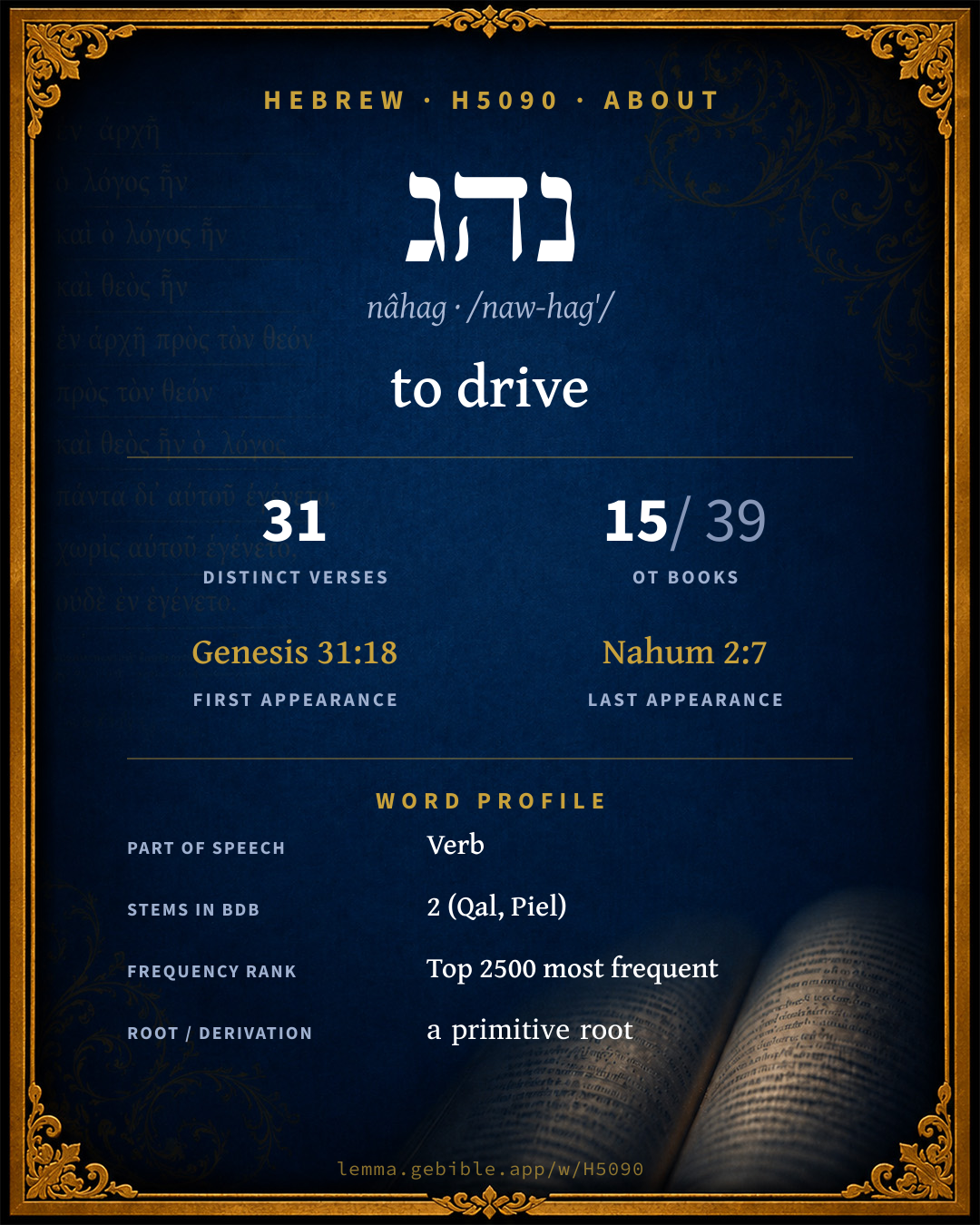
נָהַג
to drive
also: lead, guide, conduct fuller range ↓
Full lexicon entry — Brown-Driver-Briggs (BDB)
From Brown-Driver-Briggs (BDB)
Where this word appears
See every Qal verb in the Hebrew Bible →
Grammar key — what these labels mean
Part of speech
- Verb
- An action or state-of-being word.
Stem
- Qal
- The basic, simple active stem — the plain form of the verb (“he wrote”). Here: ‘drive’
- Piel
- An intensive or resultative active stem. Here: ‘drive away’
Form
- Sequential Imperfect
- An imperfect with prefixed waw — the standard past-narrative form (waw-consecutive imperfect).
- Participle Active
- A verbal adjective expressing ongoing or characteristic action (“writing / one who writes”).
- Imperfect
- An incomplete, ongoing, or future action (“he will / would write”).
- Perfect
- A completed action or state — Hebrew marks aspect (completeness) more than strict tense (“he wrote”).
- Participle Passive
- A verbal adjective expressing action received (“written”).
- Imperative
- A direct command (“write!”).
State
- Absolute
- The independent form of a noun, not bound to a following word.
Person
- 3rd Person
- The one spoken about (“he / she / it / they”).
- 2nd Person
- The one addressed (“you”).
- 1st Person
- The speaker (“I / we”).
Gender
- Masculine
- Grammatically masculine.
- Feminine
- Grammatically feminine.
- Common
- Either gender — not distinguished for this form.
Number
- Singular
- One.
- Plural
- More than one (in Hebrew, generally three or more).
Grammatical forms 17 distinct
- Verb, Qal, Sequential Imperfect, 3rd Person, Masculine, Singular 5 times (16%)
- Verb, Piel, Imperfect, 3rd Person, Masculine, Singular 4 times (13%)
- Verb, Qal, Participle Active, Masculine, Singular, Absolute 3 times (10%)
- Verb, Piel, Sequential Imperfect, 3rd Person, Masculine, Singular 3 times (10%)
- Verb, Qal, Imperfect, 3rd Person, Masculine, Singular 2 times (6%)
- Verb, Qal, Participle Active, Masculine, Plural, Absolute 2 times (6%)
- Verb, Qal, Imperfect, 3rd Person, Masculine, Plural 2 times (6%)
- Verb, Piel, Sequential Imperfect, 2nd Person, Masculine, Singular 1 time (3%)
+9 more forms (9 occurrences)
Parsed forms decoded from the imported morphology (morphhb / Westminster Leningrad Codex — WLC text public domain, morphhb tagging CC BY 4.0), counted across 31 parsed occurrences — not distinct verses.
Every verse where H5090 appears — 31 distinct verses across 15 books. Click any verse to open its interlinear word-by-word view. Verse text shown in the World English Bible for context — . Each verse’s Hebrew form is shown with its reference; the English is not keyword-highlighted, since the data carries no word-level English alignment. Use “Compare translations” on any verse to read it across multiple English versions. This concordance covers the Hebrew Bible; Septuagint (Greek Old Testament) occurrences are not indexed here.
Genesis 2 verses
- Genesis 31:18 וַ/יִּנְהַ֣ג conj + Qal wimpf 3ms and he carried away all his cattle, and all his substance which he had gathered, the cattle of his getting, which he had gathered in Paddan Aram, to go to Isaac his father to the land of Canaan.
- Genesis 31:26 וַ/תְּנַהֵג֙ conj + Piel wimpf 2ms Laban said to Jacob, "What have you done, that you have deceived me, and carried away my daughters like captives of the sword?
Exodus 3 verses
- Exodus 3:1 וַ/יִּנְהַ֤ג conj + Qal wimpf 3ms Now Moses was keeping the flock of Jethro, his father-in-law, the priest of Midian, and he led the flock to the back of the wilderness, and came to God's mountain, to Horeb.
- Exodus 10:13 נִהַ֤ג Piel pf 3ms Moses stretched forth his rod over the land of Egypt, and Yahweh brought an east wind on the land all that day, and all the night; and when it was morning, the east wind brought the locusts.
- Exodus 14:25 וַֽ/יְנַהֲגֵ֖/הוּ conj + Piel wimpf 3ms + sfx pers 3ms He took off their chariot wheels, and they drove them heavily; so that the Egyptians said, "Let's flee from the face of Israel, for Yahweh fights for them against the Egyptians!"
Deuteronomy 2 verses
- Deuteronomy 4:27 יְנַהֵ֧ג Piel impf 3ms Yahweh will scatter you among the peoples, and you shall be left few in number among the nations, where Yahweh shall lead you away.
- Deuteronomy 28:37 יְנַהֶגְ/ךָ֥ Piel impf 3ms + sfx pers 2ms You shall become an astonishment, a proverb, and a byword, among all the peoples where Yahweh shall lead you away.
1 Samuel 4 verses
- 1 Samuel 23:5 וַ/יִּנְהַג֙ conj + Qal wimpf 3ms David and his men went to Keilah, and fought with the Philistines, and brought away their cattle, and killed them with a great slaughter. So David saved the inhabitants of Keilah.
- 1 Samuel 30:2 וַ/יִּֽנְהֲג֔וּ conj + Qal wimpf 3mp and had taken captive the women [and all] who were therein, both small and great: they didn't kill any, but carried them off, and went their way.
- 1 Samuel 30:20 נָהֲג֗וּ Qal pf 3cp David took all the flocks and the herds, [which] they drove before those [other] cattle, and said, This is David's spoil.
- 1 Samuel 30:22 וְ/יִנְהֲג֖וּ conj + Qal impf 3mp Then answered all the wicked men and base fellows, of those who went with David, and said, Because they didn't go with us, we will not give them anything of the spoil that we have recovered, except to every man his wife and his children, that he may lead them away, and depart.
2 Samuel 1 verse
2 Kings 2 verses
- 2 Kings 4:24 נְהַ֣ג Qal impv 2ms Then she saddled a donkey, and said to her servant, Drive, and go forward; don't slacken me the riding, except I bid you.
- 2 Kings 9:20 יִנְהָֽג Qal impf 3ms The watchman told, saying, He came even to them, and isn't coming back: and the driving is like the driving of Jehu the son of Nimshi; for he drives furiously.
1 Chronicles 2 verses
- 1 Chronicles 13:7 נֹהֲגִ֖ים Qal ptcp.act mp They carried the ark of God on a new cart, [and brought it] out of the house of Abinadab: and Uzza and Ahio drove the cart.
- 1 Chronicles 20:1 וַ/יִּנְהַ֣ג conj + Qal wimpf 3ms It happened, at the time of the return of the year, at the time when kings go out [to battle], that Joab led forth the army, and wasted the country of the children of Ammon, and came and besieged Rabbah. But David stayed at Jerusalem. Joab struck Rabbah, and overthrew it.
2 Chronicles 1 verse
Job 1 verse
Psalms 4 verses
- Psalms 48:14 יְנַהֲגֵ֣/נוּ Piel impf 3ms + sfx pers 1cp For this God is our God forever and ever. He will be our guide even to death.
- Psalms 78:26 וַ/יְנַהֵ֖ג conj + Piel wimpf 3ms He caused the east wind to blow in the sky. By his power he guided the south wind.
- Psalms 78:52 וַֽ/יְנַהֲגֵ֥/ם conj + Piel wimpf 3ms + sfx pers 3mp But he led forth his own people like sheep, And guided them in the wilderness like a flock.
- Psalms 80:1 נֹהֵ֣ג Qal ptcp.act ms Hear us, Shepherd of Israel, You who lead Joseph like a flock, You who sit above the cherubim, shine forth.
Ecclesiastes 1 verse
Song of Solomon 1 verse
Isaiah 5 verses
- Isaiah 11:6 נֹהֵ֥ג Qal ptcp.act ms The wolf shall dwell with the lamb, and the leopard shall lie down with the kid; and the calf and the young lion and the fattened calf together; and a little child shall lead them.
- Isaiah 20:4 יִנְהַ֣ג Qal impf 3ms so shall the king of Assyria lead away the captives of Egypt, and the exiles of Ethiopia, young and old, naked and barefoot, and with buttocks uncovered, to the shame of Egypt.
- Isaiah 49:10 יְנַהֲגֵ֔/ם Piel impf 3ms + sfx pers 3mp They shall not hunger nor thirst; neither shall the heat nor sun strike them: for he who has mercy on them will lead them, even by springs of water will he guide them.
- Isaiah 60:11 נְהוּגִֽים Qal ptcp.pass mp Your gates also shall be open continually; they shall not be shut day nor night; that men may bring to you the wealth of the nations, and their kings led captive.
- Isaiah 63:14 נִהַ֣גְתָּ Piel pf 2ms As the cattle that go down into the valley, the Spirit of Yahweh caused them to rest; so did you lead your people, to make yourself a glorious name.
Lamentations 1 verse
Nahum 1 verse
About this entry
At a glance — auto-summarized from this page’s data, not written by a person. Every figure links to its source below. This summary describes the numbers; it doesn’t interpret them.
נהג (nâhag) is a Hebrew verb most often rendered “to drive.” It first appears in Genesis 31:18. With 31 verses in 15 books, it is a moderately common word in the Hebrew Bible. Across 2 stems, its meaning turns on the binyan (Qal, Piel). It clusters with מנהג under a shared root. For the data behind this summary, explore the sense tree and the renderings breakdown below.
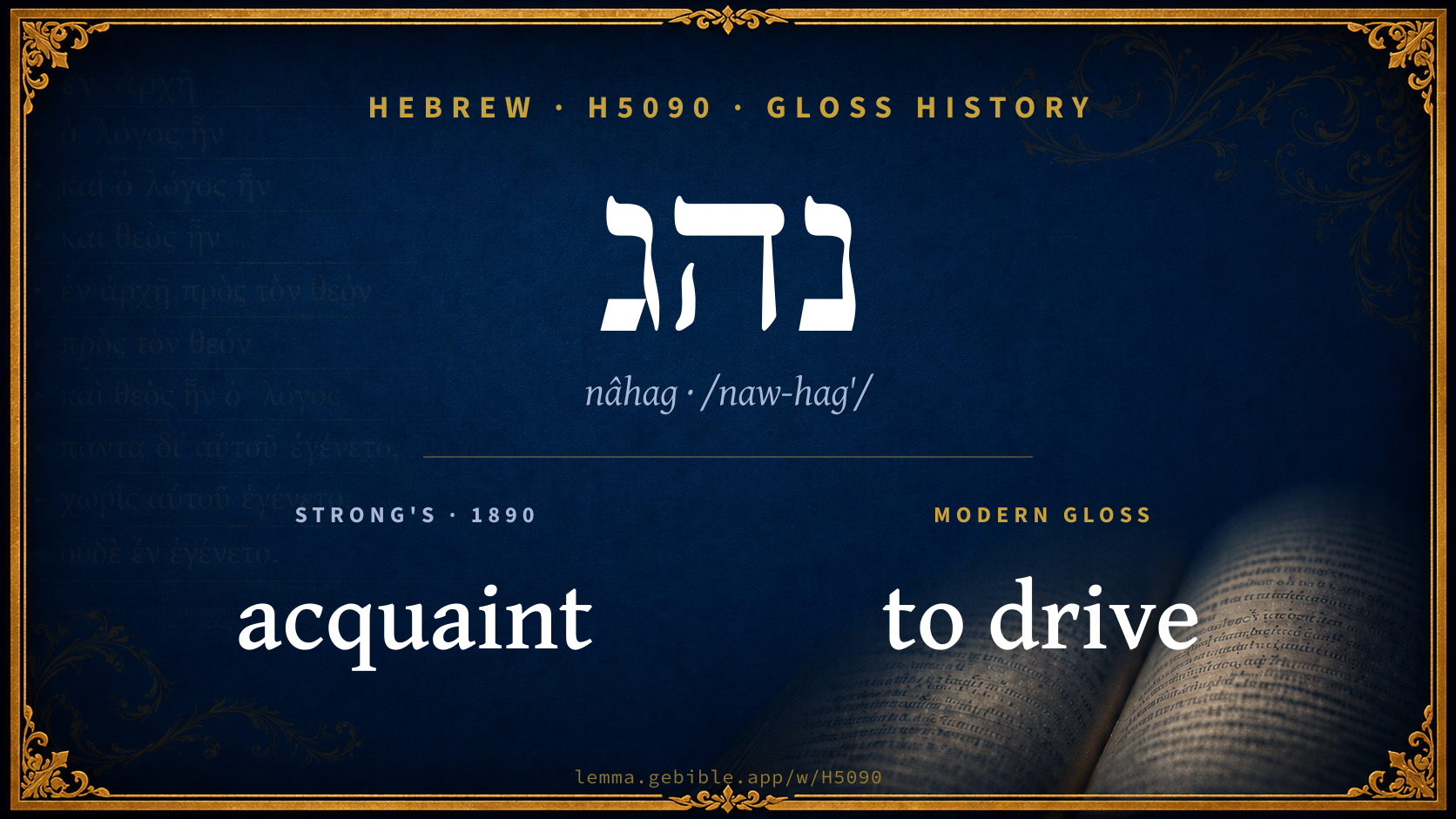
Gloss history
Strong's 1890 vs modern scholarship
About this word
Strong's H5090 catalogs a Hebrew word from the Hebrew Old Testament.
These counts are not copied from any lexicon or concordance. They are computed here, from the morphology-tagged Hebrew Old Testament. What Lemma adds →
- 31
- distinct verses
- The word appears in 31 distinct verses.
- 15 / 39
- OT books
- The word appears in 15 of 39 Old Testament books.
- #1,120
- by frequency
- Top 2500 most frequent Hebrew words (rank 1,120 of 8,640 Hebrew words by occurrence).
View all 31 occurrences in the concordance →
By section of the Old Testament
By traditional corpus
Conventional, traditional groupings — biblical authorship is debated, so this is a traditional corpus grouping, not an authorship claim. Each share is this word’s portion of its verses in that division of the Hebrew canon. Each figure is a share of the word’s 31 distinct verses.
- Prophets (Nevi'im) 13 verses · 42%
- Writings (Ketuvim) 11 verses · 35%
- Torah (Pentateuch) 7 verses · 23%
How translations render this word
Counts come from each version’s own published word-to-Strong’s tagging or interlinear alignment — an approximate guide to how each version renders this word, not a word-level alignment the data otherwise carries. Because each total is that version’s own tagged count, the per-version totals vary from one another and need not match the appearance or distinct-verse counts above. These counts may also differ from a printed concordance because Lemma counts each distinctly tagged rendering and does not collapse phrase taggings into a single head-word total. This is a fixed set of word-tagged versions (KJV, ASV, BSB, ULT) and does not change with the reading translation you choose elsewhere. Each version’s license is shown beside its name below (and on Sources).
BDB lists this Strong’s number as 2 distinct words (homographs). Each count above pools all of them and is not split by sense — see the Senses section below. A low-frequency rendering may belong to a different one of those words, not the primary meaning.
- King James Version†: Shall lead 5×, Drave 2×, They drave 2×
- American Standard Version†: Drove 2×, They drove 2×
- Berean Standard Bible†: Will drive you 2×
- unfoldingWord Literal Text†: He drove 2×
King James Version Public Domain
Renders H5090 across 31† tagged occurrences — most commonly:
Plus 22 renderings that appear only once — usually multi-word phrases or single function words the recovered tagging swept in, not distinct renderings.
American Standard Version Public Domain
Renders H5090 across 31† tagged occurrences — most commonly:
Plus 27 renderings that appear only once — usually multi-word phrases or single function words the recovered tagging swept in, not distinct renderings.
Berean Standard Bible Public Domain
Renders H5090 across 30† tagged occurrences — most commonly:
Plus 28 renderings that appear only once — usually multi-word phrases or single function words the recovered tagging swept in, not distinct renderings. Not rendered by a distinct English word in 1 further occurrence.
unfoldingWord Literal Text CC BY-SA 4.0
Renders H5090 across 34† tagged occurrences — most commonly:
Plus 32 renderings that appear only once — usually multi-word phrases or single function words the recovered tagging swept in, not distinct renderings.
8 senses and sub-senses in the full BDB
Hebrew verbs can shift meaning by stem (binyan): Qal is the basic action, Niphal is often passive or reflexive, Piel often intensifies or makes it factitive, and Hiphil is typically causative. The senses below are grouped under the stem BDB assigns to each.
What do BDB’s symbols mean?
BDB uses these scholarly abbreviations:
| Symbol | Meaning |
|---|---|
| 𝔊 | the Septuagint (the ancient Greek translation, LXX) |
| 𝔙 | the Vulgate (the Latin translation) |
| 𝔖 | the Syriac version (the Peshitta) |
| 𝔗 | the Targum (the Aramaic translation) |
| ψ | the Psalms |
| √ | root (the underlying root or stem) |
| ‖ | parallel passage (a synonymous or contrasted parallel) |
| † | the dagger: every passage where the word occurs is cited |
The 8 senses and sub-senses the full Brown-Driver-Briggs lexicon distinguishes for this word, in lexicon order (not ranked by frequency), with BDB’s own verbatim wording and sub-sense lettering. Shown in Hebrew script with BDB’s own scholarly abbreviations. The condensed entry is in the Lexicon Entry tab. See also the Forms in the corpus table below.
נהג I drive, conduct (NH conduct oneself, behave, be accustomed
Qal
- Pf. נ׳ La 3:2; נָֽהֲגוּ 1 S 30:20; Impf. יִנְהַג Is 20:4, etc.; Imv. נְהַג 2 K 4:24; Pt. act. נֹהֵג Is 11:6 + 2 times, etc.; pass. נְהוּגִים Is 60:11;— e.g. Lamentations 3:2
- 1. drive, flocks Ex 3:1; cf. (in predict.) Is 11:6 (sq. בְּ); fig., obj. Joseph, ψ 80:2 (sim. of flock); hence, obj. human being, lead on, Ct 8:2 (‖ הֵבִיא אֶל־)); also fig., subj. י׳, La 3:2 (‖ הוֹלִיךְ); pass. pt. of kings led in procession Is 60:11 cf. Di (rather than as captives, Che, as earlier usage; ‖ הֵבִיא); drive away, off, (obj. מִקְנֶה) Gn 31:18 (of Jacob, going by stealth); usually as booty (obj. flocks and herds) 1 S 23:5, חמור יתומים ינהגו Jb 24:3 (unjustly); cf. 1 S 30:2, 20 (read וַיִּנְהֲגוּ We Dr Kit Bu, cf. Th, not HPS q.v.), v 22 (no obj. expr. but really captives ‖ הָלַךְ), Is 20:4; drive an ass for riding 2 K 4:24 (‖ הָלַךְ); a cart (עֲגָלָה) 2 S 6:3 = 1 Ch 13:7 (where בָּע׳); abs. of driving chariot 2 K 9:20; lead out an army to battle (late) 1 Ch 20:1 2 Ch 25:11. e.g. Exodus 3:1
- 2. fig. וְלִבִּי נֹהֵג בַּחָכְמָה Ec 2:3 my heart behaving itself in wisdom (cf. NH supr.). e.g. Ecclesiastes 2:3
Piel
- Pf. נִהַג Ex 10:13; נִהַ֫גְתָּ Is 63:14; Impf. יְנַהֵג Dt 4:27, etc.;— e.g. Exodus 10:13
- 1. drive away, lead off, sq. acc., daughters of Laban Gn 31:26 (‖ גָּנַב); of י׳, leading off people into exile, sq. שָׁ֫מָּה Dt 4:27 (‖ הֵפִיץ), 28:37 (‖ הוֹלִיךְ). e.g. Genesis 31:26
- 2. lead on, guide, sq. acc., subj. י׳, ψ 78:52 (כַּעֵ֫דֶר ‖ הִסִּיעַ כַּצֹּאן); Is 49:10 (‖ נִהֵל, cf. ψ 23:2); 63:14; ψ 48:15; guide on, a wind, Ex 10:13 (sq. בָּאָרֶץ), ψ 78:26 (‖ הִסִּיעַ). e.g. Psalms 78:52
- 3. cause to drive (cf. Qal, 2 K 9:20) Ex 14:25 (JE; subj. י׳, v. Di). e.g. 2 Kings 9:20
נהג II Pi. moan, lament (Arabic نَهِجَ be out of breath, pant, breathe heavily
Piel
- Pt. fpl. מְנַהֲגוֹת Na 2:8 (כְּקוֹל יוֹנִים). e.g. Nahum 2:8
Senses from the full Brown-Driver-Briggs lexicon (Brown, Driver, Briggs; Oxford 1906 — public domain), digitized via Sefaria, supplemented by the OpenScriptures HebrewLexicon (CC BY 4.0). Full attribution on Sources.
Word origin
I. vb. drive, conduct (NH conduct oneself, behave, be accustomed; Arabic نَهَجَ go along the road, keep to the road; Aramaic נְהַג lead);—
II. vb.Pi. moan, lament (Arabic نَهِجَ be out of breath, pant, breathe heavily; Aramaic ܢܗܰܓ sigh, groan);—
— Brown-Driver-Briggs (Oxford 1906, public domain), digitized via Sefaria, supplemented by the OpenScriptures HebrewLexicon (CC BY 4.0). See Sources.
Origin: a primitive root
Jastrow Dictionary
A second Hebrew/Aramaic lexicon for comparison, covering Aramaic and post-biblical (Talmudic, Targumic, Midrashic) usage that the biblical-Hebrew BDB does not. Matched by lemma rather than by Strong’s number, so a lemma may carry more than one Jastrow headword (shown separately below), and the entries cover usage well beyond the Bible.
נָהַג
- (b. h.) [to drive an animal,] to lead, conduct; to demean one’s self; to be guided by, be wont to; to apply, be practiced. Keth. 103ᵇ נְהוֹג, v. דָּמִים. Ḥull. VII, 1 נוֹהֵג, v. גִּיד. Sifra Tsav, Par. 11, ch. XVIII שיִנְהוֹג הדבר לדורות which intimates that this order should be preserved at all times. Pes. IV, 1 מקום שנָהֲגוּ וכ׳ where it is a local usage to &c. Meg. 6ᵇ כל מצות שנוֹהֲגוֹת בשני וכ׳ all laws that apply to the second (Adar) apply also to the first. Ib. 5ᵇ, a. e. דברים … ואחרים נָהֲגוּ בהן איסור things which are permitted, but which some treat as forbidden; a. v. fr.—נ׳ כבוד, v. כָּבוֹד.—(ראש) נ׳ קלות, v. קַלּוּת.—Ab. Zar. 54ᵇ עולם … נוהג, v. מִנְהָג.—Yalk. Num. 764 נ׳ שמנים וכ׳ he applied oils and baths.
- same, esp.
- 1. to drive, direct; to take possession of an animal by driving. Kil. VIII, 2 להַנְהִיג, v. מָשַךְ. Ib. 3 המַנְהִיג the driver of heterogeneous animals. B. Mets. I, 2 אחד רוכב ואחד מנהיג one rode (the animal that was found), and the other directed it (by leading). Ib. 8ᵇ רכוב במקום מנהיג the rights of the driver as against those of the leader. Ib. במנהיג ברגליו when the rider drives by means of his heels. Ib. תרי גווני מנהיג there are two ways of driving; a. fr.—B. Bath. V, 1 ואת כל המַנְהִיגִין אותה and all the implements needed for directing the ship; a. e., v. מַנְהִיג.
- 2. to lead, conduct. Ber. 35ᵇ הַנְהֵג בהן דרך ארץ combine with the study of the Law a secular occupation; Yalk. Deut. 863 תּנְהוֹג. Snh. 92ᵃ כל פרנס שמנהיג … ומַנְהִיגָם וכ׳ a manager that leads a community with gentleness, will be privileged to lead it in the days to come (of resurrection); a. fr.—Tosef. Bets. II, 15 ה׳ את בני רומי וכ׳ made it a custom among the Jews in Rome &c.—ה׳ עצמו ברבנות to assume airs of superiority. Sot. 13ᵇ; a. fr.
- 1. to conduct one’s self. Sifré Deut. 323 הִתְנַהֲגוּ זה את זה וכ׳ conduct yourselves towards one another in charity; a. fr.
- 2. to be conducted. Y. B. Kam. VI, 5ᶜ top רוח שהעולם מִתְנַהֵג בו a wind by which the world is maintained, i.e. an ordinary wind, opp. של אונסים a calamitous wind (Bab. ib. 60ᵃ רוח מצויה, v. מָצָא).
- 3. to move. Gen. R. s. 66 מתנהג בה וכ׳ moves with her (Israel) from tent to tent.—V. נוֹהַג.
נְהַג
- Targ. Lam. I, 8. Ruth IV, 7. Targ. Koh. X, 4.—Part. pass. נְהִיג; pl. נְהִיגִין. Targ. Y. Ex. XXXIX, 37.—Ber. 22ᵃ; Ḥull. 136ᵇ נָהוּג עלמא כהני וכ׳ the world follows in practice the opinion of these three elders &c. Gen. R. s. 33 שרי נָהֵיג ביה יקרא he began to do him honor (= h. נהג כבוד).—Part. pass. as ab. accustomed. Y. Pes. IV, 30ᶜ sq. נשייא דנְהִיגָן … אינו מנהג (not דנהיגין) that custom of the women not to do …, is no binding custom; ib.ᵈ top דנַהֲגָן. Y. R. Hash. II, 58ᵇ top הכין אתון נ׳ גביכון וכ׳ is that your custom, to annoy your superiors?; a. fr. e.g. Ruth 4:7
A Dictionary of the Targumim, the Talmud Babli and Yerushalmi, and the Midrashic Literature (Marcus Jastrow; London, Luzac, 1903) — Public Domain. Digitized via Sefaria. Digitized via Sefaria. Full attribution on Sources.
Forms in the corpus
The 28 distinct written forms H5090 takes in the Hebrew Bible, most frequent first — each parse links to that stem’s occurrences in the concordance. Hebrew forms include their vowel points and cantillation, so a single lemma takes many written forms.
Same root — word family
Other BDB entries built from the same root as H5090, grouped by Strong’s listed origin. These share a root / origin per the lexicon — not necessarily a shared meaning. Each links to that word’s own entry.
Derived from this word
Compare all same-root words → They share a root, not necessarily a meaning.
Septuagint verse parallels
This word appears in 29 verses that also exist in the Greek Old Testament (Septuagint), out of the 31 Hebrew verses it occurs in. You can read those verses in Greek by switching the Old Testament edition to the Septuagint.
Read these verses in the Septuagint
- Genesis 31:18
- Exodus 3:1
- Deuteronomy 4:27
- 1 Samuel 23:5
- 2 Samuel 6:3
- 2 Kings 4:24
- 1 Chronicles 13:7
- 2 Chronicles 25:11
- Job 24:3
- Psalms 48:14
- Ecclesiastes 2:3
- Song of Solomon 8:2
This is a verse-level parallel only — the same verses exist in both the Hebrew and Greek Old Testaments. No word-level Hebrew↔Greek correspondence is claimed: the data carries no such alignment, so no Greek word is shown as this Hebrew word’s translation. Coverage is not total — the Septuagint omits the deuterocanon and renumbers the Psalms, so some Hebrew verses have no direct Greek parallel.