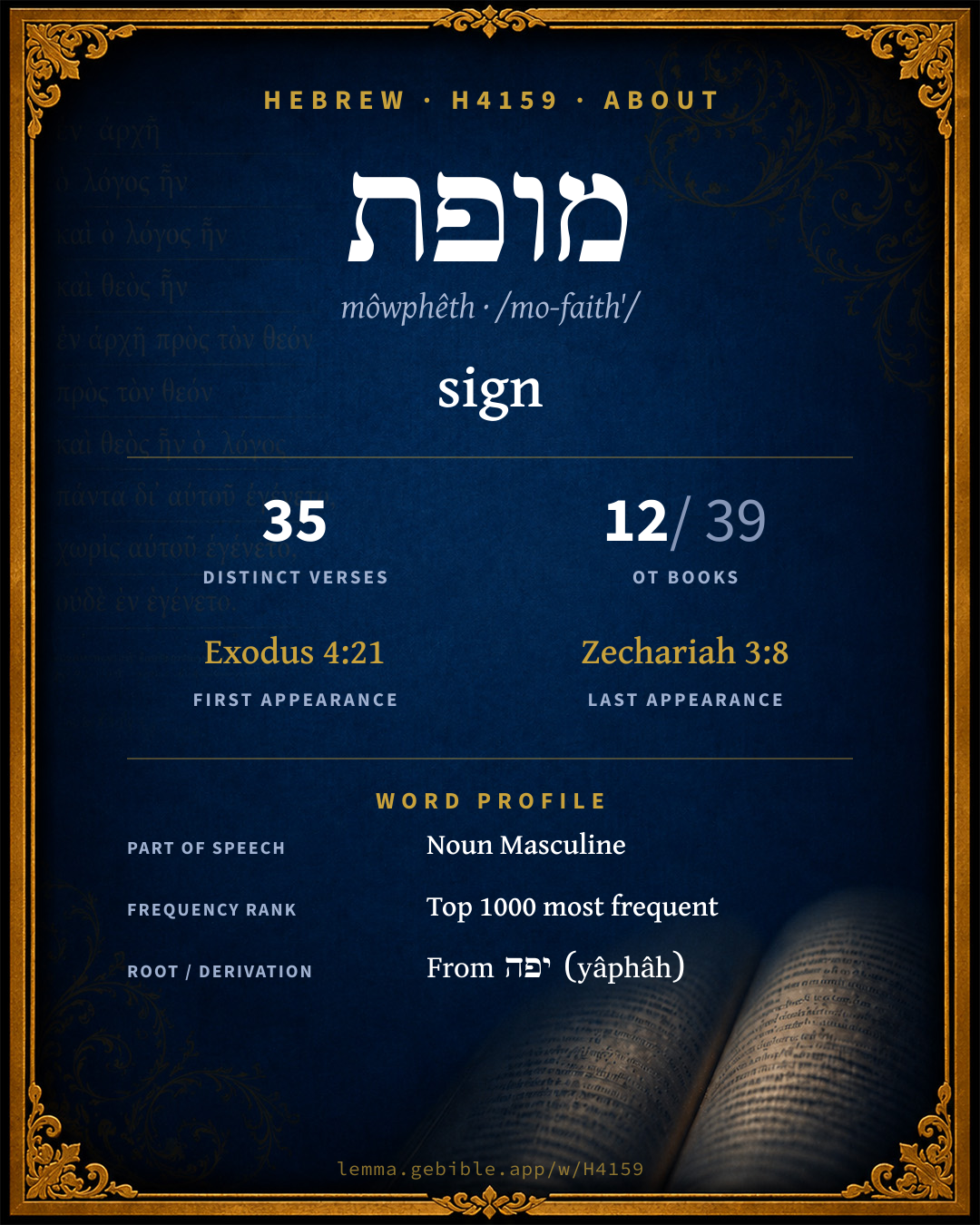
מוֹפֵת
sign
also: wonder, miracle, portent fuller range ↓
Full lexicon entry — Brown-Driver-Briggs (BDB)
From Brown-Driver-Briggs (BDB)
Where this word appears
See every Absolute-state word in the Hebrew Bible →
Grammar key — what these labels mean
Part of speech
- Noun
- A naming word — a person, place, thing, or idea.
Noun type
- Common
- A common noun — a general class of person, place, or thing (“king,” “city,” “water”), not a specific name.
State
- Absolute
- The independent form of a noun, not bound to a following word.
- Construct
- A noun bound to a following noun in a possessive / “of” relationship (the construct chain).
Gender
- Masculine
- Grammatically masculine.
Number
- Plural
- More than one (in Hebrew, generally three or more).
- Singular
- One.
Grammatical forms
- Noun, Common, Masculine, Plural, Absolute 15 times (42%)
- Noun, Common, Masculine, Singular, Absolute 15 times (42%)
- Noun, Common, Masculine, Plural, Construct 5 times (14%)
- Noun, Common, Masculine, Singular, Construct 1 time (3%)
Parsed forms decoded from the imported morphology (morphhb / Westminster Leningrad Codex — WLC text public domain, morphhb tagging CC BY 4.0), counted across 36 parsed occurrences — not distinct verses.
Every verse where H4159 appears — 35 distinct verses across 12 books. Click any verse to open its interlinear word-by-word view. Verse text shown in the World English Bible for context — . Each verse’s Hebrew form is shown with its reference; the English is not keyword-highlighted, since the data carries no word-level English alignment. Use “Compare translations” on any verse to read it across multiple English versions. This concordance covers the Hebrew Bible; Septuagint (Greek Old Testament) occurrences are not indexed here.
Exodus 5 verses
- Exodus 4:21 הַ/מֹּֽפְתִים֙ ptcl def.art + n c mp Yahweh said to Moses, "When you go back into Egypt, see that you do before Pharaoh all the wonders which I have put in your hand, but I will harden his heart and he will not let the people go.
- Exodus 7:3 מוֹפְתַ֖/י n c mp cs + sfx pers 1cs I will harden Pharaoh's heart, and multiply my signs and my wonders in the land of Egypt.
- Exodus 7:9 מוֹפֵ֑ת n c ms "When Pharaoh speaks to you, saying, 'Perform a miracle!' then you shall tell Aaron, 'Take your rod, and cast it down before Pharaoh, that it become a serpent.'"
- Exodus 11:9 מוֹפְתַ֖/י n c mp cs + sfx pers 1cs Yahweh said to Moses, "Pharaoh won't listen to you, that my wonders may be multiplied in the land of Egypt."
- Exodus 11:10 הַ/מֹּפְתִ֥ים ptcl def.art + n c mp Moses and Aaron did all these wonders before Pharaoh, and Yahweh hardened Pharaoh's heart, and he didn't let the children of Israel go out of his land.
Deuteronomy 9 verses
- Deuteronomy 4:34 וּ/בְ/מוֹפְתִ֜ים conj + prep + n c mp Or has God tried to go and take him a nation from the midst of [another] nation, by trials, by signs, and by wonders, and by war, and by a mighty hand, and by an outstretched arm, and by great terrors, according to all that Yahweh your God did for you in Egypt before your eyes?
- Deuteronomy 6:22 וּ֠/מֹפְתִים conj + n c mp and Yahweh shown signs and wonders, great and sore, on Egypt, on Pharaoh, and on all his house, before our eyes;
- Deuteronomy 7:19 וְ/הַ/מֹּֽפְתִים֙ conj + ptcl def.art + n c mp the great trials which your eyes saw, and the signs, and the wonders, and the mighty hand, and the outstretched arm, by which Yahweh your God brought you out: so shall Yahweh your God do to all the peoples of whom you are afraid.
- Deuteronomy 13:1 מוֹפֵֽת n c ms If there arise in the midst of you a prophet, or a dreamer of dreams, and he give you a sign or a wonder,
- Deuteronomy 13:2 וְ/הַ/מּוֹפֵ֔ת conj + ptcl def.art + n c ms and the sign or the wonder come to pass, of which he spoke to you, saying, Let us go after other gods, which you have not known, and let us serve them;
- Deuteronomy 26:8 וּ/בְ/מֹפְתִֽים conj + prep + n c mp and Yahweh brought us forth out of Egypt with a mighty hand, and with an outstretched arm, and with great terror, and with signs, and with wonders;
- Deuteronomy 28:46 וּ/לְ/מוֹפֵ֑ת conj + prep + n c ms and they shall be on you for a sign and for a wonder, and on your seed forever.
- Deuteronomy 29:3 וְ/הַ/מֹּפְתִ֛ים conj + ptcl def.art + n c mp the great trials which your eyes saw, the signs, and those great wonders:
- Deuteronomy 34:11 וְ/הַ/מּוֹפְתִ֗ים conj + ptcl def.art + n c mp in all the signs and the wonders, which Yahweh sent him to do in the land of Egypt, to Pharaoh, and to all his servants, and to all his land,
1 Kings 2 verses
- 1 Kings 13:3 מוֹפֵת֙ הַ/מּוֹפֵ֔ת n c ms ptcl def.art + n c ms He gave a sign the same day, saying, This is the sign which Yahweh has spoken: Behold, the altar shall be torn, and the ashes that are on it shall be poured out.
- 1 Kings 13:5 כַּ/מּוֹפֵ֗ת prep det + n c ms The altar also was torn, and the ashes poured out from the altar, according to the sign which the man of God had given by the word of Yahweh.
1 Chronicles 1 verse
2 Chronicles 2 verses
- 2 Chronicles 32:24 וּ/מוֹפֵ֖ת conj + n c ms In those days Hezekiah was sick even to death: and he prayed to Yahweh; and he spoke to him, and gave him a sign.
- 2 Chronicles 32:31 הַ/מּוֹפֵת֙ ptcl def.art + n c ms However in [the business of] the ambassadors of the princes of Babylon, who sent to him to inquire of the wonder that was done in the land, God left him, to try him, that he might know all that was in his heart.
Nehemiah 1 verse
Psalms 5 verses
- Psalms 71:7 כְּ֭/מוֹפֵת prep + n c ms I am a marvel to many, But you are my strong refuge.
- Psalms 78:43 וּ֝/מוֹפְתָ֗י/ו conj + n c mp cs + sfx pers 3ms How he set his signs in Egypt, His wonders in the field of Zoan,
- Psalms 105:5 מֹ֝פְתָ֗י/ו n c mp cs + sfx pers 3ms Remember his marvelous works that he has done; His wonders, and the judgments of his mouth,
- Psalms 105:27 וּ֝/מֹפְתִ֗ים conj + n c mp They performed miracles among them, And wonders in the land of Ham.
- Psalms 135:9 וּ֭/מֹפְתִים conj + n c mp Who sent signs and wonders into the midst of you, Egypt, On Pharaoh, and on all his servants;
Isaiah 2 verses
- Isaiah 8:18 וּ/לְ/מוֹפְתִ֖ים conj + prep + n c mp Behold, I and the children whom Yahweh has given me are for signs and for wonders in Israel from Yahweh of Hosts, who dwells in Mount Zion.
- Isaiah 20:3 וּ/מוֹפֵ֔ת conj + n c ms Yahweh said, Like as my servant Isaiah has walked naked and barefoot three years for a sign and a wonder concerning Egypt and concerning Ethiopia;
Jeremiah 2 verses
- Jeremiah 32:20 וּ/מֹפְתִ֤ים conj + n c mp who performed signs and wonders in the land of Egypt, even to this day, both in Israel and among [other] men; and made you a name, as in this day;
- Jeremiah 32:21 וּ/בְ/מוֹפְתִ֗ים conj + prep + n c mp and brought forth your people Israel out of the land of Egypt with signs, and with wonders, and with a strong hand, and with an outstretched arm, and with great terror;
Ezekiel 4 verses
- Ezekiel 12:6 מוֹפֵ֥ת n c ms In their sight shall you bear it on your shoulder, and carry it forth in the dark; you shall cover your face, that you don't see the land: for I have set you for a sign to the house of Israel.
- Ezekiel 12:11 מֽוֹפֶתְ/כֶ֑ם n c ms cs + sfx pers 2mp Say, I am your sign: like as I have done, so shall it be done to them; they shall go into exile, into captivity.
- Ezekiel 24:24 לְ/מוֹפֵ֔ת prep + n c ms Thus shall Ezekiel be to you a sign; according to all that he has done shall you do: when this comes, then shall you know that I am the Lord Yahweh.
- Ezekiel 24:27 לְ/מוֹפֵ֔ת prep + n c ms In that day shall your mouth be opened to him who is escaped, and you shall speak, and be no more mute: so shall you be a sign to them; and they shall know that I am Yahweh.
Joel 1 verse
Zechariah 1 verse
About this entry
At a glance — auto-summarized from this page’s data, not written by a person. Every figure links to its source below. This summary describes the numbers; it doesn’t interpret them.
מופת — transliterated môwphêth — is a Hebrew noun carrying the sense “sign.” It first appears in Exodus 4:21. The Hebrew Bible uses it across 35 verses — moderately common. More than a quarter of its appearances fall in Deuteronomy. It also covers “wonder”, “miracle”, and “portent”, alongside “sign” — see its full sense range. Each statement above links to its evidence; the full detail follows below.
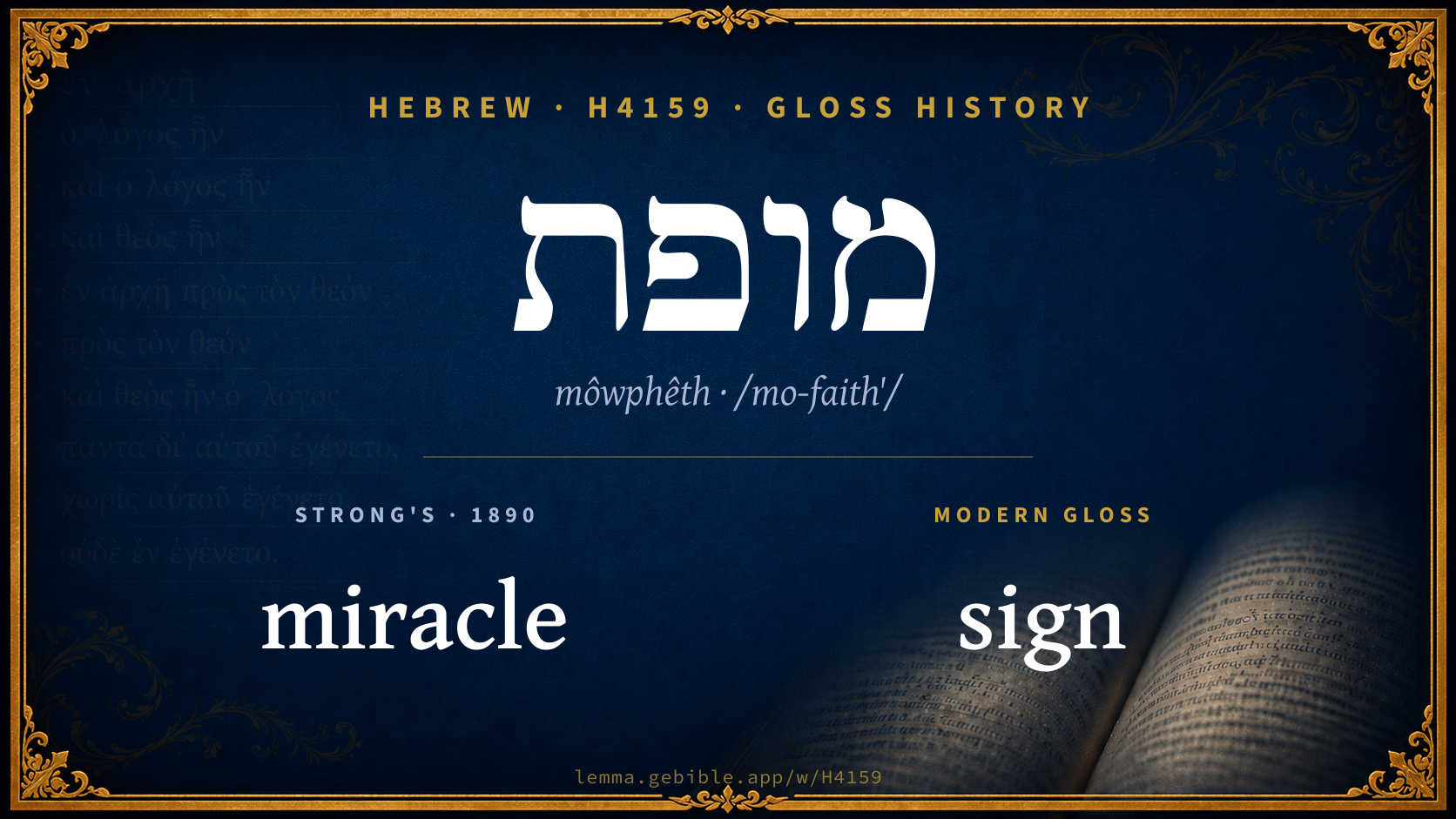
Gloss history
Strong's 1890 vs modern scholarship
About this word
Strong's H4159 catalogs a Hebrew word from the Hebrew Old Testament.
These counts are not copied from any lexicon or concordance. They are computed here, from the morphology-tagged Hebrew Old Testament. What Lemma adds →
- 35
- distinct verses
- The word appears in 35 distinct verses.
- 12 / 39
- OT books
- The word appears in 12 of 39 Old Testament books.
- #990
- by frequency
- Top 1000 most frequent Hebrew words (rank 990 of 8,640 Hebrew words by occurrence).
View all 35 occurrences in the concordance →
Most concentrated in
- Deuteronomy 9 verses 26%
- Exodus 5 verses 14%
- Psalms 5 verses 14%
By section of the Old Testament
By traditional corpus
Conventional, traditional groupings — biblical authorship is debated, so this is a traditional corpus grouping, not an authorship claim. Each share is this word’s portion of its verses in that division of the Hebrew canon. Each figure is a share of the word’s 35 distinct verses.
- Torah (Pentateuch) 14 verses · 40%
- Prophets (Nevi'im) 12 verses · 34%
- Writings (Ketuvim) 9 verses · 26%
How translations render this word
Counts come from each version’s own published word-to-Strong’s tagging or interlinear alignment — an approximate guide to how each version renders this word, not a word-level alignment the data otherwise carries. Because each total is that version’s own tagged count, the per-version totals vary from one another and need not match the appearance or distinct-verse counts above. These counts may also differ from a printed concordance because Lemma counts each distinctly tagged rendering and does not collapse phrase taggings into a single head-word total. This is a fixed set of word-tagged versions (KJV, ASV, BSB, ULT) and does not change with the reading translation you choose elsewhere. Each version’s license is shown beside its name below (and on Sources).
- King James Version: Wonders 15×, Wonder 3×, Sign 2×
- American Standard Version: Wonders 16×, Wonder 4×
- Berean Standard Bible: Wonders 17×, Sign 7×, Wonder 3×
- unfoldingWord Literal Text: Wonders 13×, Sign 8×, Miracles 6×
King James Version Public Domain
Renders H4159 across 36 tagged occurrences — most commonly:
Plus 16 renderings that appear only once — usually multi-word phrases or single function words the recovered tagging swept in, not distinct renderings.
American Standard Version Public Domain
Renders H4159 across 35 tagged occurrences — most commonly:
Plus 15 renderings that appear only once — usually multi-word phrases or single function words the recovered tagging swept in, not distinct renderings.
Berean Standard Bible Public Domain
Renders H4159 across 36 tagged occurrences — most commonly:
Plus 7 renderings that appear only once — usually multi-word phrases or single function words the recovered tagging swept in, not distinct renderings.
unfoldingWord Literal Text CC BY-SA 4.0
Renders H4159 across 35 tagged occurrences — most commonly:
Plus 6 renderings that appear only once — usually multi-word phrases or single function words the recovered tagging swept in, not distinct renderings.
Senses in the full BDB
What do BDB’s symbols mean?
BDB uses these scholarly abbreviations:
| Symbol | Meaning |
|---|---|
| 𝔊 | the Septuagint (the ancient Greek translation, LXX) |
| 𝔙 | the Vulgate (the Latin translation) |
| 𝔖 | the Syriac version (the Peshitta) |
| 𝔗 | the Targum (the Aramaic translation) |
| ψ | the Psalms |
| √ | root (the underlying root or stem) |
| ‖ | parallel passage (a synonymous or contrasted parallel) |
| † | the dagger: every passage where the word occurs is cited |
The 2 senses and sub-senses the full Brown-Driver-Briggs lexicon distinguishes for this word, in lexicon order (not ranked by frequency), with BDB’s own verbatim wording and sub-sense lettering. Shown in Hebrew script with BDB’s own scholarly abbreviations. The condensed entry is in the Lexicon Entry tab. See also the Forms in the corpus table below.
- 1. wonder, as special display of God’s power Ex 7:3; 11:9 ψ 105:5 1 Ch 16:12 Jo 3:3; by Moses and Aaron Ex 4:21; 11:10 cf. 7:9 (in mouth of Pharaoh), by false proph. Dt 13:2, 3 (‖ אות); usually ‖ אות Dt 4:34; 6:22; 7:19; 26:8; 29:2; 34:11 ψ 78:43; 105:27; 135:9 Je 32:20, 21 Ne 9:10; applied to effect of Yahweh’s curse Dt 28:46 (‖ אות); to one protected by י׳ ψ 71:7. e.g. Exodus 7:3
- 2. sign or token of future event (cf. אוֹת) 1 K 13:3(×2), 5 2 Ch 32:24, 31; symbolic act Is 20:3 (‖ אות); as such the term is applied to persons Is 8:18 (‖ אות) Ez 12:6, 11; 24:24, 27; cf. אַנְשֵׁי מ׳ Zc 3:8 men who serve as a symbol or sign.—Vb. used, of divine act, is נתן Ex 7:9 etc., שׂים Je 32:20; שׂים also of entrusting to human power Ex 4:21, cf. דִּבֶּר 1 K 13:3; of human agency עשׂה Ex 4:21; 11:10, נתן 1 K 13:3, 5. e.g. 1 Kings 13:3
Senses from the full Brown-Driver-Briggs lexicon (Brown, Driver, Briggs; Oxford 1906 — public domain), digitized via Sefaria, supplemented by the OpenScriptures HebrewLexicon (CC BY 4.0). Full attribution on Sources.
Word origin
n.m. Dt 29:2 wonder, sign, portent (= מֹאפֵת)—מוֹפֵת Ex 7:9 + 14 times; מוֹפֶתְכֶם Ez 12:11; מוֹפְתִים Dt 4:34 + 4 times; מֹפְתִים Dt 6:22 + 9 times; מוֹפְתַי Ex 7:3; 11:9; מוֹפְתָיו ψ 78:43; מֹפְתָיו 1 Ch 16:12 ψ 105:5—
— Brown-Driver-Briggs (Oxford 1906, public domain), digitized via Sefaria, supplemented by the OpenScriptures HebrewLexicon (CC BY 4.0). See Sources.
Derived from יפה (yâphâh) (H3302) — to be beautiful.
Jastrow Dictionary
A second Hebrew/Aramaic lexicon for comparison, covering Aramaic and post-biblical (Talmudic, Targumic, Midrashic) usage that the biblical-Hebrew BDB does not. Matched by lemma rather than by Strong’s number, so a lemma may carry more than one Jastrow headword (shown separately below), and the entries cover usage well beyond the Bible.
מוֹפֵת
- (יפת, cmp. יָפֶּה) confirmation, evidence; miracle. Sifré Deut. 83 אות בשמים … מ׳ בארץ oth (sign) refers to a phenomenon in the heavens, … mofeth to one on earth. Snh. 93ᵃ אנשים שנעשה להם מ׳ men in whose behalf a miracle was effected. Y. ib. XI, end, 30ᶜ; a. fr.—Ḥull. 103ᵇ מ׳ הדור thou prodigy of the generation!—Pl. מוֹפְתִים, מוֹפְתִין. Tanḥ. Sh’moth 23.
מוֹפֵת ²
- Targ. O. Deut. XIII, 2; a. e.—Pl. מוֹפְתִין, מוֹפְתַיָּא. Ib. Deut. VI, 22. Targ. O. Ex. IV, 21; a. fr. e.g. Deuteronomy 6:22
A Dictionary of the Targumim, the Talmud Babli and Yerushalmi, and the Midrashic Literature (Marcus Jastrow; London, Luzac, 1903) — Public Domain. Digitized via Sefaria. Digitized via Sefaria. Full attribution on Sources.
Forms in the corpus
The 34 distinct written forms H4159 takes in the Hebrew Bible, most frequent first — each parse links to that state’s occurrences in the concordance. Hebrew forms include their vowel points and cantillation, so a single lemma takes many written forms.
Same root — word family
Other BDB entries built from the same root as H4159, grouped by Strong’s listed origin. These share a root / origin per the lexicon — not necessarily a shared meaning. Each links to that word’s own entry.
Derives from
Shares the same root
Proper names from this root
People and places named from this root — a name, not an additional meaning of the word.
Compare all same-root words → Showing 4 of 6 — not the complete family. 1 of the same-root words is a proper name (a person or place). They share a root, not necessarily a meaning.
Septuagint verse parallels
This word appears in 32 verses that also exist in the Greek Old Testament (Septuagint), out of the 35 Hebrew verses it occurs in. You can read those verses in Greek by switching the Old Testament edition to the Septuagint.
Read these verses in the Septuagint
- Exodus 4:21
- Deuteronomy 4:34
- 1 Kings 13:3
- 1 Chronicles 16:12
- 2 Chronicles 32:24
- Psalms 71:7
- Isaiah 8:18
- Jeremiah 32:20
- Ezekiel 12:6
- Zechariah 3:8
This is a verse-level parallel only — the same verses exist in both the Hebrew and Greek Old Testaments. No word-level Hebrew↔Greek correspondence is claimed: the data carries no such alignment, so no Greek word is shown as this Hebrew word’s translation. Coverage is not total — the Septuagint omits the deuterocanon and renumbers the Psalms, so some Hebrew verses have no direct Greek parallel.