
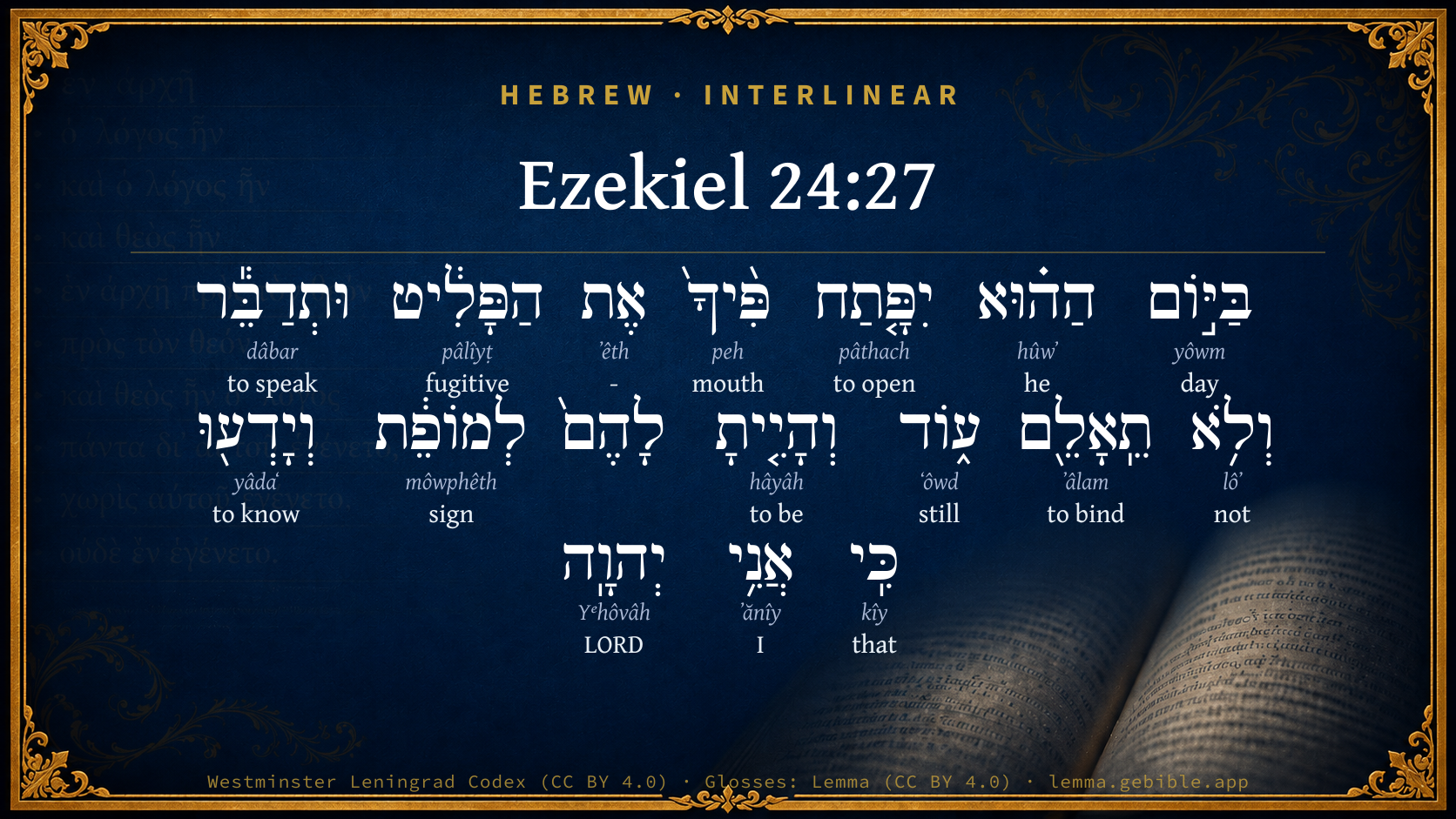
Ezekiel 24:27

Hebrew (Westminster Leningrad Codex) Ezekiel 24:27 appears in the Hebrew Old Testament. The text above is from the Westminster Leningrad Codex. Each word links to its Strong’s number, a concise gloss, and parsing drawn from the Open Scriptures Hebrew Bible morphology. Click any word for its full Brown-Driver-Briggs (BDB) entry.
Download image
Cite this verse

Ezekiel 24:27 (World English Bible). Public Domain. Lemma interlinear Bible study tool, https://lemma.gebible.app/v/ezekiel/24/27.

Show BibTeX & RIS
BibTeX
RIS
English Translation
In that day shall your mouth be opened to him who is escaped, and you shall speak, and be no more mute: so shall you be a sign to them; and they shall know that I am Yahweh.
World English Bible · Public Domain
Download a study sheet

One document with this verse’s original text, its word-by-word gloss line, the meaning frame, cross-references with their text, attributed commentary, and full source and license credits — printable, and it pastes into notes with its structure intact.

This verse Autodidact and up

Study sheet (.html) Plain text (.txt)

A passage Seminary Student

Up to 50 verses in one chapter. A passage sheet keeps up to 6 commentary sources and 12 cross-references per verse, in the order this page ranks them, and says so on the sheet whenever that leaves anything out. Ask for a single verse and you get the Autodidact verse sheet above.

Everything on this page stays free to read, with no account — the sheet is a download of what is already on screen, not access to it.

Want to remove ads? Support Godless Engineer
Compare translations 3

The same verse in 3 English versions, stacked beneath the original-language interlinear above. Click any original word for its lexicon entry.

Each is an independent rendering of the whole verse — the interlinear is not word-aligned to these translations.

Highlighted words mark where these versions differ — a whole-verse word diff, not a word-by-word alignment.

  • World English Bible Public Domain
    In that day shall your mouth be opened to him who is escaped, and you shall speak, and be no more mute: so shall you be a sign to them; and they shall know that I am Yahweh.
  • King James Version Public Domain
    In that day shall thy mouth be opened to him which is escaped, and thou shalt speak, and be no more dumb: and thou shalt be a sign unto them; and they shall know that I am the LORD.
  • unfoldingWord Literal Text CC BY-SA 4.0
    On that day your mouth will be opened up to that refugee and you will speak—you will no longer be silent. You will be a sign for them so that they will know that I am Yahweh.”

unfoldingWord Literal Text — © unfoldingWord, licensed CC BY-SA 4.0. Word-aligned USFM3 via Door43 (git.door43.org/unfoldingWord/en_ult).

Versions to compare (up to 4)

3 of 4 selected

Show all 18 translations

Every available English version of this verse, each an independent rendering of the whole verse.

  • World English Bible Public Domain
    In that day shall your mouth be opened to him who is escaped, and you shall speak, and be no more mute: so shall you be a sign to them; and they shall know that I am Yahweh.
  • Berean Standard Bible Public Domain
    On that day your mouth will be opened to him who has escaped; you will speak and no longer be mute. So you will be a sign to them, and they will know that I am the LORD.”
  • Majority Standard Bible Public Domain
    On that day your mouth will be opened to him who has escaped; you will speak and no longer be mute. So you will be a sign to them, and they will know that I am the LORD.”
  • King James Version Public Domain
    In that day shall thy mouth be opened to him which is escaped, and thou shalt speak, and be no more dumb: and thou shalt be a sign unto them; and they shall know that I am the LORD.
  • American Standard Version (1901) Public Domain
    In that day shall thy mouth be opened to him that is escaped, and thou shalt speak, and be no more dumb: so shalt thou be a sign unto them; and they shall know that I am Jehovah.
  • Revised Version (1885) Public Domain
    In that day shall thy mouth be opened to him which is escaped, and thou shalt speak, and be no more dumb: so shalt thou be a sign unto them; and they shall know that I am the LORD.
  • Geneva Bible (1599) Public Domain
    In that day shall thy mouth be opened to him which is escaped, and thou shalt speake, and be no more dumme, and thou shalt be a signe vnto them, and they shall knowe that I am the Lord.
  • Douay-Rheims (1899) Public Domain
    In that day, I say, shall thy mouth be opened to him that hath escaped, and thou shalt speak, and shalt be silent no more: and thou shalt be unto them for a sign of things to come, and you shall know that I am the Lord.
  • Young's Literal Translation Public Domain
    In that day opened is thy mouth with the escaped, And thou speakest, and art not silent any more, And thou hast been to them for a type. And they have known that I `am' Jehovah.'
  • Literal Standard Version CC BY-SA 4.0
    In that day your mouth is opened with the escaped and you speak, and are not silent anymore, and you have been for a type to them, and they have known that I [am] YHWH.”
  • Unlocked Literal Bible CC BY-SA 4.0
    On that day your mouth will be opened up to that refugee and you will speak—you will no longer be silent. You will be a sign for them so that they will know that I am Yahweh.”
  • unfoldingWord Literal Text CC BY-SA 4.0
    On that day your mouth will be opened up to that refugee and you will speak—you will no longer be silent. You will be a sign for them so that they will know that I am Yahweh.”
  • Darby Bible Public Domain
    In that day shall thy mouth be opened to him that is escaped, and thou shalt speak, and be no more dumb. So shalt thou be a sign unto them; and they shall know that I [am] Jehovah.
  • World Messianic Bible Public Domain
    In that day your mouth will be opened to him who has escaped, and you will speak and be no more mute. So you will be a sign to them. Then they will know that I am the LORD.”
  • Webster's Bible Public Domain
    In that day shall thy mouth be opened to him who hath escaped, and thou shalt speak, and be no more dumb: and thou shalt be a sign to them; and they shall know that I am the LORD.
  • Free Bible Version CC BY-SA 4.0
    On that day you will be able to speak; you won't be mute any longer. This is how you will be a sign to them, and they will know that I am the Lord.”
  • Bible in Basic English Public Domain
    In that day your mouth will be open to him who has got away safe, and you will say words to him and your lips will no longer be shut: so you will be a sign to them and they will be certain that I am the Lord.
  • JPS Tanakh (1917) Public Domain
    In that day shall thy mouth be opened together with him that is escaped, and thou shalt speak, and be no more dumb; so shalt thou be a sign unto them; and they shall know that I am the LORD.'

Literal Standard Version (2020), Covenant Press — licensed CC BY-SA 4.0. Text via the HelloAO Bible API (eBible.org). Unlocked Literal Bible (unfoldingWord) — licensed CC BY-SA 4.0. Text via the HelloAO Bible API (eBible.org). unfoldingWord Literal Text — © unfoldingWord, licensed CC BY-SA 4.0. Word-aligned USFM3 via Door43 (git.door43.org/unfoldingWord/en_ult). Free Bible Version, Dr. Jonathan Gallagher — licensed CC BY-SA 4.0. Text via the HelloAO Bible API (eBible.org).

Word by word

More ways to search: Search by grammar → Find every occurrence → Compare this word →

Practice this passage: Drill this verse → Learn its vocabulary →

תֵֽאָלֵ֖ם
ʼâlam
H481
“to bind”
Verb, Niphal, Imperfect, 2nd Person, Masculine, Singular
Part of Speech
Verb
Stem
Niphal
Form
Imperfect
Person
2nd Person
Gender
Masculine
Number
Singular
Full BDB Definition

Origin: a primitive root

TWOT: 102

to bind - (Niphal) - to be dumb - to be bound - (Piel) binding (participle)
  1. בַּיּ֣וֹם yôwm H3117 “in/at the · day” Preposition, Determined + Noun, Common, Masculine, Singular, Absolute
  2. הַה֗וּא hûwʼ H1931 “the · he” Particle, Definite Article + Pronoun, Personal, 3rd Person, Masculine, Singular
  3. יִפָּ֤תַח pâthach H6605 “to open” Verb, Niphal, Imperfect, 3rd Person, Masculine, Singular
  4. פִּ֨יךָ֙ peh H6310 “mouth · your” Noun, Common, Masculine, Singular, Construct + Suffix, Personal, 2nd Person, Masculine, Singular
  5. אֶת ʼêth H853 “-” Particle, Direct Object
  6. הַפָּלִ֔יט pâlîyṭ H6412 “the · fugitive” Particle, Definite Article + Noun, Common, Masculine, Singular, Absolute
  7. וּתְדַבֵּ֕ר dâbar H1696 “and · to speak” Conjunction + Verb, Piel, Imperfect, 2nd Person, Masculine, Singular
  8. וְלֹ֥א lôʼ H3808 “and · not” Conjunction + Particle, Negative
  9. ע֑וֹד ʻôwd H5750 “still” Adverb
  10. וְהָיִ֤יתָ hâyâh H1961 “and · to be” Conjunction + Verb, Qal, Sequential Perfect, 2nd Person, Masculine, Singular
  11. לְמוֹפֵ֔ת môwphêth H4159 “to/for · sign” Preposition + Noun, Common, Masculine, Singular, Absolute
  12. וְיָדְע֖וּ yâdaʻ H3045 “and · to know” Conjunction + Verb, Qal, Sequential Perfect, 3rd Person, Common, Plural
  13. כִּֽי kîy H3588 “that” Conjunction
  14. אֲנִ֥י ʼănîy H589 “I” Pronoun, Personal, 1st Person, Common, Singular
  15. יְהוָֽה Yᵉhôvâh H3068 “LORD” Noun, Proper

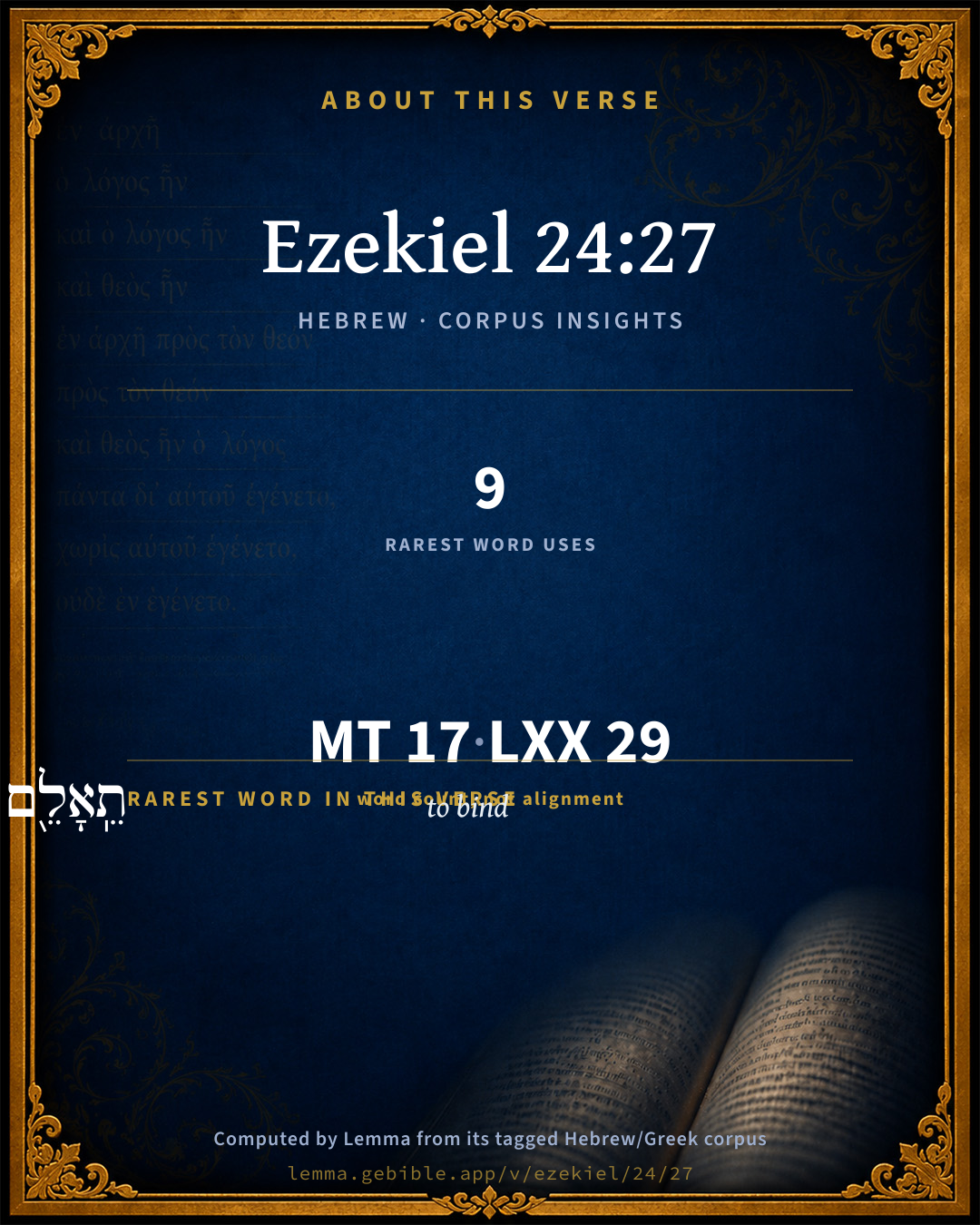
About this verse

These counts appear in no published source. They are computed here, from the morphology-tagged text and Lemma’s own curated glosses. What Lemma adds →

17
words
16
distinct lemmas
Prophets
section

Notable vocabulary

The rarest word here is תֵֽאָלֵ֖ם to bind H481 — appearing just 9 times in the whole Hebrew Bible.

Shared distinctive vocabulary

תֵֽאָלֵ֖ם to bind H481 occurs in 9 verses of the Hebrew Bible. Also found in:

Grammatical profile

  • 5 verbs
  • 5 nouns
  • 2 pronouns
  • 1 preposition
  • 1 conjunction
  • 1 adverb
  • 2 particles

Verb forms

  • יִפָּ֤תַח Niphal · Imperfect
  • וּתְדַבֵּ֕ר Piel · Imperfect
  • תֵֽאָלֵ֖ם Niphal · Imperfect
  • וְהָיִ֤יתָ Qal · Sequential Perfect
  • וְיָדְע֖וּ Qal · Sequential Perfect

Hebrew & Septuagint length

In English translation the verse runs 38 words from the Hebrew and 39 from the Septuagint (LXX English) — closely comparable.

A rough comparison of the two English renderings, which tokenize alike — not a word-level alignment.

Word counts can differ between the Hebrew and the Greek without any difference in meaning — e.g. the Hebrew direct-object marker אֵת has no separate Greek word, and Greek often adds the article ὁ.

In the original languages it is 17 Hebrew tokens and 29 Greek tokens — but the two are counted differently (Hebrew bundles its prefixes and suffixes into one token; the Greek is in lemma form), so that isn’t a like-for-like length.

Cross-references

7

Topical passages linked to Ezekiel 24:27 in the Treasury of Scripture Knowledge — connected by theme and wording, ordered by reader-vote popularity; previews shown in the World English Bible.

  • Ezekiel 33:22 Now the hand of Yahweh had been on me in the evening, before he who was escaped came; and he had opened my mouth, until he came to me in the morning; and my mouth was opened, and I was no more mute.
  • Ezekiel 29:21 In that day will I cause a horn to bud forth to the house of Israel, and I will give you the opening of the mouth in the midst of them; and they shall know that I am Yahweh.
  • Exodus 6:11–12 "Go in, speak to Pharaoh king of Egypt, that he let the children of Israel go out of his land."
  • Psalms 51:15 Lord, open my lips. My mouth shall declare your praise.
  • Ezekiel 3:26–27 and I will make your tongue cleave to the roof of your mouth, that you shall be mute, and shall not be to them a reprover; for they are a rebellious house.
  • Luke 21:15 for I will give you a mouth and wisdom which all your adversaries will not be able to withstand or to contradict.
  • Ephesians 6:19 on my behalf, that utterance may be given to me in opening my mouth, to make known with boldness the mystery of the Gospel,

Cross-references courtesy of OpenBible.info (CC BY 4.0).

Hebrew and Greek witnesses Masoretic Hebrew ↔ Greek Septuagint

The same verse in the two great witnesses to the Old Testament, shown verse-for-verse.

These are two independent witnesses, not word-aligned to each other, and the Septuagint is shown in lemma (dictionary) form.

Hebrew Ezekiel 24:27 Masoretic · Westminster Leningrad Codex

בַּיּ֣וֹם הַה֗וּא יִפָּ֤תַח פִּ֨יךָ֙ אֶת הַפָּלִ֔יט וּתְדַבֵּ֕ר וְלֹ֥א תֵֽאָלֵ֖ם ע֑וֹד וְהָיִ֤יתָ לָהֶם֙ לְמוֹפֵ֔ת וְיָדְע֖וּ כִּֽי אֲנִ֥י יְהוָֽה

In that day shall your mouth be opened to him who is escaped, and you shall speak, and be no more mute: so shall you be a sign to them; and they shall know that I am Yahweh.

World English Bible · Public Domain

Greek LXX Ezekiel 24:27 Septuagint · lemma form

ἐν ἐκεῖνος ὁ ἡμέρα δια ἀναοἴγω ὁ στόμα σύ πρός ὁ ἀνασώζω καί λαλέω καί οὐ μή ἀποκωφόω οὐκέτι καί εἰμί αὐτός εἰς τέρας καί ἐπιγιγνώσκω διότι ἐγώ κύριος

In that day your mouth shall be opened to him that escapes; you shall speak, and shall be no longer dumb: and you shall be for a sign to them, and they shall know that I am the Lord.

LXX2012 (modern English Septuagint) · Public Domain

Hebrew: Westminster Leningrad Codex (CC BY 4.0). Greek: Septuagint (public domain); English from LXX2012 (modern English Septuagint) (Public Domain). How the Septuagint differs from the Hebrew →

Targum (Aramaic paraphrase)

1

The Targum is the ancient Jewish Aramaic paraphrase of the Hebrew Scriptures — an interpretive translation, not the Hebrew text itself. Onkelos (literal) and Pseudo-Jonathan (expansive) render the Torah, and Jonathan the Prophets. Coverage is partial: where no permissively-licensed English translation exists for a verse, only the Aramaic is shown. This is verse-level text, not a word-by-word alignment to the Hebrew.

  1. Targum Jonathan Prophets (Joshua–Malachi)
    בְּיוֹמָא הַהוּא יִתְפְּתַח פּוּמָךְ בְּמֵיתֵי מְשֵׁיזְבָא וְתִתְנַבֵּי וְלָא תִשְׁתּוֹק עוֹד וּתְהֵי לְהוֹן לְאָת וְתֵידְעוּן אֲרֵי אֲנָא יְיָ:

    (no public-domain English translation for this verse)

    Targum Jonathan — Aramaic: “Mikraot Gedolot” (public domain). English: “Sefaria Community Translation” (CC0 1.0 (public-domain dedication)); “London "Chaldee Paraphrase," 1871” (public domain). Text via Sefaria.

Commentary

Notes on Ezekiel 24:27 from classic Christian and Jewish commentators (each source and its license shown beneath its notes). The classic Christian expositions comment on the surrounding passage and are grouped to its opening verse, so a note may address several verses; the Jewish commentaries on the Tanakh (Rashi and others) are per-verse, so they appear only where the commentator wrote on this verse.

Lemma curates 59 commentaries, every one of them public domain or Creative Commons licensed, each selected and text-cleaned for this edition rather than reprinted as found. About our sources →

Trapp's Complete Commentary

John Trapp

Eze 24:27 In that day shall thy mouth be opened to him which is escaped, and thou shalt speak, and be no more dumb: and thou shalt be a sign unto them; and they shall know that I [am] the LORD.

Ver. 27. In that day shall thy mouth be opened.] Meanwhile make use of a sacred silence, wait till a new prophecy concerning this people shall be committed unto thee, as was done Eze 33:1-33. Till then, prophesy against foreigners, Ammonites, Tyrians, Egyptians.

John Trapp, A Commentary or Exposition upon All the Books of the Old and New Testament (1647–1656) — public domain. Text from a community e-Sword module.

Adam Clarke's Commentary

Verse 27. In that day shall thy mouth be opened] That is, When some one who shall have escaped from Jerusalem, having arrived among the captives, shall inform them of the destruction of the city, the temple, the royal family, and the people at large; till then he might suppress his tears and lamentations. And we find from Eze 33:21, that one did actually escape from the city, and informed the prophet and his brethren in captivity that the city was smitten.

Thus he was not only a prophet to foretell such things, but he was also a sign or portent, shadowing them out by circumstances in his own person and family; and thus the prediction, agreeing so perfectly with the event, proved that the previous information was from the Lord.

Adam Clarke's Commentary on the Bible (1810–1826) — public domain. Text from a community e-Sword/MySword module.

Ellicott's Commentary for English Readers

(27) Shall thy mouth be opened.—The close of the chapter (Eze_24:25-27) tells the prophet that he shall be informed of the fall of Jerusalem by an escaped fugitive. After that his mouth shall again be opened to utter his prophecies to the captives. Meantime, for almost two years (comp. Eze_24:1 with Eze_33:21), from the investment of the city until he heard of its fall, Ezekiel gave no prophecy to the Israelites. He had abundantly foretold the result, and now awaited the issue in silence. He has, however, recorded a considerable number of prophecies against foreign nations (Ezekiel 25-32).

Here one great division of the prophecies of Ezekiel closes. They have been hitherto occupied almost exclusively with reproofs for sin and with warnings of impending judgment upon his people. The following prophecies, as far as Ezekiel 32, are indeed of the same character, but are directed entirely against foreign nations. This collection, as noticed in the Introduction, § 4, is not arranged chronologically like the rest of the book, but on the plan of putting together the prophecies against each nation. Eze_29:17-21 is dated more than sixteen years after the fall of Jerusalem, and Ezekiel 32 about two months after the tidings of that event; all the others which are dated are before, but only a little before, the capture of Jerusalem. Most of those undated seem to be in their chronological place, except that the first of them (Ezekiel 25) was evidently after the fall of Jerusalem.

After that great judgment was made known to the prophet, there is a marked change in his utterances, and from that time his general tone is far more cheering and consolatory.

A Bible Commentary for English Readers, edited by Charles John Ellicott (1878–1897) — public domain. Text from a community e-Sword module.

The Cambridge Bible for Schools and Colleges

gen. ed. J. J. S. Perowne

27. opened to him] Or, with him, i.e. when he comes. Cf. Eze_3:26-27, Eze_33:22. The last words of this verse recur to the prophet’s demeanour Eze_24:16-18.

The Cambridge Bible for Schools and Colleges (gen. ed. J. J. S. Perowne; Cambridge University Press, 1878–1918) — public domain. Text from a community e-Sword module.

Haydock's Catholic Bible Commentary

No more, if thou darest to speak before the Chaldeans, ver. 17. Reserve thy tears and lamentations for that time. (Calmet)

George Leo Haydock (1774–1849), Haydock's Catholic Family Bible and Commentary, 1859 edition — public domain. Excludes Psalms (Douay-Rheims chapter numbering differs from Protestant) and Deuterocanonical books (Catholic canon only).

Matthew Poole's English Annotations

Shall thy mouth be opened, to speak freely to him that brings the news, and to the Jews afterward.

And thou shalt speak, and be no more dumb; from this prophecy for eighteen months during the siege he doth not prophesy of Israel, but of other nations.

Thou shalt be a sign; until the event, confirmed by eye-witness, shall convince the Jews, thou shalt by sign signify to them what is coming; and when it is come to pass according to thy word, they shall confess thou wert a true prophet sent of me, and they shall see that I am the Lord.

Matthew Poole's English Annotations on the Holy Bible (1683–1685) — public domain. Text from a community e-Sword/MySword module.

Whedon's Commentary on the Bible

Daniel D. Whedon

27. Thou shalt speak, and be no more dumb — This intimates that from this date to the time of the coming of the messenger announcing the fall of Jerusalem some three years later, Ezekiel uttered no spoken prophecies, but remained in the depths of unutterable sorrow (Eze_24:16-17; Eze_24:26; Eze_33:21-22).

Daniel D. Whedon (gen. ed.), Commentary on the Old and New Testaments (1874–1909) — public domain. Text from a community e-Sword module.

The Pulpit Commentary

The dumb mouth opened.

I THERE IS A TIME TO KEEP SILENCE. Ezekiel was not stricken dumb physically like Zacharias. He was silenced by circumstances and the will of God. Even a prophet may have to learn that "silence is golden." Consider the indications of the time to keep silence.

1. When one has nothing to say. It is a great mistake to speak because one ought to say something instead of waiting till there is something to be said. Prophets have not always messages to deliver. Poets are not always inspired.

2. When men will not hear. Ezekiel"s repeated discourses, and even his striking illustrative actions, had beer treated with indifference by the Jews. It is useless to "cast pearls before swine.

3. When events are speaking. God says, "Be still, and know that I am. (Psa_46:10) The awful voice of providence silences every utterance of man.

4. When we are called to reflect. We have too much talking and too little thinking. This is an age of expression. We have lost the art of reticence. The consequence is shallowness and instability. More silence would allow of a richer brooding thoughtfulness.

II EVENTS OPEN THE MOUTH OF THE SILENT. Ezekiel was to be silent in the grief of his sudden widowhood, and the Jews would be silenced by the frightful calamities of the siege of Jerusalem. Afterwards the prophet"s lips would be unsealed, and he would be able to speak to better purpose. Events help to this result:

1. In suggesting topics. The truest thought is inspired by fact. New occurrences give rise to new lessons. The age of literature follows the age of action, and great books spring up in the soil that has been fertilized by great deeds. The facts of the gospel history are the chief topics for Christian preaching. The new scenes of the life of Christ and the Acts of the Apostles are the inspiration of all evangelistic speech.

2. In inclining men to listen. Ezekiel was silenced by indifference; he was to be rendered eloquent again by a newly awakened interest. Now, this change was to be brought about through the instrumentality of external events. Thus God breaks up the fallow ground and prepares the soil to receive the seed of the Word.

3. In inducing faith. This is the principal cause of the change in the present instance. The Jews had refused to believe Ezekiel. But when his words had been verified by the occurrence of the calamities he had predicted, the skeptical hearers would be forced to acknowledge that he was a true prophet. The fulfillments of Christ"s prophecy in the growth of the kingdom from the grain of mustard seed to the great tree should incline people to listen to Christian teaching with faith.

III THE WISE TEACHER WILL SEIZE OPPORTUNITIES FOR SPEECH. His mission is to proclaim the will of his Master; and, though silence may be suitable on occasion, and room for thought is greatly to be desired, he must be on the watch for every opportunity of delivering his great message. It is a glorious time when inspired lips are unsealed. The mere babble of empty talk is not to be compared with such utterance. The Jews had it in the thunders of prophecy, and the early Christians in the gift of the cloven tongues. But every Christian teacher who has power to speak to his brother may receive Divine impulses which should give him words of helpfulness and healing. The great art is then to utter the word in season the right word, to the right person, in the right spirit, at the right moment.

The Pulpit Commentary (1880–1919), ed. H.D.M. Spence-Jones & Joseph S. Exell — public domain. Text from a community e-Sword module.

John Wesley's Explanatory Notes

No more dumb - From this prophecy for eighteen months during the siege, he does not prophesy of Israel, but of other nations. Thou shalt be a sign - Until the event shall convince the Jews, thou shalt by sign, signify to them, what is coming.

John Wesley, Explanatory Notes Upon the Whole Bible (1754–1765) — public domain. Text via the GEBible commentary corpus.

Rashi

Rabbi Shlomo Yitzchaki (Rashi)

with the fugitive [Heb. אֶת הַפָּלִיט,] with the fugitive.

and you will speak and no longer be mute Because I said to you (3:26): “and you shall become mute, and you shall not be, etc.” From now on, they will see that your words are true, and you will no longer be mute from prophesying to them.

Rashi on the Tanakh — English translations: “The Judaica Press complete Tanach with Rashi, translated by A. J. Rosenberg” (CC BY 4.0); “Pentateuch with Rashi's commentary by M. Rosenbaum and A.M. Silbermann, 1929-1934” (public domain); “The Metsudah Tanach series, Lakewood, N.J” (CC BY 4.0); and “The Book of Joshua, Metsudah Publications, 1997” (CC BY 4.0). Text via Sefaria.

Lesson kit

Teaching starters — assembled from the data on this page, not authored interpretation. Every prompt links to the verse data it draws on. Edit before teaching.

Ezekiel, in the Prophets, opens this verse with 17 words (16 distinct Hebrew lemmas). Its most distinctive word is ʼâlam (“to bind”). A historical commentator’s framing appears above. Read the whole chapter for the surrounding context.

Discussion questions

  1. What does “to bind” (ʼâlam) contribute to the verse as a whole?
  2. Genesis 37:7 shares the word «to bind» with this verse. How do the two illuminate each other?
  3. These translations render this verse differently. What is at stake in choosing one wording over another?
  4. The verb «יִפָּ֤תַח» is Niphal Imperfect. How does its form color the action?
  5. Reading how Trapp's Complete Commentary and Adam Clarke's Commentary read this verse, where do the two commentators agree and where do they part?

Things to notice

Reading settings

Reading text

Shown beneath each verse's original-language words.

Old Testament
Old Testament edition

Read the OT as the Masoretic Hebrew (MT) or the Greek Septuagint (LXX).

English shown for the Greek Septuagint (in the Hebrew ↔ Greek comparison).

Comparing translations? Open the Compare panel on any verse page to stack up to four side by side.