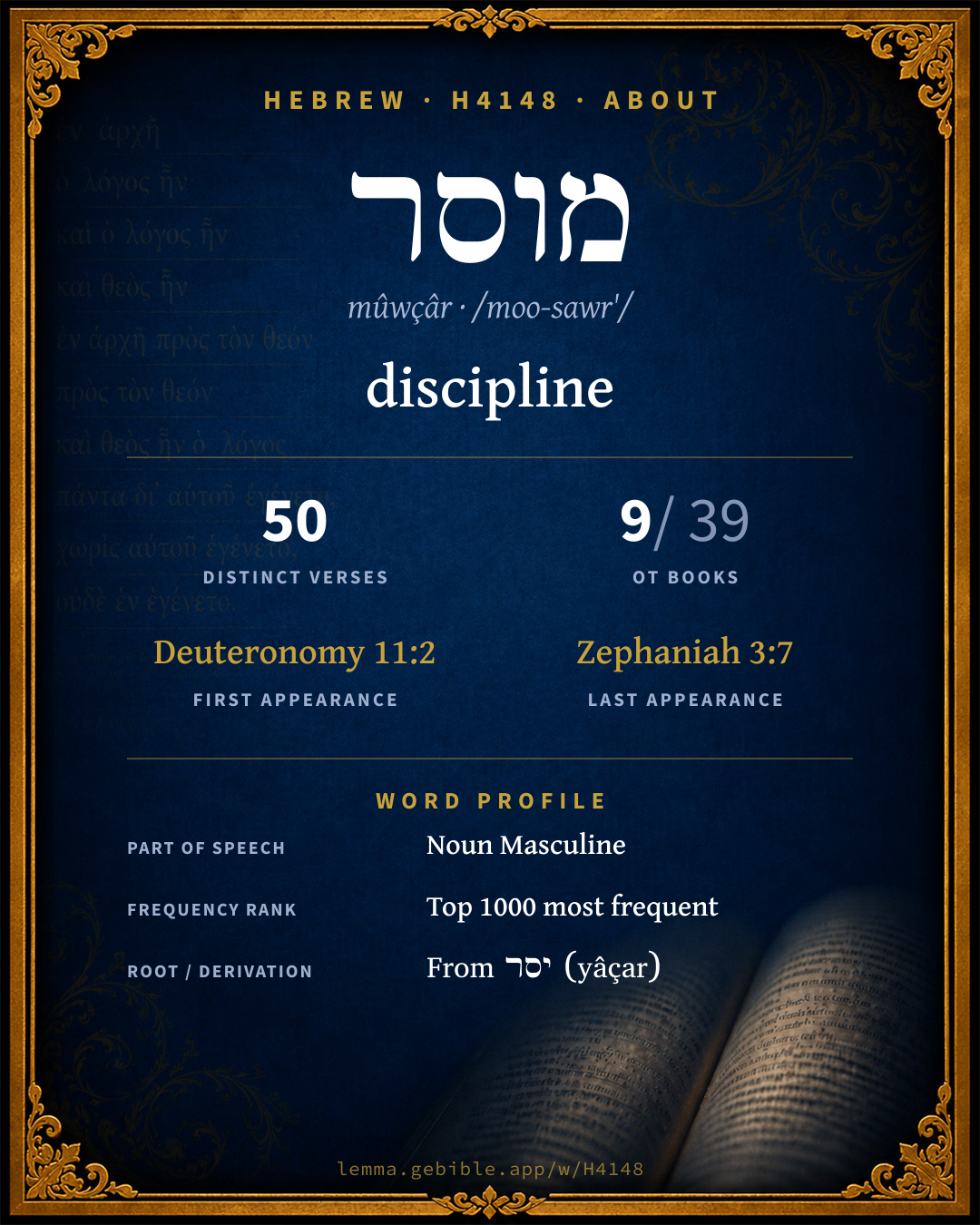
מוּסָר
discipline
also: chastening, correction fuller range ↓
Full lexicon entry — Brown-Driver-Briggs (BDB)
From Brown-Driver-Briggs (BDB)
Where this word appears
See every Absolute-state word in the Hebrew Bible →
Grammar key — what these labels mean
Part of speech
- Noun
- A naming word — a person, place, thing, or idea.
Noun type
- Common
- A common noun — a general class of person, place, or thing (“king,” “city,” “water”), not a specific name.
State
- Absolute
- The independent form of a noun, not bound to a following word.
- Construct
- A noun bound to a following noun in a possessive / “of” relationship (the construct chain).
Gender
- Masculine
- Grammatically masculine.
Number
- Singular
- One.
20 verses where H4148 appears in the Absolute state in the Book of Proverbs. Filtered view — show all forms. Click any verse to open its interlinear word-by-word view. Verse text shown in the World English Bible for context — . Each verse’s Hebrew form is shown with its reference; the English is not keyword-highlighted, since the data carries no word-level English alignment. Use “Compare translations” on any verse to read it across multiple English versions. This concordance covers the Hebrew Bible; Septuagint (Greek Old Testament) occurrences are not indexed here.
Proverbs
- Proverbs 1:2 וּ/מוּסָ֑ר conj + n c ms To know wisdom and instruction; To discern the words of understanding;
- Proverbs 1:7 וּ֝/מוּסָ֗ר conj + n c ms The fear of Yahweh is the beginning of knowledge; But the foolish despise wisdom and instruction.
- Proverbs 4:13 בַּ/מּוּסָ֣ר prep det + n c ms Take firm hold of instruction. Don't let her go. Keep her, for she is your life.
- Proverbs 5:12 מוּסָ֑ר n c ms And say, "How I have hated instruction, And my heart despised reproof;
- Proverbs 5:23 מוּסָ֑ר n c ms He will die for lack of instruction. In the greatness of his folly, he will go astray.
- Proverbs 6:23 מוּסָֽר n c ms For the commandment is a lamp, And the law is light. Reproofs of instruction are the way of life,
- Proverbs 8:33 מוּסָ֥ר n c ms Hear instruction, and be wise. Don't refuse it.
- Proverbs 10:17 מוּסָ֑ר n c ms He is in the way of life who heeds correction, But he who forsakes reproof leads others astray.
- Proverbs 12:1 מ֭וּסָר n c ms Whoever loves correction loves knowledge, But he who hates reproof is stupid.
- Proverbs 13:18 מוּסָ֑ר n c ms Poverty and shame come to him who refuses discipline, But he who heeds correction shall be honored.
- Proverbs 13:24 מוּסָֽר n c ms One who spares the rod hates his son, But one who loves him is careful to discipline him.
- Proverbs 15:10 מוּסָ֣ר n c ms There is stern discipline for one who forsakes the way: Whoever hates reproof shall die.
- Proverbs 15:32 מ֭וּסָר n c ms He who refuses correction despises his own soul, But he who listens to reproof gets understanding.
- Proverbs 19:20 מוּסָ֑ר n c ms Listen to counsel and receive instruction, That you may be wise in your latter end.
- Proverbs 19:27 מוּסָ֑ר n c ms If you stop listening to instruction, my son, You will stray from the words of knowledge.
- Proverbs 22:15 מ֝וּסָ֗ר n c ms Folly is bound up in the heart of a child: The rod of discipline drives it far from him.
- Proverbs 23:12 לַ/מּוּסָ֣ר prep det + n c ms Apply your heart to instruction, And your ears to the words of knowledge.
- Proverbs 23:13 מוּסָ֑ר n c ms Don't withhold correction from a child. If you punish him with the rod, he will not die.
- Proverbs 23:23 וּ/מוּסָ֣ר conj + n c ms Buy the truth, and don't sell it: Get wisdom, discipline, and understanding.
- Proverbs 24:32 מוּסָֽר n c ms Then I saw, and considered well. I saw, and received instruction:
About this entry
At a glance — auto-summarized from this page’s data, not written by a person. Every figure links to its source below. This summary describes the numbers; it doesn’t interpret them.
At its core, מוסר (mûwçâr) means “discipline.” The word gravitates to Proverbs (60%), then Jeremiah and Job. It appears 50 verses across 9 books of the Hebrew Bible, among its moderately common vocabulary. Not a single-sense word: its full sense range also takes in “chastening” and “correction”. Where the King James Version says “instruction,” newer translations reach for “discipline” (Berean Standard Bible); the renderings breakdown has the detail. Each statement above links to its evidence; the full detail follows below.
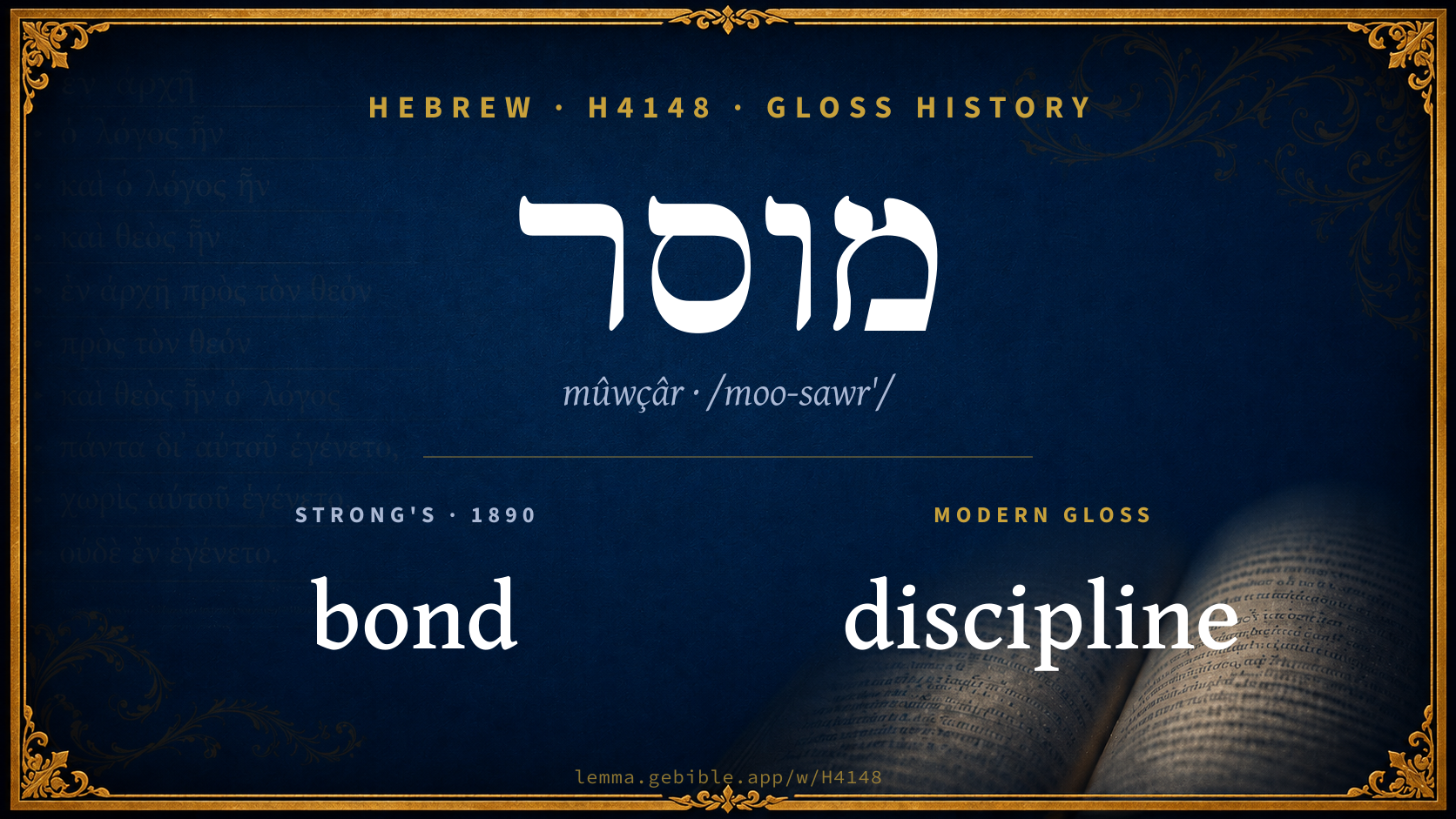
Gloss history
Strong's 1890 vs modern scholarship
About this word
Strong's H4148 catalogs a Hebrew word from the Hebrew Old Testament.
These counts are not copied from any lexicon or concordance. They are computed here, from the morphology-tagged Hebrew Old Testament. What Lemma adds →
- 50
- distinct verses
- The word appears in 50 distinct verses.
- 9 / 39
- OT books
- The word appears in 9 of 39 Old Testament books.
- #739
- by frequency
- Top 1000 most frequent Hebrew words (rank 739 of 8,640 Hebrew words by occurrence).
View all 50 occurrences in the concordance →
By section of the Old Testament
By traditional corpus
Conventional, traditional groupings — biblical authorship is debated, so this is a traditional corpus grouping, not an authorship claim. Each share is this word’s portion of its verses in that division of the Hebrew canon. Each figure is a share of the word’s 50 distinct verses.
- Writings (Ketuvim) 35 verses · 70%
- Prophets (Nevi'im) 14 verses · 28%
- Torah (Pentateuch) 1 verse · 2%
How translations render this word
Counts come from each version’s own published word-to-Strong’s tagging or interlinear alignment — an approximate guide to how each version renders this word, not a word-level alignment the data otherwise carries. Because each total is that version’s own tagged count, the per-version totals vary from one another and need not match the appearance or distinct-verse counts above. These counts may also differ from a printed concordance because Lemma counts each distinctly tagged rendering and does not collapse phrase taggings into a single head-word total. This is a fixed set of word-tagged versions (KJV, ASV, BSB, ULT) and does not change with the reading translation you choose elsewhere. Each version’s license is shown beside its name below (and on Sources).
- King James Version: Instruction 28×, Correction 8×, Chastisement 3×
- American Standard Version: Instruction 22×, Correction 11×, Chastisement 3×
- Berean Standard Bible: Discipline 24×, Instruction 13×, Correction 4×
- unfoldingWord Literal Text: Instruction 13×, Correction 9×, Discipline 8×
King James Version Public Domain
Renders H4148 across 50 tagged occurrences — most commonly:
Plus 9 renderings that appear only once — usually multi-word phrases or single function words the recovered tagging swept in, not distinct renderings.
American Standard Version Public Domain
Renders H4148 across 50 tagged occurrences — most commonly:
Plus 14 renderings that appear only once — usually multi-word phrases or single function words the recovered tagging swept in, not distinct renderings.
Berean Standard Bible Public Domain
Renders H4148 across 50 tagged occurrences — most commonly:
Plus 9 renderings that appear only once — usually multi-word phrases or single function words the recovered tagging swept in, not distinct renderings.
unfoldingWord Literal Text CC BY-SA 4.0
Renders H4148 across 47 tagged occurrences — most commonly:
Plus 6 renderings that appear only once — usually multi-word phrases or single function words the recovered tagging swept in, not distinct renderings.
6 senses and sub-senses in the full BDB
What do BDB’s symbols mean?
BDB uses these scholarly abbreviations:
| Symbol | Meaning |
|---|---|
| 𝔊 | the Septuagint (the ancient Greek translation, LXX) |
| 𝔙 | the Vulgate (the Latin translation) |
| 𝔖 | the Syriac version (the Peshitta) |
| 𝔗 | the Targum (the Aramaic translation) |
| ψ | the Psalms |
| √ | root (the underlying root or stem) |
| ‖ | parallel passage (a synonymous or contrasted parallel) |
| † | the dagger: every passage where the word occurs is cited |
The 6 senses and sub-senses the full Brown-Driver-Briggs lexicon distinguishes for this word, in lexicon order (not ranked by frequency), with BDB’s own verbatim wording and sub-sense lettering. Shown in Hebrew script with BDB’s own scholarly abbreviations. The condensed entry is in the Lexicon Entry tab. See also the Forms in the corpus table below.
- 1.
- a. discipline, correction, of God, Dt 11:2 מוּסַר י׳ the discipline of י׳ (of Y.’s wonders, as exercising a disciplinary, educating influence upon Israel, cf. Dr); לקח מ׳ Je 17:23; 32:33; 35:13 Zp 3:2, 7; ψ 50:17 Jb 33:16; 36:10; מ׳ כְּלִמָּתִי the correction of (i.e. which leadeth to) my shame Jb 20:3. e.g. Deuteronomy 11:2
- b. מ׳ הבלים עֵץ הוּא the discipline of unreal gods is wood (is like themselves, destitute of true moral force) Je 10:8; Ez 5:15 = warning example (?) Ew Sm (‖ שְׁמָמָה; del. 𝔊 Co). e.g. Jeremiah 10:8
- c. in Proverbs, discipline in the school of wisdom: חכמה ומ׳ 1:2, 7; 23:23; מ׳ חכמה discipline of wisdom 15:33; מ׳ הַשְׂכֵּל 1:3; תוכחות מ׳ 6:23; הָבִיאָה לַמּ׳ לִבֶּ֑ךָ 23:12 apply thy mind to discipline; קבּל מ׳ 19:20; לקח מ׳ 1:3; 8:10; 24:32 (cf. Je supr.); קנה מ׳ 23:23; שׁמע מ׳ 8:33; 19:27; שׁמר מ׳ 10:17; אהב מ׳ 12:1; החזק במ׳ 4:13; the reverse שׂנא מ׳ 5:12; פרע מ׳ 13:18; 15:32; בזה מ׳ 1:7; באין מ׳ for lack of discipline 5:23 (‖ בְּרֹב אִיַּלְתּוֹ); מ׳ אֱוִלִים אִוֶּלֶת 16:22 the discipline of fools is folly; of paternal discipline, correction, Pr. 1:8; 4:1; 13:1. e.g. Proverbs 1:2
- 2. more severely, chastening, chastisement:
- a. of God, מ׳ יהוה Pr 3:11 chastening of Yahweh; מ׳ שׁדַּי Jb 5:17; מוּסָֽרְךָ Is 26:16 מ׳ שְׁלוֹמֵנוּ עָלָיו Is 53:5 chastisement of (i.e. leading to) our peace was upon him; לקח מ׳ Je 2:30; 5:3; 7:28; מ׳ אַכְזָרִי Je 30:14 chastisement of a cruel one, MT, but read מוּסָר א׳ cruel chastisement, Gf and especially Gie; אני מ׳ לְכֻלָּם Ho 5:2 I am a chastisement for them all. e.g. Proverbs 3:11
- b. of man, Pr 15:5; 23:13; שִׁחֲרוֹ מ׳ 13:24; שֵׁבֶט מ׳ 22:15; מ׳ אויל 7:22 chastisement of a fool; מוּסָר רָע 15:10 grievous chastisement. e.g. Proverbs 15:5
Senses from the full Brown-Driver-Briggs lexicon (Brown, Driver, Briggs; Oxford 1906 — public domain), digitized via Sefaria, supplemented by the OpenScriptures HebrewLexicon (CC BY 4.0). Full attribution on Sources.
Word origin
n.m. Pr 15:10 discipline (of the moral nature), chastening, correction;—מ׳ Je 2:30 + 31 times (Ez 5:15 del. Co); cstr. מוּסַר Dt 11:2 + 14 times (for Jb 12:18 see אסר); sf. מוּסָרִי Pr 8:10; מוּסָֽרְךָ Is 26:16; מֹסָרָם Jb 33:16 (for מֻסָרָם Di);—
— Brown-Driver-Briggs (Oxford 1906, public domain), digitized via Sefaria, supplemented by the OpenScriptures HebrewLexicon (CC BY 4.0). See Sources.
Derived from יסר (yâçar) (H3256) — to discipline.
Jastrow Dictionary
A second Hebrew/Aramaic lexicon for comparison, covering Aramaic and post-biblical (Talmudic, Targumic, Midrashic) usage that the biblical-Hebrew BDB does not. Matched by lemma rather than by Strong’s number, so a lemma may carry more than one Jastrow headword (shown separately below), and the entries cover usage well beyond the Bible.
מוּסָר
- discipline, morality, conduct. Midr. Prov. to I, 2 אם יש … למד מ׳ if a man has wisdom, he can learn good conduct; ib. to I, 7; Yalk. ib. 929; a. e.
מוֹסֵר
- , pl. מוֹסֵרוֹת (b. h.; bands, fetters, restrictions. Yeb. 77ᵃ (ref. to Ps. CXVI, 16; cmp. אִיסּוּר) שני מ׳ שהיו עלי פְּתַחְתָּם וכ׳ two restrictions which were against me thou hast untied (permitted) (by confining the prohibition of intermarriage to male Moabites and Ammonites), v. מוֹאָבִי. e.g. Psalms 116:16
A Dictionary of the Targumim, the Talmud Babli and Yerushalmi, and the Midrashic Literature (Marcus Jastrow; London, Luzac, 1903) — Public Domain. Digitized via Sefaria. Digitized via Sefaria. Full attribution on Sources.
Forms in the corpus
The 24 distinct written forms H4148 takes in the Hebrew Bible, most frequent first — each parse links to that state’s occurrences in the concordance. Hebrew forms include their vowel points and cantillation, so a single lemma takes many written forms.
Same root — word family
Other BDB entries built from the same root as H4148, grouped by Strong’s listed origin. These share a root / origin per the lexicon — not necessarily a shared meaning. Each links to that word’s own entry.
Derives from
Shares the same root
Compare all same-root words → Showing 4 of 5 — not the complete family. They share a root, not necessarily a meaning.
Septuagint verse parallels
This word appears in 46 verses that also exist in the Greek Old Testament (Septuagint), out of the 50 Hebrew verses it occurs in. You can read those verses in Greek by switching the Old Testament edition to the Septuagint.
Read these verses in the Septuagint
- Deuteronomy 11:2
- Job 5:17
- Psalms 50:17
- Proverbs 1:2
- Isaiah 26:16
- Jeremiah 2:30
- Ezekiel 5:15
- Hosea 5:2
- Zephaniah 3:2
This is a verse-level parallel only — the same verses exist in both the Hebrew and Greek Old Testaments. No word-level Hebrew↔Greek correspondence is claimed: the data carries no such alignment, so no Greek word is shown as this Hebrew word’s translation. Coverage is not total — the Septuagint omits the deuterocanon and renumbers the Psalms, so some Hebrew verses have no direct Greek parallel.