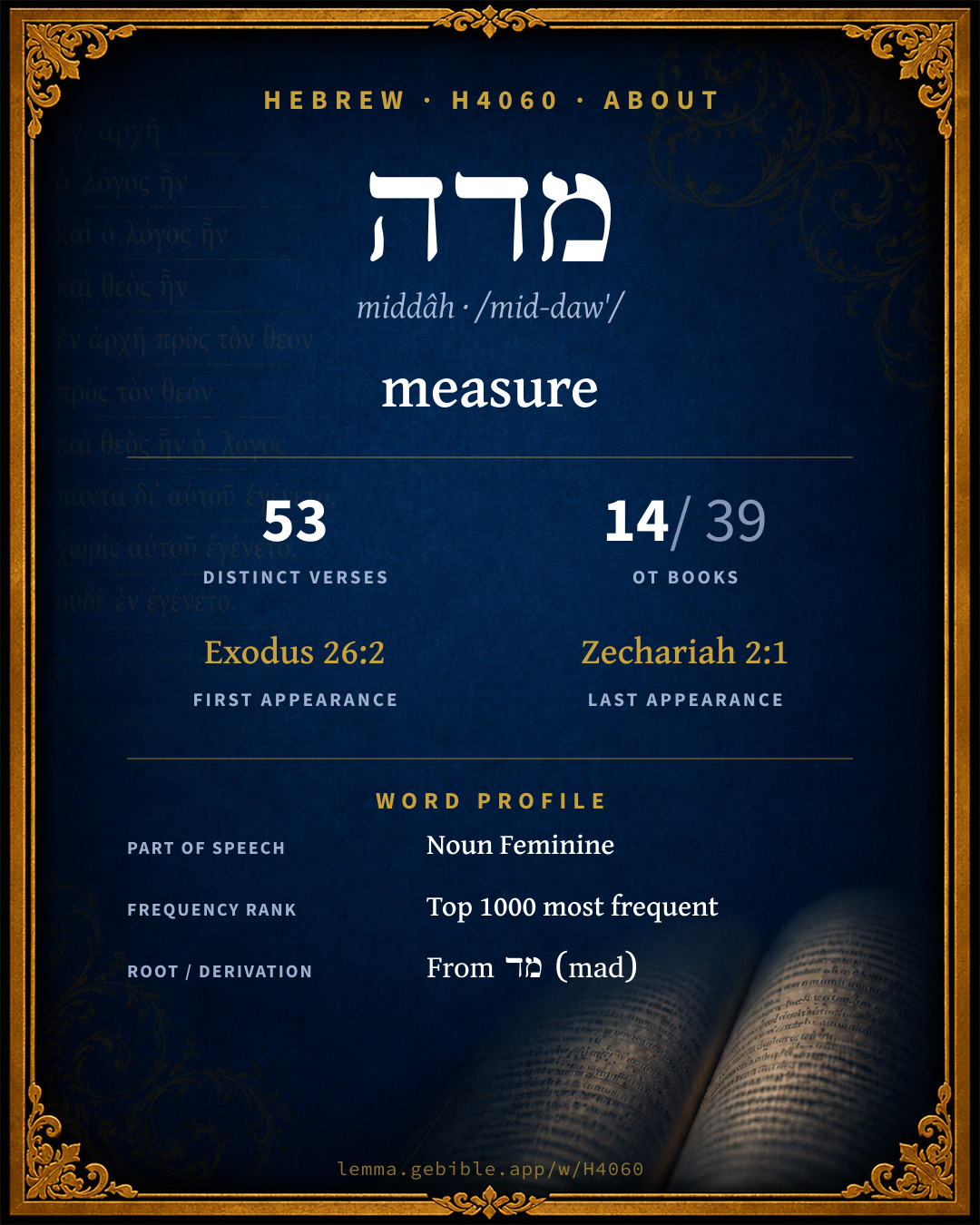
מִדָּה
measure
also: measurement, stature, size, garment fuller range ↓
Full lexicon entry — Brown-Driver-Briggs (BDB)
From Brown-Driver-Briggs (BDB)
Where this word appears
Grammar key — what these labels mean
Part of speech
- Noun
- A naming word — a person, place, thing, or idea.
Noun type
- Common
- A common noun — a general class of person, place, or thing (“king,” “city,” “water”), not a specific name.
State
- Absolute
- The independent form of a noun, not bound to a following word.
- Construct
- A noun bound to a following noun in a possessive / “of” relationship (the construct chain).
Gender
- Feminine
- Grammatically feminine.
Number
- Singular
- One.
- Plural
- More than one (in Hebrew, generally three or more).
Every verse where H4060 appears in the Book of Numbers — 1 distinct verse. Click any verse to open its interlinear word-by-word view. Verse text shown in the World English Bible for context — . Each verse’s Hebrew form is shown with its reference; the English is not keyword-highlighted, since the data carries no word-level English alignment. Use “Compare translations” on any verse to read it across multiple English versions. This concordance covers the Hebrew Bible; Septuagint (Greek Old Testament) occurrences are not indexed here.
Numbers
About this entry
At a glance — auto-summarized from this page’s data, not written by a person. Every figure links to its source below. This summary describes the numbers; it doesn’t interpret them.
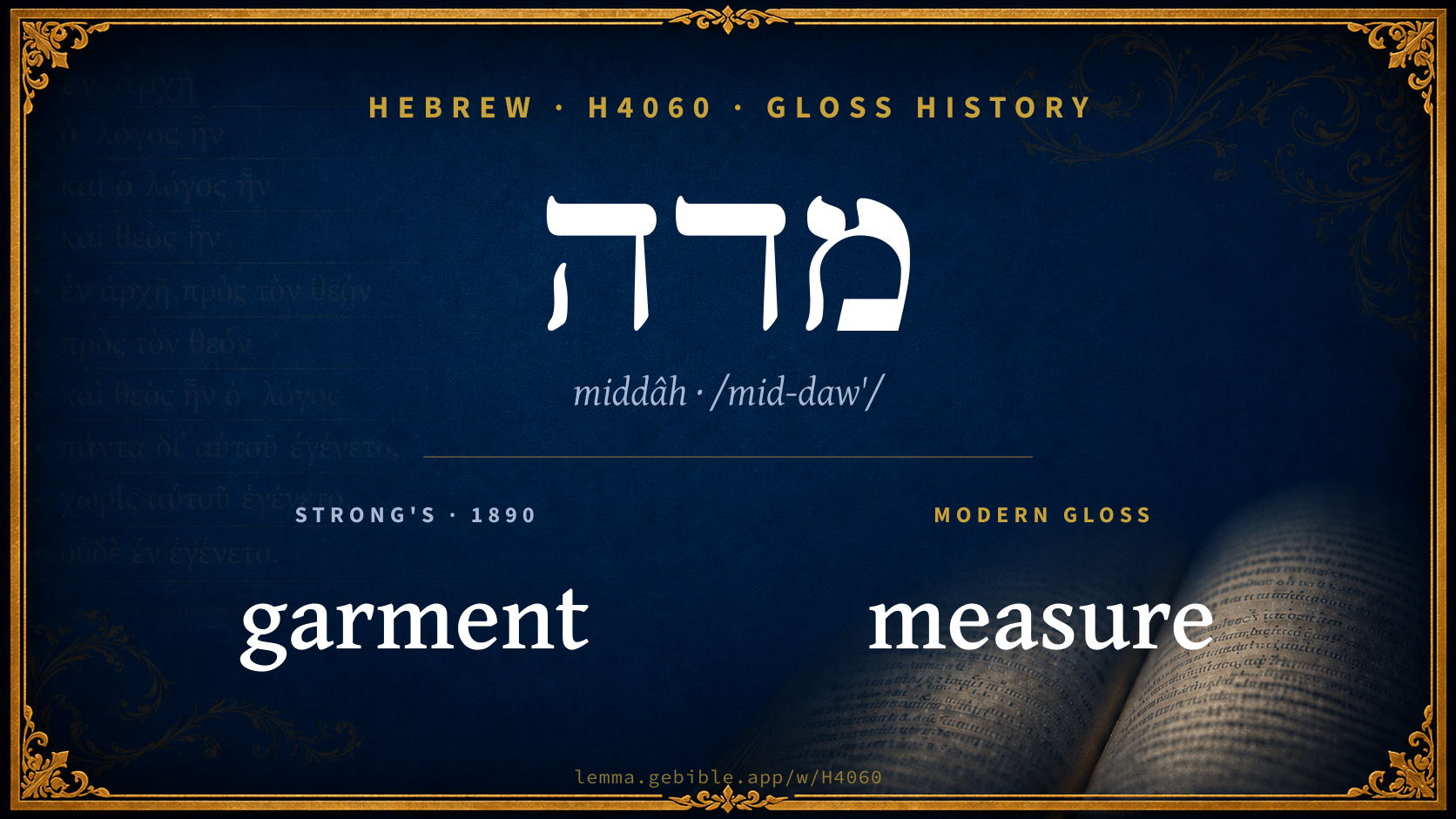
At its core, מדה (middâh) means “measure.” Its English rendering has broadened — “measure” classically, “size” (Berean Standard Bible) in modern versions; see the renderings breakdown. Spanning 53 verses in 14 books, it ranks among the moderately common words of the Hebrew Bible. Its uses concentrate in Ezekiel (43% of all occurrences). Beyond its headline sense, its full sense range takes in “measurement”, “stature”, and “size”. Each statement above links to its evidence; the full detail follows below.
Gloss history
Strong's 1890 vs modern scholarship
About this word
Strong's H4060 catalogs a Hebrew word from the Hebrew Old Testament.
These counts are not copied from any lexicon or concordance. They are computed here, from the morphology-tagged Hebrew Old Testament. What Lemma adds →
- 53
- distinct verses
- The word appears in 53 distinct verses.
- 14 / 39
- OT books
- The word appears in 14 of 39 Old Testament books.
- #686
- by frequency
- Top 1000 most frequent Hebrew words (rank 686 of 8,640 Hebrew words by occurrence).
View all 53 occurrences in the concordance →
By section of the Old Testament
By traditional corpus
Conventional, traditional groupings — biblical authorship is debated, so this is a traditional corpus grouping, not an authorship claim. Each share is this word’s portion of its verses in that division of the Hebrew canon. Each figure is a share of the word’s 53 distinct verses.
- Prophets (Nevi'im) 32 verses · 60%
- Writings (Ketuvim) 15 verses · 28%
- Torah (Pentateuch) 6 verses · 11%
How translations render this word
Counts come from each version’s own published word-to-Strong’s tagging or interlinear alignment — an approximate guide to how each version renders this word, not a word-level alignment the data otherwise carries. Because each total is that version’s own tagged count, the per-version totals vary from one another and need not match the appearance or distinct-verse counts above. These counts may also differ from a printed concordance because Lemma counts each distinctly tagged rendering and does not collapse phrase taggings into a single head-word total. This is a fixed set of word-tagged versions (KJV, ASV, BSB, ULT) and does not change with the reading translation you choose elsewhere. Each version’s license is shown beside its name below (and on Sources).
BDB lists this Strong’s number as 2 distinct words (homographs). Each count above pools all of them and is not split by sense — see the Senses section below. A low-frequency rendering may belong to a different one of those words, not the primary meaning.
- King James Version†: Measure 13×, Measuring 10×, Piece 7×
- American Standard Version†: Measure 14×, Measuring 9×, Portion 7×
- Berean Standard Bible†: Size 8×, Section 7×, Had the same measurements 6×
- unfoldingWord Literal Text†: Size 8×, A 7×, Measuring 7×
King James Version Public Domain
Renders H4060 across 55† tagged occurrences — most commonly:
Plus 12 renderings that appear only once — usually multi-word phrases or single function words the recovered tagging swept in, not distinct renderings.
American Standard Version Public Domain
Renders H4060 across 54† tagged occurrences — most commonly:
Plus 12 renderings that appear only once — usually multi-word phrases or single function words the recovered tagging swept in, not distinct renderings.
Berean Standard Bible Public Domain
Renders H4060 across 51† tagged occurrences — most commonly:
Plus 15 renderings that appear only once — usually multi-word phrases or single function words the recovered tagging swept in, not distinct renderings. Not rendered by a distinct English word in 5 further occurrences.
unfoldingWord Literal Text CC BY-SA 4.0
Renders H4060 across 66† tagged occurrences — most commonly:
Plus 22 renderings that appear only once — usually multi-word phrases or single function words the recovered tagging swept in, not distinct renderings.
Senses in the full BDB
What do BDB’s symbols mean?
BDB uses these scholarly abbreviations:
| Symbol | Meaning |
|---|---|
| 𝔊 | the Septuagint (the ancient Greek translation, LXX) |
| 𝔙 | the Vulgate (the Latin translation) |
| 𝔖 | the Syriac version (the Peshitta) |
| 𝔗 | the Targum (the Aramaic translation) |
| ψ | the Psalms |
| √ | root (the underlying root or stem) |
| ‖ | parallel passage (a synonymous or contrasted parallel) |
| † | the dagger: every passage where the word occurs is cited |
The 4 senses and sub-senses the full Brown-Driver-Briggs lexicon distinguishes for this word, in lexicon order (not ranked by frequency), with BDB’s own verbatim wording and sub-sense lettering. Shown in Hebrew script with BDB’s own scholarly abbreviations. The condensed entry is in the Lexicon Entry tab. See also the Forms in the corpus table below.
מדה I measure, measurement, stature, size, garment (mostly late)
- 1. measure, act of measurement, i.e. long measure Ez 41:17 (del. Co), 42:15; 48:30, 33; cf. Jos 3:4 (P), 1 Ch 23:29, v. also Lv 19:35 (H); once of liquid measure, fig., Jb 28:25; קַו֯ה הַמּ׳ Je 31:39 measuring-line; חֶבֶל מ׳ Zc 2:5 (id.); קְנֵה הַמּ׳ measuring-reed Ez 40:3, 5; 42:16 (del. Co), v 16, 17, 18, 19. e.g. Ezekiel 41:17
- 2. measurement, size of curtains in tabern. Ex 26:2, 8; 36:9, 15 (all P); cf. 1 K 6:25; 7:37 (both ‖ קֶצֶב), v 9, 11 2 Ch 3:3 Ez 40:10(×2), 21, 22, 24, 28, 29, 32, 33, 35; 43:13; 46:22; 48:16; once of time, מִדַּת יָמַי ψ 39:5; prob. also Jb 11:9 (fig. of God’s wisdom) where מִדָּהּ = מִדָּתָהּ, cf. Sta§ 347, c. 2; בֵּית מִדּוֹת = house of size Je 22:14; אִישׁ מִדָּה = man of size, stature, 1 Ch 11:23; 20:6; so also prob. ‖ 2 S 21:20 (for ℌ מדין, Qr מָדוֹן, v. [מַד]), We Dr Kit Bu; pl. Nu 13:32 Is 45:14. e.g. Exodus 26:2
- 3. measured portion, extent, stretch (of wall) Ne 3:11, 19, 20, 21, 24, 27, 30, cf. Ez 45:3. e.g. Nehemiah 3:11
- 4. garment (pl. poet.) ψ 133:2. e.g. Psalms 133:2
מדה II tribute (loan-word from Assyrian mandattu, id., √ nadânu = נָתַן DlHWB 451, cf. SchrCOT Ezr 4
Senses from the full Brown-Driver-Briggs lexicon (Brown, Driver, Briggs; Oxford 1906 — public domain), digitized via Sefaria, supplemented by the OpenScriptures HebrewLexicon (CC BY 4.0). Full attribution on Sources.
Word origin
I. n.f. measure, measurement, stature, size, garment (mostly late)—מ׳ Ex 26:2 + 35 times; cstr. מִדַּת Ez 40:21 + 2 times; pl. מִדּוֹת Ez 41:17 + 12 times; מִדּוֹתָיו ψ 133:2; מִדּוֹתֶיהָ 48:16;—
II. n.f. tribute (loan-word from Assyrian mandattu, id., √ nadânu = נָתַן DlHWB 451, cf. SchrCOT Ezr 4; 13; also in Biblical Aramaic מִנְדָּה, מִדָּה id.);—מִדַּת הַמֶּלֶךְ Ne 5:4.
— Brown-Driver-Briggs (Oxford 1906, public domain), digitized via Sefaria, supplemented by the OpenScriptures HebrewLexicon (CC BY 4.0). See Sources.
Derived from מד (mad) (H4055) — measure.
Jastrow Dictionary
A second Hebrew/Aramaic lexicon for comparison, covering Aramaic and post-biblical (Talmudic, Targumic, Midrashic) usage that the biblical-Hebrew BDB does not. Matched by lemma rather than by Strong’s number, so a lemma may carry more than one Jastrow headword (shown separately below), and the entries cover usage well beyond the Bible.
מִדָּה
- preced.)
- 1. dimension, measure, proportion. Sabb. 150ᵃ (play on מ̇ד̇ה̇ב̇ה, v. preced.) מ̇אד̇ מ̇אד̇ ה̇ב̇א בלא מ̇' bring much, very much, without measure. Peah VIII, 6 מ׳ זו this proportion. Gen. R. s. 64; Esth. R. introd. (ref. to מנדה, Ezra IV, 13) זו מִדַּת הארץ that is the tax from the land as measured, i.e. the (Roman) land-tax. B. Bath. VII, 3 מ׳ בחבל וכ׳ I sell thee exact land-measure by the rope. Ib. 128ᵃ מִדַּת ארכו the length-measure of the cloak. Ib. מדת משקלותיו the measure of its (the gold-bar’s) weights, i.e. an estimate as to how many coins of a certain weight can be obtained from it. Ḥag. 12ᵃ מדת יום ומ׳ לילה the combined length of day and night. Yeb. 76ᵇ (ref. to I Sam. XVII, 38) מַדָּיו כמִדָּתוֹ his (Saul’s) garments such as fitted his stature. Mikv. X, 5; Ḥull. 73ᵃ עד מקום (ה)מ׳ as far as the designed length of the handle (excluding the portion which it is intended to cut off).—Kidd. 42ᵇ; B. Mets. 56ᵇ, a. e. דבר שבמ׳ ושבמשקל וכ׳ objects which are sold by measure, by weight or by the piece. B. Bath. 89ᵇ לעולם … מ׳ חסירה וכ׳ one must never keep in one’s house too small or too large a measure (smaller or larger than the legal size); a. fr.—Pl. מִדּוֹת, מִידּוֹת. Ib. 88ᵇ עונשן של מ׳ the divine punishment for fraudulent measures. Tosef. B. Mets. VI, 14 לא היו ממונין … אלא על המ׳ they (the agoranomoi in Jerusalem) were appointed not for the regulation of market prices but for the superintendence of the measures; B. Bath. 89ᵃ, v. אֲגַרְדְּמִיס; a. fr.—Men. 18ᵃ למצות מִידּוֹתַי, v. מָצָה.—Whence: Middoth (measurements of the Temple), name of a treatise of the Mishnah, of the order of Kodashim. e.g. Ezra 4:13
- 2. dealing; reward or punishment; dispensation.—מ׳ כנגד מ׳ retaliation, adequate punishment or reward. Sot. I, 7, v. preced. Ib. 9ᵃ לכמ׳ the verse is to intimate the God dispenses adequate punishments. Ib. 8ᵇ (ref. to ib. I, 7) אע"ג דמ׳ בטילה במ׳ לא בטיל although retribution (by the Jewish court) has ceased, the adequate divine punishment has not ceased. Lam. R. introd. (R. Alex. 2) (expl. יען וביען, Lev. XXVI, 43) מ׳ כנגד מ׳ punishment corresponding to deed. Ned. 32ᵃ. Snh. 90ᵃ כל מִידּוֹתָיו של הקב"ה מ׳ כנגד מ׳ all retributions of the Lord are in correspondence with man’s doings. Ber. 48ᵇ ‘whatever the Lord thy God has given thee’ דיינך בכל … בין מ׳ טובה ובין מִדַּת פורענות (not מדה) he is thy judge in whatever sentence he decrees upon thee, whether it be a good or an evil dispensation. Ib. IX, 5, v. מְאֹד. Sabb. 97ᵃ. Ib. 151ᵇ לעולם … על מ׳ זו at all times let one pray to be spared this fate (poverty); a. fr.—Pl. as ab. Snh. 90ᵃ, v. supra. Yoma 87ᵇ המעביר על מִדּוֹתָיו וכ׳ he who passes over his retaliations (who forbears to retaliate), his failings will be passed over (be forgiven); Meg. 28ᵃ. Ib. לא עמדתי על מִידּוֹתַי I never insisted on retaliation; Kidd. 71ᵃ ואינו מעמד על מדותיו (Rashi: מעמיד); a. fr.—3) manner, ways, character, nature, condition. Ber. 40ᵃ לא כמדת הקב"ה וכ׳ the nature of divine (intellectual) affairs is not like the nature of human (material) affairs. Ib. 11ᵇ להזכיר מדת יום וכ׳ to mention the nature of the day (light) at night. Tanḥ. Balak 3 מה מִדָּתוֹ what is the nature of his power. B. Mets. 33ᵃ מ׳ ואינה מ׳ it is a (meritorious) way (of studying) and is not, i.e. you might to better; Y. Hor. III, 48ᶜ top מ׳ שאינה מ׳; a. fr.—Pl. as ab. Ab. V, 10 ארבע מ׳ באדם there are four different dispositions of men (as to treating one’s fellowman); ib. 11 ארבע מ׳ בדעות four characters (temperaments); ib. 12 ארבע מ׳ בתלמידים four natures of students (with regard to receptive and retentive faculties). Y. Snh. XI, 30ᵃ bot. כל שבע מ׳ וכ׳ all the seven characteristic features of righteous men which the scholars have defined have been realized in Rabbi. Ned. 20ᵇ בני תשע מ׳ children conceived under nine (abnormal mental) conditions. R. Hash. 17ᵇ, a. fr. שלש עשרה מ׳ the thirteen divine attributes (Ex. XXXIV, 6, sq.). Ned. 32ᵃ, v. פָּרַז; a. fr.—מדת הדין a) justice. Tosef. Yeb. IX, 3. a. e., v. לָקָה.—Esp. the divine attribute of justice, opp. מ׳ הרחמים, v. דִּין II.—b) common sense, logical argument. Yoma 43ᵇ כך (היא) מ׳ הדין נותנת common sense dictates this; Shebu. 14ᵃ. Y. Maas. Sh. II, 53ᶜ top תחומין עשו (כמ׳) למ׳ הדין they regulated the laws of Sabbath limits according to common sense (not by textual interpretation).—c) decision in money matters, civil law (contrad. to ritual law). Y. Gitt. V, 46ᶜ bot. אף למ׳ הדין הכן the same principle holds good for civil law (collection of claims, v. כַּפְרָנוּת); Y. Shebi. X, 39ᶜ bot. Ib. (last line) ולמידין מ׳ הדין וכ׳ do we apply the rules of Prosbol (v. פְּרוֹזְבּוּל) to ordinary claims? Y. B. Kam. V, beg. 4ᵈ לא הילכו במ׳ הדין אחר הרוב (strike out בממון) in civil law we are not guided by probabilities (v. דוֹב; cmp. Bab. B. Kam. 27ᵇ). Y. Ber. II, 5ᵃ bot. ולמ׳ הד׳ but civil law (questions of possession). e.g. Leviticus 26:43
- 4. principle, standard, consistency. Men. III, 4 כמדת ר׳ וכ׳ following the principle of R. &c.; Pes. 77ᵇ; Y. ib. VII, 34ᶜ top. Shek. IV, 6 אינה היא המ׳ (comment. אינה מן המ׳) this is not consistent (with a previous rule). Ib. 7 השוה את מִדָּתוֹ (Y. ed. מִדּוֹתָיו) he makes his standards even (is consistent). Pes. I, 7 אינה היא המ׳ this is not the right argument. Ib. 15ᵇ אמאי אינה היא המ׳ מ׳ ומ׳ היא why do you say, it is no argument? it is surely a correct argument. Y. Ḥag. III, 77ᵈ ‘Menahem went out’ means ממ׳ למ׳ יצא he went over from one principle to another (joined the opposition; Bab. ib. 16ᵇ יצא לתרבות רעה).—Esp. מִדּוֹת rules of interpretation. Sifra introd., ch. I, end הלל … שבע מ׳ וכ׳ Hillel the Elder explained seven rules &c.; Ab. d’R. N. ch. XXXVII; Tosef. Snh. VII, 11. Sifra introd., beg. (R. Yishm. said) בשלש עשרה מ׳ וכ׳ the Torah is interpreted by means of thirteen rules. [Appendix to treat. B’rakhoth. ל"ב מ׳ של ר׳ יוסו וכ׳ the thirty two rules of R. José the Galilean.]—Lev. R. s. 3, beg. הלכות ומ׳ decisions and interpretations (by which the decisions were reached), v. מְכִילְתָּא.—Gitt. 67ᵃ מִידּוֹתַי תרומה מתרומות מִידּוֹתָיו וכ׳ my rules of interpretation are the selection from selections of rules by R. Akiba.—Ber. 33ᵇ שעושה מדותיו של הקב"ה רחמים וכ׳ he makes compassion the standard (or reason) of the divine laws, while they are decrees (the reasons for which it behooves not man to discuss); Y. ib. V, 9ᶜ כקורא תיגר על מ׳ וכ׳ because it sounds as if he were finding fault with the ways of the Lord (as if the Lord were partial); כנותן קיצבה למ׳ וכ׳ as though he were setting limits to the attributes of the Lord.
מִדָּה ²
- 1. same. Targ. Ps. LVI, 5; 11 מידַּת דינא, מ׳ רחמין, v. preced. Targ. Lam. I, 1; a. e.—Snh. 38ᵇ אידי ואידי חדא מ׳ הוא the two dimensions are alike.—[
- 2. tribute. Ezra IV, 20, a. e., v. מִנְדָּה.] e.g. Ezra 4:20
A Dictionary of the Targumim, the Talmud Babli and Yerushalmi, and the Midrashic Literature (Marcus Jastrow; London, Luzac, 1903) — Public Domain. Digitized via Sefaria. Digitized via Sefaria. Full attribution on Sources.
Forms in the corpus
The 33 distinct written forms H4060 takes in the Hebrew Bible, most frequent first — each parse links to that state’s occurrences in the concordance. Hebrew forms include their vowel points and cantillation, so a single lemma takes many written forms.
Same root — word family
Other BDB entries built from the same root as H4060, grouped by Strong’s listed origin. These share a root / origin per the lexicon — not necessarily a shared meaning. Each links to that word’s own entry.
Derives from
Derived from this word
Compare all same-root words → They share a root, not necessarily a meaning.
Septuagint verse parallels
This word appears in 45 verses that also exist in the Greek Old Testament (Septuagint), out of the 53 Hebrew verses it occurs in. You can read those verses in Greek by switching the Old Testament edition to the Septuagint.
Read these verses in the Septuagint
- Exodus 26:2
- Leviticus 19:35
- Numbers 13:32
- Joshua 3:4
- 1 Kings 6:25
- 1 Chronicles 11:23
- 2 Chronicles 3:3
- Job 28:25
- Psalms 39:4
- Isaiah 45:14
- Jeremiah 22:14
- Ezekiel 40:3
This is a verse-level parallel only — the same verses exist in both the Hebrew and Greek Old Testaments. No word-level Hebrew↔Greek correspondence is claimed: the data carries no such alignment, so no Greek word is shown as this Hebrew word’s translation. Coverage is not total — the Septuagint omits the deuterocanon and renumbers the Psalms, so some Hebrew verses have no direct Greek parallel.