
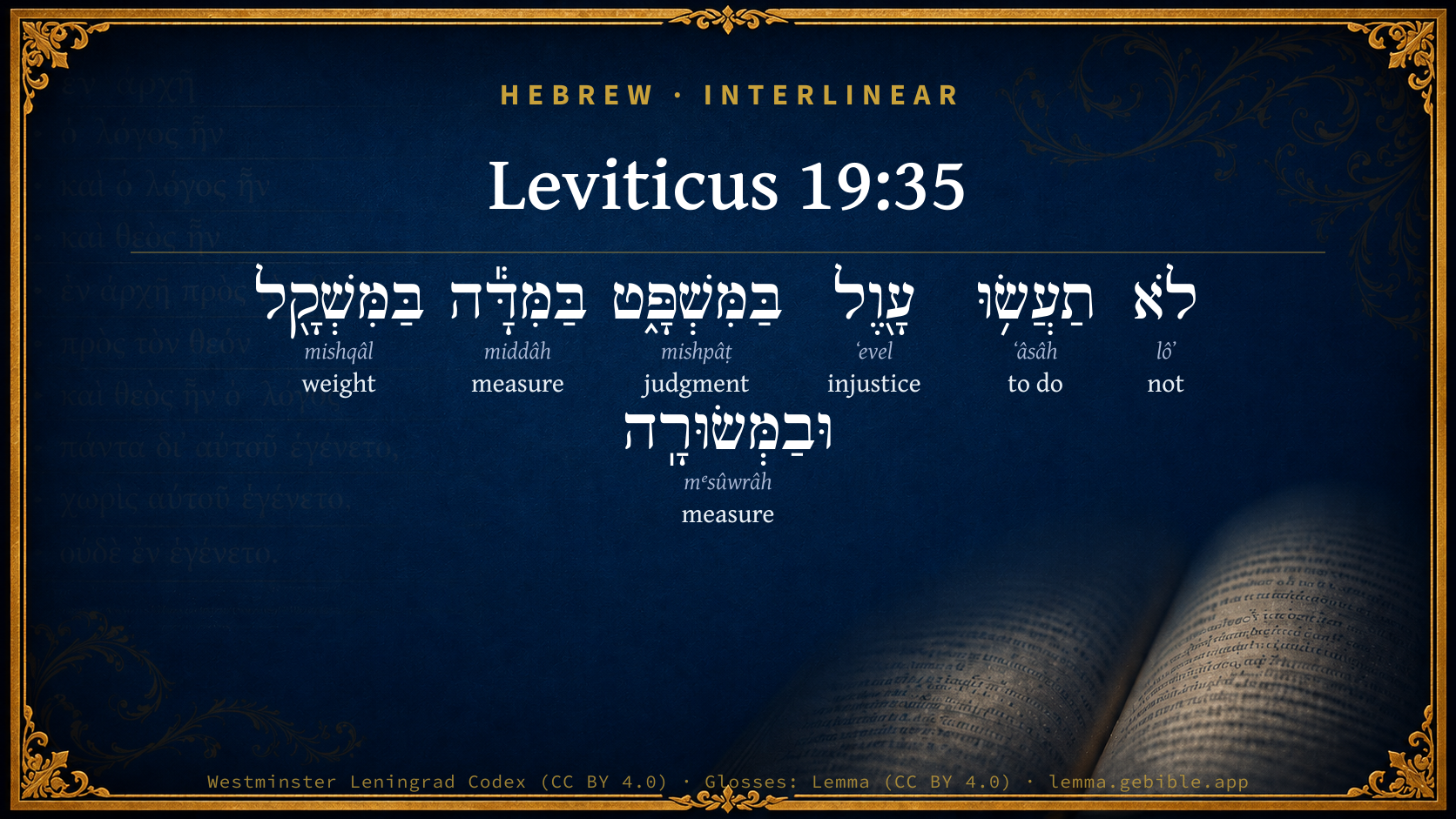
Leviticus 19:35

Hebrew (Westminster Leningrad Codex) Leviticus 19:35 appears in the Hebrew Old Testament. The text above is from the Westminster Leningrad Codex. Each word links to its Strong’s number, a concise gloss, and parsing drawn from the Open Scriptures Hebrew Bible morphology. Click any word for its full Brown-Driver-Briggs (BDB) entry.
Download image
Cite this verse

Leviticus 19:35 (World English Bible). Public Domain. Lemma interlinear Bible study tool, https://lemma.gebible.app/v/leviticus/19/35.

Show BibTeX & RIS
BibTeX
RIS
English Translation
"'You shall do no unrighteousness in judgment, in measures of length, of weight, or of quantity.
World English Bible · Public Domain
Highlights
  • 1 first appearance in the Hebrew Bible
Full analysis ↓
Download a study sheet

One document with this verse’s original text, its word-by-word gloss line, the meaning frame, cross-references with their text, attributed commentary, and full source and license credits — printable, and it pastes into notes with its structure intact.

This verse Autodidact and up

Study sheet (.html) Plain text (.txt)

A passage Seminary Student

Up to 50 verses in one chapter. A passage sheet keeps up to 6 commentary sources and 12 cross-references per verse, in the order this page ranks them, and says so on the sheet whenever that leaves anything out. Ask for a single verse and you get the Autodidact verse sheet above.

Everything on this page stays free to read, with no account — the sheet is a download of what is already on screen, not access to it.

Want to remove ads? Support Godless Engineer
Compare translations 3

The same verse in 3 English versions, stacked beneath the original-language interlinear above. Click any original word for its lexicon entry.

Each is an independent rendering of the whole verse — the interlinear is not word-aligned to these translations.

Highlighted words mark where these versions differ — a whole-verse word diff, not a word-by-word alignment.

  • World English Bible Public Domain
    "'You shall do no unrighteousness in judgment, in measures of length, of weight, or of quantity.
  • King James Version Public Domain
    Ye shall do no unrighteousness in judgment, in meteyard, in weight, or in measure.
  • unfoldingWord Literal Text CC BY-SA 4.0
    You shall not do injustice with judgment, in measure, in weight, or in volume.

unfoldingWord Literal Text — © unfoldingWord, licensed CC BY-SA 4.0. Word-aligned USFM3 via Door43 (git.door43.org/unfoldingWord/en_ult).

Versions to compare (up to 4)

3 of 4 selected

Show all 18 translations

Every available English version of this verse, each an independent rendering of the whole verse.

  • World English Bible Public Domain
    "'You shall do no unrighteousness in judgment, in measures of length, of weight, or of quantity.
  • Berean Standard Bible Public Domain
    You must not use dishonest measures of length, weight, or volume.
  • Majority Standard Bible Public Domain
    You must not use dishonest measures of length, weight, or volume.
  • King James Version Public Domain
    Ye shall do no unrighteousness in judgment, in meteyard, in weight, or in measure.
  • American Standard Version (1901) Public Domain
    Ye shall do no unrighteousness in judgment, in measures of length, of weight, or of quantity.
  • Revised Version (1885) Public Domain
    Ye shall do no unrighteousness in judgment, in meteyard, in weight, or in measure.
  • Geneva Bible (1599) Public Domain
    Ye shall not doe vniustly in iudgement, in line, in weight, or in measure.
  • Douay-Rheims (1899) Public Domain
    Do not any unjust thing in judgment, in rule, in weight, or in measure.
  • Young's Literal Translation Public Domain
    `Ye do not do perversity in judgment, in mete-yard, in weight, or in liquid measure;
  • Literal Standard Version CC BY-SA 4.0
    You do not do perversity in the judgment, in the measure, in the weight, and in the liquid measure;
  • Unlocked Literal Bible CC BY-SA 4.0
    Do not use false measures when measuring length, weight, or quantity.
  • unfoldingWord Literal Text CC BY-SA 4.0
    You shall not do injustice with judgment, in measure, in weight, or in volume.
  • Darby Bible Public Domain
    Ye shall do no unrighteousness in judgment, in measure of length, in weight, and in measure of capacity:
  • World Messianic Bible Public Domain
    “‘You shall do no unrighteousness in judgment, in measures of length, of weight, or of quantity.
  • Webster's Bible Public Domain
    Ye shall do no unrighteousness in judgment, in weight, in measure of length or of capacity.
  • Free Bible Version CC BY-SA 4.0
    Don't use dishonest weights and measures.
  • Bible in Basic English Public Domain
    Do not make false decisions in questions of yard-sticks and weights and measures.
  • JPS Tanakh (1917) Public Domain
    Ye shall do no unrighteousness in judgment, in meteyard, in weight, or in measure.

Literal Standard Version (2020), Covenant Press — licensed CC BY-SA 4.0. Text via the HelloAO Bible API (eBible.org). Unlocked Literal Bible (unfoldingWord) — licensed CC BY-SA 4.0. Text via the HelloAO Bible API (eBible.org). unfoldingWord Literal Text — © unfoldingWord, licensed CC BY-SA 4.0. Word-aligned USFM3 via Door43 (git.door43.org/unfoldingWord/en_ult). Free Bible Version, Dr. Jonathan Gallagher — licensed CC BY-SA 4.0. Text via the HelloAO Bible API (eBible.org).

Word by word

More ways to search: Search by grammar → Find every occurrence → Compare this word →

Practice this passage: Drill this verse → Learn its vocabulary →

About this verse

These counts appear in no published source. They are computed here, from the morphology-tagged text and Lemma’s own curated glosses. What Lemma adds →

7
words
7
distinct lemmas
Pentateuch
section

Notable vocabulary

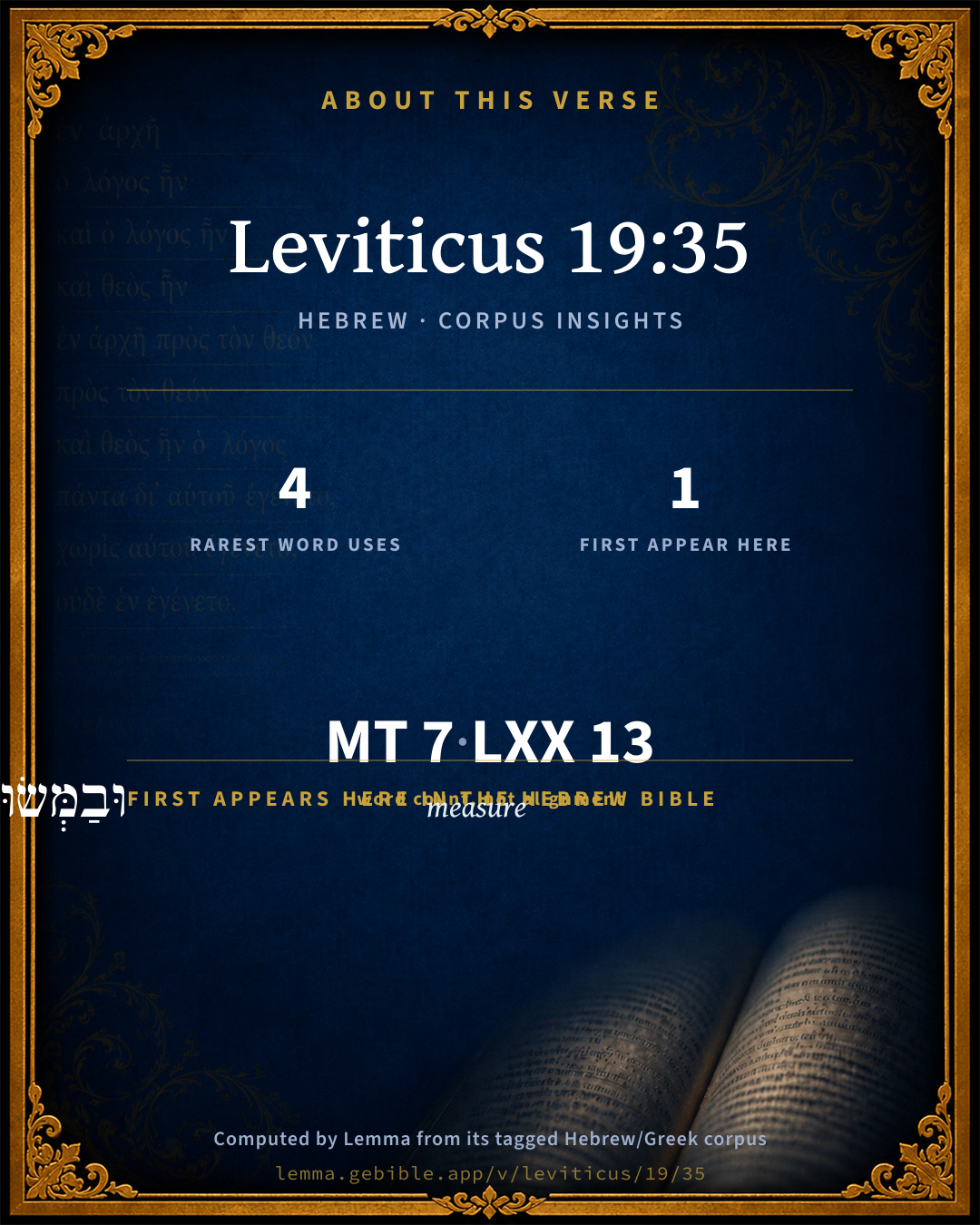
The rarest word here is וּבַמְּשׂוּרָֽה measure H4884 — appearing just 4 times in the whole Hebrew Bible.

First appearance in Scripture

This word makes its first canonical appearance in the Hebrew Bible here:

  • וּבַמְּשׂוּרָֽה measure H4884

Shared distinctive vocabulary

וּבַמְּשׂוּרָֽה measure H4884 occurs in 4 verses of the Hebrew Bible. Also found in:

Grammatical profile

  • 1 verb
  • 5 nouns
  • 1 particle

Verb forms

  • תַעֲשׂ֥וּ Qal · Imperfect

Hebrew & Septuagint length

In English translation the verse runs 16 words from the Hebrew and 13 from the Septuagint (LXX English) — closely comparable.

A rough comparison of the two English renderings, which tokenize alike — not a word-level alignment.

Word counts can differ between the Hebrew and the Greek without any difference in meaning — e.g. the Hebrew direct-object marker אֵת has no separate Greek word, and Greek often adds the article ὁ.

In the original languages it is 7 Hebrew tokens and 13 Greek tokens — but the two are counted differently (Hebrew bundles its prefixes and suffixes into one token; the Greek is in lemma form), so that isn’t a like-for-like length.

Cross-references

9

Topical passages linked to Leviticus 19:35 in the Treasury of Scripture Knowledge — connected by theme and wording, ordered by reader-vote popularity; previews shown in the World English Bible.

  • Deuteronomy 25:13 You shall not have in your bag diverse weights, a great and a small.
  • Deuteronomy 25:15 A perfect and just weight shall you have; a perfect and just measure shall you have: that your days may be long in the land which Yahweh your God gives you.
  • Leviticus 19:15 "'You shall do no injustice in judgment: you shall not be partial to the poor, nor show favoritism to the great; but in righteousness shall you judge your neighbor.
  • Proverbs 11:1 A false balance is an abomination to Yahweh, But accurate weights are his delight.
  • Proverbs 16:11 Honest balances and scales are Yahweh's; All the weights in the bag are his work.
  • Proverbs 20:10 Differing weights and differing measures, Both of them alike are an abomination to Yahweh.
  • Ezekiel 22:12–13 In you have they taken bribes to shed blood; you have taken interest and increase, and you have greedily gained of your neighbors by oppression, and have forgotten me, says the Lord Yahweh.
  • Micah 6:1 Listen now to what Yahweh says: "Arise, plead your case before the mountains, And let the hills hear what you have to say.
  • Matthew 7:2 For with whatever judgment you judge, you will be judged; and with whatever measure you measure, it will be measured to you.

Cross-references courtesy of OpenBible.info (CC BY 4.0).

Hebrew and Greek witnesses Masoretic Hebrew ↔ Greek Septuagint

The same verse in the two great witnesses to the Old Testament, shown verse-for-verse.

These are two independent witnesses, not word-aligned to each other, and the Septuagint is shown in lemma (dictionary) form.

Hebrew Leviticus 19:35 Masoretic · Westminster Leningrad Codex

לֹא תַעֲשׂ֥וּ עָ֖וֶל בַּמִּשְׁפָּ֑ט בַּמִּדָּ֕ה בַּמִּשְׁקָ֖ל וּבַמְּשׂוּרָֽה

"'You shall do no unrighteousness in judgment, in measures of length, of weight, or of quantity.

World English Bible · Public Domain

Greek LXX Leviticus 19:35 Septuagint · lemma form

οὐ ποιέω ἄδικος ἐν κρίσις ἐν μέτρον καί ἐν στάθμιον καί ἐν ζυγόν

You⌃ shall not act unrighteously in judgment, in measures and weights and scales.

LXX2012 (modern English Septuagint) · Public Domain

Hebrew: Westminster Leningrad Codex (CC BY 4.0). Greek: Septuagint (public domain); English from LXX2012 (modern English Septuagint) (Public Domain). How the Septuagint differs from the Hebrew →

Targum (Aramaic paraphrase)

2

The Targum is the ancient Jewish Aramaic paraphrase of the Hebrew Scriptures — an interpretive translation, not the Hebrew text itself. Onkelos (literal) and Pseudo-Jonathan (expansive) render the Torah, and Jonathan the Prophets. Coverage is partial: where no permissively-licensed English translation exists for a verse, only the Aramaic is shown. This is verse-level text, not a word-by-word alignment to the Hebrew.

  1. Targum Onkelos Torah (Genesis–Deuteronomy)
    לָא תַעְבְּדוּן שְׁקַר בְּדִין בִּמְשַׁחְתָּא בְּמַתְקְלָא וּבִמְכִלְתָּא

    (no public-domain English translation for this verse)

    Targum Onkelos — Aramaic: “Onkelos Genesis” (public domain); “Onkelos Exodus” (public domain); “Onkelos Leviticus” (public domain); “Onkelos Numbers” (public domain); “Onkelos Deuteronomy” (public domain). English: “Sefaria Community Translation” (CC0 1.0 (public-domain dedication)); “J.W. Etheridge. The Targums of Onkelos and Jonathan Ben Uzziel on the Pentateuch. London: Longmans, Green, 1862” (public domain). Text via Sefaria.

  2. Targum Pseudo-Jonathan Torah (Genesis–Deuteronomy)
    לָא תַעַבְדוּן שִׁיקְרָא בְּסִידְרָא דִינָא בְּמִישְׁחֲתָא דְקַיְטָא וְסִיתְוָוא בְּמַתְקְלָא וּבִמְכִילְתָּא בִּגְדִישׁוּתָא וּבִמְחִיקָא

    You shall not deal falsely in the ordering of judgment; in the admeasurement of summer and winter; in weight and measure, in heaping up, or in sweeping off:

    Targum Pseudo-Jonathan — Aramaic: “Targum Jonathan on Genesis” (public domain); “Targum Jonathan on Exodus” (public domain); “Targum Jonathan on Leviticus” (public domain); “Targum Jonathan on Numbers” (public domain); “Targum Jonathan on Deuteronomy” (public domain). English: “The Targum of Jonathan ben Uzziel, trans. J. W. Etheridge, London, 1862” (public domain). Text via Sefaria.

Commentary

Notes on Leviticus 19:35 from classic Christian and Jewish commentators (each source and its license shown beneath its notes). The classic Christian expositions comment on the surrounding passage and are grouped to its opening verse, so a note may address several verses; the Jewish commentaries on the Tanakh (Rashi and others) are per-verse, so they appear only where the commentator wrote on this verse.

Lemma curates 59 commentaries, every one of them public domain or Creative Commons licensed, each selected and text-cleaned for this edition rather than reprinted as found. About our sources →

Trapp's Complete Commentary

John Trapp

Lev 19:35 Ye shall do no unrighteousness in judgment, in meteyard, in weight, or in measure.

Ver. 35. Mete yard.] Or line, for measuring of ground.

John Trapp, A Commentary or Exposition upon All the Books of the Old and New Testament (1647–1656) — public domain. Text from a community e-Sword module.

The Biblical Illustrator

Joseph S. Exell

Lev_19:35-36

Just balances, Just weights shall ye have.

Business honesty

I. Social life is based upon commercial contracts. Each bringing to the other some product of skill or toil. We cannot supply a fraction of our own wants, we must buy; and we have also in turn something to sell. Business is the outcome of this reciprocal dependence. Each can, each must help the other, or social and civic life would be impossible.

II. Dishonesty is subversive of the very basis of social life. It breaks confidence, alienates intercourse; closes friendly relationships, substitutes roguery for righteousness, and wrecks all goodwill. Pleasant to reflect--

1. How much trade honour there is among men.

2. How surely trickery brings discovery, and therefore penalty, on rogues.

3. How honesty is ever winning respect and reward.

III. Justice sits observant of all deceitful deeds. I am the Lord. He sees all secrecies; weighs all balances; hates all dishonesties; will requite all deceits. (W. H. Jellie.)

Honesty in small things

A young American aspirant for office in the State of Iowa drove up to an hotel, alighted, and engaged a room. He desired his trunk to be taken to his room, and, seeing a man passing whom he supposed to be the porter, he imperiously ordered him to take it up. The porter charged him twenty-five cents, which he paid with a marked quarter worth only twenty cents. He then said, You know Governor Grimes? Oh, yes, sir. Well, take my card to him, and tell him I wish an interview at his earliest convenience. I am Governor Grimes, at your service, sir. You--I--that is, my dear sir, I beg--a--a thousand pardons! None needed at all, sir, replied Governor Grimes. I was rather favourably impressed with your letter, and had thought you well suited for the office specified; but, sir, any man who would swindle a working man out of a paltry five cents would defraud the public treasury had he an opportunity. Good evening, sir.

An unfair judgment

A judge in New Orleans has recently set aside a jury verdict on somewhat unusual but certainly good grounds. A man was on trial for murder. After the case had been given to the jury they retired for consultation for verdict, and spent the hours in drinking whiskey and playing cards. They found the prisoner guilty; but the next day, in setting aside their verdict, Judge Baker said: Twelve men, supplied with a quart bottle of whiskey and a deck of cards, who played poker from twelve oclock at night till four in the morning, and holding a mans life in their hands, could not possibly give the prisoner a fair trial. As long as I preside over this court I cannot sanction such a thing, and therefore I grant the prisoner a new trial. (S. S. Chronicle.)

Righteous dealing

Rev. John Miller, writing in the New York Independent the reminiscence of an interview with the late A. T. Stewart, the millionaire storekeeper of New York, tells us that on one occasion in reply to his visitors question, What is the secret of this enormous business? Mr. Stewart replied: The only secret I know is that I started with the idea of becoming professionally and actually a merchant. I saw lawyers and doctors become rich by making themselves precious to those they worked for. Hence certain rules. I had only one price. Ladies who come in their cushioned carriages dont want to be fevered by the idea of beating down. Again, perfect goods! I bought and sold nothing damaged. And in a third of a century people got to buying of me with the luxury of an easy mind. I allowed no deceit. A youth who would misrepresent anything I would discharge. I forbade ladies to be allowed to deceive each other in talking of my goods, and salesmen were ordered to correct buyers who were standing by the goods, who said they would wash, for example, if they would not. You have no idea what comfort this would give in shopping through a long course of years and the business would grow, under this entire freedom from complaint, in a way that neither the storekeeper nor the buyer at the time might quite remark or understand. This is my secret, said he, as far as I can conceive. I have demanded full profits, but then I have bought with uniform care, and sold correctly and with absolute truth all my time. Poor humanity may have only one good side, adds Mr. Miller, but, certainly, that is worthy of a record.

Honesty in common dealing

The idea running through this passage is manifestly that of an inward, solid, living truthfulness of mind, as opposed to all surface-virtue or sham, or to any mere keeping up of appearances or putting on of an outside for the avoiding of scandal or damage or disrepute. It is that of a heart entire and direct with itself: a heart without any doubleness or intricacy or prevarication; a heart that keeps itself clean of the dust and cobwebs that gather in the darkness of close designs, oblique arts, and snaky thoughts; and that rejoices to have its chambers all open, its passages clear, and full of light, and fresh and sweet with Heavens own breath. (Norman Hudson.)

Just dealings

In whatever we do or say let us by all means be faithful and true: deceiving no man; beguiling no man to his damage; punctual to our word and promise; firm and constant to our just engagements; honest and fair in all our dealings. Last, not least, let us be sure that we not only propose to ourselves good and laudable ends but that we also pursue them by no means but what are just and pure; remembering that--

Him, only him, the shield of Heaven defends

Whose means are fair and spotless as his ends.

Trade immoralities

A popular pastor preached once on the immoralities of trade. At the close of the service two of the prominent members of his church, both successful business men, came to him. Said the first: Dominie, there is no use in preaching such a sermon. That sort of thing is never practised by honourable houses or by such men as compose this congregation. The other called the preacher aside and said, Dominie, there is no use in preaching such sermons. The practices you speak of are so universal that they have ceased to merit your characterisation of them. Every business house in this city does just that thing, my own amongst the rest. It is not worth while to preach against it. (Hom. Review.)

Everyday religion

It is not Israel alone which has needed, and still needs, to hear iterated this command, for the sin is found in every people, even in every city, one might say in every town, in Christendom; and--we have to say it--often with men who make a certain profession of regard for religion. All such, however religious in certain ways, have special need to remember that without holiness no man shall see the Lord; and that holiness is now exactly what it was when the Levitical law was given out. As, on the one side, it is inspired by reverence and fear toward God, so, on the other hand, it requires love to the neighbour as to ones self, and such conduct as that will secure. It is of no account, therefore, to keep the Sabbath--in a way--and reverence--outwardly--the sanctuary, and then on the week-day water milk, adulterate medicines, sugars, and other foods, slip the yard-stick in measuring, tip the balance in weighing, and buy with one weight or measure and sell with another, water stocks and gamble in margins, as the manner of many is. God hates, and even honest atheists despise, religion of this kind. Strange notions, truly, of religion have men who have not yet discovered that it has to do with just such commonplace, everyday matters as these, and have never yet understood how certain it is that a religion which is only used on Sundays has no holiness in it; and therefore, when the day comes, as it is coming, that shall try every mans work as by fire, it will, in the fierce heat of Jehovahs judgment, be shrivelled into ashes as a spiders web in a flame, and the man and his work shall perish together. (S. H. Kellogg, D. D.)

Commercial justice in other nations

The Hindoo law imposes the highest fines not only upon those who falsify scales or measures, but upon official examiners of coins who pronounce a good piece bad or a bad piece good; it inflicts heavy penalties, and partially corporeal chastisement, upon those who overreach customers, give short measure or light weight, adulterate goods, or try to give them a deceptive appearance; and with respect to a trader in counterfeited gold, it enacts that by order of the king he must be cut in pieces with razors, or that he must at least lose three limbs of his body and pay the highest fine. In Egypt, false coiners and the manufacturers of false weights were condemned to have both their hands cut off; and fraudulent practices of this kind were held in equal detestation by other nations, and were visited with similar punishments. (M. M. Kalisch, Ph. D.)

.

The Biblical Illustrator, edited by Joseph S. Exell (c. 1880s–1900s) — public domain. Text from a community e-Sword module.

Joseph Benson's Commentary

Lev 19:35. In mete-yard — In the measuring of lands, or dry things, as cloth, riband. In measure — In the measuring liquid or such dry things as are only contiguous, as corn or wine.

Joseph Benson's Commentary on the Old and New Testaments (1811–1818) — public domain. Text from a community e-Sword module.

Tyndale Open Study Notes

Tyndale Open Resources

19:35-36 dishonest standards: Merchants would sometimes use two different sets of weights, one heavy and one light (Deut 25:13-15), in order to cheat customers. The Bible makes it clear that this practice was abhorrent to God (Prov 11:1; 16:11; 20:10, 23; Mic 6:11).

Tyndale Open Study Notes — © Tyndale Open Resources, licensed CC BY-SA 4.0. Text via the HelloAO Bible API.

Geneva Bible (1599)

Geneva Bible translators

As in measuring the ground.

Geneva Bible (1599) marginal notes — public domain. Text via Bolls.life.

Adam Clarke's Commentary

Verse 35. Ye shall do no unrighteousness] Ye shall not act contrary to the strictest justice in any case, and especially in the four following, which properly understood, comprise all that can occur between a man and his fellow.

1. JUDGMENT in all cases that come before the civil magistrate; he is to judge and decide according to the law.

2. METE-YARD, במדה bammiddah, in measures of length and surface, such as the reed, cubit, foot, span, hand's breadth, among the Jews; or ell, yard, foot, and inch, among us.

3. WEIGHT, במשכל bammishkal, in any thing that is weighed, the weights being all according to the standards kept for the purpose of trying the rest in the sanctuary, as appears from Ex 30:13; 1Ch 23:29; these weights were the talent, shekel, barleycorn, &c.

4. MEASURE, במשורה bammesurah, from which we derive our term. This refers to all measures of capacity, such as the homer, ephah, seah, hin, omer, kab, and log. See all these explained, Clarke "Ex 16:16".

Adam Clarke's Commentary on the Bible (1810–1826) — public domain. Text from a community e-Sword/MySword module.

Ellicott's Commentary for English Readers

(35) Ye shall do no unrighteousness in judgment.—It will be seen that the Lawgiver uses here exactly the same phrase with regard to meting out right measure which he used in connection with the administration of justice in Lev_19:15. He, therefore, who declares that a false measure is a legal measure is, according to this law, as much a corrupt judge, and defrauds the people by false judgment, as he who in the court of justice wilfully passes a wrong sentence. Owing to the fact that men who would otherwise disdain the idea of imposition often discard their scruples in the matter of weights and measures, the Bible frequently brands these dealings as wicked, and an abomination to the Lord, whilst it designates the right measure as coming from God himself (Deu_25:13; Deu_25:15; Eze_45:10; Eze_45:12; Hos_12:8; Amo_8:5; Mic_6:10-11; Pro_11:1; Pro_16:11; Pro_20:10; Pro_20:23). According to the authorities during the second Temple, he who gives false weight or measure, like the corrupt judge, is guilty of the following five things. He (1) defiles the land; (2) profanes the name of God; (3) causes the Shechinah to depart; (4) makes Israel perish by the sword, and (5) to go into captivity. Hence they declared that “the sin of illegal weights and measures is greater than that of incest, and is equivalent to the sin of denying that God redeemed Israel out of Egypt.” They appointed public overseers to inspect the weights and measures all over the country; they prohibited weights to be made of iron, lead, or other metal liable to become lighter by wear or rust, and ordered them to be made of polished rock, of glass, &c, and enacted the severest punishment for fraud.

A Bible Commentary for English Readers, edited by Charles John Ellicott (1878–1897) — public domain. Text from a community e-Sword module.

The Cambridge Bible for Schools and Colleges

gen. ed. J. J. S. Perowne

35, 36. Uprightness enjoined in judgement and in commercial dealings. Cp. Deu_25:13-16; Eze_45:9 ff.

meteyard] lit. (Anglo-Saxon met-geard) a measuring rod. For the word see Taming of the Shrew, iv. 3. 153.

ephah … hin] The former was about a bushel, the latter about 1 1/2 gallons of our measure.

The Cambridge Bible for Schools and Colleges (gen. ed. J. J. S. Perowne; Cambridge University Press, 1878–1918) — public domain. Text from a community e-Sword module.

John Gill's Exposition

Ye shall do no unrighteousness in judgment,.... This is repeated from Lev 19:15; and in order to lead on to some other laws and instructions; though Aben Ezra thinks this is said in connection with the preceding words, and in reference to the stranger, agreeably to Deu 1:16; but Jarchi refers it to what follows concerning weights and measures, and observes, that a measurer is a judge; and if he acts deceitfully, he perverts judgment, and does that which is detestable and abominable, and is the cause of the five following things said of a judge; he defiles the land, and profanes the name of God, and causes the Shechinah or divine Majesty to remove, or causes Israel to fall by the sword, or carries them captive out of their land:

in meteyard, in weight, or in measure; the first of these, according to Jarchi, signifies the measure of land, of fields, &c. and so likewise of anything that is measured, not only by the rod or line, but by the yard or ell, as cloth and other things, whether broad or narrow, that are measured in their length; and the second may respect the weight of all sorts of things that are weighed in scales, as money in former times, as well as various sorts of goods; and the last has respect to the measure of both dry and liquid things, by the bushel, peck, quart, pint, &c.

John Gill's Exposition of the Whole Bible (1746–1763) — public domain (CC PDM 1.0). Text via the HelloAO Bible API.

Albert Barnes' Notes on the Bible

The ephah is here taken as the standard of dry measure, and the bin (see Exo 29:40 note) as the standard of liquid measure. Of the two very different estimates of the capacities of these measures, the more probable is that the ephah did not hold quite four gallons and a half, and the hin not quite six pints. The log was a twelfth part of the hin Lev 14:10.

Lev 19:36

I am the Lord your God ... - A full stop should precede these words. They intraduce the formal conclusion to the whole string of precepts in this chapter, which are all enforced upon the ground of the election of the nation by Yahweh who had delivered them from the bondage of Egypt.

Albert Barnes' Notes on the Bible (1834–1885) — public domain. Text from a community e-Sword/MySword module.

Haydock's Catholic Bible Commentary

Rule; Hebrew, "taking dimensions" with a yard, tape, &c.

George Leo Haydock (1774–1849), Haydock's Catholic Family Bible and Commentary, 1859 edition — public domain. Excludes Psalms (Douay-Rheims chapter numbering differs from Protestant) and Deuterocanonical books (Catholic canon only).

Matthew Poole's English Annotations

In meteyard; in the measuring of lands, or any dry and continued things, as cloth, ribband, &c.

In measure; in the measuring of liquid or such dry things as are not continued, only contiguous, as of corn or wine, &c. Or, the former may note greater, the latter, less measures.

Matthew Poole's English Annotations on the Holy Bible (1683–1685) — public domain. Text from a community e-Sword/MySword module.

Whedon's Commentary on the Bible

Daniel D. Whedon

35. Meteyard — Measuring line or rod.

Daniel D. Whedon (gen. ed.), Commentary on the Old and New Testaments (1874–1909) — public domain. Text from a community e-Sword module.

The Pulpit Commentary

Vers. 35, 36. These verses, beginning with the same words as verse 15, Ye shall do no unrighteousness in judgment, contain another and wider application of that principle. Verse 15 prohibited unrighteousness in the judge, or in one who was in the position of a judge; these verses forbid it in merchants and tradesmen. It is the more necessary to condemn dishonesty, in unmistakable terms, as men who make a profession of religion, and therefore would be shocked at stealing, have often less scruple in cheating. Here and in Deuteronomy, where the Law is repeated, a religious sanction is given to the command; "For all that do such things, and all that do unrighteously, are an abomination unto the Lord thy God". (Deu_25:16) Cf. Pro_11:1, "A false balance is abomination to the Lord: but a just weight is his delight;" and Pro_20:10, "Divers weights, and divers measures, both of them are alike abomination to the Lord;" see also Mic_6:10, 11 and Eze_45:10.

The Pulpit Commentary (1880–1919), ed. H.D.M. Spence-Jones & Joseph S. Exell — public domain. Text from a community e-Sword module.

John Wesley's Explanatory Notes

In mete-yard - In the measuring of lands, or dry things, as cloth, ribband. In measure - In the measuring liquid or such dry things as are only contigious, as corn or wine.

John Wesley, Explanatory Notes Upon the Whole Bible (1754–1765) — public domain. Text via the GEBible commentary corpus.

Keil & Delitzsch

C. F. Keil & F. Delitzsch

As a universal rule, they were to do no wrong in judgment (the administration of justice, Lev 19:15), or in social intercourse and trade with weights and measures of length and capacity; but to keep just scales, weights, and measures. On ephah and hin, see at Exo 16:36 and Exo 29:40. In the renewal of this command in Deu 25:13-16, it is forbidden to carry "stone and stone" in the bag, i.e., two kinds of stones (namely, for weights), large and small; or to keep two kinds of measures, a large one for buying and a small one for selling; and full (unadulterated) and just weight and measure are laid down as an obligation. This was a command, the breach of which was frequently condemned (Pro 16:11; Pro 20:10, Pro 20:23; Amo 8:5; Mic 6:10, cf. Eze 45:10).

Keil & Delitzsch — Biblical Commentary on the Old Testament (1861–1891) — public domain (CC PDM 1.0). Text via the HelloAO Bible API. (Old Testament only.)

unfoldingWord translationNotes

Door43 World Missions Community

Do not use false measures

This prohibits the practice of intentionally using instruments that give inaccurate readings when measuring things.

ephah

This was a measurement for grain. (See: Biblical Volume)

hin

This was a measurement for liquids. (See: Biblical Volume)

must obey ... and do them

These phrases mean the same thing and emphasize the command for obedience. (See: Doublet)

translationWords

just

Yahweh

God

obey

decree

law, laws

unfoldingWord translationNotes — © Distant Shores Media and the Door43 World Missions Community, licensed CC BY-SA 4.0. Source: git.door43.org/Door43/en_tn.

Rashi

Rabbi Shlomo Yitzchaki (Rashi)

לא תעשו עול במשפט YE SHALL NOT DO UNRIGHTEOUSNESS IN משפט — If this has a reference to the execution of justice it would be redundant, for it has already been stated (v. 15) “Ye shall do no unrighteousness in judgment”. What, then is the meaning of משפט mentioned here? It refers to what is right in respect to measure of length, to weight and to measure of capacity. The use of the word משפט here teaches us, therefore, that one who has to do with measuring (in trade or commerce) is termed (is regarded as) “a judge” so that if he gives false measure he is like the judge who perverts justice and he is therefore called "an unjust person” (עַוָּל), hateful, detested, doomed to destruction, and an abomination (cf. Rashi v. 15). He brings about those five things which are mentioned in connection with the judge who perverts justice: he defiles the land, profanes the Name of the Lord, causes the Shechinah to depart from Israel's midst, Israel to fall by the sword and to be exiled from their land (Sifra, Kedoshim, Chapter 8 5).

במדה — This denotes land measure (linear and square measure);

במשקל is what the word literally implies (“in weight", from שקל, to weigh);

ובמשורה — This denotes liquid and dry measure (Sifra, Kedoshim, Chapter 8 6; Bava Metzia 61b).

Rashi on the Tanakh — English translations: “The Judaica Press complete Tanach with Rashi, translated by A. J. Rosenberg” (CC BY 4.0); “Pentateuch with Rashi's commentary by M. Rosenbaum and A.M. Silbermann, 1929-1934” (public domain); “The Metsudah Tanach series, Lakewood, N.J” (CC BY 4.0); and “The Book of Joshua, Metsudah Publications, 1997” (CC BY 4.0). Text via Sefaria.

Lesson kit

Teaching starters — assembled from the data on this page, not authored interpretation. Every prompt links to the verse data it draws on. Edit before teaching.

Leviticus, in the Pentateuch, opens this verse with 7 words (7 distinct Hebrew lemmas). Its most distinctive word is mᵉsûwrâh (“measure”). A historical commentator’s framing appears above. Read the whole chapter for the surrounding context.

Discussion questions

  1. The word mᵉsûwrâh carries the sense “measure.” How does it shape the verse?
  2. The word “measure” first appears here in Scripture. What is being introduced at this debut?
  3. 1 Chronicles 23:29 shares the word «measure» with this verse. How do the two illuminate each other?
  4. The translations on this page render this verse differently — a whole-verse word diff, not a word-by-word alignment. What might account for the different wordings?
  5. The verb «תַעֲשׂ֥וּ» is Qal Imperfect. How does its form color the action?
  6. Reading how Trapp's Complete Commentary and The Biblical Illustrator read this verse, where do the two commentators agree and where do they part?

Things to notice

Reading settings

Reading text

Shown beneath each verse's original-language words.

Old Testament
Old Testament edition

Read the OT as the Masoretic Hebrew (MT) or the Greek Septuagint (LXX).

English shown for the Greek Septuagint (in the Hebrew ↔ Greek comparison).

Comparing translations? Open the Compare panel on any verse page to stack up to four side by side.