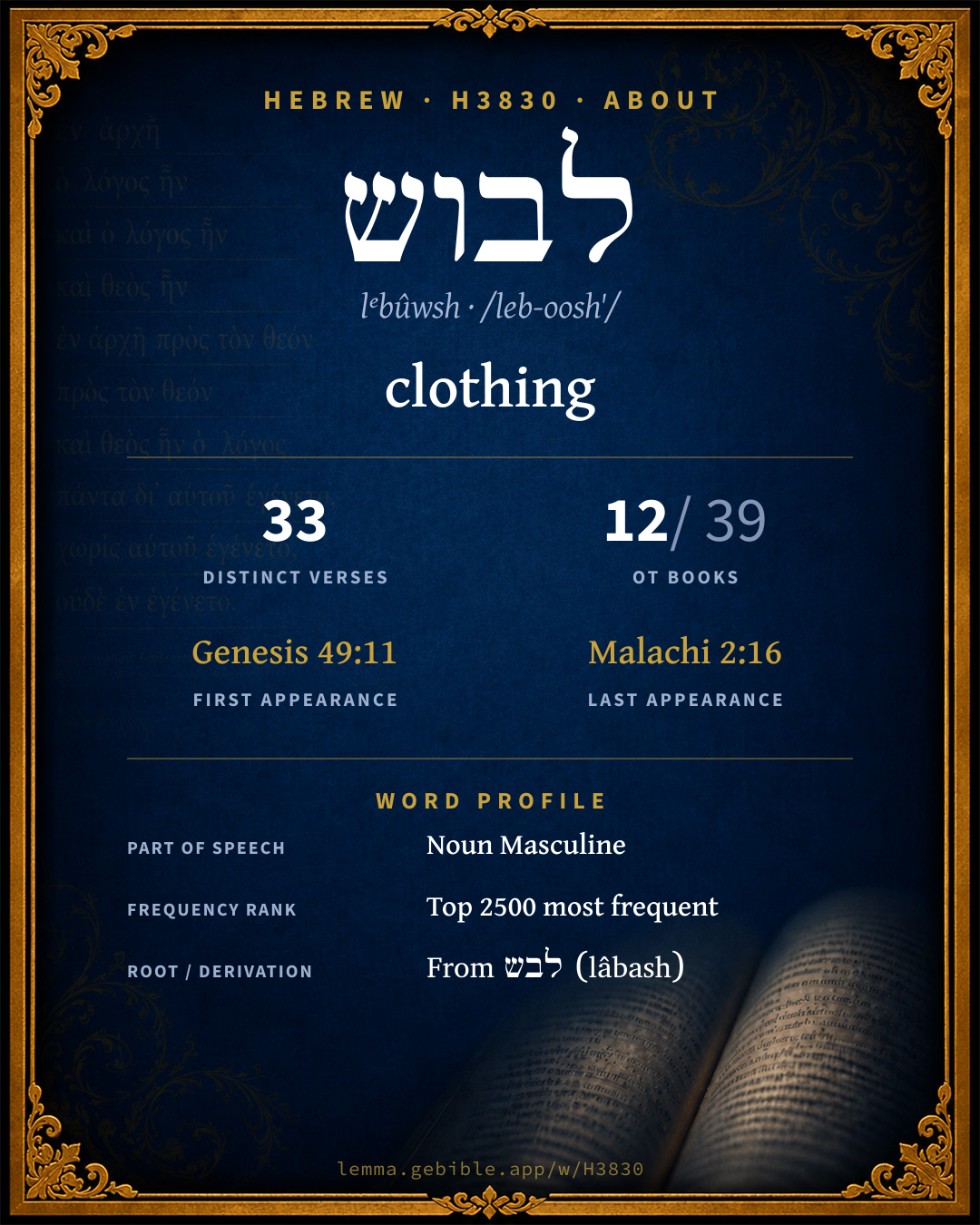
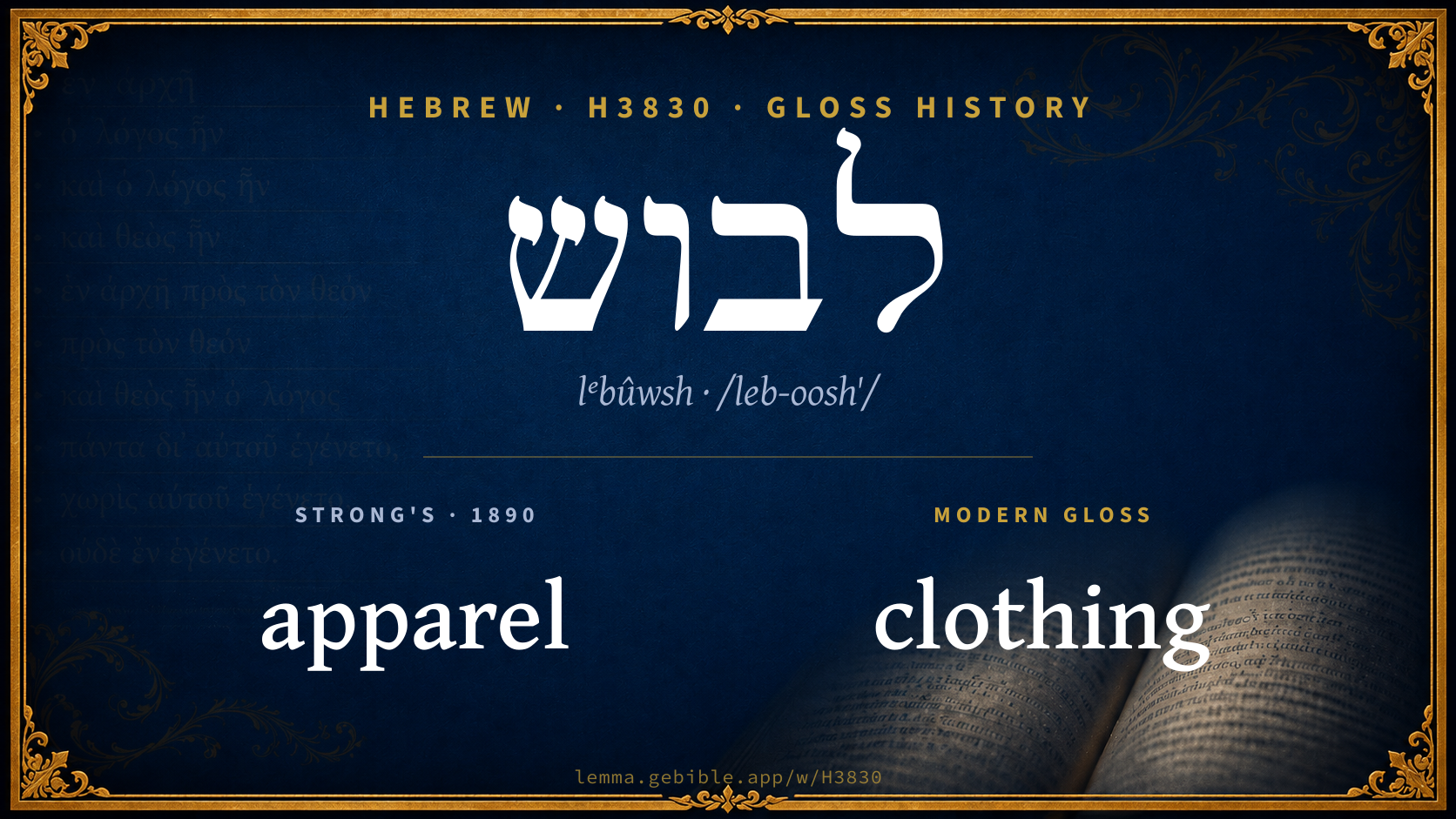
לְבוּשׁ
clothing
Full lexicon entry — Brown-Driver-Briggs (BDB)
From Brown-Driver-Briggs (BDB)
Where this word appears
Grammar key — what these labels mean
Part of speech
- Noun
- A naming word — a person, place, thing, or idea.
- Verb
- An action or state-of-being word.
Noun type
- Common
- A common noun — a general class of person, place, or thing (“king,” “city,” “water”), not a specific name.
Stem
- Qal
- The basic, simple active stem — the plain form of the verb (“he wrote”).
Form
- Participle Passive
- A verbal adjective expressing action received (“written”).
State
- Absolute
- The independent form of a noun, not bound to a following word.
- Construct
- A noun bound to a following noun in a possessive / “of” relationship (the construct chain).
Gender
- Masculine
- Grammatically masculine.
Number
- Singular
- One.
- Plural
- More than one (in Hebrew, generally three or more).
Every verse where H3830 appears in the Book of 2 Samuel — 2 distinct verses. Click any verse to open its interlinear word-by-word view. Verse text shown in the World English Bible for context — . Each verse’s Hebrew form is shown with its reference; the English is not keyword-highlighted, since the data carries no word-level English alignment. Use “Compare translations” on any verse to read it across multiple English versions. This concordance covers the Hebrew Bible; Septuagint (Greek Old Testament) occurrences are not indexed here.
2 Samuel
- 2 Samuel 1:24 לְבוּשְׁ/כֶֽן n c ms cs + sfx pers 2fp You daughters of Israel, weep over Saul, Who clothed you in scarlet delicately, Who put ornaments of gold on your clothing.
- 2 Samuel 20:8 לְבֻשׁ֗/וּ n c ms cs + sfx pers 3ms When they were at the great stone which is in Gibeon, Amasa came to meet them. Joab was girded with his apparel of war that he had put on, and thereon was a sash with a sword fastened on his loins in the sheath of it; and as he went forth it fell out.
About this entry
At a glance — auto-summarized from this page’s data, not written by a person. Every figure links to its source below. This summary describes the numbers; it doesn’t interpret them.
The Hebrew noun לבוש centers on the idea of “clothing.” Where the King James Version says “apparel,” newer translations reach for “clothing” (Berean Standard Bible); the renderings breakdown has the detail. The Hebrew Bible uses it across 33 verses — moderately common. First canonically at Genesis 49:11, it enters the text early. Related forms include לבש, לבש and מלבוש. For the data behind this summary, explore the sense tree and the renderings breakdown below.
Gloss history
Strong's 1890 vs modern scholarship
About this word
Strong's H3830 catalogs a Hebrew word from the Hebrew Old Testament.
These counts are not copied from any lexicon or concordance. They are computed here, from the morphology-tagged Hebrew Old Testament. What Lemma adds →
- 33
- distinct verses
- The word appears in 33 distinct verses.
- 12 / 39
- OT books
- The word appears in 12 of 39 Old Testament books.
- #1,064
- by frequency
- Top 2500 most frequent Hebrew words (rank 1,064 of 8,640 Hebrew words by occurrence).
View all 33 occurrences in the concordance →
By section of the Old Testament
By traditional corpus
Conventional, traditional groupings — biblical authorship is debated, so this is a traditional corpus grouping, not an authorship claim. Each share is this word’s portion of its verses in that division of the Hebrew canon. Each figure is a share of the word’s 33 distinct verses.
- Writings (Ketuvim) 23 verses · 70%
- Prophets (Nevi'im) 9 verses · 27%
- Torah (Pentateuch) 1 verse · 3%
How translations render this word
Counts come from each version’s own published word-to-Strong’s tagging or interlinear alignment — an approximate guide to how each version renders this word, not a word-level alignment the data otherwise carries. Because each total is that version’s own tagged count, the per-version totals vary from one another and need not match the appearance or distinct-verse counts above. These counts may also differ from a printed concordance because Lemma counts each distinctly tagged rendering and does not collapse phrase taggings into a single head-word total. This is a fixed set of word-tagged versions (KJV, ASV, BSB, ULT) and does not change with the reading translation you choose elsewhere. Each version’s license is shown beside its name below (and on Sources).
- King James Version: Apparel 7×, Garment 6×, Clothing 3×
- American Standard Version: Apparel 7×, Clothing 4×, Garment 3×
- Berean Standard Bible: Clothing 6×, Garments 4×, Robe 4×
- unfoldingWord Literal Text: Clothing 15×, Garment 6×, Garment of 2×
King James Version Public Domain
Renders H3830 across 32 tagged occurrences — most commonly:
Plus 10 renderings that appear only once — usually multi-word phrases or single function words the recovered tagging swept in, not distinct renderings.
American Standard Version Public Domain
Renders H3830 across 32 tagged occurrences — most commonly:
Plus 10 renderings that appear only once — usually multi-word phrases or single function words the recovered tagging swept in, not distinct renderings.
Berean Standard Bible Public Domain
Renders H3830 across 32 tagged occurrences — most commonly:
Plus 15 renderings that appear only once — usually multi-word phrases or single function words the recovered tagging swept in, not distinct renderings. Not rendered by a distinct English word in 1 further occurrence.
unfoldingWord Literal Text CC BY-SA 4.0
Renders H3830 across 35 tagged occurrences — most commonly:
Plus 12 renderings that appear only once — usually multi-word phrases or single function words the recovered tagging swept in, not distinct renderings.
Senses in BDB
The 1 sense BDB distinguishes for this word, in lexicon order (not ranked by frequency or importance). The full entry — with sub-senses — is in the Lexicon Entry tab.
- clothing, garment, apparel, raiment
Word origin
n.m. Jb 30:18 garment, clothing, raiment (on format. cf. Ges§ 84 a, 12 LagBN 64, 179);—לְבוּשׁ abs. 2 K 10:22 + 9 times; cstr. לְבוּשׁ Est 4:2 + 2 times, לְבֻשׁ Is 14:19; sf. לְבוּשִׁי Jb 30:18 + 3 times; לְבוּשֶׁ֑ךָ Is 63:2; Pr 27:26; לְבוּשׁוּ Is 63:1; Jb 41:5, לְבֻשׁוֹ 2 S 20:8 + 2 times; לְבוּשָׁהּ ψ 45:14 + 2 times; לְבוּשְׁכֶן 2 S 1:24; לְבוּשָׁם Je 10:9; pl. sf. לְבֻשֵׁיהֶם La 4:14;—garment, clothing, Gn 49:11 (poem in J; ‖ סוּתֹה), Jb 24:7 (‖ כְּסוּת), v 10; 30:18; 31:19; Pr 27:26; ψ 22:19; La 4:14; of women’s raiment 2 S 1:24 Pr 31:22, also fig. עֹז וְהָדָר לְבוּשָׁהּ v 25; specif. of princess ψ 45:14; of warrior’s tunic 2 S 20:8, cf. Is 63:1, 2 (י׳ as warrior); raiment for worshippers 2 K 10:22; for mourners, לְבוּשִׁי שָׂ֑ק ψ 35:13, cf. 69:12; בִּלְבוּשׁ שָׂק Est 4:2; of royal apparel ל׳ מַלְכוּת Est 6:8; 8:15, cf. (without מ׳) 6:9, 10, 11; scaly coat of crocod. פְּנֵיּ לְבוּשׁוֹ Jb 41:5; cover garment with violence Mal 2:16, fig. of putting away a wife, cf. RSK, 269 We; in other fig. uses:—as changed ψ 102:27 (sim. of heavens and earth), as covering 104:6 (sim. of deep upon earth); of cloud as garment of sea Jb 38:9, sim. of terrestrial objects in the light v 14.
— Brown-Driver-Briggs (Oxford 1906, public domain), digitized via Sefaria, supplemented by the OpenScriptures HebrewLexicon (CC BY 4.0). See Sources.
Derived from לבש (lâbash) (H3847) — to clothe.
Jastrow Dictionary
A second Hebrew/Aramaic lexicon for comparison, covering Aramaic and post-biblical (Talmudic, Targumic, Midrashic) usage that the biblical-Hebrew BDB does not. Matched by lemma rather than by Strong’s number, so a lemma may carry more than one Jastrow headword (shown separately below), and the entries cover usage well beyond the Bible.
לְבוּשׁ
- garment, covering. Ex. R. s. 1 לְבוּשׁוֹ מצרי his dress was Egyptian. Ukts. I, 2 הל׳ שלה the husk of the wheat grain; a. fr.—Pl. לְבוּשִׁים, לְבוּשִׁין. Snh. 90ᵇ צדיקים שנקברין בלְבוּשֵׁיהֶן the righteous who are buried in their garments, v. עָרוֹם; (Keth. 111ᵇ במלבושיהן). Meg. 16ᵇ חמשה לְבוּשֵׁי מלכות five official garments; Yalk. Esth. 1059 לבושים של מלכות; a. fr.—V. מַלְבּוּשׁ.
לְבוּשׁ ²
- 1. same. Targ. Esth. IV, 2. Targ. II Kings IV, 42 בלְבוּשֵׁיה (ed. Lag. בלבשיה); h. text בצקלנו); a. fr.—Keth. 63ᵃ שאילי מאני לבוש וכ׳ borrow dressy garments and cover thyself (to meet thy husband). Gen. R. s. 21 דלְבוּשֵׁיה מיניה וביה whose covering is a part of (inseparable from) its body. Taan. 21ᵇ, v. כּוֹסִילְתָּא. Sabb. 77ᵇ (playful etymology) לבושא לא בושה no shame. Nidd. 20ᵃ; a. fr.—Pl. לְבוּשִׁין, לְבוּשַׁיָא. Targ. Gen. III, 21. Targ. Esth. IV, 1; a. fr.—Tam. 32ᵃ לבישין דארגון purple garments; a. e.
- 2. circumvallation. Targ. Zech. XII, 6 ל׳ דנור (h. text כיור אש).
A Dictionary of the Targumim, the Talmud Babli and Yerushalmi, and the Midrashic Literature (Marcus Jastrow; London, Luzac, 1903) — Public Domain. Digitized via Sefaria. Digitized via Sefaria. Full attribution on Sources.
Forms in the corpus
The 29 distinct written forms H3830 takes in the Hebrew Bible, most frequent first — each parse links to that state’s occurrences in the concordance. Hebrew forms include their vowel points and cantillation, so a single lemma takes many written forms.
Same root — word family
Other BDB entries built from the same root as H3830, grouped by Strong’s listed origin. These share a root / origin per the lexicon — not necessarily a shared meaning. Each links to that word’s own entry.
Derives from
Shares the same root
Derived from this word
Compare all same-root words → Showing 4 of 6 — not the complete family. They share a root, not necessarily a meaning.
Septuagint verse parallels
This word appears in 29 verses that also exist in the Greek Old Testament (Septuagint), out of the 33 Hebrew verses it occurs in. You can read those verses in Greek by switching the Old Testament edition to the Septuagint.
Read these verses in the Septuagint
- Genesis 49:11
- 2 Samuel 1:24
- 2 Kings 10:22
- Esther 4:2
- Job 24:7
- Psalms 35:13
- Proverbs 27:26
- Isaiah 14:19
- Jeremiah 10:9
- Lamentations 4:14
- Ezekiel 9:11
- Malachi 2:16
This is a verse-level parallel only — the same verses exist in both the Hebrew and Greek Old Testaments. No word-level Hebrew↔Greek correspondence is claimed: the data carries no such alignment, so no Greek word is shown as this Hebrew word’s translation. Coverage is not total — the Septuagint omits the deuterocanon and renumbers the Psalms, so some Hebrew verses have no direct Greek parallel.