
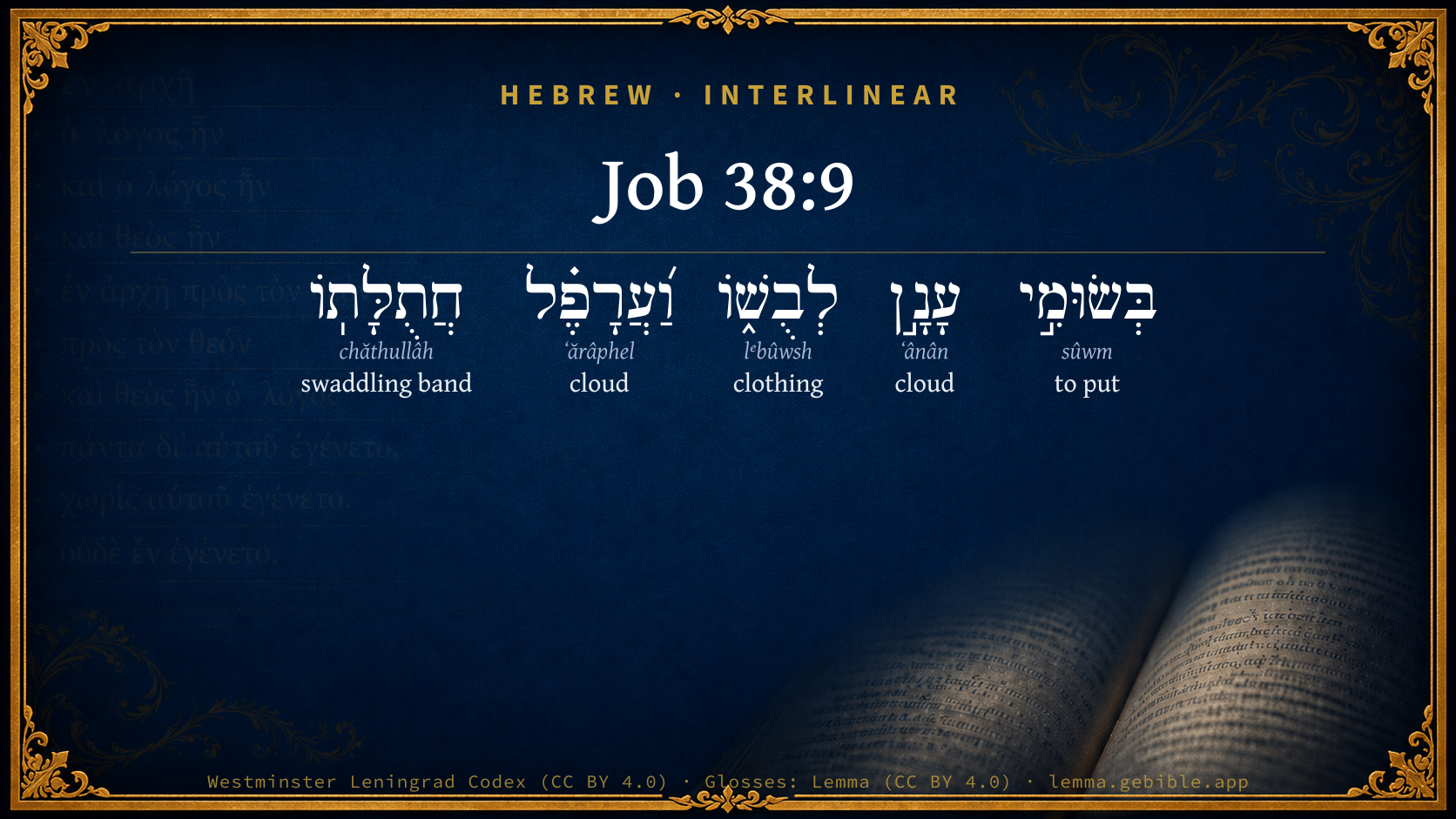
Job 38:9

Hebrew (Westminster Leningrad Codex) Job 38:9 appears in the Hebrew Old Testament. The text above is from the Westminster Leningrad Codex. Each word links to its Strong’s number, a concise gloss, and parsing drawn from the Open Scriptures Hebrew Bible morphology. Click any word for its full Brown-Driver-Briggs (BDB) entry.
Download image
Cite this verse

Job 38:9 (World English Bible). Public Domain. Lemma interlinear Bible study tool, https://lemma.gebible.app/v/job/38/9.

Show BibTeX & RIS
BibTeX
RIS
English Translation
When I made clouds the garment of it, Thick darkness a swaddling-band for it,
World English Bible · Public Domain
Highlights
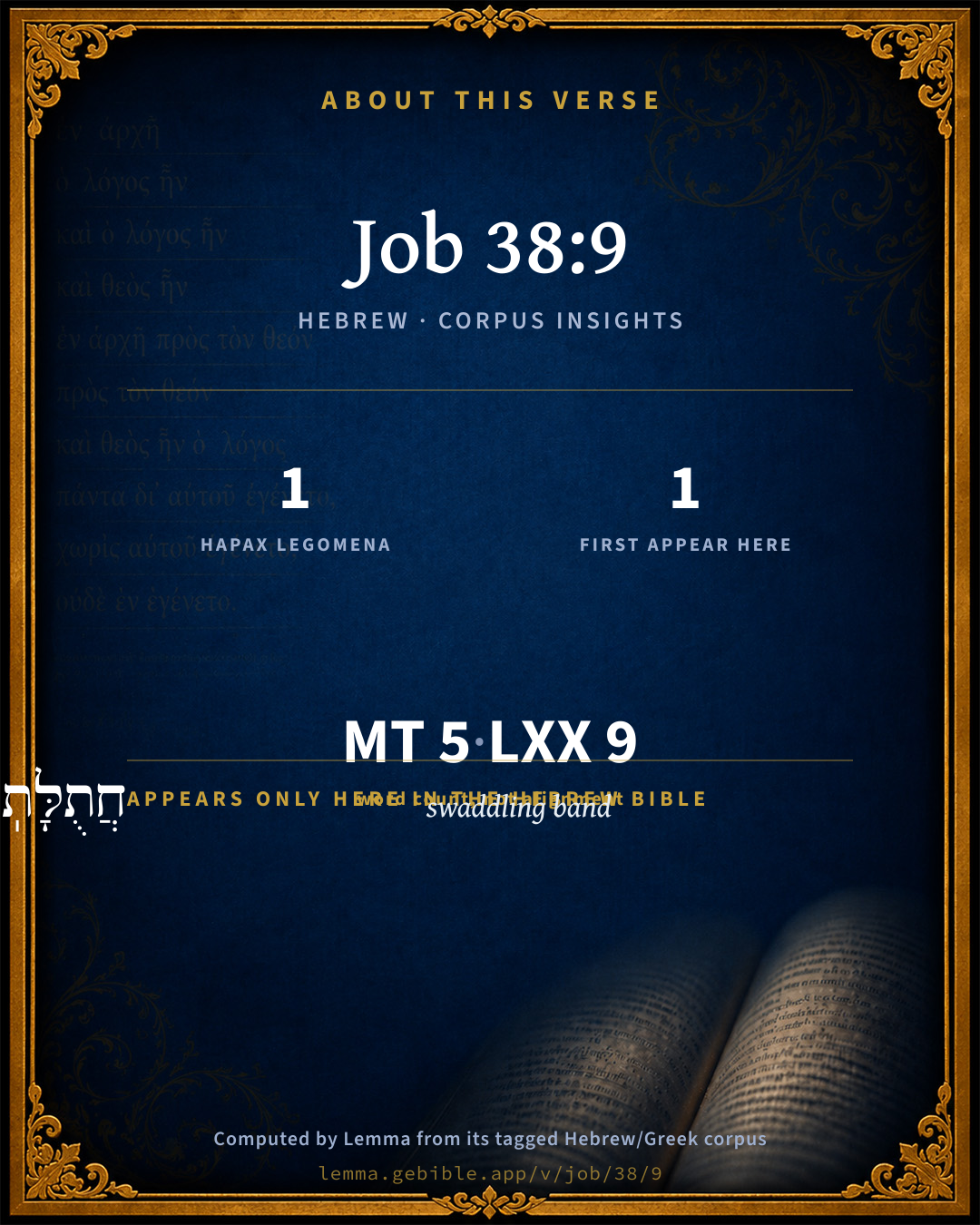
  • 1 hapax legomenon — only here in the Hebrew Bible
  • 1 first appearance in the Hebrew Bible
Full analysis ↓
Download a study sheet

One document with this verse’s original text, its word-by-word gloss line, the meaning frame, cross-references with their text, attributed commentary, and full source and license credits — printable, and it pastes into notes with its structure intact.

This verse Autodidact and up

Study sheet (.html) Plain text (.txt)

A passage Seminary Student

Up to 50 verses in one chapter. A passage sheet keeps up to 6 commentary sources and 12 cross-references per verse, in the order this page ranks them, and says so on the sheet whenever that leaves anything out. Ask for a single verse and you get the Autodidact verse sheet above.

Everything on this page stays free to read, with no account — the sheet is a download of what is already on screen, not access to it.

Want to remove ads? Support Godless Engineer
Compare translations 3

The same verse in 3 English versions, stacked beneath the original-language interlinear above. Click any original word for its lexicon entry.

Each is an independent rendering of the whole verse — the interlinear is not word-aligned to these translations.

Highlighted words mark where these versions differ — a whole-verse word diff, not a word-by-word alignment.

  • World English Bible Public Domain
    When I made clouds the garment of it, Thick darkness a swaddling-band for it,
  • King James Version Public Domain
    When I made the cloud the garment thereof, and thick darkness a swaddlingband for it,
  • unfoldingWord Literal Text CC BY-SA 4.0
    in my making the cloud its clothing and thick darkness its swaddling bands?

unfoldingWord Literal Text — © unfoldingWord, licensed CC BY-SA 4.0. Word-aligned USFM3 via Door43 (git.door43.org/unfoldingWord/en_ult).

Versions to compare (up to 4)

3 of 4 selected

Show all 18 translations

Every available English version of this verse, each an independent rendering of the whole verse.

  • World English Bible Public Domain
    When I made clouds the garment of it, Thick darkness a swaddling-band for it,
  • Berean Standard Bible Public Domain
    when I made the clouds its garment and thick darkness its blanket,
  • Majority Standard Bible Public Domain
    when I made the clouds its garment and thick darkness its blanket,
  • King James Version Public Domain
    When I made the cloud the garment thereof, and thick darkness a swaddlingband for it,
  • American Standard Version (1901) Public Domain
    When I made clouds the garment thereof, And thick darkness a swaddling-band for it,
  • Revised Version (1885) Public Domain
    When I made the cloud the garment thereof, and thick darkness a swaddlingband for it,
  • Geneva Bible (1599) Public Domain
    When I made the cloudes as a couering thereof, and darkenesse as the swadeling bands thereof:
  • Douay-Rheims (1899) Public Domain
    when I made a cloud the garment thereof, and wrapped it in a mist as in swaddling bands?
  • Young's Literal Translation Public Domain
    In My making a cloud its clothing, And thick darkness its swaddling band,
  • Literal Standard Version CC BY-SA 4.0
    In My making a cloud its clothing, || And thick darkness its swaddling band,
  • Unlocked Literal Bible CC BY-SA 4.0
    when I made clouds its clothing, and thick darkness its swaddling bands?
  • unfoldingWord Literal Text CC BY-SA 4.0
    in my making the cloud its clothing and thick darkness its swaddling bands?
  • Darby Bible Public Domain
    When I made the cloud its garment, and thick darkness a swaddling band for it;
  • World Messianic Bible Public Domain
    when I made clouds its garment, and wrapped it in thick darkness,
  • Webster's Bible Public Domain
    When I made a cloud its garment, and thick darkness a swaddling band for it,
  • Free Bible Version CC BY-SA 4.0
    Who clothed it with clouds, and wrapped it in a blanket of deep darkness?
  • Bible in Basic English Public Domain
    When I made the cloud its robe, and put thick clouds as bands round it,
  • JPS Tanakh (1917) Public Domain
    When I made the cloud the garment thereof, and thick darkness a swaddlingband for it,

Literal Standard Version (2020), Covenant Press — licensed CC BY-SA 4.0. Text via the HelloAO Bible API (eBible.org). Unlocked Literal Bible (unfoldingWord) — licensed CC BY-SA 4.0. Text via the HelloAO Bible API (eBible.org). unfoldingWord Literal Text — © unfoldingWord, licensed CC BY-SA 4.0. Word-aligned USFM3 via Door43 (git.door43.org/unfoldingWord/en_ult). Free Bible Version, Dr. Jonathan Gallagher — licensed CC BY-SA 4.0. Text via the HelloAO Bible API (eBible.org).

Word by word

More ways to search: Search by grammar → Find every occurrence → Compare this word →

Practice this passage: Drill this verse → Learn its vocabulary →

About this verse

These counts appear in no published source. They are computed here, from the morphology-tagged text and Lemma’s own curated glosses. What Lemma adds →

5
words
5
distinct lemmas
Wisdom
section

Notable vocabulary

1 hapax legomenon — a word that appears only here in the entire Hebrew Bible:

  • חֲתֻלָּתֽוֹ swaddling band H2854

First appearance in Scripture

This word makes its first canonical appearance in the Hebrew Bible here:

  • חֲתֻלָּתֽוֹ swaddling band H2854

Shared distinctive vocabulary

וַ֝עֲרָפֶ֗ל cloud H6205 occurs in 15 verses of the Hebrew Bible. Also found in:

Grammatical profile

  • 1 verb
  • 4 nouns

Verb forms

  • בְּשׂוּמִ֣י Qal · Infinitive Construct

Hebrew & Septuagint length

In English translation the verse runs 14 words from the Hebrew and 12 from the Septuagint (LXX English) — closely comparable.

A rough comparison of the two English renderings, which tokenize alike — not a word-level alignment.

Word counts can differ between the Hebrew and the Greek without any difference in meaning — e.g. the Hebrew direct-object marker אֵת has no separate Greek word, and Greek often adds the article ὁ.

In the original languages it is 5 Hebrew tokens and 9 Greek tokens — but the two are counted differently (Hebrew bundles its prefixes and suffixes into one token; the Greek is in lemma form), so that isn’t a like-for-like length.

Cross-references

1

Topical passages linked to Job 38:9 in the Treasury of Scripture Knowledge — connected by theme and wording, ordered by reader-vote popularity; previews shown in the World English Bible.

  • Genesis 1:2 Now the earth was formless and empty. Darkness was on the surface of the deep. God's Spirit was hovering over the surface of the waters.

Cross-references courtesy of OpenBible.info (CC BY 4.0).

Hebrew and Greek witnesses Masoretic Hebrew ↔ Greek Septuagint

The same verse in the two great witnesses to the Old Testament, shown verse-for-verse.

These are two independent witnesses, not word-aligned to each other, and the Septuagint is shown in lemma (dictionary) form.

Hebrew Job 38:9 Masoretic · Westminster Leningrad Codex

בְּשׂוּמִ֣י עָנָ֣ן לְבֻשׁ֑וֹ וַ֝עֲרָפֶ֗ל חֲתֻלָּתֽוֹ

When I made clouds the garment of it, Thick darkness a swaddling-band for it,

World English Bible · Public Domain

Greek LXX Job 38:9 Septuagint · lemma form

τίθημι δέ αὐτός νέφος ἀμφίασις ὁμίχλη δέ αὐτός σπαργανόω

And I made a cloud its clothing, and swathed it in mist.

LXX2012 (modern English Septuagint) · Public Domain

Hebrew: Westminster Leningrad Codex (CC BY 4.0). Greek: Septuagint (public domain); English from LXX2012 (modern English Septuagint) (Public Domain). How the Septuagint differs from the Hebrew →

Commentary

Notes on Job 38:9 from classic Christian and Jewish commentators (each source and its license shown beneath its notes). The classic Christian expositions comment on the surrounding passage and are grouped to its opening verse, so a note may address several verses; the Jewish commentaries on the Tanakh (Rashi and others) are per-verse, so they appear only where the commentator wrote on this verse.

Lemma curates 59 commentaries, every one of them public domain or Creative Commons licensed, each selected and text-cleaned for this edition rather than reprinted as found. About our sources →

Trapp's Complete Commentary

John Trapp

Job 38:9 When I made the cloud the garment thereof, and thick darkness a swaddlingband for it,

Ver. 9. When I made the cloud the garment thereof] When I clothed this new born child with a cloud, Elegans allegoria (Jun.); commanding the vapours which environ it to serve it for garments. Clouds are begotten of the waters, of the sea especially, and appear daily upon it.

And thick darkness a swaddling-band for it] This thick darkness is well interpreted to be those fogs and mists which arise upon the sea, and are between the clouds and the sea; as the swaddling bands between the upper garment and the child. Interim significat, saith Mercer here. Meanwhile here is signified, that God can as easily rule and repress the sea as the mother, or nurse, can her suckling when it is swathed up.

John Trapp, A Commentary or Exposition upon All the Books of the Old and New Testament (1647–1656) — public domain. Text from a community e-Sword module.

Geneva Bible (1599)

Geneva Bible translators

As though the great sea were but as a little babe in the hands of God to turn to and fro.

Geneva Bible (1599) marginal notes — public domain. Text via Bolls.life.

Adam Clarke's Commentary

Verse 9. When I make the cloud the garment] Alluding to the cloth in which the new-born infant is first received. The cloud was the same to the newly raised vapour, as the above recipient to the new-born child.

And thick darkness a swaddlingband for it] Here is also an allusion to the first dressings of the new-born child: it is swathed in order to support the body, too tender to bear even careful handling without some medium between the hand of the nurse and the flesh of the child. "The image," says Mr. Good, "is exquisitely maintained: the new-born ocean is represented as issuing from the womb of chaos; and its dress is that of the new-born infant."

There is here an allusion also to the creation, as described in Ge 1:1-2. Darkness is there said to be on the face of the DEEP. Here it is said, the thick darkness was a swaddlingband for the new-born SEA.

Adam Clarke's Commentary on the Bible (1810–1826) — public domain. Text from a community e-Sword/MySword module.

The Cambridge Bible for Schools and Colleges

gen. ed. J. J. S. Perowne

9. thick darkness] Or, and the thick cloud.

The Cambridge Bible for Schools and Colleges (gen. ed. J. J. S. Perowne; Cambridge University Press, 1878–1918) — public domain. Text from a community e-Sword module.

John Gill's Exposition

When I made the cloud the garment thereof,.... For this newborn babe, the sea;

and thick darkness a swaddling band for it; which was the case of the sea when it burst out of the bowels of the earth and covered it, for then darkness was upon the face of the deep, a dark, foggy, misty air, Gen 1:2; and this was before its separation from the land, and in this order it stands in this account; though since, clouds, fogs, and mists, which rise out of the sea, are as garments to it, and cover it at times, and the surrounding atmosphere, as it presses the whole terraqueous globe, and keeps the parts of the earth together, so the waters of the sea from spilling out; and these are the garments and the swaddling bands with which the hands and arms of this big and boisterous creature are wreathed; it is said of the infant in Eze 16:4 that it was neither "salted nor swaddled at all"; but both may be said of the sea; that it is salted is sufficiently known, and that it is swaddled is here affirmed; but who except the Lord Almighty could do this? and who has managed, and still does and can manage, this unruly creature, as easily as a nurse can turn about and swaddle a newborn babe upon her lap.

John Gill's Exposition of the Whole Bible (1746–1763) — public domain (CC PDM 1.0). Text via the HelloAO Bible API.

Albert Barnes' Notes on the Bible

When I made the cloud the garment thereof - Referring to the garment in which the new-born infant is wrapped up. This image is one of great beauty. It is that of the vast ocean just coming into being, with a cloud resting upon it and covering it. Thick darkness envelopes it, and it is swathed in mists; compare Gen 1:2,” And darkness was upon the face of the deep.” The time here referred to is that before the light of the sun arose upon the earth, before the dry land appeared, and before annuals and people had been formed. Then the new-born ocean lay carefully enveloped in clouds and darkness under the guardian care of God. The dark night rested upon it, and the mists hovered over it.

Albert Barnes' Notes on the Bible (1834–1885) — public domain. Text from a community e-Sword/MySword module.

Haydock's Catholic Bible Commentary

Mist. So Moses says darkness was on the face of the abyss. Obscurity covered it, as swaddling bands do a child’s body. (Calmet)

George Leo Haydock (1774–1849), Haydock's Catholic Family Bible and Commentary, 1859 edition — public domain. Excludes Psalms (Douay-Rheims chapter numbering differs from Protestant) and Deuterocanonical books (Catholic canon only).

Matthew Poole's English Annotations

When I covered it with vapours and clouds which arise out of the sea. and by God’s appointment hover above it, and cover it like a garment.

Thick darkness, i. e. black and dark clouds, called darkness by a usual metonymy of the adjunct. So the same thing is repeated in other words, after the manner. Having compared the sea to a new-born infant, he continues in the same metaphor, and makes the clouds as swaddling-bands to keep the sea within its bounds; though indeed neither clouds, nor air, nor sands and shores can bound the sea, but it is God alone who doth it in and with these things.

Matthew Poole's English Annotations on the Holy Bible (1683–1685) — public domain. Text from a community e-Sword/MySword module.

Whedon's Commentary on the Bible

Daniel D. Whedon

9. Thick darkness a swaddling band — The mighty sea, as it broke forth from unseen depths, was but an infant in the hands of God, with the cloud for garment, and the thick darkness its swaddling cloth. This carrying forward of the image of the newborn sea is evidently an allusion, if not a parallel, to “the darkness on the deep.” (Gen_1:2.) “I do not believe that this object was ever presented under a bolder figure than that by which it is expressed, of an infant which the Creator of the world swathes and clothes with its appropriate garments. It bursts forth from the clefts of the earth, as from the womb of its mother; the Ruler and Director of all things addresses it as a living being, as a young giant exulting in his subduing power, and with a word the sea is hushed, and obeys him forever.” — HERDER, Hebrew Poetry, 1:89.

Daniel D. Whedon (gen. ed.), Commentary on the Old and New Testaments (1874–1909) — public domain. Text from a community e-Sword module.

The Pulpit Commentary

When I made the cloud the garment thereof. The account of creation here given is certainly not drawn wholly from Genesis It is to be viewed as a second, independent, account of the occurrences, in fuller detail, but vaguer, by reason of the poetical phraseology. And thick darkness a swaddling-band for it. The infant sea, just come from the womb (ver. 8), is represented as clothed with a cloud, and swaddled in thick darkness, to mark its complete subjection to its Creator from the first.

The Pulpit Commentary (1880–1919), ed. H.D.M. Spence-Jones & Joseph S. Exell — public domain. Text from a community e-Sword module.

John Wesley's Explanatory Notes

The cloud - When I covered it with vapors and clouds which rise out of the sea, and hover above it, and cover it like a garment. Darkness - Black and dark clouds. Swaddling band - Having compared the sea to a new-born infant, he continues the metaphor, and makes the clouds as swaddling-bands, to keep it within its bounds: though indeed neither clouds, nor air, nor sands, nor shores, can bound the sea, but God alone.

John Wesley, Explanatory Notes Upon the Whole Bible (1754–1765) — public domain. Text via the GEBible commentary corpus.

Rashi

Rabbi Shlomo Yitzchaki (Rashi)

When I made the cloud around the ocean, which encompasses the world, and clouds encompass it like raiment.

its wrapping Heb. חתלתו, its wrapping, like (Ezek. 16:4), “nor were you swaddled (והחתל לא חתלת).”

Rashi on the Tanakh — English translations: “The Judaica Press complete Tanach with Rashi, translated by A. J. Rosenberg” (CC BY 4.0); “Pentateuch with Rashi's commentary by M. Rosenbaum and A.M. Silbermann, 1929-1934” (public domain); “The Metsudah Tanach series, Lakewood, N.J” (CC BY 4.0); and “The Book of Joshua, Metsudah Publications, 1997” (CC BY 4.0). Text via Sefaria.

Lesson kit

Teaching starters — assembled from the data on this page, not authored interpretation. Every prompt links to the verse data it draws on. Edit before teaching.

Job, in the Wisdom, opens this verse with 5 words (5 distinct Hebrew lemmas). Its most distinctive word is chăthullâh (“swaddling band”). A historical commentator’s framing appears above. Read the whole chapter for the surrounding context.

Discussion questions

  1. How does “swaddling band” (chăthullâh) shape what this verse is saying?
  2. 1 word here appears nowhere else in the Hebrew Bible. Why might the author reach for such rare wording?
  3. This is the first place “swaddling band” appears in Scripture (first appears here). What does its debut here establish?
  4. How does Exodus 20:21, which shares the word «cloud», read alongside this verse?
  5. These translations render this verse differently. What is at stake in choosing one wording over another?
  6. «בְּשׂוּמִ֣י» is a Qal Infinitive Construct verb. How does that grammatical form shape the action described?
  7. Compare how Trapp's Complete Commentary and Geneva Bible (1599) read this verse. Where do they agree or differ?

Things to notice

Reading settings

Reading text

Shown beneath each verse's original-language words.

Old Testament
Old Testament edition

Read the OT as the Masoretic Hebrew (MT) or the Greek Septuagint (LXX).

English shown for the Greek Septuagint (in the Hebrew ↔ Greek comparison).

Comparing translations? Open the Compare panel on any verse page to stack up to four side by side.