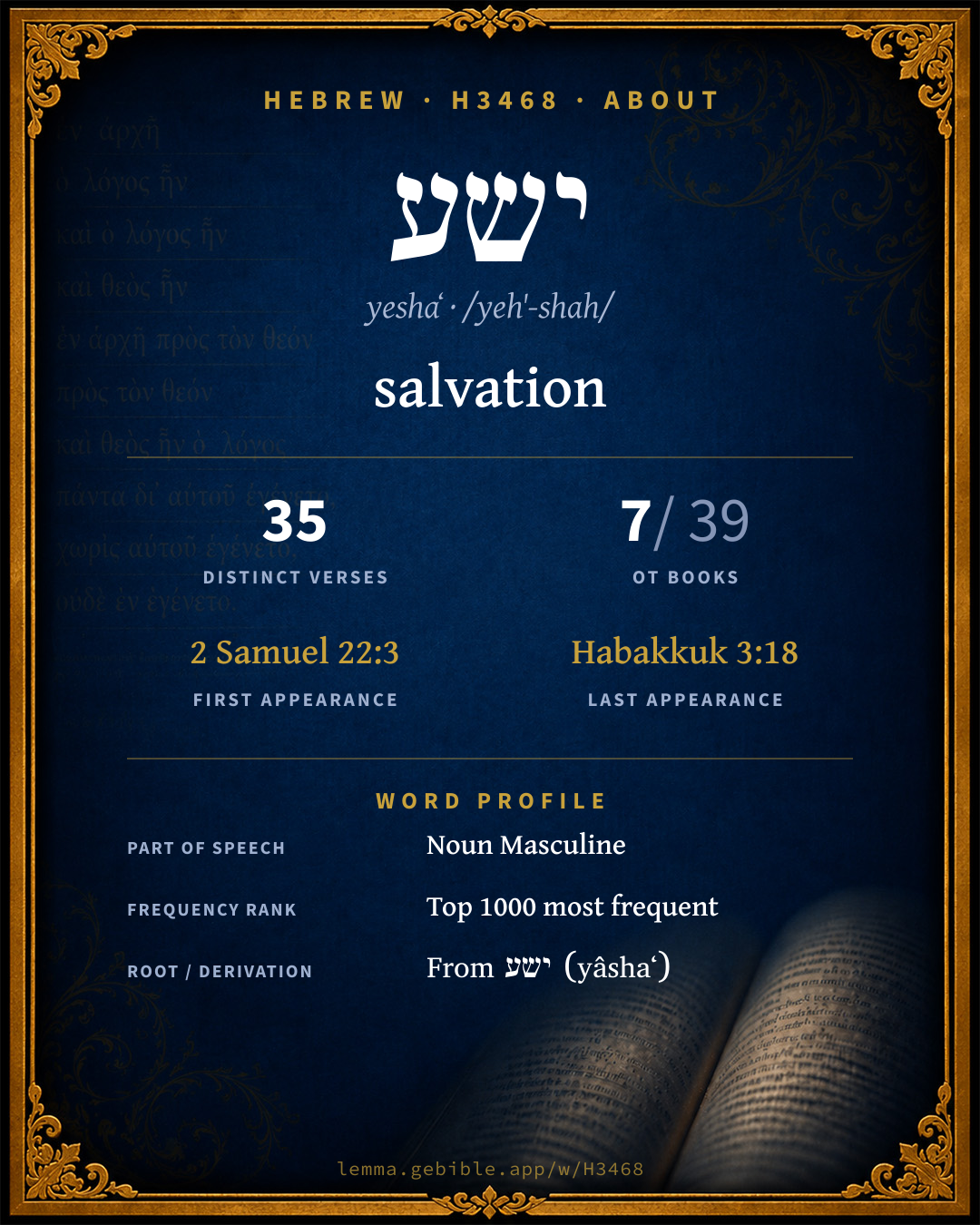
יֵ֫שַׁע
salvation
also: deliverance, rescue, safety, welfare fuller range ↓
Full lexicon entry — Brown-Driver-Briggs (BDB)
From Brown-Driver-Briggs (BDB)
Where this word appears
See every Construct-state word in the Hebrew Bible →
Grammar key — what these labels mean
Part of speech
- Noun
- A naming word — a person, place, thing, or idea.
Noun type
- Common
- A common noun — a general class of person, place, or thing (“king,” “city,” “water”), not a specific name.
State
- Construct
- A noun bound to a following noun in a possessive / “of” relationship (the construct chain).
- Absolute
- The independent form of a noun, not bound to a following word.
Gender
- Masculine
- Grammatically masculine.
Number
- Singular
- One.
3 verses where H3468 appears in the Construct state in the Book of Isaiah. Filtered view — show all forms. Click any verse to open its interlinear word-by-word view. Verse text shown in the World English Bible for context — . Each verse’s Hebrew form is shown with its reference; the English is not keyword-highlighted, since the data carries no word-level English alignment. Use “Compare translations” on any verse to read it across multiple English versions. This concordance covers the Hebrew Bible; Septuagint (Greek Old Testament) occurrences are not indexed here.
Isaiah
- Isaiah 17:10 יִשְׁעֵ֔/ךְ n c ms cs + sfx pers 2fs For you have forgotten the God of your salvation, and have not been mindful of the rock of your strength; therefore you plant pleasant plants, and set it with strange slips.
- Isaiah 51:5 יִשְׁעִ֔/י n c ms cs + sfx pers 1cs My righteousness is near, my salvation is gone forth, and my arms shall judge the peoples; the isles shall wait for me, and on my arm shall they trust.
- Isaiah 62:11 יִשְׁעֵ֖/ךְ n c ms cs + sfx pers 2fs Behold, Yahweh has proclaimed to the end of the earth, Say you to the daughter of Zion, Behold, your salvation comes; behold, his reward is with him, and his recompense before him.
About this entry
At a glance — auto-summarized from this page’s data, not written by a person. Every figure links to its source below. This summary describes the numbers; it doesn’t interpret them.
The Hebrew noun ישע centers on the idea of “salvation.” The word gravitates to Psalms (57%), then Isaiah and 2 Samuel. It appears 35 verses across 7 books of the Hebrew Bible, among its moderately common vocabulary. Its earliest occurrence is 2 Samuel 22:3. Beyond “salvation” it also covers “deliverance”, “rescue”, and “safety” — see its full sense range. For the data behind this summary, explore the sense tree and the renderings breakdown below.
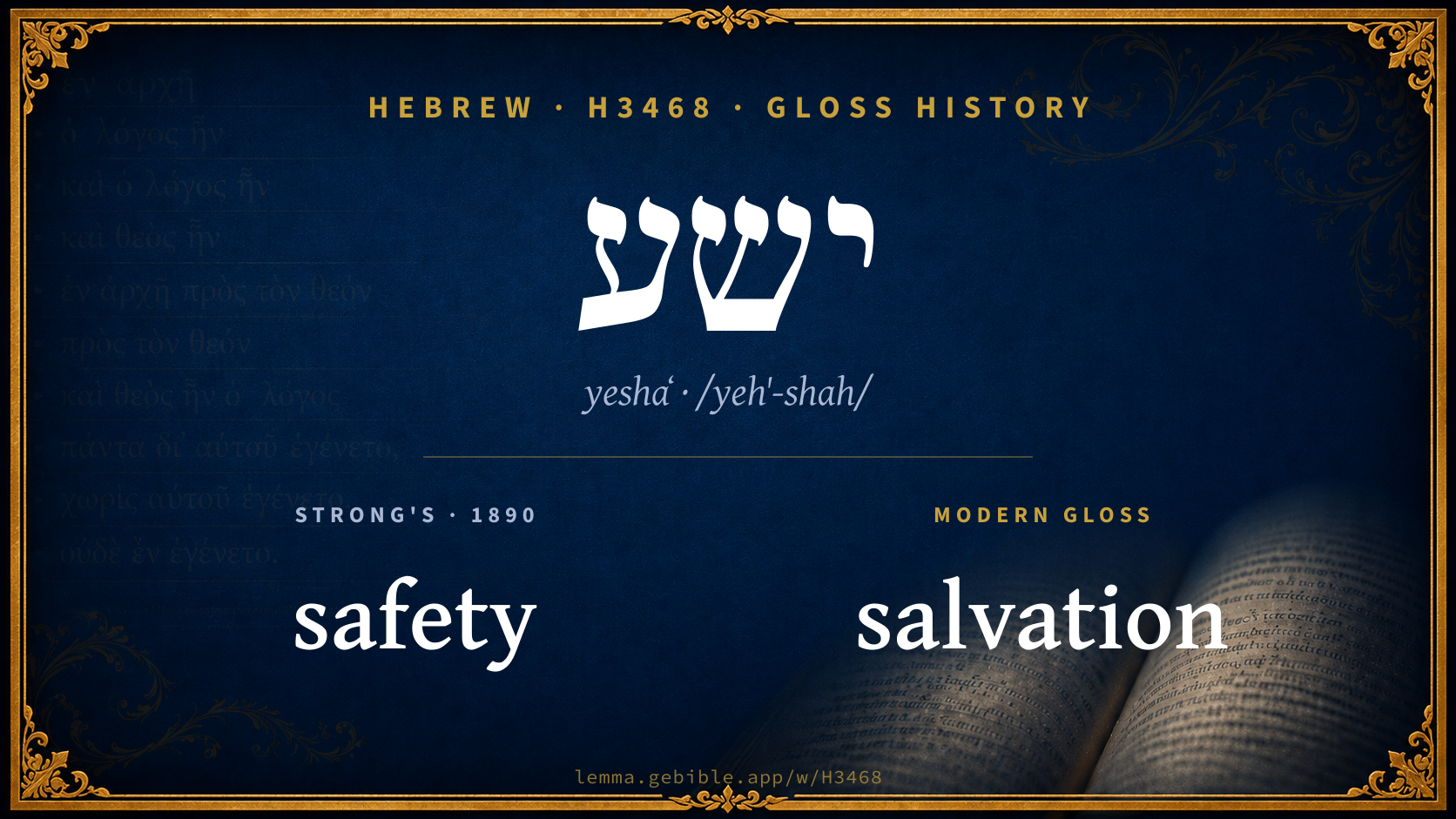
Gloss history
Strong's 1890 vs modern scholarship
About this word
Strong's H3468 catalogs a Hebrew word from the Hebrew Old Testament.
These counts are not copied from any lexicon or concordance. They are computed here, from the morphology-tagged Hebrew Old Testament. What Lemma adds →
- 35
- distinct verses
- The word appears in 35 distinct verses.
- 7 / 39
- OT books
- The word appears in 7 of 39 Old Testament books.
- #990
- by frequency
- Top 1000 most frequent Hebrew words (rank 990 of 8,640 Hebrew words by occurrence).
View all 35 occurrences in the concordance →
By section of the Old Testament
By traditional corpus
Conventional, traditional groupings — biblical authorship is debated, so this is a traditional corpus grouping, not an authorship claim. Each share is this word’s portion of its verses in that division of the Hebrew canon. Each figure is a share of the word’s 35 distinct verses.
- Writings (Ketuvim) 23 verses · 66%
- Prophets (Nevi'im) 12 verses · 34%
How translations render this word
Counts come from each version’s own published word-to-Strong’s tagging or interlinear alignment — an approximate guide to how each version renders this word, not a word-level alignment the data otherwise carries. Because each total is that version’s own tagged count, the per-version totals vary from one another and need not match the appearance or distinct-verse counts above. These counts may also differ from a printed concordance because Lemma counts each distinctly tagged rendering and does not collapse phrase taggings into a single head-word total. This is a fixed set of word-tagged versions (KJV, ASV, BSB, ULT) and does not change with the reading translation you choose elsewhere. Each version’s license is shown beside its name below (and on Sources).
- King James Version: Salvation 28×, Safety 3×
- American Standard Version: Salvation 23×, God of our salvation 3×, Safety 3×
- Berean Standard Bible: Salvation 30×, Safety 3×
- unfoldingWord Literal Text: Salvation 27×, Salvation of 4×, Safety 3×
King James Version Public Domain
Renders H3468 across 36 tagged occurrences — most commonly:
Plus 5 renderings that appear only once — usually multi-word phrases or single function words the recovered tagging swept in, not distinct renderings.
American Standard Version Public Domain
Renders H3468 across 36 tagged occurrences — most commonly:
Plus 7 renderings that appear only once — usually multi-word phrases or single function words the recovered tagging swept in, not distinct renderings.
Berean Standard Bible Public Domain
Renders H3468 across 36 tagged occurrences — most commonly:
Plus 3 renderings that appear only once — usually multi-word phrases or single function words the recovered tagging swept in, not distinct renderings.
unfoldingWord Literal Text CC BY-SA 4.0
Renders H3468 across 38 tagged occurrences — most commonly:
Plus 4 renderings that appear only once — usually multi-word phrases or single function words the recovered tagging swept in, not distinct renderings.
Senses in the full BDB
What do BDB’s symbols mean?
BDB uses these scholarly abbreviations:
| Symbol | Meaning |
|---|---|
| 𝔊 | the Septuagint (the ancient Greek translation, LXX) |
| 𝔙 | the Vulgate (the Latin translation) |
| 𝔖 | the Syriac version (the Peshitta) |
| 𝔗 | the Targum (the Aramaic translation) |
| ψ | the Psalms |
| √ | root (the underlying root or stem) |
| ‖ | parallel passage (a synonymous or contrasted parallel) |
| † | the dagger: every passage where the word occurs is cited |
The 3 senses and sub-senses the full Brown-Driver-Briggs lexicon distinguishes for this word, in lexicon order (not ranked by frequency), with BDB’s own verbatim wording and sub-sense lettering. Shown in Hebrew script with BDB’s own scholarly abbreviations. The condensed entry is in the Lexicon Entry tab. See also the Forms in the corpus table below.
- 1. safety, welfare, prosperity 2 S 23:5 ψ 12:6 Jb 5:4, 11. e.g. 2 Samuel 23:5
- 2. salvation, i.e. primarily physical rescue, by God, often with added spiritual idea: Is 62:11 ψ 69:14; 85:8, 10; יֵשַׁע אֱלֹהִים salvation from God ψ 50:23; used as infin. with acc. לְיֵשַׁע Hb 3:13(×2) (see Ew§ 239 a); accordingly Yahweh is אוֹרִי וְיִשְׁעִי my light and my salvation ψ 27:1; צוּר ישׁע 95:1; קֶרֶן ישׁע 18:3 = 2 S 22:3; אֱלֹהֵי ישׁע Is 17:10; Mi 7:7; Hb 3:18 ψ 18:47 = אֱלֹהֵי צוּר ישׁע 2 S 22:47, ψ 24:5; 25:5; 27:9; 65:6; 79:9; 85:5; 1 Ch 16:35; מָגֵן ישׁ׳ ψ 18:36 = 2 S 22:36; על אלהים ישׁעי ψ 62:8; ‖ צְדָקָה Is 45:8; 51:5; 61:10; שְׂשׂוֹן יִשְׁעֶ֑ךָ ψ 51:14 joy of thy salvation; כֹּהֲנֶיהָ אַלְבִּישׁ ישׁ׳ 132:16 her priests will I clothe with salvation. e.g. Isaiah 62:11
- 3. victory: גְּבוּרוֹת יֵשַׁע יְמִינוֹ ψ 20:7 the mighty deeds of the victory of his right hand. e.g. Psalms 20:7
Senses from the full Brown-Driver-Briggs lexicon (Brown, Driver, Briggs; Oxford 1906 — public domain), digitized via Sefaria, supplemented by the OpenScriptures HebrewLexicon (CC BY 4.0). Full attribution on Sources.
Word origin
n.m. Is 51:5 deliverance, rescue, salvation, also safety, welfare;—יֵ֫שַׁע ψ 20:7 + 4 times; יֶ֫שַׁע Jb 5:11 + 4 times; sf. יִשְׁעִי 2 S 22:3 + 11 times, + 14 times sfs.;—
— Brown-Driver-Briggs (Oxford 1906, public domain), digitized via Sefaria, supplemented by the OpenScriptures HebrewLexicon (CC BY 4.0). See Sources.
Derived from ישע (yâshaʻ) (H3467) — to save.
Jastrow Dictionary
A second Hebrew/Aramaic lexicon for comparison, covering Aramaic and post-biblical (Talmudic, Targumic, Midrashic) usage that the biblical-Hebrew BDB does not. Matched by lemma rather than by Strong’s number, so a lemma may carry more than one Jastrow headword (shown separately below), and the entries cover usage well beyond the Bible.
יָשַׁע
- cmp. preced. wds.) [to be strong, to recover.]
- to assist, help, deliver. Sot. 34ᵇ (ref. to י̇ה̇וש̇ע̇, Num. XIII, 17) י֗ה֗ יוֹשִׁ֗יעֲ֗ךָ וכ׳ Yah save thee from &c. Meg. 14ᵃ עתידה … שיושִׁיעַ וכ׳ my mother shall bear a son who will deliver Israel; Sot. 11ᵇ שמוֹשִׁיעַ. Midr. Till. to Ps. XVIII, 4 כשתּוֹשִׁיעֵנִי מאויבי when thou shalt have saved me from my enemies. Snh. 73ᵃ, v. מוֹשִׁיעַ. Ber. IV, 4 הוֹשַׁע וכ׳ help, O Lord &c.; a. fr.—V. הוֹשַׁעְנָא. e.g. Numbers 13:17
- to be saved, released. Midr. Till. l. c. אִוָּשֵׁעַ מן וכ׳ let me be delivered from my enemies, and I shall call the Lord the praised One. Tanḥ. Aḥǎré 12 (ref. to ויושע, Ex. XIV, 30) וַיִוָּשַׁע כתיב כביכול הוא נ׳ it may be read vayivvasha (and he was saved), He, as if it were, was delivered. Ib. בעוה"ז הייתם נוֹשָׁעִים ע"י ב"א in this world (the past) you were delivered through human agencies. e.g. Exodus 14:30
A Dictionary of the Targumim, the Talmud Babli and Yerushalmi, and the Midrashic Literature (Marcus Jastrow; London, Luzac, 1903) — Public Domain. Digitized via Sefaria. Digitized via Sefaria. Full attribution on Sources.
Forms in the corpus
The 30 distinct written forms H3468 takes in the Hebrew Bible, most frequent first — each parse links to that state’s occurrences in the concordance. Hebrew forms include their vowel points and cantillation, so a single lemma takes many written forms.
Same root — word family
Other BDB entries built from the same root as H3468, grouped by Strong’s listed origin. These share a root / origin per the lexicon — not necessarily a shared meaning. Each links to that word’s own entry.
Derives from
Shares the same root
Proper names from this root
People and places named from this root — a name, not an additional meaning of the word.
- הושע Hôwshêaʻ H1954 Hosea
- הושעיה Hôwshaʻyâh H1955 Hoshaiah
- ישעי Yishʻîy H3469 Ishi
- ישעיה Yᵉshaʻyâh H3470 Isaiah
- מישע Mêyshâʻ H4337 Mesha
Compare all same-root words → Showing 4 of 10 — not the complete family. 5 of the same-root words are proper names (people or places). They share a root, not necessarily a meaning.
Septuagint verse parallels
This word appears in 29 verses that also exist in the Greek Old Testament (Septuagint), out of the 35 Hebrew verses it occurs in. You can read those verses in Greek by switching the Old Testament edition to the Septuagint.
Read these verses in the Septuagint
This is a verse-level parallel only — the same verses exist in both the Hebrew and Greek Old Testaments. No word-level Hebrew↔Greek correspondence is claimed: the data carries no such alignment, so no Greek word is shown as this Hebrew word’s translation. Coverage is not total — the Septuagint omits the deuterocanon and renumbers the Psalms, so some Hebrew verses have no direct Greek parallel.