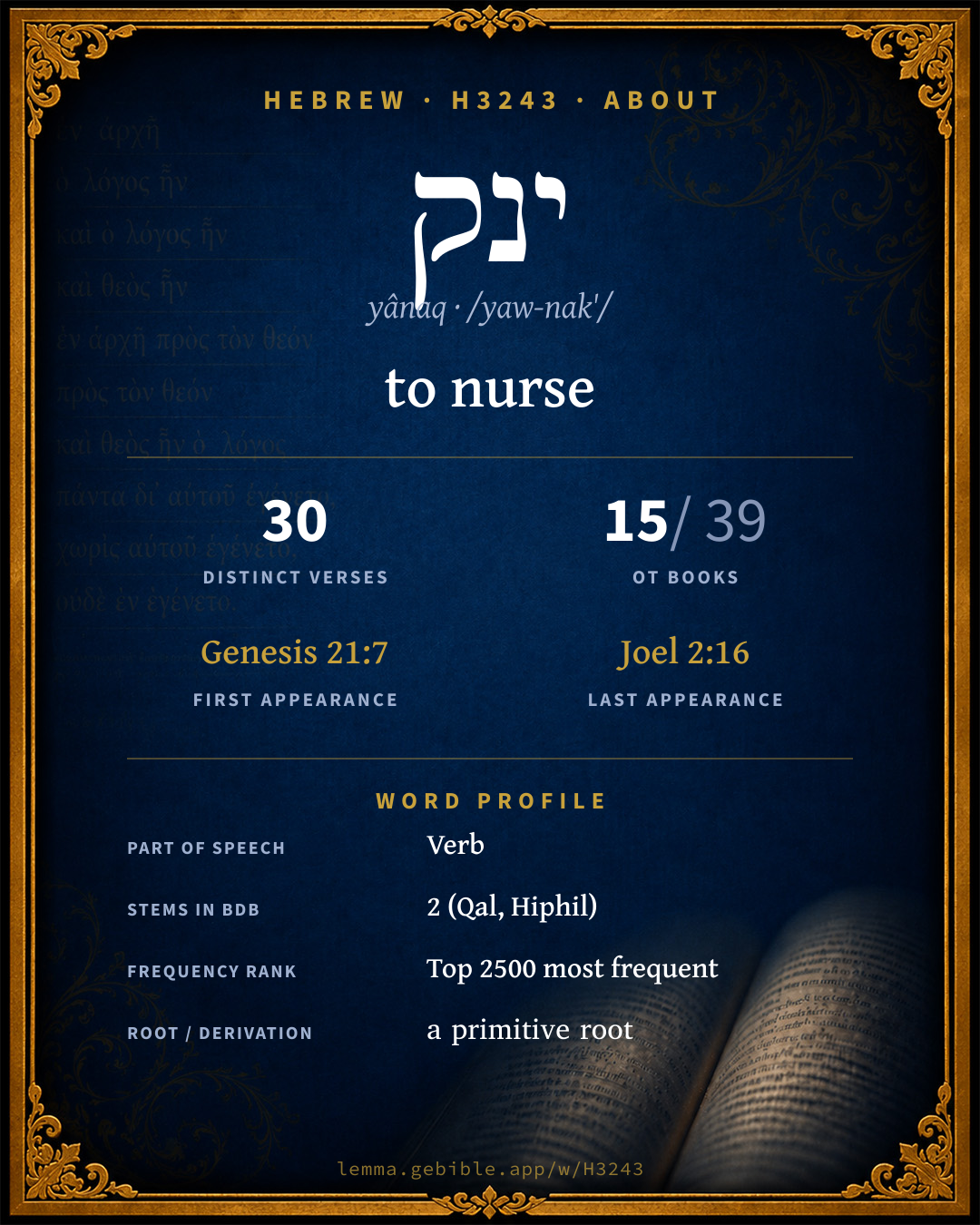
יָנַק
to nurse
‘to nurse’ is one of 5 main senses fuller range ↓
Full lexicon entry — Brown-Driver-Briggs (BDB)
From Brown-Driver-Briggs (BDB)
Where this word appears
Grammar key — what these labels mean
Part of speech
- Verb
- An action or state-of-being word.
- Noun
- A naming word — a person, place, thing, or idea.
Noun type
- Common
- A common noun — a general class of person, place, or thing (“king,” “city,” “water”), not a specific name.
Stem
- Qal
- The basic, simple active stem — the plain form of the verb (“he wrote”).
- Hiphil
- The causative active stem (“he caused / brought about”). Here: ‘suckle’
Form
- Participle Active
- A verbal adjective expressing ongoing or characteristic action (“writing / one who writes”).
- Imperfect
- An incomplete, ongoing, or future action (“he will / would write”).
- Imperative
- A direct command (“write!”).
- Sequential Imperfect
- An imperfect with prefixed waw — the standard past-narrative form (waw-consecutive imperfect).
- Sequential Perfect
- A perfect with prefixed waw continuing a preceding imperfect or command (waw-consecutive perfect).
- Infinitive Construct
- A bound verbal noun, frequently with prepositions (“to write / in writing”).
- Perfect
- A completed action or state — Hebrew marks aspect (completeness) more than strict tense (“he wrote”).
State
- Absolute
- The independent form of a noun, not bound to a following word.
- Construct
- A noun bound to a following noun in a possessive / “of” relationship (the construct chain).
Person
- 3rd Person
- The one spoken about (“he / she / it / they”).
- 2nd Person
- The one addressed (“you”).
- 1st Person
- The speaker (“I / we”).
Gender
- Masculine
- Grammatically masculine.
- Feminine
- Grammatically feminine.
- Common
- Either gender — not distinguished for this form.
Number
- Singular
- One.
- Plural
- More than one (in Hebrew, generally three or more).
Every verse where H3243 appears in the Book of 2 Kings — 1 distinct verse. Click any verse to open its interlinear word-by-word view. Verse text shown in the World English Bible for context — . Each verse’s Hebrew form is shown with its reference; the English is not keyword-highlighted, since the data carries no word-level English alignment. Use “Compare translations” on any verse to read it across multiple English versions. This concordance covers the Hebrew Bible; Septuagint (Greek Old Testament) occurrences are not indexed here.
2 Kings
About this entry
At a glance — auto-summarized from this page’s data, not written by a person. Every figure links to its source below. This summary describes the numbers; it doesn’t interpret them.
At its core, ינק (yânaq) means “to nurse.” Scripture first uses it in Genesis 21:7. It turns up in 30 verses across 15 books, a moderately common footprint. The verb spans 2 stems, from Qal to Hiphil. It shares a root with יונק and יניקה. Dig into 30-verse concordance and the renderings breakdown below.
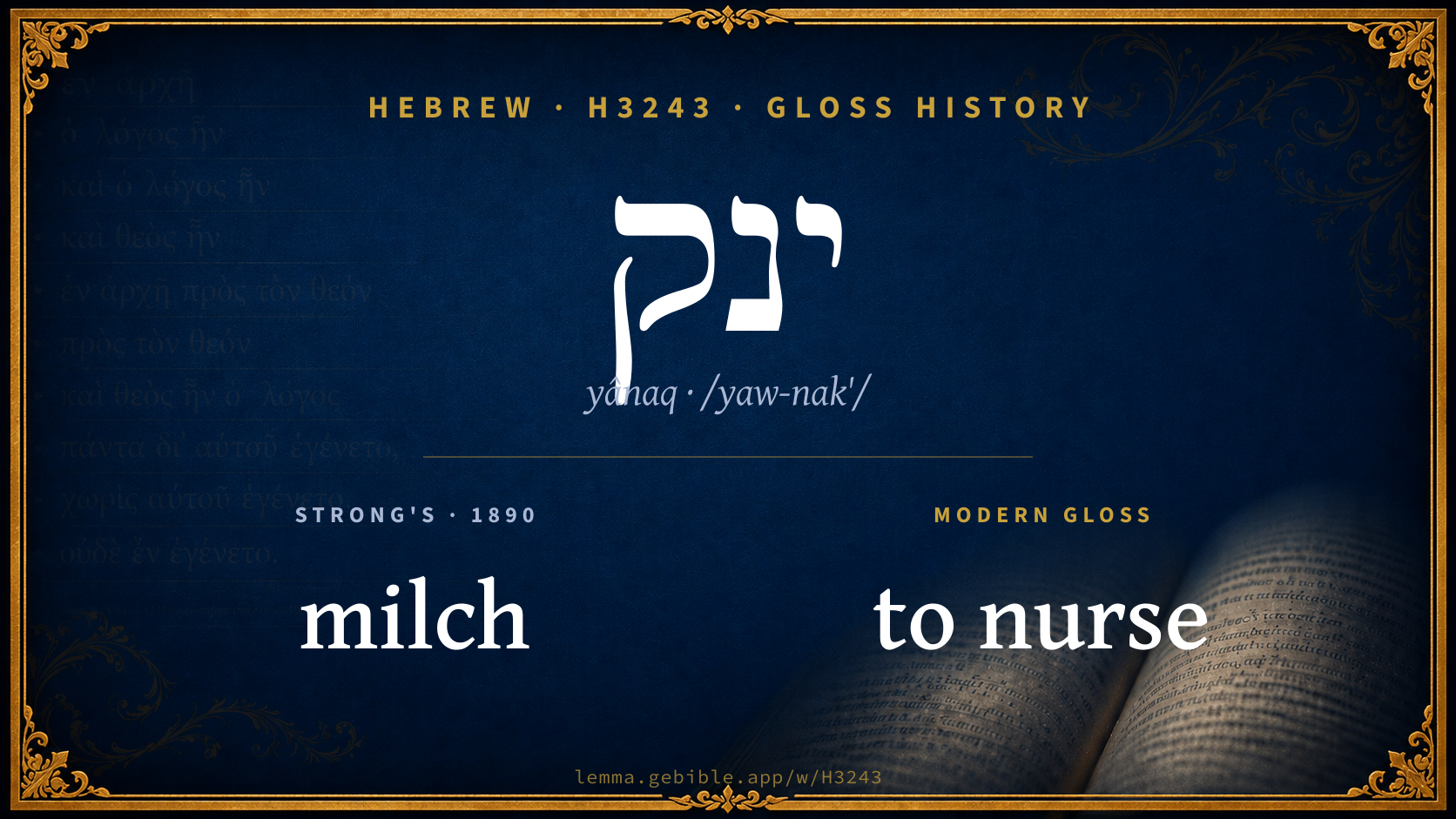
Gloss history
Strong's 1890 vs modern scholarship
About this word
Strong's H3243 catalogs a Hebrew word from the Hebrew Old Testament.
These counts are not copied from any lexicon or concordance. They are computed here, from the morphology-tagged Hebrew Old Testament. What Lemma adds →
- 30
- distinct verses
- The word appears in 30 distinct verses.
- 15 / 39
- OT books
- The word appears in 15 of 39 Old Testament books.
- #1,086
- by frequency
- Top 2500 most frequent Hebrew words (rank 1,086 of 8,640 Hebrew words by occurrence).
View all 30 occurrences in the concordance →
Most concentrated in
- Isaiah 5 verses 17%
- Genesis 4 verses 13%
- Deuteronomy 3 verses 10%
By section of the Old Testament
By traditional corpus
Conventional, traditional groupings — biblical authorship is debated, so this is a traditional corpus grouping, not an authorship claim. Each share is this word’s portion of its verses in that division of the Hebrew canon. Each figure is a share of the word’s 30 distinct verses.
- Prophets (Nevi'im) 12 verses · 40%
- Torah (Pentateuch) 10 verses · 33%
- Writings (Ketuvim) 8 verses · 27%
How translations render this word
Counts come from each version’s own published word-to-Strong’s tagging or interlinear alignment — an approximate guide to how each version renders this word, not a word-level alignment the data otherwise carries. Because each total is that version’s own tagged count, the per-version totals vary from one another and need not match the appearance or distinct-verse counts above. These counts may also differ from a printed concordance because Lemma counts each distinctly tagged rendering and does not collapse phrase taggings into a single head-word total. This is a fixed set of word-tagged versions (KJV, ASV, BSB, ULT) and does not change with the reading translation you choose elsewhere. Each version’s license is shown beside its name below (and on Sources).
BDB lists this Strong’s number as 3 distinct words (homographs). Each count above pools all of them and is not split by sense — see the Senses section below. A low-frequency rendering may belong to a different one of those words, not the primary meaning.
- King James Version†: Nurse 5×, Suck 4×, Sucking child 3×
- American Standard Version†: Nurse 4×, Suck 4×, Sucking child 3×
- Berean Standard Bible†: Nurse 7×, Infant 4×, Infants 4×
- unfoldingWord Literal Text†: Nurse 5×, Infant 3×, Nursing 3×
King James Version Public Domain
Renders H3243 across 32† tagged occurrences — most commonly:
Plus 14 renderings that appear only once — usually multi-word phrases or single function words the recovered tagging swept in, not distinct renderings.
American Standard Version Public Domain
Renders H3243 across 32† tagged occurrences — most commonly:
Plus 15 renderings that appear only once — usually multi-word phrases or single function words the recovered tagging swept in, not distinct renderings.
Berean Standard Bible Public Domain
Renders H3243 across 31† tagged occurrences — most commonly:
Plus 14 renderings that appear only once — usually multi-word phrases or single function words the recovered tagging swept in, not distinct renderings. Not rendered by a distinct English word in 1 further occurrence.
unfoldingWord Literal Text CC BY-SA 4.0
Renders H3243 across 34† tagged occurrences — most commonly:
Plus 21 renderings that appear only once — usually multi-word phrases or single function words the recovered tagging swept in, not distinct renderings.
Senses in the full BDB
Hebrew verbs can shift meaning by stem (binyan): Qal is the basic action, Niphal is often passive or reflexive, Piel often intensifies or makes it factitive, and Hiphil is typically causative. The senses below are grouped under the stem BDB assigns to each.
What do BDB’s symbols mean?
BDB uses these scholarly abbreviations:
| Symbol | Meaning |
|---|---|
| 𝔊 | the Septuagint (the ancient Greek translation, LXX) |
| 𝔙 | the Vulgate (the Latin translation) |
| 𝔖 | the Syriac version (the Peshitta) |
| 𝔗 | the Targum (the Aramaic translation) |
| ψ | the Psalms |
| √ | root (the underlying root or stem) |
| ‖ | parallel passage (a synonymous or contrasted parallel) |
| † | the dagger: every passage where the word occurs is cited |
The 3 senses and sub-senses the full Brown-Driver-Briggs lexicon distinguishes for this word, in lexicon order (not ranked by frequency), with BDB’s own verbatim wording and sub-sense lettering. Shown in Hebrew script with BDB’s own scholarly abbreviations. The condensed entry is in the Lexicon Entry tab. See also the Forms in the corpus table below.
ינק I suck (NH id.
Qal
- Pf. וְיָנַקְתְּ consec. Is 60:16; וִינַקְתֶּם 66:12; Impf. יִינָ֑ק Jb 20:16; אִינָ֑ק 3:12; תִּינָ֑קִי Is 60:16; יִינָ֑קוּ Dt 33:19; תִּינְקוּ Is 66:11; Pt. יוֹנֵק Dt 32:25 + 7 times, יֹנֵק Nu 11:12; יוֹנְקִים ψ 8:3; יוֹנְקֵי Jo 2:16;—suck, of infant at mother’s breast, abs. Jb 3:12; metaph. of abundance and honour of Jerusalem in future, Is 66:11 abs.; sq. acc. of breast 60:16, acc. of milk v 16; 66:12; sq. acc. רֹאשׁ פְּתָנִים Jb 20:16 of punishment of wicked; pt. sq. acc. יוֹנֵק שְׁדֵי אִמִּי Ct 8:1; cstr. יוֹנְקֵי־שָׁדַיִם Jo 2:16 elsewhere as subst., suckling, babe Nu 11:12; Dt 32:25 (opp. אִישׁ שֵׂיבָה); ‖ עוֹלֵל 1 S 15:3; 22:19; ψ 8:3 Je 44:7 La 2:11; ‖ עוֹלָל 4:4, cf. Jo 2:16; ‖ גָּמוּל Is 11:8;—on Is 53:2 v. יוֹנֵק Infr. e.g. Isaiah 60:16
Hiphil
- Pf. הֵינִ֫יקָה Gn 21:7; הֵנִ֫יקוּ La 4:3; Impf. sf. וַיֵּנִקֵ֫הוּ Dt 32:13; 3 fs. תֵּינִק Ex 2:7; וַתֵּ֫נֶק 1 S 1:23; וַתְּנִיקֵ֫הוּ Ex 2:9; Imv. fs. sf. הֵינִקִ֫הוּ v 9; Inf. לְהֵינִיק 1 K 3:21; Pt. מֵינֶ֫קֶת Ex 2:7; cstr. id. Gn 35:8; מֵנִקְתּוֹ 2 K 11:2; מֵינִקְתּוֹ 2 Ch 22:11; מֵנִקְתָּהּ Gn 24:59; מֵינִיקוֹת 32:16; מֵינִיקֹתַיִךְ Is 49:23;—give suck to, nurse, sq. acc. Gn 21:7 1 K 3:21 Ex 2:7, 9; 1 S 1:23; cause to suck honey, fig. Dt 32:13 (2 acc.); of animals La 4:3 sq. acc.; pt. fem. = nursing, אִשָּׁה מֵינֶקֶת Ex 2:7 lit. a nursing woman, a nurse; מ׳ alone as subst. = nurse Gn 24:59 (J), 35:8 (E דְּבֹרָה), 2 K 11:2; 2 Ch 22:11; metaph. Is 49:23; of camels גְּמַלִּים מֵינִיקוֹת Gn 32:16. e.g. Genesis 21:7
ינק II whence (si vera l.) might come,
Hiphil
- suckle, nurse;—Impf. 3 fs. sf. וַתְּנִיקֵ֫הוּ Ex 2:9, but v. ינק and Ges§ 70 e; read prob. וַתֵּינ׳ (Sam. ותיניקהו). e.g. Exodus 2:9
Senses from the full Brown-Driver-Briggs lexicon (Brown, Driver, Briggs; Oxford 1906 — public domain), digitized via Sefaria, supplemented by the OpenScriptures HebrewLexicon (CC BY 4.0). Full attribution on Sources.
Word origin
I. vb. suck (NH id.; Aramaic יְנַק, ܝܺܢܰܩ, and deriv.; Assyrian enîḳu, suck SASm Asrb. i, Gloss. mušêniḳtu, nurse, Jen ZA, 1886, 402)—
I. vb. whence (si vera l.) might come,
— Brown-Driver-Briggs (Oxford 1906, public domain), digitized via Sefaria, supplemented by the OpenScriptures HebrewLexicon (CC BY 4.0). See Sources.
Origin: a primitive root
Jastrow Dictionary
A second Hebrew/Aramaic lexicon for comparison, covering Aramaic and post-biblical (Talmudic, Targumic, Midrashic) usage that the biblical-Hebrew BDB does not. Matched by lemma rather than by Strong’s number, so a lemma may carry more than one Jastrow headword (shown separately below), and the entries cover usage well beyond the Bible.
יָנַק
- [to press,] (cmp. מָצַץ) to suck. Sot. 12ᵇ ולא י׳ and he (Moses) would not suck; פה … יִנַק דבר טמא shall the mouth destined to speak with Divinity suck in an unclean substance?—Ber. 10ᵃ; a. fr.—Trnsf. to draw sap, absorb. B. Bath. 71ᵇ יוֹנְקִין משדה וכ׳ they (the plants) are nurtured from the consecrated field. Y. Erub. III, 21ᵇ איברים יונקין זה מזה the limbs of an animal draw nourishment from one another, i.e. in either portion of a slaughtered animal to be divided between two partners there are substances absorbed from the other; a. fr.
- to give suck, feed. Pes. 112ᵃ … יותר לִינָק … להָנִיק more than the calf desires to suck, does the cow desire to give suck, i.e. the teacher is more anxious to teach than the pupil to learn. Bekh. 7ᵇ כל המוליד מֵנִיק every viviparous animal is a mammal. Keth. V, 5 ומֵנִיקָה את בנה וכ׳ (Y. ed. ומֵינִ׳) and she is bound to nurse her child herself. Nidd. I, 4 נתנה בנה למֵנִיקָה (Y. למינ׳) if she gave her child out to a wet-nurse. Ib. 5 ומניקה and while she nurses a child. Tosef. ib. II, 2; Keth. 60ᵃ מֵינֶקֶת שמת וכ׳ a woman whose husband died during her nursing period. Ib. 65ᵇ סתם מֵנִיקוֹת וכ׳ as a rule nursing women are of delicate health. Taan. 27ᵇ מניקות שיָנִיקוּ וכ׳ in behalf of the nursing women (they prayed) that they might be able to nurse &c.; a. fr.
יְנַק
- Targ. Job III, 11 אֵינִיק (Ms. אִינַק; ed. Lag. אוֹנִיק); a. fr.—Y. Ned. I, 37ᵃ; Gen. R. s. 56 אימר דלא י׳ וכ׳ the lamb that never sucked (the ram offered in Isaac’s place). Ber. 40ᵇ [read:] מירבא … מֵינַק לא יַנְקֵי וכ׳ they grow out of the ground, but draw no nurture from it. B. Bath. 71ᵇ מדנפשיה קא ינקי they draw from the ground which belongs to himself. Bets. 37ᵇ י׳ תחומין מהדדי the parts of an animal whose partners are bound by opposite Sabbath limits draw substances one from the other (v. Y. Erub. III, 21ᵃ quoted in preced.); a. fr.
- as preced. Hif.—Targ. Ex. II, 9. Targ. Y. Deut. XXXII, 13; a. fr.—Gen. R. s. 98, end דהכן אוֹנִיקוּ which nursed such a child; Y. Kil. I, 27ᵇ top אַיְינֵק; Gen. R. s. 5 end מניק (corr. acc.), v. בִּיזָּא III; a. fr.—מֵינִיקְתָּא nurse. Targ. Ex. II, 7; a. e.—Pl. מֵינִיקָתָא, v. infra.
- same. Targ. Y. II, Ex. XV, 2 (Y. I מוֹנִיק). Targ. I Sam. VI, 7; 10 (ed. Lag. מֵנִיקָן); Targ. Ps. LXXVIII, 71 מְיַנְקָן (Targ. Is. XL, 11 מֵינִיקָתָא) animals giving suck (h. text עלות).—Tanḥ. Ki Thissa 27 יַנְּקִין, v. יַנּוֹקָא
A Dictionary of the Targumim, the Talmud Babli and Yerushalmi, and the Midrashic Literature (Marcus Jastrow; London, Luzac, 1903) — Public Domain. Digitized via Sefaria. Digitized via Sefaria. Full attribution on Sources.
Forms in the corpus
The 30 distinct written forms H3243 takes in the Hebrew Bible, most frequent first — each parse links to that stem’s occurrences in the concordance. Hebrew forms include their vowel points and cantillation, so a single lemma takes many written forms.
Same root — word family
Other BDB entries built from the same root as H3243, grouped by Strong’s listed origin. These share a root / origin per the lexicon — not necessarily a shared meaning. Each links to that word’s own entry.
Derived from this word
Compare all same-root words → They share a root, not necessarily a meaning.
Septuagint verse parallels
This word appears in 30 verses that also exist in the Greek Old Testament (Septuagint), out of the 30 Hebrew verses it occurs in. You can read those verses in Greek by switching the Old Testament edition to the Septuagint.
Read these verses in the Septuagint
- Genesis 21:7
- Exodus 2:7
- Numbers 11:12
- Deuteronomy 32:13
- 1 Samuel 1:23
- 1 Kings 3:21
- 2 Kings 11:2
- 2 Chronicles 22:11
- Job 3:12
- Psalms 8:2
- Song of Solomon 8:1
- Isaiah 11:8
This is a verse-level parallel only — the same verses exist in both the Hebrew and Greek Old Testaments. No word-level Hebrew↔Greek correspondence is claimed: the data carries no such alignment, so no Greek word is shown as this Hebrew word’s translation. Coverage is not total — the Septuagint omits the deuterocanon and renumbers the Psalms, so some Hebrew verses have no direct Greek parallel.