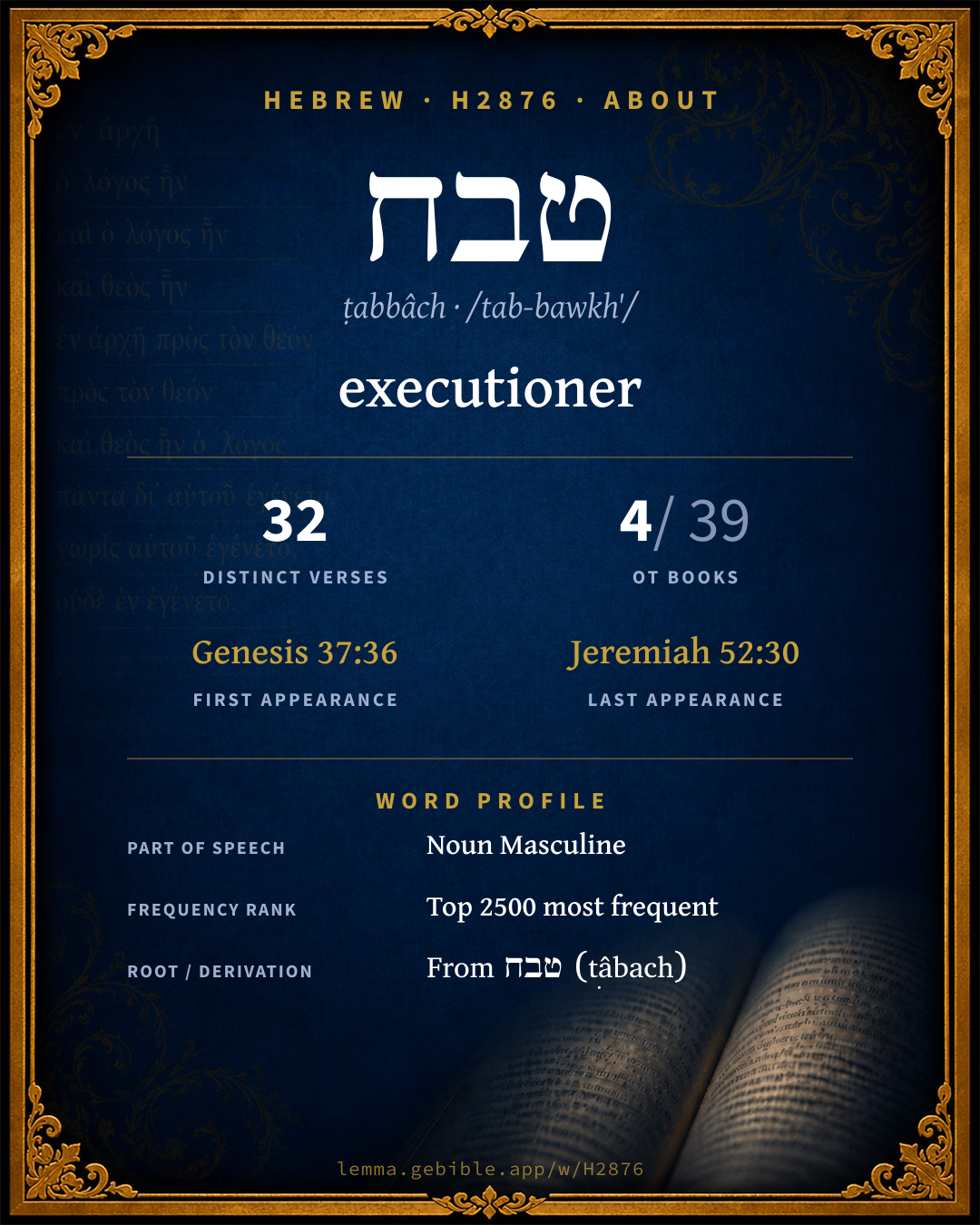
טַבָּח
executioner
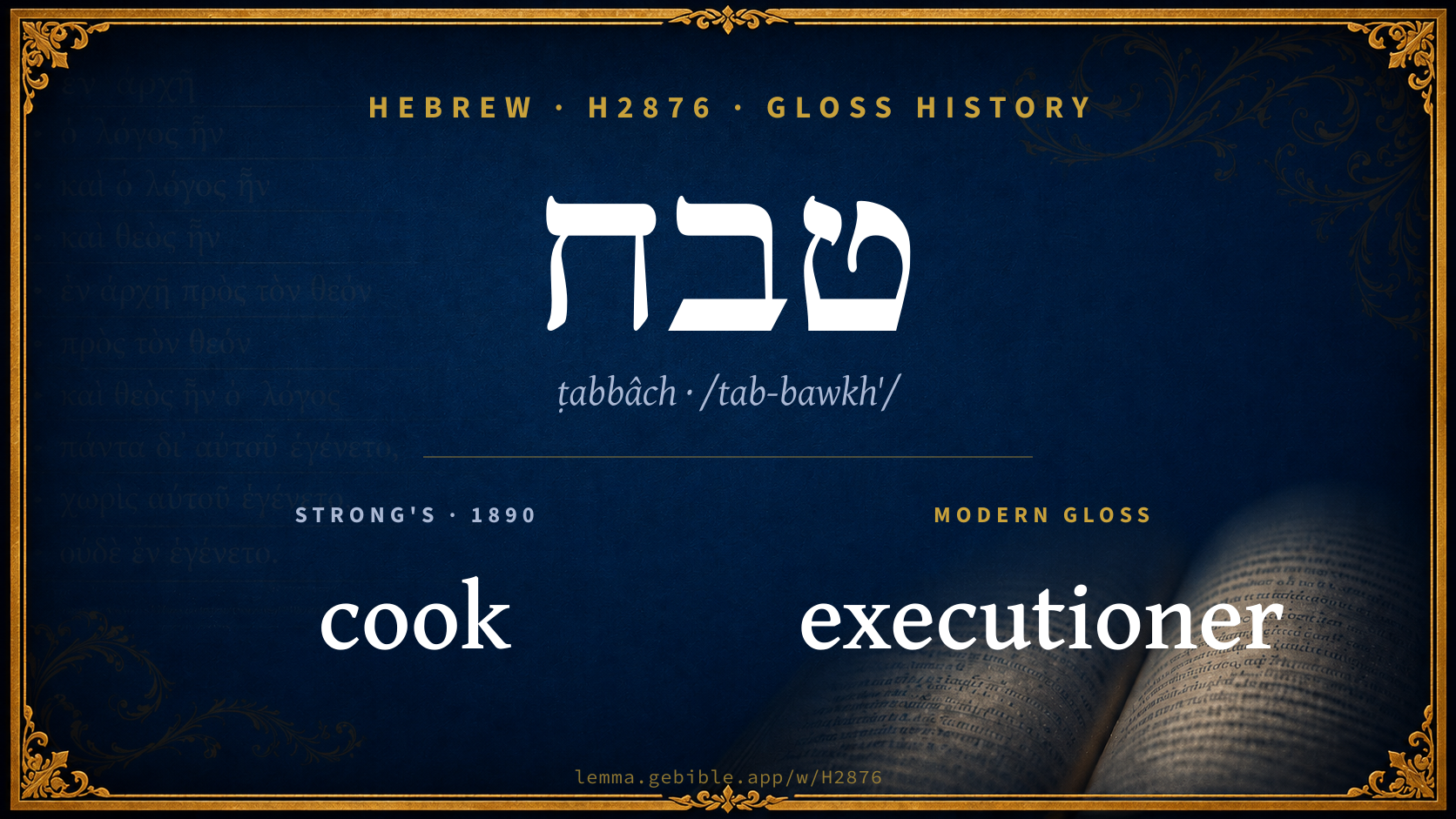
also: cook, bodyguard, guardsman fuller range ↓
Full lexicon entry — Brown-Driver-Briggs (BDB)
From Brown-Driver-Briggs (BDB)
Where this word appears
Grammar key — what these labels mean
Part of speech
- Noun
- A naming word — a person, place, thing, or idea.
Noun type
- Common
- A common noun — a general class of person, place, or thing (“king,” “city,” “water”), not a specific name.
State
- Absolute
- The independent form of a noun, not bound to a following word.
Gender
- Masculine
- Grammatically masculine.
Number
- Plural
- More than one (in Hebrew, generally three or more).
- Singular
- One.
Every verse where H2876 appears in the Book of Jeremiah — 17 distinct verses. Click any verse to open its interlinear word-by-word view. Verse text shown in the World English Bible for context — . Each verse’s Hebrew form is shown with its reference; the English is not keyword-highlighted, since the data carries no word-level English alignment. Use “Compare translations” on any verse to read it across multiple English versions. This concordance covers the Hebrew Bible; Septuagint (Greek Old Testament) occurrences are not indexed here.
Jeremiah
- Jeremiah 39:9 טַבָּחִ֖ים n c mp Then Nebuzaradan the captain of the guard carried away captive into Babylon the residue of the people who remained in the city, the deserters also who fell away to him, and the residue of the people who remained.
- Jeremiah 39:10 טַבָּחִ֖ים n c mp But Nebuzaradan the captain of the guard left of the poor of the people, who had nothing, in the land of Judah, and gave them vineyards and fields at the same time.
- Jeremiah 39:11 טַבָּחִ֖ים n c mp Now Nebuchadrezzar king of Babylon gave charge concerning Jeremiah to Nebuzaradan the captain of the guard, saying,
- Jeremiah 39:13 טַבָּחִ֗ים n c mp So Nebuzaradan the captain of the guard sent, and Nebushazban, Rabsaris, and Nergal Sharezer, Rabmag, and all the chief officers of the king of Babylon;
- Jeremiah 40:1 טַבָּחִ֖ים n c mp The word which came to Jeremiah from Yahweh, after that Nebuzaradan the captain of the guard had let him go from Ramah, when he had taken him being bound in chains among all the captives of Jerusalem and Judah, who were carried away captive to Babylon.
- Jeremiah 40:2 טַבָּחִ֖ים n c mp The captain of the guard took Jeremiah, and said to him, Yahweh your God pronounced this evil on this place;
- Jeremiah 40:5 טַבָּחִ֛ים n c mp Now while he was not yet gone back, Go back then, [said he], to Gedaliah the son of Ahikam, the son of Shaphan, whom the king of Babylon has made governor over the cities of Judah, and dwell with him among the people; or go wherever it seems right to you to go. So the captain of the guard gave him food and a present, and let him go.
- Jeremiah 41:10 טַבָּחִ֔ים n c mp Then Ishmael carried away captive all the residue of the people who were in Mizpah, even the king's daughters, and all the people who remained in Mizpah, whom Nebuzaradan the captain of the guard had committed to Gedaliah the son of Ahikam; Ishmael the son of Nethaniah carried them away captive, and departed to go over to the children of Ammon.
- Jeremiah 43:6 טַבָּחִ֔ים n c mp the men, and the women, and the children, and the king's daughters, and every person who Nebuzaradan the captain of the guard had left with Gedaliah the son of Ahikam, the son of Shaphan; and Jeremiah the prophet, and Baruch the son of Neriah;
- Jeremiah 52:12 טַבָּחִ֔ים n c mp Now in the fifth month, in the tenth day of the month, which was the nineteenth year of king Nebuchadrezzar, king of Babylon, came Nebuzaradan the captain of the guard, who stood before the king of Babylon, into Jerusalem:
- Jeremiah 52:14 טַבָּחִֽים n c mp All the army of the Chaldeans, who were with the captain of the guard, broke down all the walls of Jerusalem round about.
- Jeremiah 52:15 טַבָּחִֽים n c mp Then Nebuzaradan the captain of the guard carried away captive of the poorest of the people, and the residue of the people who were left in the city, and those who fell away, who fell to the king of Babylon, and the residue of the multitude.
- Jeremiah 52:16 טַבָּחִ֑ים n c mp But Nebuzaradan the captain of the guard left of the poorest of the land to be vineyard keepers and farmers.
- Jeremiah 52:19 טַבָּחִֽים n c mp The cups, and the fire pans, and the basins, and the pots, and the lampstands, and the spoons, and the bowls-that which was of gold, in gold, and that which was of silver, in silver,-the captain of the guard took away.
- Jeremiah 52:24 טַבָּחִ֗ים n c mp The captain of the guard took Seraiah the chief priest, and Zephaniah the second priest, and the three keepers of the threshold:
- Jeremiah 52:26 טַבָּחִ֑ים n c mp Nebuzaradan the captain of the guard took them, and brought them to the king of Babylon to Riblah.
- Jeremiah 52:30 טַבָּחִ֔ים n c mp in the three and twentieth year of Nebuchadrezzar Nebuzaradan the captain of the guard carried away captive of the Jews seven hundred forty-five persons: all the persons were four thousand and six hundred.
About this entry
At a glance — auto-summarized from this page’s data, not written by a person. Every figure links to its source below. This summary describes the numbers; it doesn’t interpret them.
“executioner” is the headline sense of the Hebrew noun טבח (ṭabbâch). More than half of its appearances fall in Jeremiah. The Hebrew Bible uses it across 32 verses — moderately common. Not a single-sense word, it carries 3 senses, among them “cook”, “bodyguard”, and “guardsman”. Where the King James Version says “guard,” newer translations reach for “guards” (unfoldingWord Literal Text); the renderings breakdown has the detail. The sections below give every sense, occurrence, and version rendering.
Gloss history
Strong's 1890 vs modern scholarship
About this word
Strong's H2876 catalogs a Hebrew word from the Hebrew Old Testament.
These counts are not copied from any lexicon or concordance. They are computed here, from the morphology-tagged Hebrew Old Testament. What Lemma adds →
- 32
- distinct verses
- The word appears in 32 distinct verses.
- 4 / 39
- OT books
- The word appears in 4 of 39 Old Testament books.
- #1,086
- by frequency
- Top 2500 most frequent Hebrew words (rank 1,086 of 8,640 Hebrew words by occurrence).
View all 32 occurrences in the concordance →
By section of the Old Testament
By traditional corpus
Conventional, traditional groupings — biblical authorship is debated, so this is a traditional corpus grouping, not an authorship claim. Each share is this word’s portion of its verses in that division of the Hebrew canon. Each figure is a share of the word’s 32 distinct verses.
- Prophets (Nevi'im) 26 verses · 81%
- Torah (Pentateuch) 6 verses · 19%
How translations render this word
Counts come from each version’s own published word-to-Strong’s tagging or interlinear alignment — an approximate guide to how each version renders this word, not a word-level alignment the data otherwise carries. Because each total is that version’s own tagged count, the per-version totals vary from one another and need not match the appearance or distinct-verse counts above. These counts may also differ from a printed concordance because Lemma counts each distinctly tagged rendering and does not collapse phrase taggings into a single head-word total. This is a fixed set of word-tagged versions (KJV, ASV, BSB, ULT) and does not change with the reading translation you choose elsewhere. Each version’s license is shown beside its name below (and on Sources).
- King James Version: Guard 29×, Cook 2×
- American Standard Version: Guard 30×, Cook 2×
- Berean Standard Bible: Guard 29×, Cook 2×
- unfoldingWord Literal Text: Guards 13×, Cook 2×
King James Version Public Domain
Renders H2876 across 32 tagged occurrences — most commonly:
Plus 1 rendering that appears only once — usually multi-word phrases or single function words the recovered tagging swept in, not distinct renderings.
American Standard Version Public Domain
Renders H2876 across 32 tagged occurrences — most commonly:
Berean Standard Bible Public Domain
Renders H2876 across 31 tagged occurrences — most commonly:
Not rendered by a distinct English word in 1 further occurrence.
unfoldingWord Literal Text CC BY-SA 4.0
Renders H2876 across 15 tagged occurrences — most commonly:
Senses in BDB
The 3 senses BDB distinguishes for this word, in lexicon order (not ranked by frequency or importance). The full entry — with sub-senses — is in the Lexicon Entry tab.
- executioner, cook, bodyguard, guardsman
- cook (who also killed the animal for food)
- guardsmen, bodyguard
Word origin
טַבָּח n.m. 1. cook, 2. guardsman
— Brown-Driver-Briggs (Oxford 1906, public domain), digitized via Sefaria, supplemented by the OpenScriptures HebrewLexicon (CC BY 4.0). See Sources.
Derived from טבח (ṭâbach) (H2873) — to slaughter.
Jastrow Dictionary
A second Hebrew/Aramaic lexicon for comparison, covering Aramaic and post-biblical (Talmudic, Targumic, Midrashic) usage that the biblical-Hebrew BDB does not. Matched by lemma rather than by Strong’s number, so a lemma may carry more than one Jastrow headword (shown separately below), and the entries cover usage well beyond the Bible.
טָבַח
- , (b. h.) to prepare a feast, esp. to slaughter and dress meat, to cook. Keth. 4ᵃ טִבְחוֹ טָבוּחַ his meat for the feast is ready (for cooking).—Bets. 25ᵃ (expl. בית טביחה) מקום שטוֹבַחַת וכ׳ the place where the animal cooks (digests) its food.
טְבַח
- Ber. 56ᵃ טַבְחַת ולא אכלת thou shalt prepare and not eat. Sabb. 129ᵇ הוה ט׳ להו וכ׳ it (the wind or demon טָבוֹחַ) would have feasted on them (the Israelites), on their flesh and their blood; a. e.—V. מַטְבְּחַיָּיא
- same. Gen. R. s. 57, end טבח טַבְּחוֹן Tabaḥ (Gen. XXII, 24) means, ‘Slaughter them’ v. גַּחֲמוֹן e.g. Genesis 22:24
טֶבַח
- preced. wds.)
- 1. the meat for a feast. Keth. 4ᵃ, v. טָבַח.
- 2. feast, trnsf. onslaught. Gen. R. s. 83 (ref. to Is. XXXIV, 6) אעפ"כ ט׳ גדול וכ׳ nevertheless the main onslaught will be in the land of Edom (Rome); Pesik. R. s. 14, end; s. 15; Yalk. Num. 759. e.g. Isaiah 34:6
טַבָּח
- (preced.) meat-dresser, butcher, cook. Bets. 28ᵃ ט׳ אומן a professional butcher; a. fr.—Pl. טַבָּחִים. Kidd. IV, 14; a. e.
A Dictionary of the Targumim, the Talmud Babli and Yerushalmi, and the Midrashic Literature (Marcus Jastrow; London, Luzac, 1903) — Public Domain. Digitized via Sefaria. Digitized via Sefaria. Full attribution on Sources.
Forms in the corpus
The 13 distinct written forms H2876 takes in the Hebrew Bible, most frequent first — each parse links to that state’s occurrences in the concordance. Hebrew forms include their vowel points and cantillation, so a single lemma takes many written forms.
| Form | Parsing | Example | Uses |
|---|---|---|---|
| טַבָּחִֽים | Noun, Common, Masculine, Plural, Absolute | 2 Kings 25:10 | 6 |
| טַבָּחִ֖ים | Noun, Common, Masculine, Plural, Absolute | Jeremiah 39:9 | 5 |
| טַבָּחִ֑ים | Noun, Common, Masculine, Plural, Absolute | 2 Kings 25:12 | 4 |
| טַבָּחִ֔ים | Noun, Common, Masculine, Plural, Absolute | Jeremiah 41:10 | 4 |
| טַבָּחִ֗ים | Noun, Common, Masculine, Plural, Absolute | 2 Kings 25:18 | 3 |
| הַ/טַּבָּחִ֔ים | Noun, Common, Masculine, Plural, Absolute | Genesis 41:10 | 2 |
| טַבָּחִ֛ים | Noun, Common, Masculine, Plural, Absolute | 2 Kings 25:8 | 2 |
| הַ/טַבָּחִ֖ים | Noun, Common, Masculine, Plural, Absolute | Genesis 40:3 | 1 |
| הַ/טַּבָּחִ֧ים | Noun, Common, Masculine, Plural, Absolute | Genesis 40:4 | 1 |
| הַ/טַּבָּחִֽים | Noun, Common, Masculine, Plural, Absolute | Genesis 37:36 | 1 |
| הַ/טַּבָּחִים֙ | Noun, Common, Masculine, Plural, Absolute | Genesis 39:1 | 1 |
| הַ֠/טַּבָּח | Noun, Common, Masculine, Singular, Absolute | 1 Samuel 9:24 | 1 |
| לַ/טַּבָּ֔ח | Noun, Common, Masculine, Singular, Absolute | 1 Samuel 9:23 | 1 |
Same root — word family
Other BDB entries built from the same root as H2876, grouped by Strong’s listed origin. These share a root / origin per the lexicon — not necessarily a shared meaning. Each links to that word’s own entry.
Derives from
Shares the same root
Derived from this word
Compare all same-root words → Showing 4 of 6 — not the complete family. They share a root, not necessarily a meaning.
Septuagint verse parallels
This word appears in 30 verses that also exist in the Greek Old Testament (Septuagint), out of the 32 Hebrew verses it occurs in. You can read those verses in Greek by switching the Old Testament edition to the Septuagint.
Read these verses in the Septuagint
This is a verse-level parallel only — the same verses exist in both the Hebrew and Greek Old Testaments. No word-level Hebrew↔Greek correspondence is claimed: the data carries no such alignment, so no Greek word is shown as this Hebrew word’s translation. Coverage is not total — the Septuagint omits the deuterocanon and renumbers the Psalms, so some Hebrew verses have no direct Greek parallel.