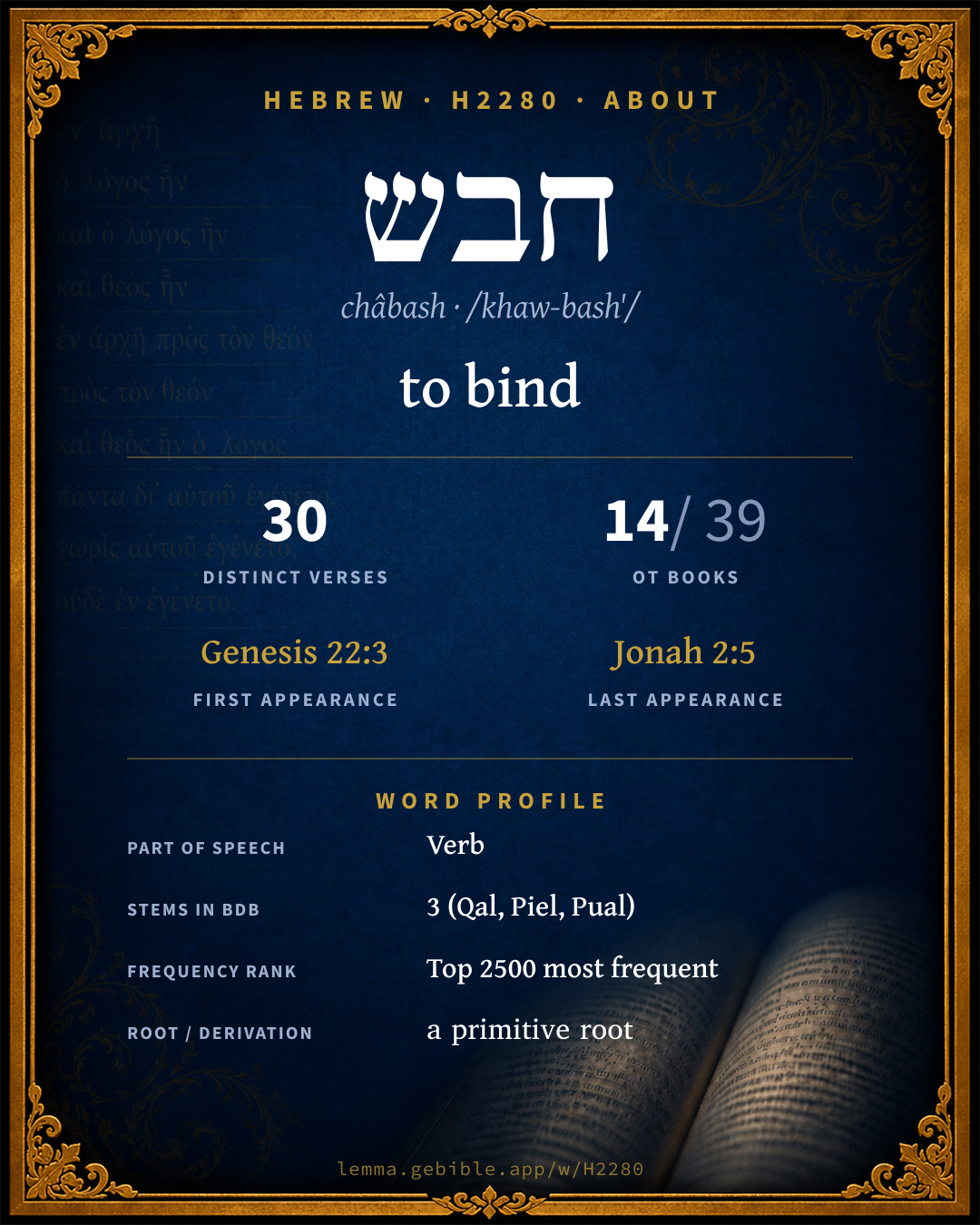
חָבַשׁ
to bind
‘to bind’ is one of 3 main senses fuller range ↓
Full lexicon entry — Brown-Driver-Briggs (BDB)
From Brown-Driver-Briggs (BDB)
Where this word appears
See every Qal verb in the Hebrew Bible →
Grammar key — what these labels mean
Part of speech
- Verb
- An action or state-of-being word.
Stem
- Qal
- The basic, simple active stem — the plain form of the verb (“he wrote”). Here: ‘bind’
- Piel
- An intensive or resultative active stem.
- Pual
- The passive counterpart of the Piel. Here: ‘be bound up’
Form
- Sequential Imperfect
- An imperfect with prefixed waw — the standard past-narrative form (waw-consecutive imperfect).
- Participle Passive
- A verbal adjective expressing action received (“written”).
- Imperfect
- An incomplete, ongoing, or future action (“he will / would write”).
- Imperative
- A direct command (“write!”).
- Participle Active
- A verbal adjective expressing ongoing or characteristic action (“writing / one who writes”).
- Sequential Perfect
- A perfect with prefixed waw continuing a preceding imperfect or command (waw-consecutive perfect).
- Infinitive Construct
- A bound verbal noun, frequently with prepositions (“to write / in writing”).
- Perfect
- A completed action or state — Hebrew marks aspect (completeness) more than strict tense (“he wrote”).
State
- Absolute
- The independent form of a noun, not bound to a following word.
Person
- 3rd Person
- The one spoken about (“he / she / it / they”).
- 1st Person
- The speaker (“I / we”).
- 2nd Person
- The one addressed (“you”).
Gender
- Masculine
- Grammatically masculine.
- Common
- Either gender — not distinguished for this form.
- Feminine
- Grammatically feminine.
Number
- Singular
- One.
- Plural
- More than one (in Hebrew, generally three or more).
2 distinct verses where H2280 appears in the Pual stem, across 2 books. Filtered view — show all forms. Click any verse to open its interlinear word-by-word view. Verse text shown in the World English Bible for context — . Each verse’s Hebrew form is shown with its reference; the English is not keyword-highlighted, since the data carries no word-level English alignment. Use “Compare translations” on any verse to read it across multiple English versions. This concordance covers the Hebrew Bible; Septuagint (Greek Old Testament) occurrences are not indexed here.
Isaiah 1 verse
Ezekiel 1 verse
About this entry
At a glance — auto-summarized from this page’s data, not written by a person. Every figure links to its source below. This summary describes the numbers; it doesn’t interpret them.
חבש (châbash) is a Hebrew verb most often rendered “to bind.” Debuting at Genesis 22:3, it then recurs through the corpus. With 30 verses in 14 books, it is a moderately common word in the Hebrew Bible. Different stems carry different senses — BDB groups them under 3 stems, among them Qal and Piel. The sections below give every sense, occurrence, and version rendering.
Gloss history
Strong's 1890 vs modern scholarship
About this word
Strong's H2280 catalogs a Hebrew word from the Hebrew Old Testament.
These counts are not copied from any lexicon or concordance. They are computed here, from the morphology-tagged Hebrew Old Testament. What Lemma adds →
- 30
- distinct verses
- The word appears in 30 distinct verses.
- 14 / 39
- OT books
- The word appears in 14 of 39 Old Testament books.
- #1,064
- by frequency
- Top 2500 most frequent Hebrew words (rank 1,064 of 8,640 Hebrew words by occurrence).
View all 30 occurrences in the concordance →
By section of the Old Testament
By traditional corpus
Conventional, traditional groupings — biblical authorship is debated, so this is a traditional corpus grouping, not an authorship claim. Each share is this word’s portion of its verses in that division of the Hebrew canon. Each figure is a share of the word’s 30 distinct verses.
- Prophets (Nevi'im) 21 verses · 70%
- Writings (Ketuvim) 5 verses · 17%
- Torah (Pentateuch) 4 verses · 13%
How translations render this word
Counts come from each version’s own published word-to-Strong’s tagging or interlinear alignment — an approximate guide to how each version renders this word, not a word-level alignment the data otherwise carries. Because each total is that version’s own tagged count, the per-version totals vary from one another and need not match the appearance or distinct-verse counts above. These counts may also differ from a printed concordance because Lemma counts each distinctly tagged rendering and does not collapse phrase taggings into a single head-word total. This is a fixed set of word-tagged versions (KJV, ASV, BSB, ULT) and does not change with the reading translation you choose elsewhere. Each version’s license is shown beside its name below (and on Sources).
- King James Version: Saddled 5×, Bind 3×, Bindeth up 3×
- American Standard Version: Saddled 5×, Bind 3×, Bindeth up 3×
- Berean Standard Bible: Saddled 7×, Bind up 2×, Saddle 2×
- unfoldingWord Literal Text: Saddled 5×, Been bound up 2×, Bind up 2×
King James Version Public Domain
Renders H2280 across 33 tagged occurrences — most commonly:
Plus 14 renderings that appear only once — usually multi-word phrases or single function words the recovered tagging swept in, not distinct renderings.
American Standard Version Public Domain
Renders H2280 across 32 tagged occurrences — most commonly:
Plus 15 renderings that appear only once — usually multi-word phrases or single function words the recovered tagging swept in, not distinct renderings.
Berean Standard Bible Public Domain
Renders H2280 across 32 tagged occurrences — most commonly:
Plus 19 renderings that appear only once — usually multi-word phrases or single function words the recovered tagging swept in, not distinct renderings. Not rendered by a distinct English word in 1 further occurrence.
unfoldingWord Literal Text CC BY-SA 4.0
Renders H2280 across 36 tagged occurrences — most commonly:
Plus 19 renderings that appear only once — usually multi-word phrases or single function words the recovered tagging swept in, not distinct renderings.
9 senses and sub-senses in the full BDB
Hebrew verbs can shift meaning by stem (binyan): Qal is the basic action, Niphal is often passive or reflexive, Piel often intensifies or makes it factitive, and Hiphil is typically causative. The senses below are grouped under the stem BDB assigns to each. This entry also uses Pual (the passive of Piel).
What do BDB’s symbols mean?
BDB uses these scholarly abbreviations:
| Symbol | Meaning |
|---|---|
| 𝔊 | the Septuagint (the ancient Greek translation, LXX) |
| 𝔙 | the Vulgate (the Latin translation) |
| 𝔖 | the Syriac version (the Peshitta) |
| 𝔗 | the Targum (the Aramaic translation) |
| ψ | the Psalms |
| √ | root (the underlying root or stem) |
| ‖ | parallel passage (a synonymous or contrasted parallel) |
| † | the dagger: every passage where the word occurs is cited |
The 9 senses and sub-senses the full Brown-Driver-Briggs lexicon distinguishes for this word, in lexicon order (not ranked by frequency), with BDB’s own verbatim wording and sub-sense lettering. Shown in Hebrew script with BDB’s own scholarly abbreviations. The condensed entry is in the Lexicon Entry tab. See also the Forms in the corpus table below.
Qal
- Pf. 2 ms. וְחָבַשְׁתָּ֫ Ex 29:9; 2 mpl. חֲבַשְׁתֶּם Ez 34:4; Impf. יַחֲבוֹשׁ Jb 34:17; וַיַּחֲבֹשׁ Gn 22:3 + 4 times; וִיַּחֲבָשׁ־ 1 K 13:23; וְיֶחְבָּ֑שׁ Jb 5:18; וַיַּחְבְּשֵׁנוּ Ho 6:1; 3 fs. וַתַּחֲבֹשׁ 2 K 4:24; אֶהֱבֹשׁ Ez 34:16; cohort. אֶחְבְּשָׁה־ 2 S 19:27 (but cf.infr.); וָאֶחְבְּשֵׁךְ Ez 16:10; וַיַּחְבְּשׁוּ־ 1 K 13:13; וַיַּחֲבֹ֑שׁוּ 1 K 13:27; Imv. חֲבֹשׁ Jb 40:13; חֲבוֹשׁ Ez 24:17; חִבְשׁוּ 1 K 13:13, 27; Inf. cstr. חֲבֹשׁ Is 30:26; 61:1; לְחָבְשָׁהּ Ez 30:21 (del. Co, cf. 𝔊). Pt. act. חֹבֵשׁ Is 3:7; pass. חָבוּשׁ Jon 2:6; חֲבוּשִׁים Ju 19:10; חֲבֻשִׁים 2 S 16:1 Ez 27:24;— e.g. Exodus 29:9
- 1. bind, bind on:
- a. headgear, c. acc. rei, לְ pers. Ex 29:9 Lv 8:13 (both P); c. על pers. Ez 24:17; pass. of seaweeds clinging about head סוּף חָבוּשׁ לְרֹאשִׁי Jon 2:6; c. sf. pers. et בְּ rei וָאֶחְבְּשֵׁךְ Ez 16:10 and I bound (or wound) about thee (i.e. thy head, Sm VB) שֵׁשׁ (in metaph. of י׳’s care for Jerus.; ‖ אַלְבִּישֵׁךְ, אֶנְעֲלֵךְ); fig. of punishment for wicked פְּנֵיהֶם חֲבֹשׁ בטמון Jb 40:13 veil their faces in darkness (‖ טָמְנֵם בֶּעָפָר) v. Di e.g. Exodus 29:9
- b. pass. prob. twined, twisted in חֲבָלִים חֲבֻשִׁים וַאֲרֻזִים Ez 27:24, cords twisted and strong, v. Sm Da. Especially e.g. Ezekiel 27:24
- c. of equipping a beast for riding; ass, in acc. Gn 22:3 Nu 22:21 (both E), 2 S 17:23 & 19:27 (where however read לוֹ חָבְשָׁה־לִּי, so 𝔊 𝔖 𝔙 Th We Dr), 1 K 2:40; 13:13(×2), 23, 27(×2) (v 27 b no dir. obj. expressed) 2 K 4:24; pass., also of asses, Ju 19:10 2 S 16:1. e.g. Genesis 22:3
- d. fig. = restrain, control (Germ. bändigen), abs. Jb 34:17. e.g. Job 34:17
- 2. bind up, viz. a wound, usually in fig., of comforting the distressed, etc.; c. sf. pers. Ho 6:1 (‖ רָכָּא, opp. הִכָּה); sq. לְ pers. לַחֲבֹשׁ לְנִשְׁבְּרֵי־לֵב Is 61:1; cf. Ez 34:4 (sq. לַנִּשְׁבֶּרֶת; ‖ חַזֵּק, רִפֵּא), v 16 (sq. id.; ‖ חִזֵּק); sq. acc. rei בְּיוֹם חֲבֹשׁ י׳ אֶת־שֶׁבֶר עַמּוֹ Is 30:26;26 (‖ רָפָא); c. acc. of Pharaoh’s broken arm Ez 30:21 (si vera l., v. supr.; cf. Pu.); abs. Jb 5:18 (opp. הִכְאִיב; ‖ רָפָה = רָפָא); also Is 3:7 of repairing fortunes of people. e.g. Hosea 6:1
Piel
- Pf. חִבֵּשׁ bind, restrain מִבְּכִי נהרות Jb 28:11; Pt. מְחַבֵּשׁ bind up לְעַצְבוֹתָם ψ 147:3. e.g. Job 28:11
Pual
- Pf. be bound up חֻבְּשָׁה Ez 30:21 (metaph.) Pharaoh’s broken arm; חֻבָּ֑שׁוּ Is 1:6 (wounds of land of Judah). e.g. Ezekiel 30:21
Senses from the full Brown-Driver-Briggs lexicon (Brown, Driver, Briggs; Oxford 1906 — public domain), digitized via Sefaria, supplemented by the OpenScriptures HebrewLexicon (CC BY 4.0). Full attribution on Sources.
Word origin
vb. bind, bind on, bind up (NH id.; Assyrian abâšu, according to DlW 70, Pr 174; Arabic حَبَسَ confine, restrict; yet on Assyrian ḫibšu ‘Kopfbinde’ (c. חֿ), etc., v. ZehnpfundBAS i. 499, 526; Aramaic ܚܒܰܫ; cf. ܚܒܽܘܫܝܳܐ, חֲבוּשְׁיָא imprisonment, etc.)—
— Brown-Driver-Briggs (Oxford 1906, public domain), digitized via Sefaria, supplemented by the OpenScriptures HebrewLexicon (CC BY 4.0). See Sources.
Origin: a primitive root
Jastrow Dictionary
A second Hebrew/Aramaic lexicon for comparison, covering Aramaic and post-biblical (Talmudic, Targumic, Midrashic) usage that the biblical-Hebrew BDB does not. Matched by lemma rather than by Strong’s number, so a lemma may carry more than one Jastrow headword (shown separately below), and the entries cover usage well beyond the Bible.
חָבַשׁ
- (b. h.) to tie;
- 1. to saddle, harness. Gen. R. s. 55, end חבשה שח׳ וכ׳ the harnessing which Abraham did.
- 2. to imprison, chain. Y. Sot. IX, 24ᵇ top; Tosef. ib. XV, 7 (Var. lect.) חֲבָשׁוֹ attempted to force him by imprisonment, v. חָבַט. Deut. R. s. 2 היה חוֹבֵשׁ וכ׳ he could imprison (condemn) whom he wanted to, opp. פָּדָה. Y. Pes. VIII, 36ᵃ bot. חֲבָשׁוּהוּ ישראל if Israelites keep him in prison (and promised to let him free for Passover); a. fr.—Part. pass. חָבוּשׁ, חֲבוּשָׁה. Ber. 5ᵇ, a. e. אין ח׳ מתיר וכ׳ a prisoner cannot release himself from prison (one cannot do as much for himself as he can for others). Ib. 54ᵇ. B. Bath. 20ᵃ חֲבוּשֵׁי מלכית imprisoned by royal authority; a. fr.
- 3. (agric.) to narrow in, to plant one species too near another species, to produce Kilayim (כִּלְאַיִם). Y. Kil. III, beg., 28ᶜ; Y. Sabb. IX, 11ᵈ bot. אין מין פוגע בחברו לחוֹבְשׁוֹ one species must not meet with the other (in the soil) so as to prevent its growth. Y. Kil. III, 28ᵈ אורכו בכמה חוֹבֵשׁ at what distance, lengthwise, does one interfere with the other (so as to be forbidden to plant)? Ib. II, 28ᵃ אין אדם חובש וכ׳ one cannot make forbidden as Kilayim that which is not his own (by planting too near); a. fr.—Part. pass. חָבוּשׁ, f. חֲבוּשָׁה too closely planted between different species. Ib. I, end, 27ᶜ שעורה ח׳ באמצע barley planted between.
- 1. to be imprisoned, be detained. Keth. II, 9 האשה שנֶחְבְשָׁה וכ׳ a married woman that has been detained in the power of gentiles, if for money &c.; a. e.
- 2. to be planted too closely, to become forbidden as Kilayim. Y. Kil. III, 28ᵈ bot. נ׳ בשמונה becomes forbidden by a neighborhood of eight cubits. Ib. שלא יֵחָבֵשׁ אלא וכ׳ that it is not made forbidden at a distance of more than eight cubits.
- to be the cause of prohibition as Kilayim. Ib. שלא יַחֲבִישׁ וכ׳ that it does not cause a prohibition at a distance of more &c.
- to be kept as prisoner. Sabb. 152ᵇ והן יִתְחַבְּשׁוּ וכ׳ (Ms. M. יֵחָבְשׁוּ) and they, themselves, shall be kept in prison.
חֲבַשׁ
- , to imprison. Y. B. Bath. V, end, 15ᵇ חַבְשִׁין ליה ought to be put in prison.—Part. pass. חֲבִישׁ closely packed. Ḥull. 52ᵃ כל דח׳ חיישינן Ar. (Var. חביט, ed. דלא משריק יש בו וכ׳) whatever is closely packed (e.g. wheat) is liable to cause injury to an animal falling upon it.
- to be imprisoned. Lev. R. s. 30 אתח׳ בפילקי he was put in prison; Pesik. Ul’kaḥ., p. 182ᵃ אִיחַבַּשׁ Ar. (ed. אתייהב).
A Dictionary of the Targumim, the Talmud Babli and Yerushalmi, and the Midrashic Literature (Marcus Jastrow; London, Luzac, 1903) — Public Domain. Digitized via Sefaria. Digitized via Sefaria. Full attribution on Sources.
Forms in the corpus
The 31 distinct written forms H2280 takes in the Hebrew Bible, most frequent first — each parse links to that stem’s occurrences in the concordance. Hebrew forms include their vowel points and cantillation, so a single lemma takes many written forms.
Septuagint verse parallels
This word appears in 29 verses that also exist in the Greek Old Testament (Septuagint), out of the 30 Hebrew verses it occurs in. You can read those verses in Greek by switching the Old Testament edition to the Septuagint.
Read these verses in the Septuagint
- Genesis 22:3
- Exodus 29:9
- Leviticus 8:13
- Numbers 22:21
- Judges 19:10
- 2 Samuel 16:1
- 1 Kings 2:40
- 2 Kings 4:24
- Job 5:18
- Psalms 147:3
- Isaiah 1:6
- Ezekiel 16:10
This is a verse-level parallel only — the same verses exist in both the Hebrew and Greek Old Testaments. No word-level Hebrew↔Greek correspondence is claimed: the data carries no such alignment, so no Greek word is shown as this Hebrew word’s translation. Coverage is not total — the Septuagint omits the deuterocanon and renumbers the Psalms, so some Hebrew verses have no direct Greek parallel.