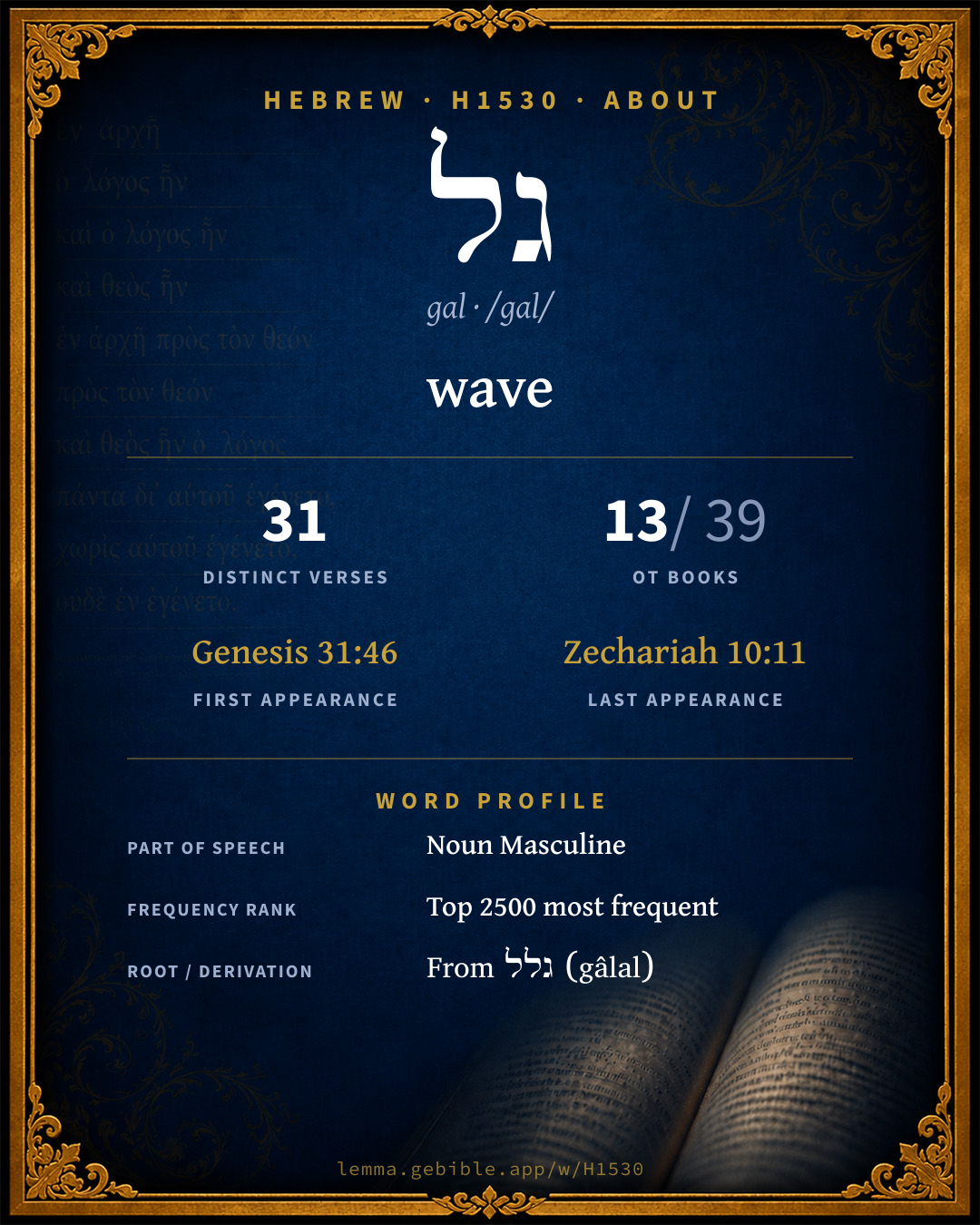
גַּל
wave
also: heap, spring, billow fuller range ↓
Full lexicon entry — Brown-Driver-Briggs (BDB)
From Brown-Driver-Briggs (BDB)
Where this word appears
Grammar key — what these labels mean
Part of speech
- Noun
- A naming word — a person, place, thing, or idea.
Noun type
- Common
- A common noun — a general class of person, place, or thing (“king,” “city,” “water”), not a specific name.
State
- Construct
- A noun bound to a following noun in a possessive / “of” relationship (the construct chain).
- Absolute
- The independent form of a noun, not bound to a following word.
Gender
- Masculine
- Grammatically masculine.
Number
- Plural
- More than one (in Hebrew, generally three or more).
- Singular
- One.
Every verse where H1530 appears in the Book of Zechariah — 1 distinct verse. Click any verse to open its interlinear word-by-word view. Verse text shown in the World English Bible for context — . Each verse’s Hebrew form is shown with its reference; the English is not keyword-highlighted, since the data carries no word-level English alignment. Use “Compare translations” on any verse to read it across multiple English versions. This concordance covers the Hebrew Bible; Septuagint (Greek Old Testament) occurrences are not indexed here.
Zechariah
About this entry
At a glance — auto-summarized from this page’s data, not written by a person. Every figure links to its source below. This summary describes the numbers; it doesn’t interpret them.
גל — transliterated gal — is a Hebrew noun carrying the sense “wave.” Alongside “wave” the lexicon also lists “heap”, “spring”, and “billow” — part of its full sense range. The Hebrew Bible uses it across 31 verses — moderately common. Debuting at Genesis 31:46, it then recurs through the corpus. It shares a root with גלל, גל and גלגל. Each statement above links to its evidence; the full detail follows below.
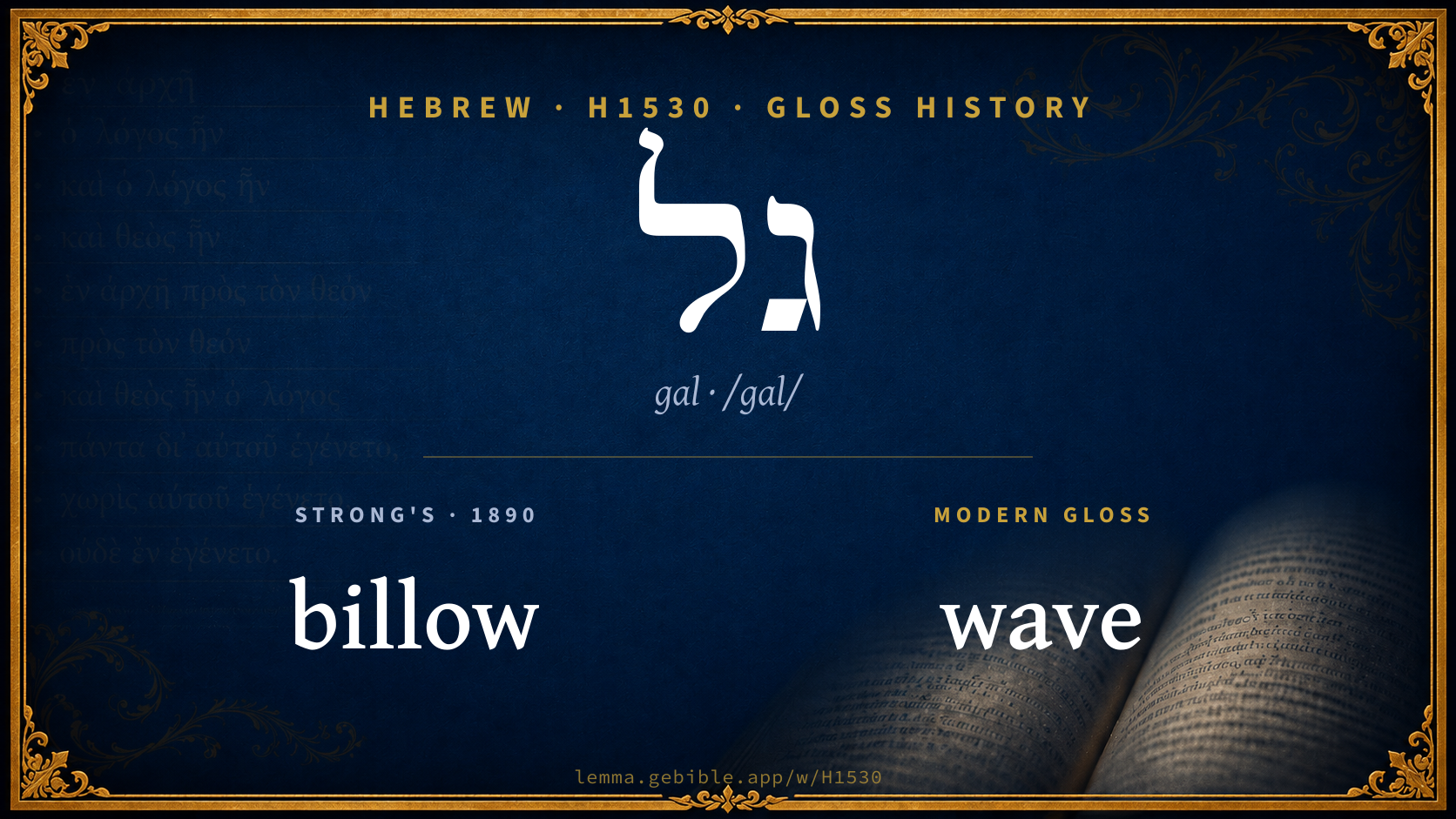
Gloss history
Strong's 1890 vs modern scholarship
About this word
Strong's H1530 catalogs a Hebrew word from the Hebrew Old Testament.
These counts are not copied from any lexicon or concordance. They are computed here, from the morphology-tagged Hebrew Old Testament. What Lemma adds →
- 31
- distinct verses
- The word appears in 31 distinct verses.
- 13 / 39
- OT books
- The word appears in 13 of 39 Old Testament books.
- #1,041
- by frequency
- Top 2500 most frequent Hebrew words (rank 1,041 of 8,640 Hebrew words by occurrence).
View all 31 occurrences in the concordance →
By section of the Old Testament
By traditional corpus
Conventional, traditional groupings — biblical authorship is debated, so this is a traditional corpus grouping, not an authorship claim. Each share is this word’s portion of its verses in that division of the Hebrew canon. Each figure is a share of the word’s 31 distinct verses.
- Prophets (Nevi'im) 18 verses · 58%
- Writings (Ketuvim) 9 verses · 29%
- Torah (Pentateuch) 4 verses · 13%
How translations render this word
Counts come from each version’s own published word-to-Strong’s tagging or interlinear alignment — an approximate guide to how each version renders this word, not a word-level alignment the data otherwise carries. Because each total is that version’s own tagged count, the per-version totals vary from one another and need not match the appearance or distinct-verse counts above. These counts may also differ from a printed concordance because Lemma counts each distinctly tagged rendering and does not collapse phrase taggings into a single head-word total. This is a fixed set of word-tagged versions (KJV, ASV, BSB, ULT) and does not change with the reading translation you choose elsewhere. Each version’s license is shown beside its name below (and on Sources).
BDB lists this Strong’s number as 2 distinct words (homographs). Each count above pools all of them and is not split by sense — see the Senses section below. A low-frequency rendering may belong to a different one of those words, not the primary meaning.
- King James Version†: Waves 13×, Heap 11×, Heaps 3×
- American Standard Version†: Heap 9×, Waves 9×, Heaps 3×
- Berean Standard Bible†: Waves 13×, Mound 8×, Heap of rubble 3×
- unfoldingWord Literal Text†: Waves 10×, Heap 9×, A 4×
King James Version Public Domain
Renders H1530 across 35† tagged occurrences — most commonly:
Plus 8 renderings that appear only once — usually multi-word phrases or single function words the recovered tagging swept in, not distinct renderings.
American Standard Version Public Domain
Renders H1530 across 35† tagged occurrences — most commonly:
Plus 12 renderings that appear only once — usually multi-word phrases or single function words the recovered tagging swept in, not distinct renderings.
Berean Standard Bible Public Domain
Renders H1530 across 34† tagged occurrences — most commonly:
Plus 6 renderings that appear only once — usually multi-word phrases or single function words the recovered tagging swept in, not distinct renderings.
unfoldingWord Literal Text CC BY-SA 4.0
Renders H1530 across 37† tagged occurrences — most commonly:
Plus 7 renderings that appear only once — usually multi-word phrases or single function words the recovered tagging swept in, not distinct renderings.
7 senses and sub-senses in the full BDB
What do BDB’s symbols mean?
BDB uses these scholarly abbreviations:
| Symbol | Meaning |
|---|---|
| 𝔊 | the Septuagint (the ancient Greek translation, LXX) |
| 𝔙 | the Vulgate (the Latin translation) |
| 𝔖 | the Syriac version (the Peshitta) |
| 𝔗 | the Targum (the Aramaic translation) |
| ψ | the Psalms |
| √ | root (the underlying root or stem) |
| ‖ | parallel passage (a synonymous or contrasted parallel) |
| † | the dagger: every passage where the word occurs is cited |
The 7 senses and sub-senses the full Brown-Driver-Briggs lexicon distinguishes for this word, in lexicon order (not ranked by frequency), with BDB’s own verbatim wording and sub-sense lettering. Shown in Hebrew script with BDB’s own scholarly abbreviations. The condensed entry is in the Lexicon Entry tab. See also the Forms in the corpus table below.
- 1. heap of stones,
- a. ג׳ אבנים raised (הקים) over dead body Jos 7:26; 8:29; cf. 2 S 18:17 (c. הִצִּיב). e.g. Joshua 7:26
- b. גַּל alone Jb 8:17 (roots wrapped about it). e.g. Job 8:17
- c. heap or pile made (עשׂה) for use in ratifying compact of Jacob with Laban Gn 31:46(×2), 48, 51, 52(×3) cf. also גַּלְעֵד n.pr. e.g. Genesis 31:46
- d. heap of ruins Is 25:2; elsewhere pl. Ho 12:12 2 K 19:25 = Is 37:26 Jb 15:28 Jer. 9:10; 51:37. e.g. Isaiah 25:2
- 2. waves (rollers) poet., only pl., waves of sea Je 5:22; 31:35 Is 51:15 Jb 38:11 ψ 65:8; 89:10; 107:25, 29; cf. also in simile Ez 26:3 Is 48:18 (גַּלֵּי־הַיָּם); fig. of chastisements from י׳ ψ 42:8 (‖ מִשְׁבָּרִים) Jon 2:3 (‖ id.); of army of Babylon’s conqueror Je 51:42, 55; cf. Zc 10:11 (VB; but BevJPh. xviii. 88 proposes גִּבְלִים cf. Ez 27:9). e.g. Jeremiah 5:22
- 3. spring, Ct 4:12 גַּן נָעוּל אֲחוֹתִי כַּלָּ֑ה גַּל נָעוּל מַעְיָן חָתוּם a garden barred (is) my sister, bride, a spring barred, a fountain sealed; but גַּן for גַּל 𝔊 𝔖 𝔙. e.g. Song of Solomon 4:12
Senses from the full Brown-Driver-Briggs lexicon (Brown, Driver, Briggs; Oxford 1906 — public domain), digitized via Sefaria, supplemented by the OpenScriptures HebrewLexicon (CC BY 4.0). Full attribution on Sources.
Word origin
n.m. Gn 31:48 heap, wave, billow (as rolled together, rolling, rolling up), also spring, MT Ct 4:12 cf. 3 infr.—abs. גַּל Jb 8:17 + 5 times (incl. הַגַּל Gn 31:48 +); גָּ֑ל Gn 31:46; הַגָּ֑ל Gn 31:46; לַגָּ֑ל Is. 25:2; cstr. גַּל־ Jos 7:26 + 2 times + Gn 31:47, 48 q.v. infr.; pl. גַּלִּים 2 K 19:25 + 6 times; cstr. גַּלֵּי־ Is 48:18; sf. גַּלָּיו ψ 89:10 + 6 times; גַּלֵּיהֶם ψ 65:8 + 2 times;—
— Brown-Driver-Briggs (Oxford 1906, public domain), digitized via Sefaria, supplemented by the OpenScriptures HebrewLexicon (CC BY 4.0). See Sources.
Derived from גלל (gâlal) (H1556) — to roll.
Jastrow Dictionary
A second Hebrew/Aramaic lexicon for comparison, covering Aramaic and post-biblical (Talmudic, Targumic, Midrashic) usage that the biblical-Hebrew BDB does not. Matched by lemma rather than by Strong’s number, so a lemma may carry more than one Jastrow headword (shown separately below), and the entries cover usage well beyond the Bible.
גַּל
- 1. heap of stones, bones &c., esp. rubbish, ruins. Sot. IX, 2 if the body of a murdered person was found טמון בג׳ buried in a heap. Keth. 15ᵇ לפקח עליו את הג׳ as to removing debris for saving one’s life (on the Sabbath). Sabb. 34ᵃ עשהו ג׳ של עצמות changed him into a heap of bones; a. fr.—Pl. גַּלִּים, גַּלִּין. Nidd. IX, 5. Kil. I, 2, v. חֲזֶרֶת. Cmp. גִּילָּא.
- 2. wave, billow. Mikv. V, 6 ג׳ שנתלש a wave thrown on shore. Yeb. 121ᵃ; a. fr.—Pl. as above. Ex. R. s. 19 הגיעוה ג׳ waves overcame her, i.e. she encountered storms; a. e.
- 3. revolving door, turning on hinges or pivots. Sabb. 81ᵃ של ג׳ the pivot of a revolving door. V. גִּלָּה.
- 4. (v. LXX Hos. XII, 12) turtoise. Pl. as above. Sifra Sh’mini, ch. IV, Par. 3. e.g. Hosea 12:12
A Dictionary of the Targumim, the Talmud Babli and Yerushalmi, and the Midrashic Literature (Marcus Jastrow; London, Luzac, 1903) — Public Domain. Digitized via Sefaria. Digitized via Sefaria. Full attribution on Sources.
Forms in the corpus
The 29 distinct written forms H1530 takes in the Hebrew Bible, most frequent first — each parse links to that state’s occurrences in the concordance. Hebrew forms include their vowel points and cantillation, so a single lemma takes many written forms.
Same root — word family
Other BDB entries built from the same root as H1530, grouped by Strong’s listed origin. These share a root / origin per the lexicon — not necessarily a shared meaning. Each links to that word’s own entry.
Derives from
Shares the same root
- גל gôl H1531 bowl, basin
- גלגל galgal H1534 whirlwind
- גלגלת gulgôleth H1538 skull
- גלה gullâh H1543 bowl
- גלול gillûwl H1544 idols
- גליל gâlîyl H1550 circuit
- גלל gâlâl H1557 dung
- גלל gâlâl H1558 on account of
- גלל gᵉlâl H1560 rolling
- מגלה mᵉgillâh H4039 scroll
Proper names from this root
People and places named from this root — a name, not an additional meaning of the word.
Compare all same-root words → Showing 4 of 16 — not the complete family. 4 of the same-root words are proper names (people or places). They share a root, not necessarily a meaning.
Septuagint verse parallels
This word appears in 24 verses that also exist in the Greek Old Testament (Septuagint), out of the 31 Hebrew verses it occurs in. You can read those verses in Greek by switching the Old Testament edition to the Septuagint.
Read these verses in the Septuagint
- Genesis 31:46
- Joshua 7:26
- 2 Samuel 18:17
- 2 Kings 19:25
- Job 8:17
- Psalms 65:7
- Song of Solomon 4:12
- Isaiah 25:2
- Jeremiah 5:22
- Ezekiel 26:3
- Hosea 12:11
- Jonah 2:3
This is a verse-level parallel only — the same verses exist in both the Hebrew and Greek Old Testaments. No word-level Hebrew↔Greek correspondence is claimed: the data carries no such alignment, so no Greek word is shown as this Hebrew word’s translation. Coverage is not total — the Septuagint omits the deuterocanon and renumbers the Psalms, so some Hebrew verses have no direct Greek parallel.