Isaiah 51:15

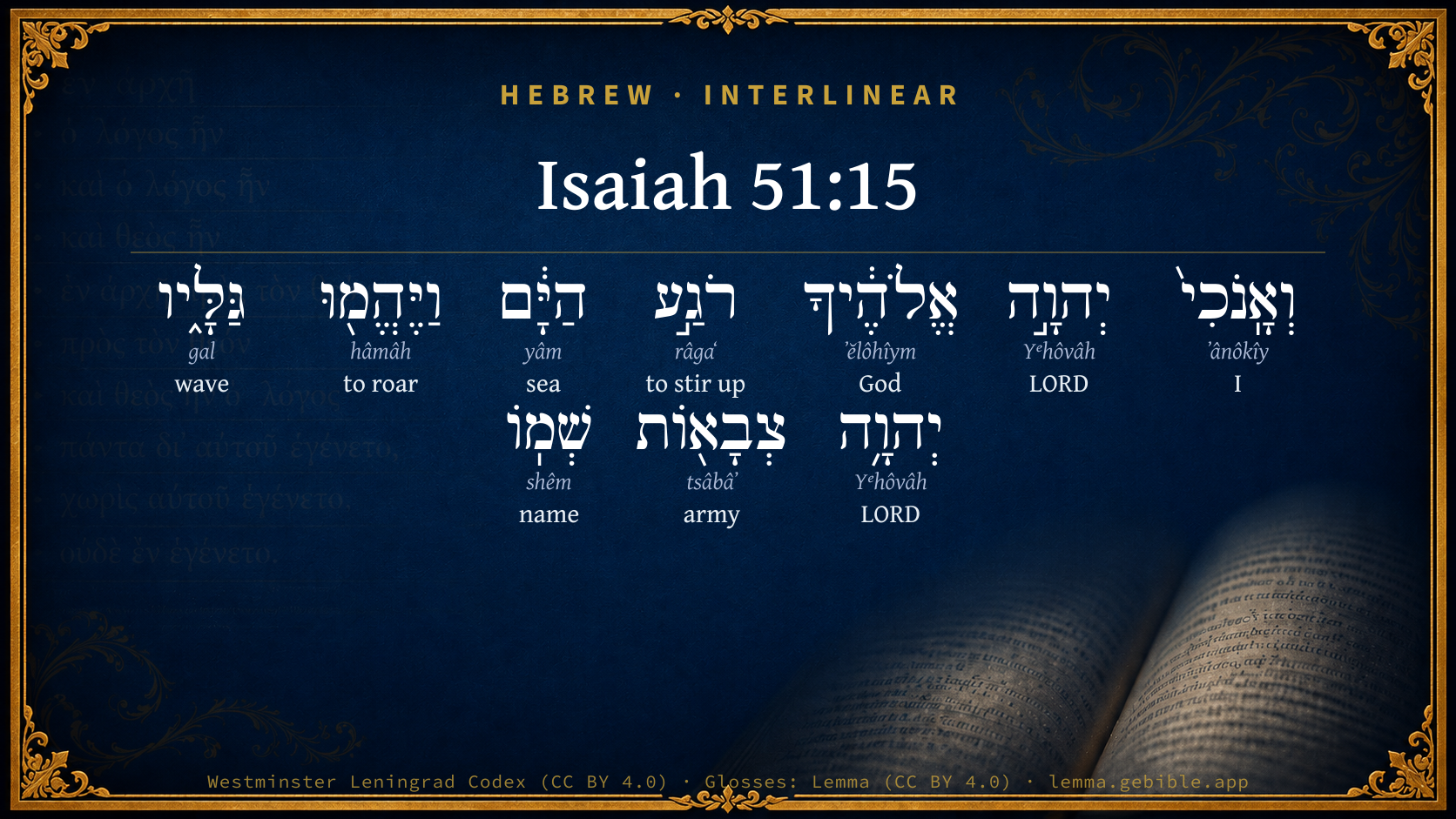
Hebrew (Westminster Leningrad Codex) Isaiah 51:15 appears in the Hebrew Old Testament. The text above is from the Westminster Leningrad Codex. Each word links to its Strong’s number, a concise gloss, and parsing drawn from the Open Scriptures Hebrew Bible morphology. Click any word for its full Brown-Driver-Briggs (BDB) entry.
Download image
Cite this verse

Isaiah 51:15 (World English Bible). Public Domain. Lemma interlinear Bible study tool, https://lemma.gebible.app/v/isaiah/51/15.

Show BibTeX & RIS
BibTeX
RIS
English Translation
For I am Yahweh your God, who stirs up the sea, so that the waves of it roar: Yahweh of Hosts is his name.
World English Bible · Public Domain
Download a study sheet

One document with this verse’s original text, its word-by-word gloss line, the meaning frame, cross-references with their text, attributed commentary, and full source and license credits — printable, and it pastes into notes with its structure intact.

This verse Autodidact and up

Study sheet (.html) Plain text (.txt)

A passage Seminary Student

Up to 50 verses in one chapter. A passage sheet keeps up to 6 commentary sources and 12 cross-references per verse, in the order this page ranks them, and says so on the sheet whenever that leaves anything out. Ask for a single verse and you get the Autodidact verse sheet above.

Everything on this page stays free to read, with no account — the sheet is a download of what is already on screen, not access to it.

Want to remove ads? Support Godless Engineer
Compare translations 3

The same verse in 3 English versions, stacked beneath the original-language interlinear above. Click any original word for its lexicon entry.

Each is an independent rendering of the whole verse — the interlinear is not word-aligned to these translations.

Highlighted words mark where these versions differ — a whole-verse word diff, not a word-by-word alignment.

  • World English Bible Public Domain
    For I am Yahweh your God, who stirs up the sea, so that the waves of it roar: Yahweh of Hosts is his name.
  • King James Version Public Domain
    But I am the LORD thy God, that divided the sea, whose waves roared: The LORD of hosts is his name.
  • unfoldingWord Literal Text CC BY-SA 4.0
    And I Yahweh your God, the one making the sea rest when its waves roar— Yahweh of Armies his name.

unfoldingWord Literal Text — © unfoldingWord, licensed CC BY-SA 4.0. Word-aligned USFM3 via Door43 (git.door43.org/unfoldingWord/en_ult).

Versions to compare (up to 4)

3 of 4 selected

Show all 18 translations

Every available English version of this verse, each an independent rendering of the whole verse.

  • World English Bible Public Domain
    For I am Yahweh your God, who stirs up the sea, so that the waves of it roar: Yahweh of Hosts is his name.
  • Berean Standard Bible Public Domain
    For I am the LORD your God who stirs up the sea so that its waves roar—the LORD of Hosts is His name.
  • Majority Standard Bible Public Domain
    For I am the LORD your God who stirs up the sea so that its waves roar—the LORD of Hosts is His name.
  • King James Version Public Domain
    But I am the LORD thy God, that divided the sea, whose waves roared: The LORD of hosts is his name.
  • American Standard Version (1901) Public Domain
    For I am Jehovah thy God, who stirreth up the sea, so that the waves thereof roar: Jehovah of hosts is his name.
  • Revised Version (1885) Public Domain
    For I am the LORD thy God, which stirreth up the sea, that the waves thereof roar: the LORD of hosts is his name.
  • Geneva Bible (1599) Public Domain
    And I am the Lord thy God that deuided the Sea, when his waues roared: the Lord of hostes is his Name.
  • Douay-Rheims (1899) Public Domain
    But I am the Lord thy God, who trouble the sea, and the waves thereof swell: the Lord of hosts is my name.
  • Young's Literal Translation Public Domain
    And I `am' Jehovah thy God, Quieting the sea, when its billows roar, Jehovah of Hosts `is' His name.
  • Literal Standard Version CC BY-SA 4.0
    And I [am] your God YHWH, || Quieting the sea when its billows roar, || YHWH of Hosts [is] His Name.
  • Unlocked Literal Bible CC BY-SA 4.0
    For I am Yahweh your God, who churns up the sea so that its waves roar—Yahweh of hosts is his name.
  • unfoldingWord Literal Text CC BY-SA 4.0
    And I Yahweh your God, the one making the sea rest when its waves roar— Yahweh of Armies his name.
  • Darby Bible Public Domain
    And I am Jehovah thy God, who raiseth the sea, so that its waves roar: Jehovah of hosts is his name.
  • World Messianic Bible Public Domain
    For I am the LORD your God, who stirs up the sea so that its waves roar. the LORD of Hosts is his name.
  • Webster's Bible Public Domain
    But I am the LORD thy God, that divided the sea, whose waves roared: The LORD of hosts is his name.
  • Free Bible Version CC BY-SA 4.0
    For I am the Lord your God who whips up the sea so its waves roar. The Lord Almighty is his name.
  • Bible in Basic English Public Domain
    For I am the Lord your God, who makes the sea calm when its waves are thundering: the Lord of armies is his name.
  • JPS Tanakh (1917) Public Domain
    For I am the LORD thy God, who stirreth up the sea, that the waves thereof roar; the LORD of hosts is His name.

Literal Standard Version (2020), Covenant Press — licensed CC BY-SA 4.0. Text via the HelloAO Bible API (eBible.org). Unlocked Literal Bible (unfoldingWord) — licensed CC BY-SA 4.0. Text via the HelloAO Bible API (eBible.org). unfoldingWord Literal Text — © unfoldingWord, licensed CC BY-SA 4.0. Word-aligned USFM3 via Door43 (git.door43.org/unfoldingWord/en_ult). Free Bible Version, Dr. Jonathan Gallagher — licensed CC BY-SA 4.0. Text via the HelloAO Bible API (eBible.org).

Word by word

More ways to search: Search by grammar → Find every occurrence → Compare this word →

Practice this passage: Drill this verse → Learn its vocabulary →

רֹגַ֣ע
râgaʻ
H7280
“stirring up”
Verb, Qal, Participle Active, Masculine, Singular, Construct
Part of Speech
Verb
Stem
Qal
Form
Participle Active
Gender
Masculine
Number
Singular
State
Construct
Full BDB Definition

Origin: a primitive root

TWOT: 2116 , 2117 , 2118

to act in an instant, stir up, disturb - (Qal) to stir up, disturb - (Hiphil) to make a twinkling - to rest or repose, be at rest or repose, settle, quiet, give rest - (Niphal) - to cause to rest (of sword, of the sea) - to wink (with preposition) - (Hiphil) - to give rest to - to rest, repose - to harden
  1. וְאָֽנֹכִי֙ ʼânôkîy H595 “and · I” Conjunction + Pronoun, Personal, 1st Person, Common, Singular
  2. יְהוָ֣ה Yᵉhôvâh H3068 “LORD” Noun, Proper
  3. אֱלֹהֶ֔יךָ ʼĕlôhîym H430 “God(s) · your” Noun, Common, Masculine, Plural, Construct + Suffix, Personal, 2nd Person, Masculine, Singular
  4. הַיָּ֔ם yâm H3220 “the · sea” Particle, Definite Article + Noun, Common, Masculine, Singular, Absolute
  5. וַיֶּהֱמ֖וּ hâmâh H1993 “and · to roar” Conjunction + Verb, Qal, Sequential Imperfect, 3rd Person, Masculine, Plural
  6. גַּלָּ֑יו gal H1530 “waves · his” Noun, Common, Masculine, Plural, Construct + Suffix, Personal, 3rd Person, Masculine, Singular
  7. יְהוָ֥ה Yᵉhôvâh H3068 “LORD” Noun, Proper
  8. צְבָא֖וֹת tsâbâʼ H6635 “armies” Noun, Common, Both, Plural, Absolute
  9. שְׁמֽוֹ shêm H8034 “name · his” Noun, Common, Masculine, Singular, Construct + Suffix, Personal, 3rd Person, Masculine, Singular

About this verse

These counts appear in no published source. They are computed here, from the morphology-tagged text and Lemma’s own curated glosses. What Lemma adds →

10
words
9
distinct lemmas
Prophets
section

Notable vocabulary

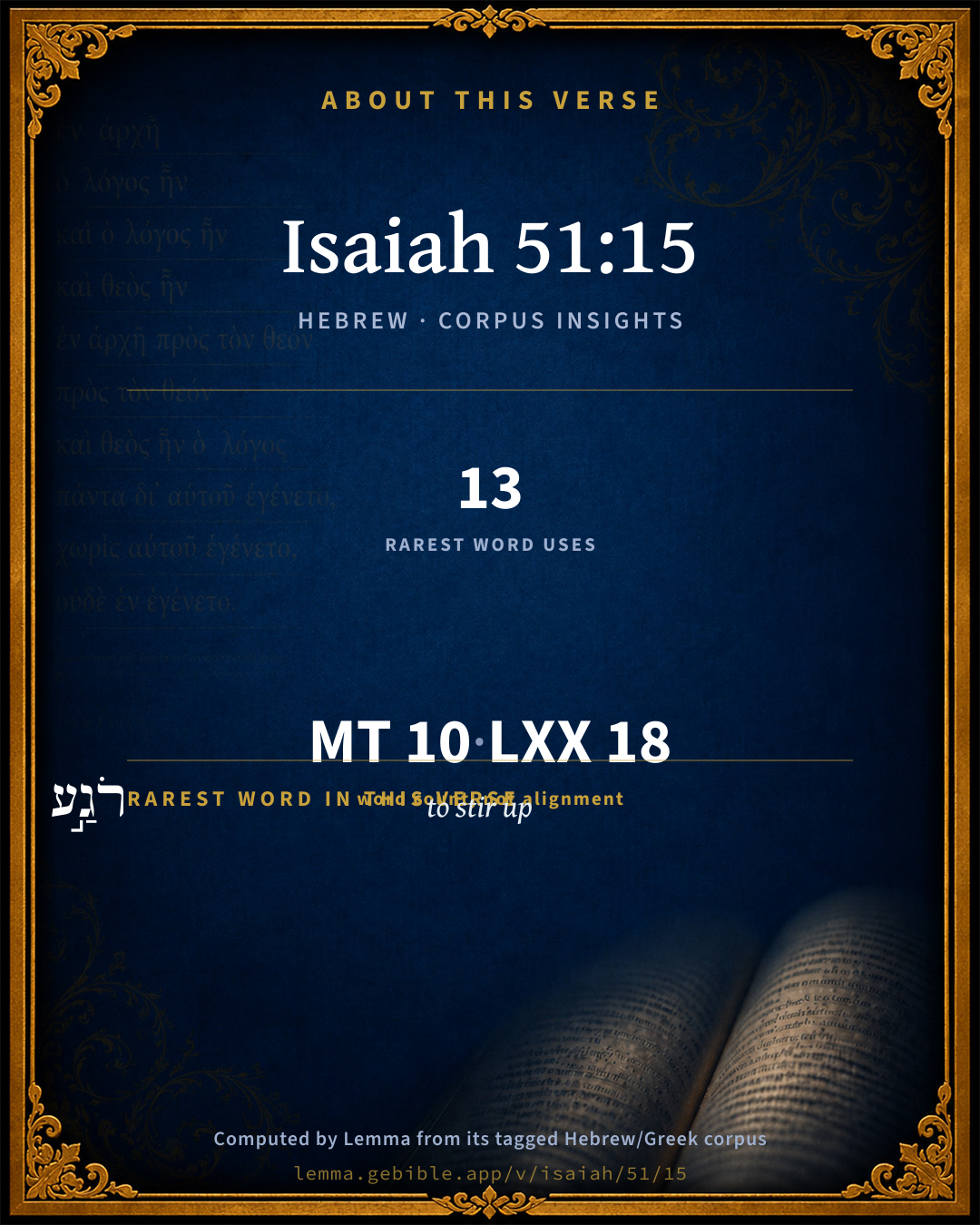
The rarest word here is רֹגַ֣ע to stir up H7280 — appearing just 13 times in the whole Hebrew Bible.

Shared distinctive vocabulary

רֹגַ֣ע to stir up H7280 occurs in 13 verses of the Hebrew Bible. Also found in:

Grammatical profile

  • 2 verbs
  • 7 nouns
  • 1 pronoun

Verb forms

  • רֹגַ֣ע Qal · Participle Active
  • וַיֶּהֱמ֖וּ Qal · Sequential Imperfect

Repetition

A word recurs within this verse — often emphatic in Hebrew:

  • יְהוָ֣ה LORD H3068 ×2

Hebrew & Septuagint length

In English translation the verse runs 24 words from the Hebrew and 23 from the Septuagint (LXX English) — closely comparable.

A rough comparison of the two English renderings, which tokenize alike — not a word-level alignment.

Word counts can differ between the Hebrew and the Greek without any difference in meaning — e.g. the Hebrew direct-object marker אֵת has no separate Greek word, and Greek often adds the article ὁ.

In the original languages it is 10 Hebrew tokens and 18 Greek tokens — but the two are counted differently (Hebrew bundles its prefixes and suffixes into one token; the Greek is in lemma form), so that isn’t a like-for-like length.

Cross-references

12

Topical passages linked to Isaiah 51:15 in the Treasury of Scripture Knowledge — connected by theme and wording, ordered by reader-vote popularity; previews shown in the World English Bible.

  • Jeremiah 31:35 Thus says Yahweh, who gives the sun for a light by day, and the ordinances of the moon and of the stars for a light by night, who stirs up the sea, so that the waves of it roar; Yahweh of hosts is his name:
  • Isaiah 54:5 For your Maker is your husband; Yahweh of Hosts is his name: and the Holy One of Israel is your Redeemer; the God of the whole earth shall he be called.
  • Amos 9:5–6 For the Lord, Yahweh of Hosts, is he who touches the land and it melts, and all who dwell in it will mourn; and it will rise up wholly like the River, and will sink again, like the River of Egypt.
  • Psalms 74:13 You divided the sea by your strength. You broke the heads of the sea monsters in the waters.
  • Psalms 114:3–5 The sea saw it, and fled. The Jordan was driven back.
  • Psalms 136:13 To him who divided the Red Sea apart; For his loving kindness endures forever;
  • Isaiah 47:4 Our Redeemer, Yahweh of hosts is his name, the Holy One of Israel.
  • Isaiah 51:10 Isn't it you who dried up the sea, the waters of the great deep; who made the depths of the sea a way for the redeemed to pass over?
  • Jeremiah 10:16 The portion of Jacob is not like these; for he is the former of all things; and Israel is the tribe of his inheritance: Yahweh of Hosts is his name.
  • Job 26:12 He stirs up the sea with his power, And by his understanding he strikes through Rahab.
  • Isaiah 48:2 (for they call themselves of the holy city, and stay themselves on the God of Israel; Yahweh of Hosts is his name):
  • Nehemiah 9:11 You divided the sea before them, so that they went through the midst of the sea on the dry land; and their pursuers you did cast into the depths, as a stone into the mighty waters.

Cross-references courtesy of OpenBible.info (CC BY 4.0).

Hebrew and Greek witnesses Masoretic Hebrew ↔ Greek Septuagint

The same verse in the two great witnesses to the Old Testament, shown verse-for-verse.

These are two independent witnesses, not word-aligned to each other, and the Septuagint is shown in lemma (dictionary) form.

Hebrew Isaiah 51:15 Masoretic · Westminster Leningrad Codex

וְאָֽנֹכִי֙ יְהוָ֣ה אֱלֹהֶ֔יךָ רֹגַ֣ע הַיָּ֔ם וַיֶּהֱמ֖וּ גַּלָּ֑יו יְהוָ֥ה צְבָא֖וֹת שְׁמֽוֹ

For I am Yahweh your God, who stirs up the sea, so that the waves of it roar: Yahweh of Hosts is his name.

World English Bible · Public Domain

Greek LXX Isaiah 51:15 Septuagint · lemma form

ὅτι ἐγώ ὁ θεός σύ ὁ ταράσσω ὁ θάλασσα καί ἠχέω ὁ κῦμα αὐτός κύριος σαβαωθ ὄνομα ἐγώ

for I am your God, that troubles the sea, and causes the waves thereof to roar: the Lord of hosts is my name.

LXX2012 (modern English Septuagint) · Public Domain

On this verse, Trapp's Complete Commentary discusses the Septuagint’s reading. Read the note in Commentary ↓

Hebrew: Westminster Leningrad Codex (CC BY 4.0). Greek: Septuagint (public domain); English from LXX2012 (modern English Septuagint) (Public Domain). How the Septuagint differs from the Hebrew →

Targum (Aramaic paraphrase)

1

The Targum is the ancient Jewish Aramaic paraphrase of the Hebrew Scriptures — an interpretive translation, not the Hebrew text itself. Onkelos (literal) and Pseudo-Jonathan (expansive) render the Torah, and Jonathan the Prophets. Coverage is partial: where no permissively-licensed English translation exists for a verse, only the Aramaic is shown. This is verse-level text, not a word-by-word alignment to the Hebrew.

  1. Targum Jonathan Prophets (Joshua–Malachi)
    וַאֲנָא יְיָ אֱלָהָךְ דִנְזֵיף בְּיַמָא וְהָמָן גַלוֹהִי יְיָ צְבָאוֹת שְׁמֵהּ:

    For I am the Lord thy God, who rebuketh the sea, though its waves roar; the Lord of hosts is His name.

    Targum Jonathan — Aramaic: “Mikraot Gedolot” (public domain). English: “Sefaria Community Translation” (CC0 1.0 (public-domain dedication)); “London "Chaldee Paraphrase," 1871” (public domain). Text via Sefaria.

Commentary

Notes on Isaiah 51:15 from classic Christian and Jewish commentators (each source and its license shown beneath its notes). The classic Christian expositions comment on the surrounding passage and are grouped to its opening verse, so a note may address several verses; the Jewish commentaries on the Tanakh (Rashi and others) are per-verse, so they appear only where the commentator wrote on this verse.

Lemma curates 59 commentaries, every one of them public domain or Creative Commons licensed, each selected and text-cleaned for this edition rather than reprinted as found. About our sources →

The Cambridge Bible for Schools and Colleges

gen. ed. J. J. S. Perowne

15. that divided the sea &c.] Render with R.V. which stirreth up (see on Isa_51:4) the sea so that the waves thereof roar (cf. Job_26:12).

The idea is parallel with that of Isa_51:9 f., being an illustration of Jehovah’s power over the elements. He can, as it were, play with the sea, for His stirring it up to fury implies that He is able to restrain it, and at the right time to still it again.

the Lord of hosts is his name] Chs. Isa_47:4, Isa_48:2, Isa_54:5.

15, 16. These verses contain a remarkable number of resemblances to other passages (see below). Isa_51:15, apart from the introductory words, occurs in Jer_31:35, though it is doubtful to which passage it originally belongs. Giesebrecht (on Jeremiah) unhesitatingly pronounces it a citation from this verse.

The Cambridge Bible for Schools and Colleges (gen. ed. J. J. S. Perowne; Cambridge University Press, 1878–1918) — public domain. Text from a community e-Sword module.

Trapp's Complete Commentary

John Trapp

Isa 51:15 But I [am] the LORD thy God, that divided the sea, whose waves roared: The LORD of hosts [is] his name.

Ver. 15. For I am the Lord thy God, that divided the sea.] Or, I the Lord thy God am he that stilleth the sea when the waves of it roar; how much more then can I curb and control the rage of man! "Surely," saith David, "the wrath of man shall praise thee: the remainder of wrath shalt thou restrain"; where the Septuagint have it, It shall keep holiday to thee, εωρταζει σοι.

John Trapp, A Commentary or Exposition upon All the Books of the Old and New Testament (1647–1656) — public domain. Text from a community e-Sword module.

Tyndale Open Study Notes

Tyndale Open Resources

51:15 I am the Lord: The Lord uses this formula to identify himself as the covenant God and to assure his people of the truth of his word and the reliability of his actions (see 27:3-4).

Tyndale Open Study Notes — © Tyndale Open Resources, licensed CC BY-SA 4.0. Text via the HelloAO Bible API.

Jamieson, Fausset & Brown

Robert Jamieson, A. R. Fausset & David Brown

divided . . . sea--the Red Sea. The same Hebrew word as "make to rest" (Isa 51:4). Rather, "that terrify the sea," that is, restrain it by My rebuke, "when its waves roar" [GESENIUS]. The Hebrew favors MAURER, "that terrify the sea so that the waves roar." The sense favors GESENIUS (Jer 5:22; Jer 31:35), or English Version (Isa 51:9-10, which favors the special reference to the exodus from Egypt).

Jamieson, Fausset & Brown — Commentary Critical and Explanatory on the Whole Bible (1871) — public domain (CC PDM 1.0). Text via the HelloAO Bible API.

Ellicott's Commentary for English Readers

(15) But I am . . .—Better, Seeing that I am. The fact which follows is not contrasted with that which precedes, but given as its ground. The might of Jehovah is seen in the storm-waves of the sea. It is seen not less in the fall and rise of empires.

A Bible Commentary for English Readers, edited by Charles John Ellicott (1878–1897) — public domain. Text from a community e-Sword module.

John Gill's Exposition

But I am the Lord thy God that divided the sea, whose waves roared,.... Referring to the dividing of the Red sea by a violent wind, at which time the waves of it doubtless roared till they were made to stand quietly, as a wall on the right and left, for the Israelites to pass through, as in Isa 51:10. Or this is to be understood of the power of God at any time in stilling and quieting the sea when it rages; which signification the word (s) here used has, as Aben Ezra observes; which power is expressed by a rebuke or reproof of it. And so the Targum,

"I am the Lord thy God, that rebuketh the sea:''

and in like manner the Syriac version; see Psa 106:9 with which compare Mat 8:26. Now he that can do, and oftentimes has done this, can rebuke, restrain, and still the fury of the oppressors, the rage of the persecutors, Rome Pagan or Papal, and deliver out of their hands, Psa 65:7,

the Lord of hosts is his name: the Lord of armies in heaven and earth, and therefore is able to do these things in a natural, civil, and religious sense.

(s) "qui tranquillat" Gakater; "faciens quiescere", so some in Vitringa; and the word has the signification of rest and quietness in ver 4.

John Gill's Exposition of the Whole Bible (1746–1763) — public domain (CC PDM 1.0). Text via the HelloAO Bible API.

Albert Barnes' Notes on the Bible

But I am the Lord thy God - In order to show them that he was able to save them, God again refers to the fact that he had divided the sea, and delivered their fathers from bondage and oppression.

That divided the sea - The Red Sea. The Chaldee renders this, ‘That rebuked the sea.’ The Septuagint, Ὁ ταράσσων ho tarassōn - ‘Who disturbs the sea.’ or, who excites a tempest. Lowth renders it, ‘Who stilleth at once the sea.’ The Hebrew word is the same which occurs in Isa 51:4, where it is rendered, ‘I will make my judgment to rest’ (רגע râga‛). Probably the idea here is, that he restrains the raging of the sea as if by fear; that is, makes it tranquil or still by rebuking it. He had this power over all raging seas, and he had shown it in a special manner by his rebuking the Red Sea and making it rest, and causing a way to be made through it, when the children of Israel came out of Egypt.

The Lord of hosts is his name - (See the notes at Isa 1:9; compare the notes at Isa 42:8).

Albert Barnes' Notes on the Bible (1834–1885) — public domain. Text from a community e-Sword/MySword module.

The Pulpit Commentary

But I am the Lord thy God, that divided the sea; rather, for I, the Lord thy God, am he that divided the sea (comp. ver. 10). The reference is once more to the great miracle wrought at the Exodus, when the Red Sea was "divided" before the host of Israelites. (Exo_14:21 Psa_74:13) Whose waves roared. (see Exo_14:27 Exo_15:10)

The Pulpit Commentary (1880–1919), ed. H.D.M. Spence-Jones & Joseph S. Exell — public domain. Text from a community e-Sword module.

J. A. Alexander on Isaiah

Joseph Addison Alexander

“And I (am) Jehovah thy God, rousing the sea and then its waves roar; Jehovah of Hosts (is) His name.” Another appeal to the power of God as a pledge for the performance of His promise. Roga‘ has been understood in two directly opposite senses, that of ‘stilling’ and that of ‘agitating’. The first is strongly recommended by the not infrequent use of the derivative conjugations in the sense of ‘quieting’ or ‘being quiet’.

Joseph Addison Alexander, The Prophecies of Isaiah (1846–1847; New York: Scribner, 1870–1878) — public domain. Text from a community e-Sword module.

Rashi

Rabbi Shlomo Yitzchaki (Rashi)

Who wrinkles the sea Heb. רֹגַע, an expression similar to (Job 7:5) “My skin was wrinkled (רָגַע).” Froncir in O.F. [froncer in Modern French, to wrinkle, gather, pucker].

Rashi on the Tanakh — English translations: “The Judaica Press complete Tanach with Rashi, translated by A. J. Rosenberg” (CC BY 4.0); “Pentateuch with Rashi's commentary by M. Rosenbaum and A.M. Silbermann, 1929-1934” (public domain); “The Metsudah Tanach series, Lakewood, N.J” (CC BY 4.0); and “The Book of Joshua, Metsudah Publications, 1997” (CC BY 4.0). Text via Sefaria.

Ibn Ezra

Rabbi Abraham ibn Ezra

רגע Who stilleth. Some say that גער ═ רגע who rebuketh, by metathesis; others compare it with מרגוע rest (Jer. 6:17), and render it who giveth rest; I approve of this latter explanation. ויהמו גליו Whose waves roared, that is, whose waves have been roaring. The meaning of the verse might also be the following: I am he who stilleth the sea, but I am also he who commandeth that its waves shall roar. Sea and waves are figurative expressions for the oppressors.

Ibn Ezra on the Tanakh — English translations: “Sefaria Community Translation” (CC0 1.0 (public-domain dedication)); “Yalkut, Sifsei Chachomim Chumash, Metsudah Publications, 2009” (CC BY 4.0); and “Commentary of Ibn Ezra on Isaiah - trans. by M. Friedlander, 1873” (public domain). Text via Sefaria.

Lesson kit

Teaching starters — assembled from the data on this page, not authored interpretation. Every prompt links to the verse data it draws on. Edit before teaching.

Isaiah, in the Prophets, opens this verse with 10 words (9 distinct Hebrew lemmas). Its most distinctive word is râgaʻ (“to stir up”). A historical commentator’s framing appears above. Read the whole chapter for the surrounding context.

Discussion questions

  1. The word râgaʻ carries the sense “to stir up.” How does it shape the verse?
  2. How does Deuteronomy 28:65, which shares the word «to stir up», read alongside this verse?
  3. What does the repetition of “LORD” (2× in this one verse) do in this verse?
  4. These translations render this verse differently; the difference is in the English rendering, not the original. What questions does that raise?
  5. «רֹגַ֣ע» is a Qal Participle Active verb. How does that grammatical form shape the action described?
  6. Compare how The Cambridge Bible for Schools and Colleges and Trapp's Complete Commentary read this verse. Where do they agree or differ?

Things to notice

Reading settings

Reading text

Shown beneath each verse's original-language words.

Old Testament
Old Testament edition

Read the OT as the Masoretic Hebrew (MT) or the Greek Septuagint (LXX).

English shown for the Greek Septuagint (in the Hebrew ↔ Greek comparison).

Comparing translations? Open the Compare panel on any verse page to stack up to four side by side.