
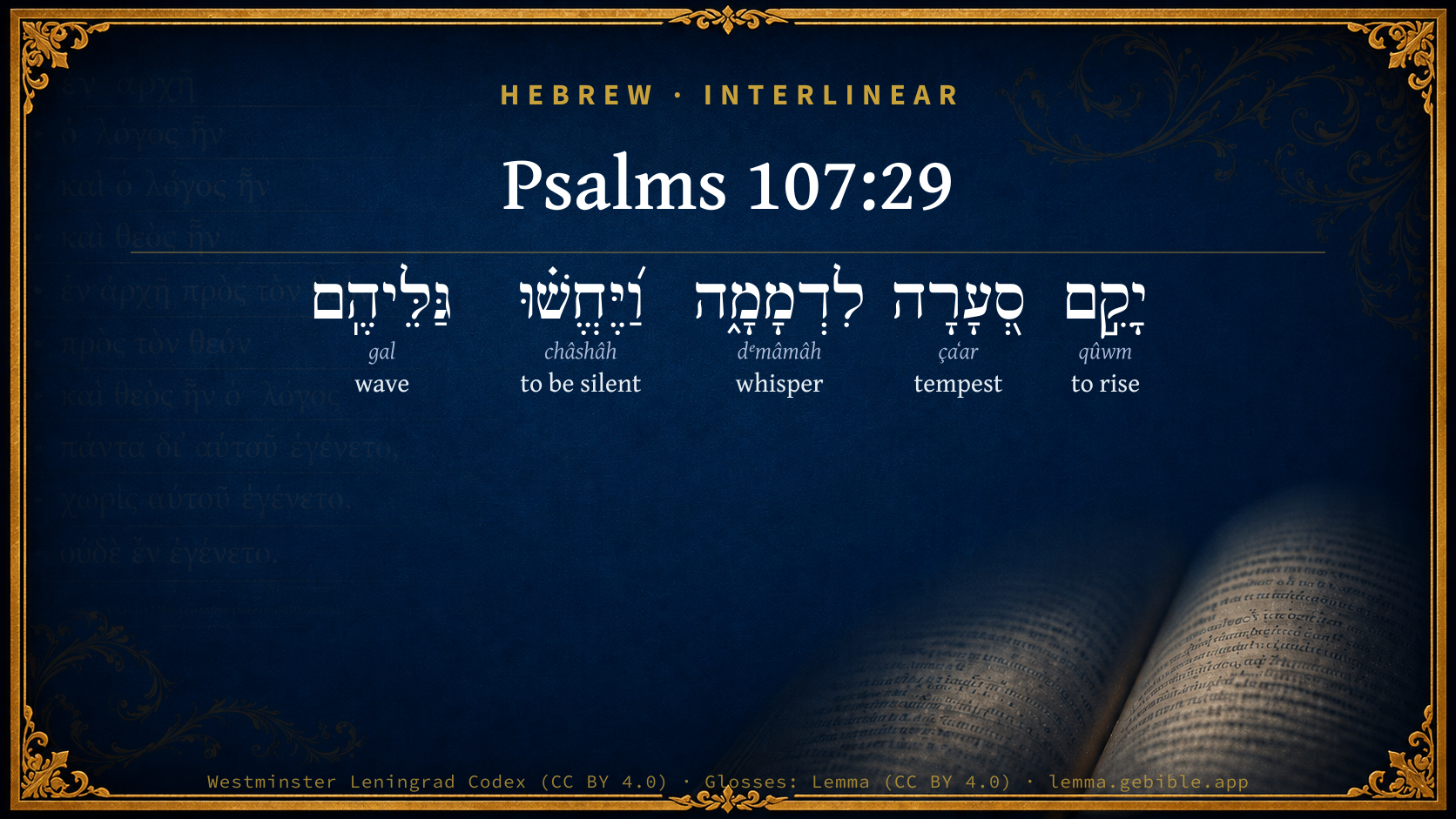
Psalms 107:29

Hebrew (Westminster Leningrad Codex) Psalms 107:29 appears in the Hebrew Old Testament. The text above is from the Westminster Leningrad Codex. Each word links to its Strong’s number, a concise gloss, and parsing drawn from the Open Scriptures Hebrew Bible morphology. Click any word for its full Brown-Driver-Briggs (BDB) entry.
Download image
Cite this verse

Psalms 107:29 (World English Bible). Public Domain. Lemma interlinear Bible study tool, https://lemma.gebible.app/v/psalms/107/29.

Show BibTeX & RIS
BibTeX
RIS
English Translation
He makes the storm a calm, So that its waves are still.
World English Bible · Public Domain
Download a study sheet

One document with this verse’s original text, its word-by-word gloss line, the meaning frame, cross-references with their text, attributed commentary, and full source and license credits — printable, and it pastes into notes with its structure intact.

This verse Autodidact and up

Study sheet (.html) Plain text (.txt)

A passage Seminary Student

Up to 50 verses in one chapter. A passage sheet keeps up to 6 commentary sources and 12 cross-references per verse, in the order this page ranks them, and says so on the sheet whenever that leaves anything out. Ask for a single verse and you get the Autodidact verse sheet above.

Everything on this page stays free to read, with no account — the sheet is a download of what is already on screen, not access to it.

Want to remove ads? Support Godless Engineer
Compare translations 3

The same verse in 3 English versions, stacked beneath the original-language interlinear above. Click any original word for its lexicon entry.

Each is an independent rendering of the whole verse — the interlinear is not word-aligned to these translations.

Highlighted words mark where these versions differ — a whole-verse word diff, not a word-by-word alignment.

  • World English Bible Public Domain
    He makes the storm a calm, So that its waves are still.
  • King James Version Public Domain
    He maketh the storm a calm, so that the waves thereof are still.
  • unfoldingWord Literal Text CC BY-SA 4.0
    He raised the storm to calmness and he quieted the waves.

unfoldingWord Literal Text — © unfoldingWord, licensed CC BY-SA 4.0. Word-aligned USFM3 via Door43 (git.door43.org/unfoldingWord/en_ult).

Versions to compare (up to 4)

3 of 4 selected

Show all 18 translations

Every available English version of this verse, each an independent rendering of the whole verse.

  • World English Bible Public Domain
    He makes the storm a calm, So that its waves are still.
  • Berean Standard Bible Public Domain
    He calmed the storm to a whisper, and the waves of the sea were hushed.
  • Majority Standard Bible Public Domain
    He calmed the storm to a whisper, and the waves of the sea were hushed.
  • King James Version Public Domain
    He maketh the storm a calm, so that the waves thereof are still.
  • American Standard Version (1901) Public Domain
    He maketh the storm a calm, So that the waves thereof are still.
  • Revised Version (1885) Public Domain
    He maketh the storm a calm, so that the waves thereof are still.
  • Geneva Bible (1599) Public Domain
    He turneth the storme to calme, so that the waues thereof are still.
  • Douay-Rheims (1899) Public Domain
    And he turned the storm into a breeze: and its waves were still.
  • Young's Literal Translation Public Domain
    He establisheth a whirlwind to a calm, And hushed are their billows.
  • Literal Standard Version CC BY-SA 4.0
    He calms a whirlwind, || And their billows are hushed.
  • Unlocked Literal Bible CC BY-SA 4.0
    He calmed the storm, and the waves were stilled.
  • unfoldingWord Literal Text CC BY-SA 4.0
    He raised the storm to calmness and he quieted the waves.
  • Darby Bible Public Domain
    He maketh the storm a calm, and the waves thereof are still:
  • World Messianic Bible Public Domain
    He makes the storm a calm, so that its waves are still.
  • Webster's Bible Public Domain
    He maketh the storm a calm, so that the waves of the sea are still.
  • Free Bible Version CC BY-SA 4.0
    He calmed the storm, the waves were quiet.
  • Bible in Basic English Public Domain
    He makes the storm into a calm, so that the waves are at peace.
  • JPS Tanakh (1917) Public Domain
    He made the storm a calm, so that the waves thereof were still.

Literal Standard Version (2020), Covenant Press — licensed CC BY-SA 4.0. Text via the HelloAO Bible API (eBible.org). Unlocked Literal Bible (unfoldingWord) — licensed CC BY-SA 4.0. Text via the HelloAO Bible API (eBible.org). unfoldingWord Literal Text — © unfoldingWord, licensed CC BY-SA 4.0. Word-aligned USFM3 via Door43 (git.door43.org/unfoldingWord/en_ult). Free Bible Version, Dr. Jonathan Gallagher — licensed CC BY-SA 4.0. Text via the HelloAO Bible API (eBible.org).

Word by word

More ways to search: Search by grammar → Find every occurrence → Compare this word →

Practice this passage: Drill this verse → Learn its vocabulary →

About this verse

These counts appear in no published source. They are computed here, from the morphology-tagged text and Lemma’s own curated glosses. What Lemma adds →

5
words
5
distinct lemmas
Wisdom
section

Notable vocabulary

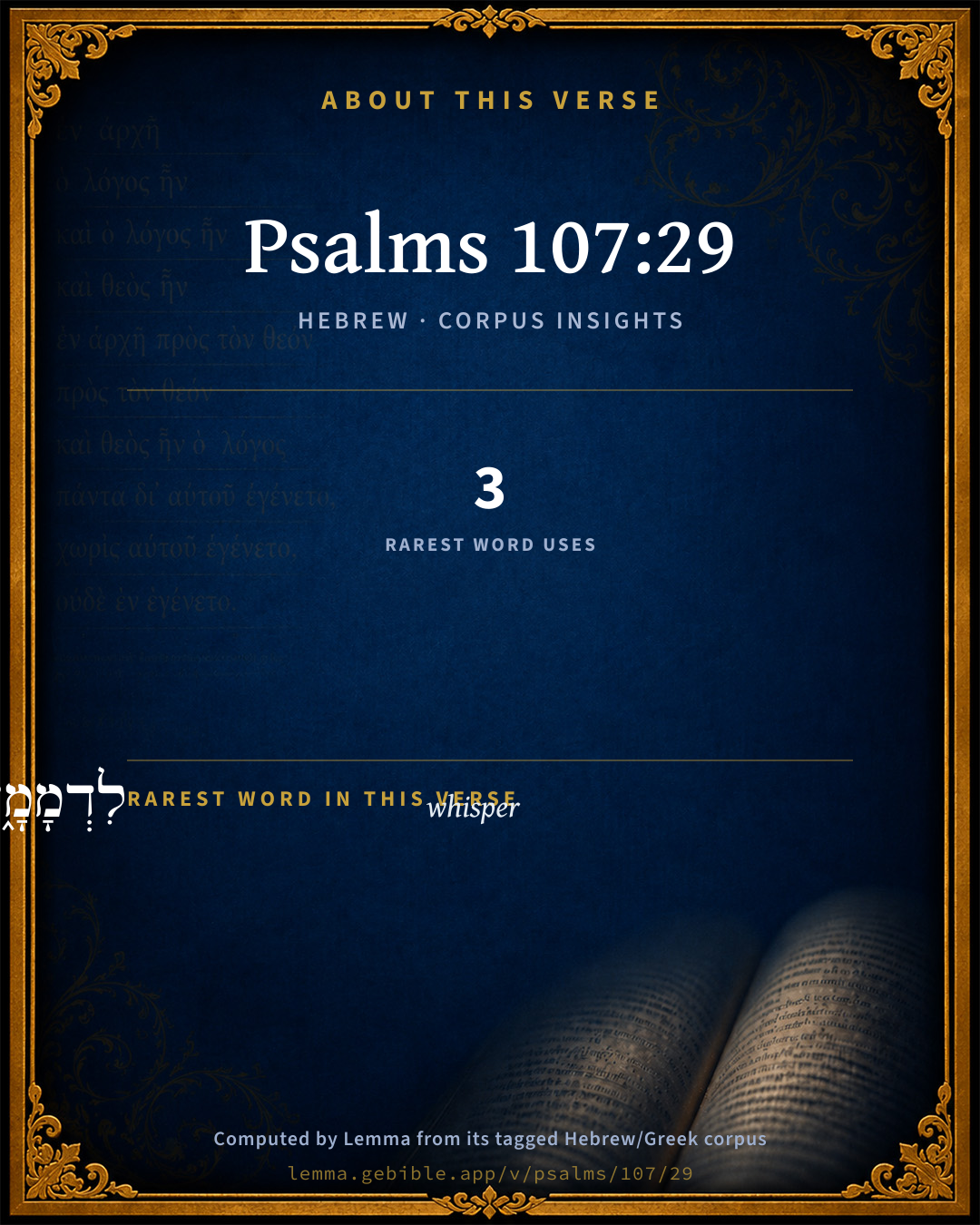
The rarest word here is לִדְמָמָ֑ה whisper H1827 — appearing just 3 times in the whole Hebrew Bible.

Shared distinctive vocabulary

לִדְמָמָ֑ה whisper H1827 occurs in 3 verses of the Hebrew Bible. Also found in:

Grammatical profile

  • 2 verbs
  • 3 nouns

Verb forms

  • יָקֵ֣ם Hiphil · Imperfect
  • וַ֝יֶּחֱשׁ֗וּ Qal · Sequential Imperfect

Hebrew & Septuagint length

In English translation the verse runs 12 words from the Hebrew and 18 from the Septuagint (LXX English) — closely comparable.

A rough comparison of the two English renderings, which tokenize alike — not a word-level alignment.

Word counts can differ between the Hebrew and the Greek without any difference in meaning — e.g. the Hebrew direct-object marker אֵת has no separate Greek word, and Greek often adds the article ὁ.

Cross-references

6

Topical passages linked to Psalms 107:29 in the Treasury of Scripture Knowledge — connected by theme and wording, ordered by reader-vote popularity; previews shown in the World English Bible.

  • Matthew 8:26 He said to them, "Why are you fearful, oh you of little faith?" Then he got up, rebuked the wind and the sea, and there was a great calm.
  • Psalms 65:7 Who stills the roaring of the seas, The roaring of their waves, And the turmoil of the nations.
  • Luke 8:23–25 But as they sailed, he fell asleep. A wind storm came down on the lake, and they were taking on dangerous amounts of water.
  • Psalms 89:9 You rule the pride of the sea. When its waves rise up, you calm them.
  • Mark 4:39–41 He awoke, and rebuked the wind, and said to the sea, "Peace! Be still!" The wind ceased, and there was a great calm.
  • Jonah 1:15 So they took up Jonah, and threw him into the sea; and the sea ceased its raging.

Cross-references courtesy of OpenBible.info (CC BY 4.0).

Hebrew and Greek witnesses Masoretic Hebrew ↔ Greek Septuagint

The same verse in the two great witnesses to the Old Testament, shown verse-for-verse.

You’re reading Greek Psalm 106 (Hebrew Psalm 107). The Septuagint counts the superscription, so verse numbers can differ from the Hebrew — chapter-level alignment, not verse-by-verse. Numbering follows Rahlfs.

These are two independent witnesses, not word-aligned to each other, and the Septuagint is shown in lemma (dictionary) form.

Hebrew Psalms 107:29 Masoretic · Westminster Leningrad Codex

יָקֵ֣ם סְ֭עָרָה לִדְמָמָ֑ה וַ֝יֶּחֱשׁ֗וּ גַּלֵּיהֶֽם

He makes the storm a calm, So that its waves are still.

World English Bible · Public Domain

Greek LXX Greek Psalm 106:29 Septuagint · lemma form

καί ἐπιτάσσω ὁ καταιγίς καί ἵστημι εἰς αὔρα καί σιγάω ὁ κῦμα αὐτός

And he commands the storm, and it is calmed into a gentle breeze, and its waves are still.

LXX2012 (modern English Septuagint) · Public Domain

Hebrew: Westminster Leningrad Codex (CC BY 4.0). Greek: Septuagint (public domain); English from LXX2012 (modern English Septuagint) (Public Domain). How the Septuagint differs from the Hebrew →

Commentary

Notes on Psalms 107:29 from classic Christian and Jewish commentators (each source and its license shown beneath its notes). The classic Christian expositions comment on the surrounding passage and are grouped to its opening verse, so a note may address several verses; the Jewish commentaries on the Tanakh (Rashi and others) are per-verse, so they appear only where the commentator wrote on this verse.

Lemma curates 59 commentaries, every one of them public domain or Creative Commons licensed, each selected and text-cleaned for this edition rather than reprinted as found. About our sources →

Trapp's Complete Commentary

John Trapp

Psa 107:29 He maketh the storm a calm, so that the waves thereof are still.

Ver. 29. He maketh the storm a calm] "He," that is, God Almighty, whose the sea is, and he made it, Psa 95:5; not the Pagans Neptune, or the papagans’ St Nicholas.

So that the waves thereof are still] If, therefore, the voluptuous humours in our body (which is but as a cup made of the husk of an acorn in respect to the sea) will not be pacified when the Lord saith unto us, "Be still"; every drop of water in the sea will be a witness of our monstrous rebellion and disobedience.

John Trapp, A Commentary or Exposition upon All the Books of the Old and New Testament (1647–1656) — public domain. Text from a community e-Sword module.

J. A. Alexander on Psalms

Joseph Addison Alexander

29. (Psa 107:29) He stills the storm, to a calm, and silent are their waves. This is an amplification of the last phrase in Psa 107:28, and shews how it is that he brings them forth. The first verb strictly means he makes it stand, but in a sense directly opposite to that of a synonymous though different verb in Psa 107:25. Calm, literally silence, stillness. Their waves, the waves from which they suffer, by which they are buffeted. Compare his waves, in Psa 107:25.

Joseph Addison Alexander, The Psalms Translated and Explained (1850) — public domain. Text from a community e-Sword module.

Adam Clarke's Commentary

Verse 29. He maketh the storm a calm] He causes the storm to stand dumb, and hushes the waves. See the original, where sense and sound emphatically meet: -

גליהם ויחשו לדממה סארה יקם galleyhem vaiyecheshu lidemamah searah yakem

He shall cause the whirlwind to stand dumb, and he shall hush their billows.

Adam Clarke's Commentary on the Bible (1810–1826) — public domain. Text from a community e-Sword/MySword module.

John Calvin's Commentaries

29. He maketh the storm a calm A profane author, in narrating the history of such an event, would have said, that the winds were hushed, and the raging billows were calmed; but the Spirit of God, by this change of the storm into a calm, places the providence of God as presiding over all; thereby meaning, that it was not by human agency that this violent commotion of the sea and wind, which threatened to subvert the frame of the world, was so suddenly stilled. When, therefore, the sea is agitated, and boils up in terrific fury, as if wave were contending with wave, whence is it that instantly it is calm and peaceful, but that God restrains the raging of the billows, the contention of which was so awful, and makes the bosom of the deep as smooth as a mirror? Having spoken of their great terror, he proceeds next to mention their joy, so that their ingratitude may appear the more striking, if they forget their remarkable deliverance. For they are not in want of a monitor, having been abundantly instructed by the storm itself, and by the calm which ensued, that their lives were in the hand and under the protection of God. Moreover, he informs them that this is a species of gratitude which deserves not only to be acknowledged privately, or to be mentioned in the family, but that it should be praised and magnified in all places, even in the great assemblies. He makes specific mention of the elders, intimating that the more wisdom and experience a person has, the more capable is he of listening to, and being a witness of, these praises.

John Calvin's Commentaries (1540-1563) — public domain. Text from the Calvin Translation Society English edition (1840s-50s) via the Christian Classics Ethereal Library (ccel.org). Calvin's coverage is partial (roughly two-thirds of the Bible); uncommented books and verses are honest gaps, never fabricated. The 19th-century editor's footnotes and remarks are omitted so the notes are faithfully Calvin's own voice.

John Gill's Exposition

Let them exalt him also in the congregation of the people,.... Of the people of God, who are gathered out of the world into a church state; and who gather themselves together to attend the worship and service of God in some one place; and here the Lord should be praised, and his name exalted, by those who have received favours from him; see Psa 111:1, the Targum explains it,

"in the congregation of the people of the house of Israel.''

And praise him in the assembly of the elders; or, "in the seat", or "chair of the elders (s)": not of the Scribes and Pharisees, and elders of the people, that sat in Moses's chair; but rather of the four and twenty elders, who are said to have four and twenty seats round the throne, where they worship and praise God; and which are emblems of Gospel churches; the members of which, for their grace, gravity, and prudence, are called elders; and over which elders in office preside, and who rule well, and labour in the word and doctrine; see Rev 4:4. The Targum renders it,

"the sanhedrim of the wise men.''

(s) "in cathedra", Pagninus, Montanus.

John Gill's Exposition of the Whole Bible (1746–1763) — public domain (CC PDM 1.0). Text via the HelloAO Bible API.

Albert Barnes' Notes on the Bible

He maketh the storm a calm - God does this, and God only can do it. The fact, therefore, that Jesus did it Mat 8:26, proves that he was divine. There can be no more striking proof of divine power than the ability to calm the raging waves of the ocean by a word. This is literally, “He places the tempest to silence.”

So that the waves thereof are still - Are lulled. The ocean ceases to be agitated, and the surface becomes smooth. Nothing is more still than the ocean in a calm. Not a breath of air seems to stir; not a ripple agitates the surface of the sea; the sails of the vessel hang loose, and even the vessel seems to be perfectly at rest: “As idle as a painted ship upon a painted ocean.” So God can calm down the tempest of the soul. He can make the mind which was heaving and tossed, like the ocean, with anguish on account of guilt, and which trembled in view of the coming judgment, as calm as the ocean is when in its state of perfect repose. God can do “this,” and none “but” God can do it; and as Jesus thus stills the agitation of the guilty soul, as he did the waves of the sea, “this” proves also that he is divine.

Albert Barnes' Notes on the Bible (1834–1885) — public domain. Text from a community e-Sword/MySword module.

The Treasury of David

Charles H. Spurgeon

Ver. 29. He maketh the storm a calm. He reveals his power in the sudden and marvellous transformations which occur at his bidding. He commanded the storm and now he ordains a calm: God is in all natural phenomena, and we do well to recognise his working.

So that the waves thereof are still. They bow in silence at his feet. Where huge billows leaped aloft there is scarce a ripple to be seen. When God makes peace it is peace indeed, the peace of God which passeth all understanding. He can in an instant change the condition of a man's mind, so that it shall seem an absolute miracle to him that he has passed so suddenly from hurricane to calm. O that the Lord would thus work in the reader, should his heart be storm beaten with outward troubles or inward fears. Lord, say the word and peace will come at once.

Ver. 29. He maketh the storm a calm, etc. The image is this. Mankind before they are redeemed are like a ship in a stormy sea, agitated with passions, tossed up and down with cares, and so blown about with various temptations, that they are never at rest. This is their calmest state in the smiling day of smooth prosperity: but afflictions will come, the afflictions of sin and Satan, and the world will raise a violent storm, which all the wit and strength of man cannot escape. He will soon be swallowed up of the devouring waves: unless that same God who created the sea speak to it, "Peace, be still." We are all in the same situation the apostles were, when they were alone in the evening in the midst of the sea, and the wind and the waves were contrary; against which they toiled rowing in vain, until Christ came to them walking upon the sea, and commanded the winds to cease and the waves to be still. Upon which there was a great calm; for they knew his voice, who had spoken them into being, and they obeyed. His word is almighty to compose and still the raging war of the most furious elements. And he is as almighty in the spiritual world, as he is in the natural. Into whatever soul he enters, he commands all the jarring passions to be still, and there is indeed a blessed calm. O may the Almighty Saviour speak thus unto you all, that you may sail on a smooth unruffled sea, until you arrive safe at the desired haven of eternal rest! William Romaine.

Ver. 29. If the sailor can do nothing so wise and oftentimes indeed can do nothing else than trust in the Lord, so is it with us in the storms of life. Like the mariner, we must use lawful means for our protection; but what are means without the divine blessing? William S. Plumer.

Psalms 107:30*

Charles H. Spurgeon's The Treasury of David (1869–1885) — public domain. Psalms only. Text from a community e-Sword/MySword module.

The Pulpit Commentary

He maketh the storm a calm; i.e. he causes the wind to drop, and to be succeeded by a "great calm". (comp. Mat_8:26) Such sudden changes do sometimes occur, not only in inland seas, but on the Mediterranean. (see Jon_1:15) So that the waves thereof are still; literally, the waves of them; i.e. of the great waters (see ver. 23).

The Pulpit Commentary (1880–1919), ed. H.D.M. Spence-Jones & Joseph S. Exell — public domain. Text from a community e-Sword module.

Lesson kit

Teaching starters — assembled from the data on this page, not authored interpretation. Every prompt links to the verse data it draws on. Edit before teaching.

Psalms, in the Wisdom, opens this verse with 5 words (5 distinct Hebrew lemmas). Its most distinctive word is dᵉmâmâh (“whisper”). A historical commentator’s framing appears above. Read the whole chapter for the surrounding context.

Discussion questions

  1. The word dᵉmâmâh carries the sense “whisper.” How does it shape the verse?
  2. How does 1 Kings 19:12, which shares the word «whisper», read alongside this verse?
  3. These translations render this verse differently. What is at stake in choosing one wording over another?
  4. «יָקֵ֣ם» is a Hiphil Imperfect verb. How does that grammatical form shape the action described?
  5. Compare how Trapp's Complete Commentary and J. A. Alexander on Psalms read this verse. Where do they agree or differ?

Things to notice

Reading settings

Reading text

Shown beneath each verse's original-language words.

Old Testament
Old Testament edition

Read the OT as the Masoretic Hebrew (MT) or the Greek Septuagint (LXX).

English shown for the Greek Septuagint (in the Hebrew ↔ Greek comparison).

Comparing translations? Open the Compare panel on any verse page to stack up to four side by side.