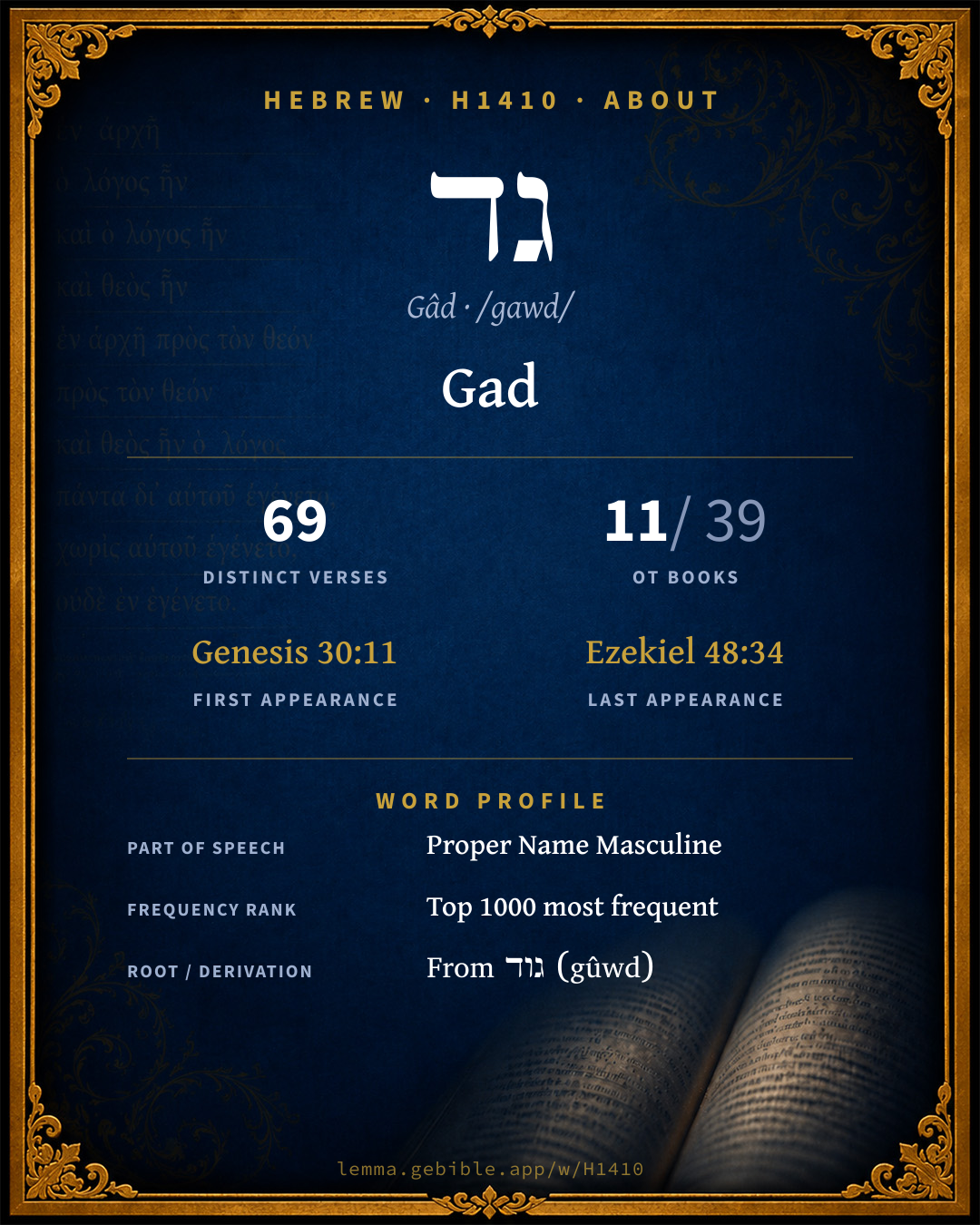
גָּד
Gad
BDB lists 4 entries for ‘Gad’ fuller range ↓
Full lexicon entry — Brown-Driver-Briggs (BDB)
From Brown-Driver-Briggs (BDB)
Where this word appears
Grammar key — what these labels mean
Part of speech
- Noun
- A naming word — a person, place, thing, or idea.
Noun type
- Proper
- A name of a specific person, place, or people (e.g. Abraham, Zion, Israel).
Every verse where H1410 appears in the Book of 1 Chronicles — 11 distinct verses. Click any verse to open its interlinear word-by-word view. Verse text shown in the World English Bible for context — . Each verse’s Hebrew form is shown with its reference; the English is not keyword-highlighted, since the data carries no word-level English alignment. Use “Compare translations” on any verse to read it across multiple English versions. This concordance covers the Hebrew Bible; Septuagint (Greek Old Testament) occurrences are not indexed here.
1 Chronicles
- 1 Chronicles 2:2 גָּ֥ד n Proper Dan, Joseph, and Benjamin, Naphtali, Gad, and Asher.
- 1 Chronicles 5:11 גָ֣ד n Proper The sons of Gad lived over against them, in the land of Bashan to Salecah:
- 1 Chronicles 6:63 גָ֞ד n Proper To the sons of Merari [were given] by lot, according to their families, out of the tribe of Reuben, and out of the tribe of Gad, and out of the tribe of Zebulun, twelve cities.
- 1 Chronicles 6:80 גָ֔ד n Proper and out of the tribe of Gad, Ramoth in Gilead with its suburbs, and Mahanaim with its suburbs,
- 1 Chronicles 12:14 גָ֖ד n Proper These of the sons of Gad were captains of the host: he who was least was equal to one hundred, and the greatest to one thousand.
- 1 Chronicles 21:9 גָּ֔ד n Proper Yahweh spoke to Gad, David's seer, saying,
- 1 Chronicles 21:11 גָ֖ד n Proper So Gad came to David, and said to him, Thus says Yahweh, Take which you will:
- 1 Chronicles 21:13 גָּ֖ד n Proper David said to Gad, I am in a great strait: let me fall, I pray, into the hand of Yahweh; for very great are his mercies: and let me not fall into the hand of man.
- 1 Chronicles 21:18 גָּ֖ד n Proper Then the angel of Yahweh commanded Gad to tell David, that David should go up, and raise an altar to Yahweh in the threshing floor of Ornan the Jebusite.
- 1 Chronicles 21:19 גָּ֔ד n Proper David went up at the saying of Gad, which he spoke in the name of Yahweh.
- 1 Chronicles 29:29 גָּ֥ד n Proper Now the acts of David the king, first and last, behold, they are written in the history of Samuel the seer, and in the history of Nathan the prophet, and in the history of Gad the seer,
About this entry
At a glance — auto-summarized from this page’s data, not written by a person. Every figure links to its source below. This summary describes the numbers; it doesn’t interpret them.
At its core, גד (Gâd) means “Gad.” Scripture first uses it in Genesis 30:11. It turns up in 69 verses across 11 books, a moderately common footprint. The word gravitates to Numbers (28%), then Joshua and 1 Chronicles. Dig into 69-verse concordance and the renderings breakdown below.
Gloss history
Strong's 1890 vs modern scholarship
About this word
Strong's H1410 catalogs a Hebrew word from the Hebrew Old Testament.
These counts are not copied from any lexicon or concordance. They are computed here, from the morphology-tagged Hebrew Old Testament. What Lemma adds →
- 69
- distinct verses
- The word appears in 69 distinct verses.
- 11 / 39
- OT books
- The word appears in 11 of 39 Old Testament books.
- #550
- by frequency
- Top 1000 most frequent Hebrew words (rank 550 of 8,640 Hebrew words by occurrence).
View all 69 occurrences in the concordance →
Most concentrated in
- Numbers 19 verses 28%
- Joshua 19 verses 28%
- 1 Chronicles 11 verses 16%
By section of the Old Testament
By traditional corpus
Conventional, traditional groupings — biblical authorship is debated, so this is a traditional corpus grouping, not an authorship claim. Each share is this word’s portion of its verses in that division of the Hebrew canon. Each figure is a share of the word’s 69 distinct verses.
- Prophets (Nevi'im) 31 verses · 45%
- Torah (Pentateuch) 26 verses · 38%
- Writings (Ketuvim) 12 verses · 17%
How translations render this word
Counts come from each version’s own published word-to-Strong’s tagging or interlinear alignment — an approximate guide to how each version renders this word, not a word-level alignment the data otherwise carries. Because each total is that version’s own tagged count, the per-version totals vary from one another and need not match the appearance or distinct-verse counts above. These counts may also differ from a printed concordance because Lemma counts each distinctly tagged rendering and does not collapse phrase taggings into a single head-word total. This is a fixed set of word-tagged versions (KJV, ASV, BSB, ULT) and does not change with the reading translation you choose elsewhere. Each version’s license is shown beside its name below (and on Sources).
BDB lists this Strong’s number as 2 distinct words (homographs). Each count above pools all of them and is not split by sense — see the Senses section below. A low-frequency rendering may belong to a different one of those words, not the primary meaning.
- King James Version†: Gad 70×
- American Standard Version†: Gad 66×, Children of gad 3×
- Berean Standard Bible†: Gad 42×, Gadites 2×
- unfoldingWord Literal Text†: Gad 67×, Dibon gad 2×
King James Version Public Domain
Renders H1410 across 70† tagged occurrences — most commonly:
American Standard Version Public Domain
Renders H1410 across 70† tagged occurrences — most commonly:
Plus 1 rendering that appears only once — usually multi-word phrases or single function words the recovered tagging swept in, not distinct renderings.
Berean Standard Bible Public Domain
Renders H1410 across 46† tagged occurrences — most commonly:
Plus 2 renderings that appear only once — usually multi-word phrases or single function words the recovered tagging swept in, not distinct renderings. Not rendered by a distinct English word in 26 further occurrences.
unfoldingWord Literal Text CC BY-SA 4.0
Renders H1410 across 72† tagged occurrences — most commonly:
Plus 3 renderings that appear only once — usually multi-word phrases or single function words the recovered tagging swept in, not distinct renderings.
Senses in the full BDB
What do BDB’s symbols mean?
BDB uses these scholarly abbreviations:
| Symbol | Meaning |
|---|---|
| 𝔊 | the Septuagint (the ancient Greek translation, LXX) |
| 𝔙 | the Vulgate (the Latin translation) |
| 𝔖 | the Syriac version (the Peshitta) |
| 𝔗 | the Targum (the Aramaic translation) |
| ψ | the Psalms |
| √ | root (the underlying root or stem) |
| ‖ | parallel passage (a synonymous or contrasted parallel) |
| † | the dagger: every passage where the word occurs is cited |
The 4 senses and sub-senses the full Brown-Driver-Briggs lexicon distinguishes for this word, in lexicon order (not ranked by frequency), with BDB’s own verbatim wording and sub-sense lettering. Shown in Hebrew script with BDB’s own scholarly abbreviations. The condensed entry is in the Lexicon Entry tab. See also the Forms in the corpus table below.
- 1. son of Jacob and Zilpah;
- a. strictly as personal name Gn 30:11; 35:26; 46:16 Ex 1:4 cf. Gn 49:19 1 Ch 2:2. e.g. Genesis 30:11
- b. as name of tribe Nu 1:14 Dt 27:13; 33:20(×2) Jos 18:7 Ez 48:27, 28; cf. אֶרֶץ גָּד 1 S 13:7 v. also Je 49:1, שַׁעַר גָּד Ez 48:34, on הַנַּחַל הַגָּד 2 S 24:5 cf. We Dr; explicitly מַטֵּה גָּד Nu 1:25; 2:14; 13:15 Jos 13:24; 20:8; 21:7, 36 1 Ch 6:48, 65; once, צְבָא מַטֵּה בְנֵי־גָד Nu 10:20; בְּנֵי גָד (MI10 אש גד) Nu 1:24 + 12 times Nu; Jos 4:12 + 14 times Jos; 1 Ch 5:11; 12:14. e.g. Numbers 1:14
- 2. a prophet in David’s time, called נָבִיא 1 S 22:5, but הַנָּבִיא חֹזֶה דָוִד 2 S 24:11 & חֹזֵה דָוִיד ‖ 1 Ch 21:9, הַחֹזֶה 1 Ch 29:29 & חֹזֵה־הַמֶּלֶךְ 2 Ch 29:25. מִגְדַּל־גַּד v. p. 154. e.g. 1 Samuel 22:5
Senses from the full Brown-Driver-Briggs lexicon (Brown, Driver, Briggs; Oxford 1906 — public domain), digitized via Sefaria, supplemented by the OpenScriptures HebrewLexicon (CC BY 4.0). Full attribution on Sources.
Word origin
n.pr.m. (fortunatus? perhaps der. from foreg. divine name SiegfJPTh 1875, 364 StaGesch. i. 148; but v. also BaeRel. 159 f.)—גָּ֥ד Gn 35:26 +, as well as גָּד֑ Gn 30:11 +;—
— Brown-Driver-Briggs (Oxford 1906, public domain), digitized via Sefaria, supplemented by the OpenScriptures HebrewLexicon (CC BY 4.0). See Sources.
Derived from גוד (gûwd) (H1464) — to attack.
Jastrow Dictionary
A second Hebrew/Aramaic lexicon for comparison, covering Aramaic and post-biblical (Talmudic, Targumic, Midrashic) usage that the biblical-Hebrew BDB does not. Matched by lemma rather than by Strong’s number, so a lemma may carry more than one Jastrow headword (shown separately below), and the entries cover usage well beyond the Bible.
גד
- , v. גדד a. נגד.
גָּד
- Gad
- 1. son of Jacob. Gen. R. s. 71; a. fr.—תנאי בני גד, v. תְּנַאי
- 2. the prophet in the days of David. B. Bath. 15ᵃ דאסקיה ג׳ החוזה וכ׳ Gad, the seer, and Nathan, the prophet, continued the Book of Samuel (from XXVIII, 3; Ms. O. דאתא ג׳ … וסיימוה).
גַּד I
- (גדד, cmp. חד) [cutting,] bitter, acrid. Ex. R. s. 5 (ref. to Num. XI, 7) מר וגד bitter and acrid. Targ. B’shall., ed. Bub. 21 גד ולענה (read כלענה; Yalk. Ex. 258 מר כלע׳).—Pl. גַּדִּים, גַּדִּין, גְּדָדִין. Gen. R. s. 71 (play on Gaddi, Num. XIII, 11) [read:] גְּדָדִין ומררין acrid and bitter (people); Yalk. Gen. 126 כגידין מררין, v. גִּידָּא II; Yalk. Ezra 1067 בר גדי (corr. acc.). [גדין, Targ. Y. Num. XXII, 7 Ar. s. v. גדין, read אִגְּרִין.] e.g. Numbers 11:7
גַּד II
- a rounded-off seed grain, coriander, (in Talm. a. Midr.) linseed. Yoma 75ᵃ (ref. to Ex. XVI, 7) עגול כגִידָּא וכ׳ the manna resembled a grain by its rounded shape, and a pearl by its white color; even so it has been taught גד שדומה לזרע וכ׳ the word gad (grain) is used, because the manna resembled linseed; Yalk. Ex. 261; Num. 734. Mekh. B’shall., Vayassa, 5 (ref. to Ex. l. c.) איני יודע של מי דומה I do not know to which the comparison refers (to shape or to color); … דומה לזרע וכ׳ it resembles (in form) linseed: but you might think &c., ת"ל לבן therefore ‘white’ is added. e.g. Exodus 16:7
גָּד ²
- 1. decree, fate, esp. Gad (Fortune), a god worshipped by the Babylonians and the Jewish exiles. Snh. 63ᵇ ג׳ נמי מיכתב כתיב Gad is also one of the names of idols mentioned in the Bible. Sabb. 67ᵇ ג׳ אינו אלא לשון ע"א Gad is nothing else than a designation of an idol, v. next w.
- 2. גַּד יָוָן pr. n. Gad Yavan (Greek Fortune) near Jerusalem. Zab. I, 5 כְּמִן ג׳ י׳ לשילוה as long as it takes from G. Y. to Siloah; Tosef. ib. I, 10 כְּמִגַּדְיָוָן לשילה; Snh. 63ᵇ כְּמִיגַּדְיָוָן לשילה (corr. acc.)—[Gad Yavan is prob. the name of a pool connected with the Siloah, perh. Fount of the Virgin, v. Sm. Bible Dict. s. v. Siloam.] [Toh. VI, 6; Erub. 22ᵇ בית גד גד, v. גִּלְגּוּל.]
גָּד ³
- , luck; genius, godhead. Targ. O. Gen. XXX, 11 גָּד; Y. II גַּדָּא (not גֵּרָא). Targ. Esth. VIII, 15 גַּדָּא (not גָּדָא).—Gen. R. s. 71 ג׳ דביתא the good genius of the house. Sabb. 67ᵇ גד גַּרִּי וסינוק לא (Ms. M. צינוק), a charm formula supposed to mean, Be lucky, my luck, and tire not (prob. Grow, my luck &c., v. נְגַד). Ḥull. 40ᵃ לג׳ דהר to the godhead of the mountain. Ned. 56ᵃ (explain. דרגש) ערסא דג׳ the bed reserved for the domestic genius (bed of state). Y. Ab. Zar. I, 39ᵈ top לגַרֵּיה וכ׳, v. ארקליס. Gen. R. s. 65 ג׳ דע"ז דאת קאים [ביה] by the idolatrous godhead by whom thou standest, i.e. to whom thou referrest in saying, ‘Let my father rise’ (Gen. XXVII, 31). Y. Sabb. XVI, end, 15ᵈ; Y. Yoma VIII, 45ᵇ; Y. Ned. IV, 38ᵈ בגַדָּךְ מדלי (not בגרך) doest thou rely upon thy good luck? Koh. R. to VII, 26 מה ביש ג׳ וכ׳ how bad is this woman’s (my) luck!; a. fr.—Pl. גַּדַּיָּיא, גַּדַּיָּא. Y. Ab. Zar. III, 43ᵃ bot. ג׳ קורין אותה גליא a place called Gaddaya is cacophemistically named Gallaya (dung-hills); Tosef. ib. VI (VII), 4 גדגיא ed. Zuck. (ed. גריא, corr. acc.). e.g. Genesis 27:31
A Dictionary of the Targumim, the Talmud Babli and Yerushalmi, and the Midrashic Literature (Marcus Jastrow; London, Luzac, 1903) — Public Domain. Digitized via Sefaria. Digitized via Sefaria. Full attribution on Sources.
Forms in the corpus
The 26 distinct written forms H1410 takes in the Hebrew Bible, most frequent first — each parse links to that state’s occurrences in the concordance. Hebrew forms include their vowel points and cantillation, so a single lemma takes many written forms.
| Form | Parsing | Example | Uses |
|---|---|---|---|
| גָ֖ד | Noun, Proper | 1 Chronicles 12:14 | 11 |
| גָ֔ד | Noun, Proper | Genesis 46:16 | 9 |
| גָּ֔ד | Noun, Proper | Ezekiel 48:28 | 5 |
| גָּ֖ד | Noun, Proper | Genesis 49:19 | 5 |
| גָ֜ד | Noun, Proper | Joshua 4:12 | 4 |
| גָּ֥ד | Noun, Proper | Exodus 1:4 | 4 |
| גָ֑ד | Noun, Proper | Numbers 1:25 | 3 |
| גָ֛ד | Noun, Proper | Joshua 22:13 | 3 |
| גָד֙ | Noun, Proper | Joshua 21:7 | 3 |
| גָּ֑ד | Noun, Proper | Deuteronomy 33:20 | 3 |
| גָּ֣ד | Noun, Proper | Deuteronomy 27:13 | 3 |
| גָ֡ד | Noun, Proper | Joshua 22:10 | 2 |
| גָ֣ד | Noun, Proper | 1 Chronicles 5:11 | 2 |
| גָ֥ד | Noun, Proper | 2 Samuel 24:13 | 2 |
| גָּֽד | Noun, Proper | Genesis 30:11 | 2 |
| גָ֗ד | Noun, Proper | Joshua 21:38 | 1 |
| גָ֞ד | Noun, Proper | 1 Chronicles 6:63 | 1 |
| גָד֩ | Noun, Proper | Numbers 32:33 | 1 |
| גָד֮ | Noun, Proper | Numbers 26:15 | 1 |
| גָּ֞ד | Noun, Proper | Ezekiel 48:34 | 1 |
| גָּ֨ד | Noun, Proper | 1 Samuel 22:5 | 1 |
| הַ/גָּ֖ד | Noun, Proper | 2 Samuel 24:5 | 1 |
| וְ/גָ֡ד | Noun, Proper | Joshua 18:7 | 1 |
| וְ/גָ֥ד | Noun, Proper | 2 Chronicles 29:25 | 1 |
| וּ/לְ/גָ֣ד | Noun, Proper | Deuteronomy 33:20 | 1 |
| לְ/גָ֕ד | Noun, Proper | Numbers 1:14 | 1 |
Same root — word family
Other BDB entries built from the same root as H1410, grouped by Strong’s listed origin. These share a root / origin per the lexicon — not necessarily a shared meaning. Each links to that word’s own entry.
Derives from
Shares the same root
Proper names from this root
People and places named from this root — a name, not an additional meaning of the word.
Compare all same-root words → Showing 4 of 7 — not the complete family. 2 of the same-root words are proper names (people or places). They share a root, not necessarily a meaning.
Bible dictionary
Public-domain dictionary articles matched to this entry by name (Gad). A biblical name can be shared by more than one person or place, so an article may treat several.
Easton's Bible Dictionary · M. G. Easton, 1897
Fortune; luck. (1.) Jacob's seventh son, by Zilpah, Leah's handmaid, and the brother of Asher (Gen. 30:11-13; 46:16, 18). In the Authorized Version of 30:11 the words, "A troop cometh: and she called," etc., should rather be rendered, "In fortune [R.V., Fortunate']: and she called," etc., or "Fortune cometh," etc.
The tribe of Gad during the march through the wilderness had their place with Simeon and Reuben on the south side of the tabernacle (Num. 2:14). The tribes of Reuben and Gad continued all through their history to follow the pastoral pursuits of the patriarchs (Num. 32:1-5).
The portion allotted to the tribe of Gad was on the east of Jordan, and comprehended the half of Gilead, a region of great beauty and fertility (Deut. 3:12), bounded on the east by the Arabian desert, on the west by the Jordan (Josh. 13:27), and on the north by the river Jabbok. It thus included the whole of the Jordan valley as far north as to the Sea of Galilee, where it narrowed almost to a point.
This tribe was fierce and warlike; they were "strong men of might, men of war for the battle, that could handle shield and buckler, their faces the faces of lions, and like roes upon the mountains for swiftness" (1 Chr. 12:8; 5:19-22). Barzillai (2 Sam. 17:27) and Elijah (1 Kings 17:1) were of this tribe. It was carried into captivity at the same time as the other tribes of the northern kingdom by Tiglath-pileser (1 Chr. 5:26), and in the time of Jeremiah (49:1) their cities were inhabited by the Ammonites.
(2.) A prophet who joined David in the "hold," and at whose advice he quitted it for the forest of Hareth (1 Chr. 29:29; 2 Chr. 29:25; 1 Sam. 22:5). Many years after we find mention made of him in connection with the punishment inflicted for numbering the people (2 Sam. 24:11-19; 1 Chr. 21:9-19). He wrote a book called the "Acts of David" (1 Chr. 29:29), and assisted in the arrangements for the musical services of the "house of God" (2 Chr. 29:25). He bore the title of "the king's seer" (2 Sam. 24:11, 13; 1 Chr. 21:9).
Smith's Bible Dictionary · William Smith, 1863
(a troop).
+ Jacob's seventh son, the first-born of Zilpah, Leah's maid, and whole-brother to Asher. (Genesis 30:11-13; 46:16,18) (B.C. 1753-1740.) + "The seer," or "the king's seer," i.e. David's (1 Chronicles 29:29; 2 Chronicles 29:25) was a "prophet" who appears to have joined David when in the old. (1 Samuel 22:5) (B.C. 1061.) He reappears in connection with the punishment inflicted for the numbering of the people. (2 Samuel 24:11-19; 1 Chronicles 21:9-19) He wrote a book of the Acts of David, (1 Chronicles 29:29) and also assisted in the arrangements for the musical service of the "house of God." (2 Chronicles 29:25)
Hitchcock's Bible Names Dictionary · Roswell D. Hitchcock, 1869
a band; a troop
Classic public-domain reference works; full attribution on Sources.
Septuagint verse parallels
This word appears in 67 verses that also exist in the Greek Old Testament (Septuagint), out of the 69 Hebrew verses it occurs in. You can read those verses in Greek by switching the Old Testament edition to the Septuagint.
Read these verses in the Septuagint
- Genesis 30:11
- Exodus 1:4
- Numbers 1:14
- Deuteronomy 27:13
- Joshua 4:12
- 1 Samuel 13:7
- 2 Samuel 24:5
- 1 Chronicles 2:2
- 2 Chronicles 29:25
- Jeremiah 49:1
- Ezekiel 48:27
This is a verse-level parallel only — the same verses exist in both the Hebrew and Greek Old Testaments. No word-level Hebrew↔Greek correspondence is claimed: the data carries no such alignment, so no Greek word is shown as this Hebrew word’s translation. Coverage is not total — the Septuagint omits the deuterocanon and renumbers the Psalms, so some Hebrew verses have no direct Greek parallel.