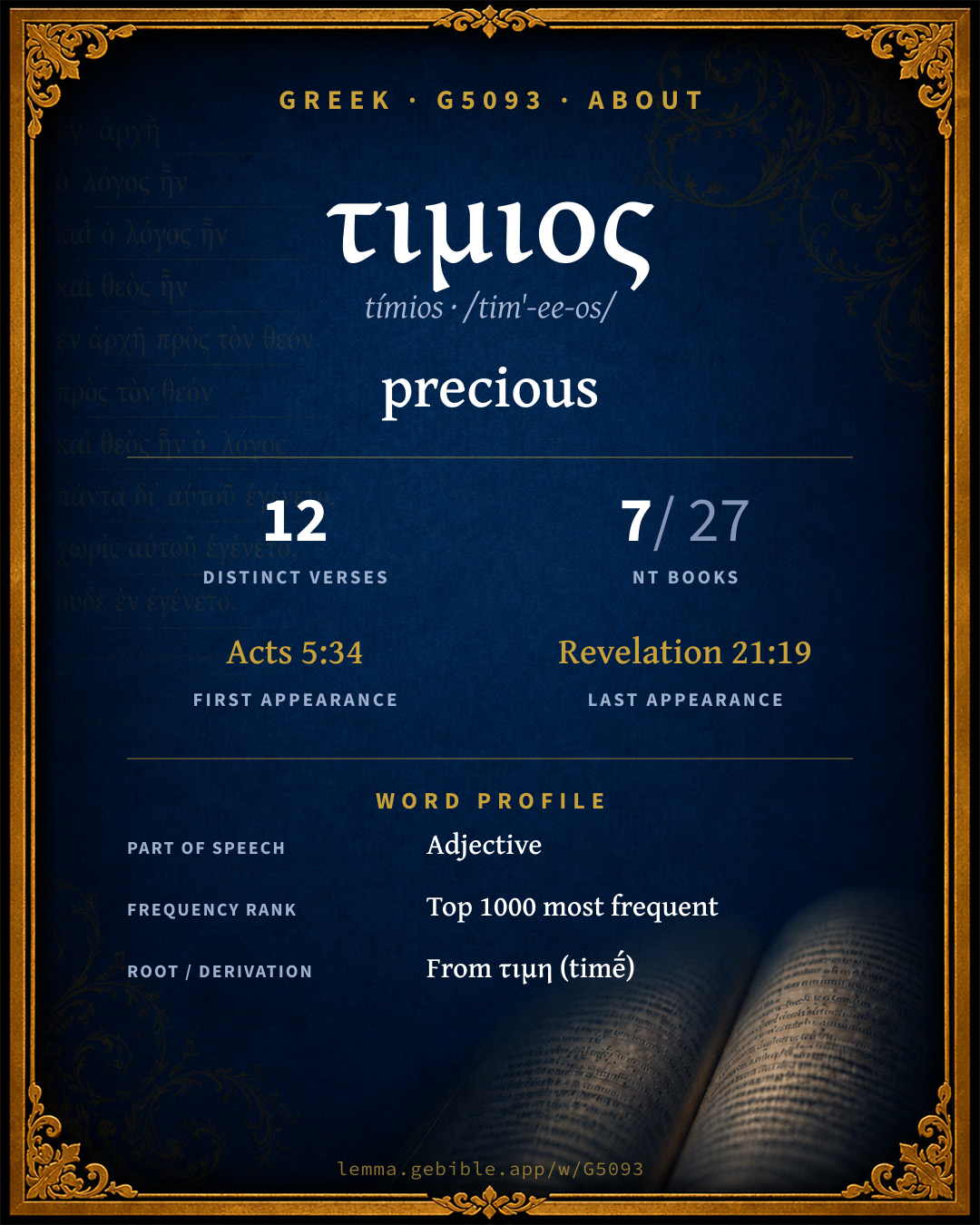
τίμιος
precious
‘precious’ is one of 2 main senses fuller range ↓
Full lexicon entry — Thayer's Greek Lexicon
From Thayer's Greek Lexicon
Where this word appears
See every Dative-case word in the Greek New Testament →
Grammar key — what these labels mean
Part of speech
- Adjective
- A word that describes or qualifies a noun.
Case
- Dative
- The case of the indirect object, means, or location — “to / for / with / in.”
- Nominative
- The case of the subject (and the predicate nominative).
- Accusative
- The case of the direct object and of extent.
- Genitive
- The case of source, possession, or “of” — answers “whose / from what.”
Gender
- Masculine
- Grammatically masculine.
- Feminine
- Grammatically feminine.
- Neuter
- Grammatically neuter.
Number
- Singular
- One.
- Plural
- More than one.
Degree
- Superlative
- Expresses the greatest degree (“greatest,” “most”).
3 distinct verses where G5093 appears in the Nominative case, across 3 books. Filtered view — show all forms. Click any verse to open its interlinear word-by-word view. Verse text shown in the World English Bible for context — . Each verse’s Greek form is shown with its reference; the English is not keyword-highlighted, since the data carries no word-level English alignment. Use “Compare translations” on any verse to read it across multiple English versions. This concordance covers the Greek New Testament; Septuagint (Greek Old Testament) occurrences of this word are not indexed here.
Acts 1 verse
Hebrews 1 verse
2 Peter 1 verse
About this entry
At a glance — auto-summarized from this page’s data, not written by a person. Every figure links to its source below. This summary describes the numbers; it doesn’t interpret them.
τιμιος (tímios) is a Greek adjective most often rendered “precious.” Debuting at Acts 5:34, it then recurs through the corpus. With 12 verses in 7 books, it is an uncommon word in the Greek New Testament. It concentrates in Revelation, which alone accounts for 42% of its uses. Its lexical range runs to 2 senses. For the data behind this summary, explore the sense tree and the renderings breakdown below.
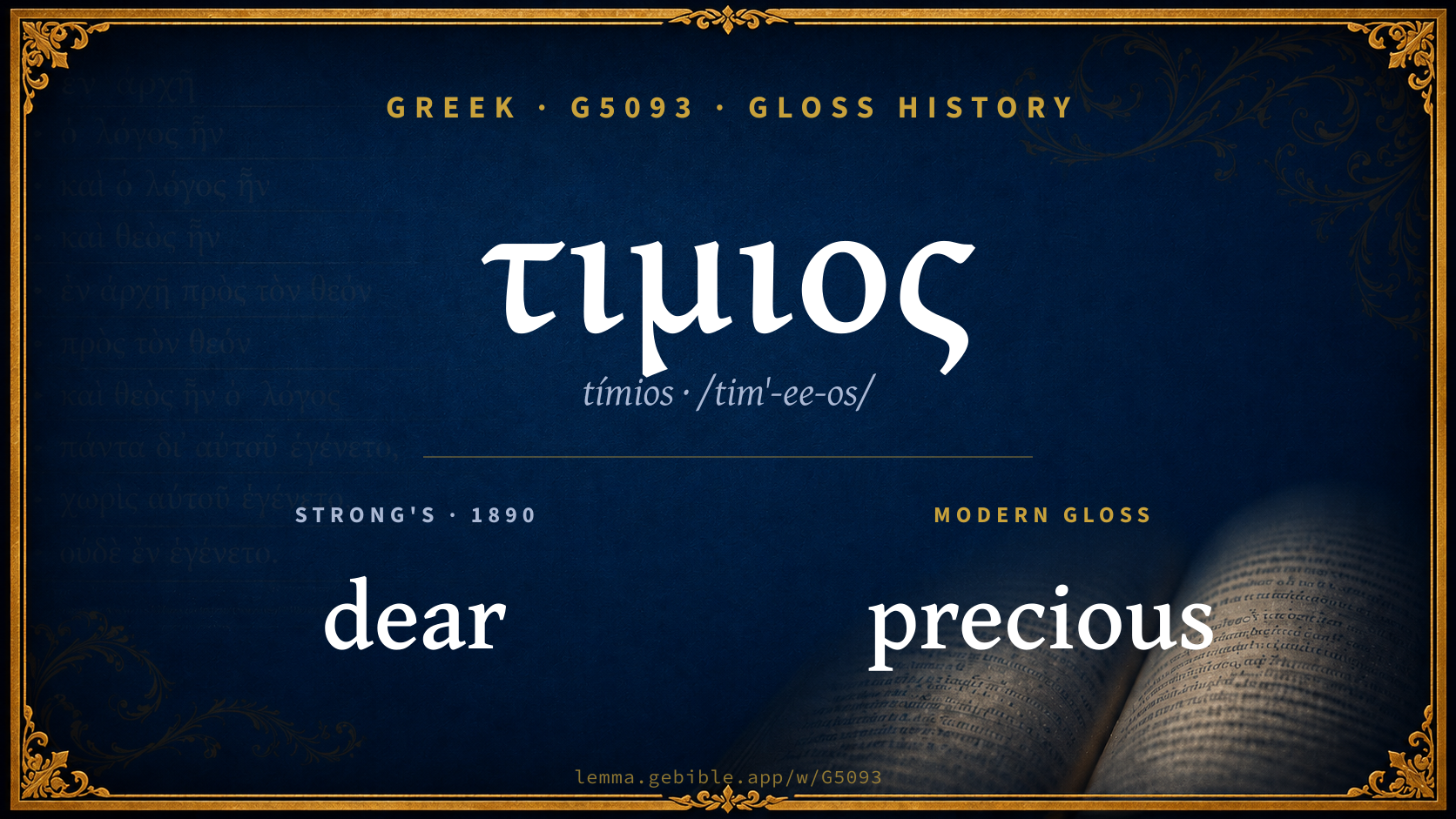
Gloss history
Strong's 1890 vs modern scholarship
About this word
Strong's G5093 catalogs a Greek word from the Greek New Testament.
These counts are not copied from any lexicon or concordance. They are computed here, from the morphology-tagged Greek New Testament. What Lemma adds →
- 12
- distinct verses
- The word appears in 12 distinct verses.
- 7 / 27
- NT books
- The word appears in 7 of 27 New Testament books.
- #863
- by frequency
- Top 1000 most frequent Greek words (rank 863 of 5,347 Greek words by occurrence).
View all 12 occurrences in the concordance →
Most concentrated in
- Revelation 5 verses 42%
- Acts 2 verses 17%
- 1 Corinthians 1 verse 8%
By section of the New Testament
By traditional corpus
Conventional, traditional groupings — biblical authorship is debated, so this is a traditional corpus grouping, not an authorship claim. Some books belong to more than one corpus (Luke is in both the Gospels and the Lukan corpus, and so on), so these shares overlap and need not total 100%. Each figure is a share of the word’s 12 distinct verses.
- Johannine 5 verses · 42%
- Revelation 5 verses · 42%
- General (Catholic) Epistles 3 verses · 25%
- Lukan (Luke–Acts) 2 verses · 17%
- Pauline corpus 1 verse · 8%
- Hebrews 1 verse · 8%
How translations render this word
Counts come from each version’s own published word-to-Strong’s tagging or interlinear alignment — an approximate guide to how each version renders this word, not a word-level alignment the data otherwise carries. Because each total is that version’s own tagged count, the per-version totals vary from one another and need not match the appearance or distinct-verse counts above. These counts may also differ from a printed concordance because Lemma counts each distinctly tagged rendering and does not collapse phrase taggings into a single head-word total. This is a fixed set of word-tagged versions (KJV, ASV, BSB, ULT) and does not change with the reading translation you choose elsewhere. Each version’s license is shown beside its name below (and on Sources).
- King James Version: Precious 8×, Most precious 2×
- American Standard Version: Precious 8×, Most precious 2×
- Berean Standard Bible: Precious 9×
- unfoldingWord Literal Text: Precious 7×, Valuable 2×
King James Version Public Domain
Renders G5093 across 14 tagged occurrences — most commonly:
Plus 4 renderings that appear only once — usually multi-word phrases or single function words the recovered tagging swept in, not distinct renderings.
American Standard Version Public Domain
Renders G5093 across 14 tagged occurrences — most commonly:
Plus 4 renderings that appear only once — usually multi-word phrases or single function words the recovered tagging swept in, not distinct renderings.
Berean Standard Bible Public Domain
Renders G5093 across 13 tagged occurrences — most commonly:
Plus 4 renderings that appear only once — usually multi-word phrases or single function words the recovered tagging swept in, not distinct renderings.
unfoldingWord Literal Text CC BY-SA 4.0
Renders G5093 across 11 tagged occurrences — most commonly:
Plus 2 renderings that appear only once — usually multi-word phrases or single function words the recovered tagging swept in, not distinct renderings.
Senses in Thayer's
The 2 senses Thayer's distinguishes for this word, in lexicon order (not ranked by frequency or importance). The full entry — with sub-senses — is in the Lexicon Entry tab.
- as of great price, precious
- held in honour, esteemed, especially dear
Word origin
Derived from τιμη (timḗ) (G5092) — honor.
Including the comparative τίμιώτερος timiō teros and the superlative τίμιώτατος timiō tatos; from G5092 ; valuable that is (objectively) costly or (subjectively) honored esteemed or (figuratively) beloved : - dear honourable (more most) precious had in reputation.
— Strong’s Exhaustive Concordance (1890), public domain.
Forms in the corpus
The 9 distinct written forms G5093 takes in the Greek New Testament, most frequent first — each parse links to that case’s occurrences in the concordance.
| Form | Parsing | Example | Uses |
|---|---|---|---|
| τιμίῳ timíō | Adjective, Dative, Singular, Masculine | Revelation 17:4 | 4 |
| τίμιος tímios | Adjective, Nominative, Singular, Masculine | Acts 5:34 | 2 |
| τίμια tímia | Adjective, Nominative, Plural, Neuter | 2 Peter 1:4 | 1 |
| τίμιον tímion | Adjective, Accusative, Singular, Masculine | James 5:7 | 1 |
| τιμίαν timían | Adjective, Accusative, Singular, Feminine | Acts 20:24 | 1 |
| τιμίου timíou | Adjective, Genitive, Singular, Masculine | Revelation 18:12 | 1 |
| τιμίους timíous | Adjective, Accusative, Plural, Masculine | 1 Corinthians 3:12 | 1 |
| τιμιωτάτου timiōtátou | Adjective, Genitive, Singular, Neuter, Superlative | Revelation 18:12 | 1 |
| τιμιωτάτῳ timiōtátō | Adjective, Dative, Singular, Masculine, Superlative | Revelation 21:11 | 1 |
Same root — word family
Other Thayer's entries built from the same root as G5093, grouped by Strong’s listed origin. These share a root / origin per the lexicon — not necessarily a shared meaning. Each links to that word’s own entry.
Derives from
Shares the same root
Derived from this word
Proper names from this root
People and places named from this root — a name, not an additional meaning of the word.
Compare all same-root words → Showing 4 of 7 — not the complete family. 2 of the same-root words are proper names (people or places). They share a root, not necessarily a meaning.
Septuagint usage
The same Greek word τιμιος appears 34 times in the Greek Old Testament (Septuagint), across 33 verses in 13 books.
- 34
- LXX occurrences
- Tagged occurrences of this Greek word in the Septuagint.
- 33
- verses
- Distinct Septuagint verses containing this word.
- 13 / 39
- OT books
- The word appears in 13 of the 39 Old Testament books.
Sample Septuagint occurrences
- 1 Samuel 3:1 τίμιος
- 2 Samuel 12:30 τίμιος
- 1 Kings 6:1 τίμιος
- 1 Chronicles 20:2 τίμιος
- 2 Chronicles 3:6 τίμιος
- Ezra 4:10 τίμιος
- Job 28:16 τίμιος
- Psalms 18:11 τίμιος
- Proverbs 3:15 τίμιος
- Ecclesiastes 10:1 τίμιος
- Jeremiah 15:19 τίμιος
- Lamentations 4:2 τίμιος
Septuagint occurrences (same lexeme)
Every verse where the same Strong’s number (G5093) appears in the Greek Septuagint. Verse text shown in the World English Bible for context; the Greek form is the matched word — the English is not keyword-highlighted.
- 1 Samuel 3:1 τίμιος The child Samuel ministered to Yahweh before Eli. The word of Yahweh was precious in those days; there was no frequent vision.
- 2 Samuel 12:30 τίμιος He took the crown of their king from off his head; and the weight of it was a talent of gold, and [in it were] precious stones; and it was set on David's head. He brought forth the spoil of the city, exceeding much.
- 1 Kings 6:1 τίμιος It happened in the four hundred and eightieth year after the children of Israel were come out of the land of Egypt, in the fourth year of Solomon's reign over Israel, in the month Ziv, which is the second month, that he began to build the house of Yahweh.
- 1 Kings 7:46 τίμιος In the plain of the Jordan did the king cast them, in the clay ground between Succoth and Zarethan.
- 1 Kings 7:47 τίμιος Solomon left all the vessels [unweighed], because they were exceeding many: the weight of the brass could not be found out.
- 1 Kings 7:48 τίμιος Solomon made all the vessels that were in the house of Yahweh: the golden altar, and the table whereupon the show bread was, of gold;
- 1 Kings 10:2 τίμιος She came to Jerusalem with a very great train, with camels that bore spices, and very much gold, and precious stones; and when she was come to Solomon, she talked with him of all that was in her heart.
- 1 Kings 10:10 τίμιος She gave the king one hundred twenty talents of gold, and of spices very great store, and precious stones: there came no more such abundance of spices as these which the queen of Sheba gave to king Solomon.
- 1 Kings 10:11 τίμιος The navy also of Hiram, that brought gold from Ophir, brought in from Ophir great plenty of almug trees and precious stones.
- 1 Chronicles 20:2 τίμιος David took the crown of their king from off his head, and found it to weigh a talent of gold, and there were precious stones in it; and it was set on David's head: and he brought forth the spoil of the city, exceeding much.
- 1 Chronicles 29:2 τίμιος Now I have prepared with all my might for the house of my God the gold for the [things of] gold, and the silver for the [things of] silver, and the brass for the [things of] brass, the iron for the [things of] iron, and wood for the [things of] wood; onyx stones, and [stones] to be set, stones for inlaid work, and of various colors, and all manner of precious stones, and marble stones in abundance.
- 2 Chronicles 3:6 τίμιος He garnished the house with precious stones for beauty: and the gold was gold of Parvaim.
- 2 Chronicles 9:1 τίμιος When the queen of Sheba heard of the fame of Solomon, she came to prove Solomon with hard questions at Jerusalem, with a very great train, and camels that bore spices, and gold in abundance, and precious stones: and when she was come to Solomon, she talked with him of all that was in her heart.
- 2 Chronicles 9:9 τίμιος She gave the king one hundred and twenty talents of gold, and spices in great abundance, and precious stones: neither was there any such spice as the queen of Sheba gave to king Solomon.
- 2 Chronicles 9:10 τίμιος The servants also of Huram, and the servants of Solomon, who brought gold from Ophir, brought algum trees and precious stones.
- 2 Chronicles 32:27 τίμιος Hezekiah had exceeding much riches and honor: and he provided him treasuries for silver, and for gold, and for precious stones, and for spices, and for shields, and for all manner of goodly vessels;
- Ezra 4:10 τίμιος and the rest of the nations whom the great and noble Osnappar brought over, and set in the city of Samaria, and in the rest [of the country] beyond the River, and so forth.
- Job 28:16 τίμιος It can't be valued with the gold of Ophir, With the precious onyx, or the sapphire.
- Psalms 18:11 τίμιος He made darkness his hiding-place, his pavilion around him, Darkness of waters, thick clouds of the skies.
- Psalms 20:4 τίμιος May He grant you your heart's desire, And fulfill all your counsel.
- Psalms 115:6 τίμιος They have ears, but they don't hear; They have noses, but they don't smell;
- Proverbs 3:15 τίμιος She is more precious than rubies. None of the things you can desire are to be compared to her.
- Proverbs 6:26 τίμιος For a prostitute reduces you to a piece of bread. The adulteress hunts for your precious life.
- Proverbs 8:11 τίμιος For wisdom is better than rubies. All the things that may be desired can't be compared to it.
- Proverbs 8:19 τίμιος My fruit is better than gold, yes, than fine gold; My yield than choice silver.
- Proverbs 12:27 τίμιος The slothful man doesn't roast his game, But the possessions of diligent men are prized.
- Proverbs 20:6 τίμιος Many men claim to be men of unfailing love, But who can find a faithful man?
- Proverbs 24:4 τίμιος By knowledge the rooms are filled With all rare and beautiful treasure.
- Proverbs 31:10 τίμιος Who can find a worthy woman? For her price is far above rubies.
- Ecclesiastes 10:1 τίμιος Dead flies cause the oil of the perfumer to send forth an evil odor; so does a little folly outweigh wisdom and honor.
- Jeremiah 15:19 τίμιος Therefore thus says Yahweh, If you return, then will I bring you again, that you may stand before me; and if you take forth the precious from the vile, you shall be as my mouth: they shall return to you, but you shall not return to them.
- Lamentations 4:2 τίμιος The precious sons of Zion, comparable to fine gold, How are they esteemed as earthen pitchers, the work of the hands of the potter!
- Hosea 11:7 τίμιος My people are determined to turn from me. Though they call to the Most High, He certainly won't exalt them.
These are occurrences of the same Greek lexeme (G5093) in the Septuagint — not a translation of any one Hebrew word. The store carries no word-level Hebrew↔Greek alignment, so no Hebrew original is asserted here. Counts come from the recovered LXX Strong's tagging — high-frequency vocabulary is well covered, while rare or late forms may be untagged — so they reflect tagged occurrences and may slightly undercount.