
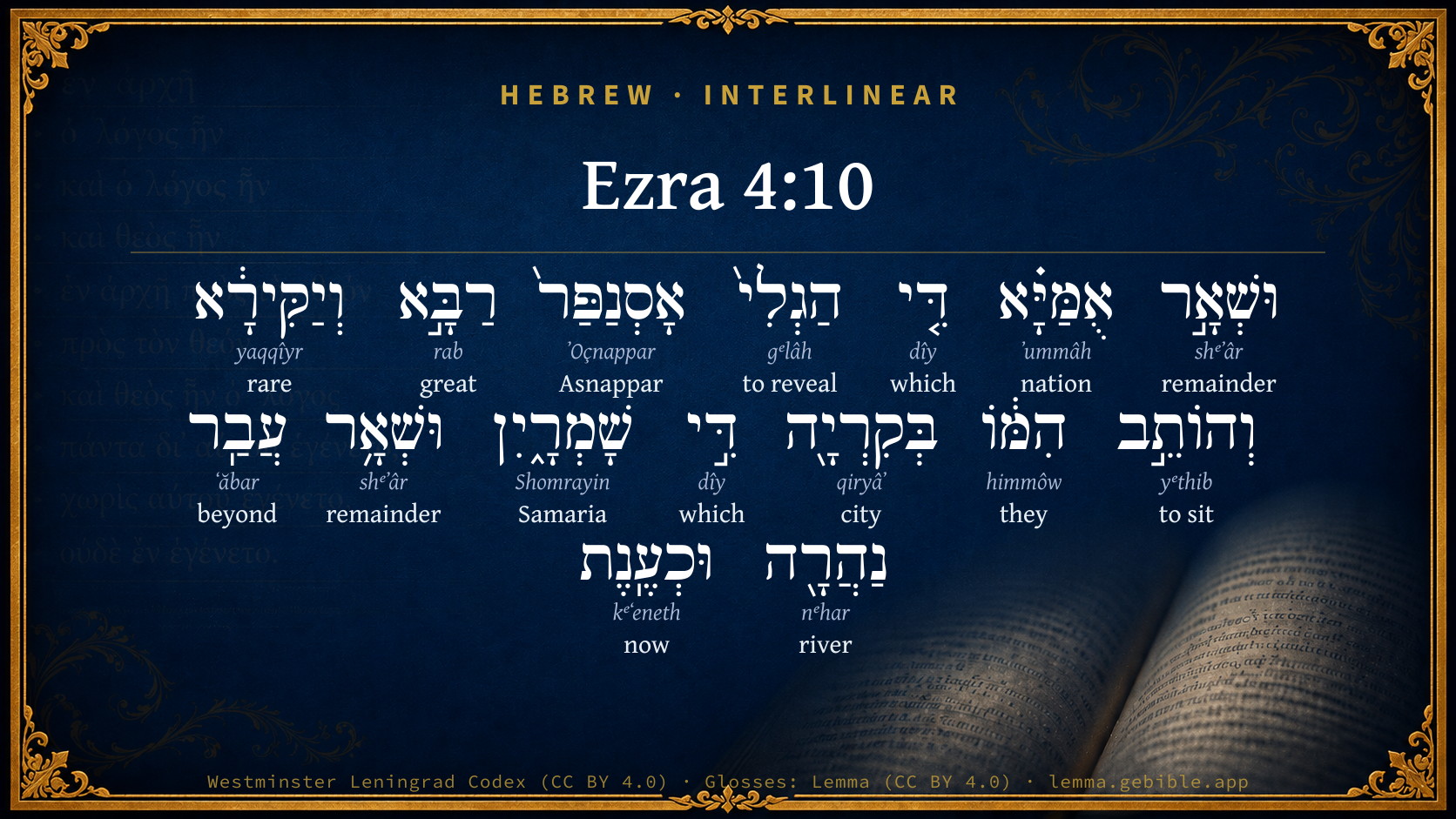
Ezra 4:10

Hebrew (Westminster Leningrad Codex) Ezra 4:10 appears in the Hebrew Old Testament. The text above is from the Westminster Leningrad Codex. Each word links to its Strong’s number, a concise gloss, and parsing drawn from the Open Scriptures Hebrew Bible morphology. Click any word for its full Brown-Driver-Briggs (BDB) entry.
Download image
Cite this verse

Ezra 4:10 (World English Bible). Public Domain. Lemma interlinear Bible study tool, https://lemma.gebible.app/v/ezra/4/10.

Show BibTeX & RIS
BibTeX
RIS
English Translation
and the rest of the nations whom the great and noble Osnappar brought over, and set in the city of Samaria, and in the rest [of the country] beyond the River, and so forth.
World English Bible · Public Domain
Highlights
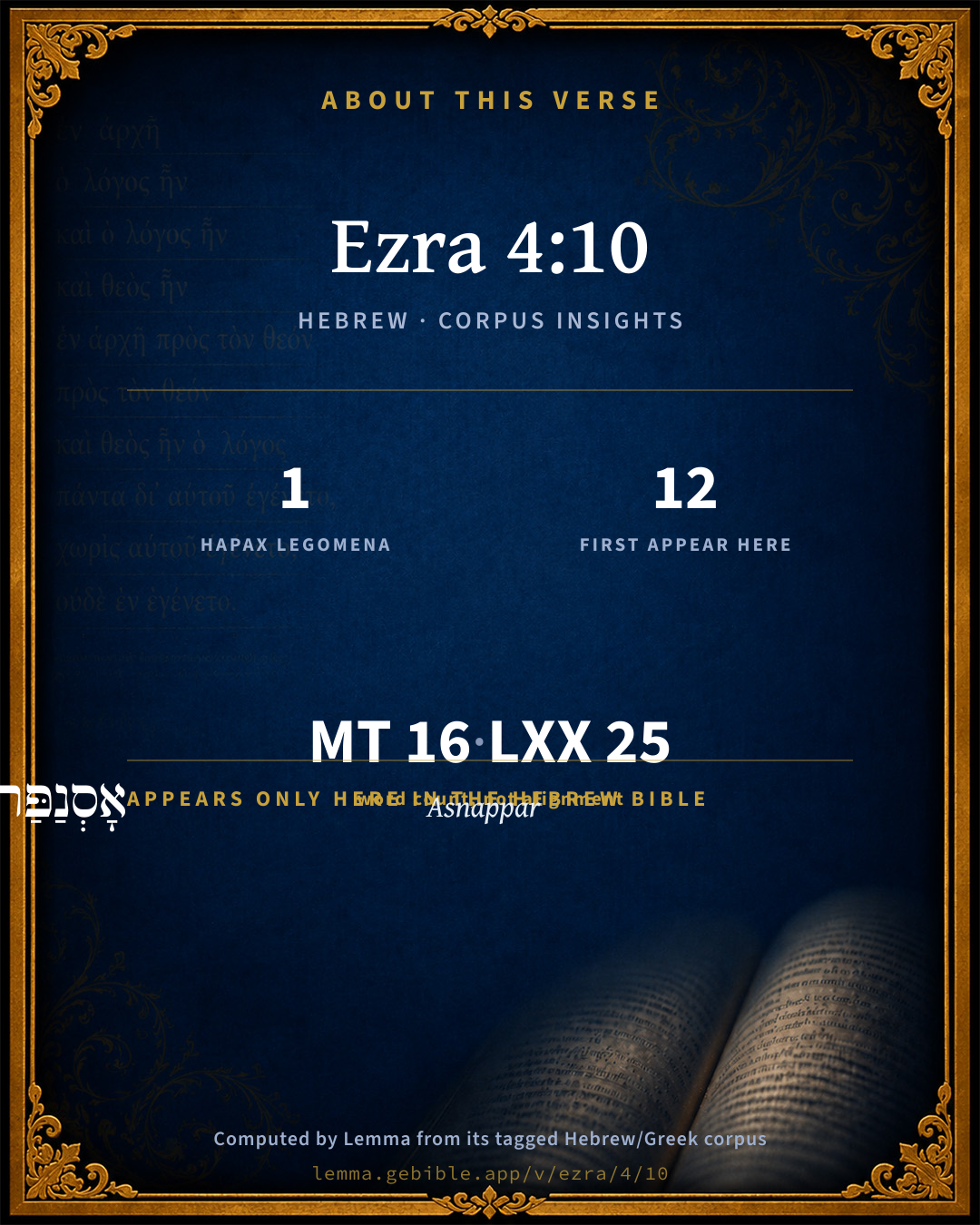
  • 1 hapax legomenon — only here in the Hebrew Bible
  • 12 first appearances in the Hebrew Bible
Full analysis ↓
Download a study sheet

One document with this verse’s original text, its word-by-word gloss line, the meaning frame, cross-references with their text, attributed commentary, and full source and license credits — printable, and it pastes into notes with its structure intact.

This verse Autodidact and up

Study sheet (.html) Plain text (.txt)

A passage Seminary Student

Up to 50 verses in one chapter. A passage sheet keeps up to 6 commentary sources and 12 cross-references per verse, in the order this page ranks them, and says so on the sheet whenever that leaves anything out. Ask for a single verse and you get the Autodidact verse sheet above.

Everything on this page stays free to read, with no account — the sheet is a download of what is already on screen, not access to it.

Want to remove ads? Support Godless Engineer
Compare translations 3

The same verse in 3 English versions, stacked beneath the original-language interlinear above. Click any original word for its lexicon entry.

Each is an independent rendering of the whole verse — the interlinear is not word-aligned to these translations.

Highlighted words mark where these versions differ — a whole-verse word diff, not a word-by-word alignment.

  • World English Bible Public Domain
    and the rest of the nations whom the great and noble Osnappar brought over, and set in the city of Samaria, and in the rest [of the country] beyond the River, and so forth.
  • King James Version Public Domain
    And the rest of the nations whom the great and noble Asnapper brought over, and set in the cities of Samaria, and the rest that are on this side the river, and at such a time.
  • unfoldingWord Literal Text CC BY-SA 4.0
    and the rest of the nations whom Ashurbanipal the great and the noble caused to be exiled and caused them to dwell in the cities of Samaria, and the rest of Beyond-the-River. And now:

unfoldingWord Literal Text — © unfoldingWord, licensed CC BY-SA 4.0. Word-aligned USFM3 via Door43 (git.door43.org/unfoldingWord/en_ult).

Versions to compare (up to 4)

3 of 4 selected

Show all 18 translations

Every available English version of this verse, each an independent rendering of the whole verse.

  • World English Bible Public Domain
    and the rest of the nations whom the great and noble Osnappar brought over, and set in the city of Samaria, and in the rest [of the country] beyond the River, and so forth.
  • Berean Standard Bible Public Domain
    and the rest of the peoples whom the great and honorable Ashurbanipal deported and settled in the cities of Samaria and elsewhere west of the Euphrates.
  • Majority Standard Bible Public Domain
    and the rest of the peoples whom the great and honorable Ashurbanipal deported and settled in the cities of Samaria and elsewhere west of the Euphrates.
  • King James Version Public Domain
    And the rest of the nations whom the great and noble Asnapper brought over, and set in the cities of Samaria, and the rest that are on this side the river, and at such a time.
  • American Standard Version (1901) Public Domain
    and the rest of the nations whom the great and noble Osnappar brought over, and set in the city of Samaria, and in the rest `of the country' beyond the River, and so forth.
  • Revised Version (1885) Public Domain
    and the rest of the nations whom the great and noble Osnappar brought over, and set in the city of Samaria, and in the rest of the country beyond the river, and so forth.
  • Geneva Bible (1599) Public Domain
    And the rest of the people whom the great and noble Asnappar brought ouer, and set in the cities of Samaria, and other that are beyonde the Riuer and Cheeneth.
  • Douay-Rheims (1899) Public Domain
    And the rest of the nations, whom the great and glorious Asenaphar brought over: and made to dwell in the cities of Samaria and in the rest of the countries of this side of the river in peace.
  • Young's Literal Translation Public Domain
    and the rest of the nations that the great and honourable Asnapper removed and set in the city of Samaria, and the rest beyond the river, and at such a time:
  • Literal Standard Version CC BY-SA 4.0
    and the rest of the nations that the great and honorable Asnapper removed and set in the city of Samaria, and the rest beyond the river, and at such a time:
  • Unlocked Literal Bible CC BY-SA 4.0
    and they were joined by the people whom the great and noble Ashurbanipal forced to settle in Samaria, along with the rest who were in the Province Beyond the River.
  • unfoldingWord Literal Text CC BY-SA 4.0
    and the rest of the nations whom Ashurbanipal the great and the noble caused to be exiled and caused them to dwell in the cities of Samaria, and the rest of Beyond-the-River. And now:
  • Darby Bible Public Domain
    and the rest of the peoples whom the great and noble Osnappar brought over and settled in the cities of Samaria, and the rest [of the country] on this side the river, and so forth.
  • World Messianic Bible Public Domain
    and the rest of the nations whom the great and noble Osnappar brought over and settled in the city of Samaria, and in the rest of the country beyond the River, and so forth, wrote.
  • Webster's Bible Public Domain
    And the rest of the nations whom the great and noble Asnapper brought over, and set in the cities of Samaria, and the rest that are on this side of the river, and at such a time.
  • Free Bible Version CC BY-SA 4.0
    and the rest of the people whom the great and noble Ashurbanipal deported and resettled in the towns of Samaria and other places west of the Euphrates.
  • Bible in Basic English Public Domain
    And the rest of the nations which the great and noble Osnappar took over and put in Samaria and the rest of the country over the river:
  • JPS Tanakh (1917) Public Domain
    and the rest of the nations whom the great and noble Asenappar brought over, and set in the city of Samaria, and the rest that are in the country beyond the River: — 'And now —

Literal Standard Version (2020), Covenant Press — licensed CC BY-SA 4.0. Text via the HelloAO Bible API (eBible.org). Unlocked Literal Bible (unfoldingWord) — licensed CC BY-SA 4.0. Text via the HelloAO Bible API (eBible.org). unfoldingWord Literal Text — © unfoldingWord, licensed CC BY-SA 4.0. Word-aligned USFM3 via Door43 (git.door43.org/unfoldingWord/en_ult). Free Bible Version, Dr. Jonathan Gallagher — licensed CC BY-SA 4.0. Text via the HelloAO Bible API (eBible.org).

Word by word

More ways to search: Search by grammar → Find every occurrence → Compare this word →

Practice this passage: Drill this verse → Learn its vocabulary →

אָסְנַפַּר֙
ʼOçnappar
H620
“Asnappar”
Adjective, N
Part of Speech
Adjective
Full BDB Definition

Origin: of foreign derivation

TWOT: None

Asnappar or Osnappar = "horned bull: thorn abolished" - an Assyrian king who transported other peoples into Samaria - probably the king, Ashurbanipal
  1. וּשְׁאָ֣ר shᵉʼâr H7606 “and · remainder of” Adjective, C + Noun, Common, Masculine, Singular, Construct
  2. אֻמַּיָּ֗א ʼummâh H524 “nations · the” Adjective, N, Common + Particle, Definite Article
  3. דִּ֤י dîy H1768 “which” Adjective, T
  4. הַגְלִי֙ gᵉlâh H1541 “to reveal” Adjective, V, Plural
  5. רַבָּ֣א rab H7229 “great · the” Adjective, A + Particle, Definite Article
  6. וְיַקִּירָ֔א yaqqîyr H3358 “and · rare · the” Adjective, C + Adjective, Adjective, Masculine, Singular, Determined + Particle, Definite Article
  7. וְהוֹתֵ֣ב yᵉthib H3488 “and · to sit” Adjective, C + Verb, Hiphil, Perfect, 3rd Person, Masculine, Singular
  8. הִמּ֔וֹ himmôw H1994 “they” Adjective, P
  9. בְּקִרְיָ֖ה qiryâʼ H7149 “in/at · cities” Adjective, R + Noun, Common, Feminine, Plural, Absolute
  10. דִּ֣י dîy H1768 “which” Adjective, T
  11. שָׁמְרָ֑יִן Shomrayin H8115 “Samaria” Adjective, N
  12. וּשְׁאָ֥ר shᵉʼâr H7606 “and · remainder of” Adjective, C + Noun, Common, Masculine, Singular, Construct
  13. עֲבַֽר ʻăbar H5675 “beyond” Adjective, N
  14. נַהֲרָ֖ה nᵉhar H5103 “river · the” Adjective, N + Particle, Definite Article
  15. וּכְעֶֽנֶת kᵉʻeneth H3706 “and · now” Adjective, C + Adverb

About this verse

These counts appear in no published source. They are computed here, from the morphology-tagged text and Lemma’s own curated glosses. What Lemma adds →

16
words
14
distinct lemmas
Historical
section

Notable vocabulary

1 hapax legomenon — a word that appears only here in the entire Hebrew Bible:

  • אָסְנַפַּר֙ Asnappar H620

First appearance in Scripture

These words make their first canonical appearance in the Hebrew Bible here (12 in total — showing 8):

  • אֻמַּיָּ֗א nation H524
  • הַגְלִי֙ to reveal H1541
  • אָסְנַפַּר֙ Asnappar H620
  • רַבָּ֣א great H7229
  • וְיַקִּירָ֔א rare H3358
  • וְהוֹתֵ֣ב to sit H3488
  • הִמּ֔וֹ they H1994
  • בְּקִרְיָ֖ה city H7149

Shared distinctive vocabulary

וְיַקִּירָ֔א rare H3358 occurs in 2 verses of the Hebrew Bible. Also found in:

Grammatical profile

  • 1 verb
  • 3 nouns
  • 7 adjectives
  • 1 adverb
  • 4 particles

Verb forms

  • וְהוֹתֵ֣ב Hiphil · Perfect

Repetition

Words recur within this verse — often emphatic in Hebrew:

  • וּשְׁאָ֣ר remainder H7606 ×2
  • דִּ֤י which H1768 ×2

Hebrew & Septuagint length

In English translation the verse runs 34 words from the Hebrew and 29 from the Septuagint (LXX English) — closely comparable.

A rough comparison of the two English renderings, which tokenize alike — not a word-level alignment.

Word counts can differ between the Hebrew and the Greek without any difference in meaning — e.g. the Hebrew direct-object marker אֵת has no separate Greek word, and Greek often adds the article ὁ.

In the original languages it is 16 Hebrew tokens and 25 Greek tokens — but the two are counted differently (Hebrew bundles its prefixes and suffixes into one token; the Greek is in lemma form), so that isn’t a like-for-like length.

Cross-references

6

Topical passages linked to Ezra 4:10 in the Treasury of Scripture Knowledge — connected by theme and wording, ordered by reader-vote popularity; previews shown in the World English Bible.

  • Ezra 4:17 [Then] sent the king an answer to Rehum the chancellor, and to Shimshai the scribe, and to the rest of their companions who dwell in Samaria, and in the rest [of the country] beyond the River: Peace, and so forth.
  • Ezra 4:11 This is the copy of the letter that they sent to Artaxerxes the king: Your servants the men beyond the River, and so forth.
  • Ezra 7:12 Artaxerxes, king of kings, to Ezra the priest, the scribe of the law of the God of heaven, perfect and so forth.
  • 2 Kings 17:24–41 The king of Assyria brought men from Babylon, and from Cuthah, and from Avva, and from Hamath and Sepharvaim, and placed them in the cities of Samaria instead of the children of Israel; and they possessed Samaria, and lived in the cities of it.
  • Ezra 4:1 Now when the adversaries of Judah and Benjamin heard that the children of the captivity were building a temple to Yahweh, the God of Israel;
  • Romans 13:7 Give therefore to everyone what you owe: taxes to whom taxes are due; customs to whom customs; respect to whom respect; honor to whom honor.

Cross-references courtesy of OpenBible.info (CC BY 4.0).

Hebrew and Greek witnesses Masoretic Hebrew ↔ Greek Septuagint

The same verse in the two great witnesses to the Old Testament, shown verse-for-verse.

These are two independent witnesses, not word-aligned to each other, and the Septuagint is shown in lemma (dictionary) form.

Hebrew Ezra 4:10 Masoretic · Westminster Leningrad Codex

וּשְׁאָ֣ר אֻמַּיָּ֗א דִּ֤י הַגְלִי֙ אָסְנַפַּר֙ רַבָּ֣א וְיַקִּירָ֔א וְהוֹתֵ֣ב הִמּ֔וֹ בְּקִרְיָ֖ה דִּ֣י שָׁמְרָ֑יִן וּשְׁאָ֥ר עֲבַֽר נַהֲרָ֖ה וּכְעֶֽנֶת

and the rest of the nations whom the great and noble Osnappar brought over, and set in the city of Samaria, and in the rest [of the country] beyond the River, and so forth.

World English Bible · Public Domain

Greek LXX Ezra 4:10 Septuagint · lemma form

καί ὁ κατάλοιπος ἔθνος ὅς ἀποοἰκίζω ασενναφαρ ὁ μέγας καί ὁ τίμιος καί καταοἰκίζω αὐτός ἐν πόλις ὁ σομορων καί ὁ κατάλοιπος πέραν ὁ ποταμός

and the rest of the nations whom the great and noble Assenaphar removed, and settled them in the cities of Somoron, and the rest of them beyond the river.

LXX2012 (modern English Septuagint) · Public Domain

In the Septuagint this is one book — Esdras B (2 Esdras): Ezra is chapters 1–10, Nehemiah 11–23.

On this verse, The Cambridge Bible for Schools and Colleges discusses the Septuagint’s reading. Read the note in Commentary ↓

Hebrew: Westminster Leningrad Codex (CC BY 4.0). Greek: Septuagint (public domain); English from LXX2012 (modern English Septuagint) (Public Domain). How the Septuagint differs from the Hebrew →

Commentary

Notes on Ezra 4:10 from classic Christian and Jewish commentators (each source and its license shown beneath its notes). The classic Christian expositions comment on the surrounding passage and are grouped to its opening verse, so a note may address several verses; the Jewish commentaries on the Tanakh (Rashi and others) are per-verse, so they appear only where the commentator wrote on this verse.

Lemma curates 59 commentaries, every one of them public domain or Creative Commons licensed, each selected and text-cleaned for this edition rather than reprinted as found. About our sources →

Trapp's Complete Commentary

John Trapp

Ezr 4:10 And the rest of the nations whom the great and noble Asnappar brought over, and set in the cities of Samaria, and the rest [that are] on this side the river, and at such a time.

Ver. 10. The great and noble Asnapper] Some great commander under the Assyrian monarch. There is, they say, a greatness belluine, and a greatness genuine. Asnapper, notwithstanding his big-swollen titles, might be rather great than good; and more notable than noble, Nobilitas sola est atque unica virtus (Juvenal).

On this side the river] That ancient river, the river Euphrates, which the more I see the more I admire, saith one.

John Trapp, A Commentary or Exposition upon All the Books of the Old and New Testament (1647–1656) — public domain. Text from a community e-Sword module.

Joseph Benson's Commentary

Ezr 4:10. Whom the great and noble Asnapper brought over — Some take Asnapper to be another name for Shalmaneser, or for Esar-haddon, who sent these colonies hither. But it is more reasonable to think he was some great commander, or other person of eminence, who was appointed captain of this colony, and intrusted with the office of conducting them over the river Euphrates, and seeing them settled in these countries.

Joseph Benson's Commentary on the Old and New Testaments (1811–1818) — public domain. Text from a community e-Sword module.

Tyndale Open Study Notes

Tyndale Open Resources

4:10 Ashurbanipal had deported people from other conquered lands into the lands of Israel and Aram (see 2 Kgs 17:24-41). • The city of Samaria was the former capital of the northern kingdom of Israel. • The province west of the Euphrates River included Syria, Israel, and Judah.

Tyndale Open Study Notes — © Tyndale Open Resources, licensed CC BY-SA 4.0. Text via the HelloAO Bible API.

Geneva Bible (1599)

Geneva Bible translators

Which were a certain people that envied the Jews.

Some think it was Sennacherib, but rather Shalmaneser.

To wit, Euphrates: and he meaneth in respect of Babel that they dwelt beyond it.

Geneva Bible (1599) marginal notes — public domain. Text via Bolls.life.

Adam Clarke's Commentary

Verse 10. The great and noble Asnapper] Whether this was Shalmaneser, or Esar-haddon, or some other person, learned men and chronologists are not agreed. The Syriac terms him Asphid; but of this person we know no more than we do of Asnapper. He might have been the military officer who was appointed to escort this people to Judea.

Adam Clarke's Commentary on the Bible (1810–1826) — public domain. Text from a community e-Sword/MySword module.

Ellicott's Commentary for English Readers

(10) Asnapper cannot be Esar-haddon, but was probably his chief officer.

And at such a time.—And so forth.

A Bible Commentary for English Readers, edited by Charles John Ellicott (1878–1897) — public domain. Text from a community e-Sword module.

The Cambridge Bible for Schools and Colleges

gen. ed. J. J. S. Perowne

10. and the rest of the nations] Implying that the number was not nearly exhausted by these nine names.

whom the great and noble Asnappar] R.V. Osnappar. This name is nowhere else mentioned in the O.T. Who this Osnappar was, has been much disputed. Some have identified him with Esarhaddon, conjecturing that this was either another name or an honorific title. Others have supposed him to be a general commanding Esarhaddon’s armies. But the name nowhere occurs in the Inscriptions as a second name or as a title of Esarhaddon, even if it were probable that having been called Esarhaddon in Ezr_4:2 he should here be called by a different name or title without any explanatory word. No general appears of this name. And the manner of the allusion presupposes his royal dignity. Moreover, neither Esarhaddon nor any general of his invaded Elam.

Scholars now begin to accept the ingenious and most probable suggestion that ‘Osnappar’ is the Aramaic attempt to reproduce the name of Assur-bani-pal, the great Assyrian king. He was the only Assyrian king who captured Susa and could carry off ‘Susanchites’; no king so fully deserved the titles of ‘great and noble’; this name (‘Assur the father of the son’) by a strong contraction of the middle word, is not so far removed from the sound of ‘Osnappar’, especially if the final ‘1’ of ‘pal’ is changed to ‘r’ (cf. ‘Pôrus’ for ‘Pul’, or ‘Babiru’ for ‘Babilu’), and the ‘r’ of ‘Assur’ is weakened to ‘n’ (cf. Nebuchadrezzar and Nebuchadnezzar) = Assun … par.

Assur-bani-pal reigned 42 years (668–626). The records of his brilliant and successful reign have recently been deciphered (G. Smith’s Assurbanipal, p. 187). His arms were everywhere victorious. The severest contest in which he was engaged was with his own brother Sassumukem, governor of Babylon, who rebelled against him. The rebel’s death and the capture of Babylon (646) ended the struggle. But this fact in conjunction with his great conquest of Elam explains the joint mention of Babylonians, Susanchites and Elamites among the colonists, whom he transplanted into Samaritan territory.

It appears then that Assur-bani-pal by introducing his colonists into Samaria was the author of the fourth colonization. It would be wasted labour to try to identify the nationalities of Ezr_4:9 with the names recorded in 2Ki_17:24 in connexion with a different colonization.

in the cities of Samaria] R.V. ‘in the city of Samaria’.—The word in the Aramaic is singular, cf. Ezr_4:17. The other cities are covered by the next phrase.

and the rest that are on this side the river] R.V. and in the rest of the country beyond the river. In these words two things deserve to be noted. (1) The words ‘beyond the river’ clearly indicate the country W. of the Euphrates. The names of the nationalities who send the letter are presented in the light in which they would appear to the receiver, i.e. the king, at Susa to the E. of the Euphrates. The phrase ‘The country beyond the river’ (the Abhar-Nahara) was a recognised geographical name for the Syrian satrapy. (2) The wideness of the expression ‘in the rest of the country’ may be compared with the version given in 1Es_2:17 where ‘the Dinaites, &c.’ are compressed into ‘the judges that are in Cœlesyria and Phœnice’. The word ‘judges’ is a mistranslation. But the mention of Cœlesyria and Phœnica corresponds with the indefinite language used in this verse. It is not impossible that the letter of accusation against the Jews may have been the joint production of many communities throughout the satrapy of Syria, who felt themselves aggrieved at privileges accorded to the Jews, or imperilled by the revival of their strength.

and at such a time] R.V. and so forth. The A.V. regarded this word as a brief way of expressing the date of the letter. The LXX. omitted it. The Vulgate rendered it as a salutation ‘in pace’.—It signifies the suppression of matter that is unimportant = ‘et cætera’.

The Cambridge Bible for Schools and Colleges (gen. ed. J. J. S. Perowne; Cambridge University Press, 1878–1918) — public domain. Text from a community e-Sword module.

John Gill's Exposition

This is the copy of the letter they sent unto him, even unto Artaxerxes the king,.... Which Ezra brought with him from Babylon, and is contained in the five following verses:

thy servants the men on this side the river, and at such a time; this was the inscription of the letter, or the beginning of it.

John Gill's Exposition of the Whole Bible (1746–1763) — public domain (CC PDM 1.0). Text via the HelloAO Bible API.

Haydock's Catholic Bible Commentary

Asenaphar, commonly supposed to be the Asarhaddon, though we know not that he caused any of these nations to remove thither, as Salmanasar certainly did. (Calmet) --- The name of the latter occurs in some copies. (Lyranus) --- River, Euphrates. --- In peace. (Haydock) --- The original, cehenth, is neglected by the Septuagint and Arabic. The Syriac reads, "Acheeneth." Others translate, "at that time," as if the date had been lost. (Junius, &c.) --- Protestants, "and at such a time." (Haydock) --- Others suppose the writers lived "at Kineeth." (Pagnin) --- But who ever heard of such a place? Le Clerc takes it to mean "and the rest," as if the title were curtailed. But it is more probable that the text ought to be Ceheth, as [in] ver. 17, and that we should translate, "beyond the river, (Calmet) as now, (11) unless this word ought to be here omitted, (Haydock) to Artaxerxes, the king, peace (and prosperity) as at present." (Calmet) --- Chaldean sslum ucath, "peace even now." (Haydock) --- So Horace says, suaviter ut unc est, wishing a continuation of happiness. 3 Esdras (ii. 17.) joins the last word with ver. 12, "And now be it," &c. Canoth may have this sense, (Calmet) and consequently no change is necessary. (Haydock)

George Leo Haydock (1774–1849), Haydock's Catholic Family Bible and Commentary, 1859 edition — public domain. Excludes Psalms (Douay-Rheims chapter numbering differs from Protestant) and Deuterocanonical books (Catholic canon only).

Matthew Poole's English Annotations

Asnappar; either Esar-haddon, or some other person then of great eminency, especially with his subjects and followers, who was captain of this colony, and conducted them hither.

On this side the river, to wit, Euphrates.

At such a time: the date of the epistle was particularly expressed in the epistle, but here it was sufficient to note it in the general.

Matthew Poole's English Annotations on the Holy Bible (1683–1685) — public domain. Text from a community e-Sword/MySword module.

Whedon's Commentary on the Bible

Daniel D. Whedon

10. The great and noble Asnapper — Some have supposed that Asnapper is another name, or another form of the name, of Shalmanezer, or of Esar-haddon, and such a supposition is especially plausible here, as the name occurs in a document written in a different language, in which the form of the name might suffer change. But it is, perhaps, better to understand the name as the title of the Assyrian general or satrap by whom these nations were brought over and settled in Samaria. Thus it was Esar-haddon’s “captains” that carried Manasseh to Babylon. 2Ch_33:11. To such an officer these nations would naturally apply the epithets great and noble.

On this side the river — Better, beyond the river, that is Euphrates. The writer employs the usus loquendi of the Persians, who would speak of the country west of the Euphrates as beyond the river. Furst renders it, the (western) bank district of the river. Syria and Palestine probably formed one satrapy under the Persian kings, and was under the charge of one governor. Compare Ezr_5:3, note.

And at such a time — Chald. וכענת, and so forth; compare Ezr_4:11; Ezr_4:17; Ezr_7:12 : a sort of abbreviation where certain items or forms of statement are assumed to be understood, and, therefore, not expressed, but simply indicated. Hence it indicates not the date of the letter, but the omission of certain formularies of introduction, and is equivalent to our et cetera — and so forth.

Daniel D. Whedon (gen. ed.), Commentary on the Old and New Testaments (1874–1909) — public domain. Text from a community e-Sword module.

The Pulpit Commentary

The rest of the nations whom the great and noble Asnapper brought over. Nothing more is known of "the great and noble Asnapper," who is here mentioned as bringing the colonists and setting them in the cities of Samaria. We must suppose him to have been an officer employed by Esar-haddon on this service. The name is Assyrian in form, and may have meant "Asshur pursues." The rest that are on this side the river. Rather, across the river." As Romans in North Italy, writing to Rome, would have spoken of themselves as Trans padani," so Persian subjects, writing to Susa from the west of the Jordan, speak of theft country as across the Jordan." And at such a time. Rather, "and so forth." This and the preceding verse set forth the address of Rehum"s letter. The whole address not being given, the writer ends with the phrase ukeneth, which means "and so forth," or "et cetera". (comp. Ezr_7:12)

The Pulpit Commentary (1880–1919), ed. H.D.M. Spence-Jones & Joseph S. Exell — public domain. Text from a community e-Sword module.

John Wesley's Explanatory Notes

Asnapper - Either Esarhaddon, or some other person of eminency, who was captain of this colony, and conducted them hither. The river - Euphrates. Time - The date of the epistle was particularly expressed therein, but here it was sufficient to note it in general.

John Wesley, Explanatory Notes Upon the Whole Bible (1754–1765) — public domain. Text via the GEBible commentary corpus.

Rashi

Rabbi Shlomo Yitzchaki (Rashi)

And the rest of the nations and the rest of the nations that Sennacherib exiled; they have all concurred.

Asenappar Sennacherib.

the great and honored for he was a great and honored king, as it says (Isa. 36:4): “So has the great king, the king of Assyria, said.”

in the cities of Samaria in the cities surrounding Samaria.

and the rest of the other side of the river and the rest of the nations that are on the other side of the river; because the river Euphrates intervenes between the land of Israel and Babylon, those nations that are in Israel are on the opposite side of the river of those found in Babylon.

and Ke’eneth a name of a place; and all the people of Ke’eneth have concurred with the commission of this letter.

Rashi on the Tanakh — English translations: “The Judaica Press complete Tanach with Rashi, translated by A. J. Rosenberg” (CC BY 4.0); “Pentateuch with Rashi's commentary by M. Rosenbaum and A.M. Silbermann, 1929-1934” (public domain); “The Metsudah Tanach series, Lakewood, N.J” (CC BY 4.0); and “The Book of Joshua, Metsudah Publications, 1997” (CC BY 4.0). Text via Sefaria.

Lesson kit

Teaching starters — assembled from the data on this page, not authored interpretation. Every prompt links to the verse data it draws on. Edit before teaching.

Ezra, in the Historical, opens this verse with 16 words (14 distinct Hebrew lemmas). Its most distinctive word is ʼOçnappar (“Asnappar”). A historical commentator’s framing appears above. Read the whole chapter for the surrounding context.

Discussion questions

  1. What does “Asnappar” (ʼOçnappar) contribute to the verse as a whole?
  2. 1 word here appears nowhere else in the Hebrew Bible. Why might the author reach for such rare wording?
  3. 12 words make their first appearance in Scripture here. What does this debut establish?
  4. How does Daniel 2:11, which shares the word «rare», read alongside this verse?
  5. What does the repetition of “remainder” (2× in this one verse) do in this verse?
  6. The translations on this page render this verse differently — a whole-verse word diff, not a word-by-word alignment. What might account for the different wordings?
  7. «וְהוֹתֵ֣ב» is a Hiphil Perfect verb. How does that grammatical form shape the action described?
  8. Compare how Trapp's Complete Commentary and Joseph Benson's Commentary read this verse. Where do they agree or differ?

Things to notice

  • 1 word in this verse appears nowhere else in the Hebrew Bible.
  • 12 words make their first canonical appearance in Scripture here.
  • This verse counts 16 Hebrew ↔ 25 Greek words.
  • These translations choose different wording for 20 words in this verse.
  • “remainder” occurs 2× in this single verse.

Reading settings

Reading text

Shown beneath each verse's original-language words.

Old Testament
Old Testament edition

Read the OT as the Masoretic Hebrew (MT) or the Greek Septuagint (LXX).

English shown for the Greek Septuagint (in the Hebrew ↔ Greek comparison).

Comparing translations? Open the Compare panel on any verse page to stack up to four side by side.