
Job 28:16

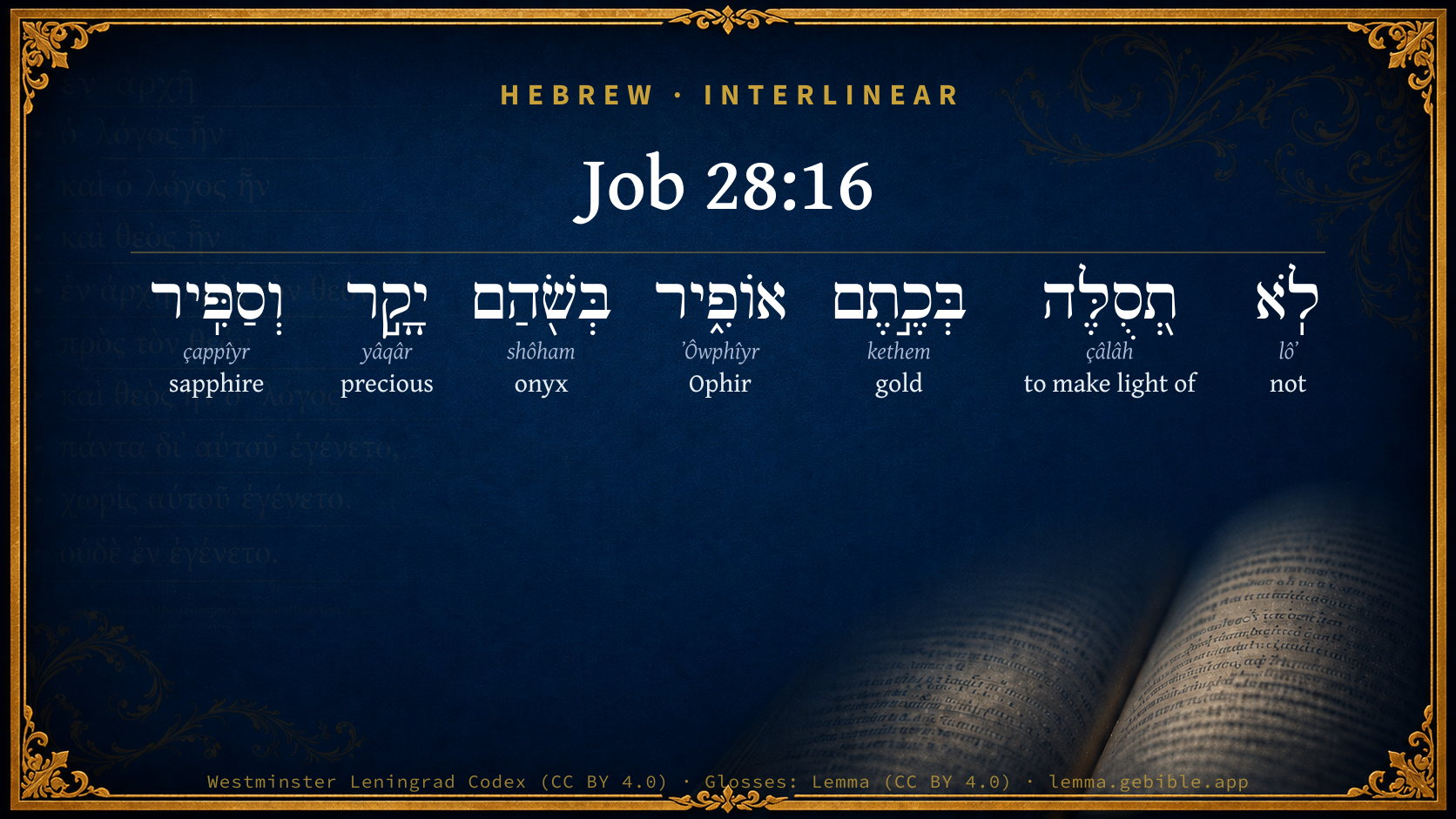
Hebrew (Westminster Leningrad Codex) Job 28:16 appears in the Hebrew Old Testament. The text above is from the Westminster Leningrad Codex. Each word links to its Strong’s number, a concise gloss, and parsing drawn from the Open Scriptures Hebrew Bible morphology. Click any word for its full Brown-Driver-Briggs (BDB) entry.
Download image
Cite this verse

Job 28:16 (World English Bible). Public Domain. Lemma interlinear Bible study tool, https://lemma.gebible.app/v/job/28/16.

Show BibTeX & RIS
BibTeX
RIS
English Translation
It can't be valued with the gold of Ophir, With the precious onyx, or the sapphire.
World English Bible · Public Domain
Highlights
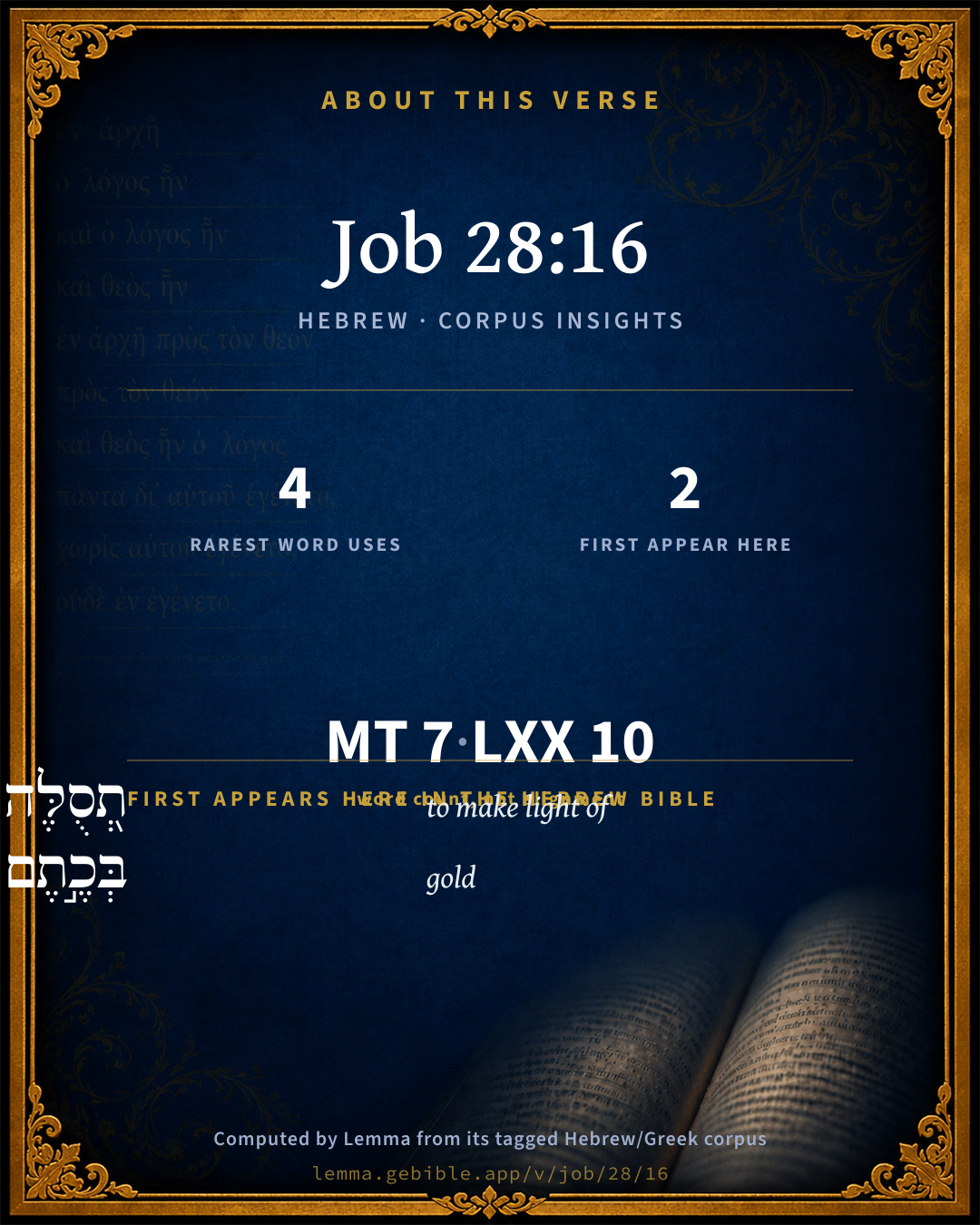
  • 2 first appearances in the Hebrew Bible
Full analysis ↓
Download a study sheet

One document with this verse’s original text, its word-by-word gloss line, the meaning frame, cross-references with their text, attributed commentary, and full source and license credits — printable, and it pastes into notes with its structure intact.

This verse Autodidact and up

Study sheet (.html) Plain text (.txt)

A passage Seminary Student

Up to 50 verses in one chapter. A passage sheet keeps up to 6 commentary sources and 12 cross-references per verse, in the order this page ranks them, and says so on the sheet whenever that leaves anything out. Ask for a single verse and you get the Autodidact verse sheet above.

Everything on this page stays free to read, with no account — the sheet is a download of what is already on screen, not access to it.

Want to remove ads? Support Godless Engineer
Compare translations 3

The same verse in 3 English versions, stacked beneath the original-language interlinear above. Click any original word for its lexicon entry.

Each is an independent rendering of the whole verse — the interlinear is not word-aligned to these translations.

Highlighted words mark where these versions differ — a whole-verse word diff, not a word-by-word alignment.

  • World English Bible Public Domain
    It can't be valued with the gold of Ophir, With the precious onyx, or the sapphire.
  • King James Version Public Domain
    It cannot be valued with the gold of Ophir, with the precious onyx, or the sapphire.
  • unfoldingWord Literal Text CC BY-SA 4.0
    It is not valued with the gold of Ophir, with precious onyx or sapphire.

unfoldingWord Literal Text — © unfoldingWord, licensed CC BY-SA 4.0. Word-aligned USFM3 via Door43 (git.door43.org/unfoldingWord/en_ult).

Versions to compare (up to 4)

3 of 4 selected

Show all 18 translations

Every available English version of this verse, each an independent rendering of the whole verse.

  • World English Bible Public Domain
    It can't be valued with the gold of Ophir, With the precious onyx, or the sapphire.
  • Berean Standard Bible Public Domain
    It cannot be valued in the gold of Ophir, in precious onyx or sapphire.
  • Majority Standard Bible Public Domain
    It cannot be valued in the gold of Ophir, in precious onyx or sapphire.
  • King James Version Public Domain
    It cannot be valued with the gold of Ophir, with the precious onyx, or the sapphire.
  • American Standard Version (1901) Public Domain
    It cannot be valued with the gold of Ophir, With the precious onyx, or the sapphire.
  • Revised Version (1885) Public Domain
    It cannot be valued with the gold of Ophir, with the precious onyx, or the sapphire.
  • Geneva Bible (1599) Public Domain
    It shall not be valued with the wedge of golde of Ophir, nor with the precious onix, nor the saphir.
  • Douay-Rheims (1899) Public Domain
    It shall not be compared with the dyed colours of India, or with the most precious stone sardonyx, or the sapphire.
  • Young's Literal Translation Public Domain
    It is not valued with pure gold of Ophir, With precious onyx and sapphire,
  • Literal Standard Version CC BY-SA 4.0
    It is not valued with pure gold of Ophir, || With precious onyx and sapphire,
  • Unlocked Literal Bible CC BY-SA 4.0
    It cannot be valued with the gold of Ophir, with precious onyx or sapphire.
  • unfoldingWord Literal Text CC BY-SA 4.0
    It is not valued with the gold of Ophir, with precious onyx or sapphire.
  • Darby Bible Public Domain
    It is not set in the balance with gold of Ophir, with the precious onyx, and the sapphire.
  • World Messianic Bible Public Domain
    It can’t be valued with the gold of Ophir, with the precious onyx, or the sapphire.
  • Webster's Bible Public Domain
    It cannot be valued with the gold of Ophir, with the precious onyx, or the sapphire.
  • Free Bible Version CC BY-SA 4.0
    Its value cannot be measured, even with the gold of Ophir; it is more precious than onyx or lapis lazuli.
  • Bible in Basic English Public Domain
    It may not be valued with the gold of Ophir, with the onyx of great price, or the sapphire.
  • JPS Tanakh (1917) Public Domain
    It cannot be valued with the gold of Ophir, with the precious onyx, or the sapphire.

Literal Standard Version (2020), Covenant Press — licensed CC BY-SA 4.0. Text via the HelloAO Bible API (eBible.org). Unlocked Literal Bible (unfoldingWord) — licensed CC BY-SA 4.0. Text via the HelloAO Bible API (eBible.org). unfoldingWord Literal Text — © unfoldingWord, licensed CC BY-SA 4.0. Word-aligned USFM3 via Door43 (git.door43.org/unfoldingWord/en_ult). Free Bible Version, Dr. Jonathan Gallagher — licensed CC BY-SA 4.0. Text via the HelloAO Bible API (eBible.org).

Word by word

More ways to search: Search by grammar → Find every occurrence → Compare this word →

Practice this passage: Drill this verse → Learn its vocabulary →

About this verse

These counts appear in no published source. They are computed here, from the morphology-tagged text and Lemma’s own curated glosses. What Lemma adds →

7
words
7
distinct lemmas
Wisdom
section

Notable vocabulary

The rarest word here is תְ֭סֻלֶּה to make light of H5541 — appearing just 4 times in the whole Hebrew Bible.

First appearance in Scripture

These words make their first canonical appearance in the Hebrew Bible here:

  • תְ֭סֻלֶּה to make light of H5541
  • בְּכֶ֣תֶם gold H3800

Shared distinctive vocabulary

תְ֭סֻלֶּה to make light of H5541 occurs in 4 verses of the Hebrew Bible. Also found in:

Grammatical profile

  • 1 verb
  • 4 nouns
  • 1 adjective
  • 1 particle

Verb forms

  • תְ֭סֻלֶּה Pual · Imperfect

Hebrew & Septuagint length

In English translation the verse runs 16 words from the Hebrew and 15 from the Septuagint (LXX English) — closely comparable.

A rough comparison of the two English renderings, which tokenize alike — not a word-level alignment.

Word counts can differ between the Hebrew and the Greek without any difference in meaning — e.g. the Hebrew direct-object marker אֵת has no separate Greek word, and Greek often adds the article ὁ.

In the original languages it is 7 Hebrew tokens and 10 Greek tokens — but the two are counted differently (Hebrew bundles its prefixes and suffixes into one token; the Greek is in lemma form), so that isn’t a like-for-like length.

Cross-references

5

Topical passages linked to Job 28:16 in the Treasury of Scripture Knowledge — connected by theme and wording, ordered by reader-vote popularity; previews shown in the World English Bible.

  • Psalms 45:9 Kings' daughters are among your honorable women. At your right hand the queen stands in gold of Ophir.
  • Isaiah 13:12 I will make a man more rare than fine gold, even a man than the pure gold of Ophir.
  • Ezekiel 28:13 You were in Eden, the garden of God; every precious stone adorned you: ruby, topaz, emerald, chrysolite, onx, jasper, sapphire, turquoise, and beryl. Gold work of tambourines and of pipes was in you. In the day that you were created they were prepared.
  • Exodus 28:20 and the fourth row a chrysolite, an onyx, and a jasper: they shall be enclosed in gold in their settings.
  • 1 Chronicles 29:4 even three thousand talents of gold, of the gold of Ophir, and seven thousand talents of refined silver, with which to overlay the walls of the houses;

Cross-references courtesy of OpenBible.info (CC BY 4.0).

Hebrew and Greek witnesses Masoretic Hebrew ↔ Greek Septuagint

The same verse in the two great witnesses to the Old Testament, shown verse-for-verse.

These are two independent witnesses, not word-aligned to each other, and the Septuagint is shown in lemma (dictionary) form.

Hebrew Job 28:16 Masoretic · Westminster Leningrad Codex

לֹֽא תְ֭סֻלֶּה בְּכֶ֣תֶם אוֹפִ֑יר בְּשֹׁ֖הַם יָקָ֣ר וְסַפִּֽיר

It can't be valued with the gold of Ophir, With the precious onyx, or the sapphire.

World English Bible · Public Domain

Greek LXX Job 28:16 Septuagint · lemma form

καί οὐ συνβαστάζω χρυσίον ωφιρ ἐν ὄνυξ τίμιος καί σάπφειρος

Neither shall it be compared with gold of Sophir, with the precious onyx and sapphire.

LXX2012 (modern English Septuagint) · Public Domain

On this verse, Haydock's Catholic Bible Commentary discusses the Septuagint’s reading. Read the note in Commentary ↓

Hebrew: Westminster Leningrad Codex (CC BY 4.0). Greek: Septuagint (public domain); English from LXX2012 (modern English Septuagint) (Public Domain). How the Septuagint differs from the Hebrew →

Commentary

Notes on Job 28:16 from classic Christian and Jewish commentators (each source and its license shown beneath its notes). The classic Christian expositions comment on the surrounding passage and are grouped to its opening verse, so a note may address several verses; the Jewish commentaries on the Tanakh (Rashi and others) are per-verse, so they appear only where the commentator wrote on this verse.

Lemma curates 59 commentaries, every one of them public domain or Creative Commons licensed, each selected and text-cleaned for this edition rather than reprinted as found. About our sources →

Trapp's Complete Commentary

John Trapp

Job 28:16 It cannot be valued with the gold of Ophir, with the precious onyx, or the sapphire.

Ver. 16. It cannot be valued] Heb. Thrown on the ground, as wares were wont to be, and are yet, when they are set to sale, and to be prized or valued.

With the gold of Ophir] The word here rendered gold is not the same as that in the former or those in the following verses. Five different times gold is here mentioned (because so highly prized among men), and in four different words. Jerome on Jer 10:1-25 observeth that the Hebrew have seven different words for gold; and five different sorts are here instanced. That here mentioned is a special name for the most resplendent and glistering gold, Psa 45:9 Dan 10:5 Son 5:11. Of it comes Michtam of David, or David’s golden psalm, Psa 16:1, his ingot of gold. Broughton thinks it to be no Hebrew word, but the name of gold in Ophir; Obrizium dictum volunt, quasi Ophirizium. Ophir is Peru, say some; others, an island in the Indies, where the most precious gold was to be had, called also gold of Parvaim, 2Ch 3:6. This is supposed to be in Havilah, Gen 2:11. It is called perfections of gold, 2Ch 4:21.

With the precious onyx, or the sapphire] The onyx is a stone said to be found in the river Ganges, and to be of a white colour, like the white of a man’s nail, whence it hath its name. See of it, Plin. lib. 37, cap. 4; Boet. Hist. Gem. lib. 2, cap. 90. The sapphire is a stone of a sky coloured blue, or of a light coloured purple.

John Trapp, A Commentary or Exposition upon All the Books of the Old and New Testament (1647–1656) — public domain. Text from a community e-Sword module.

Tyndale Open Study Notes

Tyndale Open Resources

28:16-19 The metals, gemstones, and glass listed here were precious in the ancient world, but the speaker says that wisdom is much more precious than wealth.

Tyndale Open Study Notes — © Tyndale Open Resources, licensed CC BY-SA 4.0. Text via the HelloAO Bible API.

Jamieson, Fausset & Brown

Robert Jamieson, A. R. Fausset & David Brown

gold of Ophir--the most precious (See on Job 22:24 and Psa 45:9).

onyx-- (Gen 2:12). More valued formerly than now. The term is Greek, meaning "thumb nail," from some resemblance in color. The Arabic denotes, of two colors, white preponderating.

Jamieson, Fausset & Brown — Commentary Critical and Explanatory on the Whole Bible (1871) — public domain (CC PDM 1.0). Text via the HelloAO Bible API.

Adam Clarke's Commentary

Verse 16. The gold of Ophir] Gold is five times mentioned in this and verses 17 and 19, and four of the times in different words. I shall consider them all at once.

1. סגור SEGOR, from סגר sagar, to shut up. Gold. in the mine, or shut up in the ore; native gold washed by the streams out of the mountains, c. unwrought gold.

Ver. 16. 2. כתם KETHEM, from כתם catham, to sign or stamp: gold made current by being coined, or stamped with its weight or value; what we would call standard or sterling gold.

Ver. 17. 3. זהב ZAHAB, from זהב zahab, to be Lear, bright, or resplendent: the untarnishing metal; the only metal that always keeps its lustre. But probably here it means gold chased, or that in which precious stones are set; burnished gold.

4. פז PAZ, from פז paz, to consolidate, joined here with keley, vessels, ornaments, instruments, c.: hammered or wrought gold gold in the finest forms, and most elegant utensils. This metal is at once the brightest, most solid, and most precious, of all the metals yet discovered, of which we have no less than forty in our catalogues.

In these verses there are also seven kinds of precious stones, c., mentioned: onyx, sapphire, crystal, coral, pearls, rubies, and topaz. These I shall also consider in the order of their occurrence.

Ver. 16. 1. שהם shoham, the ONYX, from ονυξ, a man's nail, hoof of a horse, because in colour it resembles both. This stone is a species of chalcedony and consists of alternate layers of white and brown chalcedony, under which it generally ranges. In the Vulgate it is called sardonyx, compounded of sard and onyx. Sard is also a variety of chalcedony, of a deep reddish-brown colour, of which, and alternate layers of milk-white chalcedony, the sardonyx consists. A most beautiful block of this mineral sardonyx, from Iceland, now lies before me.

2. ספיר sappir, the SAPPHIRE stone, from ספר saphar, to count, number; probably from the number of golden spots with which it is said the sapphire of the ancients abounded. PLINY says, Hist. Nat. lib. xxxvii., cap. 8: Sapphirus aureis punctis collucet: coeruleae et sapphiri, raraque cum purpura: optimae apud Medos, nusquam tame perlucidae. "The sapphire glitters with golden spots. Sapphires are sometimes of an azure, never of a purple colour. Those of Media are the best, but there are none transparent." This may mean the blood stones; but see below.

What we call the sapphire is a variety of the perfect corundum; it is in hardness inferior only to the diamond. It is of several colours, and from them it has obtained several names.

1. The transparent or translucent is called the white sapphire.

2. The blue is called the oriental sapphire.

3. The violet blue, the oriental amethyst.

4. The yellow, the oriental topaz.

5. The green, the oriental emerald.

6. That with pearly reflections, the opalescent sapphire.

7. When transparent, with a pale, reddish, or bluish reflection, it is called the girasol sapphire.

8. A variety which, when polished, shows a silvered star of six rays in a direction perpendicular to the axis, is called asteria.

When the meaning of the Hebrew word is collated with the description given by Pliny, it must be evident that a spotted opaque stone is meant, and consequently not what is now known by the name sapphire. I conjecture, therefore, that lapis lazuli, which is of a blue colour, with golden-like spots, formed by pyrites of iron, must be intended. The lapis lazuli is that from which the beautiful and unfading colour called ultramarine is obtained.

Ver. 17. 3. זכוכית zechuchith, CRYSTAL, or glass, from זכה zachah, to be pure, clear, transparent. Crystal or crystal of quartz is a six-sided prism, terminated by six-sided pyramids. It belongs to the siliceous class of minerals: it is exceedingly clear and brilliant, insomuch that this property of it has become proverbial, as clear as crystal.

Adam Clarke's Commentary on the Bible (1810–1826) — public domain. Text from a community e-Sword/MySword module.

The Cambridge Bible for Schools and Colleges

gen. ed. J. J. S. Perowne

16. it cannot be valued] lit. weighed for gold of Ophir. Wisdom is conceived as put in the balance as other articles are that are sold, the price given for it being gold of Ophir. The meaning is, it cannot be purchased for gold of Ophir. The word weighed here differs from that in Job_28:15, though it has the same meaning.

The Cambridge Bible for Schools and Colleges (gen. ed. J. J. S. Perowne; Cambridge University Press, 1878–1918) — public domain. Text from a community e-Sword module.

John Gill's Exposition

It cannot be valued with the gold of Ophir,.... Which is often spoken of in Scripture as choice gold, if not the best; See Gill on Job 22:24; the sense is, that the gold of Ophir is not of the value of wisdom, or of the same worth with that, and so not sufficient to purchase it: with the precious onyx and sapphire: two precious stones that were in the breastplate of the high priest, of which See Gill on Exo 28:9; see Gill on Exo 28:18, and See Gill on Exo 28:20; but not so precious, or of such value as wisdom. Pliny (y) speaks of the onyx stone as in Arabia, near which Job lived, and who doubtless was acquainted with it and its worth, and also with the sapphire he makes mention of before; see Gill on Job 28:6. The word for "valued" is by some rendered "strowed" (z), as goods are when they are exposed to sale; but wisdom should not be laid, or put on a level with these, though so excellent and precious.

(y) Nat. Hist. l. 37. c. 6. (z) "verbum significat sternere", Michaelis.

John Gill's Exposition of the Whole Bible (1746–1763) — public domain (CC PDM 1.0). Text via the HelloAO Bible API.

Albert Barnes' Notes on the Bible

The gold of Ophir - Uniformly spoken of as the most precious gold; see the notes at Job 22:24.

With the precious onyx - The onyx is a semi-pellucid gem, with variously colored veins or zones. It is a variety of the chalcedony. The Arabic word denotes that which was of two colors, where the white predominated. The Greeks gave the name “onyx” ὄνυξ onux to the gem from its resemblance to the color of the thumbnail; see Passow.

Or the sapphire - See the notes at Job 28:6.

Albert Barnes' Notes on the Bible (1834–1885) — public domain. Text from a community e-Sword/MySword module.

Haydock's Catholic Bible Commentary

Dyed, &c. Hebrew cethem ophir, (Haydock) "the shut up" (gold, though the Vulgate, Septuagint, &c., very in the interpretation) "of Ophir." This country was famous for its gold. (Calmet) --- Its situation is not clearly ascertained. St. Jerome seems to have placed it in India, which Josephus, "in the golden country," now Malacca. --- Stone. Protestants, onyx. Hebrew shoham (Haydock) means, probably, the emerald, Genesis ii. 12. (Calmet) --- But these names are very indeterminate. Theodotion, from whom grater part of this chapter is inserted in the Septuagint has "the gold of Ophir, and the precious onyx and sapphire." (Haydock)

George Leo Haydock (1774–1849), Haydock's Catholic Family Bible and Commentary, 1859 edition — public domain. Excludes Psalms (Douay-Rheims chapter numbering differs from Protestant) and Deuterocanonical books (Catholic canon only).

Matthew Poole's English Annotations

The gold of Ophir was the best sort of gold. See Poole "1Ki 9:28", See Poole "Job 22:24". Onyx, or sardonyx. See Poole "Exo 28:20".

Matthew Poole's English Annotations on the Holy Bible (1683–1685) — public domain. Text from a community e-Sword/MySword module.

Whedon's Commentary on the Bible

Daniel D. Whedon

16. Ophir — See note Job_22:24. The precious onyx — Canon Cook alludes to an Egyptian inscription (in Brugsch) which certainly refers to a period before Moses, in which distinct mention is made of precious stones that had been collected by chieftains of the Phoenicians in their voyages.

Onyx — Hebrew, shoham, is supposed by Winer to have been the beryl; and, by equally good authorities, to have been the same as our onyx. It is a stone or gem in colour resembling that of the human fingernail, as denoted by the Greek ονυξ, nail.

Sapphire — See Job_28:6.

Daniel D. Whedon (gen. ed.), Commentary on the Old and New Testaments (1874–1909) — public domain. Text from a community e-Sword module.

The Pulpit Commentary

It cannot be valued with the gold of Ophir. The locality of Ophir has been much contested, but, on the whole, the weight of evidence would seem to be in favour of Arabia, on the south-east coast (see the article on "Ophir" in Smith"s "Dict. of the Bible," which exhausts all that can be said on the subject). The high estimation in which "gold of Ophir" was held appears not only in this passage, but also in Job_22:24 Psa_45:9 and Isa_13:12. It is to be accounted for by the imperfection of all the anciently known processes of refining, which left the best refined gold inferior to the natural product of the Ophir mines or washings. With the precious onyx, or the sapphire. (On the latter of these two stones, see the comment upon ver. 6) The "onyx" is probably the stone now known as the "sardonyx," which was highly prized by the ancients. It had a place in the breastplate of the high priest, (Exo_28:20) and is mentioned among the treasures of the King of Tyre. (Eze_28:13) The sardonyx presents layers variously coloured, as blue, black, white, and vermilion.

The Pulpit Commentary (1880–1919), ed. H.D.M. Spence-Jones & Joseph S. Exell — public domain. Text from a community e-Sword module.

Rashi

Rabbi Shlomo Yitzchaki (Rashi)

It cannot be praised Heb. תסלה, an expression of (Ps. 68:5), “Extol Him (סלו) Who rides in Aravoth.” He who praises it saying, “It is as esteemed as the gold of Ophir and as precious onyx,”—this is no praise for it. Similar to this is (Lam. 4:2), “praised (המסלאים) with fine gold.”

Rashi on the Tanakh — English translations: “The Judaica Press complete Tanach with Rashi, translated by A. J. Rosenberg” (CC BY 4.0); “Pentateuch with Rashi's commentary by M. Rosenbaum and A.M. Silbermann, 1929-1934” (public domain); “The Metsudah Tanach series, Lakewood, N.J” (CC BY 4.0); and “The Book of Joshua, Metsudah Publications, 1997” (CC BY 4.0). Text via Sefaria.

Lesson kit

Teaching starters — assembled from the data on this page, not authored interpretation. Every prompt links to the verse data it draws on. Edit before teaching.

Job, in the Wisdom, opens this verse with 7 words (7 distinct Hebrew lemmas). Its most distinctive word is çâlâh (“to make light of”). A historical commentator’s framing appears above. Read the whole chapter for the surrounding context.

Discussion questions

  1. The word çâlâh carries the sense “to make light of.” How does it shape the verse?
  2. 2 words here appear for the first time in Scripture. What is being introduced at this debut?
  3. Job 28:19 shares the word «to make light of» with this verse. How do the two illuminate each other?
  4. These translations render this verse differently. What is at stake in choosing one wording over another?
  5. The verb «תְ֭סֻלֶּה» is Pual Imperfect. How does its form color the action?
  6. Reading how Trapp's Complete Commentary and Tyndale Open Study Notes read this verse, where do the two commentators agree and where do they part?

Things to notice

Reading settings

Reading text

Shown beneath each verse's original-language words.

Old Testament
Old Testament edition

Read the OT as the Masoretic Hebrew (MT) or the Greek Septuagint (LXX).

English shown for the Greek Septuagint (in the Hebrew ↔ Greek comparison).

Comparing translations? Open the Compare panel on any verse page to stack up to four side by side.