2 Chronicles 9:10

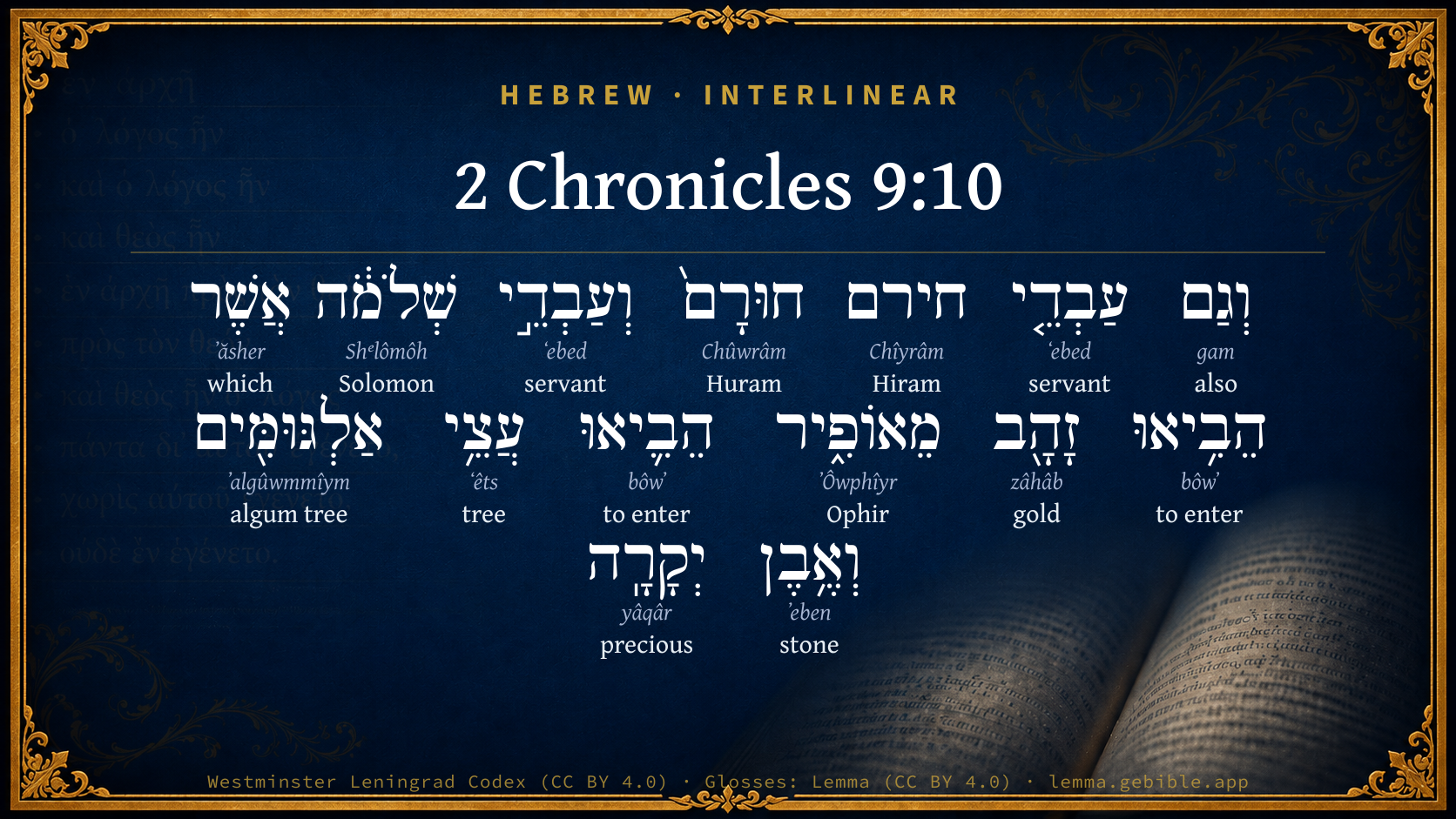
Hebrew (Westminster Leningrad Codex) 2 Chronicles 9:10 appears in the Hebrew Old Testament. The text above is from the Westminster Leningrad Codex. Each word links to its Strong’s number, a concise gloss, and parsing drawn from the Open Scriptures Hebrew Bible morphology. Click any word for its full Brown-Driver-Briggs (BDB) entry.
Download image
Cite this verse

2 Chronicles 9:10 (World English Bible). Public Domain. Lemma interlinear Bible study tool, https://lemma.gebible.app/v/2-chronicles/9/10.

Show BibTeX & RIS
BibTeX
RIS
English Translation
The servants also of Huram, and the servants of Solomon, who brought gold from Ophir, brought algum trees and precious stones.
World English Bible · Public Domain
Download a study sheet

One document with this verse’s original text, its word-by-word gloss line, the meaning frame, cross-references with their text, attributed commentary, and full source and license credits — printable, and it pastes into notes with its structure intact.

This verse Autodidact and up

Study sheet (.html) Plain text (.txt)

A passage Seminary Student

Up to 50 verses in one chapter. A passage sheet keeps up to 6 commentary sources and 12 cross-references per verse, in the order this page ranks them, and says so on the sheet whenever that leaves anything out. Ask for a single verse and you get the Autodidact verse sheet above.

Everything on this page stays free to read, with no account — the sheet is a download of what is already on screen, not access to it.

Want to remove ads? Support Godless Engineer
Compare translations 3

The same verse in 3 English versions, stacked beneath the original-language interlinear above. Click any original word for its lexicon entry.

Each is an independent rendering of the whole verse — the interlinear is not word-aligned to these translations.

Highlighted words mark where these versions differ — a whole-verse word diff, not a word-by-word alignment.

  • World English Bible Public Domain
    The servants also of Huram, and the servants of Solomon, who brought gold from Ophir, brought algum trees and precious stones.
  • King James Version Public Domain
    And the servants also of Huram, and the servants of Solomon, which brought gold from Ophir, brought algum trees and precious stones.
  • unfoldingWord Literal Text CC BY-SA 4.0
    And also the servants of Hiram and the servants of Solomon, who brought gold from Ophir, brought algum wood and precious stone.

unfoldingWord Literal Text — © unfoldingWord, licensed CC BY-SA 4.0. Word-aligned USFM3 via Door43 (git.door43.org/unfoldingWord/en_ult).

Versions to compare (up to 4)

3 of 4 selected

Show all 18 translations

Every available English version of this verse, each an independent rendering of the whole verse.

  • World English Bible Public Domain
    The servants also of Huram, and the servants of Solomon, who brought gold from Ophir, brought algum trees and precious stones.
  • Berean Standard Bible Public Domain
    (The servants of Hiram and of Solomon who brought gold from Ophir also brought algum wood and precious stones.
  • Majority Standard Bible Public Domain
    (The servants of Hiram and of Solomon who brought gold from Ophir also brought algum wood and precious stones.
  • King James Version Public Domain
    And the servants also of Huram, and the servants of Solomon, which brought gold from Ophir, brought algum trees and precious stones.
  • American Standard Version (1901) Public Domain
    And the servants also of Huram, and the servants of Solomon, that brought gold from Ophir, brought algum-trees and precious stones.
  • Revised Version (1885) Public Domain
    And the servants also of Huram, and the servants of Solomon, which brought gold from Ophir; brought algum trees and precious stones.
  • Geneva Bible (1599) Public Domain
    And the seruants also of Huram, and the seruants of Salomon which brought golde from Ophir, brought Algummim wood and precious stones.
  • Douay-Rheims (1899) Public Domain
    And the servants also of Hiram, with the servants of Solomon, brought gold from Ophir, and thyine trees, and most precious stones:
  • Young's Literal Translation Public Domain
    And also, servants of Huram, and servants of Solomon, who brought in gold from Ophir, have brought in algum-trees and precious stone.
  • Literal Standard Version CC BY-SA 4.0
    And also, servants of Huram, and servants of Solomon, who brought in gold from Ophir, have brought in algum-trees and precious stone.
  • Unlocked Literal Bible CC BY-SA 4.0
    The servants of Hiram and the servants of Solomon, who brought gold from Ophir, also brought algum wood and precious stones.
  • unfoldingWord Literal Text CC BY-SA 4.0
    And also the servants of Hiram and the servants of Solomon, who brought gold from Ophir, brought algum wood and precious stone.
  • Darby Bible Public Domain
    (And the servants also of Huram, and the servants of Solomon, who brought gold from Ophir, brought sandal-wood and precious stones.
  • World Messianic Bible Public Domain
    The servants of Huram and the servants of Solomon, who brought gold from Ophir, also brought algum trees and precious stones.
  • Webster's Bible Public Domain
    And the servants also of Huram, and the servants of Solomon, who brought gold from Ophir, brought algum trees and precious stones.
  • Free Bible Version CC BY-SA 4.0
    (Hiram and Solomon's men, who brought gold from Ophir, also brought algum wood and precious stones.
  • Bible in Basic English Public Domain
    And the servants of Huram and the servants of Solomon, in addition to gold from Ophir, came back with sandal-wood and jewels.
  • JPS Tanakh (1917) Public Domain
    And the servants also of Huram, and the servants of Solomon that brought gold from Ophir, brought sandal-wood and precious stones.

Literal Standard Version (2020), Covenant Press — licensed CC BY-SA 4.0. Text via the HelloAO Bible API (eBible.org). Unlocked Literal Bible (unfoldingWord) — licensed CC BY-SA 4.0. Text via the HelloAO Bible API (eBible.org). unfoldingWord Literal Text — © unfoldingWord, licensed CC BY-SA 4.0. Word-aligned USFM3 via Door43 (git.door43.org/unfoldingWord/en_ult). Free Bible Version, Dr. Jonathan Gallagher — licensed CC BY-SA 4.0. Text via the HelloAO Bible API (eBible.org).

Word by word

More ways to search: Search by grammar → Find every occurrence → Compare this word →

Practice this passage: Drill this verse → Learn its vocabulary →

אַלְגּוּמִּ֖ים
ʼalgûwmmîym
H418
“algum trees”
Noun, Common, Masculine, Plural, Absolute
Part of Speech
Noun
Type
Common
Gender
Masculine
Number
Plural
State
Absolute
Full BDB Definition

Origin: by transposition for H484

TWOT: 89b

a tree (from Lebanon), algum trees
  1. וְגַם gam H1571 “and · also” Conjunction + Particle, Accusative
  2. עַבְדֵ֤י ʻebed H5650 “servants of” Noun, Common, Masculine, Plural, Construct
  3. חירם Chîyrâm H2438 “Hiram” Noun, Proper
  4. חוּרָם֙ Chûwrâm H2361 “Huram” Noun, Proper
  5. וְעַבְדֵ֣י ʻebed H5650 “and · servants of” Conjunction + Noun, Common, Masculine, Plural, Construct
  6. שְׁלֹמֹ֔ה Shᵉlômôh H8010 “Solomon” Noun, Proper
  7. אֲשֶׁר ʼăsher H834 “which” Particle, Relative
  8. הֵבִ֥יאוּ bôwʼ H935 “to enter” Verb, Hiphil, Perfect, 3rd Person, Common, Plural
  9. זָהָ֖ב zâhâb H2091 “gold” Noun, Common, Masculine, Singular, Absolute
  10. מֵאוֹפִ֑יר ʼÔwphîyr H211 “from · Ophir” Preposition + Noun, Proper
  11. הֵבִ֛יאוּ bôwʼ H935 “to enter” Verb, Hiphil, Perfect, 3rd Person, Common, Plural
  12. עֲצֵ֥י ʻêts H6086 “trees of” Noun, Common, Masculine, Plural, Construct
  13. וְאֶ֥בֶן ʼeben H68 “and · stone” Conjunction + Noun, Common, Feminine, Singular, Absolute
  14. יְקָרָֽה yâqâr H3368 “precious” Adjective, Adjective, Feminine, Singular, Absolute

About this verse

These counts appear in no published source. They are computed here, from the morphology-tagged text and Lemma’s own curated glosses. What Lemma adds →

15
words
13
distinct lemmas
Historical
section

Notable vocabulary

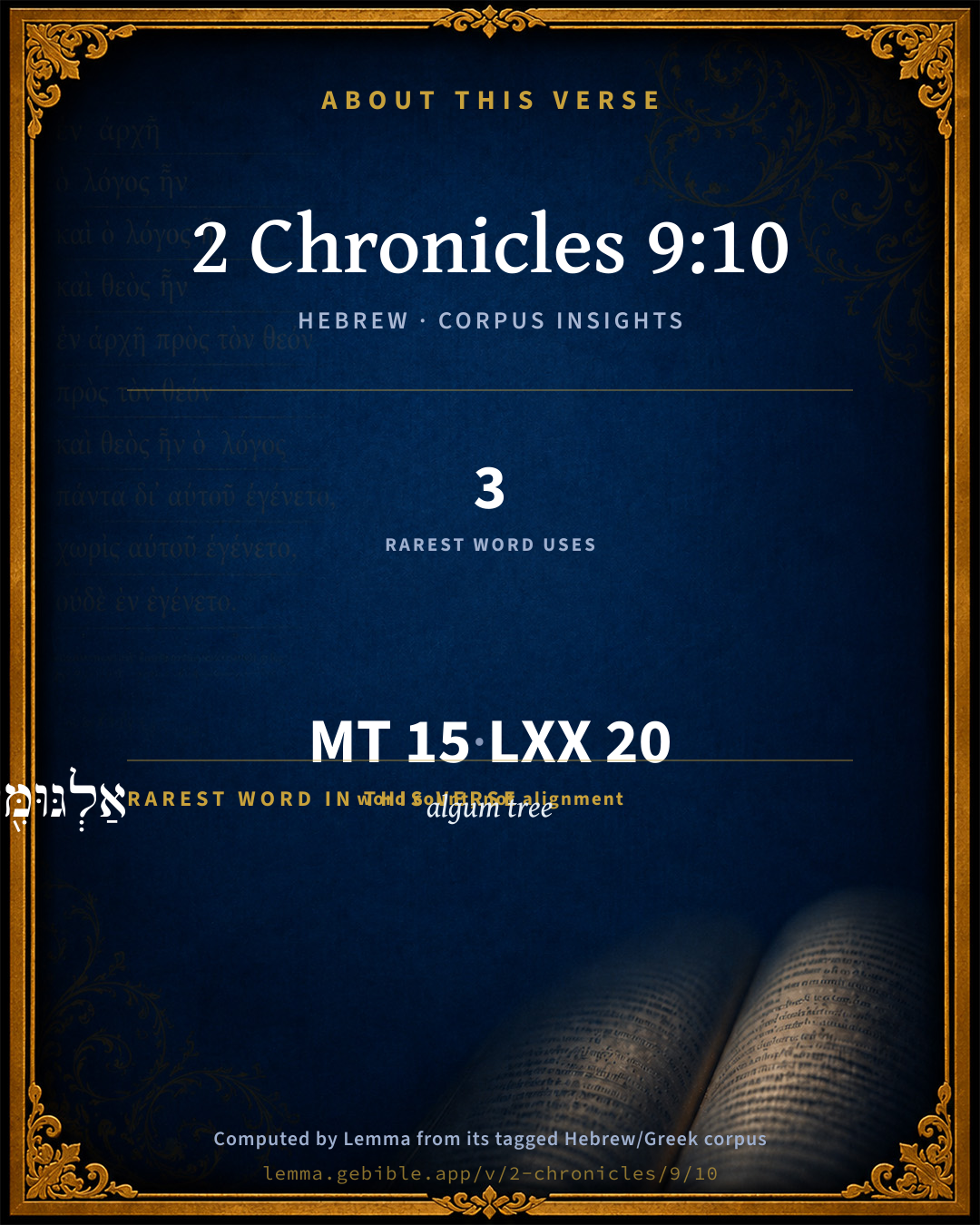
The rarest word here is אַלְגּוּמִּ֖ים algum tree H418 — appearing just 3 times in the whole Hebrew Bible.

Shared distinctive vocabulary

אַלְגּוּמִּ֖ים algum tree H418 occurs in 3 verses of the Hebrew Bible. Also found in:

Grammatical profile

  • 2 verbs
  • 10 nouns
  • 1 adjective
  • 2 particles

Verb forms

  • הֵבִ֥יאוּ Hiphil · Perfect
  • הֵבִ֛יאוּ Hiphil · Perfect

Repetition

Words recur within this verse — often emphatic in Hebrew:

  • עַבְדֵ֤י servant H5650 ×2
  • הֵבִ֥יאוּ to enter H935 ×2

Hebrew & Septuagint length

In English translation the verse runs 21 words from the Hebrew and 23 from the Septuagint (LXX English) — closely comparable.

A rough comparison of the two English renderings, which tokenize alike — not a word-level alignment.

Word counts can differ between the Hebrew and the Greek without any difference in meaning — e.g. the Hebrew direct-object marker אֵת has no separate Greek word, and Greek often adds the article ὁ.

In the original languages it is 15 Hebrew tokens and 20 Greek tokens — but the two are counted differently (Hebrew bundles its prefixes and suffixes into one token; the Greek is in lemma form), so that isn’t a like-for-like length.

Cross-references

4

Topical passages linked to 2 Chronicles 9:10 in the Treasury of Scripture Knowledge — connected by theme and wording, ordered by reader-vote popularity; previews shown in the World English Bible.

  • 2 Chronicles 8:18 Huram sent him by the hands of his servants ships, and servants who had knowledge of the sea; and they came with the servants of Solomon to Ophir, and fetched from there four hundred fifty talents of gold, and brought them to king Solomon.
  • 1 Kings 10:11 The navy also of Hiram, that brought gold from Ophir, brought in from Ophir great plenty of almug trees and precious stones.
  • 1 Kings 9:27–28 Hiram sent in the navy his servants, sailors who had knowledge of the sea, with the servants of Solomon.
  • 1 Kings 10:22 For the king had at sea a navy of Tarshish with the navy of Hiram: once every three years came the navy of Tarshish, bringing gold, and silver, ivory, and apes, and peacocks.

Cross-references courtesy of OpenBible.info (CC BY 4.0).

Hebrew and Greek witnesses Masoretic Hebrew ↔ Greek Septuagint

The same verse in the two great witnesses to the Old Testament, shown verse-for-verse.

These are two independent witnesses, not word-aligned to each other, and the Septuagint is shown in lemma (dictionary) form.

Hebrew 2 Chronicles 9:10 Masoretic · Westminster Leningrad Codex

וְגַם עַבְדֵ֤י חירם חוּרָם֙ וְעַבְדֵ֣י שְׁלֹמֹ֔ה אֲשֶׁר הֵבִ֥יאוּ זָהָ֖ב מֵאוֹפִ֑יר הֵבִ֛יאוּ עֲצֵ֥י אַלְגּוּמִּ֖ים וְאֶ֥בֶן יְקָרָֽה

The servants also of Huram, and the servants of Solomon, who brought gold from Ophir, brought algum trees and precious stones.

World English Bible · Public Domain

Greek LXX 2 Chronicles 9:10 Septuagint · lemma form

καί ὁ παῖς σαλωμών καί ὁ παῖς χιραμ φέρω χρυσίον ὁ σαλωμών ἐκ σουφιρ καί ξύλον πεύκινος καί λίθος τίμιος

And the servants of Solomon and the servants of Chiram brought gold to Solomon out of Suphir, and pine timber, and precious stones.

LXX2012 (modern English Septuagint) · Public Domain

On this verse, Ellicott's Commentary for English Readers discusses the Septuagint’s reading. Read the note in Commentary ↓

Hebrew: Westminster Leningrad Codex (CC BY 4.0). Greek: Septuagint (public domain); English from LXX2012 (modern English Septuagint) (Public Domain). How the Septuagint differs from the Hebrew →

Commentary

Notes on 2 Chronicles 9:10 from classic Christian and Jewish commentators (each source and its license shown beneath its notes). The classic Christian expositions comment on the surrounding passage and are grouped to its opening verse, so a note may address several verses; the Jewish commentaries on the Tanakh (Rashi and others) are per-verse, so they appear only where the commentator wrote on this verse.

Lemma curates 59 commentaries, every one of them public domain or Creative Commons licensed, each selected and text-cleaned for this edition rather than reprinted as found. About our sources →

Trapp's Complete Commentary

John Trapp

2Ch 9:10 And the servants also of Huram, and the servants of Solomon, which brought gold from Ophir, brought algum trees and precious stones.

Ver. 10. And the servants also of Huram.] See 1Ki 10:11.

Brought algum trees.] Not corals, as some would have it, but brazil wood, or rather ebony.

John Trapp, A Commentary or Exposition upon All the Books of the Old and New Testament (1647–1656) — public domain. Text from a community e-Sword module.

The Pulpit Commentary

Vers. 10, 11. Either these two verses are misplaced (with their parallel, (1Ki_10:11, 1Ki_10:12) or they ought to have, though unstated, some occult bearing on the queen. There are some slight indications pointing to this, and the meaning is perhaps that the terraces, balustrades, stairs (which possibly is the idea in the "ascent," ver. 4), pillars, etc., made of the wood which Hiram"s and Solomon"s servants had formerly brought with gold, were the artificial-work wonders which helped to astound the queen. Terraces to the house of the Lord, and to the king"s palace. These so rendered terraces were probably stairs, and, as already intimated, may have composed the "ascent" (ver. 4), and explain the mention of it in ver. 4. The algum trees. This is the Hebrew text order of the lamed and gimel alphabet characters, as the Authorized Version order in the parallel almug is also the order of its Hebrew. The tree is mentioned only six times three times in Chronicles (2Ch_2:8 2Ch_9:10, 2Ch_9:11) and three times in. (1Ki_10:11, 1Ki_10:12) Apparently this wood did grow in Lebanon, (2Ch_2:8) though we think this not certain. Kimchi thinks it was the bukkum (Arabic word), which Europeans call Brazil wood, and which (Keil) was found in Ethiopia, as well as India. Some think it the sandal-wood of Malabar. Whatever it was, it no doubt was to be purchased at the emporium of Ophir. The intrinsic nature of the wood, and its intrinsically valuable nature, may easily be inferred from its use for the woodwork and sounding-board woodwork of musical instruments like the harp and psaltery. This fact would much incline to the view that the red sandal-wood is what is here called algum. The "Speaker"s Commentary" quotes Max Muller ("Lectures on Language," 1st series, p. 191) for the statement that the vernacular for this wood in India is valguka. Harps psalteries. (see our Exposition on 2Ch_5:12, and articles in Smith"s" Dictionary of the Bible," and others) The sentence, there were none such seen in the land of Judah, may Be read as an indication that they had been part of the exhibition made to the Queen of Sheba.

The Pulpit Commentary (1880–1919), ed. H.D.M. Spence-Jones & Joseph S. Exell — public domain. Text from a community e-Sword module.

Geneva Bible (1599)

Geneva Bible translators

Read 2 Chron. 2:8 and 1 Kings 10:11.

Geneva Bible (1599) marginal notes — public domain. Text via Bolls.life.

Ellicott's Commentary for English Readers

(10) And the servants also of Huram, and the servants of Solomon.—Kings, “And the fleet also of Huram which carried gold from Ophir.” The phrase is altered here to correspond with 2Ch_8:18.

Brought algum trees.—See 2Ch_2:8. LXX., ξύλα πεύκιυα; Vulg., “ligna thyina;” Syriac, “acacia (?) wood” (’eshkor‘ô); Kings, “brought from Ophir almug trees in great abundance.” In the Mishna ’almûg is “coral;” and the Rabbis ascribe a red colour to the algum wood. The Pterocarpus Santalinus has blood-red wood with black streaks, is fragrant, and is used in works of art, as well as for burning. The tree called Valgu or Valgum is the Santalum album, which produces white and yellow sandalwood. Thenius doubts whether the algum wood of Solomon was not the teak (Cytharexylon Tectona), which abounds in East India, and is a hard, yellow-streaked, strongly-scented wood, used in India for temple building.

A Bible Commentary for English Readers, edited by Charles John Ellicott (1878–1897) — public domain. Text from a community e-Sword module.

The Cambridge Bible for Schools and Colleges

gen. ed. J. J. S. Perowne

10. algum trees] in 1 Kin. “almug trees.” Cp. 2Ch_2:8 (note).

10, 11. These vv. interrupt the connexion. 2Ch_9:12 concludes the account of the visit of the Queen of Sheba.

The Cambridge Bible for Schools and Colleges (gen. ed. J. J. S. Perowne; Cambridge University Press, 1878–1918) — public domain. Text from a community e-Sword module.

Haydock's Catholic Bible Commentary

Thyine-trees, very odoriferous. (Calmet) --- Hebrew algumim: 3 Kings almugim, as the letters are frequently transposed in Hebrew. (Du Hamel) --- Huet thinks these were citron-trees, which did not produce fruit, but were used to make costly tables, and were a species of cedar.

George Leo Haydock (1774–1849), Haydock's Catholic Family Bible and Commentary, 1859 edition — public domain. Excludes Psalms (Douay-Rheims chapter numbering differs from Protestant) and Deuterocanonical books (Catholic canon only).

unfoldingWord translationNotes

Door43 World Missions Community

Hiram

Hiram was the king of Tyre. See how you translated his name in 2 Chronicles 2:11. AT: "Hiram, the king of Tyre" or "King Hiram" (See: How to Translate Names)

Ophir

This is the name of a place. Its location is not known. See how you translated this in 2 Chronicles 8:18. (See: How to Translate Names)

algum wood

Algum is a kind of tree that grows in Lebanon. King Hiram sent this kind of wood to Solomon. See how you translated it in 2 Chronicles 2:8.

the king made steps ... well as harps and lyres

The author speaks of the king having his workers make these things as if he himself had made them. AT: "the king had his workers make the steps .. as well as harps and lyres" or "the king's workers made steps ... well as harps and lyres" (See: Metonymy)

No wood like this had been seen before in the land of Judah

This can be stated in active form. AT: "No one had seen wood like this before in the land of Judah" (See: Active or Passive)

translationWords

servant

Solomon

house of God

harp

lute

Judah

unfoldingWord translationNotes — © Distant Shores Media and the Door43 World Missions Community, licensed CC BY-SA 4.0. Source: git.door43.org/Door43/en_tn.

Rashi

Rabbi Shlomo Yitzchaki (Rashi)

algom wood In Pesikta it is explained: One verse (I Kings 10:11) says אַלְמֻגִּים, and one verse says אַלְגּוּמִּים. The truth is that its name is אַלְגּוּמִּים, but it is called אַלְמֻגִּים because it melted and bent because of its softness, (like cups, which bend because of their value.)

Rashi on the Tanakh — English translations: “The Judaica Press complete Tanach with Rashi, translated by A. J. Rosenberg” (CC BY 4.0); “Pentateuch with Rashi's commentary by M. Rosenbaum and A.M. Silbermann, 1929-1934” (public domain); “The Metsudah Tanach series, Lakewood, N.J” (CC BY 4.0); and “The Book of Joshua, Metsudah Publications, 1997” (CC BY 4.0). Text via Sefaria.

Lesson kit

Teaching starters — assembled from the data on this page, not authored interpretation. Every prompt links to the verse data it draws on. Edit before teaching.

2 Chronicles, in the Historical, opens this verse with 15 words (13 distinct Hebrew lemmas). Its most distinctive word is ʼalgûwmmîym (“algum tree”). A historical commentator’s framing appears above. Read the whole chapter for the surrounding context.

Discussion questions

  1. How does “algum tree” (ʼalgûwmmîym) shape what this verse is saying?
  2. 2 Chronicles 2:8 shares the word «algum tree» with this verse. How do the two illuminate each other?
  3. “servant” occurs 2× in this one verse. What is the effect of the repetition?
  4. These translations render this verse differently; the difference is in the English rendering, not the original. What questions does that raise?
  5. The verb «הֵבִ֥יאוּ» is Hiphil Perfect. How does its form color the action?
  6. Reading how Trapp's Complete Commentary and The Pulpit Commentary read this verse, where do the two commentators agree and where do they part?

Things to notice

Reading settings

Reading text

Shown beneath each verse's original-language words.

Old Testament
Old Testament edition

Read the OT as the Masoretic Hebrew (MT) or the Greek Septuagint (LXX).

English shown for the Greek Septuagint (in the Hebrew ↔ Greek comparison).

Comparing translations? Open the Compare panel on any verse page to stack up to four side by side.