
Deuteronomy 18:13

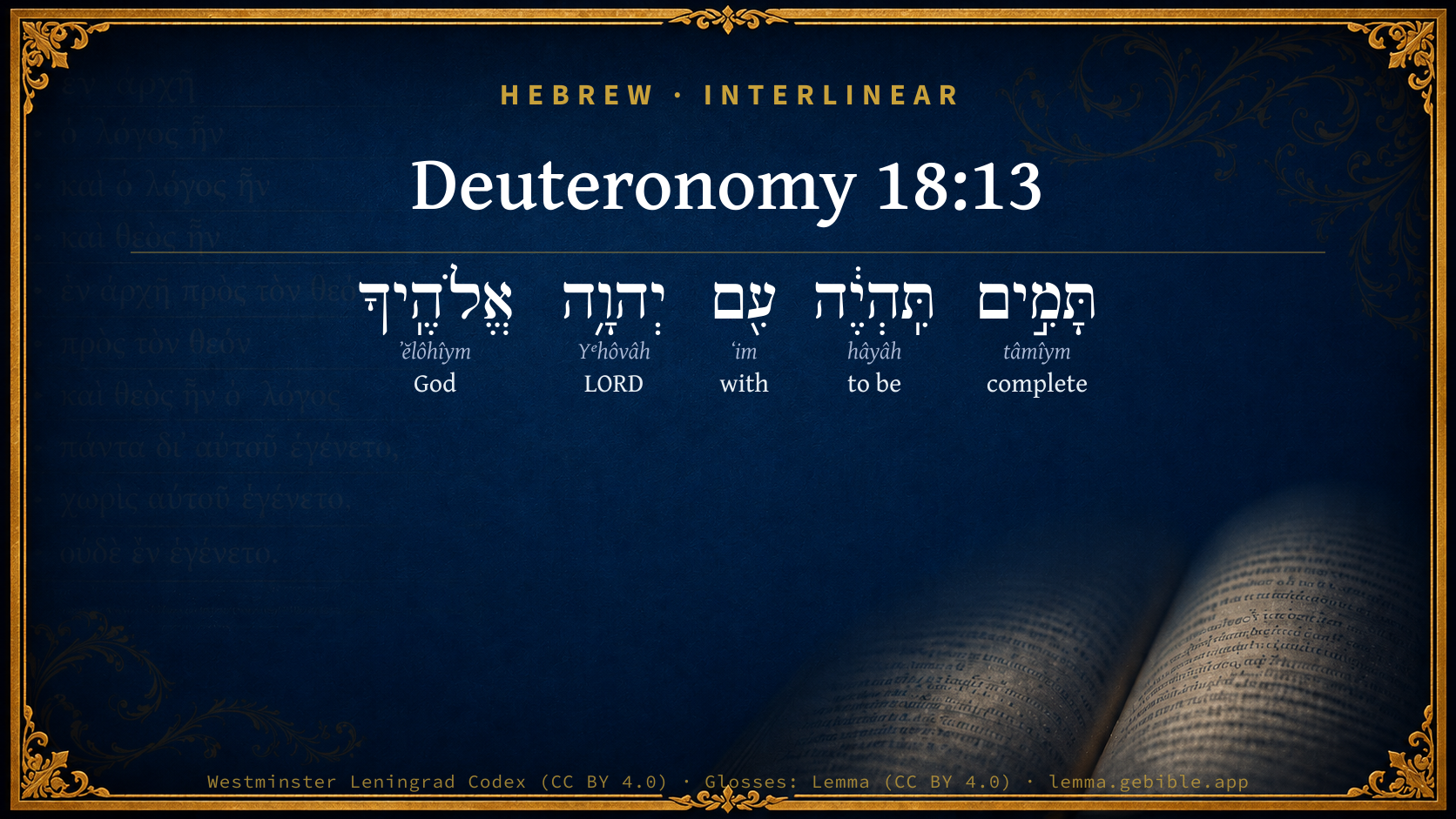
Hebrew (Westminster Leningrad Codex) Deuteronomy 18:13 appears in the Hebrew Old Testament. The text above is from the Westminster Leningrad Codex. Each word links to its Strong’s number, a concise gloss, and parsing drawn from the Open Scriptures Hebrew Bible morphology. Click any word for its full Brown-Driver-Briggs (BDB) entry.
Download image
Cite this verse

Deuteronomy 18:13 (World English Bible). Public Domain. Lemma interlinear Bible study tool, https://lemma.gebible.app/v/deuteronomy/18/13.

Show BibTeX & RIS
BibTeX
RIS
English Translation
You shall be perfect with Yahweh your God.
World English Bible · Public Domain
Download a study sheet

One document with this verse’s original text, its word-by-word gloss line, the meaning frame, cross-references with their text, attributed commentary, and full source and license credits — printable, and it pastes into notes with its structure intact.

This verse Autodidact and up

Study sheet (.html) Plain text (.txt)

A passage Seminary Student

Up to 50 verses in one chapter. A passage sheet keeps up to 6 commentary sources and 12 cross-references per verse, in the order this page ranks them, and says so on the sheet whenever that leaves anything out. Ask for a single verse and you get the Autodidact verse sheet above.

Everything on this page stays free to read, with no account — the sheet is a download of what is already on screen, not access to it.

Want to remove ads? Support Godless Engineer
Compare translations 3

The same verse in 3 English versions, stacked beneath the original-language interlinear above. Click any original word for its lexicon entry.

Each is an independent rendering of the whole verse — the interlinear is not word-aligned to these translations.

Highlighted words mark where these versions differ — a whole-verse word diff, not a word-by-word alignment.

  • World English Bible Public Domain
    You shall be perfect with Yahweh your God.
  • King James Version Public Domain
    Thou shalt be perfect with the LORD thy God.
  • unfoldingWord Literal Text CC BY-SA 4.0
    You shall be blameless with Yahweh your God.

unfoldingWord Literal Text — © unfoldingWord, licensed CC BY-SA 4.0. Word-aligned USFM3 via Door43 (git.door43.org/unfoldingWord/en_ult).

Versions to compare (up to 4)

3 of 4 selected

Show all 18 translations

Every available English version of this verse, each an independent rendering of the whole verse.

  • World English Bible Public Domain
    You shall be perfect with Yahweh your God.
  • Berean Standard Bible Public Domain
    You must be blameless before the LORD your God.
  • Majority Standard Bible Public Domain
    You must be blameless before the LORD your God.
  • King James Version Public Domain
    Thou shalt be perfect with the LORD thy God.
  • American Standard Version (1901) Public Domain
    Thou shalt be perfect with Jehovah thy God.
  • Revised Version (1885) Public Domain
    Thou shalt be perfect with the LORD thy God.
  • Geneva Bible (1599) Public Domain
    Thou shalt be vpright therefore with the Lord thy God.
  • Douay-Rheims (1899) Public Domain
    Thou shalt be perfect, and without spot before the Lord thy God.
  • Young's Literal Translation Public Domain
    Perfect thou art with Jehovah thy God,
  • Literal Standard Version CC BY-SA 4.0
    You must be perfect with your God YHWH,
  • Unlocked Literal Bible CC BY-SA 4.0
    You must be blameless before Yahweh your God.
  • unfoldingWord Literal Text CC BY-SA 4.0
    You shall be blameless with Yahweh your God.
  • Darby Bible Public Domain
    Thou shalt be perfect with Jehovah thy God.
  • World Messianic Bible Public Domain
    You shall be blameless with the LORD your God.
  • Webster's Bible Public Domain
    Thou shalt be perfect with the LORD thy God.
  • Free Bible Version CC BY-SA 4.0
    You are to be innocent of such things in the presence of the Lord your God.
  • Bible in Basic English Public Domain
    You are to be upright in heart before the Lord your God.
  • JPS Tanakh (1917) Public Domain
    Thou shalt be whole-hearted with the LORD thy God.

Literal Standard Version (2020), Covenant Press — licensed CC BY-SA 4.0. Text via the HelloAO Bible API (eBible.org). Unlocked Literal Bible (unfoldingWord) — licensed CC BY-SA 4.0. Text via the HelloAO Bible API (eBible.org). unfoldingWord Literal Text — © unfoldingWord, licensed CC BY-SA 4.0. Word-aligned USFM3 via Door43 (git.door43.org/unfoldingWord/en_ult). Free Bible Version, Dr. Jonathan Gallagher — licensed CC BY-SA 4.0. Text via the HelloAO Bible API (eBible.org).

Word by word

More ways to search: Search by grammar → Find every occurrence → Compare this word →

Practice this passage: Drill this verse → Learn its vocabulary →

תָּמִ֣ים
tâmîym
H8549
“complete”
Adjective, Adjective, Masculine, Singular, Absolute
Part of Speech
Adjective
Type
Adjective
Gender
Masculine
Number
Singular
State
Absolute
Full BDB Definition

Origin: from H8552

TWOT: 2522d

complete, whole, entire, sound - complete, whole, entire - whole, sound, healthful - complete, entire (of time) - sound, wholesome, unimpaired, innocent, having integrity - what is complete or entirely in accord with truth and fact (neuter adjective/substantive)
  1. תִּֽהְיֶ֔ה hâyâh H1961 “to be” Verb, Qal, Imperfect, 2nd Person, Masculine, Singular
  2. עִ֖ם ʻim H5973 “with” Preposition
  3. יְהוָ֥ה Yᵉhôvâh H3068 “LORD” Noun, Proper
  4. אֱלֹהֶֽיךָ ʼĕlôhîym H430 “God(s) · your” Noun, Common, Masculine, Plural, Construct + Suffix, Personal, 2nd Person, Masculine, Singular

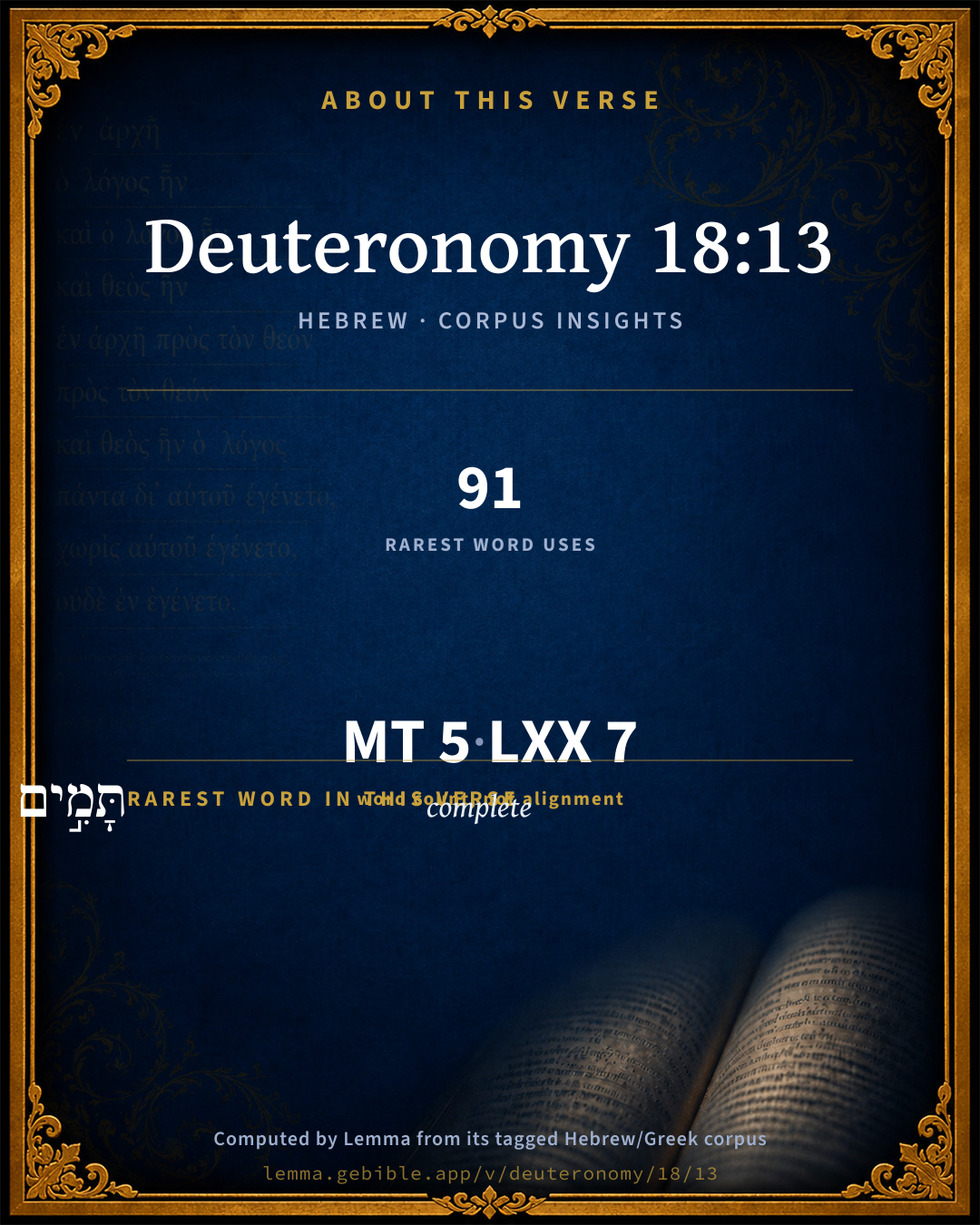
About this verse

These counts appear in no published source. They are computed here, from the morphology-tagged text and Lemma’s own curated glosses. What Lemma adds →

5
words
5
distinct lemmas
Pentateuch
section

Grammatical profile

  • 1 verb
  • 2 nouns
  • 1 adjective
  • 1 preposition

Verb forms

  • תִּֽהְיֶ֔ה Qal · Imperfect

Hebrew & Septuagint length

In English translation the verse runs 8 words from the Hebrew and 9 from the Septuagint (LXX English) — closely comparable.

A rough comparison of the two English renderings, which tokenize alike — not a word-level alignment.

Word counts can differ between the Hebrew and the Greek without any difference in meaning — e.g. the Hebrew direct-object marker אֵת has no separate Greek word, and Greek often adds the article ὁ.

In the original languages it is 5 Hebrew tokens and 7 Greek tokens — but the two are counted differently (Hebrew bundles its prefixes and suffixes into one token; the Greek is in lemma form), so that isn’t a like-for-like length.

Cross-references

9

Topical passages linked to Deuteronomy 18:13 in the Treasury of Scripture Knowledge — connected by theme and wording, ordered by reader-vote popularity; previews shown in the World English Bible.

  • Matthew 5:48 Therefore you shall be perfect, just as your Father in heaven is perfect.
  • Genesis 17:1 When Abram was ninety-nine years old, Yahweh appeared to Abram, and said to him, "I am God Almighty. Walk before me, and be blameless.
  • Genesis 6:9 This is the history of the generations of Noah. Noah was a righteous man, blameless among the people of his time. Noah walked with God.
  • Job 1:1 There was a man in the land of Uz, whose name was Job. That man was blameless and upright, and one who feared God, and turned away from evil.
  • Job 1:8 Yahweh said to Satan, "Have you considered my servant, Job? For there is none like him in the earth, a blameless and an upright man, one who fears God, and turns away from evil."
  • Psalms 37:37 Mark the perfect man, and see the upright, For there is a future for the man of peace.
  • Philippians 3:12 Not that I have already obtained, or am already made perfect; but I press on, if it is so that I may take hold of that for which also I was taken hold of by Christ Jesus.
  • Philippians 3:15 Let us therefore, as many as are perfect, think this way. If in anything you think otherwise, God will also reveal that to you.
  • Revelation 3:2 Wake up, and keep the things that remain, which you were about to throw away, for I have found no works of yours perfected before my God.

Cross-references courtesy of OpenBible.info (CC BY 4.0).

Hebrew and Greek witnesses Masoretic Hebrew ↔ Greek Septuagint

The same verse in the two great witnesses to the Old Testament, shown verse-for-verse.

These are two independent witnesses, not word-aligned to each other, and the Septuagint is shown in lemma (dictionary) form.

Hebrew Deuteronomy 18:13 Masoretic · Westminster Leningrad Codex

תָּמִ֣ים תִּֽהְיֶ֔ה עִ֖ם יְהוָ֥ה אֱלֹהֶֽיךָ

You shall be perfect with Yahweh your God.

World English Bible · Public Domain

Greek LXX Deuteronomy 18:13 Septuagint · lemma form

τέλειος εἰμί ἐναντίον κύριος ὁ θεός σύ

You shall be perfect before the Lord your God.

LXX2012 (modern English Septuagint) · Public Domain

Hebrew: Westminster Leningrad Codex (CC BY 4.0). Greek: Septuagint (public domain); English from LXX2012 (modern English Septuagint) (Public Domain). How the Septuagint differs from the Hebrew →

Targum (Aramaic paraphrase)

2

The Targum is the ancient Jewish Aramaic paraphrase of the Hebrew Scriptures — an interpretive translation, not the Hebrew text itself. Onkelos (literal) and Pseudo-Jonathan (expansive) render the Torah, and Jonathan the Prophets. Coverage is partial: where no permissively-licensed English translation exists for a verse, only the Aramaic is shown. This is verse-level text, not a word-by-word alignment to the Hebrew.

  1. Targum Onkelos Torah (Genesis–Deuteronomy)
    שְׁלִים תְּהֵי בְּדַחַלְתָּא דַיְיָ אֱלָהָךְ

    (no public-domain English translation for this verse)

    Targum Onkelos — Aramaic: “Onkelos Genesis” (public domain); “Onkelos Exodus” (public domain); “Onkelos Leviticus” (public domain); “Onkelos Numbers” (public domain); “Onkelos Deuteronomy” (public domain). English: “Sefaria Community Translation” (CC0 1.0 (public-domain dedication)); “J.W. Etheridge. The Targums of Onkelos and Jonathan Ben Uzziel on the Pentateuch. London: Longmans, Green, 1862” (public domain). Text via Sefaria.

  2. Targum Pseudo-Jonathan Torah (Genesis–Deuteronomy)
    שַׁלְמִין תְּהוֹן בְּדַחַלְתָּא דַיְיָ אֱלָהָכוֹן

    Ye shall be perfect in the fear of the Lord your God.

    Targum Pseudo-Jonathan — Aramaic: “Targum Jonathan on Genesis” (public domain); “Targum Jonathan on Exodus” (public domain); “Targum Jonathan on Leviticus” (public domain); “Targum Jonathan on Numbers” (public domain); “Targum Jonathan on Deuteronomy” (public domain). English: “The Targum of Jonathan ben Uzziel, trans. J. W. Etheridge, London, 1862” (public domain). Text via Sefaria.

Commentary

Notes on Deuteronomy 18:13 from classic Christian and Jewish commentators (each source and its license shown beneath its notes). The classic Christian expositions comment on the surrounding passage and are grouped to its opening verse, so a note may address several verses; the Jewish commentaries on the Tanakh (Rashi and others) are per-verse, so they appear only where the commentator wrote on this verse.

Lemma curates 59 commentaries, every one of them public domain or Creative Commons licensed, each selected and text-cleaned for this edition rather than reprinted as found. About our sources →

Trapp's Complete Commentary

John Trapp

Deu 18:13 Thou shalt be perfect with the LORD thy God.

Ver. 13. Thou shalt be perfect.] {See Trapp on "Mat 5:48"} In the original there is a bigger tau than ordinary in the word Tamim, rendered perfect, to show, say Hebricians, that we must keep the whole law of God from the first letter thereof to the last - tau is the last letter of the alphabet - and this we must do constantly to the very last, and with the whole man. But how can this be done otherwise than by running to Christ, and in an evangelical way? In sincerity and integrity we must hate such wicked persons, even as God also hateth them. {Psa 139:21-24} {Hebrew Text Note}

John Trapp, A Commentary or Exposition upon All the Books of the Old and New Testament (1647–1656) — public domain. Text from a community e-Sword module.

Joseph Benson's Commentary

Deu 18:13-14. Thou shalt be perfect with the Lord thy God — Sincerely and wholly his, seeking him and cleaving to him, and to his word alone, and therefore abhorring all commerce and conversations with devils. Hath not suffered thee so to do — Hath not suffered thee to follow these superstitious and diabolical practices, as he hath suffered other nations to do, but hath instructed thee better by his word and Spirit, and will more fully instruct thee by a great Prophet.

Joseph Benson's Commentary on the Old and New Testaments (1811–1818) — public domain. Text from a community e-Sword module.

Geneva Bible (1599)

Geneva Bible translators

Without hypocrisy or mixture or false religion.

Geneva Bible (1599) marginal notes — public domain. Text via Bolls.life.

Ellicott's Commentary for English Readers

(13) Thou shalt be perfect with the Lord thy God.—Rashi’s note on this is worth preserving: “Thou shalt walk with Him in sincerity, and wait for Him. And thou shalt not pry into the future. But whatsoever cometh upon thee, take it with simplicity, and then thou shalt be with Him, and be His portion.”

A Bible Commentary for English Readers, edited by Charles John Ellicott (1878–1897) — public domain. Text from a community e-Sword module.

The Cambridge Bible for Schools and Colleges

gen. ed. J. J. S. Perowne

13. perfect] blameless; not elsewhere in D, but twice in P in this moral sense (Gen_6:9 of Noah, Deu_17:1 required of Abraham as the condition of God granting him His covenant) and frequent in a physical sense, Lev_1:3; Lev_1:10; Lev_3:1, etc. The sense of the incompatibility of magic and necromancy with loyalty to the God of Israel is traceable from at least Saul’s time onward, and is very articulate in the great prophets. The instinct was sound. That such practices divert men from the rational and ethical elements of religion and weaken both the judgement and will of those who resort to them is notorious in the history of modern spiritualism. Cp. Luk_16:31 : if they hear not Moses and the prophets, neither will they be persuaded, if one rise from the dead. Let other nations hearken to soothsayers and diviners, God does not grant such to His people (Deu_18:14). For them the living word of the living God is the thing! (Isa_8:19), to which this law now therefore naturally turns.

The Cambridge Bible for Schools and Colleges (gen. ed. J. J. S. Perowne; Cambridge University Press, 1878–1918) — public domain. Text from a community e-Sword module.

John Gill's Exposition

Thou shalt be perfect with the Lord thy God. Sincerely serve and worship him, faithfully adhere to his word, laws, statutes, and ordinances, and walk uprightly before him.

Thou shalt be perfect with the Lord thy God. Sincerely serve and worship him, faithfully adhere to his word, laws, statutes, and ordinances, and walk uprightly before him.

Deuteronomy 18:14

deu 18:14

deu 18:14

deu 18:14For those nations which thou shall possess hearkened unto observers of times, and unto diviners,.... Such as are before mentioned, and did as they directed them:

but as for thee, the Lord thy God hath not suffered thee so to do; or, "but thou not so" (m) thou shouldest not do so, not hearken to such persons, but to the Lord thy God, and to his law and testimony; nor art thou left to the deception of such persons:

the Lord thy God hath given thee: his word and statutes, as a rule to go by, which he has not given to other nations: the Targum of Jonathan adds,"the priests shall ask by Urim and Thummim, and a true prophet shall the Lord your God give unto you;''so that they had no need to hearken to such impostors and deceivers: or, "as for thee, not so are they whom the Lord thy God giveth thee" (n); that is, the prophets whom the Lord would give unto them would not be like the diviners of the Heathens, who imposed on the people and deceived them; but would be men sent and inspired by God, and true and faithful in the discharge of their office; and to hearken to these they are encouraged by the promise of a very eminent one, like to Moses, in the next verse.

(m) "et tu non sic", Montanus. (n) "De teau tem non ita sunt quos dat tibi Jehova Deus tuus", Junius & Tremellius.

John Gill's Exposition of the Whole Bible (1746–1763) — public domain (CC PDM 1.0). Text via the HelloAO Bible API.

Albert Barnes' Notes on the Bible

Perfect - As in Gen 17:1; Job 1:1; Mat 5:48. The sense is that Israel was to keep the worship of the true God wholly uncontaminated by idolatrous pollutions.

Albert Barnes' Notes on the Bible (1834–1885) — public domain. Text from a community e-Sword/MySword module.

Haydock's Catholic Bible Commentary

And without spot. This is by way of explication of the word perfect. Any mixture of superstition in the worship of God is hateful to him; and that man who acknowledges any other spirit capable of foretelling what will come to pass, freely (Haydock) denies the Lord. (Calmet)

George Leo Haydock (1774–1849), Haydock's Catholic Family Bible and Commentary, 1859 edition — public domain. Excludes Psalms (Douay-Rheims chapter numbering differs from Protestant) and Deuterocanonical books (Catholic canon only).

Matthew Poole's English Annotations

Sincerely and wholly his, seeking him and cleaving to him and to his word alone, and therefore abhorring all commerce and conversations with devils or their agents, such as were now mentioned.

Matthew Poole's English Annotations on the Holy Bible (1683–1685) — public domain. Text from a community e-Sword/MySword module.

Whedon's Commentary on the Bible

Daniel D. Whedon

13. Thou shalt be perfect with the Lord thy God — Blameless with Jehovah, wholly devoted to him. The people of Israel are not to be like these nations; they are to be blameless in seeking intercourse with their God. In the rabbinical copies of the Hebrew Bible the initial consonant of the word rendered perfect (תמים) is large, to denote the special significance of this precept.

Daniel D. Whedon (gen. ed.), Commentary on the Old and New Testaments (1874–1909) — public domain. Text from a community e-Sword module.

The Pulpit Commentary

Thou shalt be perfect with the Lord thy God. The word translated "per-feet" properly means entire, whole, answering to the Latin integer; it is used only in a moral sense, and is best rendered by "upright;" the Israelites were to be upright and sincere with, i.e. in relation with, Jehovah their God.

The Pulpit Commentary (1880–1919), ed. H.D.M. Spence-Jones & Joseph S. Exell — public domain. Text from a community e-Sword module.

John Wesley's Explanatory Notes

Perfect - Sincerely and wholly his, seeking him and cleaving to him and to his word alone, and therefore abhorring all commerce and conversations with devils.

John Wesley, Explanatory Notes Upon the Whole Bible (1754–1765) — public domain. Text via the GEBible commentary corpus.

Rashi

Rabbi Shlomo Yitzchaki (Rashi)

תמים תהיה עם ה' אלהיך THOU SHALT BE PERFECT WITH THE LORD THY GOD — walk before him whole-heartedly, put thy hope in Him and do not attempt to investigate the future, but whatever it may be that comes upon thee accept it whole-heartedly, and then thou shalt be with Him and become His portion (Sifrei Devarim 173:3).

Rashi on the Tanakh — English translations: “The Judaica Press complete Tanach with Rashi, translated by A. J. Rosenberg” (CC BY 4.0); “Pentateuch with Rashi's commentary by M. Rosenbaum and A.M. Silbermann, 1929-1934” (public domain); “The Metsudah Tanach series, Lakewood, N.J” (CC BY 4.0); and “The Book of Joshua, Metsudah Publications, 1997” (CC BY 4.0). Text via Sefaria.

Ramban (Nachmanides)

Rabbi Moshe ben Nachman (Ramban / Nachmanides)

THOU SHALT BE WHOLE-HEARTED WITH THE ETERNAL THY G-D. The meaning thereof is that we are to direct our hearts to Him only, and believe that He alone does everything. It is He Who knows the truth about all future events, and from His prophets, or from His pious ones, in other words the Urim and Thummim — are we to inquire about future events. We are not to inquire of the astrologers or from anyone else, or by any means to trust that their words will be fulfilled. Instead, if we hear any prediction [of the diviners] we should say, “Everything is in the hands of Heaven, for He is the G-d of gods Who is supreme above all, the Omnipotent One over everything, Who changes the set order of the stars and constellations at His Will, Who frustrateth the tokens of the imposters, and maketh diviners mad,” and we are to believe that future events will occur according to man’s drawing closer to His service. Therefore after the warning against inquiring about future events from diviners, and of seeking on behalf of the living to the dead, he stated that you are to be whole-hearted with G-d in all these matters and not be afraid of those who tell of things to come. Rather, you should inquire of His prophet and to him shall you hearken. And this is the opinion of Onkelos who translated, “You shall be whole-hearted in the fear of the Eternal your G-d,” meaning that you should not be deficient in the fear of Him, for tamim (whole) indicates perfection in a thing, just as ‘seh tamim’ (a lamb that is perfect) means one that is without blemish and any deficiency. This verse [before us] constitutes a positive commandment. I have already mentioned this in connection with the verse, and be thou whole-hearted.

Ramban (Nachmanides) on the Tanakh — English translation: “Commentary on the Torah by Ramban (Nachmanides). Translated and annotated by Charles B. Chavel. New York, Shilo Pub. House, 1971-1976” (CC BY 4.0). Text via Sefaria.

Lesson kit

Teaching starters — assembled from the data on this page, not authored interpretation. Every prompt links to the verse data it draws on. Edit before teaching.

Deuteronomy, in the Pentateuch, opens this verse with 5 words (5 distinct Hebrew lemmas). Its most distinctive word is tâmîym (“complete”). A historical commentator’s framing appears above. Read the whole chapter for the surrounding context.

Discussion questions

  1. How does “complete” (tâmîym) shape what this verse is saying?
  2. Matthew 5:48 shares this passage’s theme. How do the two illuminate each other?
  3. These translations render this verse differently. What is at stake in choosing one wording over another?
  4. The verb «תִּֽהְיֶ֔ה» is Qal Imperfect. How does its form color the action?
  5. Reading how Trapp's Complete Commentary and Joseph Benson's Commentary read this verse, where do the two commentators agree and where do they part?

Things to notice

Reading settings

Reading text

Shown beneath each verse's original-language words.

Old Testament
Old Testament edition

Read the OT as the Masoretic Hebrew (MT) or the Greek Septuagint (LXX).

English shown for the Greek Septuagint (in the Hebrew ↔ Greek comparison).

Comparing translations? Open the Compare panel on any verse page to stack up to four side by side.