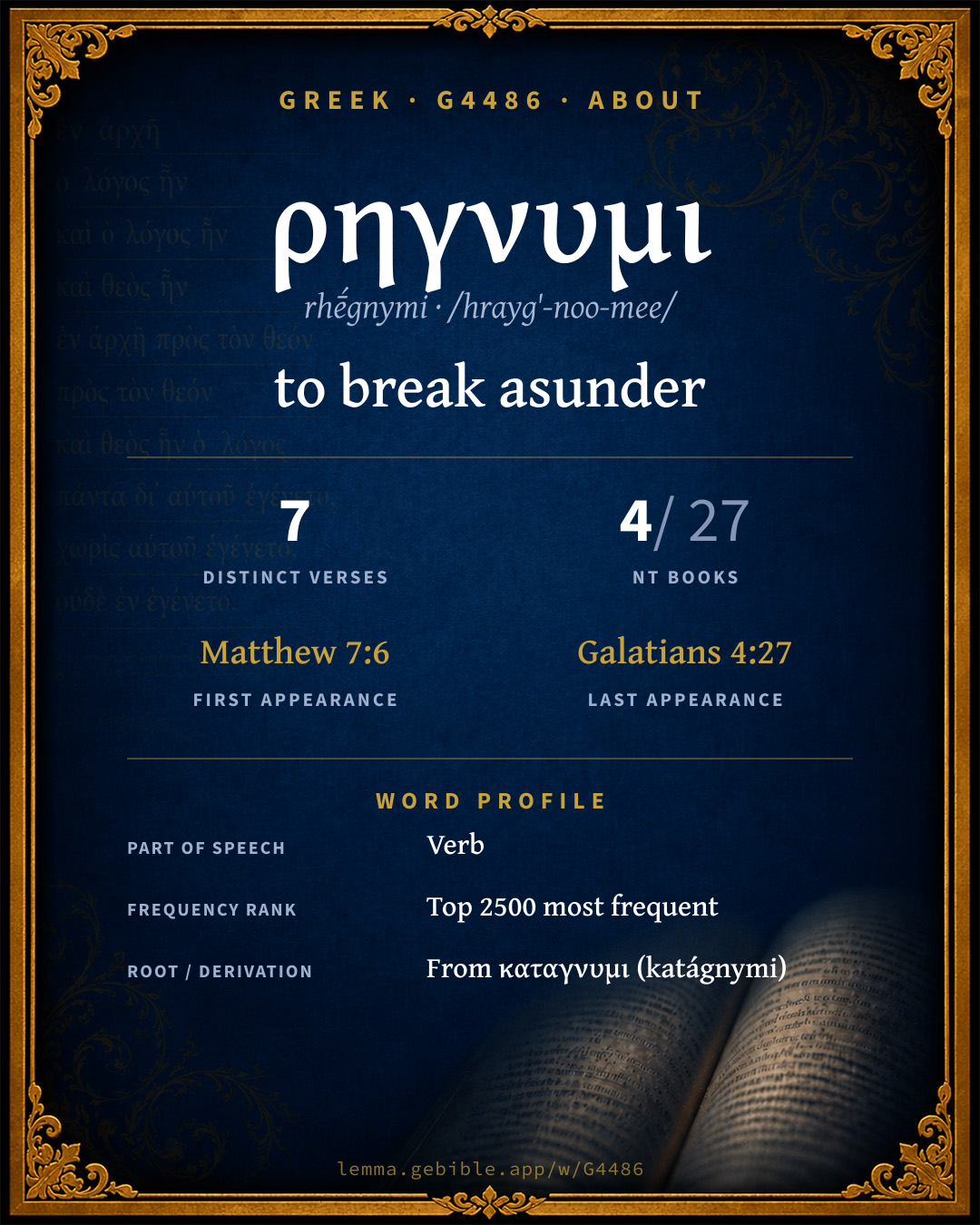
ρηγνυμι
to break asunder
Full lexicon entry — Thayer's Greek Lexicon
From Thayer's Greek Lexicon
Where this word appears
See every Future-tense verb in the Greek New Testament →
Grammar key — what these labels mean
Part of speech
- Verb
- An action or state-of-being word.
Tense
- Future
- Action expected in future time.
- Aorist
- Action viewed as a simple whole, without regard to duration — often past (perfective aspect).
- Present
- Ongoing or general action in present time (imperfective aspect).
Voice
- Active
- The subject performs the action.
- Passive
- The subject receives the action.
Mood
- Indicative
- States a fact or asks a factual question (the mood of reality).
- Imperative
- Expresses a command or request.
- Subjunctive
- Expresses probability, purpose, or possibility (the mood of contingency).
Person
- 3rd person
- The one spoken about (“he / she / it / they”).
- 2nd person
- The one addressed (“you”).
Number
- Singular
- One.
- Plural
- More than one.
Every verse where G4486 appears in the Book of Mark — 2 distinct verses. Click any verse to open its interlinear word-by-word view. Verse text shown in the World English Bible for context — . Each verse’s Greek form is shown with its reference; the English is not keyword-highlighted, since the data carries no word-level English alignment. Use “Compare translations” on any verse to read it across multiple English versions. This concordance covers the Greek New Testament; Septuagint (Greek Old Testament) occurrences of this word are not indexed here.
Mark
- Mark 2:22 ῥήξει fut act ind 3sg No one puts new wine into old wineskins, or else the new wine will burst the skins, and the wine pours out, and the skins will be destroyed; but they put new wine into fresh wineskins."
- Mark 9:18 ῥήσσει pres act ind 3sg and wherever it seizes him, it throws him down, and he foams at the mouth, and grinds his teeth, and wastes away. I asked your disciples to cast it out, and they weren't able."
About this entry
At a glance — auto-summarized from this page’s data, not written by a person. Every figure links to its source below. This summary describes the numbers; it doesn’t interpret them.
ρηγνυμι — transliterated rhḗgnymi — is a Greek verb carrying the sense “to break asunder.” It first appears in Matthew 7:6. The Greek New Testament uses it across 7 verses — uncommon. More than a quarter of its appearances fall in Matthew. From the same root come καταγνυμι, αξινη and ρακος. The sections below give every sense, occurrence, and version rendering.
Gloss history
Strong's 1890 vs modern scholarship
About this word
Strong's G4486 catalogs a Greek word from the Greek New Testament.
These counts are not copied from any lexicon or concordance. They are computed here, from the morphology-tagged Greek New Testament. What Lemma adds →
- 7
- distinct verses
- The word appears in 7 distinct verses.
- 4 / 27
- NT books
- The word appears in 4 of 27 New Testament books.
- #1,358
- by frequency
- Top 2500 most frequent Greek words (rank 1,358 of 5,347 Greek words by occurrence).
View all 7 occurrences in the concordance →
By section of the New Testament
By traditional corpus
Conventional, traditional groupings — biblical authorship is debated, so this is a traditional corpus grouping, not an authorship claim. Some books belong to more than one corpus (Luke is in both the Gospels and the Lukan corpus, and so on), so these shares overlap and need not total 100%. Each figure is a share of the word’s 7 distinct verses.
- Gospels 6 verses · 86%
- Lukan (Luke–Acts) 2 verses · 29%
- Pauline corpus 1 verse · 14%
How translations render this word
Counts come from each version’s own published word-to-Strong’s tagging or interlinear alignment — an approximate guide to how each version renders this word, not a word-level alignment the data otherwise carries. Because each total is that version’s own tagged count, the per-version totals vary from one another and need not match the appearance or distinct-verse counts above. These counts may also differ from a printed concordance because Lemma counts each distinctly tagged rendering and does not collapse phrase taggings into a single head-word total. This is a fixed set of word-tagged versions (KJV, ASV, BSB, ULT) and does not change with the reading translation you choose elsewhere. Each version’s license is shown beside its name below (and on Sources).
- King James Version: Break 1×, Break forth 1×, Doth burst 1×
- American Standard Version: Will burst 2×
- Berean Standard Bible: Will burst 3×
- unfoldingWord Literal Text: Down 2×, Will burst 2×
King James Version Public Domain
Renders G4486 across 8 tagged occurrences — most commonly:
American Standard Version Public Domain
Renders G4486 across 8 tagged occurrences — most commonly:
Plus 6 renderings that appear only once — usually multi-word phrases or single function words the recovered tagging swept in, not distinct renderings.
Berean Standard Bible Public Domain
Renders G4486 across 7 tagged occurrences — most commonly:
Plus 4 renderings that appear only once — usually multi-word phrases or single function words the recovered tagging swept in, not distinct renderings.
unfoldingWord Literal Text CC BY-SA 4.0
Renders G4486 across 10 tagged occurrences — most commonly:
Plus 6 renderings that appear only once — usually multi-word phrases or single function words the recovered tagging swept in, not distinct renderings.
Senses in Thayer's
The 1 sense Thayer's distinguishes for this word, in lexicon order (not ranked by frequency or importance). The full entry — with sub-senses — is in the Lexicon Entry tab.
- to rend, burst or break asunder, break up, break through
Word origin
Derived from καταγνυμι (katágnymi) (G2608) — to break.
Both are prolonged forms of ῥήκω rhē ko (which appears only in certain forms and is itself probably a strengthened form of ἄγνυμι agnumi (see in G2608 )); to break wreck or crack that is (especially) to sunder (by separation of the parts; G2608 being its intensive (with the preposition in compounds) and G2352 a shattering to minute fragments; but not a reduction to the constituent particles like G3089 ) or disrupt lacerate ; by implication to convulse (with spasms ); figuratively to give vent to joyful emotions : - break (forth) burst rend tear.
— Strong’s Exhaustive Concordance (1890), public domain.
Forms in the corpus
The 6 distinct written forms G4486 takes in the Greek New Testament, most frequent first — each parse links to that tense’s occurrences in the concordance.
| Form | Parsing | Example | Uses |
|---|---|---|---|
| ῥήξει rhḗxei | Verb, Future, Active, Indicative, 3rd person, Singular | Mark 2:22 | 2 |
| ἔρρηξεν érrēxen | Verb, Aorist, Active, Indicative, 3rd person, Singular | Luke 9:42 | 1 |
| ῥήγνυνται rhḗgnyntai | Verb, Present, Passive, Indicative, 3rd person, Plural | Matthew 9:17 | 1 |
| ῥήξωσιν rhḗxōsin | Verb, Aorist, Active, Subjunctive, 3rd person, Plural | Matthew 7:6 | 1 |
| ῥήσσει rhḗssei | Verb, Present, Active, Indicative, 3rd person, Singular | Mark 9:18 | 1 |
| ῥῆξον rhē̂xon | Verb, Aorist, Active, Imperative, 2nd person, Singular | Galatians 4:27 | 1 |
Same root — word family
Other Thayer's entries built from the same root as G4486, grouped by Strong’s listed origin. These share a root / origin per the lexicon — not necessarily a shared meaning. Each links to that word’s own entry.
Derives from
Derived from this word
- αξινη axínē G513 axe
- ρακος rhákos G4470 cloth
- ρηγμα rhēgma G4485 fragment
- τραχυς trachýs G5138 rough
Compare all same-root words → Showing 4 of 6 — not the complete family. They share a root, not necessarily a meaning.
Septuagint usage
The same Greek word ρηγνυμι appears 30 times in the Greek Old Testament (Septuagint), across 30 verses in 13 books.
- 30
- LXX occurrences
- Tagged occurrences of this Greek word in the Septuagint.
- 30
- verses
- Distinct Septuagint verses containing this word.
- 13 / 39
- OT books
- The word appears in 13 of the 39 Old Testament books.
Sample Septuagint occurrences
- Genesis 7:11 ῥήγνυμι
- Exodus 14:16 ῥήγνυμι
- Numbers 16:31 ῥήγνυμι
- Joshua 9:13 ῥήγνυμι
- Judges 15:19 ῥήγνυμι
- 1 Kings 1:40 ῥήγνυμι
- 2 Kings 25:4 ῥήγνυμι
- Ezra 19:11 ῥήγνυμι
- Job 2:12 ῥήγνυμι
- Proverbs 3:20 ῥήγνυμι
- Isaiah 5:27 ῥήγνυμι
- Jeremiah 46:2 ῥήγνυμι
Septuagint occurrences (same lexeme)
Every verse where the same Strong’s number (G4486) appears in the Greek Septuagint. Verse text shown in the World English Bible for context; the Greek form is the matched word — the English is not keyword-highlighted.
- Genesis 7:11 ῥήγνυμι In the six hundredth year of Noah's life, in the second month, on the seventeenth day of the month, on the same day all the fountains of the great deep were burst open, and the sky's windows were opened.
- Exodus 14:16 ῥήγνυμι Lift up your rod, and stretch out your hand over the sea, and divide it: and the children of Israel shall go into the midst of the sea on dry ground.
- Numbers 16:31 ῥήγνυμι It happened, as he made an end of speaking all these words, that the ground split apart that was under them;
- Joshua 9:13 ῥήγνυμι and these wine-skins, which we filled, were new; and, behold, they are torn: and these our garments and our shoes are become old by reason of the very long journey.
- Judges 15:19 ῥήγνυμι But God split the hollow place that is in Lehi, and water came out of it. When he had drunk, his spirit came again, and he revived: therefore the name of it was called En Hakkore, which is in Lehi, to this day.
- 1 Kings 1:40 ῥήγνυμι All the people came up after him, and the people piped with pipes, and rejoiced with great joy, so that the earth shook with the sound of them.
- 1 Kings 11:31 ῥήγνυμι He said to Jeroboam, Take ten pieces; for thus says Yahweh, the God of Israel, Behold, I will tear the kingdom out of the hand of Solomon, and will give ten tribes to you
- 1 Kings 13:3 ῥήγνυμι He gave a sign the same day, saying, This is the sign which Yahweh has spoken: Behold, the altar shall be torn, and the ashes that are on it shall be poured out.
- 1 Kings 13:5 ῥήγνυμι The altar also was torn, and the ashes poured out from the altar, according to the sign which the man of God had given by the word of Yahweh.
- 2 Kings 25:4 ῥήγνυμι Then a breach was made in the city, and all the men of war [fled] by night by the way of the gate between the two walls, which was by the king's garden (now the Chaldeans were against the city round about); and [the king] went by the way of the Arabah.
- Ezra 19:11 ῥήγνυμι
- Job 2:12 ῥήγνυμι When they lifted up their eyes from a distance, and didn't recognize him, they raised their voices, and wept; and they each tore his robe, and sprinkled dust on their heads toward the sky.
- Job 6:5 ῥήγνυμι Does the wild donkey bray when he has grass? Or does the ox low over his fodder?
- Job 15:13 ῥήγνυμι That you turn your spirit against God, And let such words go out of your mouth?
- Job 17:11 ῥήγνυμι My days are past, my plans are broken off, As are the thoughts of my heart.
- Job 26:8 ῥήγνυμι He binds up the waters in his thick clouds, And the cloud is not burst under them.
- Job 28:10 ῥήγνυμι He cuts out channels among the rocks. His eye sees every precious thing.
- Job 31:37 ῥήγνυμι I would declare to him the number of my steps. As a prince would I go near to him.
- Job 32:19 ῥήγνυμι Behold, my breast is as wine which has no vent; Like new wineskins it is ready to burst.
- Proverbs 3:20 ῥήγνυμι By his knowledge, the depths were broken up, And the skies drop down the dew.
- Isaiah 5:27 ῥήγνυμι None shall be weary nor stumble among them; None shall slumber nor sleep; Neither shall the belt of their loins be untied, Nor the latchet of their shoes be broken:
- Isaiah 33:23 ῥήγνυμι Your rigging is untied; they could not strengthen the foot of their mast, they could not spread the sail: then was the prey of a great spoil divided; the lame took the prey.
- Isaiah 35:6 ῥήγνυμι Then shall the lame man leap as a hart, and the tongue of the mute shall sing; for in the wilderness shall waters break out, and streams in the desert.
- Isaiah 49:13 ῥήγνυμι Sing, heavens; and be joyful, earth; and break forth into singing, mountains: for Yahweh has comforted his people, and will have compassion on his afflicted.
- Isaiah 52:9 ῥήγνυμι Break forth into joy, sing together, you waste places of Jerusalem; for Yahweh has comforted his people, he has redeemed Jerusalem.
- Isaiah 54:1 ῥήγνυμι Sing, barren, you who didn't bear; break forth into singing, and cry aloud, you who did not travail with child: for more are the children of the desolate than the children of the married wife, says Yahweh.
- Isaiah 58:8 ῥήγνυμι Then shall your light break forth as the morning, and your healing shall spring forth speedily; and your righteousness shall go before you; the glory of Yahweh shall by your rearward.
- Isaiah 59:5 ῥήγνυμι They hatch adders' eggs, and weave the spider's web: he who eats of their eggs dies; and that which is crushed breaks out into a viper.
- Jeremiah 46:2 ῥήγνυμι Of Egypt: concerning the army of Pharaoh Necoh king of Egypt, which was by the river Euphrates in Carchemish, which Nebuchadrezzar king of Babylon struck in the fourth year of Jehoiakim the son of Josiah, king of Judah.
- Habakkuk 3:9 ῥήγνυμι You uncovered your bow. You called for your sworn arrows. Selah. You split the earth with rivers.
These are occurrences of the same Greek lexeme (G4486) in the Septuagint — not a translation of any one Hebrew word. The store carries no word-level Hebrew↔Greek alignment, so no Hebrew original is asserted here. Counts come from the recovered LXX Strong's tagging — high-frequency vocabulary is well covered, while rare or late forms may be untagged — so they reflect tagged occurrences and may slightly undercount.